Network Cabling
       Making connections with Cat5


   Way cool!
Overview


 What  cable types are
  available?
 How do cables work?
 How are cables used in
  networking?
 How are connections made?
Learning Objectives

   List common cable types used in networking
   Describe how UTP cables are made
   Explain how UTP cables are used in Ethernet networks
   Demonstrate the ability to make a working patch cable
   Name the two wiring standards used for wired Ethernet
    networks and their uses
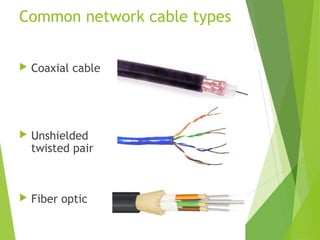
Common network cable types


   Coaxial cable


   Unshielded
    twisted pair


   Fiber optic
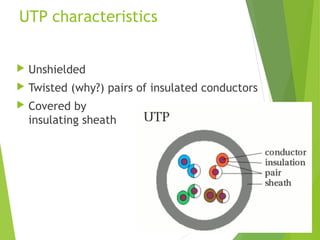
UTP characteristics


   Unshielded
   Twisted (why?) pairs of insulated conductors
   Covered by
    insulating sheath
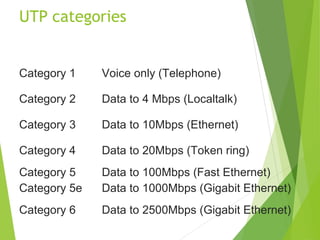
UTP categories


Category 1    Voice only (Telephone)

Category 2    Data to 4 Mbps (Localtalk)

Category 3    Data to 10Mbps (Ethernet)

Category 4    Data to 20Mbps (Token ring)
Category 5    Data to 100Mbps (Fast Ethernet)
Category 5e   Data to 1000Mbps (Gigabit Ethernet)
Category 6    Data to 2500Mbps (Gigabit Ethernet)
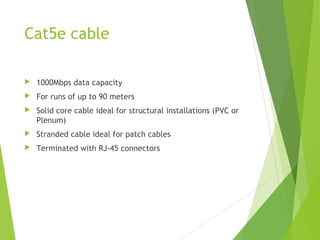
Cat5e cable

   1000Mbps data capacity
   For runs of up to 90 meters
   Solid core cable ideal for structural installations (PVC or
    Plenum)
   Stranded cable ideal for patch cables
   Terminated with RJ-45 connectors
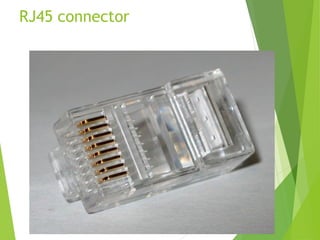
RJ45 connector
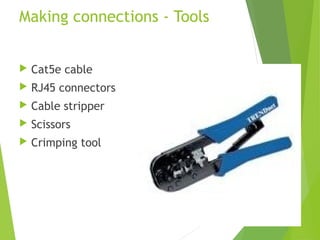
Making connections - Tools


   Cat5e cable
   RJ45 connectors
   Cable stripper
   Scissors
   Crimping tool
Making connections - Steps


1.   Strip cable end
2.   Untwist wire ends
3.   Arrange wires
4.   Trim wires to size
5.   Attach connector
6.   Check
7.   Crimp
8.   Test
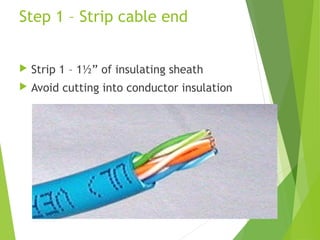
Step 1 – Strip cable end


   Strip 1 – 1½” of insulating sheath
   Avoid cutting into conductor insulation
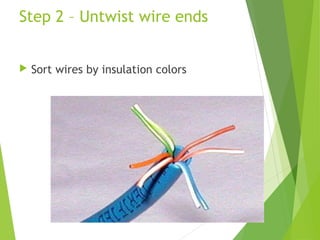
Step 2 – Untwist wire ends


   Sort wires by insulation colors
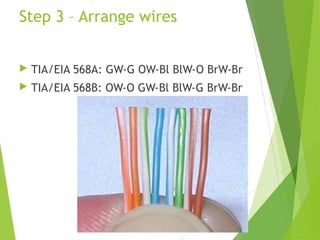
Step 3 – Arrange wires


   TIA/EIA 568A: GW-G OW-Bl BlW-O BrW-Br
   TIA/EIA 568B: OW-O GW-Bl BlW-G BrW-Br
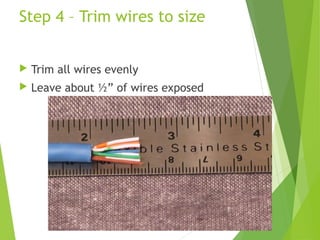
Step 4 – Trim wires to size


   Trim all wires evenly
   Leave about ½” of wires exposed
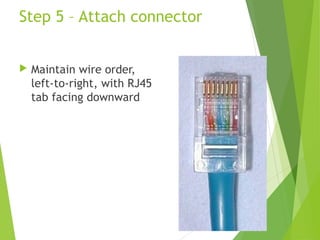
Step 5 – Attach connector


   Maintain wire order,
    left-to-right, with RJ45
    tab facing downward
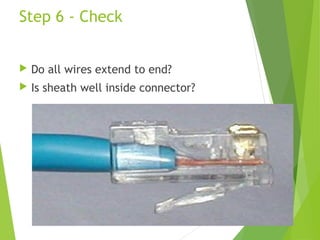
Step 6 - Check


   Do all wires extend to end?
   Is sheath well inside connector?
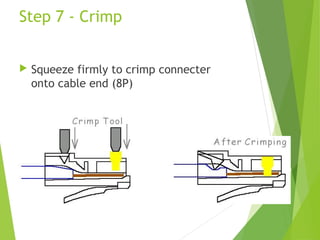
Step 7 - Crimp


   Squeeze firmly to crimp connecter
    onto cable end (8P)
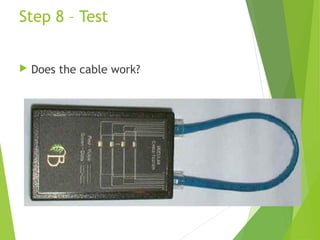
Step 8 – Test


   Does the cable work?
Let’s go to work!

Cabling

  • 1.
    Network Cabling Making connections with Cat5 Way cool!
  • 2.
    Overview  What cable types are available?  How do cables work?  How are cables used in networking?  How are connections made?
  • 3.
    Learning Objectives  List common cable types used in networking  Describe how UTP cables are made  Explain how UTP cables are used in Ethernet networks  Demonstrate the ability to make a working patch cable  Name the two wiring standards used for wired Ethernet networks and their uses
  • 4.
    Common network cabletypes  Coaxial cable  Unshielded twisted pair  Fiber optic
  • 5.
    UTP characteristics  Unshielded  Twisted (why?) pairs of insulated conductors  Covered by insulating sheath
  • 6.
    UTP categories Category 1 Voice only (Telephone) Category 2 Data to 4 Mbps (Localtalk) Category 3 Data to 10Mbps (Ethernet) Category 4 Data to 20Mbps (Token ring) Category 5 Data to 100Mbps (Fast Ethernet) Category 5e Data to 1000Mbps (Gigabit Ethernet) Category 6 Data to 2500Mbps (Gigabit Ethernet)
  • 7.
    Cat5e cable  1000Mbps data capacity  For runs of up to 90 meters  Solid core cable ideal for structural installations (PVC or Plenum)  Stranded cable ideal for patch cables  Terminated with RJ-45 connectors
  • 8.
  • 9.
    Making connections -Tools  Cat5e cable  RJ45 connectors  Cable stripper  Scissors  Crimping tool
  • 10.
    Making connections -Steps 1. Strip cable end 2. Untwist wire ends 3. Arrange wires 4. Trim wires to size 5. Attach connector 6. Check 7. Crimp 8. Test
  • 11.
    Step 1 –Strip cable end  Strip 1 – 1½” of insulating sheath  Avoid cutting into conductor insulation
  • 12.
    Step 2 –Untwist wire ends  Sort wires by insulation colors
  • 13.
    Step 3 –Arrange wires  TIA/EIA 568A: GW-G OW-Bl BlW-O BrW-Br  TIA/EIA 568B: OW-O GW-Bl BlW-G BrW-Br
  • 14.
    Step 4 –Trim wires to size  Trim all wires evenly  Leave about ½” of wires exposed
  • 15.
    Step 5 –Attach connector  Maintain wire order, left-to-right, with RJ45 tab facing downward
  • 16.
    Step 6 -Check  Do all wires extend to end?  Is sheath well inside connector?
  • 17.
    Step 7 -Crimp  Squeeze firmly to crimp connecter onto cable end (8P)
  • 18.
    Step 8 –Test  Does the cable work?
  • 19.