Engineering your Future
PROFINET Vs
PROFIBUS
©AutomationTechnologyDivision-2
ABB
PROFIBUS
 PROFIBUS is the world’s leading fieldbus system.
 PROFIBUS has been around for almost 25 years.
 High speed synchronized servo application( robotics and NC
machines).
 Functional safety systems.
 Operation in hazardous environments.
 High availability systems.
©AutomationTechnologyDivision-3
ABB
PROFIBUS FAMILY
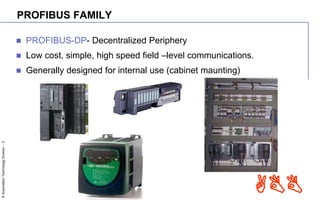
 PROFIBUS-DP- Decentralized Periphery
 Low cost, simple, high speed field –level communications.
 Generally designed for internal use (cabinet maunting)
©AutomationTechnologyDivision-4
ABB
 PROFIBUS PA- Process Automation
 Developed specifically for the process industry to replace 4-20mA
transmission.
 Two wire connection carrying both power and data.
 Generally designed for external use(field mounting).
©AutomationTechnologyDivision-5
ABB
PROFINET
 Standardized Industrial Ethernet.
 High speed highly deterministic and capable networking.
 Generally designed for internal use (just like DP)
©AutomationTechnologyDivision-6
ABB
CONNECTION TECHNOLOGIES
 PROFIBUS DP uses 2-core RS485 screened twisted pair wiring.
 9-pin sub-d or M12 connectors extensively used.
 DP can also use plastic or glass fiber optic cabling.
 PROFIBUS PA uses “ Manchester Bus Powered” (MBP) cabling
over 2 cores.
 PROFINET Uses 4-core Ethernet screened twisted pair cabling.
 RJ45 or M12 connectors universally used.
©AutomationTechnologyDivision-7
ABB
©AutomationTechnologyDivision-8
ABB
©AutomationTechnologyDivision-9
ABB
 PROFINET is the open and all-encompassing Industrial Ethernet
solution.
 PROFINET has many features in common with PROFIBUS,
including shared profiles, engineering and support.
 Its innovative IO solution makes it perfect for modern real-time
applications.
©AutomationTechnologyDivision-10
ABB
Supporting Devices
Profibus supports two main type of devices, namely, masters and
slaves.
 Master devices control the bus and when they have the right to
access the bus, they may transfer messages without any remote
request.
 Slave devices are typically peripheral devices i.e transmitters/sensor
and actuators.
©AutomationTechnologyDivision-11
ABB
Profibus standards
 Profibus DP(master slave).
 Profibus FMS(multi-master/peer-to-peer).
 Profibus PA(intrinsically safe).
©AutomationTechnologyDivision-12
ABB
FUNCTION CLASSES OF PROFINET
 In PROFINET have two function classes that are Independent of
each other.
 Profinet IO: The distributed field devices are connected through the
PROFINET IO .
 PROFINET IO uses three different communication channels to
exchange data with the control systems and other devices. The
standard TCP/IP channel is used for parameterization, configuration
and acyclic read/write operations.
©AutomationTechnologyDivision-13
ABB
PROFINET CBA:
 This concept is designed for distributed industrial automation
applications.
 The PROFINET CBA is built on the standard DCOM (Distributed
Component Object Model) and RPC (Remote Procedure Call)
technologies.
©AutomationTechnologyDivision-14
ABB
PROFINET Communication Concept
 PROFINET uses Ethernet as a communication medium.
 For transporting the data, the TCP or UDP and IP protocols are
implemented.
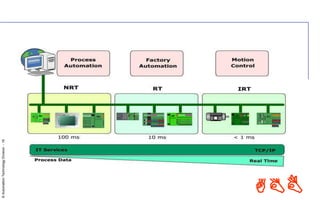
 PROFINET uses three channels for communication with different
performance classes according to the use envisaged .
 NRT (Non-Real Time) for non-time-critical processes: PROFINET
uses standard TCP/IP and UDP/IP to transmit data packets.
 RT (Real Time) for optimized data exchange performance: The read-
write operation for industrial automation requires mostly high-speed
data transfer, while standard TCP/IP or UDP/IP cannot satisfy this
requirement.
©AutomationTechnologyDivision-15
ABB
 IRT (Isochronous Real Time) for clock-synchronized communication:
Drive applications, such as Motion Control, need to be satisfied
immediately. The IRT can do this with a response time of less than 1
millisecond.
©AutomationTechnologyDivision-16
ABB
©AutomationTechnologyDivision-17
ABB
PROFINET Security Concept
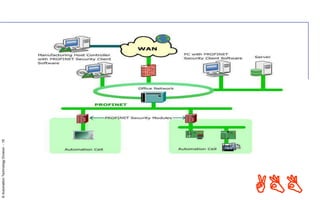
 The core of the PROFINET Security Concept focuses on securing
networks in the separated security zones, the so-called cells .
 Different cells may be interconnected by a backbone network.
 Each cell can be connected to the backbone through an entry point
and is protected by using special security network components, such
as switches or other security devices.
©AutomationTechnologyDivision-18
ABB
©AutomationTechnologyDivision-19
ABB
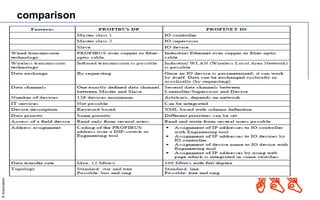
comparison
©AutomationTechnologyDivision-20
ABB

Profibus vs profinet