IMPROVING HAND HYGIENE 
COMPLIANCE 
Quality Improvement Project using “FOCUS PDCA” 
Methodology.
Find the problem. 
• One of highest priority risk factor in the risk 
assessment matrix of Infection Prevention & 
Control Department program at AIGH. 
• Hand hygiene is the number one step in any 
infection prevention and control program. 
• It is one of international patient safety goal 
(no. 5). 
• In our daily rounds , it was observed that hand 
hygiene compliance is below expectation.
Risk Assessment & Prioritization 
Risk Item Likelihood 
Human 
Impact 
Material 
Business 
Impact 
Color code 
Hand Hygiene 
Non-Compliance 3 5 5 RED
Find The Problem 
• Impact of the problem: 
• This “SINGLE STEP” is 
• First component of STANDARD PRECAUTION. 
• Decreases all health-care associated infections. 
• Part of all CARE-Bundles.
Find the status of problem 
• Hospital Wide Baseline Data Collection: 
• Measurement of the perception of staff (Health 
Care Workers & Senior Hospital Managers) 
regarding Infection Control practices in AIGH. 
• Measurement of the availability of Facility e.g. 
Hand washing sinks, Hand rub dispensers, Hand 
towels…etc. 
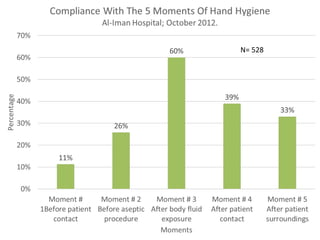
• Measurement of Compliance of HCW on the 5 
Moments for Hand Hygiene.
Perception Questionnaire 
HCW Perception 
Questionnaire 
SHM Perception 
Questionnaire
The perceptions of both healthcare workers and 
senior managers regarding hand hygiene and 
perceived effectiveness of measures for increasing 
hand hygiene compliance 
"In your opinion, how effective are the following 
interventions to increase compliance with hand 
hygiene?"
N= 328
N=17
Facility Survey
N (Beds)= 
207
N (Sinks)= 
131
Hand Hygiene Compliance
YOUR 5 MOMENTS FOR HAND HYGIENE 
Clean your hands before 
touching a patient when 
approaching him/her! 
To protect the patient 
against harmful germs 
carried on your hands! 
Clean your hands immediately 
before an aseptic task! 
To protect the patient against 
harmful germs, including the 
patient’s own, entering his/her 
body! Clean your hands after touching a 
Clean your hands immediately 
after an exposure risk to body 
fluids (and after glove removal)! 
To protect yourself and the 
health-care environment from 
harmful germs! 
patient and his/her immediate 
surroundings, when leaving the 
patient’s side! 
To protect yourself and the 
health-care environment from 
harmful germs! 
Clean your hands after touching any object 
or furniture in the patient’s immediate 
surroundings, when leaving-even if the 
patient has not been touched! 
To protect yourself and the health-care 
environment from harmful germs!
Observation Form – Basic Compliance Calculation 
Facility: Period: Setting: 
Prof.cat. 
Prof.cat. 
Prof.cat. 
Prof.cat. 
Total per session 
Session N° Opp 
(n) 
HW 
(n) 
HR 
(n) 
Opp 
(n) 
HW 
(n) 
HR 
(n) 
Opp 
(n) 
HW 
(n) 
HR 
(n) 
Opp 
(n) 
HW 
(n) 
HR 
(n) 
Opp 
(n) 
HW 
(n) 
HR 
(n) 
1 
2 
3 
4 
5 
6 
7 
8 
9 
10 
11 
12 
13 
14 
15 
16 
17 
18 
19 
20 
Total 
Calculation Act (n) = 
Opp (n) = 
Act (n) = 
Opp (n) = 
Act (n) = 
Opp (n) = 
Act (n) = 
Opp (n) = 
Act (n) = 
Opp (n) = 
Compliance 
Compliance (%) = Actions x 100 
Opportunities 
Instructions for use 
1. Define the setting outlining the scope for analysis and report related data according to the chosen setting. 
2. Check data in the observation form. Hand hygiene actions not related to an indication should not be taken into 
account and vice versa. 
3. Report the session number and the related observation data in the same line. This attribution of session number 
validates the fact that data has been taken into count for compliance calculation. 
4. Results per professional category and per session (vertical): 
4.1 Sum up recorded opportunities (opp) in the case report form per professional category: report the sum in the corresponding 
cell in the calculation form. 
4.2 Sum up the positive hand hygiene actions related to the total of opportunities above, making difference between handwash 
(HW) and handrub (HR): report the sum in the corresponding cell in the calculation form. 
4.3 Proceed in the same way for each session (data record form). 
4.4 Add up all sums per each professional category and put the calculation to calculate the compliance rate (given in percent) 
5. The addition of results of each line permits to get the global compliance at the end of the last right column.
Observation Form – Optional Calculation Form 
(Indication-related compliance with hand hygiene) 
Facility: Period: Setting: 
Before touching a 
Before clean/ aseptic 
After body fluid 
patient 
procedure 
exposure risk 
After touching a 
patient 
After touching 
patient surroundings 
Session N° Indic 
(n) 
HW 
(n) 
HR 
(n) 
Indic 
(n) 
HW 
(n) 
HR 
(n) 
Indic 
(n) 
HW 
(n) 
HR 
(n) 
Indic 
(n) 
HW 
(n) 
HR 
(n) 
Indic 
(n) 
HW 
(n) 
HR 
(n) 
1 
2 
3 
4 
5 
6 
7 
8 
9 
10 
11 
12 
13 
14 
15 
16 
17 
18 
19 
20 
Total 
Calculation Act (n) = 
Indic1 (n) = 
Act (n) = 
Indic2 (n) = 
Act (n) = 
Indic3 (n) = 
Act (n) = 
Indic4 (n) = 
Act (n) = 
Indic5 (n) = 
Ratio 
act / indic 
Instructions for use 
1. Define the setting outlining the scope for analysis and report related data according to the chosen setting. 
2. Check data in the observation form. Hand hygiene actions not related to an indication should not be taken into 
account and vice versa. 
3. If several indications occur within the same opportunity, each one should be considered separately as well as the 
related action. 
4. Report the session number and the related observation data in the same line. This attribution of session number 
validates the fact that data has been taken into count for compliance calculation. 
5. Results per indication (indic) and per session (vertical): 
4.1 Sum up indications per indication in the observation form: report the sum in the corresponding cell in the calculation form. 
4.2 Sum up positive hand hygiene actions related to the total of indications above, making the difference between handwash 
(HW) and handrub (HR): report the sum in the corresponding cell in the calculation form. 
4.3 Proceed in the same way for each session (observation form). 
4.4 Add up all sums per each indication and put the calculation to calculate the ratio (given in percent) 
 Note: This calculation is not exactly a compliance result, as the denominator of the calculation is an indication instead of an opportunity. Action is 
artif icially overestimated according to each indication. How ever, the result gives an overall idea of health-care w orker’s behaviour towards each type 
of indication. 
All reasonable precautions have been taken by the World Health Organization to verify the information contained in this document. However, the published material is being distributed without warranty
N=328 
N=158 
N=42
N=114 N=33 N=91 N=72 N=39 N=179
N= 528
Moment # 3 After body fluid exposure 
Moment # 2 Befor e aseptic procedur e 
Moment # 4 After patient contact 
Moment # 1Before patient contact 
Moment # 5 After patient sur roundings 
3.5 
3.0 
2.5 
2.0 
1.5 
1.0 
0.5 
0.0 
100 
80 
60 
40 
20 
0 
Pe r ce n t 
Pareto Chart for I ncompliance of 5 Moments for Hand Hygiene
Find The Problem 
• The project Mission is: 
• To improve Hand Hygiene compliance from 
26% to 90% by March 2014.
Organize The Team 
• Team Leader: Infection Control Director 
• Facilitator: Quality Director. 
• Members: 
• ICU team. 
• Supervisor ICP. 
• Nursing Supervisor. 
• ICP. 
• IC Link Nurses. 
• MOH team.
Clarify Current Process
Hand Hygiene Definition 
• Hand Hygiene refers to killing or removal of 
microorganisms on the hands that have been 
picked up by contact with patients, staff, 
contaminated equipment or the environment*. 
*CDC (Centers for Disease Control).
Steps of Hand Rub
Steps of Hand Washing
Understand The Variation
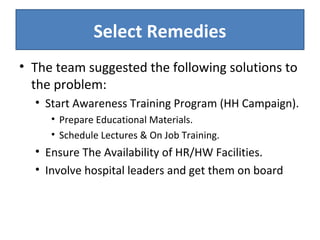
Select Remedies 
• The team suggested the following solutions to 
the problem: 
• Start Awareness Training Program (HH Campaign). 
• Prepare Educational Materials. 
• Schedule Lectures & On Job Training. 
• Ensure The Availability of HR/HW Facilities. 
• Involve hospital leaders and get them on board
Selection Matrix 
Solution Feasibility Cost 
(Inverse Scoring) 
Impact Score 
Awareness Training Program 6 10 10 600 
Provide the missing Hand Rubs 7 6 9 378 
Provide the missing Sinks 5 4 9 180 
Apply Educational Posters 10 8 5 400 
Assign Physician Champion 10 9 8 720 
Involve top management by regular 
monitoring feedback 
7 10 9 630 
Recognition/Awarding compliant 
staff 
4 9 6 216
Selection Matrix 
Solution Feasibility Cost 
(Inverse Scoring) 
Impact Score 
Reminder from patients 4 5 6 120 
Notice to non-compliant staff 8 9 6 432 
Auditing by some other team 3 6 7 126 
Hand print culture 8 4 7 224
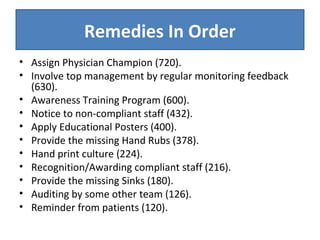
Remedies In Order 
• Assign Physician Champion (720). 
• Involve top management by regular monitoring feedback 
(630). 
• Awareness Training Program (600). 
• Notice to non-compliant staff (432). 
• Apply Educational Posters (400). 
• Provide the missing Hand Rubs (378). 
• Hand print culture (224). 
• Recognition/Awarding compliant staff (216). 
• Provide the missing Sinks (180). 
• Auditing by some other team (126). 
• Reminder from patients (120).
Plan
Plan 
ACTION RESPONSIBLE PERSON DUE DATE 
Assign Physician Champion IC Committee 1 month 
Involve top management 
Dr. Fatma Noman Ongoing 
by regular monitoring 
feedback 
Awareness Training 
Program hospital-wide: 
- Hand Hygiene Day 
IC Team 
May 5 
-Lectures. Dr. Fatma Noman Next Month (For Doctors) 
Monthly for Nurses 
Focus Training Program in 
ICU & NICU: 
-Daily Interactive training/ 
Video Presentation. 
IC Team Next Month 
-Small group lectures. IC Team Monthly schedule 
Notice to non-compliant 
Dr. Fatma Noman Ongoing 
staff
Plan 
ACTION RESPONSIBLE PERSON DUE DATE 
Apply Educational Posters IC Team/Admin Request to be sent within 
next week 
Provide the missing Hand 
Rubs 
IC Team/Admin Request to be sent within 
next week 
Hand print culture 
Campaign 
IC Team Start next month with 
small group lectures
Do Pilot
Do (Pilot) 
• ICU & NICU was identified as the areas of greatest 
RISK and was selected for implying the pilot. 
• Reasons: 
• Vulnerable Patients. 
• Complex Care. 
• Confined Area. 
• Easy to monitor compliance. 
• Many HH opportunities.
ICU & NICU Hand Hygiene Campaign 
• Demographic data about ICU & NICU: 
 No. of ICU Beds: 12 Beds 
 No. of NICU Incubators: 19 
 No. of ICU Physicians: 7 
 No. of NICU Physicians: 4 
 No. of ICU Nurses: 36 
 No. of NICU Nurses: 20 
 Average no. of admissions per month for ICU: 26 
 Average no. of admissions per month for NICU: 17
ICU & NICU Hand Hygiene Campaign 
• Time Frame: 
 The campaign lasted over one month (February). 
• Educational Tools: 
 Posters. 
 Interactive Visual Training (Video). 
 On job training. 
 Hand Hygiene advocate badges.
Doctor Giving Hand Print
Dr. Fatima Giving On-site Training For 
Hand Hygiene
ICU1 
Dr Fatima Teaching Hand Hygiene to 
Doctors
ICU1 
HOD Giving Hand Print
Hand Print
ICU 
Dr Fatima Training Doctors and staff 
on Hand Hygiene
Hand Print Culture 
Colonies Of Micro Organisms Growing
Meeting With Assigned Physician Champions 
(Wearing HH Badge), Discussing The Status Quo 
Of Hand Hygiene Compliance
ICN Demonstrating Trend Of Hand 
Hygiene Trend To Physician Champion
CHECK PILOT RESULTS
Hand Hygiene Compliance Rate 
Critical Areas 
N=103 
N=110
Act (Generalize Hospital Wide)
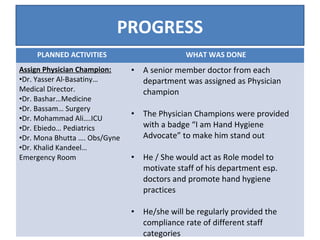
PROGRESS 
PLANNED ACTIVITIES WHAT WAS DONE 
Assign Physician Champion: 
•Dr. Yasser Al-Basatiny… 
Medical Director. 
•Dr. Bashar…Medicine 
•Dr. Bassam… Surgery 
•Dr. Mohammad Ali….ICU 
•Dr. Ebiedo… Pediatrics 
•Dr. Mona Bhutta …. Obs/Gyne 
•Dr. Khalid Kandeel… 
Emergency Room 
• A senior member doctor from each 
department was assigned as Physician 
champion 
• The Physician Champions were provided 
with a badge “I am Hand Hygiene 
Advocate” to make him stand out 
• He / She would act as Role model to 
motivate staff of his department esp. 
doctors and promote hand hygiene 
practices 
• He/she will be regularly provided the 
compliance rate of different staff 
categories
PROGRESS 
PLANNED ACTIVITIES WHAT WAS DONE 
Involve top management by 
regular monitoring feedback 
• Monthly Hand Hygiene compliance rate (figures 
and graph) reported to Infection Control 
Committee members and Medical Director(ICC 
Chairperson) where It showed compliance rate 
by 
o Staff categories 
o Unit wise 
Awareness Training Program 
hospital-wide: 
- Hand Hygiene Day 
• Distribution of hand-outs/badges 
• Video show in open areas (5 Moments for Hand 
Hygiene). 
Lectures followed by demonstration of steps of 
Hand Hygiene by Infection control nurses. 
• There are 80 attendees participated.
PROGRESS 
PLANNED ACTIVITIES WHAT WAS DONE 
-Lectures. • General Orientation Day (Why Hand Hygiene So 
Important). 
• Monthly Orientation for new staff (5 Moments 
for Hand Hygiene & The Proper Steps). 
• Weekly lectures for Nurses (Hand Hygiene & 
Breaking The Chain of Infection). 
• These lectures done in the Multi-purpose hall 
and lasted for an hour. 
(Contents: Role of Hand Hygiene in preventing 
HAIs, 5 moments, steps, IPSG 5, standard 
precautions, Bundles of care). 
-Small group lectures. • Unit-wise lectures & post – test (attendants are 
asked to demonstrate back the steps with Hand 
Rub)/ 
• (5 Moments for Hand Hygiene Video) lasting 15 
to 30 minutes
PROGRESS 
PLANNED ACTIVITIES WHAT WAS DONE 
Notice to non compliant staff  Five Doctors were given a verbal feedback with 
polite reminders by the Infection Control Director. 
 Ten nurses and fifteen technicians given a one on 
one explanation by the ICP to make them 
accountable to their actions. 
 No written warnings/punishments. 
Apply Educational Posters  Number of posters were increased from 
occasional to 400 posters all over the hospital: 
• 5 Moments 
• Steps of using Alcohol Hand-Rub (English and 
Arabic) 
• Steps of Hand wash with soap and water
PROGRESS 
PLANNED ACTIVITIES WHAT WAS DONE 
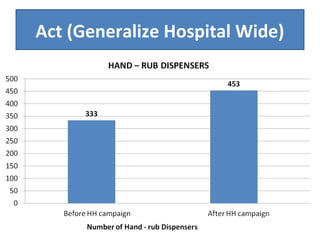
Provide the missing Hand 
Rubs 
 120 hand rub dispensers newly installed in 
addition to the 333 functional dispensers . 
Hand print culture Campaign 13 Hand imprint samples were taken from doctors , 
Nurses and others during Teaching Rounds and 
The Results were demonstrated to them 
To give them feedback and idea that although visibly 
clean; their hands were carrying germs ..to motivate 
them doing Hand Hygiene before contact with 
patients and contacting Sterile sites.
Act (Generalize Hospital Wide) 
• The first phase of the campaign/program started 
on the critical areas, thereafter it was extended 
to all hospital locations. 
• Time Frame : lasted over a month 
• Educational Tools 
- Campaign posters. 
- Interactive trainings. 
- In service education. 
- Competencies.
Act (Generalize Hospital Wide)
N=386 
N=115
Monitoring 
• After the marked improvement done by the 
project, the IC team kept an eye on the 
process and continuously measured the 
compliance rate to hold the gains and 
maintain the staff adherence to the hand 
hygiene practice.
Target

Improving Hand Hygiene Project

  • 1.
    IMPROVING HAND HYGIENE COMPLIANCE Quality Improvement Project using “FOCUS PDCA” Methodology.
  • 2.
    Find the problem. • One of highest priority risk factor in the risk assessment matrix of Infection Prevention & Control Department program at AIGH. • Hand hygiene is the number one step in any infection prevention and control program. • It is one of international patient safety goal (no. 5). • In our daily rounds , it was observed that hand hygiene compliance is below expectation.
  • 3.
    Risk Assessment &Prioritization Risk Item Likelihood Human Impact Material Business Impact Color code Hand Hygiene Non-Compliance 3 5 5 RED
  • 4.
    Find The Problem • Impact of the problem: • This “SINGLE STEP” is • First component of STANDARD PRECAUTION. • Decreases all health-care associated infections. • Part of all CARE-Bundles.
  • 5.
    Find the statusof problem • Hospital Wide Baseline Data Collection: • Measurement of the perception of staff (Health Care Workers & Senior Hospital Managers) regarding Infection Control practices in AIGH. • Measurement of the availability of Facility e.g. Hand washing sinks, Hand rub dispensers, Hand towels…etc. • Measurement of Compliance of HCW on the 5 Moments for Hand Hygiene.
  • 6.
    Perception Questionnaire HCWPerception Questionnaire SHM Perception Questionnaire
  • 7.
    The perceptions ofboth healthcare workers and senior managers regarding hand hygiene and perceived effectiveness of measures for increasing hand hygiene compliance "In your opinion, how effective are the following interventions to increase compliance with hand hygiene?"
  • 8.
  • 9.
  • 10.
  • 11.
  • 12.
  • 13.
  • 14.
    YOUR 5 MOMENTSFOR HAND HYGIENE Clean your hands before touching a patient when approaching him/her! To protect the patient against harmful germs carried on your hands! Clean your hands immediately before an aseptic task! To protect the patient against harmful germs, including the patient’s own, entering his/her body! Clean your hands after touching a Clean your hands immediately after an exposure risk to body fluids (and after glove removal)! To protect yourself and the health-care environment from harmful germs! patient and his/her immediate surroundings, when leaving the patient’s side! To protect yourself and the health-care environment from harmful germs! Clean your hands after touching any object or furniture in the patient’s immediate surroundings, when leaving-even if the patient has not been touched! To protect yourself and the health-care environment from harmful germs!
  • 16.
    Observation Form –Basic Compliance Calculation Facility: Period: Setting: Prof.cat. Prof.cat. Prof.cat. Prof.cat. Total per session Session N° Opp (n) HW (n) HR (n) Opp (n) HW (n) HR (n) Opp (n) HW (n) HR (n) Opp (n) HW (n) HR (n) Opp (n) HW (n) HR (n) 1 2 3 4 5 6 7 8 9 10 11 12 13 14 15 16 17 18 19 20 Total Calculation Act (n) = Opp (n) = Act (n) = Opp (n) = Act (n) = Opp (n) = Act (n) = Opp (n) = Act (n) = Opp (n) = Compliance Compliance (%) = Actions x 100 Opportunities Instructions for use 1. Define the setting outlining the scope for analysis and report related data according to the chosen setting. 2. Check data in the observation form. Hand hygiene actions not related to an indication should not be taken into account and vice versa. 3. Report the session number and the related observation data in the same line. This attribution of session number validates the fact that data has been taken into count for compliance calculation. 4. Results per professional category and per session (vertical): 4.1 Sum up recorded opportunities (opp) in the case report form per professional category: report the sum in the corresponding cell in the calculation form. 4.2 Sum up the positive hand hygiene actions related to the total of opportunities above, making difference between handwash (HW) and handrub (HR): report the sum in the corresponding cell in the calculation form. 4.3 Proceed in the same way for each session (data record form). 4.4 Add up all sums per each professional category and put the calculation to calculate the compliance rate (given in percent) 5. The addition of results of each line permits to get the global compliance at the end of the last right column.
  • 17.
    Observation Form –Optional Calculation Form (Indication-related compliance with hand hygiene) Facility: Period: Setting: Before touching a Before clean/ aseptic After body fluid patient procedure exposure risk After touching a patient After touching patient surroundings Session N° Indic (n) HW (n) HR (n) Indic (n) HW (n) HR (n) Indic (n) HW (n) HR (n) Indic (n) HW (n) HR (n) Indic (n) HW (n) HR (n) 1 2 3 4 5 6 7 8 9 10 11 12 13 14 15 16 17 18 19 20 Total Calculation Act (n) = Indic1 (n) = Act (n) = Indic2 (n) = Act (n) = Indic3 (n) = Act (n) = Indic4 (n) = Act (n) = Indic5 (n) = Ratio act / indic Instructions for use 1. Define the setting outlining the scope for analysis and report related data according to the chosen setting. 2. Check data in the observation form. Hand hygiene actions not related to an indication should not be taken into account and vice versa. 3. If several indications occur within the same opportunity, each one should be considered separately as well as the related action. 4. Report the session number and the related observation data in the same line. This attribution of session number validates the fact that data has been taken into count for compliance calculation. 5. Results per indication (indic) and per session (vertical): 4.1 Sum up indications per indication in the observation form: report the sum in the corresponding cell in the calculation form. 4.2 Sum up positive hand hygiene actions related to the total of indications above, making the difference between handwash (HW) and handrub (HR): report the sum in the corresponding cell in the calculation form. 4.3 Proceed in the same way for each session (observation form). 4.4 Add up all sums per each indication and put the calculation to calculate the ratio (given in percent)  Note: This calculation is not exactly a compliance result, as the denominator of the calculation is an indication instead of an opportunity. Action is artif icially overestimated according to each indication. How ever, the result gives an overall idea of health-care w orker’s behaviour towards each type of indication. All reasonable precautions have been taken by the World Health Organization to verify the information contained in this document. However, the published material is being distributed without warranty
  • 18.
  • 19.
    N=114 N=33 N=91N=72 N=39 N=179
  • 20.
  • 21.
    Moment # 3After body fluid exposure Moment # 2 Befor e aseptic procedur e Moment # 4 After patient contact Moment # 1Before patient contact Moment # 5 After patient sur roundings 3.5 3.0 2.5 2.0 1.5 1.0 0.5 0.0 100 80 60 40 20 0 Pe r ce n t Pareto Chart for I ncompliance of 5 Moments for Hand Hygiene
  • 22.
    Find The Problem • The project Mission is: • To improve Hand Hygiene compliance from 26% to 90% by March 2014.
  • 23.
    Organize The Team • Team Leader: Infection Control Director • Facilitator: Quality Director. • Members: • ICU team. • Supervisor ICP. • Nursing Supervisor. • ICP. • IC Link Nurses. • MOH team.
  • 24.
  • 25.
    Hand Hygiene Definition • Hand Hygiene refers to killing or removal of microorganisms on the hands that have been picked up by contact with patients, staff, contaminated equipment or the environment*. *CDC (Centers for Disease Control).
  • 26.
  • 27.
  • 28.
  • 29.
    Select Remedies •The team suggested the following solutions to the problem: • Start Awareness Training Program (HH Campaign). • Prepare Educational Materials. • Schedule Lectures & On Job Training. • Ensure The Availability of HR/HW Facilities. • Involve hospital leaders and get them on board
  • 30.
    Selection Matrix SolutionFeasibility Cost (Inverse Scoring) Impact Score Awareness Training Program 6 10 10 600 Provide the missing Hand Rubs 7 6 9 378 Provide the missing Sinks 5 4 9 180 Apply Educational Posters 10 8 5 400 Assign Physician Champion 10 9 8 720 Involve top management by regular monitoring feedback 7 10 9 630 Recognition/Awarding compliant staff 4 9 6 216
  • 31.
    Selection Matrix SolutionFeasibility Cost (Inverse Scoring) Impact Score Reminder from patients 4 5 6 120 Notice to non-compliant staff 8 9 6 432 Auditing by some other team 3 6 7 126 Hand print culture 8 4 7 224
  • 32.
    Remedies In Order • Assign Physician Champion (720). • Involve top management by regular monitoring feedback (630). • Awareness Training Program (600). • Notice to non-compliant staff (432). • Apply Educational Posters (400). • Provide the missing Hand Rubs (378). • Hand print culture (224). • Recognition/Awarding compliant staff (216). • Provide the missing Sinks (180). • Auditing by some other team (126). • Reminder from patients (120).
  • 33.
  • 34.
    Plan ACTION RESPONSIBLEPERSON DUE DATE Assign Physician Champion IC Committee 1 month Involve top management Dr. Fatma Noman Ongoing by regular monitoring feedback Awareness Training Program hospital-wide: - Hand Hygiene Day IC Team May 5 -Lectures. Dr. Fatma Noman Next Month (For Doctors) Monthly for Nurses Focus Training Program in ICU & NICU: -Daily Interactive training/ Video Presentation. IC Team Next Month -Small group lectures. IC Team Monthly schedule Notice to non-compliant Dr. Fatma Noman Ongoing staff
  • 35.
    Plan ACTION RESPONSIBLEPERSON DUE DATE Apply Educational Posters IC Team/Admin Request to be sent within next week Provide the missing Hand Rubs IC Team/Admin Request to be sent within next week Hand print culture Campaign IC Team Start next month with small group lectures
  • 36.
  • 37.
    Do (Pilot) •ICU & NICU was identified as the areas of greatest RISK and was selected for implying the pilot. • Reasons: • Vulnerable Patients. • Complex Care. • Confined Area. • Easy to monitor compliance. • Many HH opportunities.
  • 38.
    ICU & NICUHand Hygiene Campaign • Demographic data about ICU & NICU:  No. of ICU Beds: 12 Beds  No. of NICU Incubators: 19  No. of ICU Physicians: 7  No. of NICU Physicians: 4  No. of ICU Nurses: 36  No. of NICU Nurses: 20  Average no. of admissions per month for ICU: 26  Average no. of admissions per month for NICU: 17
  • 39.
    ICU & NICUHand Hygiene Campaign • Time Frame:  The campaign lasted over one month (February). • Educational Tools:  Posters.  Interactive Visual Training (Video).  On job training.  Hand Hygiene advocate badges.
  • 40.
  • 41.
    Dr. Fatima GivingOn-site Training For Hand Hygiene
  • 42.
    ICU1 Dr FatimaTeaching Hand Hygiene to Doctors
  • 43.
    ICU1 HOD GivingHand Print
  • 44.
  • 45.
    ICU Dr FatimaTraining Doctors and staff on Hand Hygiene
  • 46.
    Hand Print Culture Colonies Of Micro Organisms Growing
  • 47.
    Meeting With AssignedPhysician Champions (Wearing HH Badge), Discussing The Status Quo Of Hand Hygiene Compliance
  • 48.
    ICN Demonstrating TrendOf Hand Hygiene Trend To Physician Champion
  • 49.
  • 50.
    Hand Hygiene ComplianceRate Critical Areas N=103 N=110
  • 51.
  • 52.
    PROGRESS PLANNED ACTIVITIESWHAT WAS DONE Assign Physician Champion: •Dr. Yasser Al-Basatiny… Medical Director. •Dr. Bashar…Medicine •Dr. Bassam… Surgery •Dr. Mohammad Ali….ICU •Dr. Ebiedo… Pediatrics •Dr. Mona Bhutta …. Obs/Gyne •Dr. Khalid Kandeel… Emergency Room • A senior member doctor from each department was assigned as Physician champion • The Physician Champions were provided with a badge “I am Hand Hygiene Advocate” to make him stand out • He / She would act as Role model to motivate staff of his department esp. doctors and promote hand hygiene practices • He/she will be regularly provided the compliance rate of different staff categories
  • 53.
    PROGRESS PLANNED ACTIVITIESWHAT WAS DONE Involve top management by regular monitoring feedback • Monthly Hand Hygiene compliance rate (figures and graph) reported to Infection Control Committee members and Medical Director(ICC Chairperson) where It showed compliance rate by o Staff categories o Unit wise Awareness Training Program hospital-wide: - Hand Hygiene Day • Distribution of hand-outs/badges • Video show in open areas (5 Moments for Hand Hygiene). Lectures followed by demonstration of steps of Hand Hygiene by Infection control nurses. • There are 80 attendees participated.
  • 54.
    PROGRESS PLANNED ACTIVITIESWHAT WAS DONE -Lectures. • General Orientation Day (Why Hand Hygiene So Important). • Monthly Orientation for new staff (5 Moments for Hand Hygiene & The Proper Steps). • Weekly lectures for Nurses (Hand Hygiene & Breaking The Chain of Infection). • These lectures done in the Multi-purpose hall and lasted for an hour. (Contents: Role of Hand Hygiene in preventing HAIs, 5 moments, steps, IPSG 5, standard precautions, Bundles of care). -Small group lectures. • Unit-wise lectures & post – test (attendants are asked to demonstrate back the steps with Hand Rub)/ • (5 Moments for Hand Hygiene Video) lasting 15 to 30 minutes
  • 55.
    PROGRESS PLANNED ACTIVITIESWHAT WAS DONE Notice to non compliant staff  Five Doctors were given a verbal feedback with polite reminders by the Infection Control Director.  Ten nurses and fifteen technicians given a one on one explanation by the ICP to make them accountable to their actions.  No written warnings/punishments. Apply Educational Posters  Number of posters were increased from occasional to 400 posters all over the hospital: • 5 Moments • Steps of using Alcohol Hand-Rub (English and Arabic) • Steps of Hand wash with soap and water
  • 56.
    PROGRESS PLANNED ACTIVITIESWHAT WAS DONE Provide the missing Hand Rubs  120 hand rub dispensers newly installed in addition to the 333 functional dispensers . Hand print culture Campaign 13 Hand imprint samples were taken from doctors , Nurses and others during Teaching Rounds and The Results were demonstrated to them To give them feedback and idea that although visibly clean; their hands were carrying germs ..to motivate them doing Hand Hygiene before contact with patients and contacting Sterile sites.
  • 57.
    Act (Generalize HospitalWide) • The first phase of the campaign/program started on the critical areas, thereafter it was extended to all hospital locations. • Time Frame : lasted over a month • Educational Tools - Campaign posters. - Interactive trainings. - In service education. - Competencies.
  • 58.
  • 59.
  • 60.
    Monitoring • Afterthe marked improvement done by the project, the IC team kept an eye on the process and continuously measured the compliance rate to hold the gains and maintain the staff adherence to the hand hygiene practice.
  • 61.