© 2019, IJSRMS All Rights Reserved 28
International Journal of Scientific Research in _______________________________ Research Paper .
Multidisciplinary Studies E-ISSN: 2454-9312
Vol.5, Issue.9, pp.28-32, September (2019) P-ISSN: 2454-6143
Derivation of Dimensionless Unit Hydrograph and S Curve for Mini-
Watershed of Manvi Taluk Raichur District Karnataka
Mohammed Badiuddin Parvez1
*, M Inayathulla2
1,2
Department of Civil Engineering, UVCE, Bangalore University, Bangalore, Karnataka, India
*Corresponding Author: parvezuvce@gmail.com Tel.: +919060506390
Available online at: www.isroset.org
Received: 26/Aug/2019, Accepted: 20/Sept/2019, Online: 30/Sept/2019
Abstract- Unit Hydrograph (UH) is the most famous and generally utilized technique for analysing and deriving flood
hydrograph resulting from a known storm in a basin area. For ungauged catchments, unit hydrograph are derived using either
regional unit hydrograph approach. Central Water Commission (CWC) derived the regional unit hydrograph relationships for
different sub-zones of India relating to the various unit hydrograph parameters with some prominent physiographic
characteristics. In this study, the lately developed UH model is applied located between Latitude 15º54′2′′ N to 16º16′19′′ N
Latitude and 76º48′40′′ E to77º4′21′′ E Longitude. The study area covers an area of 466.02 km2
, having maximum length of
36.5 km. The maximum and minimum elevation of the basin is 569 m and 341 m above MSL, respectively. The Peak discharge
of unit hydrograph obtained is 171.58m3
/s. The final cumulative discharge is 1669.05 m3
/s.
Keywords: Unit hydrograph, Flood hydrograph, Slope, Synthetic Parameter CWC.
I. INTRODUCTION
Estimation of design flood for various water resources
structures, particularly for medium and major water
resources schemes, has been one of the most active areas of
research for the hydrologists and water resource engineers.
Unit Hydrographs have been proposed by several engineers
as a tool to simulate runoff hydrographs from rainfall for
ungauged catchments. Traditional techniques for design
flood estimation uses historical rainfall-runoff data for unit
hydrograph derivation. Such techniques have been widely
applied for the estimation of design flood hydrograph at
the sites of gauged Catchment. The estimation of design
flood hydrograph is easy if information about runoff at the
site is available. In cases where the available runoff data are
inadequate for the complete hydrologic analysis, for such
cases the available information of the nearby catchment or
the information of the region can be used to carry out the
further analysis. This approach attempts to establish
relationships between model parameters and physically
measurable Catchment characteristics for gauged
catchments. These relationships are then assumed to hold for
ungauged Catchments having similar hydrologic
characteristics (CWC, 1986).
Floods are caused by weather phenomena and events that
deliver more precipitation to a drainage basin than can be
readily absorbed or stored within the basin. An overflow or
inundation that comes from a river or other body of water
and causes damage. Any relatively high stream flow
overtopping the natural or artificial banks in any reach of a
stream is termed as flood.
The Unit Hydrograph (abbreviated as UH) of a drainage
basin is defined as a hydrograph of direct runoff resulting
from one unit of effective rainfall which is uniformly
distributed over the basin at a uniform rate during the
specified period of time known as unit time or unit duration.
The unit quantity of effective rainfall is generally taken as
1mm or 1cm and the outflow hydrograph is expressed by the
discharge ordinates.
II. MATERIALS AND METHODSA
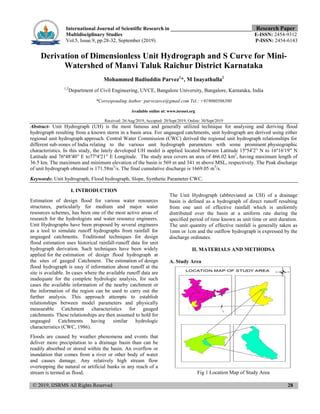
A. Study Area
Fig 1 Location Map of Study Area
Int. J. Sci. Res. in Multidisciplinary Studies Vol. 5(9), Sept 2019
© 2019, IJSRMS All Rights Reserved 29
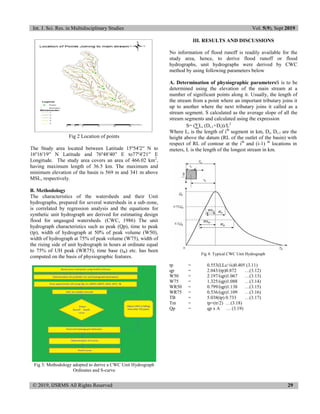
Fig 2 Location of points
The Study area located between Latitude 15º54′2′′ N to
16º16′19′′ N Latitude and 76º48′40′′ E to77º4′21′′ E
Longitude. The study area covers an area of 466.02 km2
,
having maximum length of 36.5 km. The maximum and
minimum elevation of the basin is 569 m and 341 m above
MSL, respectively.
B. Methodology
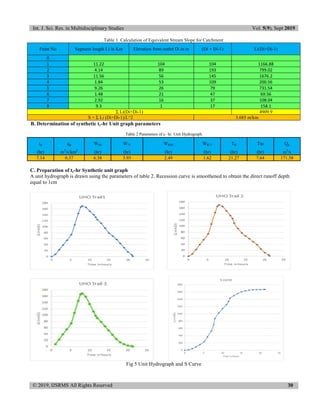
The characteristics of the watersheds and their Unit
hydrographs, prepared for several watersheds in a sub-zone,
is correlated by regression analysis and the equations for
synthetic unit hydrograph are derived for estimating design
flood for ungauged watersheds. (CWC, 1986) The unit
hydrograph characteristics such as peak (Qp), time to peak
(tp), width of hydrograph at 50% of peak volume (W50),
width of hydrograph at 75% of peak volume (W75), width of
the rising side of unit hydrograph in hours at ordinate equal
to 75% of UH peak (WR75), time base (tB) etc. has been
computed on the basis of physiographic features.
Fig 3: Methodology adopted to derive a CWC Unit Hydrograph
Ordinates and S-curve
III. RESULTS AND DISCUSSIONS
No information of flood runoff is readily available for the
study area, hence, to derive flood runoff or flood
hydrographs, unit hydrographs were derived by CWC
method by using following parameters below
A. Determination of physiographic parametersS is to be
determined using the elevation of the main stream at a
number of significant points along it. Usually, the length of
the stream from a point where an important tributary joins it
up to another where the next tributary joins it called as a
stream segment. S calculated as the average slope of all the
stream segments and calculated using the expression
S= (∑Li (Di-1+Di))/L2
Where Li is the length of ith
segment in km, Di, Di-1 are the
height above the datum (RL of the outlet of the basin) with
respect of RL of contour at the ith
and (i-1) th
locations in
meters, L is the length of the longest stream in km.
Fig 4: Typical CWC Unit Hydrograph
tp = 0.553(LLc/√s)0.405 (3.11)
qp = 2.043/(tp)0.872 …(3.12)
W50 = 2.197/(qp)1.067 …(3.13)
W75 = 1.325/(qp)1.088 …(3.14)
WR50 = 0.799/(qp)1.138 …(3.15)
WR75 = 0.536/(qp)1.109 …(3.16)
TB = 5.038(tp) 0.733 …(3.17)
Tm = tp+(tr/2) …(3.18)
Qp = qp x A … (3.19)
Int. J. Sci. Res. in Multidisciplinary Studies Vol. 5(9), Sept 2019
© 2019, IJSRMS All Rights Reserved 30
Table 1 Calculation of Equivalent Stream Slope for Catchment
Point No Segment length Li in Km Elevation from outlet Di in m (Di + Di-1) Li(Di+Di-1)
0
1 11.22 104 104 1166.88
2 4.14 89 193 799.02
3 11.56 56 145 1676.2
4 1.84 53 109 200.56
5 9.26 26 79 731.54
6 1.48 21 47 69.56
7 2.92 16 37 108.04
8 9.3 1 17 158.1
Σ Li(Di+Di-1) 4909.9
S = Σ Li (Di+Di-1)/L^2 3.685 m/km
B. Determination of synthetic tr-hr Unit graph parameters
Table 2 Parameters of tr- hr. Unit Hydrograph
tp qp W50 W75 WR50 WR75 TB Tm Qp
(hr) m3
/s/km2
(hr) (hr) (hr) (hr) (hr) (hr) m3
/s
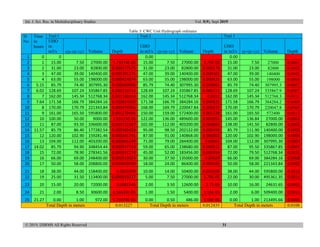
7.14 0.37 6.38 3.93 2.49 1.62 21.27 7.64 171.58
C. Preparation of tr-hr Synthetic unit graph
A unit hydrograph is drawn using the parameters of table 2. Recession curve is smoothened to obtain the direct runoff depth
equal to 1cm
Fig 5 Unit Hydrograph and S Curve
Int. J. Sci. Res. in Multidisciplinary Studies Vol. 5(9), Sept 2019
© 2019, IJSRMS All Rights Reserved 31
Table 3: CWC Unit Hydrograph ordinates
Sl
No
Time
in
hours
Trail 1 Trail 2 Trail 3
UHO
in
m3/s (Qi+Qi+1)/2 Volume Depth
UHO
in m3/s Qi+Qi+1)/2 Volume Depth
UHO
in m3/s Qi+Qi+1)/2 Volume Depth
1 0 0 0.00 0.00
2 1 15.00 7.50 27000.00 5.79374E-05 15.00 7.50 27000.00 5.79E-05 15.00 7.50 27000 0.0001
3 2 31.00 23.00 82800.00 0.000177675 31.00 23.00 82800.00 0.000178 31.00 23.00 82800 0.0002
4 3 47.00 39.00 140400.00 0.000301275 47.00 39.00 140400.00 0.000301 47.00 39.00 140400 0.0003
5 4 63.00 55.00 198000.00 0.000424874 63.00 55.00 198000.00 0.000425 63.00 55.00 198000 0.0004
6 5.15 85.79 74.40 307995.30 0.000660906 85.79 74.40 307995.30 0.000661 85.79 74.40 307995.3 0.0007
7 6.02 128.69 107.24 335867.85 0.000720716 128.69 107.24 335867.85 0.000721 128.69 107.24 335867.9 0.0007
8 7 162.00 145.34 512768.34 0.001100314 162.00 145.34 512768.34 0.0011 162.00 145.34 512768.3 0.0011
9 7.64 171.58 166.79 384284.16 0.000824609 171.58 166.79 384284.16 0.000825 171.58 166.79 384284.2 0.0008
10 8 170.00 170.79 221343.84 0.000474966 168.00 169.79 220047.84 0.000472 170.00 170.79 220047.8 0.0005
11 9 161.00 165.50 595800.00 0.001278486 150.00 159.00 572400.00 0.001228 161.00 165.50 572400 0.0012
12 10 100.00 50.00 9000.00 1.93125E-05 122.00 136.00 489600.00 0.001051 145.00 136.84 27000.00 0.0001
13 11 87.00 93.50 336600.00 0.000722287 102.00 112.00 403200.00 0.000865 138.00 141.50 82800.00 0.0002
14 11.57 85.79 86.40 177282.54 0.000380418 95.00 98.50 202122.00 0.000434 85.79 111.90 140400.00 0.0003
15 12 120.00 102.90 159281.46 0.000341791 87.00 91.00 140868.00 0.000302 120.00 102.90 198000.00 0.0004
16 13 104.00 112.00 403200.00 0.000865199 71.00 79.00 284400.00 0.00061 104.00 112.00 307995.30 0.0007
17 14.02 85.79 94.90 348454.44 0.000747724 59.00 65.00 238680.00 0.000512 87.00 95.50 335867.85 0.0007
18 15 72.00 78.90 278341.56 0.000597274 45.00 52.00 183456.00 0.000394 72.00 79.50 512768.34 0.0011
19 16 66.00 69.00 248400.00 0.000533024 30.00 37.50 135000.00 0.00029 66.00 69.00 384284.16 0.0008
20 17 50.00 58.00 208800.00 0.000448049 18.00 24.00 86400.00 0.000185 50.00 58.00 221343.84 0.0005
21 18 38.00 44.00 158400.00 0.0003399 10.00 14.00 50400.00 0.000108 38.00 44.00 595800.00 0.0013
22 19 25.00 31.50 113400.00 0.000243337 5.00 7.50 27000.00 5.79E-05 22.00 30.00 495361.35 0.0011
23 20 15.00 20.00 72000.00 0.0001545 2.00 3.50 12600.00 2.7E-05 10.00 16.00 24631.65 0.0001
24 21 2.00 8.50 30600.00 6.56624E-05 1.00 1.50 5400.00 1.16E-05 2.00 6.00 509400.00 0.0011
25 21.27 0.00 1.00 972.00 5.79374E-05 0.00 0.50 486.00 1.04E-06 0.00 1.00 213495.66 0.0005
Total Depth in meters 0.013227 Total Depth in meters 0.012435 Total Depth in meters 0.0108
Int. J. Sci. Res. in Multidisciplinary Studies Vol. 5(9), Sept 2019
© 2019, IJSRMS All Rights Reserved 32
IV. CONCLUSIONS
Using very limited data makes this model very useful for an
ungauged catchment aiming at event prediction. Equivalent
discharge is the maximum discharge that takes place in a
Catchment which can be used to design hydraulic structures.
To derive flood runoff or flood hydrographs, unit
hydrographs were derived by central water commission
method. This information is useful to derive flood
hydrograph along the stream. This drainage network analysis
and application of the UH can provide a significant
contribution towards flood management program. Thus, the
present model could be applied to simulate flood
hydrographs for the catchments that have not been studied
yet. The Peak discharge of unit hydrograph obtained is
171.58m3
/s. The final cumulative discharge is 1669.05 m3
/s.
REFERENCES
[1]. CWC (1986). Flood estimation report for Kaveri basin subzone
3(i). Directorate of Hydrology (small Catchments), Central Water
Commission, New Delhi
[2]. Mohammed Badiuddin Parvez, M Inayathulla “Generation Of
Intensity Duration Frequency Curves For Different Return Period
Using Short Duration Rainfall For Manvi Taluk Raichur District
Karnataka”, International Research Journal of Engineering and
Management Studies (IRJEMS), Volume: 03 Issue: 04 | April -
2019.
[3]. Mohammed Badiuddin Parvez, M Inayathulla “Prioritization Of
Subwatersheds of Cauvery Region Based on Morphometric
Analysis Using GIS”, International Journal for Research in
Engineering Application & Management (IJREAM), Volume: 05
Issue: 01, April -2019. 4.
[4]. Mohammed Badiuddin Parvez, M Inayathulla, "Rainfall Analysis
for Modelling of IDF Curves for Bangalore Rural, Karnataka",
International Journal of Scientific Research in Multidisciplinary
Studies , Vol.5, Issue.8, pp.114-132, 2019.
[5]. Mohammed Badiuddin Parvez, M Inayathulla, "Development of S
Curve for Mini-Watershed of Raichur City Karnataka",
International Journal of Scientific Research in Multidisciplinary
Studies , Vol.5, Issue.8, pp.1-11, 2019
[6]. Clark, C.O. (1945). “Storage and the Unit hydrograph”.
Transactions of the American Society of Civil Engineers
110:1491-46.
Authors Profile
Mohammed Badiuddin Parvez Is a life
member of Indian Water Resources
Society, ASCE Born in Gangavathi,
Obtained his BE in Civil Engineering in
the year 2009-2013 from UVCE,
Banagalore and M.E with specialization
on Water Resources Engineering
during 2013-2015 from UVCE, Bangalore University and
Pursuing Ph.D from Bangalore University. And has 3 years
of teaching experience. Till date, has presented and
published several technical papers in many National and
International seminars, Journals and conferences.
Dr M Inayathulla Is a life member of
Environmental and Water Resources
Engineering (EWRI), ASCE, WWI,
ASTEE, ASFPM. Born in Karnataka,
Obtained his BE in Civil Engineering in
the year 1987-1991 from UBDT,
Davanagere and M.E with specialization
on Water Resources Engineering during
1992-1994 from UVCE, Bangalore University and got
Doctorate from Bangalore University in the year 1990-1995.
Presently working as Professor at UVCE, Bangalore
University, India. And has more than 25 years of teaching
experience. Till date, has presented and published several
technical papers in many National and International
seminars and conferences.

5 ijsrms-02617 (1)

  • 1.
    © 2019, IJSRMSAll Rights Reserved 28 International Journal of Scientific Research in _______________________________ Research Paper . Multidisciplinary Studies E-ISSN: 2454-9312 Vol.5, Issue.9, pp.28-32, September (2019) P-ISSN: 2454-6143 Derivation of Dimensionless Unit Hydrograph and S Curve for Mini- Watershed of Manvi Taluk Raichur District Karnataka Mohammed Badiuddin Parvez1 *, M Inayathulla2 1,2 Department of Civil Engineering, UVCE, Bangalore University, Bangalore, Karnataka, India *Corresponding Author: parvezuvce@gmail.com Tel.: +919060506390 Available online at: www.isroset.org Received: 26/Aug/2019, Accepted: 20/Sept/2019, Online: 30/Sept/2019 Abstract- Unit Hydrograph (UH) is the most famous and generally utilized technique for analysing and deriving flood hydrograph resulting from a known storm in a basin area. For ungauged catchments, unit hydrograph are derived using either regional unit hydrograph approach. Central Water Commission (CWC) derived the regional unit hydrograph relationships for different sub-zones of India relating to the various unit hydrograph parameters with some prominent physiographic characteristics. In this study, the lately developed UH model is applied located between Latitude 15º54′2′′ N to 16º16′19′′ N Latitude and 76º48′40′′ E to77º4′21′′ E Longitude. The study area covers an area of 466.02 km2 , having maximum length of 36.5 km. The maximum and minimum elevation of the basin is 569 m and 341 m above MSL, respectively. The Peak discharge of unit hydrograph obtained is 171.58m3 /s. The final cumulative discharge is 1669.05 m3 /s. Keywords: Unit hydrograph, Flood hydrograph, Slope, Synthetic Parameter CWC. I. INTRODUCTION Estimation of design flood for various water resources structures, particularly for medium and major water resources schemes, has been one of the most active areas of research for the hydrologists and water resource engineers. Unit Hydrographs have been proposed by several engineers as a tool to simulate runoff hydrographs from rainfall for ungauged catchments. Traditional techniques for design flood estimation uses historical rainfall-runoff data for unit hydrograph derivation. Such techniques have been widely applied for the estimation of design flood hydrograph at the sites of gauged Catchment. The estimation of design flood hydrograph is easy if information about runoff at the site is available. In cases where the available runoff data are inadequate for the complete hydrologic analysis, for such cases the available information of the nearby catchment or the information of the region can be used to carry out the further analysis. This approach attempts to establish relationships between model parameters and physically measurable Catchment characteristics for gauged catchments. These relationships are then assumed to hold for ungauged Catchments having similar hydrologic characteristics (CWC, 1986). Floods are caused by weather phenomena and events that deliver more precipitation to a drainage basin than can be readily absorbed or stored within the basin. An overflow or inundation that comes from a river or other body of water and causes damage. Any relatively high stream flow overtopping the natural or artificial banks in any reach of a stream is termed as flood. The Unit Hydrograph (abbreviated as UH) of a drainage basin is defined as a hydrograph of direct runoff resulting from one unit of effective rainfall which is uniformly distributed over the basin at a uniform rate during the specified period of time known as unit time or unit duration. The unit quantity of effective rainfall is generally taken as 1mm or 1cm and the outflow hydrograph is expressed by the discharge ordinates. II. MATERIALS AND METHODSA A. Study Area Fig 1 Location Map of Study Area
  • 2.
    Int. J. Sci.Res. in Multidisciplinary Studies Vol. 5(9), Sept 2019 © 2019, IJSRMS All Rights Reserved 29 Fig 2 Location of points The Study area located between Latitude 15º54′2′′ N to 16º16′19′′ N Latitude and 76º48′40′′ E to77º4′21′′ E Longitude. The study area covers an area of 466.02 km2 , having maximum length of 36.5 km. The maximum and minimum elevation of the basin is 569 m and 341 m above MSL, respectively. B. Methodology The characteristics of the watersheds and their Unit hydrographs, prepared for several watersheds in a sub-zone, is correlated by regression analysis and the equations for synthetic unit hydrograph are derived for estimating design flood for ungauged watersheds. (CWC, 1986) The unit hydrograph characteristics such as peak (Qp), time to peak (tp), width of hydrograph at 50% of peak volume (W50), width of hydrograph at 75% of peak volume (W75), width of the rising side of unit hydrograph in hours at ordinate equal to 75% of UH peak (WR75), time base (tB) etc. has been computed on the basis of physiographic features. Fig 3: Methodology adopted to derive a CWC Unit Hydrograph Ordinates and S-curve III. RESULTS AND DISCUSSIONS No information of flood runoff is readily available for the study area, hence, to derive flood runoff or flood hydrographs, unit hydrographs were derived by CWC method by using following parameters below A. Determination of physiographic parametersS is to be determined using the elevation of the main stream at a number of significant points along it. Usually, the length of the stream from a point where an important tributary joins it up to another where the next tributary joins it called as a stream segment. S calculated as the average slope of all the stream segments and calculated using the expression S= (∑Li (Di-1+Di))/L2 Where Li is the length of ith segment in km, Di, Di-1 are the height above the datum (RL of the outlet of the basin) with respect of RL of contour at the ith and (i-1) th locations in meters, L is the length of the longest stream in km. Fig 4: Typical CWC Unit Hydrograph tp = 0.553(LLc/√s)0.405 (3.11) qp = 2.043/(tp)0.872 …(3.12) W50 = 2.197/(qp)1.067 …(3.13) W75 = 1.325/(qp)1.088 …(3.14) WR50 = 0.799/(qp)1.138 …(3.15) WR75 = 0.536/(qp)1.109 …(3.16) TB = 5.038(tp) 0.733 …(3.17) Tm = tp+(tr/2) …(3.18) Qp = qp x A … (3.19)
  • 3.
    Int. J. Sci.Res. in Multidisciplinary Studies Vol. 5(9), Sept 2019 © 2019, IJSRMS All Rights Reserved 30 Table 1 Calculation of Equivalent Stream Slope for Catchment Point No Segment length Li in Km Elevation from outlet Di in m (Di + Di-1) Li(Di+Di-1) 0 1 11.22 104 104 1166.88 2 4.14 89 193 799.02 3 11.56 56 145 1676.2 4 1.84 53 109 200.56 5 9.26 26 79 731.54 6 1.48 21 47 69.56 7 2.92 16 37 108.04 8 9.3 1 17 158.1 Σ Li(Di+Di-1) 4909.9 S = Σ Li (Di+Di-1)/L^2 3.685 m/km B. Determination of synthetic tr-hr Unit graph parameters Table 2 Parameters of tr- hr. Unit Hydrograph tp qp W50 W75 WR50 WR75 TB Tm Qp (hr) m3 /s/km2 (hr) (hr) (hr) (hr) (hr) (hr) m3 /s 7.14 0.37 6.38 3.93 2.49 1.62 21.27 7.64 171.58 C. Preparation of tr-hr Synthetic unit graph A unit hydrograph is drawn using the parameters of table 2. Recession curve is smoothened to obtain the direct runoff depth equal to 1cm Fig 5 Unit Hydrograph and S Curve
  • 4.
    Int. J. Sci.Res. in Multidisciplinary Studies Vol. 5(9), Sept 2019 © 2019, IJSRMS All Rights Reserved 31 Table 3: CWC Unit Hydrograph ordinates Sl No Time in hours Trail 1 Trail 2 Trail 3 UHO in m3/s (Qi+Qi+1)/2 Volume Depth UHO in m3/s Qi+Qi+1)/2 Volume Depth UHO in m3/s Qi+Qi+1)/2 Volume Depth 1 0 0 0.00 0.00 2 1 15.00 7.50 27000.00 5.79374E-05 15.00 7.50 27000.00 5.79E-05 15.00 7.50 27000 0.0001 3 2 31.00 23.00 82800.00 0.000177675 31.00 23.00 82800.00 0.000178 31.00 23.00 82800 0.0002 4 3 47.00 39.00 140400.00 0.000301275 47.00 39.00 140400.00 0.000301 47.00 39.00 140400 0.0003 5 4 63.00 55.00 198000.00 0.000424874 63.00 55.00 198000.00 0.000425 63.00 55.00 198000 0.0004 6 5.15 85.79 74.40 307995.30 0.000660906 85.79 74.40 307995.30 0.000661 85.79 74.40 307995.3 0.0007 7 6.02 128.69 107.24 335867.85 0.000720716 128.69 107.24 335867.85 0.000721 128.69 107.24 335867.9 0.0007 8 7 162.00 145.34 512768.34 0.001100314 162.00 145.34 512768.34 0.0011 162.00 145.34 512768.3 0.0011 9 7.64 171.58 166.79 384284.16 0.000824609 171.58 166.79 384284.16 0.000825 171.58 166.79 384284.2 0.0008 10 8 170.00 170.79 221343.84 0.000474966 168.00 169.79 220047.84 0.000472 170.00 170.79 220047.8 0.0005 11 9 161.00 165.50 595800.00 0.001278486 150.00 159.00 572400.00 0.001228 161.00 165.50 572400 0.0012 12 10 100.00 50.00 9000.00 1.93125E-05 122.00 136.00 489600.00 0.001051 145.00 136.84 27000.00 0.0001 13 11 87.00 93.50 336600.00 0.000722287 102.00 112.00 403200.00 0.000865 138.00 141.50 82800.00 0.0002 14 11.57 85.79 86.40 177282.54 0.000380418 95.00 98.50 202122.00 0.000434 85.79 111.90 140400.00 0.0003 15 12 120.00 102.90 159281.46 0.000341791 87.00 91.00 140868.00 0.000302 120.00 102.90 198000.00 0.0004 16 13 104.00 112.00 403200.00 0.000865199 71.00 79.00 284400.00 0.00061 104.00 112.00 307995.30 0.0007 17 14.02 85.79 94.90 348454.44 0.000747724 59.00 65.00 238680.00 0.000512 87.00 95.50 335867.85 0.0007 18 15 72.00 78.90 278341.56 0.000597274 45.00 52.00 183456.00 0.000394 72.00 79.50 512768.34 0.0011 19 16 66.00 69.00 248400.00 0.000533024 30.00 37.50 135000.00 0.00029 66.00 69.00 384284.16 0.0008 20 17 50.00 58.00 208800.00 0.000448049 18.00 24.00 86400.00 0.000185 50.00 58.00 221343.84 0.0005 21 18 38.00 44.00 158400.00 0.0003399 10.00 14.00 50400.00 0.000108 38.00 44.00 595800.00 0.0013 22 19 25.00 31.50 113400.00 0.000243337 5.00 7.50 27000.00 5.79E-05 22.00 30.00 495361.35 0.0011 23 20 15.00 20.00 72000.00 0.0001545 2.00 3.50 12600.00 2.7E-05 10.00 16.00 24631.65 0.0001 24 21 2.00 8.50 30600.00 6.56624E-05 1.00 1.50 5400.00 1.16E-05 2.00 6.00 509400.00 0.0011 25 21.27 0.00 1.00 972.00 5.79374E-05 0.00 0.50 486.00 1.04E-06 0.00 1.00 213495.66 0.0005 Total Depth in meters 0.013227 Total Depth in meters 0.012435 Total Depth in meters 0.0108
  • 5.
    Int. J. Sci.Res. in Multidisciplinary Studies Vol. 5(9), Sept 2019 © 2019, IJSRMS All Rights Reserved 32 IV. CONCLUSIONS Using very limited data makes this model very useful for an ungauged catchment aiming at event prediction. Equivalent discharge is the maximum discharge that takes place in a Catchment which can be used to design hydraulic structures. To derive flood runoff or flood hydrographs, unit hydrographs were derived by central water commission method. This information is useful to derive flood hydrograph along the stream. This drainage network analysis and application of the UH can provide a significant contribution towards flood management program. Thus, the present model could be applied to simulate flood hydrographs for the catchments that have not been studied yet. The Peak discharge of unit hydrograph obtained is 171.58m3 /s. The final cumulative discharge is 1669.05 m3 /s. REFERENCES [1]. CWC (1986). Flood estimation report for Kaveri basin subzone 3(i). Directorate of Hydrology (small Catchments), Central Water Commission, New Delhi [2]. Mohammed Badiuddin Parvez, M Inayathulla “Generation Of Intensity Duration Frequency Curves For Different Return Period Using Short Duration Rainfall For Manvi Taluk Raichur District Karnataka”, International Research Journal of Engineering and Management Studies (IRJEMS), Volume: 03 Issue: 04 | April - 2019. [3]. Mohammed Badiuddin Parvez, M Inayathulla “Prioritization Of Subwatersheds of Cauvery Region Based on Morphometric Analysis Using GIS”, International Journal for Research in Engineering Application & Management (IJREAM), Volume: 05 Issue: 01, April -2019. 4. [4]. Mohammed Badiuddin Parvez, M Inayathulla, "Rainfall Analysis for Modelling of IDF Curves for Bangalore Rural, Karnataka", International Journal of Scientific Research in Multidisciplinary Studies , Vol.5, Issue.8, pp.114-132, 2019. [5]. Mohammed Badiuddin Parvez, M Inayathulla, "Development of S Curve for Mini-Watershed of Raichur City Karnataka", International Journal of Scientific Research in Multidisciplinary Studies , Vol.5, Issue.8, pp.1-11, 2019 [6]. Clark, C.O. (1945). “Storage and the Unit hydrograph”. Transactions of the American Society of Civil Engineers 110:1491-46. Authors Profile Mohammed Badiuddin Parvez Is a life member of Indian Water Resources Society, ASCE Born in Gangavathi, Obtained his BE in Civil Engineering in the year 2009-2013 from UVCE, Banagalore and M.E with specialization on Water Resources Engineering during 2013-2015 from UVCE, Bangalore University and Pursuing Ph.D from Bangalore University. And has 3 years of teaching experience. Till date, has presented and published several technical papers in many National and International seminars, Journals and conferences. Dr M Inayathulla Is a life member of Environmental and Water Resources Engineering (EWRI), ASCE, WWI, ASTEE, ASFPM. Born in Karnataka, Obtained his BE in Civil Engineering in the year 1987-1991 from UBDT, Davanagere and M.E with specialization on Water Resources Engineering during 1992-1994 from UVCE, Bangalore University and got Doctorate from Bangalore University in the year 1990-1995. Presently working as Professor at UVCE, Bangalore University, India. And has more than 25 years of teaching experience. Till date, has presented and published several technical papers in many National and International seminars and conferences.