© 2019, WAJES All Rights Reserved 7
World Academics Journal of ______________________________________________ Research Paper .
Engineering Sciences
Vol.6, Issue.1, pp.07-17, October (2019) E-ISSN: 2348-635X
Multivariate Geomorphometric Approach to Prioritize Erosion Prone
Watershed of Upper Cauvery Karnataka
Mohammed Badiuddin Parvez1
*, M Inayathulla2
1,2
Dept. of Civil Engineering, UVCE, Bangalore University, Bangalore, Karnataka, India
Corresponding Author: parvezuvce@gmail.com Tel.: +919060506390
Available online at: www.isroset.org
Received: 05/Oct/2019, Accepted: 17/Oct/2019, Online: 31/Oct/2019
Abstract-Prioritization of watershed has Grabbed up significance in watershed management. Morphometic investigation is
been usually applied to organize the watershed. In the present study upper cauvery of Karnataka with an area of 10874.65 km2
and highest order stream of 8 was considered. The area was divided into Eight Watersheds. Various morphometric parameters
namely Bifurcation ratio(Rb), Drainage density (Dd), Stream frequency(Ns), Texture ratio(T), Form factor(Rf), Circularity
ratio(Rc), Elongation Ratio(Re), length of overland flow, shape factor(Bs), compactness ratio (Cc) has been determined for
each watershed and allotted position on premise of relationship as to arrive at a Compound value for final ranking of
watershed. The morphometric parameters ranges between Rb (3.416-5.0442), Dd (1.377-1.463), Ns (1.397-1.579), T (5.235-
8.540), Rf (0.233-1.082), Rc (0.179-0.447), Re (0.545-1.173), Cc (1.496-2.365), Lof (0.341-0.363), and Bs (0.924-4.284). It
is found that the 38.83 % of area falls under high priority category where as 42.12% of area falls under this Medium category
and 19.05% of the area falls under low catergory.
Keywords: GIS, DEM, Morphometric analysis, Watershed, Priority, Compound Factor.
I. INTRODUCTION
Soil disintegration is viewed as one of the most significant
corruption forms on the planet. The soil resource is limited
and its wide use is of utmost importance; it sustains bio
geochemical processes and is the habitat for a great diversity
of microorganisms. Morphometric analysis provides
quantitative description of the basin geometry to understand
initial slope or inequalities in the rock hardness, structural
controls, recent diastrophism, geological and geomorphic
history of drainage basin (Strahler, 1964). Morphometric
analysis requires measurement of linear features, gradient of
channel network and contributing ground slopes of the
drainage basin. Morphometry is the measurement and
mathematical analysis of the configuration of the earth's
surface, shape and dimension of its landforms. A major
emphasis in geomorphology over the past several decades
has been on the development of quantitative physiographic
methods to describe the evolution and behavior of surface
drainage networks (Horton, 1945). Drainage basin
examination based on morphometric parameters is very
fundamental for watershed planning since it gives an thought
regarding the basin characteristics in terms of slope,
topography, soil condition, runoff characteristics, surface
water potential etc. Geographic Information System
techniques strategies described by an exceptionally high
exactness of mapping and measurement prove to be a tool in
morphometric analysis. One of the advantages of
quantitative analysis is that many of the basin parameters
derived are in the form of ratios, and dimensionless
numbers, thus providing an effective comparison
irrespective of the scale (Krishnamurthy et al. 1996).
II. MATERIALS AND METHODS
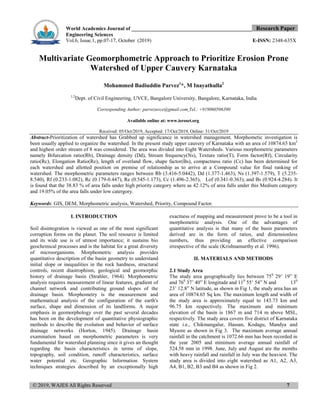
2.1 Study Area
The study area geographically lies between 750
29’ 19” E
and 760
37’ 40” E longitude and 110
55’ 54” N and 130
23’ 12.8” N latitude, as shown in Fig 1, the study area has an
area of 10874.65 Sq km. The maximum length and width of
the study area is approximately equal to 143.73 km and
96.75 km respectively. The maximum and minimum
elevation of the basin is 1867 m and 714 m above MSL,
respectively. The study area covers five district of Karnataka
state i.e., Chikmangalur, Hassan, Kodagu, Mandya and
Mysore as shown in Fig 3. The maximum average annual
rainfall in the catchment is 1072.66 mm has been recorded in
the year 2005 and minimum average annual rainfall of
524.58 mm in 1998. June, July and August are the months
with heavy rainfall and rainfall in July was the heaviest. The
study area is divided into eight watershed as A1, A2, A3,
A4, B1, B2, B3 and B4 as shown in Fig 2.
World Academics J. of Engg. Sciences Vol. 6(1), Oct 2019, ISSN: 2348-635X
© 2019, WAJES All Rights Reserved 8
2.2 Methodology
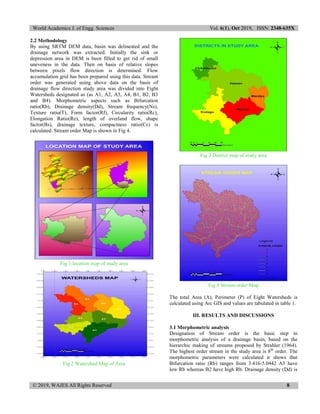
By using SRTM DEM data, basin was delineated and the
drainage network was extracted. Initially the sink or
depression area in DEM is been filled to get rid of small
uneveness in the data. Then on basis of relative slopes
between pixels flow direction is determined. Flow
accumulation grid has been prepared using this data. Stream
order was generated using above data on the basis of
drainage flow direction study area was divided into Eight
Watersheds designated as (as A1, A2, A3, A4, B1, B2, B3
and B4). Morphometric aspects such as Bifurcation
ratio(Rb), Drainage density(Dd), Stream frequency(Ns),
Texture ratio(T), Form factor(Rf), Circularity ratio(Rc),
Elongation Ratio(Re), length of overland flow, shape
factor(Bs), drainage texture, compactness ratio(Cc) is
calculated. Stream order Map is shown in Fig 4.
Fig 1 location map of study area
Fig 2 Watershed Map of Area
Fig 3 District map of study area
Fig 4 Stream order Map
The total Area (A), Perimeter (P) of Eight Watersheds is
calculated using Arc GIS and values are tabulated in table 1.
III. RESULTS AND DISCUSSIONS
3.1 Morphometric analysis
Designation of Stream order is the basic step in
morphometric analysis of a drainage basin, based on the
hierarchic making of streams proposed by Strahler (1964).
The highest order stream in the study area is 8th
order. The
morphometric parameters were calculated it shows that
Bifurcation ratio (Rb) ranges from 3.416-5.0442 A3 have
low Rb whereas B2 have high Rb. Drainage density (Dd) is
World Academics J. of Engg. Sciences Vol. 6(1), Oct 2019, ISSN: 2348-635X
© 2019, WAJES All Rights Reserved 9
low in A3 and high in B1 its value ranges from 1.377-1.463.
Stream frequency (Ns) varies from 1.397-1.579 with A1
having low and B4 has high value. Texture ratio (T) ranges
from 5.23-8.54 with low in B4 and high in B1. Form factor
(Rf) is low in B3 and high in B2 it ranges from 0.233 to
1.082. Length of overland flow varies from 0.341 to 0.363
with low in B1 and high in A3. Basin shape (Bs) is low in
B2 and high in B3 it ranges from 0.921 to 4.284.
Compactness coefficient (Cc) show wide variation across the
watershed it is more in B4 and less in B1 it varies from
1.496 to 2.365. Elongation ratio(Re) varies from 0.545 to
1.173 with B2 has low and B2 has high value. Circularity
ratio(Rc) of watersheds ranges from 0.179 to 0.447 with low
in B4 and high in B1. The Tabulated results are shown in
Table 3. Linear morphometric characteristics is shown in
Table 2.
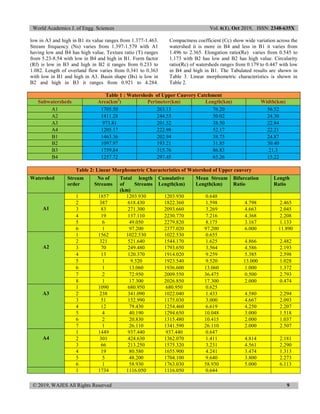
Table 1 : Watersheds of Upper Cauvery Catchment
Subwatersheds Area(km2
) Perimeter(km) Length(km) Width(km)
A1 1705.50 263.13 76.20 56.52
A2 1411.28 244.53 50.02 24.30
A3 973.81 201.52 38.50 22.84
A4 1205.17 222.98 52.17 22.21
B1 1463.36 202.94 38.75 24.87
B2 1097.97 193.21 31.85 30.40
B3 1759.84 315.76 86.83 21.3
B4 1257.72 297.45 65.26 15.22
Table 2: Linear Morphometric Characteristics of Watershed of Upper cauvery
Watershed Stream
order
No of
Streams
Total length
of Streams
(km)
Cumulative
Length(km)
Mean Stream
Length(km)
Bifurcation
Ratio
Length
Ratio
A1
1 1857 1203.930 1203.930 0.648
2 387 618.430 1822.360 1.598 4.798 2.465
3 83 271.300 2093.660 3.269 4.663 2.045
4 19 137.110 2230.770 7.216 4.368 2.208
5 6 49.050 2279.820 8.175 3.167 1.133
6 1 97.200 2377.020 97.200 6.000 11.890
A2
1 1562 1022.530 1022.530 0.655
2 321 521.640 1544.170 1.625 4.866 2.482
3 70 249.480 1793.650 3.564 4.586 2.193
4 13 120.370 1914.020 9.259 5.385 2.598
5 1 9.520 1923.540 9.520 13.000 1.028
6 1 13.060 1936.600 13.060 1.000 1.372
7 2 72.950 2009.550 36.475 0.500 2.793
8 1 17.300 2026.850 17.300 2.000 0.474
A3
1 1090 680.950 680.950 0.625
2 238 341.090 1022.040 1.433 4.580 2.294
3 51 152.990 1175.030 3.000 4.667 2.093
4 12 79.430 1254.460 6.619 4.250 2.207
5 4 40.190 1294.650 10.048 3.000 1.518
6 2 20.830 1315.480 10.415 2.000 1.037
7 1 26.110 1341.590 26.110 2.000 2.507
A4
1 1449 937.440 937.440 0.647
2 301 424.630 1362.070 1.411 4.814 2.181
3 66 213.250 1575.320 3.231 4.561 2.290
4 19 80.580 1655.900 4.241 3.474 1.313
5 5 48.200 1704.100 9.640 3.800 2.273
6 1 58.930 1763.030 58.930 5.000 6.113
1 1734 1116.050 1116.050 0.644
World Academics J. of Engg. Sciences Vol. 6(1), Oct 2019, ISSN: 2348-635X
© 2019, WAJES All Rights Reserved 10
B1
2 374 535.540 1651.590 1.432 4.636 2.225
3 79 223.030 1874.620 2.823 4.734 1.972
4 21 130.550 2005.170 6.217 3.762 2.202
5 5 68.420 2073.590 13.684 4.200 2.201
6 2 6.990 2080.580 3.495 2.500 0.255
7 1 60.730 2141.310 60.730 2.000 17.376
B2
1 1286 828.930 828.930 0.645
2 266 400.140 1229.070 1.504 4.835 2.334
3 58 194.150 1423.220 3.347 4.586 2.225
4 10 77.300 1500.520 7.730 5.800 2.309
5 1 48.460 1548.980 48.460 10.000 6.269
6 0 0.000 1548.980 - - -
7 1 36.170 1585.150 36.170 - -
B3 1 2022 1308.330 1308.330 0.647
2 421 627.240 1935.570 1.490 4.803 2.303
3 86 290.350 2225.920 3.376 4.895 2.266
4 22 162.740 2388.660 7.397 3.909 2.191
5 5 40.270 2428.930 8.054 4.400 1.089
6 2 76.490 2505.420 38.245 2.500 4.749
7 1 11.470 2516.890 11.470 2.000 0.300
B4
1 1557 922.450 922.450 0.592
2 340 478.000 1400.450 1.406 4.579 2.373
3 68 207.300 1607.750 3.049 5.000 2.168
4 16 126.390 1734.140 7.899 4.250 2.591
5 4 29.550 1763.690 7.388 4.000 0.935
6 1 50.700 1814.390 50.700 4.000 6.863
3.2 Priortization of Watershed
Morphometric aspects such as Drainage density (Dd),
Stream frequency (Ns), Texture ratio (T), Form factor (Rf),
Bifurcation ratio (Rb), Circularity ratio (Rc), Elongation
Ratio (Re), length of overland flow, Basin Shape (Bs),
compactness ratio(Cc) are also termed as erosin risk
assessment parameters and have been used for prioritizing
Watersheds [3]. The preliminary priority ranking of
Watersheds was done on the basis of morphological
characteristics the parameters such as Bifurcation ratio(Rb),
Stream frequency (Ns), Drainage density(Dd), Texture
ratio(T), have a direct relationship with erodibility higher
values of all these have been have been given rank 1 second
largest is rated as rank 2 and so on with the least ranked last
in each of the mini watersheds. Parameters such as Form
factor (Rf), Circularity ratio (Rc), Elongation Ratio (Re),
Basin Shape (Bs) have inverse relationship with the
erodibility higher the value less is erosion lower the value
high is erodibility [5]. In this manner least estimations of this
is appraised as rank 1 and second least been rated as rank 2
and so on and the highest values is given last rank. The final
priority ranking and related categorization were made on the
basis of the compound factor value, which was computed by
multiplying the ranks from morphometric analysis and their
weights obtained using cross-correlation analysis of these
parameters to give compound factor for final prioritization
of sub-watersheds[5]. The compound factor is calculated
using equation 1.
CF= PPRmp x Wmp (1) Where CF is compound factor,
PPRmp is the preliminary priority rank based on
morphometric parameter, and Wmp is the weight of
morphometric parameter obtained using cross correlation
analysis. Based on final value of compound factor
Watershed with least rating was assigned highest rank next
value was assigned second rank and so on and the
Watershed with highest compound value was assigned last
rank.
3.2.1 Prioritization of sub-watershed based on weighted
sum approach
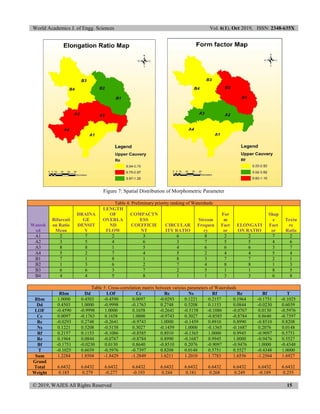
The cross-correlation analysis among various morphometric
parameters (Table 5) was performed and tested at 5% level
of significance. The priority ranks of Watersheds were
determined on the basis of compound factor (Table 4),
which was calculated using Eq.1.The value of weights
assigned to a morphometric parameter was calculated by
dividing the sum of correlation coefficient of each parameter
by the grand total of correlations (Table 5)[5]. By assigning
the weights to different parameters, a model was formulated
to assess the final priority ranking. The compound factor for
Watershed A1 prioritization was computed as follows:
World Academics J. of Engg. Sciences Vol. 6(1), Oct 2019, ISSN: 2348-635X
© 2019, WAJES All Rights Reserved 11
Compound factor =(0.185*PPR of Rbm)+(0.297*PPR of
Dd)-(0.277*PPR of LOF)- (0.193*PPR of Cc)+(0.244*PPR
of Rc)+(0.181*PPR of Ns)+(0.268*PPR of Rf)-(0.189*PPR
of Bs)+(0.249*PPR of Re)+(0.255*PPR of T) .
The final priority ranking was made in such a way that the
lowest value of compound factor was given the priority rank
of 1, the next lower value was given priority rank of 2, and
so on for all the Watersheds. Figure 8 shows the final
priority ranking map of Eight watershed under study.
Based on the compound factor value, all the Watersheds
were classified into Three priority categories such as (i)
High (0 to 3), (ii) Medium (3.0 to 6.0), (iii) Low (6.0 to 9.0),
as given in Table 6 and 7. It was observed from Table 11
that the three Watersheds (A4, B3 and B4) were under very
high category, Three Watershed (A1, A2 and B1) under
medium, and Two Watershed (A3 and B2) was under low
category.
Table 3 Morphometric Parameters of Watershed of Upper Cauvery
Watershed
Bifurcation
Ratio
Mean
Drainage
Density
Length
Of
Overland
Flow
Compactness
Coefficient
Circularity
Ratio
Stream
Frequency
Form
Factor
Elongation
Ratio
Shape
Factor
Texture
Ratio
A1 4.5990 1.3937 0.3587 1.7970 0.3099 1.3797 0.2937 0.6112 3.4045 7.0573
A2 4.4770 1.4362 0.3481 1.8358 0.2969 1.3966 0.5641 0.8470 1.7729 6.3878
A3 3.4160 1.3777 0.3629 1.8213 0.3017 1.4356 0.6570 0.9141 1.5221 5.4089
A4 4.3300 1.4629 0.3418 1.8115 0.3049 1.5276 0.4428 0.7505 2.2584 6.4983
B1 3.6387 1.4633 0.3417 1.4962 0.4470 1.5143 0.9746 1.1133 1.0261 8.5444
B2 5.0442 1.4437 0.3463 1.6445 0.3700 1.4773 1.0824 1.1733 0.9239 6.6560
B3 3.7512 1.4302 0.3496 2.1228 0.2220 1.4541 0.2334 0.5449 4.2842 6.4036
B4 4.3659 1.4426 0.3466 2.3655 0.1788 1.5790 0.2953 0.6129 3.3862 5.2345
World Academics J. of Engg. Sciences Vol. 6(1), Oct 2019, ISSN: 2348-635X
© 2019, WAJES All Rights Reserved 12
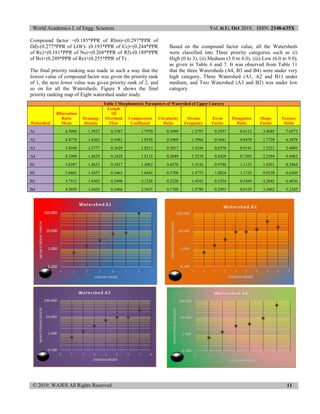
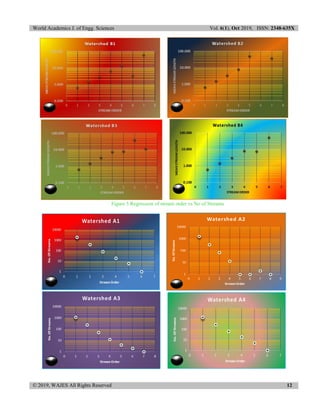
Figure 5 Regression of stream order vs No of Streams
World Academics J. of Engg. Sciences Vol. 6(1), Oct 2019, ISSN: 2348-635X
© 2019, WAJES All Rights Reserved 13
Figure 6 Regression of stream order vs mean stream length
World Academics J. of Engg. Sciences Vol. 6(1), Oct 2019, ISSN: 2348-635X
© 2019, WAJES All Rights Reserved 14
World Academics J. of Engg. Sciences Vol. 6(1), Oct 2019, ISSN: 2348-635X
© 2019, WAJES All Rights Reserved 15
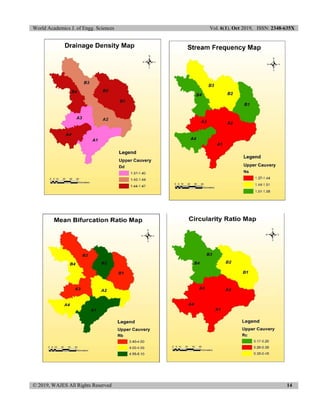
Figure 7: Spatial Distribution of Morphometric Parameter
Table 4: Preliminary priority ranking of Watersheds
Watesh
ed
Bifurcati
on Ratio
Mean
DRAINA
GE
DENSIT
Y
LENGTH
OF
OVERLA
ND
FLOW
COMPACTN
ESS
COEFFICIE
NT
CIRCULAR
ITY RATIO
Stream
Frequen
cy
For
m
Fact
or
ELONGATI
ON RATIO
Shap
e
Fact
or
Textu
re
Ratio
A1 2 7 2 3 6 8 2 2 7 2
A2 3 5 4 6 3 7 5 5 4 6
A3 8 8 1 5 4 6 6 6 3 7
A4 5 2 7 4 5 2 4 4 5 4
B1 7 1 8 1 8 3 7 7 2 1
B2 1 3 6 2 7 4 8 8 1 3
B3 6 6 3 7 2 5 1 1 8 5
B4 4 4 5 8 1 1 3 3 6 8
Table 5: Cross-correlation matrix between various parameters of Watersheds
Rbm Dd LOF Cc Rc Ns Rf Re Bf T
Rbm 1.0000 0.4503 -0.4590 0.0097 -0.0293 0.1221 0.2157 0.1964 -0.1751 -0.1025
Dd 0.4503 1.0000 -0.9998 -0.1763 0.2748 0.5208 0.1153 0.0844 -0.0230 0.6039
LOF -0.4590 -0.9998 1.0000 0.1658 -0.2641 -0.5158 -0.1086 -0.0767 0.0130 -0.5976
Cc 0.0097 -0.1763 0.1658 1.0000 -0.9743 0.3027 -0.8585 -0.8784 0.8640 -0.7397
Rc -0.0293 0.2748 -0.2641 -0.9743 1.0000 -0.1459 0.8910 0.8990 -0.8510 0.8208
Ns 0.1221 0.5208 -0.5158 0.3027 -0.1459 1.0000 -0.1365 -0.1687 0.2076 0.0148
Rf 0.2157 0.1153 -0.1086 -0.8585 0.8910 -0.1365 1.0000 0.9945 -0.9097 0.5751
Re 0.1964 0.0844 -0.0767 -0.8784 0.8990 -0.1687 0.9945 1.0000 -0.9476 0.5527
Bf -0.1751 -0.0230 0.0130 0.8640 -0.8510 0.2076 -0.9097 -0.9476 1.0000 -0.4348
T -0.1025 0.6039 -0.5976 -0.7397 0.8208 0.0148 0.5751 0.5527 -0.4348 1.0000
Sum 1.2284 1.8504 -1.8429 -1.2849 1.6211 1.2010 1.7783 1.6556 -1.2564 1.6927
Grand
Total 6.6432 6.6432 6.6432 6.6432 6.6432 6.6432 6.6432 6.6432 6.6432 6.6432
Weight 0.185 0.279 -0.277 -0.193 0.244 0.181 0.268 0.249 -0.189 0.255
World Academics J. of Engg. Sciences Vol. 6(1), Oct 2019, ISSN: 2348-635X
© 2019, WAJES All Rights Reserved 16
Table 6 : Final Priority Ranking
Watershed
Name
Compound factor Rank
A1 4.323 4
A2 5.042 5
A3 8.852 8
A4 2.497 3
B1 5.156 6
B2 6.118 7
B3 2.275 2
B4 1.809 1
Table 7: Priority category based on compound factor for mini-
watershed 1
Sl
No
Priority
Level
Priority
Category
Watershed name % Area
1 0.0-2.5 High A4, B3, B4 38.83
2 2.5-5.0 Medium A1, A2, B1 42.12
3 5.0-7.5 Low A3, B2 19.05
Figure 8 Priority Map
IV. CONCLUSIONS
The length of overland flow (lof) for all the Watersheds in
the present study is more than 0.30 hence they have longer
flow paths associated with more infiltration and reduced
runoff. Stream frequency (Ns) for present study is low
demonstrating relatively a low runoff. Higher value of form
factor (Rf) indicates wider basin and lower value indicates
narrow basin. Drainage density varies from1.377 km/km2
to
1.463 km/km2
indicating watersheds fall under coarse and
very coarse texture. From Table 6 and 7 it can be found that
the 38.83 % of area falls under high priority category where
as 42.12% of area falls under this Medium category and
19.05% of the area falls under low catergory. We can also
conclude that in case of unavailability of soil maps this type
of study could be used in selecting area for soil conservation
measure.
REFERENCES
[1] Horton R.E.(1945). Erosional Development of streams and their
drainage basins, Hydro physical approach to quantitative
morphology. Geological Society of American Bulletin. 56: 275-
370.
[2] Horton,R.E.(1932).Drainage Basin Characteristics. Transfixions of
Am.Geophysics.Union, 13:350
[3] Mohammed Badiuddin Parvez, M Inayathulla “Prioritization Of
Subwatersheds of Cauvery Region Based on Morphometric
Analysis Using GIS”, International Journal for Research in
Engineering Application & Management (IJREAM), Volume: 05
Issue: 01, April -2019.
[4] Mohammed Badiuddin Parvez, M Inayathulla “Modelling of Short
Duration Isopluvial Map For Raichur District Karnataka”,
World Academics J. of Engg. Sciences Vol. 6(1), Oct 2019, ISSN: 2348-635X
© 2019, WAJES All Rights Reserved 17
International Journal for Science and Advance Research in
Technology (IJSART), Volume: 05 Issue: 4, April -2019.
[5] Mohammed Badiuddin Parvez, and M .Inayathulla. "Morphometry,
Hypsometry Analysis and Runoff Estimation of Aam Talab
Watershed Raichur, Karnataka" International Journal Of Advance
Research And Innovative
Ideas In Education Volume 5 Issue 3 2019 Page 1713-1727 [6]
Strahler.A.N(1964) : Quantitative geomorphology of drainage
basin sand channel networks, section 4II, in: Handbook of Applied
Hydrology, edited by V.T.Chow, Mc GrawHill:439
[7] Vijith, H and Sateesh, R. (2006). GIS based morphometric analysis
of two major upland Sub-watershed of Meenachil river in Kerala.
Journal of Indian society of Remote Sensing. 34(2): 181-185.
AUTHORS PROFILE
Mohammed Badiuddin Parvez Is a life
member of Indian Water Resources
Society, ASCE Born in Gangavathi,
Obtained his BE in Civil Engineering in
the year 2009-2013 from UVCE,
Banagalore and M.E with specialization
in Water Resources Engineering during
2013-2015 from UVCE, Bangalore University and Pursuing
Ph.D from Bangalore University. And has 3 years of
teaching experience. Till date, has presented and published
several technical papers in many National and International
seminars, Journals and conferences.
M Inayathulla Is a life member of
Environmental and Water Resources
Engineering (EWRI), ASCE, WWI,
ASTEE, ASFPM. Born in Karnataka,
Obtained his BE in Civil Engineering in
the year 1987-1991 from UBDT,
Davanagere and M.E with specialization
on Water Resources Engineering during 1992-1994 from
UVCE, Bangalore University and got Doctorate from
Bangalore University. Presently working as Professor at
UVCE, Bangalore University, India. And has more than 25
years of teaching experience. Till date, has presented and
published several technical papers in many National and
International seminars and conferences

2 wajes-02668

  • 1.
    © 2019, WAJESAll Rights Reserved 7 World Academics Journal of ______________________________________________ Research Paper . Engineering Sciences Vol.6, Issue.1, pp.07-17, October (2019) E-ISSN: 2348-635X Multivariate Geomorphometric Approach to Prioritize Erosion Prone Watershed of Upper Cauvery Karnataka Mohammed Badiuddin Parvez1 *, M Inayathulla2 1,2 Dept. of Civil Engineering, UVCE, Bangalore University, Bangalore, Karnataka, India Corresponding Author: parvezuvce@gmail.com Tel.: +919060506390 Available online at: www.isroset.org Received: 05/Oct/2019, Accepted: 17/Oct/2019, Online: 31/Oct/2019 Abstract-Prioritization of watershed has Grabbed up significance in watershed management. Morphometic investigation is been usually applied to organize the watershed. In the present study upper cauvery of Karnataka with an area of 10874.65 km2 and highest order stream of 8 was considered. The area was divided into Eight Watersheds. Various morphometric parameters namely Bifurcation ratio(Rb), Drainage density (Dd), Stream frequency(Ns), Texture ratio(T), Form factor(Rf), Circularity ratio(Rc), Elongation Ratio(Re), length of overland flow, shape factor(Bs), compactness ratio (Cc) has been determined for each watershed and allotted position on premise of relationship as to arrive at a Compound value for final ranking of watershed. The morphometric parameters ranges between Rb (3.416-5.0442), Dd (1.377-1.463), Ns (1.397-1.579), T (5.235- 8.540), Rf (0.233-1.082), Rc (0.179-0.447), Re (0.545-1.173), Cc (1.496-2.365), Lof (0.341-0.363), and Bs (0.924-4.284). It is found that the 38.83 % of area falls under high priority category where as 42.12% of area falls under this Medium category and 19.05% of the area falls under low catergory. Keywords: GIS, DEM, Morphometric analysis, Watershed, Priority, Compound Factor. I. INTRODUCTION Soil disintegration is viewed as one of the most significant corruption forms on the planet. The soil resource is limited and its wide use is of utmost importance; it sustains bio geochemical processes and is the habitat for a great diversity of microorganisms. Morphometric analysis provides quantitative description of the basin geometry to understand initial slope or inequalities in the rock hardness, structural controls, recent diastrophism, geological and geomorphic history of drainage basin (Strahler, 1964). Morphometric analysis requires measurement of linear features, gradient of channel network and contributing ground slopes of the drainage basin. Morphometry is the measurement and mathematical analysis of the configuration of the earth's surface, shape and dimension of its landforms. A major emphasis in geomorphology over the past several decades has been on the development of quantitative physiographic methods to describe the evolution and behavior of surface drainage networks (Horton, 1945). Drainage basin examination based on morphometric parameters is very fundamental for watershed planning since it gives an thought regarding the basin characteristics in terms of slope, topography, soil condition, runoff characteristics, surface water potential etc. Geographic Information System techniques strategies described by an exceptionally high exactness of mapping and measurement prove to be a tool in morphometric analysis. One of the advantages of quantitative analysis is that many of the basin parameters derived are in the form of ratios, and dimensionless numbers, thus providing an effective comparison irrespective of the scale (Krishnamurthy et al. 1996). II. MATERIALS AND METHODS 2.1 Study Area The study area geographically lies between 750 29’ 19” E and 760 37’ 40” E longitude and 110 55’ 54” N and 130 23’ 12.8” N latitude, as shown in Fig 1, the study area has an area of 10874.65 Sq km. The maximum length and width of the study area is approximately equal to 143.73 km and 96.75 km respectively. The maximum and minimum elevation of the basin is 1867 m and 714 m above MSL, respectively. The study area covers five district of Karnataka state i.e., Chikmangalur, Hassan, Kodagu, Mandya and Mysore as shown in Fig 3. The maximum average annual rainfall in the catchment is 1072.66 mm has been recorded in the year 2005 and minimum average annual rainfall of 524.58 mm in 1998. June, July and August are the months with heavy rainfall and rainfall in July was the heaviest. The study area is divided into eight watershed as A1, A2, A3, A4, B1, B2, B3 and B4 as shown in Fig 2.
  • 2.
    World Academics J.of Engg. Sciences Vol. 6(1), Oct 2019, ISSN: 2348-635X © 2019, WAJES All Rights Reserved 8 2.2 Methodology By using SRTM DEM data, basin was delineated and the drainage network was extracted. Initially the sink or depression area in DEM is been filled to get rid of small uneveness in the data. Then on basis of relative slopes between pixels flow direction is determined. Flow accumulation grid has been prepared using this data. Stream order was generated using above data on the basis of drainage flow direction study area was divided into Eight Watersheds designated as (as A1, A2, A3, A4, B1, B2, B3 and B4). Morphometric aspects such as Bifurcation ratio(Rb), Drainage density(Dd), Stream frequency(Ns), Texture ratio(T), Form factor(Rf), Circularity ratio(Rc), Elongation Ratio(Re), length of overland flow, shape factor(Bs), drainage texture, compactness ratio(Cc) is calculated. Stream order Map is shown in Fig 4. Fig 1 location map of study area Fig 2 Watershed Map of Area Fig 3 District map of study area Fig 4 Stream order Map The total Area (A), Perimeter (P) of Eight Watersheds is calculated using Arc GIS and values are tabulated in table 1. III. RESULTS AND DISCUSSIONS 3.1 Morphometric analysis Designation of Stream order is the basic step in morphometric analysis of a drainage basin, based on the hierarchic making of streams proposed by Strahler (1964). The highest order stream in the study area is 8th order. The morphometric parameters were calculated it shows that Bifurcation ratio (Rb) ranges from 3.416-5.0442 A3 have low Rb whereas B2 have high Rb. Drainage density (Dd) is
  • 3.
    World Academics J.of Engg. Sciences Vol. 6(1), Oct 2019, ISSN: 2348-635X © 2019, WAJES All Rights Reserved 9 low in A3 and high in B1 its value ranges from 1.377-1.463. Stream frequency (Ns) varies from 1.397-1.579 with A1 having low and B4 has high value. Texture ratio (T) ranges from 5.23-8.54 with low in B4 and high in B1. Form factor (Rf) is low in B3 and high in B2 it ranges from 0.233 to 1.082. Length of overland flow varies from 0.341 to 0.363 with low in B1 and high in A3. Basin shape (Bs) is low in B2 and high in B3 it ranges from 0.921 to 4.284. Compactness coefficient (Cc) show wide variation across the watershed it is more in B4 and less in B1 it varies from 1.496 to 2.365. Elongation ratio(Re) varies from 0.545 to 1.173 with B2 has low and B2 has high value. Circularity ratio(Rc) of watersheds ranges from 0.179 to 0.447 with low in B4 and high in B1. The Tabulated results are shown in Table 3. Linear morphometric characteristics is shown in Table 2. Table 1 : Watersheds of Upper Cauvery Catchment Subwatersheds Area(km2 ) Perimeter(km) Length(km) Width(km) A1 1705.50 263.13 76.20 56.52 A2 1411.28 244.53 50.02 24.30 A3 973.81 201.52 38.50 22.84 A4 1205.17 222.98 52.17 22.21 B1 1463.36 202.94 38.75 24.87 B2 1097.97 193.21 31.85 30.40 B3 1759.84 315.76 86.83 21.3 B4 1257.72 297.45 65.26 15.22 Table 2: Linear Morphometric Characteristics of Watershed of Upper cauvery Watershed Stream order No of Streams Total length of Streams (km) Cumulative Length(km) Mean Stream Length(km) Bifurcation Ratio Length Ratio A1 1 1857 1203.930 1203.930 0.648 2 387 618.430 1822.360 1.598 4.798 2.465 3 83 271.300 2093.660 3.269 4.663 2.045 4 19 137.110 2230.770 7.216 4.368 2.208 5 6 49.050 2279.820 8.175 3.167 1.133 6 1 97.200 2377.020 97.200 6.000 11.890 A2 1 1562 1022.530 1022.530 0.655 2 321 521.640 1544.170 1.625 4.866 2.482 3 70 249.480 1793.650 3.564 4.586 2.193 4 13 120.370 1914.020 9.259 5.385 2.598 5 1 9.520 1923.540 9.520 13.000 1.028 6 1 13.060 1936.600 13.060 1.000 1.372 7 2 72.950 2009.550 36.475 0.500 2.793 8 1 17.300 2026.850 17.300 2.000 0.474 A3 1 1090 680.950 680.950 0.625 2 238 341.090 1022.040 1.433 4.580 2.294 3 51 152.990 1175.030 3.000 4.667 2.093 4 12 79.430 1254.460 6.619 4.250 2.207 5 4 40.190 1294.650 10.048 3.000 1.518 6 2 20.830 1315.480 10.415 2.000 1.037 7 1 26.110 1341.590 26.110 2.000 2.507 A4 1 1449 937.440 937.440 0.647 2 301 424.630 1362.070 1.411 4.814 2.181 3 66 213.250 1575.320 3.231 4.561 2.290 4 19 80.580 1655.900 4.241 3.474 1.313 5 5 48.200 1704.100 9.640 3.800 2.273 6 1 58.930 1763.030 58.930 5.000 6.113 1 1734 1116.050 1116.050 0.644
  • 4.
    World Academics J.of Engg. Sciences Vol. 6(1), Oct 2019, ISSN: 2348-635X © 2019, WAJES All Rights Reserved 10 B1 2 374 535.540 1651.590 1.432 4.636 2.225 3 79 223.030 1874.620 2.823 4.734 1.972 4 21 130.550 2005.170 6.217 3.762 2.202 5 5 68.420 2073.590 13.684 4.200 2.201 6 2 6.990 2080.580 3.495 2.500 0.255 7 1 60.730 2141.310 60.730 2.000 17.376 B2 1 1286 828.930 828.930 0.645 2 266 400.140 1229.070 1.504 4.835 2.334 3 58 194.150 1423.220 3.347 4.586 2.225 4 10 77.300 1500.520 7.730 5.800 2.309 5 1 48.460 1548.980 48.460 10.000 6.269 6 0 0.000 1548.980 - - - 7 1 36.170 1585.150 36.170 - - B3 1 2022 1308.330 1308.330 0.647 2 421 627.240 1935.570 1.490 4.803 2.303 3 86 290.350 2225.920 3.376 4.895 2.266 4 22 162.740 2388.660 7.397 3.909 2.191 5 5 40.270 2428.930 8.054 4.400 1.089 6 2 76.490 2505.420 38.245 2.500 4.749 7 1 11.470 2516.890 11.470 2.000 0.300 B4 1 1557 922.450 922.450 0.592 2 340 478.000 1400.450 1.406 4.579 2.373 3 68 207.300 1607.750 3.049 5.000 2.168 4 16 126.390 1734.140 7.899 4.250 2.591 5 4 29.550 1763.690 7.388 4.000 0.935 6 1 50.700 1814.390 50.700 4.000 6.863 3.2 Priortization of Watershed Morphometric aspects such as Drainage density (Dd), Stream frequency (Ns), Texture ratio (T), Form factor (Rf), Bifurcation ratio (Rb), Circularity ratio (Rc), Elongation Ratio (Re), length of overland flow, Basin Shape (Bs), compactness ratio(Cc) are also termed as erosin risk assessment parameters and have been used for prioritizing Watersheds [3]. The preliminary priority ranking of Watersheds was done on the basis of morphological characteristics the parameters such as Bifurcation ratio(Rb), Stream frequency (Ns), Drainage density(Dd), Texture ratio(T), have a direct relationship with erodibility higher values of all these have been have been given rank 1 second largest is rated as rank 2 and so on with the least ranked last in each of the mini watersheds. Parameters such as Form factor (Rf), Circularity ratio (Rc), Elongation Ratio (Re), Basin Shape (Bs) have inverse relationship with the erodibility higher the value less is erosion lower the value high is erodibility [5]. In this manner least estimations of this is appraised as rank 1 and second least been rated as rank 2 and so on and the highest values is given last rank. The final priority ranking and related categorization were made on the basis of the compound factor value, which was computed by multiplying the ranks from morphometric analysis and their weights obtained using cross-correlation analysis of these parameters to give compound factor for final prioritization of sub-watersheds[5]. The compound factor is calculated using equation 1. CF= PPRmp x Wmp (1) Where CF is compound factor, PPRmp is the preliminary priority rank based on morphometric parameter, and Wmp is the weight of morphometric parameter obtained using cross correlation analysis. Based on final value of compound factor Watershed with least rating was assigned highest rank next value was assigned second rank and so on and the Watershed with highest compound value was assigned last rank. 3.2.1 Prioritization of sub-watershed based on weighted sum approach The cross-correlation analysis among various morphometric parameters (Table 5) was performed and tested at 5% level of significance. The priority ranks of Watersheds were determined on the basis of compound factor (Table 4), which was calculated using Eq.1.The value of weights assigned to a morphometric parameter was calculated by dividing the sum of correlation coefficient of each parameter by the grand total of correlations (Table 5)[5]. By assigning the weights to different parameters, a model was formulated to assess the final priority ranking. The compound factor for Watershed A1 prioritization was computed as follows:
  • 5.
    World Academics J.of Engg. Sciences Vol. 6(1), Oct 2019, ISSN: 2348-635X © 2019, WAJES All Rights Reserved 11 Compound factor =(0.185*PPR of Rbm)+(0.297*PPR of Dd)-(0.277*PPR of LOF)- (0.193*PPR of Cc)+(0.244*PPR of Rc)+(0.181*PPR of Ns)+(0.268*PPR of Rf)-(0.189*PPR of Bs)+(0.249*PPR of Re)+(0.255*PPR of T) . The final priority ranking was made in such a way that the lowest value of compound factor was given the priority rank of 1, the next lower value was given priority rank of 2, and so on for all the Watersheds. Figure 8 shows the final priority ranking map of Eight watershed under study. Based on the compound factor value, all the Watersheds were classified into Three priority categories such as (i) High (0 to 3), (ii) Medium (3.0 to 6.0), (iii) Low (6.0 to 9.0), as given in Table 6 and 7. It was observed from Table 11 that the three Watersheds (A4, B3 and B4) were under very high category, Three Watershed (A1, A2 and B1) under medium, and Two Watershed (A3 and B2) was under low category. Table 3 Morphometric Parameters of Watershed of Upper Cauvery Watershed Bifurcation Ratio Mean Drainage Density Length Of Overland Flow Compactness Coefficient Circularity Ratio Stream Frequency Form Factor Elongation Ratio Shape Factor Texture Ratio A1 4.5990 1.3937 0.3587 1.7970 0.3099 1.3797 0.2937 0.6112 3.4045 7.0573 A2 4.4770 1.4362 0.3481 1.8358 0.2969 1.3966 0.5641 0.8470 1.7729 6.3878 A3 3.4160 1.3777 0.3629 1.8213 0.3017 1.4356 0.6570 0.9141 1.5221 5.4089 A4 4.3300 1.4629 0.3418 1.8115 0.3049 1.5276 0.4428 0.7505 2.2584 6.4983 B1 3.6387 1.4633 0.3417 1.4962 0.4470 1.5143 0.9746 1.1133 1.0261 8.5444 B2 5.0442 1.4437 0.3463 1.6445 0.3700 1.4773 1.0824 1.1733 0.9239 6.6560 B3 3.7512 1.4302 0.3496 2.1228 0.2220 1.4541 0.2334 0.5449 4.2842 6.4036 B4 4.3659 1.4426 0.3466 2.3655 0.1788 1.5790 0.2953 0.6129 3.3862 5.2345
  • 6.
    World Academics J.of Engg. Sciences Vol. 6(1), Oct 2019, ISSN: 2348-635X © 2019, WAJES All Rights Reserved 12 Figure 5 Regression of stream order vs No of Streams
  • 7.
    World Academics J.of Engg. Sciences Vol. 6(1), Oct 2019, ISSN: 2348-635X © 2019, WAJES All Rights Reserved 13 Figure 6 Regression of stream order vs mean stream length
  • 8.
    World Academics J.of Engg. Sciences Vol. 6(1), Oct 2019, ISSN: 2348-635X © 2019, WAJES All Rights Reserved 14
  • 9.
    World Academics J.of Engg. Sciences Vol. 6(1), Oct 2019, ISSN: 2348-635X © 2019, WAJES All Rights Reserved 15 Figure 7: Spatial Distribution of Morphometric Parameter Table 4: Preliminary priority ranking of Watersheds Watesh ed Bifurcati on Ratio Mean DRAINA GE DENSIT Y LENGTH OF OVERLA ND FLOW COMPACTN ESS COEFFICIE NT CIRCULAR ITY RATIO Stream Frequen cy For m Fact or ELONGATI ON RATIO Shap e Fact or Textu re Ratio A1 2 7 2 3 6 8 2 2 7 2 A2 3 5 4 6 3 7 5 5 4 6 A3 8 8 1 5 4 6 6 6 3 7 A4 5 2 7 4 5 2 4 4 5 4 B1 7 1 8 1 8 3 7 7 2 1 B2 1 3 6 2 7 4 8 8 1 3 B3 6 6 3 7 2 5 1 1 8 5 B4 4 4 5 8 1 1 3 3 6 8 Table 5: Cross-correlation matrix between various parameters of Watersheds Rbm Dd LOF Cc Rc Ns Rf Re Bf T Rbm 1.0000 0.4503 -0.4590 0.0097 -0.0293 0.1221 0.2157 0.1964 -0.1751 -0.1025 Dd 0.4503 1.0000 -0.9998 -0.1763 0.2748 0.5208 0.1153 0.0844 -0.0230 0.6039 LOF -0.4590 -0.9998 1.0000 0.1658 -0.2641 -0.5158 -0.1086 -0.0767 0.0130 -0.5976 Cc 0.0097 -0.1763 0.1658 1.0000 -0.9743 0.3027 -0.8585 -0.8784 0.8640 -0.7397 Rc -0.0293 0.2748 -0.2641 -0.9743 1.0000 -0.1459 0.8910 0.8990 -0.8510 0.8208 Ns 0.1221 0.5208 -0.5158 0.3027 -0.1459 1.0000 -0.1365 -0.1687 0.2076 0.0148 Rf 0.2157 0.1153 -0.1086 -0.8585 0.8910 -0.1365 1.0000 0.9945 -0.9097 0.5751 Re 0.1964 0.0844 -0.0767 -0.8784 0.8990 -0.1687 0.9945 1.0000 -0.9476 0.5527 Bf -0.1751 -0.0230 0.0130 0.8640 -0.8510 0.2076 -0.9097 -0.9476 1.0000 -0.4348 T -0.1025 0.6039 -0.5976 -0.7397 0.8208 0.0148 0.5751 0.5527 -0.4348 1.0000 Sum 1.2284 1.8504 -1.8429 -1.2849 1.6211 1.2010 1.7783 1.6556 -1.2564 1.6927 Grand Total 6.6432 6.6432 6.6432 6.6432 6.6432 6.6432 6.6432 6.6432 6.6432 6.6432 Weight 0.185 0.279 -0.277 -0.193 0.244 0.181 0.268 0.249 -0.189 0.255
  • 10.
    World Academics J.of Engg. Sciences Vol. 6(1), Oct 2019, ISSN: 2348-635X © 2019, WAJES All Rights Reserved 16 Table 6 : Final Priority Ranking Watershed Name Compound factor Rank A1 4.323 4 A2 5.042 5 A3 8.852 8 A4 2.497 3 B1 5.156 6 B2 6.118 7 B3 2.275 2 B4 1.809 1 Table 7: Priority category based on compound factor for mini- watershed 1 Sl No Priority Level Priority Category Watershed name % Area 1 0.0-2.5 High A4, B3, B4 38.83 2 2.5-5.0 Medium A1, A2, B1 42.12 3 5.0-7.5 Low A3, B2 19.05 Figure 8 Priority Map IV. CONCLUSIONS The length of overland flow (lof) for all the Watersheds in the present study is more than 0.30 hence they have longer flow paths associated with more infiltration and reduced runoff. Stream frequency (Ns) for present study is low demonstrating relatively a low runoff. Higher value of form factor (Rf) indicates wider basin and lower value indicates narrow basin. Drainage density varies from1.377 km/km2 to 1.463 km/km2 indicating watersheds fall under coarse and very coarse texture. From Table 6 and 7 it can be found that the 38.83 % of area falls under high priority category where as 42.12% of area falls under this Medium category and 19.05% of the area falls under low catergory. We can also conclude that in case of unavailability of soil maps this type of study could be used in selecting area for soil conservation measure. REFERENCES [1] Horton R.E.(1945). Erosional Development of streams and their drainage basins, Hydro physical approach to quantitative morphology. Geological Society of American Bulletin. 56: 275- 370. [2] Horton,R.E.(1932).Drainage Basin Characteristics. Transfixions of Am.Geophysics.Union, 13:350 [3] Mohammed Badiuddin Parvez, M Inayathulla “Prioritization Of Subwatersheds of Cauvery Region Based on Morphometric Analysis Using GIS”, International Journal for Research in Engineering Application & Management (IJREAM), Volume: 05 Issue: 01, April -2019. [4] Mohammed Badiuddin Parvez, M Inayathulla “Modelling of Short Duration Isopluvial Map For Raichur District Karnataka”,
  • 11.
    World Academics J.of Engg. Sciences Vol. 6(1), Oct 2019, ISSN: 2348-635X © 2019, WAJES All Rights Reserved 17 International Journal for Science and Advance Research in Technology (IJSART), Volume: 05 Issue: 4, April -2019. [5] Mohammed Badiuddin Parvez, and M .Inayathulla. "Morphometry, Hypsometry Analysis and Runoff Estimation of Aam Talab Watershed Raichur, Karnataka" International Journal Of Advance Research And Innovative Ideas In Education Volume 5 Issue 3 2019 Page 1713-1727 [6] Strahler.A.N(1964) : Quantitative geomorphology of drainage basin sand channel networks, section 4II, in: Handbook of Applied Hydrology, edited by V.T.Chow, Mc GrawHill:439 [7] Vijith, H and Sateesh, R. (2006). GIS based morphometric analysis of two major upland Sub-watershed of Meenachil river in Kerala. Journal of Indian society of Remote Sensing. 34(2): 181-185. AUTHORS PROFILE Mohammed Badiuddin Parvez Is a life member of Indian Water Resources Society, ASCE Born in Gangavathi, Obtained his BE in Civil Engineering in the year 2009-2013 from UVCE, Banagalore and M.E with specialization in Water Resources Engineering during 2013-2015 from UVCE, Bangalore University and Pursuing Ph.D from Bangalore University. And has 3 years of teaching experience. Till date, has presented and published several technical papers in many National and International seminars, Journals and conferences. M Inayathulla Is a life member of Environmental and Water Resources Engineering (EWRI), ASCE, WWI, ASTEE, ASFPM. Born in Karnataka, Obtained his BE in Civil Engineering in the year 1987-1991 from UBDT, Davanagere and M.E with specialization on Water Resources Engineering during 1992-1994 from UVCE, Bangalore University and got Doctorate from Bangalore University. Presently working as Professor at UVCE, Bangalore University, India. And has more than 25 years of teaching experience. Till date, has presented and published several technical papers in many National and International seminars and conferences