Sea Surface Current Measurement With Ku-Band SAR Along-Track Interferometry Nobuo Kumagae, Kazuo Kawamura,  Kenji Tatsumi, Masatada Furuhata, Masayoshi Tsuchida, Masao Tsuji, Tomoya Yamaoka, Kei Suwa Japan Resources Observation System and Utilization Organization Mitsubishi Electric Corporation
Outline Introduction SAR-ATI The SAR System Test Site & The Ground Truth Results and Discussion Conclusion
Introduction Applications of sea surface current map Ecological studies Coastal surveillance Validation of coastal tide and current models SAR-ATI (Along Track Interferometry) for sea surface current map SAR-ATI measures the line-of-sight component of the surface velocity. Two-dimensional sea surface current map can be obtained by combing two perpendicular ATI data sets in rapid succession.
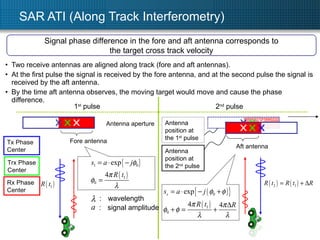
SAR ATI (Along Track Interferometry)  Two receive antennas are aligned along track (fore and aft antennas).  At the first pulse the signal is received by the fore antenna, and at the second pulse the signal is received by the aft antenna. By the time aft antenna observes, the moving target would move and cause the phase difference. 2 nd  pulse 1 st  pulse Antenna aperture Antenna position at the 1 st  pulse Antenna position at the 2 nd  pulse Trx Phase Center Tx Phase Center Rx Phase Center Fore antenna Aft antenna Signal phase difference in the fore and aft antenna corresponds to the target cross track velocity :  wavelength :  signal amplitude
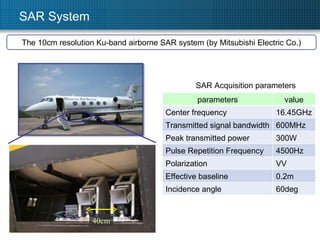
SAR System SAR Acquisition parameters The 10cm resolution Ku-band airborne SAR system (by Mitsubishi Electric Co.) 40cm 60deg Incidence angle 0.2m Effective baseline 300W Peak transmitted power 4500Hz Pulse Repetition Frequency 600MHz Transmitted signal bandwidth 16.45GHz Center frequency parameters value Polarization VV
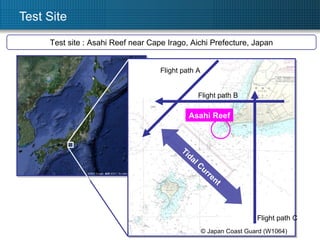
Test Site Tidal Current Test site : Asahi Reef near Cape Irago, Aichi Prefecture, Japan © Japan Coast Guard (W1064) Flight path A Flight path B Flight path C Asahi Reef
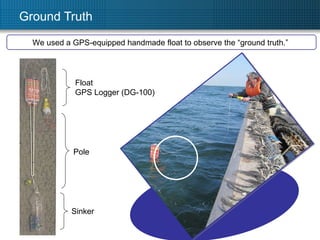
Ground Truth We used a GPS-equipped handmade float to observe the “ground truth.”  Sinker Pole Float GPS Logger (DG-100)
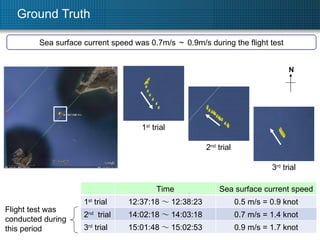
Ground Truth Sea surface current speed was 0.7m/s ~ 0.9m/s during the flight test 1 st  trial 2 nd  trial 3 rd  trial Flight test was conducted during this period N 15:01:48 ~ 15:02:53 14:02:18 ~ 14:03:18 12:37:18 ~ 12:38:23 Time 0.9 m/s = 1.7 knot 3 rd  trial 0.7 m/s = 1.4 knot 2 nd   trial 0.5 m/s = 0.9 knot 1 st  trial Sea surface current speed
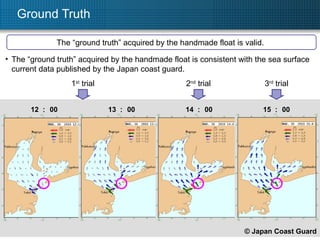
Ground Truth The “ground truth” acquired by the handmade float is valid.  12 : 00 13 : 00 14 : 00 15 : 00 © Japan Coast Guard The “ground truth” acquired by the handmade float is consistent with the sea surface current data published by the Japan coast guard.  1 st  trial 2 nd  trial 3 rd  trial
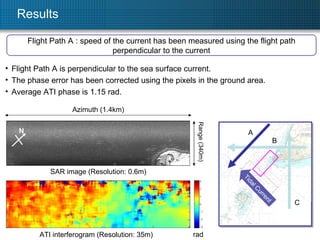
Results Flight Path A : speed of the current has been measured using the flight path perpendicular to the current SAR image (Resolution: 0.6m) rad Azimuth (1.4km) Range (340m) ATI interferogram (Resolution: 35m) Tidal Current Flight Path A is perpendicular to the sea surface current. The phase error has been corrected using the pixels in the ground area.  Average ATI phase is 1.15 rad. N A B C Tidal Current
Results Flight Path A : average cross range velocity was estimated to be 0.95m/s Radial velocity map (Resolution: 35m) SAR image (Resolution: 0.6m) m/s Azimuth (1.4km) Range (340m) v GND  = 0.95[m/s] N A B C Tidal Current ATI phase off-nadir angle wavelength Effective baseline platform velocity 0.018 m 60° 0.2 m 100 m/s parameters value 1.15 rad
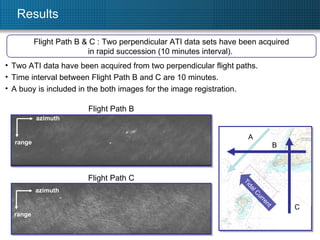
Results Flight Path B & C : Two perpendicular ATI data sets have been acquired in rapid succession (10 minutes interval).  Flight Path B Flight Path C Two ATI data have been acquired from two perpendicular flight paths. Time interval between Flight Path B and C are 10 minutes. A buoy is included in the both images for the image registration. azimuth range azimuth range A B C Tidal Current
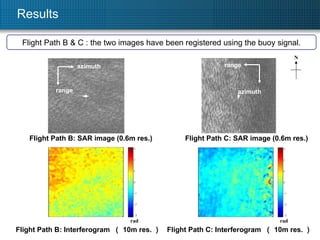
Results Flight Path B & C : the two images have been registered using the buoy signal.   Flight Path C: SAR image (0.6m res.) rad rad Flight Path C: Interferogram  ( 10m res. ) azimuth range   Flight Path B: SAR image (0.6m res.) Flight Path B: Interferogram  ( 10m res. ) N azimuth range
Results V_N = 0 . 51 [m/s] V_E = -0 . 64m/s] Mean velocity Estimated sea surface current speed : 0.82m/s Matches well with the ground truth (0.7m/s ~ 0.9m/s ). Spatial resolution : 10m x 10m Flight Path B & C : Two-dimensional sea surface current map can be obtained by combing two perpendicular ATI data sets in rapid succession.  N
Conclusion We have successfully demonstrated that the along track interferometry SAR is a valuable tool for the sea surface current mapping.  The correspondence with the GPS record of sea surface current proves the validity of ATI SAR technique for the sea surface current mapping.

TU3.T10.3.ppt

  • 1.
    Sea Surface CurrentMeasurement With Ku-Band SAR Along-Track Interferometry Nobuo Kumagae, Kazuo Kawamura, Kenji Tatsumi, Masatada Furuhata, Masayoshi Tsuchida, Masao Tsuji, Tomoya Yamaoka, Kei Suwa Japan Resources Observation System and Utilization Organization Mitsubishi Electric Corporation
  • 2.
    Outline Introduction SAR-ATIThe SAR System Test Site & The Ground Truth Results and Discussion Conclusion
  • 3.
    Introduction Applications ofsea surface current map Ecological studies Coastal surveillance Validation of coastal tide and current models SAR-ATI (Along Track Interferometry) for sea surface current map SAR-ATI measures the line-of-sight component of the surface velocity. Two-dimensional sea surface current map can be obtained by combing two perpendicular ATI data sets in rapid succession.
  • 4.
    SAR ATI (AlongTrack Interferometry) Two receive antennas are aligned along track (fore and aft antennas). At the first pulse the signal is received by the fore antenna, and at the second pulse the signal is received by the aft antenna. By the time aft antenna observes, the moving target would move and cause the phase difference. 2 nd pulse 1 st pulse Antenna aperture Antenna position at the 1 st pulse Antenna position at the 2 nd pulse Trx Phase Center Tx Phase Center Rx Phase Center Fore antenna Aft antenna Signal phase difference in the fore and aft antenna corresponds to the target cross track velocity : wavelength : signal amplitude
  • 5.
    SAR System SARAcquisition parameters The 10cm resolution Ku-band airborne SAR system (by Mitsubishi Electric Co.) 40cm 60deg Incidence angle 0.2m Effective baseline 300W Peak transmitted power 4500Hz Pulse Repetition Frequency 600MHz Transmitted signal bandwidth 16.45GHz Center frequency parameters value Polarization VV
  • 6.
    Test Site TidalCurrent Test site : Asahi Reef near Cape Irago, Aichi Prefecture, Japan © Japan Coast Guard (W1064) Flight path A Flight path B Flight path C Asahi Reef
  • 7.
    Ground Truth Weused a GPS-equipped handmade float to observe the “ground truth.” Sinker Pole Float GPS Logger (DG-100)
  • 8.
    Ground Truth Seasurface current speed was 0.7m/s ~ 0.9m/s during the flight test 1 st trial 2 nd trial 3 rd trial Flight test was conducted during this period N 15:01:48 ~ 15:02:53 14:02:18 ~ 14:03:18 12:37:18 ~ 12:38:23 Time 0.9 m/s = 1.7 knot 3 rd trial 0.7 m/s = 1.4 knot 2 nd trial 0.5 m/s = 0.9 knot 1 st trial Sea surface current speed
  • 9.
    Ground Truth The“ground truth” acquired by the handmade float is valid. 12 : 00 13 : 00 14 : 00 15 : 00 © Japan Coast Guard The “ground truth” acquired by the handmade float is consistent with the sea surface current data published by the Japan coast guard. 1 st trial 2 nd trial 3 rd trial
  • 10.
    Results Flight PathA : speed of the current has been measured using the flight path perpendicular to the current SAR image (Resolution: 0.6m) rad Azimuth (1.4km) Range (340m) ATI interferogram (Resolution: 35m) Tidal Current Flight Path A is perpendicular to the sea surface current. The phase error has been corrected using the pixels in the ground area. Average ATI phase is 1.15 rad. N A B C Tidal Current
  • 11.
    Results Flight PathA : average cross range velocity was estimated to be 0.95m/s Radial velocity map (Resolution: 35m) SAR image (Resolution: 0.6m) m/s Azimuth (1.4km) Range (340m) v GND = 0.95[m/s] N A B C Tidal Current ATI phase off-nadir angle wavelength Effective baseline platform velocity 0.018 m 60° 0.2 m 100 m/s parameters value 1.15 rad
  • 12.
    Results Flight PathB & C : Two perpendicular ATI data sets have been acquired in rapid succession (10 minutes interval). Flight Path B Flight Path C Two ATI data have been acquired from two perpendicular flight paths. Time interval between Flight Path B and C are 10 minutes. A buoy is included in the both images for the image registration. azimuth range azimuth range A B C Tidal Current
  • 13.
    Results Flight PathB & C : the two images have been registered using the buoy signal.   Flight Path C: SAR image (0.6m res.) rad rad Flight Path C: Interferogram ( 10m res. ) azimuth range   Flight Path B: SAR image (0.6m res.) Flight Path B: Interferogram ( 10m res. ) N azimuth range
  • 14.
    Results V_N =0 . 51 [m/s] V_E = -0 . 64m/s] Mean velocity Estimated sea surface current speed : 0.82m/s Matches well with the ground truth (0.7m/s ~ 0.9m/s ). Spatial resolution : 10m x 10m Flight Path B & C : Two-dimensional sea surface current map can be obtained by combing two perpendicular ATI data sets in rapid succession. N
  • 15.
    Conclusion We havesuccessfully demonstrated that the along track interferometry SAR is a valuable tool for the sea surface current mapping. The correspondence with the GPS record of sea surface current proves the validity of ATI SAR technique for the sea surface current mapping.