GASTRIC
MOTILITY &
EMPTYING
By Dr S B Phiri
Dr Phiri S B
Objectives
At the end, learner must be able to………
 Gastric motility and emptying
 Regulation of Gastric motility and emptying
Dr Phiri S B
Motor functions of the stomach
The motor functions of the stomach are
threefold;
1. Storage of large quantities of food until the
food can be processed in the duodenum and
lower intestinal tract.
2. Mixing of this food with gastric secretions until
it forms a semifluid mixture called chyme, and
3. slow emptying of the chyme from the
stomach into the small intestine at a rate
suitable for proper digestion and
absorption by the small intestine.
Dr Phiri S B
Introduction
 Food from the esophagus is stored in the stomach;
thus its’ a reservoir.
 Then mixed with acid, mucus, and pepsin; and
released at a controlled, steady rate into the
duodenum.
 Both peristaltic and segmental contractions occur in
the stomach.
 Regulation is achieved through intergration of neural
reflexes and hormonal influences mediated via entericDr Phiri S B
Gastric motility and emptying
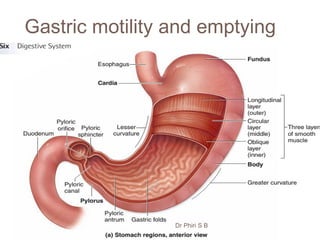
 The stomach has three anatomic divisions—the
fundus, body, and antrum.
 The orad region of the stomach includes LES, the
fundus and the proximal body; contains oxyntic
glands and is responsible for receiving the ingested
meal.
 The caudad region of the stomach includes the
antrum, distal body and pyloric sphincter;
responsible for the contractions that mix food and
propel it into the duodenum.
Dr Phiri S B
1. Receptive relaxation
• A vagovagal reflex that is initiated by distention of
the stomach and is abolished by vagotomy.
 The orad region of the stomach relaxes to
accommodate the ingested meal.
 Mediated by vagal afferents stimulation and
movement of the pharynx and esophagus.
 CCK participates in "receptive relaxation" by
increasing the distensibility of the orad stomach...ie
inhibits gastric motility.
Dr Phiri S B
2. Mixing movements
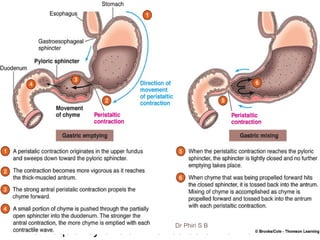
• The caudad region of the stomach contracts to mix
the food with gastric secretions and begins the
process of digestion and the size of food particles
is reduced.
 Slow waves , initiated by Interstitial cells of Cajal in
the caudad stomach occur at a frequency of 3-4
waves/min. They depolarize the smooth muscle
cells.
 If threshold is reached during the slow waves,
action potentials are fired, followed by contraction.
 The frequency of slow waves sets the maximal
 A wave of contraction closes the distal antrum.
Thus, as the caudad stomach contracts, food is
propelled back into the stomach to be mixed
(retropulsion).
 Gastric contractions are increased by vagal
stimulation and decreased by sympathetic
stimulation.
 Even during fasting, contractions (the "migrating
myoelectriccomplex") occur at 90-minute intervals
and clear the stomach of residual food. Motilin is
the mediator of these contractionsDr Phiri S B
3. Gastric emptying and regulation
 The caudad region of the stomach contracts to propel food into the
duodenum.
 The rate of gastric emptying depends on
1. Isotonicity or osmolality of the stomach contents.
 If the stomach contents are hypertonic or hypotonic, gastric
emptying is slowed via a negative feedback ie enterogastric
feedback mechanism.
2. Type of food ingested.
• Food rich in carbohydrate leaves the stomach in a few hours.
Protein-rich food leaves more slowly, and emptying is slowest after
a meal containing fat
 Fat inhibits gastric emptying (i.e., increases gastric emptying time)
by stimulating the release of CCK. (Enterogastrone feedback)
3. H+ in the duodenum; inhibits gastric emptying via direct neural
reflexes. H+ receptors in the duodenum relay information to the
gastric smooth muscle via interneurons in the GI plexuses.Dr Phiri S B
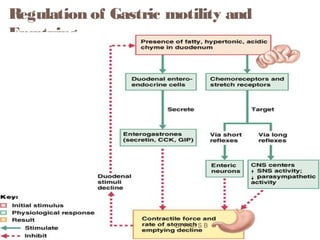
Regulation of Gastric motility and
Emptying
  2 mechanisms inhibit gastric motility, secretion
and duodenal filling:
1. Neural enterogastric reflex
2. Hormonal (enterogastrone) mechanisms.
Dr Phiri S B
The end
DR S B PHIRI

5. git lecture 5

  • 1.
    GASTRIC MOTILITY & EMPTYING By DrS B Phiri Dr Phiri S B
  • 2.
    Objectives At the end,learner must be able to………  Gastric motility and emptying  Regulation of Gastric motility and emptying Dr Phiri S B
  • 3.
    Motor functions ofthe stomach The motor functions of the stomach are threefold; 1. Storage of large quantities of food until the food can be processed in the duodenum and lower intestinal tract. 2. Mixing of this food with gastric secretions until it forms a semifluid mixture called chyme, and 3. slow emptying of the chyme from the stomach into the small intestine at a rate suitable for proper digestion and absorption by the small intestine. Dr Phiri S B
  • 4.
    Introduction  Food fromthe esophagus is stored in the stomach; thus its’ a reservoir.  Then mixed with acid, mucus, and pepsin; and released at a controlled, steady rate into the duodenum.  Both peristaltic and segmental contractions occur in the stomach.  Regulation is achieved through intergration of neural reflexes and hormonal influences mediated via entericDr Phiri S B
  • 5.
    Gastric motility andemptying  The stomach has three anatomic divisions—the fundus, body, and antrum.  The orad region of the stomach includes LES, the fundus and the proximal body; contains oxyntic glands and is responsible for receiving the ingested meal.  The caudad region of the stomach includes the antrum, distal body and pyloric sphincter; responsible for the contractions that mix food and propel it into the duodenum. Dr Phiri S B
  • 6.
    1. Receptive relaxation •A vagovagal reflex that is initiated by distention of the stomach and is abolished by vagotomy.  The orad region of the stomach relaxes to accommodate the ingested meal.  Mediated by vagal afferents stimulation and movement of the pharynx and esophagus.  CCK participates in "receptive relaxation" by increasing the distensibility of the orad stomach...ie inhibits gastric motility. Dr Phiri S B
  • 7.
    2. Mixing movements •The caudad region of the stomach contracts to mix the food with gastric secretions and begins the process of digestion and the size of food particles is reduced.  Slow waves , initiated by Interstitial cells of Cajal in the caudad stomach occur at a frequency of 3-4 waves/min. They depolarize the smooth muscle cells.  If threshold is reached during the slow waves, action potentials are fired, followed by contraction.  The frequency of slow waves sets the maximal  A wave of contraction closes the distal antrum. Thus, as the caudad stomach contracts, food is propelled back into the stomach to be mixed (retropulsion).  Gastric contractions are increased by vagal stimulation and decreased by sympathetic stimulation.  Even during fasting, contractions (the "migrating myoelectriccomplex") occur at 90-minute intervals and clear the stomach of residual food. Motilin is the mediator of these contractionsDr Phiri S B
  • 8.
    3. Gastric emptyingand regulation  The caudad region of the stomach contracts to propel food into the duodenum.  The rate of gastric emptying depends on 1. Isotonicity or osmolality of the stomach contents.  If the stomach contents are hypertonic or hypotonic, gastric emptying is slowed via a negative feedback ie enterogastric feedback mechanism. 2. Type of food ingested. • Food rich in carbohydrate leaves the stomach in a few hours. Protein-rich food leaves more slowly, and emptying is slowest after a meal containing fat  Fat inhibits gastric emptying (i.e., increases gastric emptying time) by stimulating the release of CCK. (Enterogastrone feedback) 3. H+ in the duodenum; inhibits gastric emptying via direct neural reflexes. H+ receptors in the duodenum relay information to the gastric smooth muscle via interneurons in the GI plexuses.Dr Phiri S B
  • 9.
    Regulation of Gastricmotility and Emptying   2 mechanisms inhibit gastric motility, secretion and duodenal filling: 1. Neural enterogastric reflex 2. Hormonal (enterogastrone) mechanisms. Dr Phiri S B
  • 10.
    The end DR SB PHIRI