Presented by-
Kiran Kendre
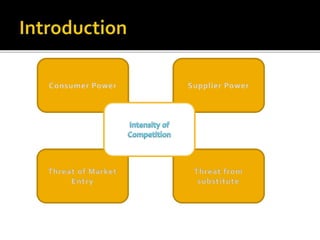
Supplier Power:
 This is driven by the number of suppliers of each key input, the
uniqueness of their product or service, their strength and control
over you, the cost of switching from one to another, and so on.
 The fewer the supplier choices you have, and the more you need
suppliers' help, the more powerful your suppliers are.
Buyer Power: Again, this is driven by the number of buyers, the
importance of each individual buyer to your business, the cost to
them of switching from your products and services to those of
someone else, and so on.
 If you deal with few, powerful buyers, then they are often able to
dictate terms to you.
Competitive Rivalry:
 What is important here is the number and capability of your
competitors.
 If you have many competitors, and they offer equally attractive
products and services, then you'll most likely have little power in
the situation, because suppliers and buyers will go elsewhere if
they don't get a good deal from you.
 On the other hand, if no-one else can do what you do, then you
can often have tremendous strength.
Threat of Substitution:
 This is affected by the ability of your customers to find a different
way of doing what you do – for example, if you supply a unique
software product that automates an important process, people
may substitute by doing the process manually or by outsourcing it.
 If substitution is easy and substitution is viable, then this weakens
your power.
Threat of New Entry:
 Power is also affected by the ability of people to enter your
market.
 If it costs little in time or money to enter your market and compete
effectively, if there are few economies of scale in place, or if you
have little protection for your key technologies, then new
competitors can quickly enter your market and weaken your
position.
 It is aWide range of companies and organizations involved in the
design, development, manufacturing, marketing, and selling of
motor vehicles.
 It is one of the world's most important economic sectors by
revenue.
 More than 30 Manufacturing companies in world, whereToyota is
dominator.
 Automobiles Market Share
1)Passenger Cars 15.86 %
2)Commercial Vehicles 4.32 %
3)Two Wheelers 3.58 %
4)Two Wheelers 76.23 %
 Too many Brands available to select.
 Various Segments available.
 Each and every segment is available in all price ranges.
 Increased awareness about products and safety .
 Product differentiation viaWebsites.
 Example: More in market of US as compare to Singapore.
 Brand Name
 Product Quality
 Product Performance
 Operational Efficiency
 Additional Features in product
 Unique Service / Product
 Example: Automaker group(BMW,Honda,Toyota,Ford)
 Since it’s a very costly to set up an automobile industry, new
entrant is rare.
 Only possible new entrant can be established brand from other
location.
 Legislation and government policy.
 Capital Requirements.
 Knowledge andTechnology.
 Access to Distribution Channels.
 More than 30 Big brands available.
 Around 700 Different models available globally.
 Change in Consumer Preference(Other forms of transportation
available).
 Competitive Pricing.
 Low switching cost.
 There is competition Segment wise
 cost of competition is high.
 Number and Diversity of Competitor
 Price Competition
 Product Quality
 porter’s 5 force model

porter’s 5 force model

  • 1.
  • 3.
    Supplier Power:  Thisis driven by the number of suppliers of each key input, the uniqueness of their product or service, their strength and control over you, the cost of switching from one to another, and so on.  The fewer the supplier choices you have, and the more you need suppliers' help, the more powerful your suppliers are. Buyer Power: Again, this is driven by the number of buyers, the importance of each individual buyer to your business, the cost to them of switching from your products and services to those of someone else, and so on.  If you deal with few, powerful buyers, then they are often able to dictate terms to you.
  • 4.
    Competitive Rivalry:  Whatis important here is the number and capability of your competitors.  If you have many competitors, and they offer equally attractive products and services, then you'll most likely have little power in the situation, because suppliers and buyers will go elsewhere if they don't get a good deal from you.  On the other hand, if no-one else can do what you do, then you can often have tremendous strength. Threat of Substitution:  This is affected by the ability of your customers to find a different way of doing what you do – for example, if you supply a unique software product that automates an important process, people may substitute by doing the process manually or by outsourcing it.  If substitution is easy and substitution is viable, then this weakens your power.
  • 5.
    Threat of NewEntry:  Power is also affected by the ability of people to enter your market.  If it costs little in time or money to enter your market and compete effectively, if there are few economies of scale in place, or if you have little protection for your key technologies, then new competitors can quickly enter your market and weaken your position.
  • 6.
     It isaWide range of companies and organizations involved in the design, development, manufacturing, marketing, and selling of motor vehicles.  It is one of the world's most important economic sectors by revenue.  More than 30 Manufacturing companies in world, whereToyota is dominator.  Automobiles Market Share 1)Passenger Cars 15.86 % 2)Commercial Vehicles 4.32 % 3)Two Wheelers 3.58 % 4)Two Wheelers 76.23 %
  • 7.
     Too manyBrands available to select.  Various Segments available.  Each and every segment is available in all price ranges.  Increased awareness about products and safety .  Product differentiation viaWebsites.  Example: More in market of US as compare to Singapore.
  • 8.
     Brand Name Product Quality  Product Performance  Operational Efficiency  Additional Features in product  Unique Service / Product  Example: Automaker group(BMW,Honda,Toyota,Ford)
  • 9.
     Since it’sa very costly to set up an automobile industry, new entrant is rare.  Only possible new entrant can be established brand from other location.  Legislation and government policy.  Capital Requirements.  Knowledge andTechnology.  Access to Distribution Channels.
  • 10.
     More than30 Big brands available.  Around 700 Different models available globally.  Change in Consumer Preference(Other forms of transportation available).  Competitive Pricing.  Low switching cost.
  • 11.
     There iscompetition Segment wise  cost of competition is high.  Number and Diversity of Competitor  Price Competition  Product Quality