GROWTH AND DEVELOPMENT
FINAL YEAR BDS
DEFINITIONS
 GROWTH- increase in size OR number. It is an anatomic
phenomenon.
 DEVELOPMENT- increase in complexity. It is physiologic and
behavioral phenomenon
 MATURATION- the emergence of personal characteristic and
behavioral phenomena through the growth process
Kinds of Growth
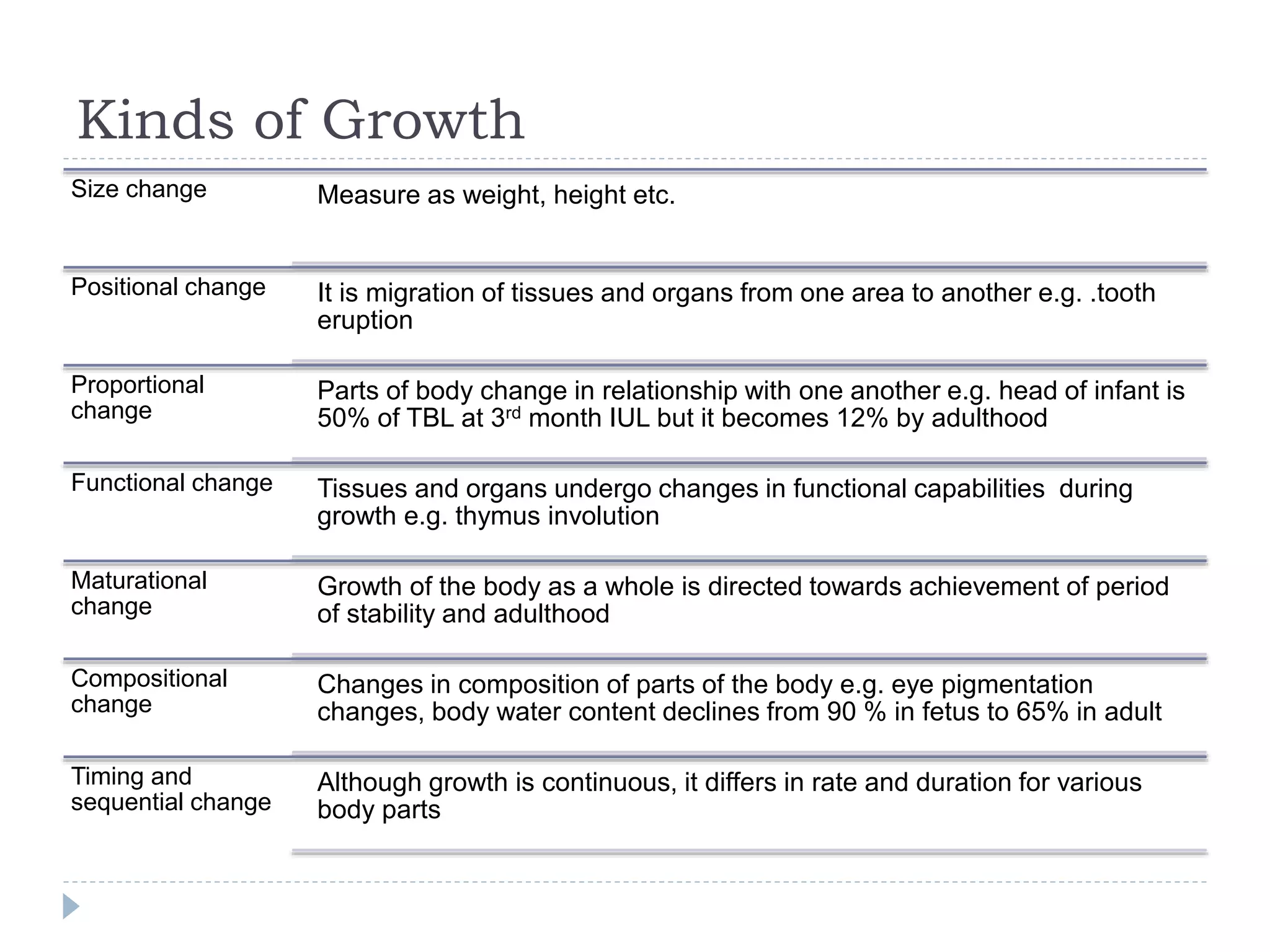
Size change Measure as weight, height etc.
Positional change It is migration of tissues and organs from one area to another e.g. .tooth
eruption
Proportional
change
Parts of body change in relationship with one another e.g. head of infant is
50% of TBL at 3rd month IUL but it becomes 12% by adulthood
Functional change Tissues and organs undergo changes in functional capabilities during
growth e.g. thymus involution
Maturational
change
Growth of the body as a whole is directed towards achievement of period
of stability and adulthood
Compositional
change
Changes in composition of parts of the body e.g. eye pigmentation
changes, body water content declines from 90 % in fetus to 65% in adult
Timing and
sequential change
Although growth is continuous, it differs in rate and duration for various
body parts
Growth: Pattern, Variability and Timing
 Concept #1.Patterns
 Is proportional
 “Cephalocaudal Gradient of Growth”- Axis of increased
growth extending from head towards feet
 Varying rates
 Predictable
Growth: Pattern, Variability and Timing
 Concept #2. Variability- Affected by genetic, neural,
hormonal, nutrition, secular, season, circadian,
disease and cultural factors
Average Early Maturing
Genetically Tall Late Maturing
Genetically Short
Children who start
puberty either early or
late and subsequently
have either much less
or much more growth
in height than
expected
Growth: Pattern, Variability and Timing
Neural Control- Growth
center in hypothalamus
keeps children on their
growth center curves.
Peripheral nerve fibers exert
a nutritive effect on
structures they innervate
Hormonal Control- Growth,
Insulin, thyrotrophic,
androgens,parathyroid
hormones
Nutrition- 9 amino acids,
calcium, phosphorous,
manganese, magnesium,
fluorides. Vitamins A, B2, C
and D
Season and Circadian-
Growth in height is faster in
spring. Growth in weight is
faster in autumn. Growth in
height and tooth eruption is
greater at night time
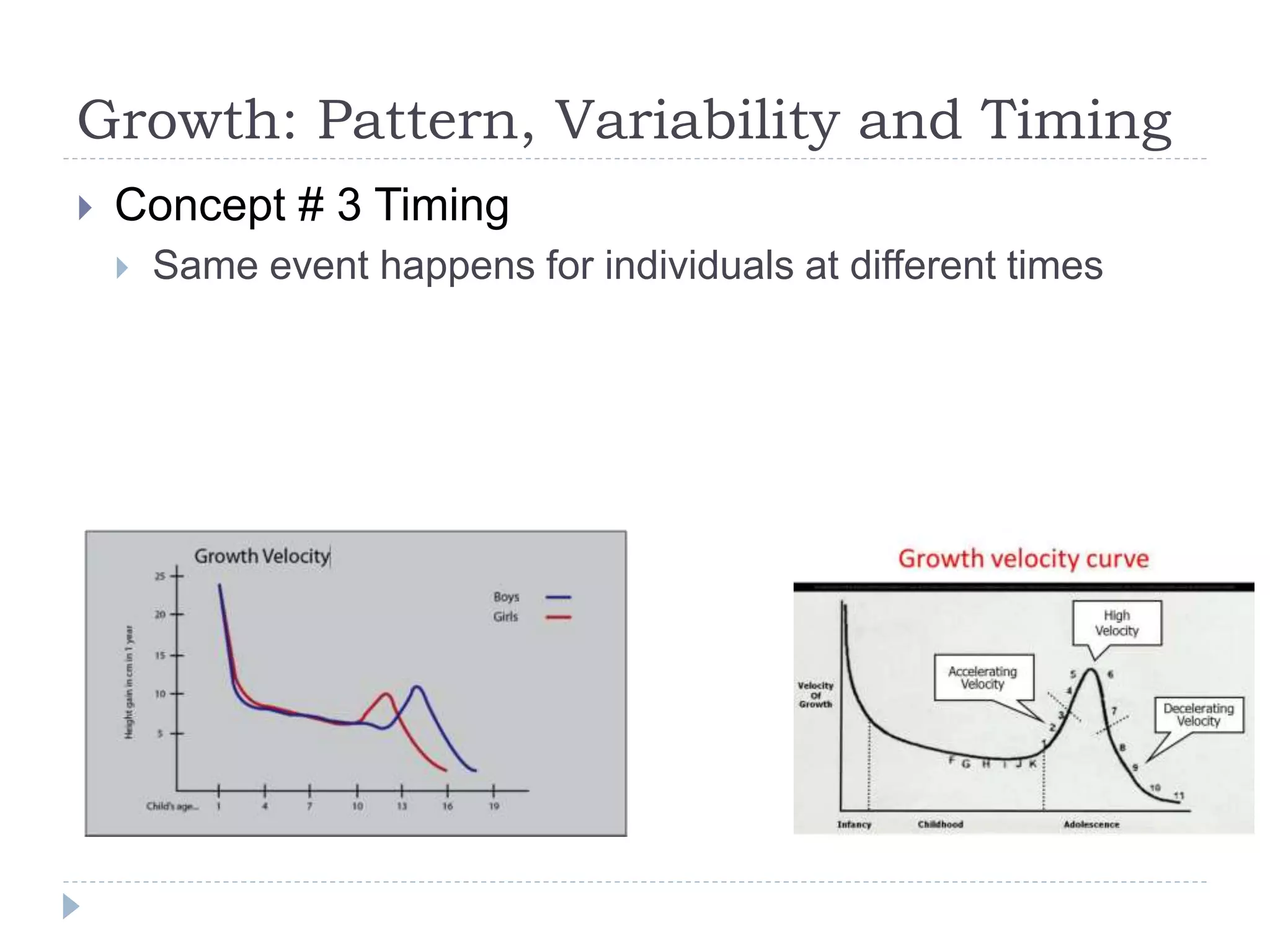
 Concept # 3 Timing
 Same event happens for individuals at different times
Growth: Pattern, Variability and Timing
 Concept # 3 Timing
Morphologic – from
late infancy to early
adulthood
Dental- birth to early
adolescence
Sexual- for
adolescent growth
spurt
Skeletal- for
evaluation of biologic
maturity status of
individual child
Chronologic
Methods of Studying Growth
Measurement Approaches
 Acquiring Measurement Data
 Craniometry- Based on measurement of skulls found among human
remains. Advantage is ,”precise”. Disadvantage, data is “cross-
sectional”
 Anthropometry- Measured on living individuals by soft tissue points
overlying bony landmarks. Data is longitudinal
Methods of Studying Growth
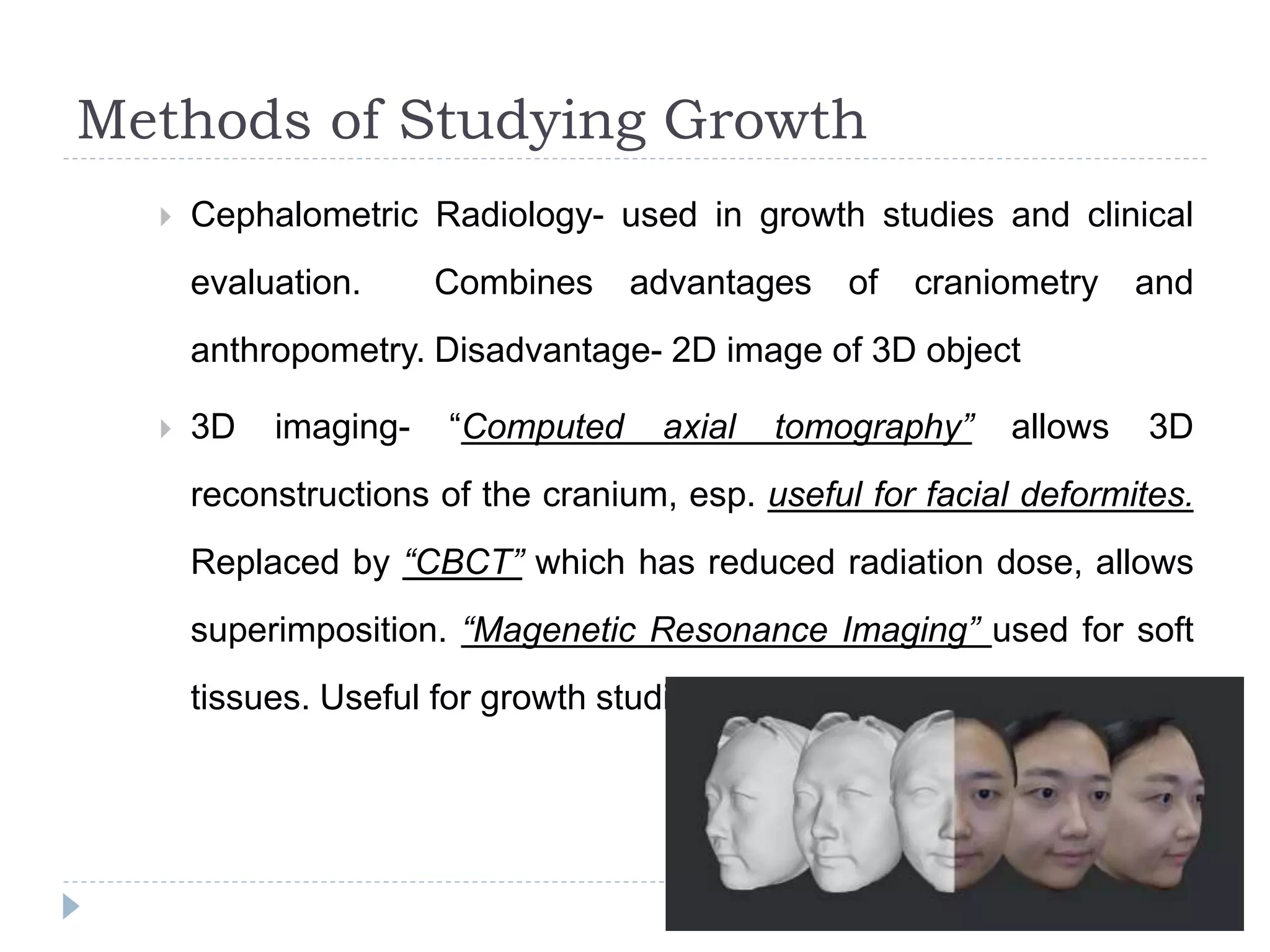
 Cephalometric Radiology- used in growth studies and clinical
evaluation. Combines advantages of craniometry and
anthropometry. Disadvantage- 2D image of 3D object
 3D imaging- “Computed axial tomography” allows 3D
reconstructions of the cranium, esp. useful for facial deformites.
Replaced by “CBCT” which has reduced radiation dose, allows
superimposition. “Magenetic Resonance Imaging” used for soft
tissues. Useful for growth studies and has no radiation exposure
Analysis of Measurement Data
 Growth studies are of 3 basic types:
1. Cross Sectional- Large number of individuals of different
ages are examined on one occasion. Easier and quicker.
Disadvantage is variability within sample can conceal
details of growth pattern, particularly when there is no
correction for timing variation
Analysis of Measurement Data
2. Longitudinal- Repeatable over long period during active
growth. Great deal of information obtained and shows
variability due to timing as well. Drawbacks are small
sample size, difficulties in keeping subjects and long term
data collection
3. Mixed Longitudinal Studies- Combination of cross
sectional and longitudinal studies Subjects at different age
levels are seen longitudinally for shorter periods
Graphic Interpretation of Growth Data
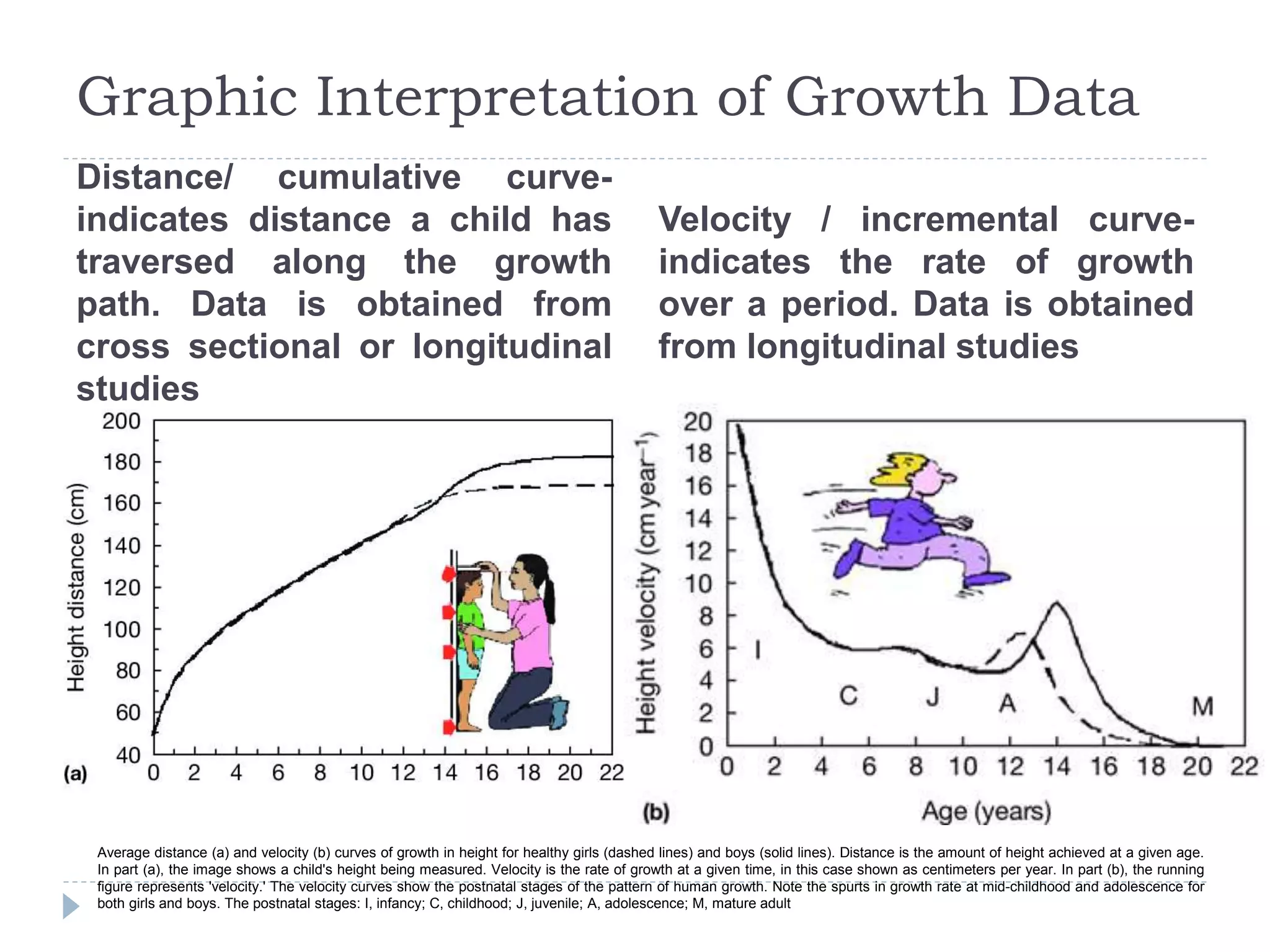
Distance/ cumulative curve-
indicates distance a child has
traversed along the growth
path. Data is obtained from
cross sectional or longitudinal
studies
Velocity / incremental curve-
indicates the rate of growth
over a period. Data is obtained
from longitudinal studies
Average distance (a) and velocity (b) curves of growth in height for healthy girls (dashed lines) and boys (solid lines). Distance is the amount of height achieved at a given age.
In part (a), the image shows a child's height being measured. Velocity is the rate of growth at a given time, in this case shown as centimeters per year. In part (b), the running
figure represents 'velocity.' The velocity curves show the postnatal stages of the pattern of human growth. Note the spurts in growth rate at mid-childhood and adolescence for
both girls and boys. The postnatal stages: I, infancy; C, childhood; J, juvenile; A, adolescence; M, mature adult
Experimental Approaches
 Vital Staining- Dyes that stain mineralizing tissues
are injected into animal. They remain in the bones
and teeth and can be detected later after death
 Dyes used:
 Alizarin- reacts strongly with calcium at sites where bone
calcification is occurring
 Tetracycline- binds to calcium same way as alizarin.
Causes discoloration of teeth
Experimental Approaches (contd.)
 Radioactive tracers-
 Carbon 14 (14C)- proline {major constituent of collagen, site is
extracellular collagen}
 Tritium (3H) –thymidine {incorporated into DNA , replicated when
cell divides}
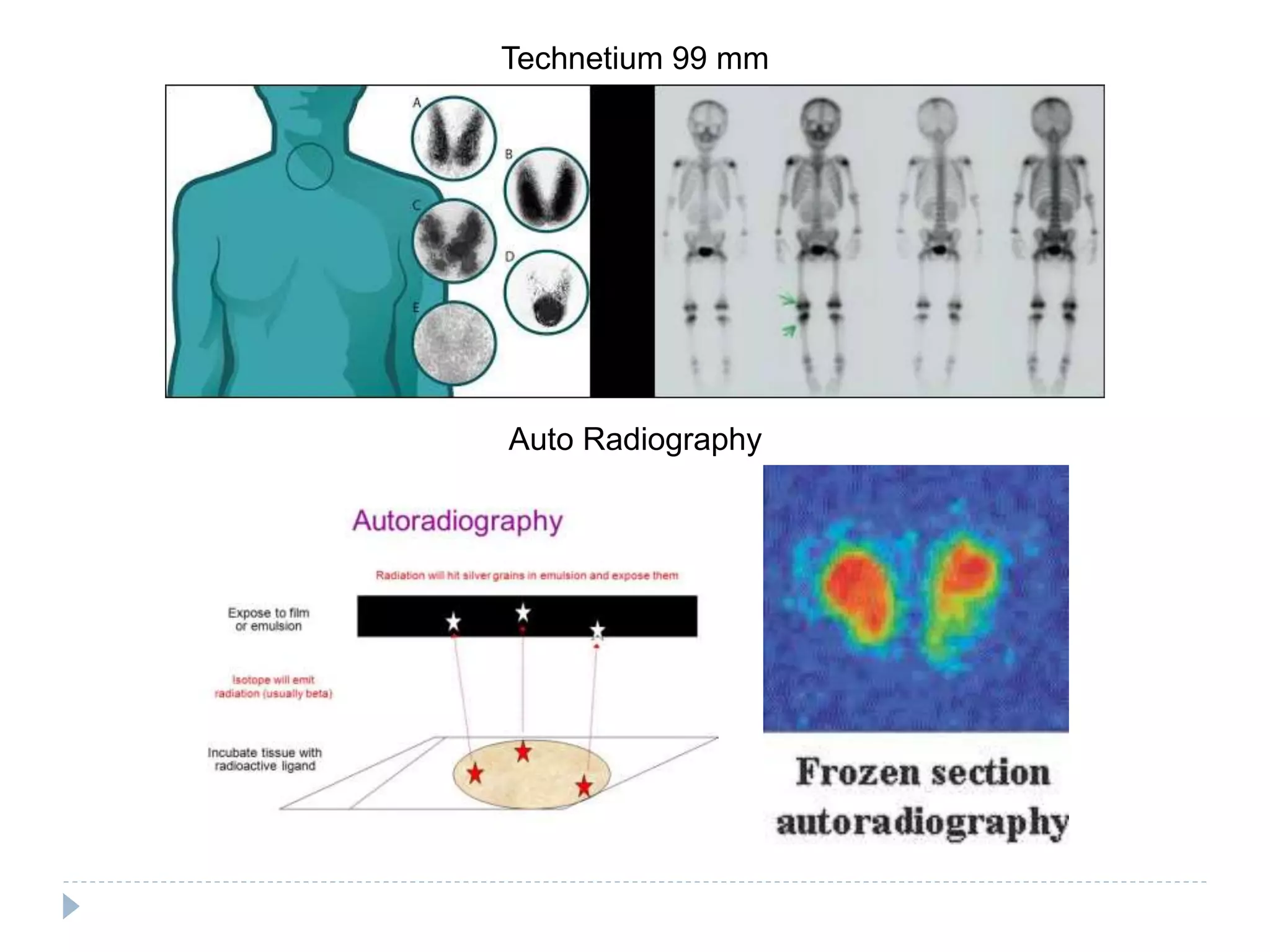
 Technetium 99 m (99m Tc)- detect areas of rapid bone growth,
images used in diagnosis of localised growth problems such as
condylar hyperplasia
 Autoradiography- Film emulsion placed over thin section of tissue
containing the isotope and then exposed in the dark by radiation.
Location of radiation indicates growth site
Technetium 99 mm
Auto Radiography
Experimental Approaches (contd.)
 Implant Radiography- Inert metal pins are
placed . Developed by Dr. Arne Bjork
 7 areas on cephalogram which predict
future mandibular growth direction:
 Inclination of condyle
 Curvature of mandibular canal
 Shape of lower border of the mandible
 Symphysis inclination (anterior aspect
below point B)
 Interpremolar / intermolar angle
 Interincisal angle
 Lower anterior face height
Structure Forward Rotator Backward Rotator
Inclination of condyle
Curves forward
Straight OR slopes up and
back
Curvature of
mandibular canal Curved forward Straight
Shape of lower border
of the mandible Curved downward Notched, antegonial notch
Symphysis inclination
(anterior aspect below
point B)
Slopes backward Slopes forward
Interpremolar /
intermolar angle Vertical OR obtuse Acute
Interincisal angle Vertical OR obtuse Acute
Lower anterior face height
Short Long
Genetic Influences on Growth
 Msx and Dix genes are important to establish body
plan, pattern formation, and morphogenesis
 Msx-1- predominates in tooth formation, expressed
in basal bone
 Msx- 2- expressed in alveolar bone
 Dix-1 and 2 are expressed in dental mesenchyme
and in the epithelium of maxillary and mandibular
arch mesenchyme.
What you do makes a difference, and you have to decide what kind of
difference you want to make."
Jane Goodall

1. growth and development

  • 1.
  • 2.
    DEFINITIONS  GROWTH- increasein size OR number. It is an anatomic phenomenon.  DEVELOPMENT- increase in complexity. It is physiologic and behavioral phenomenon  MATURATION- the emergence of personal characteristic and behavioral phenomena through the growth process
  • 3.
    Kinds of Growth Sizechange Measure as weight, height etc. Positional change It is migration of tissues and organs from one area to another e.g. .tooth eruption Proportional change Parts of body change in relationship with one another e.g. head of infant is 50% of TBL at 3rd month IUL but it becomes 12% by adulthood Functional change Tissues and organs undergo changes in functional capabilities during growth e.g. thymus involution Maturational change Growth of the body as a whole is directed towards achievement of period of stability and adulthood Compositional change Changes in composition of parts of the body e.g. eye pigmentation changes, body water content declines from 90 % in fetus to 65% in adult Timing and sequential change Although growth is continuous, it differs in rate and duration for various body parts
  • 4.
    Growth: Pattern, Variabilityand Timing  Concept #1.Patterns  Is proportional  “Cephalocaudal Gradient of Growth”- Axis of increased growth extending from head towards feet  Varying rates  Predictable
  • 5.
    Growth: Pattern, Variabilityand Timing  Concept #2. Variability- Affected by genetic, neural, hormonal, nutrition, secular, season, circadian, disease and cultural factors Average Early Maturing Genetically Tall Late Maturing Genetically Short Children who start puberty either early or late and subsequently have either much less or much more growth in height than expected
  • 6.
    Growth: Pattern, Variabilityand Timing Neural Control- Growth center in hypothalamus keeps children on their growth center curves. Peripheral nerve fibers exert a nutritive effect on structures they innervate Hormonal Control- Growth, Insulin, thyrotrophic, androgens,parathyroid hormones Nutrition- 9 amino acids, calcium, phosphorous, manganese, magnesium, fluorides. Vitamins A, B2, C and D Season and Circadian- Growth in height is faster in spring. Growth in weight is faster in autumn. Growth in height and tooth eruption is greater at night time
  • 7.
     Concept #3 Timing  Same event happens for individuals at different times Growth: Pattern, Variability and Timing
  • 8.
    Growth: Pattern, Variabilityand Timing  Concept # 3 Timing Morphologic – from late infancy to early adulthood Dental- birth to early adolescence Sexual- for adolescent growth spurt Skeletal- for evaluation of biologic maturity status of individual child Chronologic
  • 9.
  • 10.
    Measurement Approaches  AcquiringMeasurement Data  Craniometry- Based on measurement of skulls found among human remains. Advantage is ,”precise”. Disadvantage, data is “cross- sectional”  Anthropometry- Measured on living individuals by soft tissue points overlying bony landmarks. Data is longitudinal
  • 11.
    Methods of StudyingGrowth  Cephalometric Radiology- used in growth studies and clinical evaluation. Combines advantages of craniometry and anthropometry. Disadvantage- 2D image of 3D object  3D imaging- “Computed axial tomography” allows 3D reconstructions of the cranium, esp. useful for facial deformites. Replaced by “CBCT” which has reduced radiation dose, allows superimposition. “Magenetic Resonance Imaging” used for soft tissues. Useful for growth studies and has no radiation exposure
  • 12.
    Analysis of MeasurementData  Growth studies are of 3 basic types: 1. Cross Sectional- Large number of individuals of different ages are examined on one occasion. Easier and quicker. Disadvantage is variability within sample can conceal details of growth pattern, particularly when there is no correction for timing variation
  • 13.
    Analysis of MeasurementData 2. Longitudinal- Repeatable over long period during active growth. Great deal of information obtained and shows variability due to timing as well. Drawbacks are small sample size, difficulties in keeping subjects and long term data collection 3. Mixed Longitudinal Studies- Combination of cross sectional and longitudinal studies Subjects at different age levels are seen longitudinally for shorter periods
  • 14.
    Graphic Interpretation ofGrowth Data Distance/ cumulative curve- indicates distance a child has traversed along the growth path. Data is obtained from cross sectional or longitudinal studies Velocity / incremental curve- indicates the rate of growth over a period. Data is obtained from longitudinal studies Average distance (a) and velocity (b) curves of growth in height for healthy girls (dashed lines) and boys (solid lines). Distance is the amount of height achieved at a given age. In part (a), the image shows a child's height being measured. Velocity is the rate of growth at a given time, in this case shown as centimeters per year. In part (b), the running figure represents 'velocity.' The velocity curves show the postnatal stages of the pattern of human growth. Note the spurts in growth rate at mid-childhood and adolescence for both girls and boys. The postnatal stages: I, infancy; C, childhood; J, juvenile; A, adolescence; M, mature adult
  • 15.
    Experimental Approaches  VitalStaining- Dyes that stain mineralizing tissues are injected into animal. They remain in the bones and teeth and can be detected later after death  Dyes used:  Alizarin- reacts strongly with calcium at sites where bone calcification is occurring  Tetracycline- binds to calcium same way as alizarin. Causes discoloration of teeth
  • 16.
    Experimental Approaches (contd.) Radioactive tracers-  Carbon 14 (14C)- proline {major constituent of collagen, site is extracellular collagen}  Tritium (3H) –thymidine {incorporated into DNA , replicated when cell divides}  Technetium 99 m (99m Tc)- detect areas of rapid bone growth, images used in diagnosis of localised growth problems such as condylar hyperplasia  Autoradiography- Film emulsion placed over thin section of tissue containing the isotope and then exposed in the dark by radiation. Location of radiation indicates growth site
  • 17.
  • 18.
    Experimental Approaches (contd.) Implant Radiography- Inert metal pins are placed . Developed by Dr. Arne Bjork  7 areas on cephalogram which predict future mandibular growth direction:  Inclination of condyle  Curvature of mandibular canal  Shape of lower border of the mandible  Symphysis inclination (anterior aspect below point B)  Interpremolar / intermolar angle  Interincisal angle  Lower anterior face height
  • 19.
    Structure Forward RotatorBackward Rotator Inclination of condyle Curves forward Straight OR slopes up and back Curvature of mandibular canal Curved forward Straight Shape of lower border of the mandible Curved downward Notched, antegonial notch Symphysis inclination (anterior aspect below point B) Slopes backward Slopes forward Interpremolar / intermolar angle Vertical OR obtuse Acute Interincisal angle Vertical OR obtuse Acute Lower anterior face height Short Long
  • 20.
    Genetic Influences onGrowth  Msx and Dix genes are important to establish body plan, pattern formation, and morphogenesis  Msx-1- predominates in tooth formation, expressed in basal bone  Msx- 2- expressed in alveolar bone  Dix-1 and 2 are expressed in dental mesenchyme and in the epithelium of maxillary and mandibular arch mesenchyme.
  • 21.
    What you domakes a difference, and you have to decide what kind of difference you want to make." Jane Goodall