FINAL YEAR BDS
DR. TANIA ARSHAD SIDDIQUI
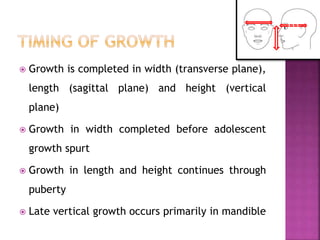
 Growth is completed in width (transverse plane),
length (sagittal plane) and height (vertical
plane)
 Growth in width completed before adolescent
growth spurt
 Growth in length and height continues through
puberty
 Late vertical growth occurs primarily in mandible
111
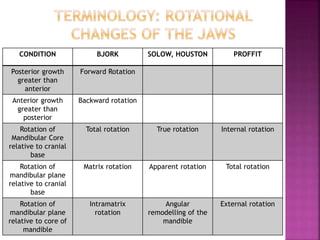
CONDITION BJORK SOLOW, HOUSTON PROFFIT
Posterior growth
greater than
anterior
Forward Rotation
Anterior growth
greater than
posterior
Backward rotation
Rotation of
Mandibular Core
relative to cranial
base
Total rotation True rotation Internal rotation
Rotation of
mandibular plane
relative to cranial
base
Matrix rotation Apparent rotation Total rotation
Rotation of
mandibular plane
relative to core of
mandible
Intramatrix
rotation
Angular
remodelling of the
mandible
External rotation
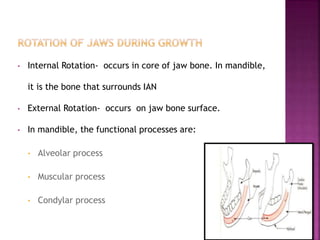
• Internal Rotation- occurs in core of jaw bone. In mandible,
it is the bone that surrounds IAN
• External Rotation- occurs on jaw bone surface.
• In mandible, the functional processes are:
• Alveolar process
• Muscular process
• Condylar process
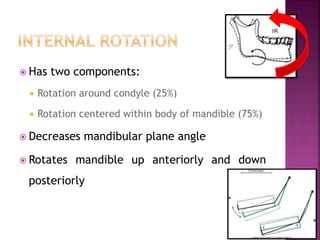
 Has two components:
 Rotation around condyle (25%)
 Rotation centered within body of mandible (75%)
 Decreases mandibular plane angle
 Rotates mandible up anteriorly and down
posteriorly
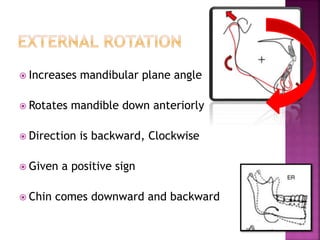
 Increases mandibular plane angle
 Rotates mandible down anteriorly
 Direction is backward, Clockwise
 Given a positive sign
 Chin comes downward and backward
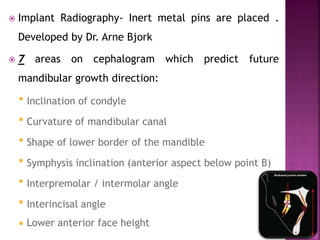
 Implant Radiography- Inert metal pins are placed .
Developed by Dr. Arne Bjork
 7 areas on cephalogram which predict future
mandibular growth direction:
 Inclination of condyle
 Curvature of mandibular canal
 Shape of lower border of the mandible
 Symphysis inclination (anterior aspect below point B)
 Interpremolar / intermolar angle
 Interincisal angle
 Lower anterior face height
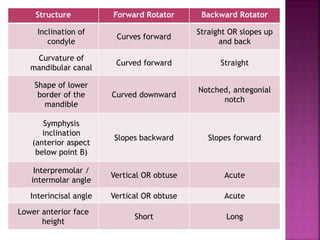
Structure Forward Rotator Backward Rotator
Inclination of
condyle
Curves forward
Straight OR slopes up
and back
Curvature of
mandibular canal
Curved forward Straight
Shape of lower
border of the
mandible
Curved downward
Notched, antegonial
notch
Symphysis
inclination
(anterior aspect
below point B)
Slopes backward Slopes forward
Interpremolar /
intermolar angle
Vertical OR obtuse Acute
Interincisal angle Vertical OR obtuse Acute
Lower anterior face
height
Short Long
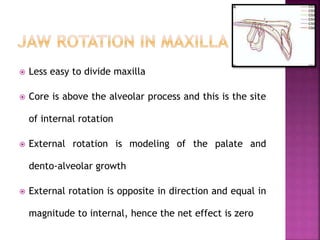
 Less easy to divide maxilla
 Core is above the alveolar process and this is the site
of internal rotation
 External rotation is modeling of the palate and
dento-alveolar growth
 External rotation is opposite in direction and equal in
magnitude to internal, hence the net effect is zero
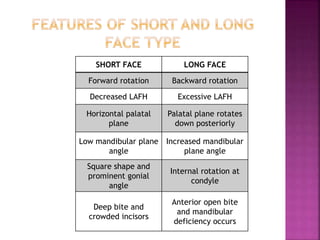
SHORT FACE LONG FACE
Forward rotation Backward rotation
Decreased LAFH Excessive LAFH
Horizontal palatal
plane
Palatal plane rotates
down posteriorly
Low mandibular plane
angle
Increased mandibular
plane angle
Square shape and
prominent gonial
angle
Internal rotation at
condyle
Deep bite and
crowded incisors
Anterior open bite
and mandibular
deficiency occurs
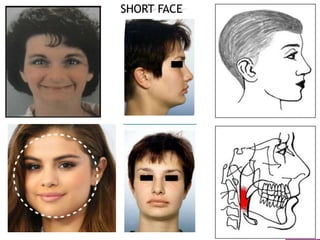
SHORT FACE
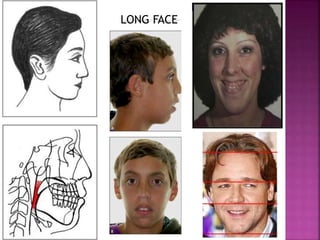
LONG FACE
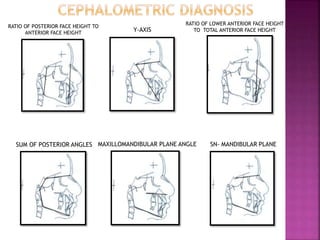
RATIO OF POSTERIOR FACE HEIGHT TO
ANTERIOR FACE HEIGHT
RATIO OF LOWER ANTERIOR FACE HEIGHT
TO TOTAL ANTERIOR FACE HEIGHTY-AXIS
SUM OF POSTERIOR ANGLES SN- MANDIBULAR PLANEMAXILLOMANDIBULAR PLANE ANGLE
QUESTIONS?
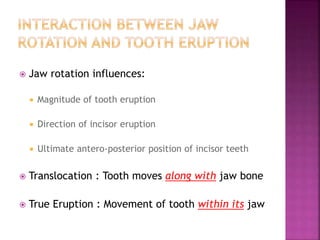
 Jaw rotation influences:
 Magnitude of tooth eruption
 Direction of incisor eruption
 Ultimate antero-posterior position of incisor teeth
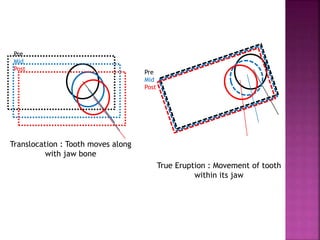
 Translocation : Tooth moves along with jaw bone
 True Eruption : Movement of tooth within its jaw
Translocation : Tooth moves along
with jaw bone
True Eruption : Movement of tooth
within its jaw
Pre
Mid
Post
Pre
Mid
Post
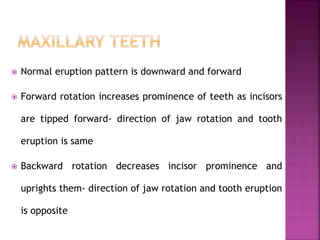
 Normal eruption pattern is downward and forward
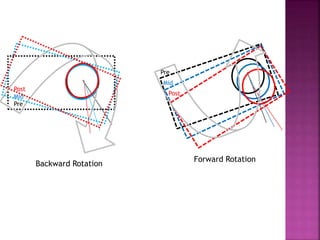
 Forward rotation increases prominence of teeth as incisors
are tipped forward- direction of jaw rotation and tooth
eruption is same
 Backward rotation decreases incisor prominence and
uprights them- direction of jaw rotation and tooth eruption
is opposite
Pre
Mid
Post
Mid
Pre
Post
Forward Rotation
Backward Rotation
 Normal eruption path is upward and forward
 Internal rotation alters eruption path of
incisors, tending to upright them
 Arch length decreases
 Facial growth continues in adult life
 Vertical growth is most prominent
 Jaw rotation continues into adult life
 Males have net forward rotation while females have
backward rotation
 Facial soft tissue changes are greater
 Elongation of nose, flattening of lips and augmentation
of soft tissue occurs
 Lips and other soft tissue sag downward with
aging
 Exposure of upper incisors decreases and
lower incisors increases at rest and on smile
 Lips become progressively thinner with less
vermilion display
• Lips become thinner
• Lips appear less full and elongatedas vertical
height of the vermilion decreases
• Lower part of the face lengthens
• Interlabial line descends
• Number of vertical muscle fibers in the upper lip
decreases
• Philtrum columns become less prominent
• In profile, upper lip flattens
• Jowling develops due to flattening of nasolabial
fold
• Commisures drop giving the face appearance of
a frown
• M and W shapes of the lips becomes a flat line
 Alveolar bone bends due to heavy
mastication allowing teeth to move relative
to one another
 Coarse diet causes occlusal wear which
reduces height and width of teeth
 Spacing develops in anterior teeth but not
posterior due to mesial migration of molars
 Crowding of mandibular teeth in late teens and early 20s
 Theories are:
 Lack of normal attrition in the modern diet
 Pressure from third molars
 Late mandibular growth
 Contact relation between upper and lower incisors changes and one of
the following may happen:
 Mandible is displaced distally – myofascial pain and dysfunction
occurs; rare phenomenon
 Upper incisors flare forward, space opens- rare phenomenon
 Lower incisors displace distally and become crowded
 Pulp chamber decreases in size
 Apical movement of attachment from vertical growth
of the jaws and accompanying eruption of teeth
 Gingival attachment shifts from its high position in
crown to CEJ level
 Passive eruption- actual gingival migration of the
attachment without any eruption of the tooth
Later stages in development

Later stages in development

  • 1.
    FINAL YEAR BDS DR.TANIA ARSHAD SIDDIQUI
  • 3.
     Growth iscompleted in width (transverse plane), length (sagittal plane) and height (vertical plane)  Growth in width completed before adolescent growth spurt  Growth in length and height continues through puberty  Late vertical growth occurs primarily in mandible 111
  • 4.
    CONDITION BJORK SOLOW,HOUSTON PROFFIT Posterior growth greater than anterior Forward Rotation Anterior growth greater than posterior Backward rotation Rotation of Mandibular Core relative to cranial base Total rotation True rotation Internal rotation Rotation of mandibular plane relative to cranial base Matrix rotation Apparent rotation Total rotation Rotation of mandibular plane relative to core of mandible Intramatrix rotation Angular remodelling of the mandible External rotation
  • 5.
    • Internal Rotation-occurs in core of jaw bone. In mandible, it is the bone that surrounds IAN • External Rotation- occurs on jaw bone surface. • In mandible, the functional processes are: • Alveolar process • Muscular process • Condylar process
  • 6.
     Has twocomponents:  Rotation around condyle (25%)  Rotation centered within body of mandible (75%)  Decreases mandibular plane angle  Rotates mandible up anteriorly and down posteriorly
  • 7.
     Increases mandibularplane angle  Rotates mandible down anteriorly  Direction is backward, Clockwise  Given a positive sign  Chin comes downward and backward
  • 8.
     Implant Radiography-Inert metal pins are placed . Developed by Dr. Arne Bjork  7 areas on cephalogram which predict future mandibular growth direction:  Inclination of condyle  Curvature of mandibular canal  Shape of lower border of the mandible  Symphysis inclination (anterior aspect below point B)  Interpremolar / intermolar angle  Interincisal angle  Lower anterior face height
  • 9.
    Structure Forward RotatorBackward Rotator Inclination of condyle Curves forward Straight OR slopes up and back Curvature of mandibular canal Curved forward Straight Shape of lower border of the mandible Curved downward Notched, antegonial notch Symphysis inclination (anterior aspect below point B) Slopes backward Slopes forward Interpremolar / intermolar angle Vertical OR obtuse Acute Interincisal angle Vertical OR obtuse Acute Lower anterior face height Short Long
  • 10.
     Less easyto divide maxilla  Core is above the alveolar process and this is the site of internal rotation  External rotation is modeling of the palate and dento-alveolar growth  External rotation is opposite in direction and equal in magnitude to internal, hence the net effect is zero
  • 11.
    SHORT FACE LONGFACE Forward rotation Backward rotation Decreased LAFH Excessive LAFH Horizontal palatal plane Palatal plane rotates down posteriorly Low mandibular plane angle Increased mandibular plane angle Square shape and prominent gonial angle Internal rotation at condyle Deep bite and crowded incisors Anterior open bite and mandibular deficiency occurs
  • 12.
  • 13.
  • 14.
    RATIO OF POSTERIORFACE HEIGHT TO ANTERIOR FACE HEIGHT RATIO OF LOWER ANTERIOR FACE HEIGHT TO TOTAL ANTERIOR FACE HEIGHTY-AXIS SUM OF POSTERIOR ANGLES SN- MANDIBULAR PLANEMAXILLOMANDIBULAR PLANE ANGLE
  • 15.
  • 16.
     Jaw rotationinfluences:  Magnitude of tooth eruption  Direction of incisor eruption  Ultimate antero-posterior position of incisor teeth  Translocation : Tooth moves along with jaw bone  True Eruption : Movement of tooth within its jaw
  • 17.
    Translocation : Toothmoves along with jaw bone True Eruption : Movement of tooth within its jaw Pre Mid Post Pre Mid Post
  • 18.
     Normal eruptionpattern is downward and forward  Forward rotation increases prominence of teeth as incisors are tipped forward- direction of jaw rotation and tooth eruption is same  Backward rotation decreases incisor prominence and uprights them- direction of jaw rotation and tooth eruption is opposite
  • 19.
  • 20.
     Normal eruptionpath is upward and forward  Internal rotation alters eruption path of incisors, tending to upright them  Arch length decreases
  • 22.
     Facial growthcontinues in adult life  Vertical growth is most prominent  Jaw rotation continues into adult life  Males have net forward rotation while females have backward rotation  Facial soft tissue changes are greater  Elongation of nose, flattening of lips and augmentation of soft tissue occurs
  • 23.
     Lips andother soft tissue sag downward with aging  Exposure of upper incisors decreases and lower incisors increases at rest and on smile  Lips become progressively thinner with less vermilion display
  • 24.
    • Lips becomethinner • Lips appear less full and elongatedas vertical height of the vermilion decreases • Lower part of the face lengthens • Interlabial line descends • Number of vertical muscle fibers in the upper lip decreases • Philtrum columns become less prominent • In profile, upper lip flattens • Jowling develops due to flattening of nasolabial fold • Commisures drop giving the face appearance of a frown • M and W shapes of the lips becomes a flat line
  • 25.
     Alveolar bonebends due to heavy mastication allowing teeth to move relative to one another  Coarse diet causes occlusal wear which reduces height and width of teeth  Spacing develops in anterior teeth but not posterior due to mesial migration of molars
  • 26.
     Crowding ofmandibular teeth in late teens and early 20s  Theories are:  Lack of normal attrition in the modern diet  Pressure from third molars  Late mandibular growth  Contact relation between upper and lower incisors changes and one of the following may happen:  Mandible is displaced distally – myofascial pain and dysfunction occurs; rare phenomenon  Upper incisors flare forward, space opens- rare phenomenon  Lower incisors displace distally and become crowded
  • 27.
     Pulp chamberdecreases in size  Apical movement of attachment from vertical growth of the jaws and accompanying eruption of teeth  Gingival attachment shifts from its high position in crown to CEJ level  Passive eruption- actual gingival migration of the attachment without any eruption of the tooth