B Y G R O U P 3
A N N I S A F A D I L A H T R G
D U R R I Y A H L B S
L E T T Y N A I N G G O L A N
P U T R I D I A N H A M I A N
S O H M I Y A T I L I N G G A
Biochemistry:
“PROTEIN”
What is Protein??
 Protein is a macro nutrient composed of
monomer form amino acids that is necessary for
the proper growth and function of the human body.
 Amino acids are small molecules that contain
carbon, hydrogen, oxygen, and nitrogen atoms; two
also contain sulfur atoms.
 A chain amino acids is called a polypeptide
chain
The structure of Amino
acid
How can we get Protein?
A set of essential amino acid we obtained from
animal and/or vegetable protein sources.
Legumes
 Peanut
A 1-cup serving of raw peanuts contains 828
calories and 38 grams of protein. Peanuts lack the
essential amino acid L-methionine, but contain high
levels of the other essential amino acids, including L-
lysine.
Cereal and grains
 Cereal and grains
 Cereal rich of carbohydrates, complete protein, low
fat, and rich of rough fiber.
Animal
 Seafood (compelete protein)
A 3.5 ounce salmon filet contains
about 27 grams of protein, while a
single six ounce can of tuna holds a
whopping 40 grams of the body-
building macronutrient.
Fruits
 Fruits
Fruits can be a good source of protein, though
they tend to provide less than vegetables, beans, and
legumes. When looking for protein, dried fruits and
berries are best.
Vegetables
 Vegetables
Eat more of green vegetables, because
green vegetables contain more protein
than other vegetables. So the protein
needed in our body enough to get.
Functions of Protein
Biological function
Structural proteins , has function to
support.
(Microtubule and microfi lament proteins form
supporting fibers inside cells; collagen and other
proteins surround and support animal cells; cell wall
proteins support plant cells.)
Enzymatic proteins, Increase the rate of
biological reactions.
e.g
 DNA polymerase increases the rate of duplication
of DNA molecules; RuBP carboxylase/oxygenase
increases the rates of the first synthetic reactions of
photosynthesis; the digestive enzymes lipases and
proteases increase the rate of breakdown of fats
and proteins, respectively.
 Membrane Transport proteins, To Speed up
movement of substances across biological
membranes.
E.g :
 Ion transporters move ions such as Na, K, and Ca2
across membranes
 Glucose transporters move glucose into cells
 Aquaporins allow water molecules to move across
membranes.
 Motile proteins, to produce cellular
movements.
e.g.:
 Myosin acts on microfilaments to produce muscle
movements
 dynein acts on microtubules to produce the
whipping movements of sperm tails, flagella, and
cilia
 kinesin acts on microtubules of the cytoskeleton
 Regulatory proteins, Promote or
inhibit the activity of other cellular
molecules.
e.g.:
 Nuclear regulatory proteins turn genes on or off to
control the activity of DNA.
 Protein kinase add phosphate groups to other
proteins to modify their activity.
Receptor proteins, to bind molecules at
cell surface or within cell; some trigger
internal cellular responses.
e.g.:
 Hormone receptors bind hormones at the cell
surface or within cells and trigger cellular
responses.
 LDL receptors bind cholesterol-containing
particles to cell surfaces.
 Storage proteins, Hold amino acids and
other substances in stored form.
e.g.:
 Ovalbumin is a storage protein of eggs
 Apolipoproteins hold cholesterol in stored form
for transport hrough the bloodstream.
 Venoms and toxins, Interfere with
competing organisms Interfere with
competing organisms.
e.g.:
 Ricin is a castor-bean protein that
stops protein synthesis.
 Bungarotoxin is a snake venom
thatcauses muscle paralysis.
Physical funtion
Proteins form the basis of cells, which come
together to form organs, muscle tissue, bones, skin,
hair and nails.
 help organize your cells into separate tissues and
they can protect the body as well.
 for example, specialized proteins tightly connect one
skin cell to another to create a cohesive barrier
against the outside environment.
Classification of Protein
 Based on Their needed in our body.
o Essential (very needed, cannot synthesize,
cosume via diet)
o Conditionally essential (not always
needed)
ex: a young and growing individual, or
during illness.
o Non-essential amino acids ( needed, can
synthesize)
Essential amino acids:
• Histidine, Isoleucine, Valine , Leucine, Lysine,
Methionine, Phenylalanine, Threonine,
Tryptophan
Non Essential amino acids:
 Alanine, Asparagine, Aspartic acid, and
Glutamic acid.
Conditionally amino acids:
 Arginine, Cysteine, Glutamine, Tyrosine,
Glycine, Ornithine, Proline, and Serine.
•Based on the sidegroup
Structure of Protein.
 Proteins have four level of structure. each level has
different characteristics and degrees of structural
complexity to the molecule.
 Primary structure is the particular and sequence of amino
acids forming a polypeptide.
 secondary structure is produced by the
polypeptide chain twists into coil (helix)
and turns of the amino acid chain.
Tertiary structure is the folding of the
amino acid chain into a functional
domain such as a barrel or pocket with its
secondary structures, into the overall
three-dimensional shape of a Protein.
In this example, the coils of a globin chain
form a pocket
 Quaternary structure, when present,
refers to the arrangement of polypeptide
chains in a protein that is formed from
more than one chain. Hemoglobin, shown
here, consists of four globin chains ( brown and
blue). Each globin pocket now holds a heme group
(red ).
Disease and clinical diagnose caused by protein
 Changes in a protein’s shape may have drastic
consequences to health. And can cause disease.
 If proteins get denature, it will affect to their
function.
Disease caused by the changing shape of protein:
 Prion diseases (Prions are misfolded
 proteins), including mad cow disease (bovine
spongiform encephalitis, or BSE) in cattle. Affect the
nervous system
The symptoms:
 hard to diagnose until it has nearly run its
course.
 people have symptoms related to the nervous
system
 depression and loss of coordination
 Dementia develops (the loss of mental functions
such as thinking, memory, and reasoning that is severe
enough to interfere with a person's daily functioning
 Creutzfeldt-Jakob disease in humans
 CJD is a degenerative neurological disorder (brain disease)
that is incurable and invariably fatal.
The symptoms:
• leading to memory loss, personality changes and
hallucinations
• physical problems such as speech impairment, jerky
movements (myoclonus), balance and coordination
dysfunction (ataxia), changes in gait, rigid posture, and
seizures.
• CJD can be fatal within months or even weeks
How can diagnose?
 Standard diagnostic tests include,
 A spinal tap (rule out common causes of dementia
)
 Electroencephalogram (EEG) to record the brain’s
electrical pattern
 Computerized tomography of the brain ( know the
symptoms caused by another problem like can
stroke or tumor)
 Magnetic resonance imaging (MRI) brain scans
also can reveal characteristic patterns of brain
degeneration that can help diagnose CJD.
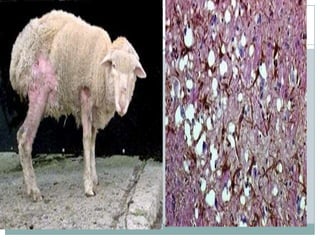
 Scrapie in sheep,is a fatal, degenerative disease
affecting the central nervous system of sheep and
goats.
 The diseases classified as transmissible spongiform
encephalopathies (TSE).
 The disease apparently causes an itching sensation
in the animals.
Clinical sign and diagnosis
The symptoms:
 There may be behavioural changes and maybe an
increase in chewing movements.
 Ataxi.a and neurological signs then develop.
 Some sheep scratch excessively
 show patches of wool loss and lesions on the skin.
 weight loss, anorexia, lethargy and possibly death.
Biochemistry(protein)

Biochemistry(protein)

  • 1.
    B Y GR O U P 3 A N N I S A F A D I L A H T R G D U R R I Y A H L B S L E T T Y N A I N G G O L A N P U T R I D I A N H A M I A N S O H M I Y A T I L I N G G A Biochemistry: “PROTEIN”
  • 2.
    What is Protein?? Protein is a macro nutrient composed of monomer form amino acids that is necessary for the proper growth and function of the human body.  Amino acids are small molecules that contain carbon, hydrogen, oxygen, and nitrogen atoms; two also contain sulfur atoms.
  • 3.
     A chainamino acids is called a polypeptide chain
  • 4.
    The structure ofAmino acid
  • 5.
    How can weget Protein? A set of essential amino acid we obtained from animal and/or vegetable protein sources.
  • 6.
    Legumes  Peanut A 1-cupserving of raw peanuts contains 828 calories and 38 grams of protein. Peanuts lack the essential amino acid L-methionine, but contain high levels of the other essential amino acids, including L- lysine.
  • 7.
    Cereal and grains Cereal and grains  Cereal rich of carbohydrates, complete protein, low fat, and rich of rough fiber.
  • 8.
    Animal  Seafood (compeleteprotein) A 3.5 ounce salmon filet contains about 27 grams of protein, while a single six ounce can of tuna holds a whopping 40 grams of the body- building macronutrient.
  • 9.
    Fruits  Fruits Fruits canbe a good source of protein, though they tend to provide less than vegetables, beans, and legumes. When looking for protein, dried fruits and berries are best.
  • 10.
    Vegetables  Vegetables Eat moreof green vegetables, because green vegetables contain more protein than other vegetables. So the protein needed in our body enough to get.
  • 11.
    Functions of Protein Biologicalfunction Structural proteins , has function to support. (Microtubule and microfi lament proteins form supporting fibers inside cells; collagen and other proteins surround and support animal cells; cell wall proteins support plant cells.)
  • 12.
    Enzymatic proteins, Increasethe rate of biological reactions. e.g  DNA polymerase increases the rate of duplication of DNA molecules; RuBP carboxylase/oxygenase increases the rates of the first synthetic reactions of photosynthesis; the digestive enzymes lipases and proteases increase the rate of breakdown of fats and proteins, respectively.
  • 13.
     Membrane Transportproteins, To Speed up movement of substances across biological membranes. E.g :  Ion transporters move ions such as Na, K, and Ca2 across membranes  Glucose transporters move glucose into cells  Aquaporins allow water molecules to move across membranes.
  • 15.
     Motile proteins,to produce cellular movements. e.g.:  Myosin acts on microfilaments to produce muscle movements  dynein acts on microtubules to produce the whipping movements of sperm tails, flagella, and cilia  kinesin acts on microtubules of the cytoskeleton
  • 16.
     Regulatory proteins,Promote or inhibit the activity of other cellular molecules. e.g.:  Nuclear regulatory proteins turn genes on or off to control the activity of DNA.  Protein kinase add phosphate groups to other proteins to modify their activity.
  • 18.
    Receptor proteins, tobind molecules at cell surface or within cell; some trigger internal cellular responses. e.g.:  Hormone receptors bind hormones at the cell surface or within cells and trigger cellular responses.  LDL receptors bind cholesterol-containing particles to cell surfaces.
  • 19.
     Storage proteins,Hold amino acids and other substances in stored form. e.g.:  Ovalbumin is a storage protein of eggs  Apolipoproteins hold cholesterol in stored form for transport hrough the bloodstream.
  • 20.
     Venoms andtoxins, Interfere with competing organisms Interfere with competing organisms. e.g.:  Ricin is a castor-bean protein that stops protein synthesis.  Bungarotoxin is a snake venom thatcauses muscle paralysis.
  • 21.
    Physical funtion Proteins formthe basis of cells, which come together to form organs, muscle tissue, bones, skin, hair and nails.  help organize your cells into separate tissues and they can protect the body as well.  for example, specialized proteins tightly connect one skin cell to another to create a cohesive barrier against the outside environment.
  • 22.
    Classification of Protein Based on Their needed in our body. o Essential (very needed, cannot synthesize, cosume via diet) o Conditionally essential (not always needed) ex: a young and growing individual, or during illness. o Non-essential amino acids ( needed, can synthesize)
  • 23.
    Essential amino acids: •Histidine, Isoleucine, Valine , Leucine, Lysine, Methionine, Phenylalanine, Threonine, Tryptophan Non Essential amino acids:  Alanine, Asparagine, Aspartic acid, and Glutamic acid. Conditionally amino acids:  Arginine, Cysteine, Glutamine, Tyrosine, Glycine, Ornithine, Proline, and Serine.
  • 24.
    •Based on thesidegroup
  • 27.
    Structure of Protein. Proteins have four level of structure. each level has different characteristics and degrees of structural complexity to the molecule.  Primary structure is the particular and sequence of amino acids forming a polypeptide.
  • 28.
     secondary structureis produced by the polypeptide chain twists into coil (helix) and turns of the amino acid chain.
  • 29.
    Tertiary structure isthe folding of the amino acid chain into a functional domain such as a barrel or pocket with its secondary structures, into the overall three-dimensional shape of a Protein. In this example, the coils of a globin chain form a pocket
  • 30.
     Quaternary structure,when present, refers to the arrangement of polypeptide chains in a protein that is formed from more than one chain. Hemoglobin, shown here, consists of four globin chains ( brown and blue). Each globin pocket now holds a heme group (red ).
  • 31.
    Disease and clinicaldiagnose caused by protein  Changes in a protein’s shape may have drastic consequences to health. And can cause disease.  If proteins get denature, it will affect to their function.
  • 32.
    Disease caused bythe changing shape of protein:  Prion diseases (Prions are misfolded  proteins), including mad cow disease (bovine spongiform encephalitis, or BSE) in cattle. Affect the nervous system The symptoms:  hard to diagnose until it has nearly run its course.  people have symptoms related to the nervous system  depression and loss of coordination  Dementia develops (the loss of mental functions such as thinking, memory, and reasoning that is severe enough to interfere with a person's daily functioning
  • 34.
     Creutzfeldt-Jakob diseasein humans  CJD is a degenerative neurological disorder (brain disease) that is incurable and invariably fatal. The symptoms: • leading to memory loss, personality changes and hallucinations • physical problems such as speech impairment, jerky movements (myoclonus), balance and coordination dysfunction (ataxia), changes in gait, rigid posture, and seizures. • CJD can be fatal within months or even weeks
  • 35.
    How can diagnose? Standard diagnostic tests include,  A spinal tap (rule out common causes of dementia )  Electroencephalogram (EEG) to record the brain’s electrical pattern  Computerized tomography of the brain ( know the symptoms caused by another problem like can stroke or tumor)  Magnetic resonance imaging (MRI) brain scans also can reveal characteristic patterns of brain degeneration that can help diagnose CJD.
  • 37.
     Scrapie insheep,is a fatal, degenerative disease affecting the central nervous system of sheep and goats.  The diseases classified as transmissible spongiform encephalopathies (TSE).  The disease apparently causes an itching sensation in the animals.
  • 38.
    Clinical sign anddiagnosis The symptoms:  There may be behavioural changes and maybe an increase in chewing movements.  Ataxi.a and neurological signs then develop.  Some sheep scratch excessively  show patches of wool loss and lesions on the skin.  weight loss, anorexia, lethargy and possibly death.