Lesson 4.5 1st.notebook                                                                                         November 22, 2010


                                                                              Characteristics of direct variation graphs.
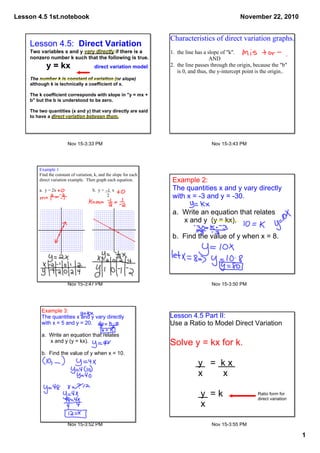
    Lesson 4.5:  Direct Variation
    Two variables x and y vary directly if there is a                         1.  the line has a slope of "k".
    nonzero number k such that the following is true.                                                     AND
                y = kx          direct variation model                        2.  the line passes through the origin, because the "b" 
                                                                                   is 0, and thus, the y­intercept point is the origin..
    The number k is constant of variation (or slope) 
    although k is technically a coefficient of x.

    The k coefficient corresponds with slope in "y = mx + 
    b" but the b is understood to be zero.

    The two quantities (x and y) that vary directly are said 
    to have a direct variation between them.


                                   Nov 15­3:33 PM                                                 Nov 15­3:43 PM


           Example 1
           Find the constant of variation, k, and the slope for each 
           direct variation example.  Then graph each equation.                Example 2:
           a.  y = 2x                                 b.  y =  ­1  x           The quantities x and y vary directly 
                                                                        2      with x = ­3 and y = ­30.  

                                                                               a.  Write an equation that relates 
                                                                                     x and y  (y = kx).

                                                                               b.  Find the value of y when x = 8.


                                   Nov 15­3:47 PM                                                 Nov 15­3:50 PM


            Example 3:
            The quantities x and y vary directly                              Lesson 4.5 Part II:
            with x = 5 and y = 20.                                            Use a Ratio to Model Direct Variation
            a.  Write an equation that relates 
                  x and y (y = kx).                                           Solve y = kx for k.
            b.  Find the value of y when x = 10.

                                                                                         y   =  k x 
                                                                                         x        x

                                                                                          y  = k                        Ratio form for 
                                                                                                                        direct variation
                                                                                          x

                                   Nov 15­3:52 PM                                                 Nov 15­3:55 PM

                                                                                                                                           1
Lesson 4.5 1st.notebook                                                          November 22, 2010

                                         Review:
                                         Direct Variations are linear functions that meet 
                                         extra conditions.
                                         I.  Equation:  y = kx (or y = mx + 0) form.  
                                         The m or k must be a positive or negative.

                                         II.  Graph:  A line with a positive or negative slope, 
                                         and the line crosses the y­axis at (0, 0) the origin.

                                         III.  Table:  If x­values are selected so as to change 
                                         constantly by 1, then the y­values will change 
                                         constantly by an amount called k (or m). 

                                           x  | ­2  |  ­1  |  0  |  1  |  2  |
                                           y  |­10    ­5     0    5    10
                                                                                       y = 5x

                Nov 15­4:06 PM                                    Nov 15­8:31 PM


   Homework:  p. 237
   (1­14, 16 ­ 20 even, 21­23, 28, 30)


                Nov 15­4:08 PM


                                                                                                     2

Lesson 4.5

  • 1.
    Lesson 4.5 1st.notebook November 22, 2010 Characteristics of direct variation graphs. Lesson 4.5:  Direct Variation Two variables x and y vary directly if there is a  1.  the line has a slope of "k". nonzero number k such that the following is true.                             AND             y = kx          direct variation model 2.  the line passes through the origin, because the "b"       is 0, and thus, the y­intercept point is the origin.. The number k is constant of variation (or slope)  although k is technically a coefficient of x. The k coefficient corresponds with slope in "y = mx +  b" but the b is understood to be zero. The two quantities (x and y) that vary directly are said  to have a direct variation between them. Nov 15­3:33 PM Nov 15­3:43 PM Example 1 Find the constant of variation, k, and the slope for each  direct variation example.  Then graph each equation. Example 2: a.  y = 2x                                 b.  y =  ­1  x The quantities x and y vary directly                                                               2   with x = ­3 and y = ­30.   a.  Write an equation that relates        x and y  (y = kx). b.  Find the value of y when x = 8. Nov 15­3:47 PM Nov 15­3:50 PM Example 3: The quantities x and y vary directly  Lesson 4.5 Part II: with x = 5 and y = 20.   Use a Ratio to Model Direct Variation a.  Write an equation that relates        x and y (y = kx). Solve y = kx for k. b.  Find the value of y when x = 10.            y   =  k x             x        x             y  = k            Ratio form for  direct variation             x Nov 15­3:52 PM Nov 15­3:55 PM 1
  • 2.
    Lesson 4.5 1st.notebook November 22, 2010 Review: Direct Variations are linear functions that meet  extra conditions. I.  Equation:  y = kx (or y = mx + 0) form.   The m or k must be a positive or negative. II.  Graph:  A line with a positive or negative slope,  and the line crosses the y­axis at (0, 0) the origin. III.  Table:  If x­values are selected so as to change  constantly by 1, then the y­values will change  constantly by an amount called k (or m).    x  | ­2  |  ­1  |  0  |  1  |  2  |   y  |­10    ­5     0    5    10  y = 5x Nov 15­4:06 PM Nov 15­8:31 PM Homework:  p. 237 (1­14, 16 ­ 20 even, 21­23, 28, 30) Nov 15­4:08 PM 2