Jointly Proportional.
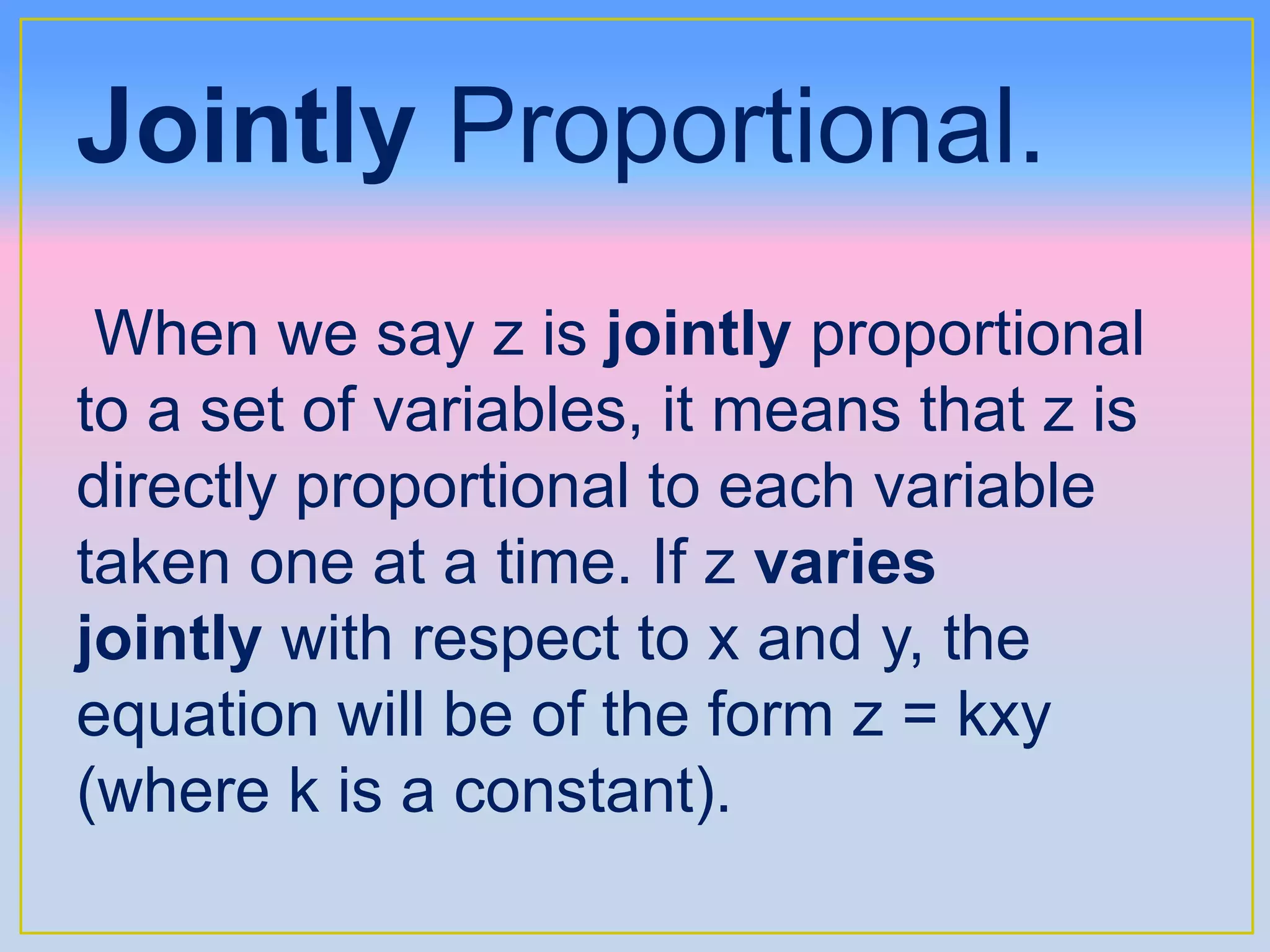
When we say z is jointly proportional
to a set of variables, it means that z is
directly proportional to each variable
taken one at a time. If z varies
jointly with respect to x and y, the
equation will be of the form z = kxy
(where k is a constant).
Examples:
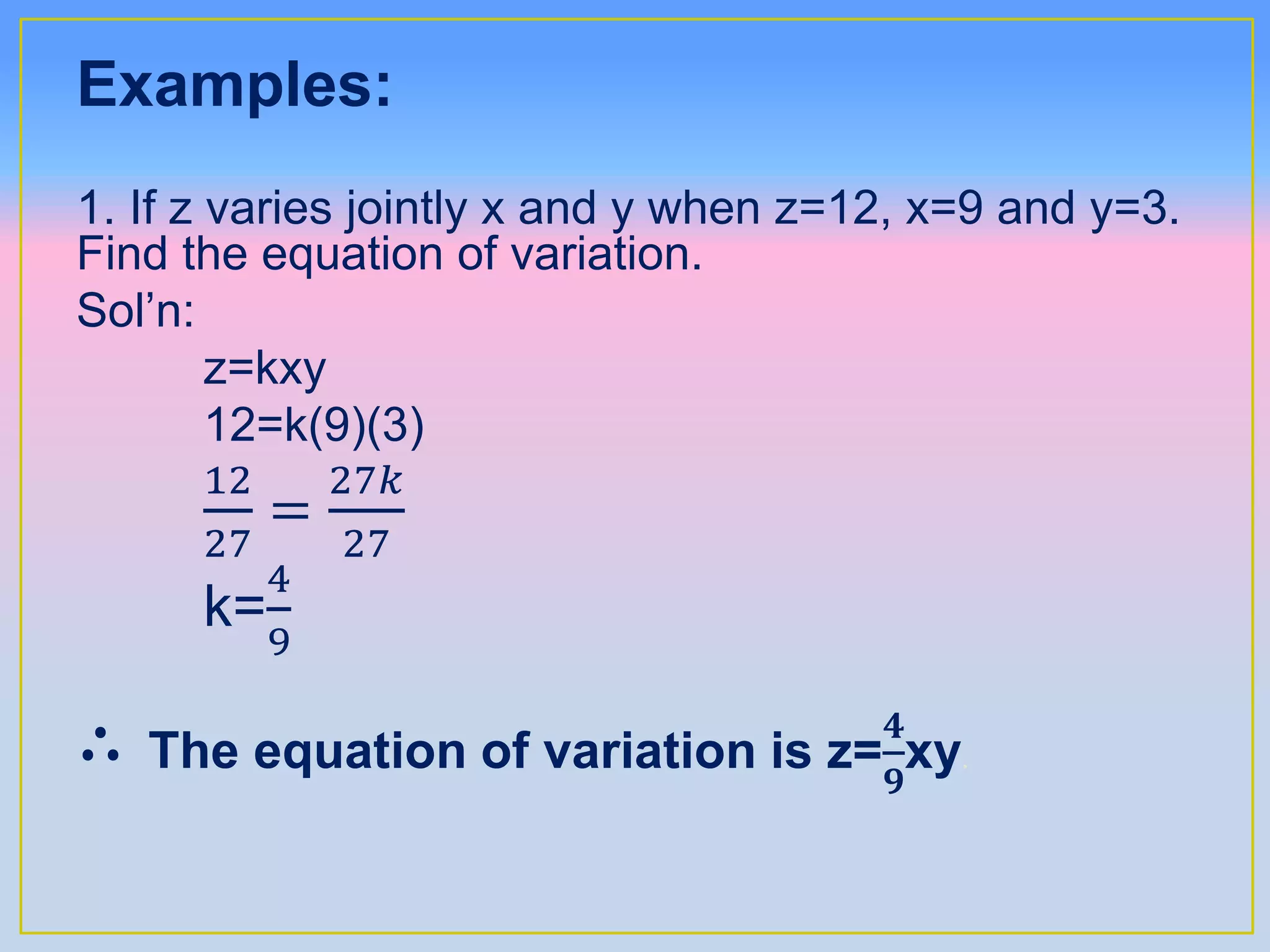
1. If z varies jointly x and y when z=12, x=9 and y=3.
Find the equation of variation.
Sol’n:
z=kxy
12=k(9)(3)
12
27
=
27𝑘
27
k=
4
9
∴ The equation of variation is z=
𝟒
𝟗
xy.
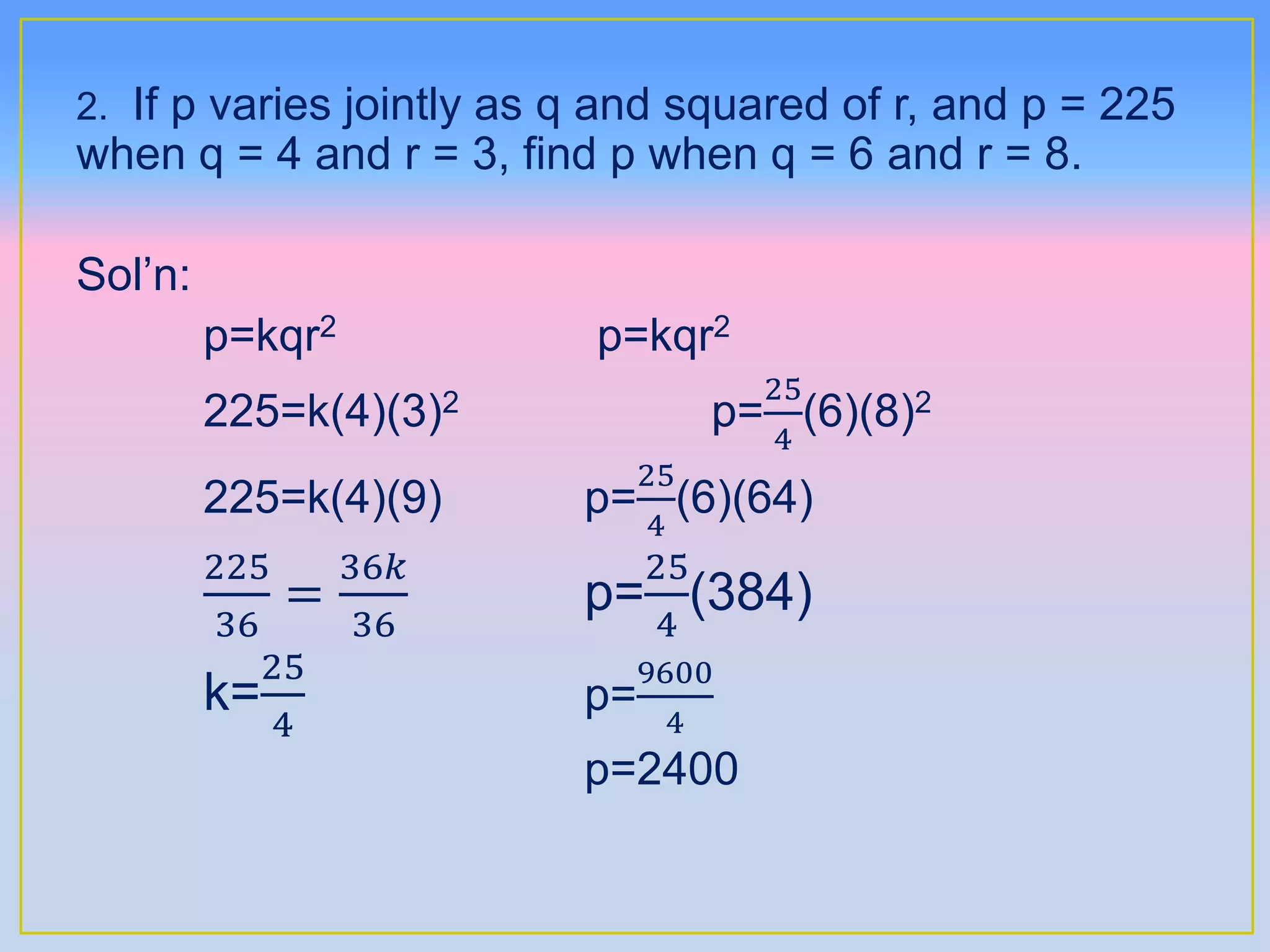
2. If p varies jointly as q and squared of r, and p = 225
when q = 4 and r = 3, find p when q = 6 and r = 8.
Sol’n:
p=kqr2 p=kqr2
225=k(4)(3)2 p=
25
4
(6)(8)2
225=k(4)(9) p=
25
4
(6)(64)
225
36
=
36𝑘
36
p=
25
4
(384)
k=
25
4
p=
9600
4
p=2400
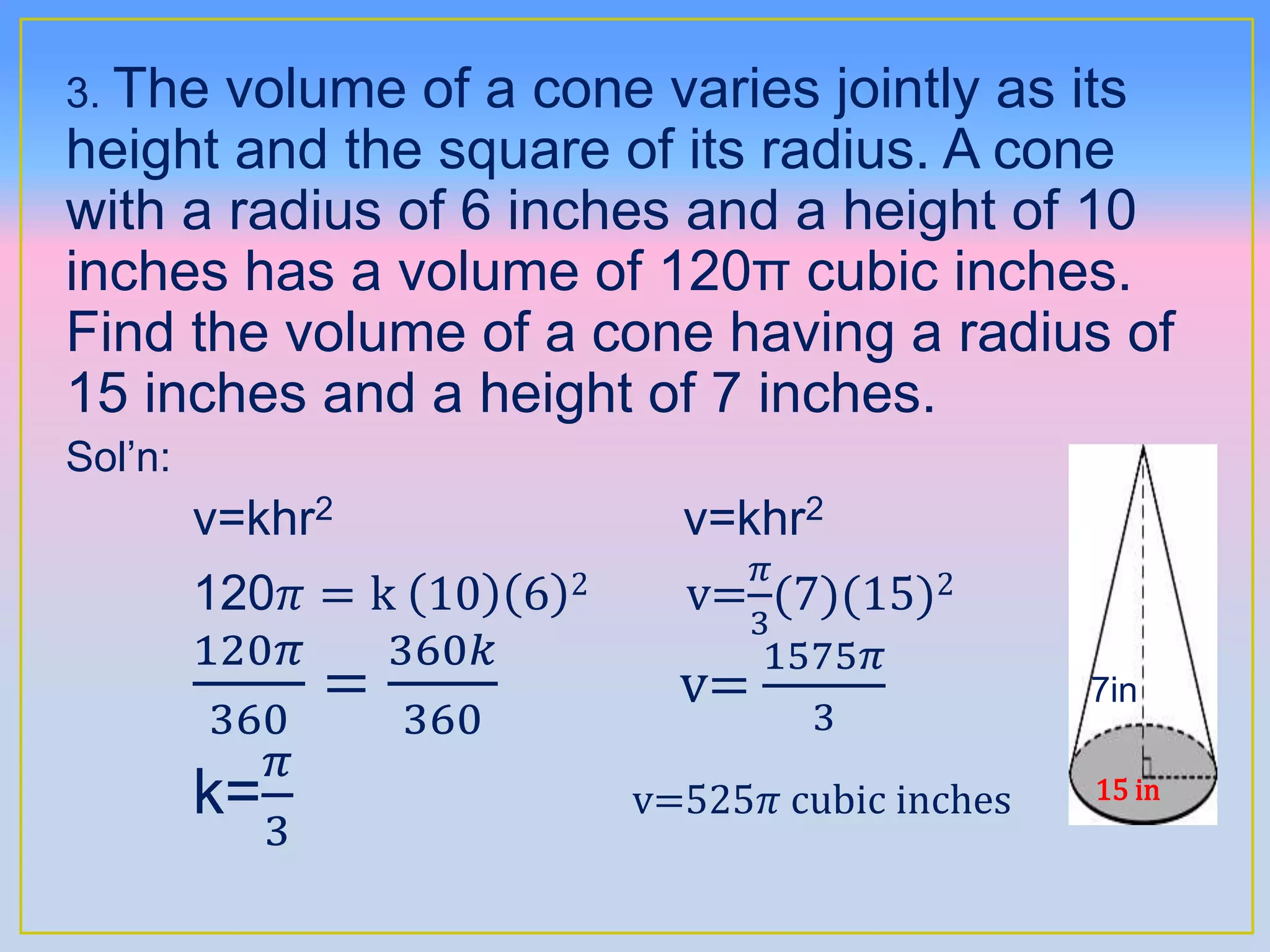
3. The volume of a cone varies jointly as its
height and the square of its radius. A cone
with a radius of 6 inches and a height of 10
inches has a volume of 120π cubic inches.
Find the volume of a cone having a radius of
15 inches and a height of 7 inches.
Sol’n:
v=khr2 v=khr2
120𝜋 = k 10 6 2 v=
𝜋
3
(7)(15)2
120𝜋
360
=
360𝑘
360
v=
1575𝜋
3
7in
k=
𝜋
3
v=525𝜋 cubic inches 15 in
Activity(Board work)
Column A Column B
“a varies jointly as b and c”
1. Translate the statement
above into mathematical
equation.
2. If a=6, b=6 and c=2.
What is k?
3. What is a when b=9 and c=2?
“ area(a) varies jointly as length(l) and
width(w)”
4. Translate the statement
above into mathematical
equation.
5. If area is 12cm2, length is 2 and width is 4, then what is k?
6. What is a when l=8cm and w=3cm?
j. a=
𝑘
𝑏𝑐
u.
1
2
a. 36cm2
e. 9
d. k=
3
2
h. a=kbc
n. a=klw
Answer:
_ __ __ __ __ __
1 2 3 4 5 6
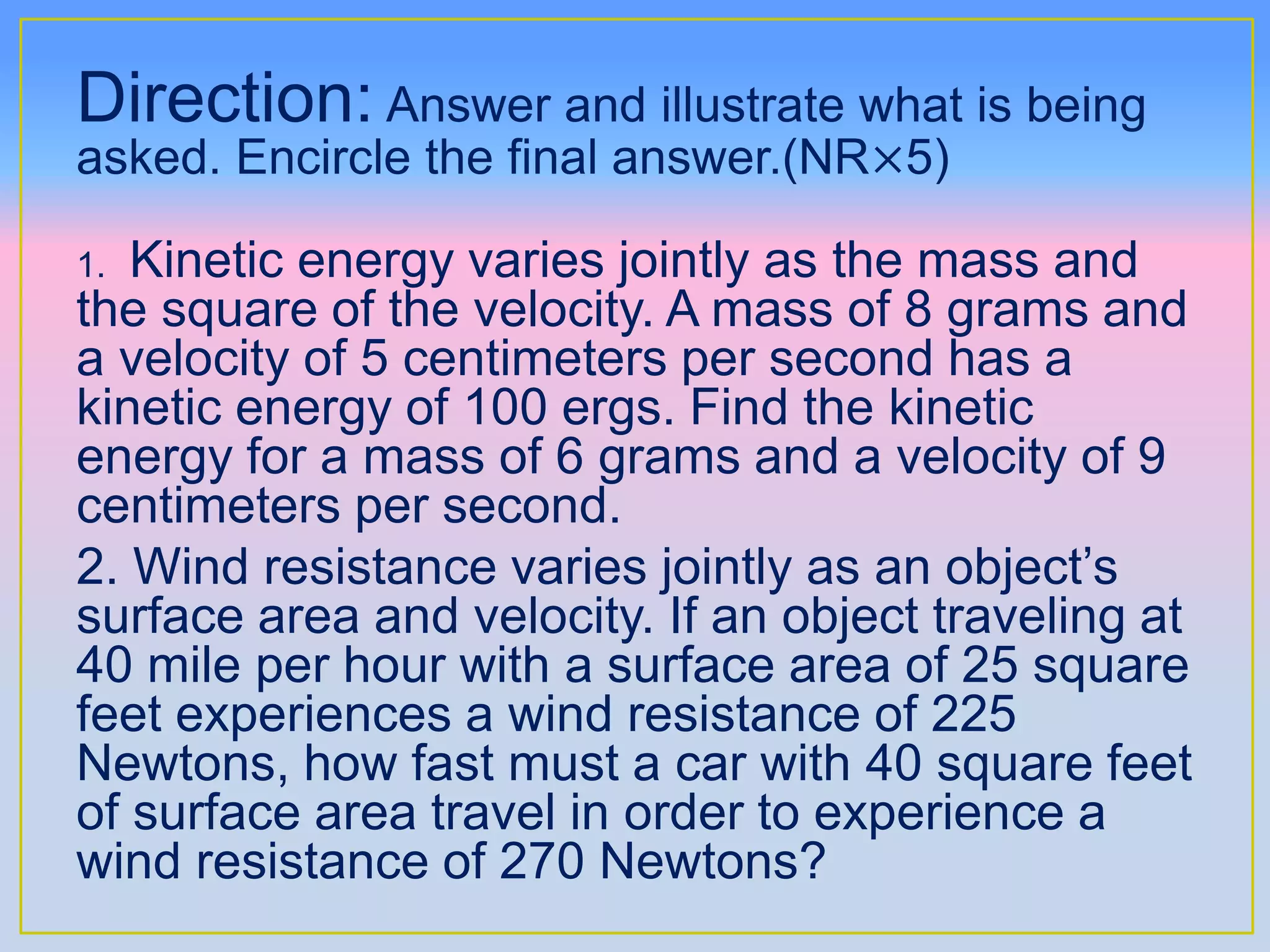
Direction: Answer and illustrate what is being
asked. Encircle the final answer.(NR×5)
1. Kinetic energy varies jointly as the mass and
the square of the velocity. A mass of 8 grams and
a velocity of 5 centimeters per second has a
kinetic energy of 100 ergs. Find the kinetic
energy for a mass of 6 grams and a velocity of 9
centimeters per second.
2. Wind resistance varies jointly as an object’s
surface area and velocity. If an object traveling at
40 mile per hour with a surface area of 25 square
feet experiences a wind resistance of 225
Newtons, how fast must a car with 40 square feet
of surface area travel in order to experience a
wind resistance of 270 Newtons?
Assignment:
In your study guide page 216
answer activity numbers
5and 6. Write it in a one
WHOLE sheet of paper.

Joint variation final

  • 2.
    Jointly Proportional. When wesay z is jointly proportional to a set of variables, it means that z is directly proportional to each variable taken one at a time. If z varies jointly with respect to x and y, the equation will be of the form z = kxy (where k is a constant).
  • 3.
    Examples: 1. If zvaries jointly x and y when z=12, x=9 and y=3. Find the equation of variation. Sol’n: z=kxy 12=k(9)(3) 12 27 = 27𝑘 27 k= 4 9 ∴ The equation of variation is z= 𝟒 𝟗 xy.
  • 4.
    2. If pvaries jointly as q and squared of r, and p = 225 when q = 4 and r = 3, find p when q = 6 and r = 8. Sol’n: p=kqr2 p=kqr2 225=k(4)(3)2 p= 25 4 (6)(8)2 225=k(4)(9) p= 25 4 (6)(64) 225 36 = 36𝑘 36 p= 25 4 (384) k= 25 4 p= 9600 4 p=2400
  • 5.
    3. The volumeof a cone varies jointly as its height and the square of its radius. A cone with a radius of 6 inches and a height of 10 inches has a volume of 120π cubic inches. Find the volume of a cone having a radius of 15 inches and a height of 7 inches. Sol’n: v=khr2 v=khr2 120𝜋 = k 10 6 2 v= 𝜋 3 (7)(15)2 120𝜋 360 = 360𝑘 360 v= 1575𝜋 3 7in k= 𝜋 3 v=525𝜋 cubic inches 15 in
  • 6.
    Activity(Board work) Column AColumn B “a varies jointly as b and c” 1. Translate the statement above into mathematical equation. 2. If a=6, b=6 and c=2. What is k? 3. What is a when b=9 and c=2? “ area(a) varies jointly as length(l) and width(w)” 4. Translate the statement above into mathematical equation. 5. If area is 12cm2, length is 2 and width is 4, then what is k? 6. What is a when l=8cm and w=3cm? j. a= 𝑘 𝑏𝑐 u. 1 2 a. 36cm2 e. 9 d. k= 3 2 h. a=kbc n. a=klw
  • 7.
    Answer: _ __ ____ __ __ 1 2 3 4 5 6
  • 8.
    Direction: Answer andillustrate what is being asked. Encircle the final answer.(NR×5) 1. Kinetic energy varies jointly as the mass and the square of the velocity. A mass of 8 grams and a velocity of 5 centimeters per second has a kinetic energy of 100 ergs. Find the kinetic energy for a mass of 6 grams and a velocity of 9 centimeters per second. 2. Wind resistance varies jointly as an object’s surface area and velocity. If an object traveling at 40 mile per hour with a surface area of 25 square feet experiences a wind resistance of 225 Newtons, how fast must a car with 40 square feet of surface area travel in order to experience a wind resistance of 270 Newtons?
  • 9.
    Assignment: In your studyguide page 216 answer activity numbers 5and 6. Write it in a one WHOLE sheet of paper.