Haemogram
Interpretation
By
Dr M.KATASO
Haematology Unit,
Department of Internal Medicine
17/01/2023
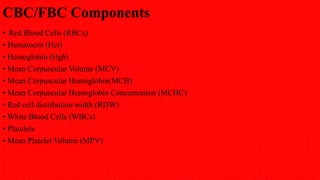
CBC/FBC Components
• Red Blood Cells (RBCs)
• Hematocrit (Hct)
• Hemoglobin (Hgb)
• Mean Corpuscular Volume (MCV)
• Mean Corpuscular Hemoglobin(MCH)
• Mean Corpuscular Hemoglobin Concentration (MCHC)
• Red cell distribution width (RDW)
• White Blood Cells (WBCs)
• Platelets
• Mean Platelet Volume (MPV)
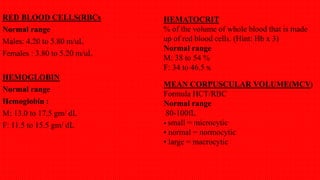
RED BLOOD CELLS(RBCs
Normal range
Males: 4.20 to 5.80 m/uL
Females : 3.80 to 5.20 m/uL
HEMOGLOBIN
Normal range
Hemoglobin :
M: 13.0 to 17.5 gm/ dL
F: 11.5 to 15.5 gm/ dL
HEMATOCRIT
% of the volume of whole blood that is made
up of red blood cells. (Hint: Hb x 3)
Normal range
M: 38 to 54 %
F: 34 to 46.5 %
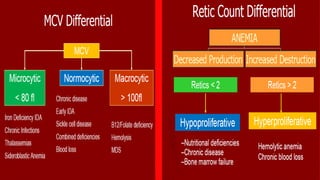
MEAN CORPUSCULAR VOLUME(MCV)
Formula HCT/RBC
Normal range
80-100fL
• small = microcytic
• normal = normocytic
• large = macrocytic
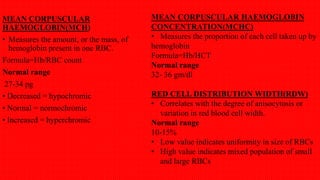
MEAN CORPUSCULAR
HAEMOGLOBIN(MCH)
• Measures the amount, or the mass, of
hemoglobin present in one RBC.
Formula=Hb/RBC count
Normal range
27-34 pg
• Decreased = hypochromic
• Normal = normochromic
• Increased = hyperchromic
MEAN CORPUSCULAR HAEMOGLOBIN
CONCENTRATION(MCHC)
• Measures the proportion of each cell taken up by
hemoglobin
Formula=Hb/HCT
Normal range
32- 36 gm/dl
RED CELL DISTRIBUTION WIDTH(RDW)
• Correlates with the degree of anisocytosis or
variation in red blood cell width.
Normal range
10-15%
• Low value indicates uniformity in size of RBCs
• High value indicates mixed population of small
and large RBCs
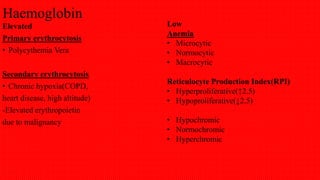
Haemoglobin
Elevated
Primary erythrocytosis
• Polycythemia Vera
Secondary erythrocytosis
• Chronic hypoxia(COPD,
heart disease, high altitude)
-Elevated erythropoietin
due to malignancy
Low
Anemia
• Microcytic
• Normocytic
• Macrocytic
Reticulocyte Production Index(RPI)
• Hyperproliferative(↑2.5)
• Hypoproliferative(↓2.5)
• Hypochromic
• Normochromic
• Hyperchromic
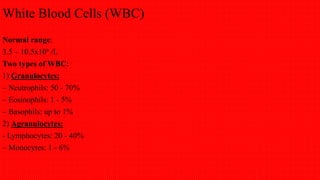
White Blood Cells (WBC)
Normal range:
3.5 – 10.5x10⁹ /L
Two types of WBC:
1) Granulocytes:
– Neutrophils: 50 - 70%
– Eosinophils: 1 - 5%
– Basophils: up to 1%
2) Agranulocytes:
- Lymphocytes: 20 - 40%
– Monocytes: 1 - 6%
The Neutrophil
Neutrophilia – an increase in neutrophils
• Bacterial infections
• Tissue destruction (burns)
• Inflammation (SLE, RA, UC)
• Thyrotoxicosis
• Cigarette smoking
• Corticosteroids
• B-agonist
• Leukemia
• Myeloproliferative disorders
• Allergies
• Post splenectomy
Neutropenia – a decrease in neutrophils
• Decreased bone marrow production
•Medications:
cephalosporins,Cotrimoxazole,Chlorpromazine,
dapsone, sirolimus, mycophenolate mofetil,
tacrolimus, cyclosporine,carbimazole,Propyl
thiouracil,Ticlopidine,phenytoin,
Chemotherapy.
• Immune related (ex. SLE, RA)
• Post acute infection (HSV, CMV, HIV, EBV)
• Zinc & Copper deficiency
• Vitamin B12, folate deficiency
• Autoimmune neutropenia
The Eosinophil
Eosinophilia:↑eosinophil count
• Parasitic infections
• Allergic conditions and hypersensitivity
reaction
• Aspergillosis
• Vasculitis
• Some cancers, leukemias or lymphomas
• Drug reactions
• Inflammatory disorders (celiac disease,
inflammatory bowel disease)
Eosinopenia:↓Eosinophil count
• Sepsis
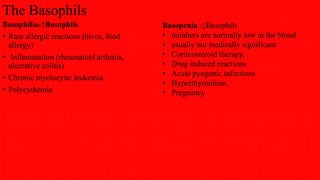
The Basophils
Basophilia-↑Basophils
• Rare allergic reactions (hives, food
allergy)
• Inflammation (rheumatoid arthritis,
ulcerative colitis)
• Chronic myelocytic leukemia.
• Polycythemia
Basopenia :↓Basophils
• numbers are normally low in the blood
• usually not medically significant
• Corticosteroid therapy,
• Drug induced reactions
• Acute pyogenic infections
• Hyperthyroidism.
• Pregnancy
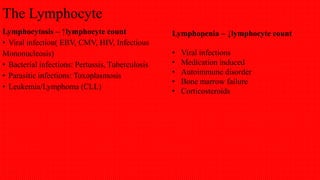
The Lymphocyte
Lymphocytosis – ↑lymphocyte count
• Viral infection( EBV, CMV, HIV, Infectious
Mononucleosis)
• Bacterial infections: Pertussis, Tuberculosis
• Parasitic infections: Toxoplasmosis
• Leukemia/Lymphoma (CLL)
Lymphopenia – ↓lymphocyte count
• Viral infections
• Medication induced
• Autoimmune disorder
• Bone marrow failure
• Corticosteroids
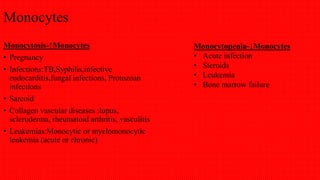
Monocytes
Monocytosis-↑Monocytes
• Pregnancy
• Infections:TB,Syphilis,infective
endocarditis,fungal infections, Protozoan
infections
• Sarcoid
• Collagen vascular diseases :lupus,
scleroderma, rheumatoid arthritis, vasculitis
• Leukemias:Monocytic or myelomonocytic
leukemia (acute or chronic)
Monocytopenia-↓Monocytes
• Acute infection
• Steroids
• Leukemia
• Bone marrow failure
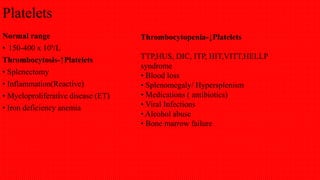
Platelets
Normal range
• 150-400 x 10⁹/L
Thrombocytosis-↑Platelets
• Splenectomy
• Inflammation(Reactive)
• Myeloproliferative disease (ET)
• Iron deficiency anemia
Thrombocytopenia-↓Platelets
TTP,HUS, DIC, ITP, HIT,VITT,HELLP
syndrome
• Blood loss
• Splenomegaly/ Hypersplenism
• Medications ( antibiotics)
• Viral Infections
• Alcohol abuse
• Bone marrow failure
References
• Oxford Handbook of Clinical Haematology, 2nd Edition
• Oxford Handbook of Clinical Medicine, 9th Edition
END!!!
Questions??

4.Haemogram Interpretation.pdf

  • 1.
  • 2.
    CBC/FBC Components • RedBlood Cells (RBCs) • Hematocrit (Hct) • Hemoglobin (Hgb) • Mean Corpuscular Volume (MCV) • Mean Corpuscular Hemoglobin(MCH) • Mean Corpuscular Hemoglobin Concentration (MCHC) • Red cell distribution width (RDW) • White Blood Cells (WBCs) • Platelets • Mean Platelet Volume (MPV)
  • 3.
    RED BLOOD CELLS(RBCs Normalrange Males: 4.20 to 5.80 m/uL Females : 3.80 to 5.20 m/uL HEMOGLOBIN Normal range Hemoglobin : M: 13.0 to 17.5 gm/ dL F: 11.5 to 15.5 gm/ dL HEMATOCRIT % of the volume of whole blood that is made up of red blood cells. (Hint: Hb x 3) Normal range M: 38 to 54 % F: 34 to 46.5 % MEAN CORPUSCULAR VOLUME(MCV) Formula HCT/RBC Normal range 80-100fL • small = microcytic • normal = normocytic • large = macrocytic
  • 4.
    MEAN CORPUSCULAR HAEMOGLOBIN(MCH) • Measuresthe amount, or the mass, of hemoglobin present in one RBC. Formula=Hb/RBC count Normal range 27-34 pg • Decreased = hypochromic • Normal = normochromic • Increased = hyperchromic MEAN CORPUSCULAR HAEMOGLOBIN CONCENTRATION(MCHC) • Measures the proportion of each cell taken up by hemoglobin Formula=Hb/HCT Normal range 32- 36 gm/dl RED CELL DISTRIBUTION WIDTH(RDW) • Correlates with the degree of anisocytosis or variation in red blood cell width. Normal range 10-15% • Low value indicates uniformity in size of RBCs • High value indicates mixed population of small and large RBCs
  • 5.
    Haemoglobin Elevated Primary erythrocytosis • PolycythemiaVera Secondary erythrocytosis • Chronic hypoxia(COPD, heart disease, high altitude) -Elevated erythropoietin due to malignancy Low Anemia • Microcytic • Normocytic • Macrocytic Reticulocyte Production Index(RPI) • Hyperproliferative(↑2.5) • Hypoproliferative(↓2.5) • Hypochromic • Normochromic • Hyperchromic
  • 7.
    White Blood Cells(WBC) Normal range: 3.5 – 10.5x10⁹ /L Two types of WBC: 1) Granulocytes: – Neutrophils: 50 - 70% – Eosinophils: 1 - 5% – Basophils: up to 1% 2) Agranulocytes: - Lymphocytes: 20 - 40% – Monocytes: 1 - 6%
  • 8.
    The Neutrophil Neutrophilia –an increase in neutrophils • Bacterial infections • Tissue destruction (burns) • Inflammation (SLE, RA, UC) • Thyrotoxicosis • Cigarette smoking • Corticosteroids • B-agonist • Leukemia • Myeloproliferative disorders • Allergies • Post splenectomy Neutropenia – a decrease in neutrophils • Decreased bone marrow production •Medications: cephalosporins,Cotrimoxazole,Chlorpromazine, dapsone, sirolimus, mycophenolate mofetil, tacrolimus, cyclosporine,carbimazole,Propyl thiouracil,Ticlopidine,phenytoin, Chemotherapy. • Immune related (ex. SLE, RA) • Post acute infection (HSV, CMV, HIV, EBV) • Zinc & Copper deficiency • Vitamin B12, folate deficiency • Autoimmune neutropenia
  • 9.
    The Eosinophil Eosinophilia:↑eosinophil count •Parasitic infections • Allergic conditions and hypersensitivity reaction • Aspergillosis • Vasculitis • Some cancers, leukemias or lymphomas • Drug reactions • Inflammatory disorders (celiac disease, inflammatory bowel disease) Eosinopenia:↓Eosinophil count • Sepsis
  • 10.
    The Basophils Basophilia-↑Basophils • Rareallergic reactions (hives, food allergy) • Inflammation (rheumatoid arthritis, ulcerative colitis) • Chronic myelocytic leukemia. • Polycythemia Basopenia :↓Basophils • numbers are normally low in the blood • usually not medically significant • Corticosteroid therapy, • Drug induced reactions • Acute pyogenic infections • Hyperthyroidism. • Pregnancy
  • 11.
    The Lymphocyte Lymphocytosis –↑lymphocyte count • Viral infection( EBV, CMV, HIV, Infectious Mononucleosis) • Bacterial infections: Pertussis, Tuberculosis • Parasitic infections: Toxoplasmosis • Leukemia/Lymphoma (CLL) Lymphopenia – ↓lymphocyte count • Viral infections • Medication induced • Autoimmune disorder • Bone marrow failure • Corticosteroids
  • 12.
    Monocytes Monocytosis-↑Monocytes • Pregnancy • Infections:TB,Syphilis,infective endocarditis,fungalinfections, Protozoan infections • Sarcoid • Collagen vascular diseases :lupus, scleroderma, rheumatoid arthritis, vasculitis • Leukemias:Monocytic or myelomonocytic leukemia (acute or chronic) Monocytopenia-↓Monocytes • Acute infection • Steroids • Leukemia • Bone marrow failure
  • 13.
    Platelets Normal range • 150-400x 10⁹/L Thrombocytosis-↑Platelets • Splenectomy • Inflammation(Reactive) • Myeloproliferative disease (ET) • Iron deficiency anemia Thrombocytopenia-↓Platelets TTP,HUS, DIC, ITP, HIT,VITT,HELLP syndrome • Blood loss • Splenomegaly/ Hypersplenism • Medications ( antibiotics) • Viral Infections • Alcohol abuse • Bone marrow failure
  • 14.
    References • Oxford Handbookof Clinical Haematology, 2nd Edition • Oxford Handbook of Clinical Medicine, 9th Edition
  • 15.