3G VS 4G COMMUNICATION
A LOOK AT THE DEVELOPING TECHNOLOGY……
CONTENTS 1.
•INTRODUCTION
2.
• 3G
• DRAWBACKS ; USERS WORLDWIDE
3.
• 4G
• DRAWBACKS ; USERS WORLDWIDE
4.
5.
6.
• 3G V/S 4G - THE MAIN TOPIC
• BIBLIOGRAPHY
• THANK YOU!!!
“
Wireless communication is among technology’s biggest
contributions to mankind. Wireless communication involves the
transmission of information over a distance without help of wires,
cables or any other forms of electrical conductors. The
transmitted distance can be anywhere between a few meters (for
example, a television’s remote control) and thousands of
kilometer's (for example, radio communication).
Some of the devices used for wireless communication are
cordless telephones, mobiles, GPS units, wireless computer
parts, and satellite television.
Let us take a look at these developing technologies………
3G
T H E L E V E L W H I C H H A S B E E N L E F T B E H I N D .
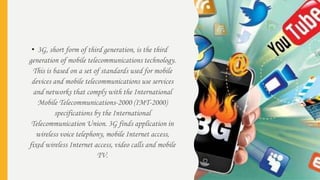
• 3G, short form of third generation, is the third
generation of mobile telecommunications technology.
This is based on a set of standards used for mobile
devices and mobile telecommunications use services
and networks that comply with the International
Mobile Telecommunications-2000 (IMT-2000)
specifications by the International
Telecommunication Union. 3G finds application in
wireless voice telephony, mobile Internet access,
fixed wireless Internet access, video calls and mobile
TV.
• Several telecommunications companies market
wireless mobile Internet services as 3G, indicating
that the advertised service is provided over a 3G
wireless network. Services advertised as 3G are
required to meet IMT-2000 technical standards,
including standards for reliability and speed (data
transfer rates). To meet the IMT-2000 standards, a
system is required to provide peak data rates of at
least 200 kbp/s (about 0.2 Mbp/s).
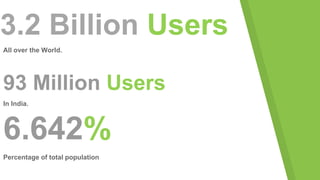
3.2 Billion Users
All over the World.
6.642%
Percentage of total population
93 Million Users
In India.
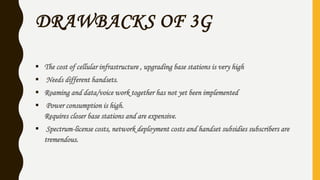
DRAWBACKS OF 3G
 The cost of cellular infrastructure , upgrading base stations is very high
 Needs different handsets.
 Roaming and data/voice work together has not yet been implemented
 Power consumption is high.
Requires closer base stations and are expensive.
 Spectrum-license costs, network deployment costs and handset subsidies subscribers are
tremendous.
4G
T H E L E V E L W H I C H I S C U R R E N T L Y R U L I N G T H E
W O R L D .
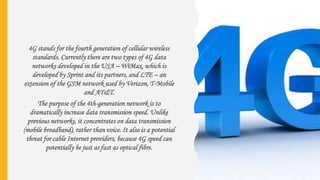
4G stands for the fourth generation of cellular wireless
standards. Currently there are two types of 4G data
networks developed in the USA – WiMax, which is
developed by Sprint and its partners, and LTE – an
extension of the GSM network used by Verizon, T-Mobile
and AT&T.
The purpose of the 4th-generation network is to
dramatically increase data transmission speed. Unlike
previous networks, it concentrates on data transmission
(mobile broadband), rather than voice. It also is a potential
threat for cable Internet providers, because 4G speed can
potentially be just as fast as optical fibre.
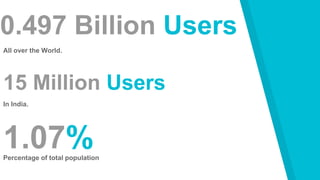
0.497 Billion Users
All over the World.
1.07%Percentage of total population
15 Million Users
In India.
DRAWBACKS OF 4G
• It’s actual high speeds are only restricted to specific cities in the world.
• It is quite expensive.
• People require new devices to run 4G and most devices only claim to support 4G but
actually don’t .
• 4G mobile networks use multiple antennae and transmitters and hence, users would
experience much poorer battery life on their mobile devices, while on this network.
• Cities having 4G don’t actually have so many network towers which actually supply the
high speed signals.
3G V/S 4G
PROCEEDING TOWARDS THE MAIN TOPIC
SO…….
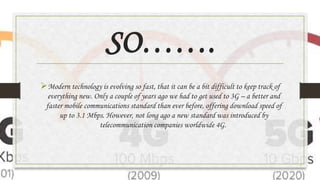
Modern technology is evolving so fast, that it can be a bit difficult to keep track of
everything new. Only a couple of years ago we had to get used to 3G – a better and
faster mobile communications standard than ever before, offering download speed of
up to 3.1 Mbps. However, not long ago a new standard was introduced by
telecommunication companies worldwide 4G.
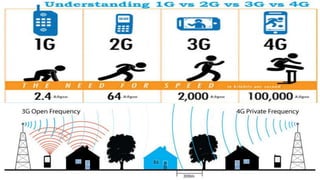
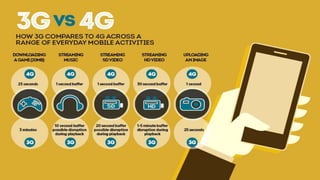
 The main difference between 3G and 4G is
speed. 4G speeds can be up to 10 times faster
than 3G, similar to the speed difference
between DSL and high-speed cable modem.
This speed difference is significant enough for
people to completely abandon 3G mobile
broadband as soon as there is sufficient 4G
network coverage.
• Another significant advantage of 4G over 3G is QoS
support. QoS (Quality of Service) , is a technology
that is used by land-based data networks. Basically,
QoS makes it possible to vary priority levels for
different data streams. For example, watching
online HD videos – they usually get higher priority
than other data. The implementation of QoS in 4G
networks will enable people to use VoIP
applications, such as Skype, on their mobile phones
without any loss of quality. It will also enable users
to watch high quality online videos straight from
their mobile devices.
VIDEO
S T
P E
E S
E T
D
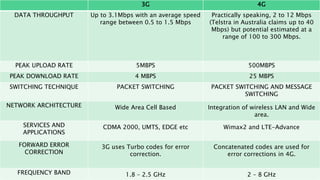
3G 4G
DATA THROUGHPUT Up to 3.1Mbps with an average speed
range between 0.5 to 1.5 Mbps
Practically speaking, 2 to 12 Mbps
(Telstra in Australia claims up to 40
Mbps) but potential estimated at a
range of 100 to 300 Mbps.
PEAK UPLOAD RATE 5MBPS 500MBPS
PEAK DOWNLOAD RATE 4 MBPS 25 MBPS
SWITCHING TECHNIQUE PACKET SWITCHING PACKET SWITCHING AND MESSAGE
SWITCHING
NETWORK ARCHITECTURE Wide Area Cell Based Integration of wireless LAN and Wide
area.
SERVICES AND
APPLICATIONS
CDMA 2000, UMTS, EDGE etc Wimax2 and LTE-Advance
FORWARD ERROR
CORRECTION
3G uses Turbo codes for error
correction.
Concatenated codes are used for
error corrections in 4G.
FREQUENCY BAND 1.8 – 2.5 GHz 2 – 8 GHz
How is 3G better than 4G
?????
• All of us know the fact that 3G has been in the
market for a quite long time now and because
of this reason it is available almost everywhere
in the world and has appropriate network
towers set up everywhere . And the 4G is still
limited to specific countries and does not have
appropriate network towers.
• Compared to 4G the 3G network is quite cheap.
• 3G networks mostly don’t affect the battery life
of the devices which the 4G networks do .
• For countries like India- the developing
countries, it is more important for people to
first use 3G than directly jumping to 4G as this
would contribute to the overall development of
the country.
VIDEO
BIBLIOGRAPHY
 http://mobiledevices.about.com/od/carrierfaq/a/4g-Mobile-Networks-The-
Pros-And-The-Cons.htm
 http://www.whatisnetworking.net/tag/4g-technology-advantages-and-
disadvantages/
 http://www.techweekeurope.co.uk/mobility/4g/4g-subscriptions-lte-users-
164428
 http://www.business-standard.com/article/pti-stories/india-likely-to-have-
10-15-mn-4g-subscribers-by-dec-2015-pwc-114122100090_1.html
 https://www.itu.int/en/ITU-
D/Statistics/Documents/facts/ICTFactsFigures2015.pdf
3G V/S 4G

3G V/S 4G

  • 2.
    3G VS 4GCOMMUNICATION A LOOK AT THE DEVELOPING TECHNOLOGY……
  • 3.
    CONTENTS 1. •INTRODUCTION 2. • 3G •DRAWBACKS ; USERS WORLDWIDE 3. • 4G • DRAWBACKS ; USERS WORLDWIDE 4. 5. 6. • 3G V/S 4G - THE MAIN TOPIC • BIBLIOGRAPHY • THANK YOU!!!
  • 4.
    “ Wireless communication isamong technology’s biggest contributions to mankind. Wireless communication involves the transmission of information over a distance without help of wires, cables or any other forms of electrical conductors. The transmitted distance can be anywhere between a few meters (for example, a television’s remote control) and thousands of kilometer's (for example, radio communication). Some of the devices used for wireless communication are cordless telephones, mobiles, GPS units, wireless computer parts, and satellite television. Let us take a look at these developing technologies………
  • 5.
    3G T H EL E V E L W H I C H H A S B E E N L E F T B E H I N D .
  • 6.
    • 3G, shortform of third generation, is the third generation of mobile telecommunications technology. This is based on a set of standards used for mobile devices and mobile telecommunications use services and networks that comply with the International Mobile Telecommunications-2000 (IMT-2000) specifications by the International Telecommunication Union. 3G finds application in wireless voice telephony, mobile Internet access, fixed wireless Internet access, video calls and mobile TV.
  • 7.
    • Several telecommunicationscompanies market wireless mobile Internet services as 3G, indicating that the advertised service is provided over a 3G wireless network. Services advertised as 3G are required to meet IMT-2000 technical standards, including standards for reliability and speed (data transfer rates). To meet the IMT-2000 standards, a system is required to provide peak data rates of at least 200 kbp/s (about 0.2 Mbp/s).
  • 8.
    3.2 Billion Users Allover the World. 6.642% Percentage of total population 93 Million Users In India.
  • 9.
    DRAWBACKS OF 3G The cost of cellular infrastructure , upgrading base stations is very high  Needs different handsets.  Roaming and data/voice work together has not yet been implemented  Power consumption is high. Requires closer base stations and are expensive.  Spectrum-license costs, network deployment costs and handset subsidies subscribers are tremendous.
  • 10.
    4G T H EL E V E L W H I C H I S C U R R E N T L Y R U L I N G T H E W O R L D .
  • 11.
    4G stands forthe fourth generation of cellular wireless standards. Currently there are two types of 4G data networks developed in the USA – WiMax, which is developed by Sprint and its partners, and LTE – an extension of the GSM network used by Verizon, T-Mobile and AT&T. The purpose of the 4th-generation network is to dramatically increase data transmission speed. Unlike previous networks, it concentrates on data transmission (mobile broadband), rather than voice. It also is a potential threat for cable Internet providers, because 4G speed can potentially be just as fast as optical fibre.
  • 12.
    0.497 Billion Users Allover the World. 1.07%Percentage of total population 15 Million Users In India.
  • 13.
    DRAWBACKS OF 4G •It’s actual high speeds are only restricted to specific cities in the world. • It is quite expensive. • People require new devices to run 4G and most devices only claim to support 4G but actually don’t . • 4G mobile networks use multiple antennae and transmitters and hence, users would experience much poorer battery life on their mobile devices, while on this network. • Cities having 4G don’t actually have so many network towers which actually supply the high speed signals.
  • 14.
    3G V/S 4G PROCEEDINGTOWARDS THE MAIN TOPIC
  • 15.
    SO……. Modern technology isevolving so fast, that it can be a bit difficult to keep track of everything new. Only a couple of years ago we had to get used to 3G – a better and faster mobile communications standard than ever before, offering download speed of up to 3.1 Mbps. However, not long ago a new standard was introduced by telecommunication companies worldwide 4G.
  • 16.
     The maindifference between 3G and 4G is speed. 4G speeds can be up to 10 times faster than 3G, similar to the speed difference between DSL and high-speed cable modem. This speed difference is significant enough for people to completely abandon 3G mobile broadband as soon as there is sufficient 4G network coverage.
  • 17.
    • Another significantadvantage of 4G over 3G is QoS support. QoS (Quality of Service) , is a technology that is used by land-based data networks. Basically, QoS makes it possible to vary priority levels for different data streams. For example, watching online HD videos – they usually get higher priority than other data. The implementation of QoS in 4G networks will enable people to use VoIP applications, such as Skype, on their mobile phones without any loss of quality. It will also enable users to watch high quality online videos straight from their mobile devices.
  • 18.
  • 20.
    3G 4G DATA THROUGHPUTUp to 3.1Mbps with an average speed range between 0.5 to 1.5 Mbps Practically speaking, 2 to 12 Mbps (Telstra in Australia claims up to 40 Mbps) but potential estimated at a range of 100 to 300 Mbps. PEAK UPLOAD RATE 5MBPS 500MBPS PEAK DOWNLOAD RATE 4 MBPS 25 MBPS SWITCHING TECHNIQUE PACKET SWITCHING PACKET SWITCHING AND MESSAGE SWITCHING NETWORK ARCHITECTURE Wide Area Cell Based Integration of wireless LAN and Wide area. SERVICES AND APPLICATIONS CDMA 2000, UMTS, EDGE etc Wimax2 and LTE-Advance FORWARD ERROR CORRECTION 3G uses Turbo codes for error correction. Concatenated codes are used for error corrections in 4G. FREQUENCY BAND 1.8 – 2.5 GHz 2 – 8 GHz
  • 23.
    How is 3Gbetter than 4G ????? • All of us know the fact that 3G has been in the market for a quite long time now and because of this reason it is available almost everywhere in the world and has appropriate network towers set up everywhere . And the 4G is still limited to specific countries and does not have appropriate network towers. • Compared to 4G the 3G network is quite cheap. • 3G networks mostly don’t affect the battery life of the devices which the 4G networks do . • For countries like India- the developing countries, it is more important for people to first use 3G than directly jumping to 4G as this would contribute to the overall development of the country.
  • 24.
  • 26.
    BIBLIOGRAPHY  http://mobiledevices.about.com/od/carrierfaq/a/4g-Mobile-Networks-The- Pros-And-The-Cons.htm  http://www.whatisnetworking.net/tag/4g-technology-advantages-and- disadvantages/ http://www.techweekeurope.co.uk/mobility/4g/4g-subscriptions-lte-users- 164428  http://www.business-standard.com/article/pti-stories/india-likely-to-have- 10-15-mn-4g-subscribers-by-dec-2015-pwc-114122100090_1.html  https://www.itu.int/en/ITU- D/Statistics/Documents/facts/ICTFactsFigures2015.pdf