Enabling Open
Software Project
Management data
with Antipatterns
Mindtrek2015, Tampere 22-24 September 2015
Prof. Panos FITSILIS, fitsilis@teilar.gr, Technological
Educational Institute of Thessaly, Greece
Dr. Dimitrios Settas, Consultant
Prof. Ioannis Stamelos, Kyriakos Tilentzidis, Ilias Moustakas,
Aristotle University of Thessaloniki, Greece
Contents
 The ONSOCIAL project
 The case study under discussion
 Patterns and antipatterns
 ArC Crawler, the ontology data collection process
 antipattern detection system DENSE
 Conclusions, further work
1
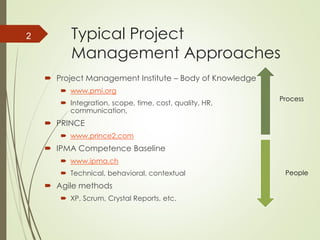
Typical Project
Management Approaches
 Project Management Institute – Body of Knowledge
 www.pmi.org
 Integration, scope, time, cost, quality, HR,
communication,
 PRINCE
 www.prince2.com
 IPMA Competence Baseline
 www.ipma.ch
 Technical, behavioral, contextual
 Agile methods
 XP, Scrum, Crystal Reports, etc.
Process
People
2
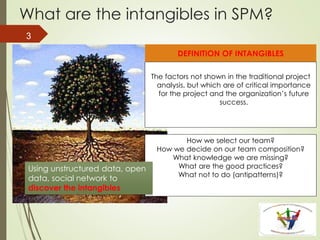
What are the intangibles in SPM?
DEFINITION OF INTANGIBLES
The factors not shown in the traditional project
analysis, but which are of critical importance
for the project and the organization’s future
success.
How we select our team?
How we decide on our team composition?
What knowledge we are missing?
What are the good practices?
What not to do (antipatterns)?
Using unstructured data, open
data, social network to
discover the intangibles
3
ONSOCIAL project
 Two major cases studies up to now
 How to locate experts with specific technical and
behavioral skills?
 a) what constitutes expertise evidence
 Technical skills and
 Behavioural skills
 b) how to identify expertise when project artifacts
 How to locate antipatterns?
 locate antipatterns
 Transform data to open data
Research question 1-
Expert location problem
 How to locate experts with specific technical
and behavioral skills?
 a) what constitutes expertise evidence
 Technical skills and
 Behavioural skills
 b) how to identify expertise when project artifacts
Research question –
Measure Social Capital
 Ego network size index for measuring the diversity
(different) of contacts.
 Ego average tie strength index for measuring the tie
strengths, which is the frequency of communication or
collaboration between two actors.
 Ego betweenness centrality index for measuring the
structural position (control the communication flow within
the group of people).
 Individual effectiveness index for measuring brokerage
and diversity.
 Contact status (power) for measuring the embeddedness
of resources. Power is measured either
 by degree centrality
 by betweenness centrality
…
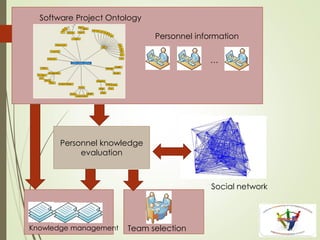
Software Project Ontology
Personnel information
Personnel knowledge
evaluation
Knowledge management Team selection
Social network
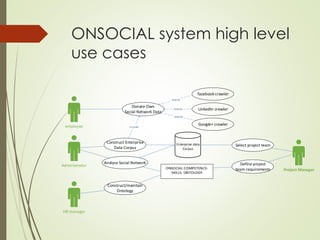
ONSOCIAL system high level
use cases
employee
Donate Own
Social Network Data
facebook crawler
extend
LinkedIn crawler
Google+ crawler
extend
extend
Administrator
Construct Enterprise
Data Corpus
Define project
team requirements Project Manager
Select project team
Analyse Social Network
Enterprise data
Corpus
Construct/maintain
Ontology
HR manager
include
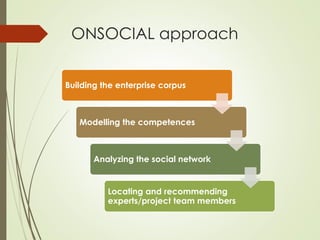
Building the enterprise corpus
Modelling the competences
Analyzing the social network
Locating and recommending
experts/project team members
ONSOCIAL approach
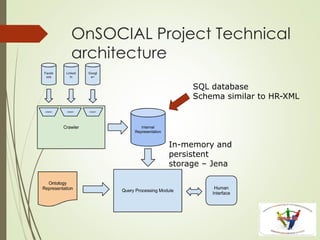
OnSOCIAL Project Technical
architecture
SQL database
Schema similar to HR-XML
In-memory and
persistent
storage – Jena
Research question 2-
SPM antipatterns
 How to locate software project management
antipatterns
 How to categorize antipatterns?
 How to make them available for collaborative
development?
What is an antipattern?
 An anti-pattern (or antipattern) is a common response
to a recurring problem that is usually ineffective and
risks being highly counterproductive. “Negative
Solutions,” or solutions that present more problems
than they address.
 natural extensions to design patterns
 Provide Knowledge to prevent and recover from
common Mistakes.
 The term, coined in 1995 by Andrew Koenig,was
inspired by a book, Design Patterns, which highlights a
number of design patterns in software development
that its authors considered to be highly reliable and
effective.
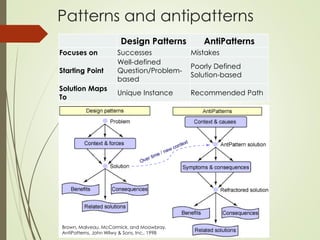
Patterns and antipatterns
Design Patterns AntiPatterns
Focuses on Successes Mistakes
Starting Point
Well-defined
Question/Problem-
based
Poorly Defined
Solution-based
Solution Maps
To
Unique Instance Recommended Path
Brown, Malveau, McCormick, and Moowbray.
AntiPatterns. John Wilwy & Sons, Inc.. 1998
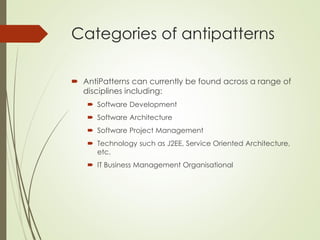
Categories of antipatterns
 AntiPatterns can currently be found across a range of
disciplines including:
 Software Development
 Software Architecture
 Software Project Management
 Technology such as J2EE, Service Oriented Architecture,
etc.
 IT Business Management Organisational
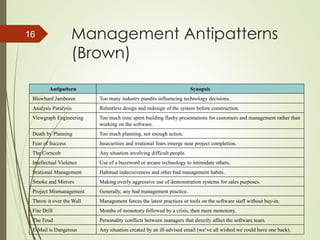
16
Antipattern Synopsis
Blowhard Jamboree Too many industry pundits influencing technology decisions.
Analysis Paralysis Relentless design and redesign of the system before construction.
Viewgraph Engineering Too much time spent building flashy presentations for customers and management rather than
working on the software.
Death by Planning Too much planning, not enough action.
Fear of Success Insecurities and irrational fears emerge near project completion.
The Corncob Any situation involving difficult people.
Intellectual Violence Use of a buzzword or arcane technology to intimidate others.
Irrational Management Habitual indecisiveness and other bad management habits.
Smoke and Mirrors Making overly aggressive use of demonstration systems for sales purposes.
Project Mismanagement Generally, any bad management practice.
Throw it over the Wall Management forces the latest practices or tools on the software staff without buy-in.
Fire Drill Months of monotony followed by a crisis, then more monotony.
The Feud Personality conflicts between managers that directly affect the software team.
E-Mail is Dangerous Any situation created by an ill-advised email (we’ve all wished we could have one back).
Management Antipatterns
(Brown)
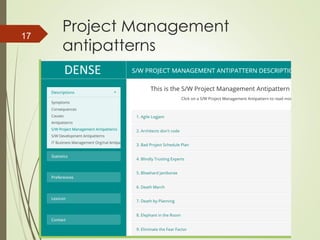
Project Management
antipatterns
17
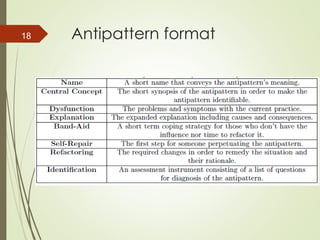
18 Antipattern format
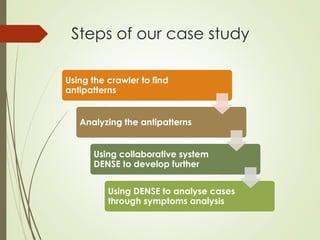
Steps of our case study
Using the crawler to find
antipatterns
Analyzing the antipatterns
Using collaborative system
DENSE to develop further
Using DENSE to analyse cases
through symptoms analysis
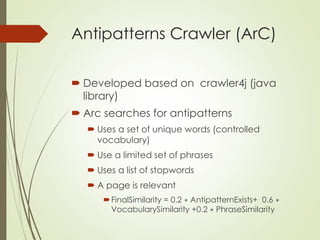
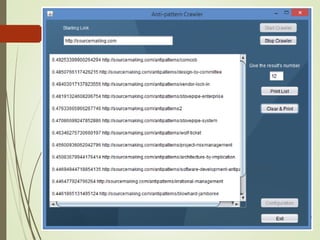
Antipatterns Crawler (ArC)
 Developed based on crawler4j (java
library)
 Arc searches for antipatterns
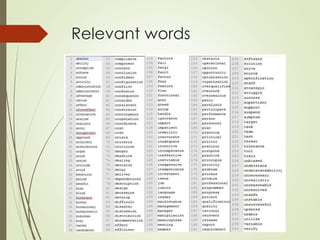
 Uses a set of unique words (controlled
vocabulary)
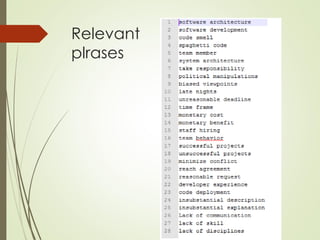
 Use a limited set of phrases
 Uses a list of stopwords
 A page is relevant
FinalSimilarity = 0.2 ∗ AntipatternExists+ 0.6 ∗
VocabularySimilarity +0.2 ∗ PhraseSimilarity
Relevant words
Relevant
plrases
Results from our experiment
 The execution of ArC took place using the antipatterns
 Wikipedia page [11] and lasted approximately 50 hours.
 Project Management Institute (PMI) Web Page and
lasted approximately 75 hours.
 ZDNet.com (a business technology news website) and
 Personal blogs
 47 antipatterns were detected and were found in 10 different
Web pages.
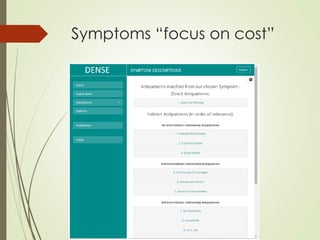
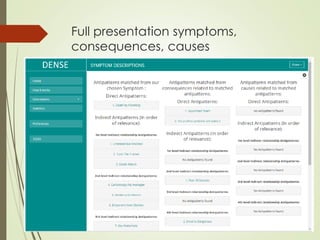
DENSE system
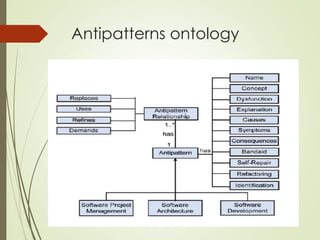
 Based on ontology developed web protege
 Uses reasoner to find
 Symptoms lead to
 Concenquences
 Causes
 Antipatterns
Symptoms “focus on cost”
Full presentation symptoms,
consequences, causes
Conclusion
 We have presented
 Project management experiments
 Analysis data from social networks
 Analysis of web data
 Using crawling
 Using ontologies
 Building implicit knowledge that can offer new set of
tools for assisting project management
Antipatterns ontology

Mindtrek 2015 - Tampere Finland

  • 1.
    Enabling Open Software Project Managementdata with Antipatterns Mindtrek2015, Tampere 22-24 September 2015 Prof. Panos FITSILIS, fitsilis@teilar.gr, Technological Educational Institute of Thessaly, Greece Dr. Dimitrios Settas, Consultant Prof. Ioannis Stamelos, Kyriakos Tilentzidis, Ilias Moustakas, Aristotle University of Thessaloniki, Greece
  • 2.
    Contents  The ONSOCIALproject  The case study under discussion  Patterns and antipatterns  ArC Crawler, the ontology data collection process  antipattern detection system DENSE  Conclusions, further work 1
  • 3.
    Typical Project Management Approaches Project Management Institute – Body of Knowledge  www.pmi.org  Integration, scope, time, cost, quality, HR, communication,  PRINCE  www.prince2.com  IPMA Competence Baseline  www.ipma.ch  Technical, behavioral, contextual  Agile methods  XP, Scrum, Crystal Reports, etc. Process People 2
  • 4.
    What are theintangibles in SPM? DEFINITION OF INTANGIBLES The factors not shown in the traditional project analysis, but which are of critical importance for the project and the organization’s future success. How we select our team? How we decide on our team composition? What knowledge we are missing? What are the good practices? What not to do (antipatterns)? Using unstructured data, open data, social network to discover the intangibles 3
  • 5.
    ONSOCIAL project  Twomajor cases studies up to now  How to locate experts with specific technical and behavioral skills?  a) what constitutes expertise evidence  Technical skills and  Behavioural skills  b) how to identify expertise when project artifacts  How to locate antipatterns?  locate antipatterns  Transform data to open data
  • 6.
    Research question 1- Expertlocation problem  How to locate experts with specific technical and behavioral skills?  a) what constitutes expertise evidence  Technical skills and  Behavioural skills  b) how to identify expertise when project artifacts
  • 7.
    Research question – MeasureSocial Capital  Ego network size index for measuring the diversity (different) of contacts.  Ego average tie strength index for measuring the tie strengths, which is the frequency of communication or collaboration between two actors.  Ego betweenness centrality index for measuring the structural position (control the communication flow within the group of people).  Individual effectiveness index for measuring brokerage and diversity.  Contact status (power) for measuring the embeddedness of resources. Power is measured either  by degree centrality  by betweenness centrality
  • 8.
    … Software Project Ontology Personnelinformation Personnel knowledge evaluation Knowledge management Team selection Social network
  • 9.
    ONSOCIAL system highlevel use cases employee Donate Own Social Network Data facebook crawler extend LinkedIn crawler Google+ crawler extend extend Administrator Construct Enterprise Data Corpus Define project team requirements Project Manager Select project team Analyse Social Network Enterprise data Corpus Construct/maintain Ontology HR manager include
  • 10.
    Building the enterprisecorpus Modelling the competences Analyzing the social network Locating and recommending experts/project team members ONSOCIAL approach
  • 11.
    OnSOCIAL Project Technical architecture SQLdatabase Schema similar to HR-XML In-memory and persistent storage – Jena
  • 12.
    Research question 2- SPMantipatterns  How to locate software project management antipatterns  How to categorize antipatterns?  How to make them available for collaborative development?
  • 13.
    What is anantipattern?  An anti-pattern (or antipattern) is a common response to a recurring problem that is usually ineffective and risks being highly counterproductive. “Negative Solutions,” or solutions that present more problems than they address.  natural extensions to design patterns  Provide Knowledge to prevent and recover from common Mistakes.  The term, coined in 1995 by Andrew Koenig,was inspired by a book, Design Patterns, which highlights a number of design patterns in software development that its authors considered to be highly reliable and effective.
  • 14.
    Patterns and antipatterns DesignPatterns AntiPatterns Focuses on Successes Mistakes Starting Point Well-defined Question/Problem- based Poorly Defined Solution-based Solution Maps To Unique Instance Recommended Path Brown, Malveau, McCormick, and Moowbray. AntiPatterns. John Wilwy & Sons, Inc.. 1998
  • 15.
    Categories of antipatterns AntiPatterns can currently be found across a range of disciplines including:  Software Development  Software Architecture  Software Project Management  Technology such as J2EE, Service Oriented Architecture, etc.  IT Business Management Organisational
  • 16.
    16 Antipattern Synopsis Blowhard JamboreeToo many industry pundits influencing technology decisions. Analysis Paralysis Relentless design and redesign of the system before construction. Viewgraph Engineering Too much time spent building flashy presentations for customers and management rather than working on the software. Death by Planning Too much planning, not enough action. Fear of Success Insecurities and irrational fears emerge near project completion. The Corncob Any situation involving difficult people. Intellectual Violence Use of a buzzword or arcane technology to intimidate others. Irrational Management Habitual indecisiveness and other bad management habits. Smoke and Mirrors Making overly aggressive use of demonstration systems for sales purposes. Project Mismanagement Generally, any bad management practice. Throw it over the Wall Management forces the latest practices or tools on the software staff without buy-in. Fire Drill Months of monotony followed by a crisis, then more monotony. The Feud Personality conflicts between managers that directly affect the software team. E-Mail is Dangerous Any situation created by an ill-advised email (we’ve all wished we could have one back). Management Antipatterns (Brown)
  • 17.
  • 18.
  • 19.
    Steps of ourcase study Using the crawler to find antipatterns Analyzing the antipatterns Using collaborative system DENSE to develop further Using DENSE to analyse cases through symptoms analysis
  • 20.
    Antipatterns Crawler (ArC) Developed based on crawler4j (java library)  Arc searches for antipatterns  Uses a set of unique words (controlled vocabulary)  Use a limited set of phrases  Uses a list of stopwords  A page is relevant FinalSimilarity = 0.2 ∗ AntipatternExists+ 0.6 ∗ VocabularySimilarity +0.2 ∗ PhraseSimilarity
  • 21.
  • 22.
  • 23.
    Results from ourexperiment  The execution of ArC took place using the antipatterns  Wikipedia page [11] and lasted approximately 50 hours.  Project Management Institute (PMI) Web Page and lasted approximately 75 hours.  ZDNet.com (a business technology news website) and  Personal blogs  47 antipatterns were detected and were found in 10 different Web pages.
  • 25.
    DENSE system  Basedon ontology developed web protege  Uses reasoner to find  Symptoms lead to  Concenquences  Causes  Antipatterns
  • 26.
  • 27.
  • 28.
    Conclusion  We havepresented  Project management experiments  Analysis data from social networks  Analysis of web data  Using crawling  Using ontologies  Building implicit knowledge that can offer new set of tools for assisting project management
  • 29.