Apple Inc. (previously Apple Computer, Inc.) isan American
multinational corporation that designsand marketsconsumer
electronics, computer software, and personal computers.
AppleInc. ignited thepersonal computer revolution in the1970s
with theAppleII and sincethen hasbeen reinventing and
innovating not only computers, but also other electronic goodsand
services.
Thecompany'sbest-known productsincludetheMacintosh lineof
computers, theiPod, theiPhoneand theiPad.
Asof July 2011, thecompany operates317 retail storesin ten
countries,and an onlinestorewherehardwareand software
productsaresold.
INTRODUCTION
“Man isthecreator of changein thisworld.
Assuch heshould beabovesystemsand
structures, and not subordinateto them.”
VISION
“theCompany iscommitted to bringing thebest
personal computing, portabledigital music and
mobilecommunication experienceto students,
educators, creativeprofessionals, businesses,
government agencies, and consumersthrough its
innovativehardware, software, peripherals,
services, and Internet offerings.”
MISSION
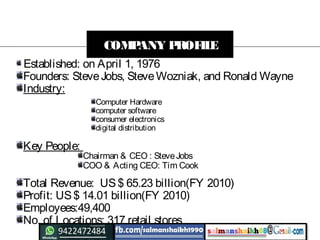
Established: on April 1, 1976
Founders: SteveJobs, SteveWozniak, and Ronald Wayne
Industry:
Key People:
Total Revenue: US$ 65.23 billion(FY 2010)
Profit: US$ 14.01 billion(FY 2010)
Employees:49,400
No. of Locations: 317 retail stores
COMPANY PROFILE
Computer Hardware
computer software
consumer electronics
digital distribution
Chairman & CEO : SteveJobs
COO & Acting CEO: Tim Cook
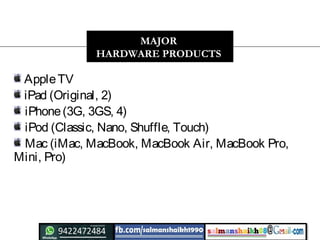
AppleTV 
iPad (Original, 2) 
iPhone (3G, 3GS, 4) 
iPod (Classic, Nano, Shuffle, Touch)
Mac (iMac, MacBook, MacBook Air, MacBook Pro,
Mini, Pro)
MAJOR
HARDWARE PRODUCTS
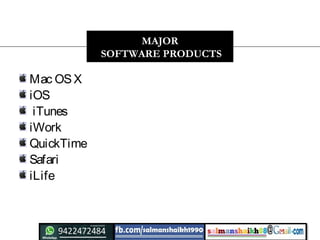
Mac OSX
iOS
 iTunes
iWork 
QuickTime
Safari
iLife
MAJOR
SOFTWARE PRODUCTS
 AppleStore (online)
 App Store
Certifications
GameCenter
iAd 
iBookstore 
iTunesSto re
iWork.com
 iCloud 
STORES AND SERVICES
Emagic 
 FingerWorks 
 Intrinsity 
NeXT  
 Nothing Real  
P.A. Semi
 Silicon Color
Siri 
SpruceTechnologies
ACQUISITIONS
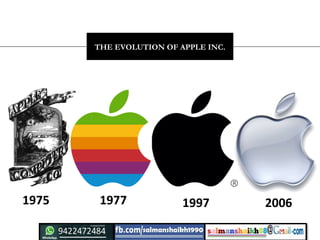
THE EVOLUTION OF APPLE INC.
2006199719771975
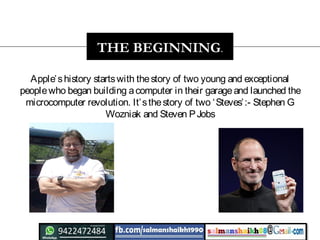
Apple’shistory startswith thestory of two young and exceptional
peoplewho began building acomputer in their garageand launched the
microcomputer revolution. It’sthestory of two ‘Steves’:- Stephen G
Wozniak and Steven PJobs
THE BEGINNING.
THE BEGINNING
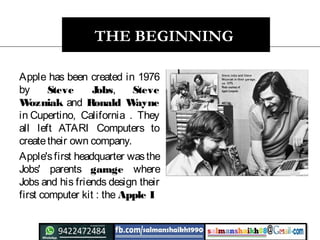
Apple has been created in 1976
by Steve Jobs, Steve
Wozniak and Ronald Wayne
in Cupertino, California . They
all left ATARI Computers to
createtheir own company.
Apple'sfirst headquarter wasthe
Jobs' parents garage where
Jobs and his friends design their
first computer kit : the Apple I
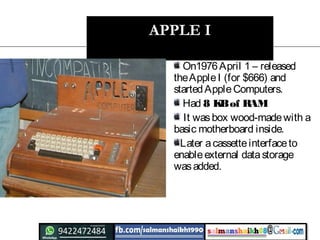
APPLE I
On1976April 1 – released
theAppleI (for $666) and
startedAppleComputers.
Had 8 KBof RAM
It wasbox wood-madewith a
basic motherboard inside.
Later acassetteinterfaceto
enableexternal datastorage
wasadded.
15
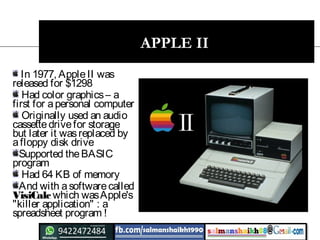
APPLE II
In 1977, AppleII was
released for $1298
Had color graphics– a
first for apersonal computer
Originally used an audio
cassettedrivefor storage
but later it wasreplaced by
afloppy disk drive
Supported theBASIC
program
Had 64 KB of memory
And with asoftwarecalled
VisiCalc which wasApple's
"killer application" : a
spreadsheet program !
In 1979 Jobsand someother Appleemployeesvisited
theXerox PARC( Palo Alto Research Centre). There
they saw Xerox Alto. “Theenvironment of thescreen
wasgraphically based” with icons, with amousefor
pointing at them, windowsand pull-down menus. Thus
theuser could ”interact easily with thecomputer
without ever typing asingleletter”
EXTRA SHOT
Apple III
 Released May 1980
 Had 128K of RAM
 Designed for businesses– expensive!! > $4300!!!
 Had lotsof problems– didn’t do well..
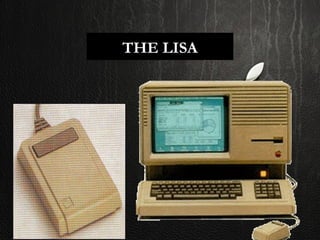
Apple Lisa
 Released in 1983
 Becamethefirst personal computer sold to thepublic with
aGUI. Aimed at largebusinesses
 Commercial failuredueto high pricetag (almost $10,000)
and limited softwareit could run
OTHER
EARLY ENDEAVORS
LISA
18
THE LISA
20
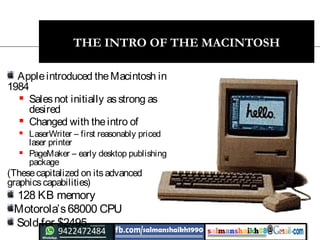
THE INTRO OF THE MACINTOSH
Appleintroduced theMacintosh in
1984
 Salesnot initially asstrong as
desired
 Changed with theintro of
 LaserWriter – first reasonably priced
laser printer
 PageMaker – early desktop publishing
package
(Thesecapitalized on itsadvanced
graphicscapabilities)
128 KB memory
Motorola’s68000 CPU
Sold for $2495
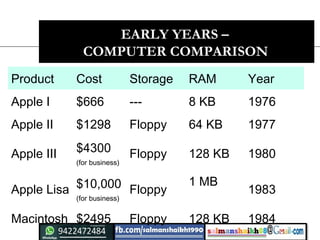
EARLY YEARS –
COMPUTER COMPARISON
Product Cost Storage RAM Year
Apple I $666 --- 8 KB 1976
Apple II $1298 Floppy 64 KB 1977
Apple III $4300
(for business)
Floppy 128 KB 1980
Apple Lisa $10,000
(for business)
Floppy
1 MB
1983
Macintosh $2495 Floppy 128 KB 1984
1985: dueto somepower strugglebetween Jobs and
then CEO John Sculley, Jobsresignsfrom Apple
Computersand started anew company NeXTInc.
EXTRA SHOT…
23
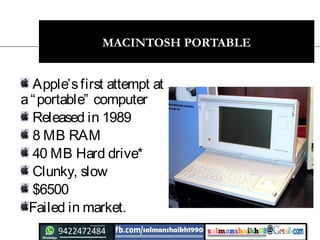
MACINTOSH PORTABLE
Apple’sfirst attempt at
a“portable” computer
Released in 1989
8 MB RAM
40 MB Hard drive*
Clunky, slow
$6500
Failed in market.
24
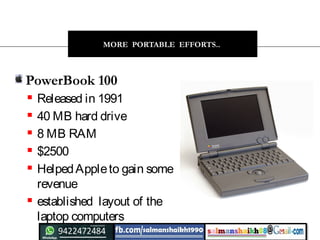
MORE PORTABLE EFFORTS..
PowerBook 100
 Released in 1991
 40 MB hard drive
 8 MB RAM
 $2500
 HelpedAppleto gain some
revenue
 established  layout of the
laptop computers
1991:System 7- upgraded OSwhich added colour to
interfacesand new networking capabilities
ThePerfo rma linesof Macintosh LC- adisaster
Appletastesfailuresof many other productsincluding
digital cameras, portableCD audio players, speakers,
video consoles, and TV appliances
Microsoft gainsmarket with cheap commodity
personal computers
1994: Appleallied with IBMand Mo to ro la in theAIM
alliance.
1991-’95
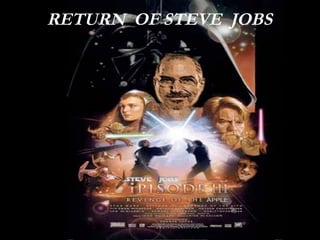
RETURN OF STEVE JOBS
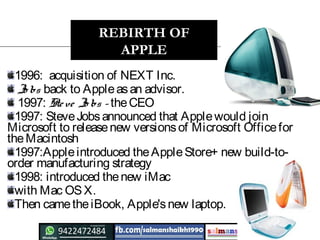
1996: acquisition of NEXT Inc.
Jo bs back to Appleasan advisor.
1997: Steve Jo bs – theCEO
1997: SteveJobsannounced that Applewould join
Microsoft to releasenew versionsof Microsoft Officefor
theMacintosh
1997:Appleintroduced theAppleStore+ new build-to-
order manufacturing strategy
1998: introduced thenew iMac
with Mac OSX.
Then cametheiBook, Apple'snew laptop.
REBIRTH OF
APPLE
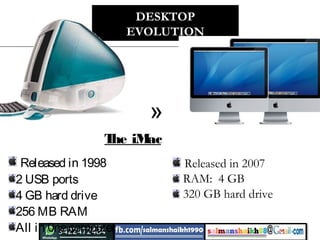
Released in 1998
2 USB ports
4 GB hard drive
256 MB RAM
All in 0necomputer
DESKTOP
EVOLUTION
The iMac
»
Released in 2007
RAM: 4 GB
320 GB hard drive
30
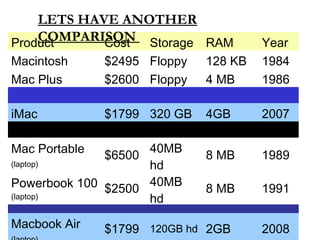
Product Cost Storage RAM Year
Macintosh $2495 Floppy 128 KB 1984
Mac Plus $2600 Floppy 4 MB 1986
iMac $1799 320 GB 4GB 2007
Mac Portable
(laptop)
$6500
40MB
hd
8 MB 1989
Powerbook 100
(laptop)
$2500
40MB
hd
8 MB 1991
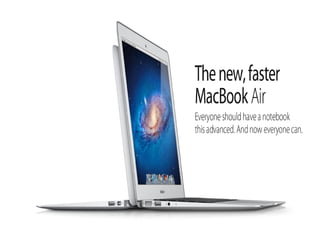
Macbook Air $1799 120GB hd 2GB 2008
LETS HAVE ANOTHER
COMPARISON
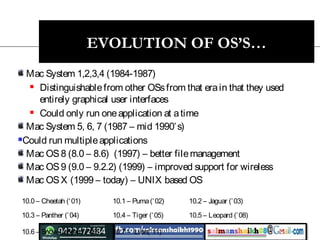
EVOLUTION OF OS’S…
Mac System 1,2,3,4 (1984-1987)
 Distinguishablefrom other OSsfrom that erain that they used
entirely graphical user interfaces
 Could only run oneapplication at atime
Mac System 5, 6, 7 (1987 – mid 1990’s)
Could run multipleapplications
Mac OS8 (8.0 – 8.6) (1997) – better filemanagement
Mac OS9 (9.0 – 9.2.2) (1999) – improved support for wireless
Mac OSX (1999 – today) – UNIX based OS
10.0 – Cheetah (‘01) 10.1 – Puma(‘02) 10.2 – Jaguar (’03)
10.3 – Panther (’04) 10.4 – Tiger (’05) 10.5 – Leopard (’08)
10.6 – Snow Leopard (’09) 10.7 – Lion(‘11)
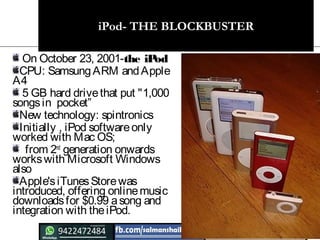
iPod- THE BLOCKBUSTER
On October 23, 2001-the iPod 
CPU: SamsungARM andApple
A4
 5 GB hard drivethat put "1,000
songsin pocket”
New technology: spintronics
Initially , iPod softwareonly
worked with Mac OS;
 from 2nd
generation onwards
workswith Microsoft Windows
also
Apple's iTunesStorewas
introduced, offering online music
downloads for $0.99 asong and
integration with theiPod.
Albert Fert and PeterGruenberg won the2007 Nobel
Prizefor physicsfor work that hasallowed hard disksto be
mademuch smaller for everything from laptopsto iPods
Theprizewasawarded for work on magnetoelectronics,
also known asspintronics.
It usesthespin of theelectron to storeand transport
information instead of theelectrical charge, meaning much
moreinformation could bekept in asmaller spacethan
before.
EXTRA SHOT..
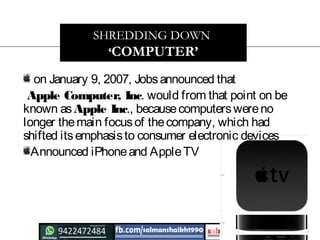
on January 9, 2007, Jobsannounced that
Apple Computer, Inc. would from that point on be
known asApple Inc., becausecomputerswereno
longer themain focusof thecompany, which had
shifted itsemphasisto consumer electronic devices
Announced iPhoneand AppleTV
SHREDDING DOWN
‘COMPUTER’
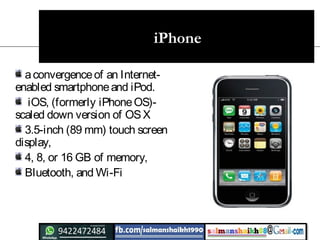
iPhone
 aconvergenceof an Internet-
enabled smartphone and iPod.
  iOS, (formerly iPhoneOS)-
scaled down version of OSX
3.5-inch (89 mm) touch screen
display,
4, 8, or 16 GB of memory, 
Bluetooth, and Wi-Fi
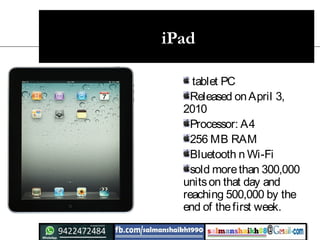
iPad
tablet PC
Released onApril 3,
2010
Processor: A4
256 MB RAM
Bluetooth n Wi-Fi
sold morethan 300,000
unitson that day and
reaching 500,000 by the
end of thefirst week.
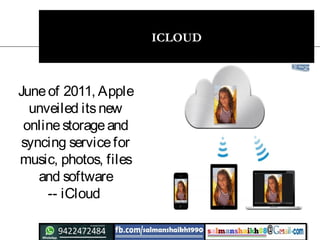
ICLOUD
Juneof 2011, Apple
unveiled itsnew
onlinestorageand
syncing servicefor
music, photos, files
and software
-- iCloud
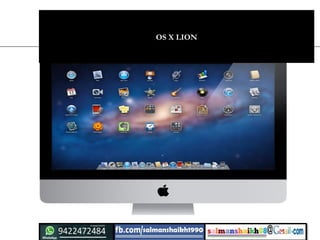
OS X LION
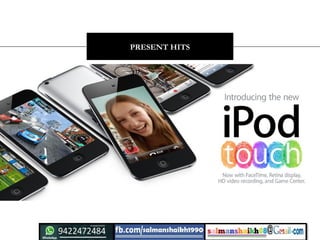
PRESENT HITS
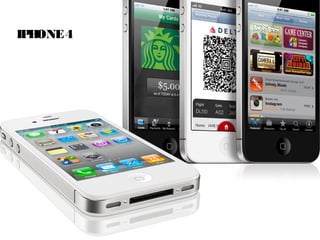
IPHONE4
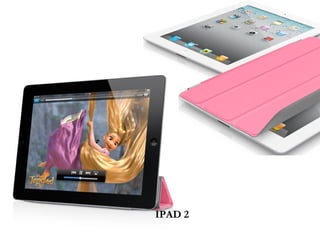
IPAD 2
AND THE UPCOMINGS..
iPhone5 (thisSeptember)
iOS5 (thisSeptember)
iPad3 (on testing)
iPhone-low cost version(on lab)
SOME BUSINESS THINGS
Differentiation Strategy
Value Creation
CORE COMPETENCIES
DIFFERENTIATION STRATEGY
UniqueFeaturesand characteristics
CommandsPremium Price
High Customer Service
Superior Quality
Prestige
Rapid Innovation
FF
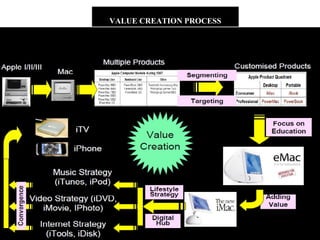
VALUE CREATION PROCESS
Focus On Education
eMac
Adding Value
iMac
Lifestyle Strategy
Digital Hub
Music Strategy (iTunes)
Video Strategy (iMovie)
Internet Strategy (iTools)
C
o
n
v
e
r
g
e
n
c
e
Apple I,II,III
Mac
Branding
Innovation
Differentiated Product
Easeof Use
Superior Quality
Retail Strategy
Marketing and Sales
Customer Loyalty
OnlineSales
High PriceProprietary System
NicheMarket
Cannibalization
strengths weaknesses
STRENGTHS& WEAKNESSES
Appleevokesaloyalty from itsworkersthat
information only leavesitscampuswhen SteveJobs
takesthestageto unveil it.
Secrecy at Appleisnot just theprevailing
communication strategy, but it isbaked in to their
corporateculture.
WORK CULTURE
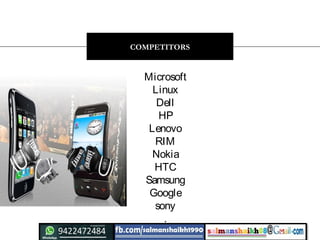
Microsoft
Linux
Dell
HP
Lenovo
RIM
Nokia
HTC
Samsung
Google
sony
.
COMPETITORS
WHERE APPLE STANDS NOW?
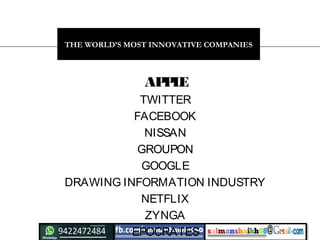
APPLE
TWITTER
FACEBOOK
NISSAN
GROUPON
GOOGLE
DRAWING INFORMATION INDUSTRY
NETFLIX
ZYNGA
EPOCRATES
THE WORLD’S MOST INNOVATIVE COMPANIES
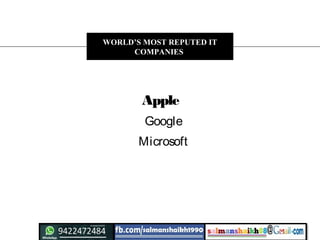
Apple
Google
Microsoft
WORLD’S MOST REPUTED IT
COMPANIES
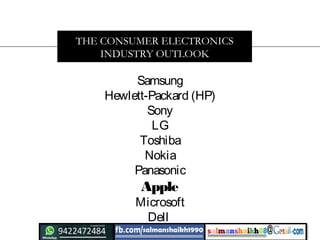
Samsung
Hewlett-Packard (HP)
Sony
LG
Toshiba
Nokia
Panasonic
Apple
Microsoft
Dell
THE CONSUMER ELECTRONICS
INDUSTRY OUTLOOK
LETS HAVE SOME MARKET
ANALYSIS
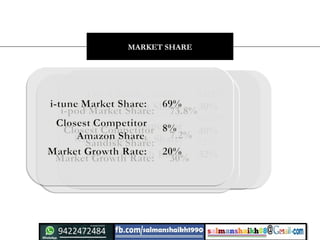
MARKET SHARE
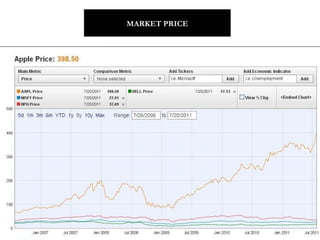
MARKET PRICE
BecauseApplethinksDifferent
from others
HOW?
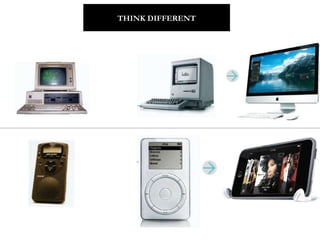
THINK DIFFERENT
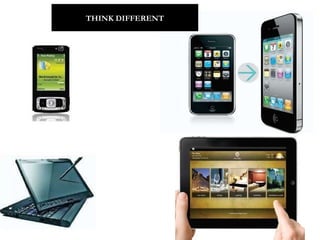
THINK DIFFERENT
CONCLUSION
For35 years Apple has been a trend-
settercompany able to foresee the
future of domestic computerand
consumerelectronics. it will probably
continue during the next decades.
because theirstrength is the
innovation . And they know, how to
‘think different’.
Apple, go on innovating…..
www.apple.com
en.wikipedia.org/wiki/Apple_Inc
www.technologyguardian.co.uk
TheEconomic Times
TheHindu
T3 –thegadget magazine
REFERENCES
48 apple story

48 apple story

  • 3.
    Apple Inc. (previouslyApple Computer, Inc.) isan American multinational corporation that designsand marketsconsumer electronics, computer software, and personal computers. AppleInc. ignited thepersonal computer revolution in the1970s with theAppleII and sincethen hasbeen reinventing and innovating not only computers, but also other electronic goodsand services. Thecompany'sbest-known productsincludetheMacintosh lineof computers, theiPod, theiPhoneand theiPad. Asof July 2011, thecompany operates317 retail storesin ten countries,and an onlinestorewherehardwareand software productsaresold. INTRODUCTION
  • 4.
    “Man isthecreator ofchangein thisworld. Assuch heshould beabovesystemsand structures, and not subordinateto them.” VISION
  • 5.
    “theCompany iscommitted tobringing thebest personal computing, portabledigital music and mobilecommunication experienceto students, educators, creativeprofessionals, businesses, government agencies, and consumersthrough its innovativehardware, software, peripherals, services, and Internet offerings.” MISSION
  • 6.
    Established: on April 1, 1976 Founders:SteveJobs, SteveWozniak, and Ronald Wayne Industry: Key People: Total Revenue: US$ 65.23 billion(FY 2010) Profit: US$ 14.01 billion(FY 2010) Employees:49,400 No. of Locations: 317 retail stores COMPANY PROFILE Computer Hardware computer software consumer electronics digital distribution Chairman & CEO : SteveJobs COO & Acting CEO: Tim Cook
  • 7.
  • 8.
  • 9.
  • 10.
    Emagic   FingerWorks   Intrinsity  NeXT    Nothing Real   P.A.Semi  Silicon Color Siri  SpruceTechnologies ACQUISITIONS
  • 11.
    THE EVOLUTION OFAPPLE INC. 2006199719771975
  • 12.
    Apple’shistory startswith thestoryof two young and exceptional peoplewho began building acomputer in their garageand launched the microcomputer revolution. It’sthestory of two ‘Steves’:- Stephen G Wozniak and Steven PJobs THE BEGINNING.
  • 13.
    THE BEGINNING Apple hasbeen created in 1976 by Steve Jobs, Steve Wozniak and Ronald Wayne in Cupertino, California . They all left ATARI Computers to createtheir own company. Apple'sfirst headquarter wasthe Jobs' parents garage where Jobs and his friends design their first computer kit : the Apple I
  • 14.
    APPLE I On1976April 1– released theAppleI (for $666) and startedAppleComputers. Had 8 KBof RAM It wasbox wood-madewith a basic motherboard inside. Later acassetteinterfaceto enableexternal datastorage wasadded.
  • 15.
    15 APPLE II In 1977,AppleII was released for $1298 Had color graphics– a first for apersonal computer Originally used an audio cassettedrivefor storage but later it wasreplaced by afloppy disk drive Supported theBASIC program Had 64 KB of memory And with asoftwarecalled VisiCalc which wasApple's "killer application" : a spreadsheet program !
  • 16.
    In 1979 Jobsandsomeother Appleemployeesvisited theXerox PARC( Palo Alto Research Centre). There they saw Xerox Alto. “Theenvironment of thescreen wasgraphically based” with icons, with amousefor pointing at them, windowsand pull-down menus. Thus theuser could ”interact easily with thecomputer without ever typing asingleletter” EXTRA SHOT
  • 17.
    Apple III  ReleasedMay 1980  Had 128K of RAM  Designed for businesses– expensive!! > $4300!!!  Had lotsof problems– didn’t do well.. Apple Lisa  Released in 1983  Becamethefirst personal computer sold to thepublic with aGUI. Aimed at largebusinesses  Commercial failuredueto high pricetag (almost $10,000) and limited softwareit could run OTHER EARLY ENDEAVORS
  • 18.
  • 19.
  • 20.
    20 THE INTRO OFTHE MACINTOSH Appleintroduced theMacintosh in 1984  Salesnot initially asstrong as desired  Changed with theintro of  LaserWriter – first reasonably priced laser printer  PageMaker – early desktop publishing package (Thesecapitalized on itsadvanced graphicscapabilities) 128 KB memory Motorola’s68000 CPU Sold for $2495
  • 21.
    EARLY YEARS – COMPUTERCOMPARISON Product Cost Storage RAM Year Apple I $666 --- 8 KB 1976 Apple II $1298 Floppy 64 KB 1977 Apple III $4300 (for business) Floppy 128 KB 1980 Apple Lisa $10,000 (for business) Floppy 1 MB 1983 Macintosh $2495 Floppy 128 KB 1984
  • 22.
    1985: dueto somepowerstrugglebetween Jobs and then CEO John Sculley, Jobsresignsfrom Apple Computersand started anew company NeXTInc. EXTRA SHOT…
  • 23.
    23 MACINTOSH PORTABLE Apple’sfirst attemptat a“portable” computer Released in 1989 8 MB RAM 40 MB Hard drive* Clunky, slow $6500 Failed in market.
  • 24.
    24 MORE PORTABLE EFFORTS.. PowerBook100  Released in 1991  40 MB hard drive  8 MB RAM  $2500  HelpedAppleto gain some revenue  established  layout of the laptop computers
  • 25.
    1991:System 7- upgradedOSwhich added colour to interfacesand new networking capabilities ThePerfo rma linesof Macintosh LC- adisaster Appletastesfailuresof many other productsincluding digital cameras, portableCD audio players, speakers, video consoles, and TV appliances Microsoft gainsmarket with cheap commodity personal computers 1994: Appleallied with IBMand Mo to ro la in theAIM alliance. 1991-’95
  • 26.
  • 27.
    1996: acquisition ofNEXT Inc. Jo bs back to Appleasan advisor. 1997: Steve Jo bs – theCEO 1997: SteveJobsannounced that Applewould join Microsoft to releasenew versionsof Microsoft Officefor theMacintosh 1997:Appleintroduced theAppleStore+ new build-to- order manufacturing strategy 1998: introduced thenew iMac with Mac OSX. Then cametheiBook, Apple'snew laptop. REBIRTH OF APPLE
  • 28.
    Released in 1998 2USB ports 4 GB hard drive 256 MB RAM All in 0necomputer DESKTOP EVOLUTION The iMac » Released in 2007 RAM: 4 GB 320 GB hard drive
  • 29.
    30 Product Cost StorageRAM Year Macintosh $2495 Floppy 128 KB 1984 Mac Plus $2600 Floppy 4 MB 1986 iMac $1799 320 GB 4GB 2007 Mac Portable (laptop) $6500 40MB hd 8 MB 1989 Powerbook 100 (laptop) $2500 40MB hd 8 MB 1991 Macbook Air $1799 120GB hd 2GB 2008 LETS HAVE ANOTHER COMPARISON
  • 30.
    EVOLUTION OF OS’S… MacSystem 1,2,3,4 (1984-1987)  Distinguishablefrom other OSsfrom that erain that they used entirely graphical user interfaces  Could only run oneapplication at atime Mac System 5, 6, 7 (1987 – mid 1990’s) Could run multipleapplications Mac OS8 (8.0 – 8.6) (1997) – better filemanagement Mac OS9 (9.0 – 9.2.2) (1999) – improved support for wireless Mac OSX (1999 – today) – UNIX based OS 10.0 – Cheetah (‘01) 10.1 – Puma(‘02) 10.2 – Jaguar (’03) 10.3 – Panther (’04) 10.4 – Tiger (’05) 10.5 – Leopard (’08) 10.6 – Snow Leopard (’09) 10.7 – Lion(‘11)
  • 32.
    iPod- THE BLOCKBUSTER OnOctober 23, 2001-the iPod  CPU: SamsungARM andApple A4  5 GB hard drivethat put "1,000 songsin pocket” New technology: spintronics Initially , iPod softwareonly worked with Mac OS;  from 2nd generation onwards workswith Microsoft Windows also Apple's iTunesStorewas introduced, offering online music downloads for $0.99 asong and integration with theiPod.
  • 33.
    Albert Fert andPeterGruenberg won the2007 Nobel Prizefor physicsfor work that hasallowed hard disksto be mademuch smaller for everything from laptopsto iPods Theprizewasawarded for work on magnetoelectronics, also known asspintronics. It usesthespin of theelectron to storeand transport information instead of theelectrical charge, meaning much moreinformation could bekept in asmaller spacethan before. EXTRA SHOT..
  • 34.
    on January 9,2007, Jobsannounced that Apple Computer, Inc. would from that point on be known asApple Inc., becausecomputerswereno longer themain focusof thecompany, which had shifted itsemphasisto consumer electronic devices Announced iPhoneand AppleTV SHREDDING DOWN ‘COMPUTER’
  • 35.
    iPhone  aconvergenceof an Internet- enabled smartphone andiPod.   iOS, (formerly iPhoneOS)- scaled down version of OSX 3.5-inch (89 mm) touch screen display, 4, 8, or 16 GB of memory,  Bluetooth, and Wi-Fi
  • 36.
    iPad tablet PC Released onApril3, 2010 Processor: A4 256 MB RAM Bluetooth n Wi-Fi sold morethan 300,000 unitson that day and reaching 500,000 by the end of thefirst week.
  • 37.
    ICLOUD Juneof 2011, Apple unveileditsnew onlinestorageand syncing servicefor music, photos, files and software -- iCloud
  • 38.
  • 39.
  • 40.
  • 41.
  • 43.
    AND THE UPCOMINGS.. iPhone5(thisSeptember) iOS5 (thisSeptember) iPad3 (on testing) iPhone-low cost version(on lab)
  • 44.
  • 45.
  • 46.
    DIFFERENTIATION STRATEGY UniqueFeaturesand characteristics CommandsPremiumPrice High Customer Service Superior Quality Prestige Rapid Innovation
  • 47.
    FF VALUE CREATION PROCESS FocusOn Education eMac Adding Value iMac Lifestyle Strategy Digital Hub Music Strategy (iTunes) Video Strategy (iMovie) Internet Strategy (iTools) C o n v e r g e n c e Apple I,II,III Mac
  • 48.
    Branding Innovation Differentiated Product Easeof Use SuperiorQuality Retail Strategy Marketing and Sales Customer Loyalty OnlineSales High PriceProprietary System NicheMarket Cannibalization strengths weaknesses STRENGTHS& WEAKNESSES
  • 49.
    Appleevokesaloyalty from itsworkersthat informationonly leavesitscampuswhen SteveJobs takesthestageto unveil it. Secrecy at Appleisnot just theprevailing communication strategy, but it isbaked in to their corporateculture. WORK CULTURE
  • 50.
  • 51.
  • 52.
  • 53.
  • 54.
  • 55.
    LETS HAVE SOMEMARKET ANALYSIS
  • 56.
  • 57.
  • 58.
  • 59.
  • 60.
  • 61.
    CONCLUSION For35 years Applehas been a trend- settercompany able to foresee the future of domestic computerand consumerelectronics. it will probably continue during the next decades. because theirstrength is the innovation . And they know, how to ‘think different’. Apple, go on innovating…..
  • 64.

Editor's Notes

  • #16 http://www.apple-history.com/
  • #18 http://www.apple-history.com/
  • #19 http://www.apple-history.com/
  • #24 First introduction of hard drive! Previously – all storage primarily floppy (there were capabilities for external hard drives – but nothing built in..)