(Management Information Systems)
Content:
• Steve Jobs
• Company Profile
• Apple Store
• Company History
• Legal Structure
• Vision & Mission Statement
• Value & Strategies
• Core competencies
• Market share
• SWOT Analysis
Short Introduction
Apple Inc. is an American multinational technology company headquartered in
Cupertino, California, that designs, develops, and sells consumer electronics,
computer software, and online services. It is considered one of the Big Four
tech companies along with Amazon, Google, and Facebook.
The company's hardware products include the iPhone smartphone, the iPad
tablet computer, the Mac personal computer, the iPod portable media player,
the Apple Watch smartwatch, the Apple TV digital media player, the AirPods
wireless earbuds and the HomePod smart speaker. Apple's software includes the
macOS, iOS, iPadOS, watchOS, and tvOS operating systems, the iTunes media
player, the Safari web browser. Its online services include the iTunes Store, the
iOS App Store, Mac App Store, Apple Music, Apple TV+, iMessage, and iCloud.
Other services include Apple Store, Genius Bar, AppleCare, Apple Pay, Apple Pay
Cash, and Apple Card.
• born of Feb. 24, 1955
• dropped out university after just one term
• started working at a video game manufacturer
• founded apple on 1977 but left it on 1985
• started the company Next Inc. * introduced a
desktop computer, how but failed.
• Pixar animation studios was formed on 1986 * sold
the company to the Walt Disney Co. for $7.4B in
stock on 2006.
• On Aug. 2011, he resigned as the CEO but still
continued to work as Chairman of the Board.
STEVE JOBS AS A PERSON AND AS A LEADER
• Employees describe him as a tyrant, that they
feared meeting on the elevator
• Known for publicly expressing his opinion about
competitors & former colleagues.
• Perfectionist
• He was a skilled speaker.
• He had a high standard in everything and
attention to details.
• A Charismatic and Authocratic Leader
Company Profile
Name Apple Incorporation
Former CEO Steve Jobs
Current CEO Tim Cook
Revenue 258.5 billion USD
Area Served World Wide
Headquarter California, United States
Total number of employee 132,000
Apple Store is a chain of retail stores owned and operated by Apple
Inc. The stores sell various Apple products, including Mac personal
computers, iPhone smartphones, iPad tablet computers, iPod
portable media players, Apple Watch smartwatches, Apple TV digital
media players, software, and selected third-party accessories.
The first Apple Stores were originally opened as two locations in May
2001 by then-CEO Steve Jobs, after years of attempting but failing
store-within-a-store concepts. Seeing a need for improved retail
presentation of the company's products, he began an effort in 1997 to
revamp the retail program to get an improved relationship to
consumers, and hired Ron Johnson in 2000. Jobs relaunched Apple's
online store in 1997, and opened the first two physical stores in 2001.
The media initially speculated that Apple would fail, but its stores
were highly successful, by passing the sales numbers of competing
nearby stores and within three years reached US$1 billion in annual
sales, becoming the fastest retailer in history to do so. Over the years,
Apple has expanded the number of retail locations and its
geographical coverage, with 506 stores across 25 countries worldwide
as of 2018.[2] Strong product sales have placed Apple among the top-
tier retail stores, with sales over $16 billion globally in 2011.
Apple founder
Steve Jobs Steve Woznaik
Friends
History
❖ How Was Apple Founded
Jobs and Wozniak met up again in 1975 at the Homebrew Computer Club, a local club for computer enthusiasts. Inspired by the
DIY attitude, Wozniak went off and created his own home computer.
This is a modest way of describing a game-changing creation; Woz's computer was the first to connect to a television,
generating characters with a typewriter-inspired keyboard and successfully displaying them on the TV screen. Unknowingly, he
had created the earliest archetype for what the common home PC would later become. His employer, Hewlett-Packard, also
didn't know this, and rejected the design several times.
Jobs, on the other hand, saw potential in the computer immediately. He convinced Wozniak that they could make a business,
and after selling some of their belongings for cash, they and Jobs's co-worker at Atari, Ronald Wayne, formed Apple
Computers. Wozniak's computer became known as the Apple I.
Jobs made a deal with local computer store The Byte Shop to sell them, and the manager of the store had to confirm that to an
electronics distributor before they could get their parts. Ultimately, 200 Apple I computers were created
1976
The original Apple Computer, also known as
the Apple I, that kicked everything off in
1976. It was designed and built by Apple co-
founder Steve Wozniak. Wozniak’s friend
Steve Jobs had the idea of selling the
computer and the Apple I was born.
1977
Mark 2 of Apple’s computer - the Apple II -
was a much more commercial product and
came with its own case. It had a MOS
Technology processor running at just 1MHz
with 4KB of RAM. Today’s iPhones have
processors running at 1,800 times the clock
speed with 500,000 times more RAM.
1983
The Apple Lisa computer was
groundbreaking, with an
integrated screen, user interface
and Apple’s first mouse. But at
$10,000 (almost $20,000 in
today’s money), the Lisa was
never going to fly off the shelves.
1984
This is what was classed as a
‘portable’ computer in 1984. The
Apple IIc could be carried about, but
had no battery, which meant a power
socket needed to be close by (how
things change but stay the same).
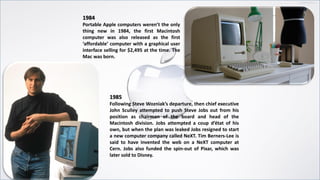
1984
Portable Apple computers weren’t the only
thing new in 1984, the first Macintosh
computer was also released as the first
‘affordable’ computer with a graphical user
interface selling for $2,495 at the time. The
Mac was born.
1985
Following Steve Wozniak’s departure, then chief executive
John Sculley attempted to push Steve Jobs out from his
position as chairman of the board and head of the
Macintosh division. Jobs attempted a coup d’état of his
own, but when the plan was leaked Jobs resigned to start
a new computer company called NeXT. Tim Berners-Lee is
said to have invented the web on a NeXT computer at
Cern. Jobs also funded the spin-out of Pixar, which was
later sold to Disney.
1991
Apple’s first true laptop as we know them today,
the PowerBook 100 (right), was designed and
manufactured by Sony for Apple. It cost $2,500 at
the time. For size comparison, the machine on
the left is a 2012 13in retina MacBook Pro.
1993
Before the iPhone was a twinkle in Steve Jobs’ eye, the Newton Message pad was
Apple’s first attempt at a pocket computer. It took 6.5 years to develop, had the
first real handwriting recognition and coined the term ‘personal digital assistant’ or
PDA. It only lasted for five years but the team that developed the software for it
eventually went on to develop the first iPod operating system.
1993
Before the iPhone was a twinkle in Steve Jobs’ eye, the Newton Message pad was Apple’s
first attempt at a pocket computer. It took 6.5 years to develop, had the first real
handwriting recognition and coined the term ‘personal digital assistant’ or PDA. It only
lasted for five years but the team that developed the software for it eventually went on
to develop the first iPod operating system.
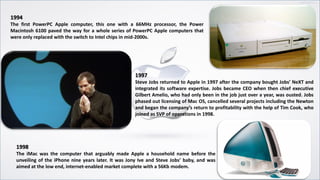
1994
The first PowerPC Apple computer, this one with a 66MHz processor, the Power
Macintosh 6100 paved the way for a whole series of PowerPC Apple computers that
were only replaced with the switch to Intel chips in mid-2000s.
1997
Steve Jobs returned to Apple in 1997 after the company bought Jobs’ NeXT and
integrated its software expertise. Jobs became CEO when then chief executive
Gilbert Amelio, who had only been in the job just over a year, was ousted. Jobs
phased out licensing of Mac OS, cancelled several projects including the Newton
and began the company’s return to profitability with the help of Tim Cook, who
joined as SVP of operations in 1998.
1998
The iMac was the computer that arguably made Apple a household name before the
unveiling of the iPhone nine years later. It was Jony Ive and Steve Jobs’ baby, and was
aimed at the low end, internet-enabled market complete with a 56Kb modem.
1999
Following the iMac the iBook was the next step for Apple aimed at the mass
market. It had a number of firsts for Apple, including now standard wireless
networking - Apple’s Wi-Fi-based AirPort. The iBook, iMac and PowerBook sat
alongside the Power Mac desktop, immediately behind Jobs in this picture.
2001
Apple dumped its legacy operating system wholesale
and switched to a new incompatible version with the
launch of OS X 10.0 Cheetah, which went on to form
the basis of not only the current version of OS X 1o.11
El Capitan, but iOS, which runs the iPhone and iPad.
2001
The product that would completely change the face of Apple, from a
computer company into a devices company, the iPod was born in
2001. It had 5GB of space, a small LCD screen and wasn’t
revolutionary, but was smaller than most and was marketed well,
eventually dominating the market. The first iPod was Mac-only and
had a physical wheel that moved to scroll.
2006
Apple dumped PowerPC processors for the faster, more energy efficient x86 chips
from Intel in 2006. The iBook, PowerBook and Power Mac were out, replaced by the
MacBook (pictured), the MacBook Pro and Mac Pro, which still form the basis for
Apple’s computers today. The iMac survived with just its chips changed over in its
now familiar thin, flatscreen design.
2007
Following the success of the iPod, the iPhone launched Apple into a new age. It
turned the company into a powerhouse, shipping with 4GB of storage, a 3.5in
capacitive multi-touch screen and 620MHz Samsung processor. The iPhone took 2.5
years to develop and was arguably the start of the internet-connected, portable
computing age we live in now, even if it have rivals that did things first and didn’t
even support native apps for a year.
2008
The MacBook Air was the biggest change in Apple’s laptop line for years,
and invented a whole new category of computers called ‘ultrabooks’ by
Intel. The first MacBook Air had a slow, tiny hard drive, slow processor and
relatively poor battery life but it heralded a new era of thin and light
laptops.
2010
Running with the success of the iPhone, the iPad attempted to reinvent tablet computers as
finger-based mobile devices rather than full PCs. The iPad’s origins hark back to the 1993
Newton when a prototype tablet was made but never released and was conceived in its
current form before the iPhone but delayed until after the release of Apple’s smartphone.
2011
After a long battle with pancreatic cancer, Apple’s founder and driving force
died at the age of 56. It was a turning point for the company. Tim Cook, former
head of operations and interim CEO took over as Jobs stood down six weeks
before he died.
2014
Apple bought Dr Dre and Jimmy Iovine’s Beats, which made headphones and ran a
music service, for $3bn in 2014. The headphones continue to be sold, but Beats
Music morphed into the Apple Music subscription service, with radio station Beats
One the lasting remnants of the brand.
2015
Apple’s first new product line since the iPad and Steve
Jobs’ death, the Apple Watch quickly became the most
popular smartwatch on the market outselling rivals from
Samsung, LG, Sony and Pebble
2014
Apple struck a deal with U2 to release the band’s latest album called
Songs of Innocence for free to every user of Apple’s iTunes. album
was automatically added to users’ iPhones causing a backlash, an
apology and eventually a way to remove it.
Vision & Mission Statement
❖ Apple is committed to bringing the best
personal computing experience to students,
educators, creative professional and
consumers around the world through it’s
innovative hardware, software and internet
offering
❖ Apple designs Macs, The best personal
computers in the world. Along with OSX,
iLife, iWork and professional software.
Apple lead the digital music revolution
with its iPod and iTunes online store.
Apple has reinvented the mobile phone
with its revolutionary iPhone and
Appstore, and is defining the future of
mobile media and computing devices.
Apple Inc. Competitors
in computers Industries
Get the latest Airpods to match your standard here: https://amzn.to/3DmKlSa
And match your style with sporty style sneakers in reasonable price: https://amzn.to/3dgc0cC

Apple Inc. Documentary

  • 1.
  • 2.
    Content: • Steve Jobs •Company Profile • Apple Store • Company History • Legal Structure • Vision & Mission Statement • Value & Strategies • Core competencies • Market share • SWOT Analysis
  • 3.
    Short Introduction Apple Inc.is an American multinational technology company headquartered in Cupertino, California, that designs, develops, and sells consumer electronics, computer software, and online services. It is considered one of the Big Four tech companies along with Amazon, Google, and Facebook. The company's hardware products include the iPhone smartphone, the iPad tablet computer, the Mac personal computer, the iPod portable media player, the Apple Watch smartwatch, the Apple TV digital media player, the AirPods wireless earbuds and the HomePod smart speaker. Apple's software includes the macOS, iOS, iPadOS, watchOS, and tvOS operating systems, the iTunes media player, the Safari web browser. Its online services include the iTunes Store, the iOS App Store, Mac App Store, Apple Music, Apple TV+, iMessage, and iCloud. Other services include Apple Store, Genius Bar, AppleCare, Apple Pay, Apple Pay Cash, and Apple Card.
  • 4.
    • born ofFeb. 24, 1955 • dropped out university after just one term • started working at a video game manufacturer • founded apple on 1977 but left it on 1985 • started the company Next Inc. * introduced a desktop computer, how but failed. • Pixar animation studios was formed on 1986 * sold the company to the Walt Disney Co. for $7.4B in stock on 2006. • On Aug. 2011, he resigned as the CEO but still continued to work as Chairman of the Board.
  • 5.
    STEVE JOBS ASA PERSON AND AS A LEADER • Employees describe him as a tyrant, that they feared meeting on the elevator • Known for publicly expressing his opinion about competitors & former colleagues. • Perfectionist • He was a skilled speaker. • He had a high standard in everything and attention to details. • A Charismatic and Authocratic Leader
  • 6.
  • 7.
    Name Apple Incorporation FormerCEO Steve Jobs Current CEO Tim Cook Revenue 258.5 billion USD Area Served World Wide Headquarter California, United States Total number of employee 132,000
  • 8.
    Apple Store isa chain of retail stores owned and operated by Apple Inc. The stores sell various Apple products, including Mac personal computers, iPhone smartphones, iPad tablet computers, iPod portable media players, Apple Watch smartwatches, Apple TV digital media players, software, and selected third-party accessories. The first Apple Stores were originally opened as two locations in May 2001 by then-CEO Steve Jobs, after years of attempting but failing store-within-a-store concepts. Seeing a need for improved retail presentation of the company's products, he began an effort in 1997 to revamp the retail program to get an improved relationship to consumers, and hired Ron Johnson in 2000. Jobs relaunched Apple's online store in 1997, and opened the first two physical stores in 2001. The media initially speculated that Apple would fail, but its stores were highly successful, by passing the sales numbers of competing nearby stores and within three years reached US$1 billion in annual sales, becoming the fastest retailer in history to do so. Over the years, Apple has expanded the number of retail locations and its geographical coverage, with 506 stores across 25 countries worldwide as of 2018.[2] Strong product sales have placed Apple among the top- tier retail stores, with sales over $16 billion globally in 2011.
  • 9.
    Apple founder Steve JobsSteve Woznaik Friends
  • 10.
    History ❖ How WasApple Founded Jobs and Wozniak met up again in 1975 at the Homebrew Computer Club, a local club for computer enthusiasts. Inspired by the DIY attitude, Wozniak went off and created his own home computer. This is a modest way of describing a game-changing creation; Woz's computer was the first to connect to a television, generating characters with a typewriter-inspired keyboard and successfully displaying them on the TV screen. Unknowingly, he had created the earliest archetype for what the common home PC would later become. His employer, Hewlett-Packard, also didn't know this, and rejected the design several times. Jobs, on the other hand, saw potential in the computer immediately. He convinced Wozniak that they could make a business, and after selling some of their belongings for cash, they and Jobs's co-worker at Atari, Ronald Wayne, formed Apple Computers. Wozniak's computer became known as the Apple I. Jobs made a deal with local computer store The Byte Shop to sell them, and the manager of the store had to confirm that to an electronics distributor before they could get their parts. Ultimately, 200 Apple I computers were created
  • 11.
    1976 The original AppleComputer, also known as the Apple I, that kicked everything off in 1976. It was designed and built by Apple co- founder Steve Wozniak. Wozniak’s friend Steve Jobs had the idea of selling the computer and the Apple I was born. 1977 Mark 2 of Apple’s computer - the Apple II - was a much more commercial product and came with its own case. It had a MOS Technology processor running at just 1MHz with 4KB of RAM. Today’s iPhones have processors running at 1,800 times the clock speed with 500,000 times more RAM.
  • 12.
    1983 The Apple Lisacomputer was groundbreaking, with an integrated screen, user interface and Apple’s first mouse. But at $10,000 (almost $20,000 in today’s money), the Lisa was never going to fly off the shelves. 1984 This is what was classed as a ‘portable’ computer in 1984. The Apple IIc could be carried about, but had no battery, which meant a power socket needed to be close by (how things change but stay the same).
  • 13.
    1984 Portable Apple computersweren’t the only thing new in 1984, the first Macintosh computer was also released as the first ‘affordable’ computer with a graphical user interface selling for $2,495 at the time. The Mac was born. 1985 Following Steve Wozniak’s departure, then chief executive John Sculley attempted to push Steve Jobs out from his position as chairman of the board and head of the Macintosh division. Jobs attempted a coup d’état of his own, but when the plan was leaked Jobs resigned to start a new computer company called NeXT. Tim Berners-Lee is said to have invented the web on a NeXT computer at Cern. Jobs also funded the spin-out of Pixar, which was later sold to Disney.
  • 14.
    1991 Apple’s first truelaptop as we know them today, the PowerBook 100 (right), was designed and manufactured by Sony for Apple. It cost $2,500 at the time. For size comparison, the machine on the left is a 2012 13in retina MacBook Pro. 1993 Before the iPhone was a twinkle in Steve Jobs’ eye, the Newton Message pad was Apple’s first attempt at a pocket computer. It took 6.5 years to develop, had the first real handwriting recognition and coined the term ‘personal digital assistant’ or PDA. It only lasted for five years but the team that developed the software for it eventually went on to develop the first iPod operating system. 1993 Before the iPhone was a twinkle in Steve Jobs’ eye, the Newton Message pad was Apple’s first attempt at a pocket computer. It took 6.5 years to develop, had the first real handwriting recognition and coined the term ‘personal digital assistant’ or PDA. It only lasted for five years but the team that developed the software for it eventually went on to develop the first iPod operating system.
  • 15.
    1994 The first PowerPCApple computer, this one with a 66MHz processor, the Power Macintosh 6100 paved the way for a whole series of PowerPC Apple computers that were only replaced with the switch to Intel chips in mid-2000s. 1997 Steve Jobs returned to Apple in 1997 after the company bought Jobs’ NeXT and integrated its software expertise. Jobs became CEO when then chief executive Gilbert Amelio, who had only been in the job just over a year, was ousted. Jobs phased out licensing of Mac OS, cancelled several projects including the Newton and began the company’s return to profitability with the help of Tim Cook, who joined as SVP of operations in 1998. 1998 The iMac was the computer that arguably made Apple a household name before the unveiling of the iPhone nine years later. It was Jony Ive and Steve Jobs’ baby, and was aimed at the low end, internet-enabled market complete with a 56Kb modem.
  • 16.
    1999 Following the iMacthe iBook was the next step for Apple aimed at the mass market. It had a number of firsts for Apple, including now standard wireless networking - Apple’s Wi-Fi-based AirPort. The iBook, iMac and PowerBook sat alongside the Power Mac desktop, immediately behind Jobs in this picture. 2001 Apple dumped its legacy operating system wholesale and switched to a new incompatible version with the launch of OS X 10.0 Cheetah, which went on to form the basis of not only the current version of OS X 1o.11 El Capitan, but iOS, which runs the iPhone and iPad. 2001 The product that would completely change the face of Apple, from a computer company into a devices company, the iPod was born in 2001. It had 5GB of space, a small LCD screen and wasn’t revolutionary, but was smaller than most and was marketed well, eventually dominating the market. The first iPod was Mac-only and had a physical wheel that moved to scroll.
  • 17.
    2006 Apple dumped PowerPCprocessors for the faster, more energy efficient x86 chips from Intel in 2006. The iBook, PowerBook and Power Mac were out, replaced by the MacBook (pictured), the MacBook Pro and Mac Pro, which still form the basis for Apple’s computers today. The iMac survived with just its chips changed over in its now familiar thin, flatscreen design. 2007 Following the success of the iPod, the iPhone launched Apple into a new age. It turned the company into a powerhouse, shipping with 4GB of storage, a 3.5in capacitive multi-touch screen and 620MHz Samsung processor. The iPhone took 2.5 years to develop and was arguably the start of the internet-connected, portable computing age we live in now, even if it have rivals that did things first and didn’t even support native apps for a year. 2008 The MacBook Air was the biggest change in Apple’s laptop line for years, and invented a whole new category of computers called ‘ultrabooks’ by Intel. The first MacBook Air had a slow, tiny hard drive, slow processor and relatively poor battery life but it heralded a new era of thin and light laptops.
  • 18.
    2010 Running with thesuccess of the iPhone, the iPad attempted to reinvent tablet computers as finger-based mobile devices rather than full PCs. The iPad’s origins hark back to the 1993 Newton when a prototype tablet was made but never released and was conceived in its current form before the iPhone but delayed until after the release of Apple’s smartphone. 2011 After a long battle with pancreatic cancer, Apple’s founder and driving force died at the age of 56. It was a turning point for the company. Tim Cook, former head of operations and interim CEO took over as Jobs stood down six weeks before he died. 2014 Apple bought Dr Dre and Jimmy Iovine’s Beats, which made headphones and ran a music service, for $3bn in 2014. The headphones continue to be sold, but Beats Music morphed into the Apple Music subscription service, with radio station Beats One the lasting remnants of the brand.
  • 19.
    2015 Apple’s first newproduct line since the iPad and Steve Jobs’ death, the Apple Watch quickly became the most popular smartwatch on the market outselling rivals from Samsung, LG, Sony and Pebble 2014 Apple struck a deal with U2 to release the band’s latest album called Songs of Innocence for free to every user of Apple’s iTunes. album was automatically added to users’ iPhones causing a backlash, an apology and eventually a way to remove it.
  • 22.
    Vision & MissionStatement ❖ Apple is committed to bringing the best personal computing experience to students, educators, creative professional and consumers around the world through it’s innovative hardware, software and internet offering ❖ Apple designs Macs, The best personal computers in the world. Along with OSX, iLife, iWork and professional software. Apple lead the digital music revolution with its iPod and iTunes online store. Apple has reinvented the mobile phone with its revolutionary iPhone and Appstore, and is defining the future of mobile media and computing devices.
  • 25.
    Apple Inc. Competitors incomputers Industries
  • 27.
    Get the latestAirpods to match your standard here: https://amzn.to/3DmKlSa
  • 28.
    Get the latestAirpods to match your standard here: https://amzn.to/3DmKlSa And match your style with sporty style sneakers in reasonable price: https://amzn.to/3dgc0cC