A Journey
Apple Computer  Apple Inc
Presented by:
Anusha Mushtaque
Sidra Shaikh
Fahad Ansari
Farah Shaikh
Company Founders
Steve Jobs Steve Wozniak
Introduction
Apple Computer, Inc. since January 3, 1977
now Apple Inc. since January 9, 2007
American multinational corporation that designs and markets consumer electronics,
computer software, and personal computers.
The largest technology company in the world by revenue and profit, earning more than
Google and Microsoft combined
The largest publicly traded corporation in the world by market capitalization, with an
estimated value of US$695 billion as of February 9, 2017.
Steve noticed that all the computers being sold were mainframe ones, (computers which take
up basically a whole room and the cost is great). Both the founders redid the designs they
were working on to build personal computers,(computers much smaller and the price much
cheaper then the mainframe computers)
$470.94 B $231.2 B
Enterprise Value Total GDP
Timeline
1974  The idea for Apple Computers was Born.
1976  First Computer was Sold
1984  Macintosh was Introduced
1985  Steve Jobs Resigned
1990s  Decline sales & low market share
Steve Jobs started its company NeXT
1996  NeXT bought by Apple and Steve Jobs returned
1997  Became CEO
1998  Started original iMac
1999  Unveiled the iBook
2001  Introduced iPod music Player
2003  Introduced iTunes music store
2007  Launched iPhone
And the innovation Continues…..
One cannot talk about
Innovation
without mentioning…
Apple Inc. & Sir Steve Jobs…
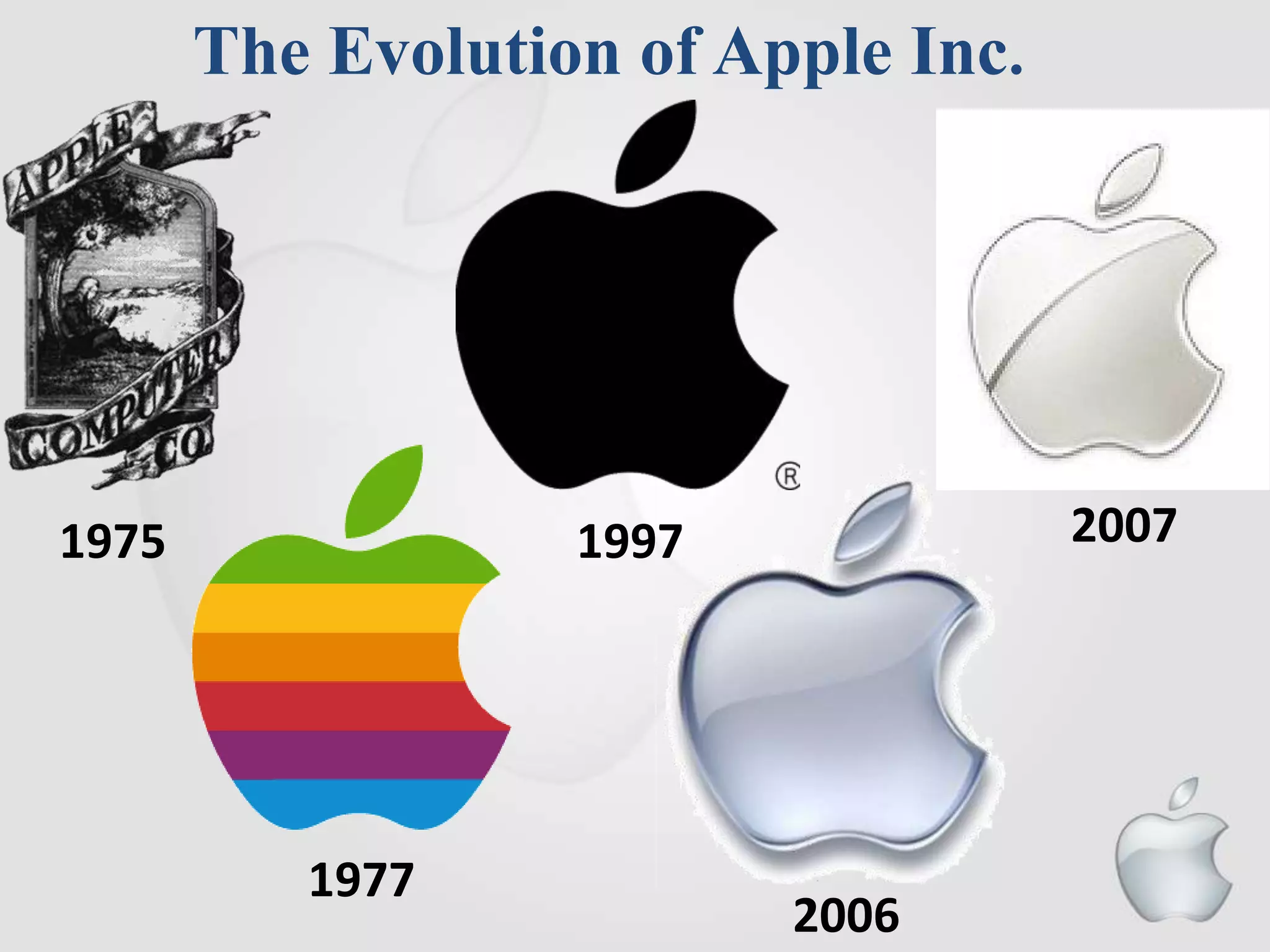
The Evolution of Apple Inc.
2006
1997
1977
1975 2007
• Launch of Macintosh on January
24, 1984.
• First mass-market personal
computer that came with
Graphic User Interface (GUI)
and mouse.
• Change the development of the
computer industry.
• One of the Apple products that
failed in the market due to its
very high price ($2,495).
GUI And Mouse
• Macintosh was the first personal
computer using icons to operate the
system.
• Before ,all computers were text-
based.
• Now, we can see all the computers
using icons as commands.
• The icons of Macintosh was
designed by Susan Kare, who also
created icons for Microsoft,
Facebook, etc.
Pc with Icons
• Backlit keyboard on laptops
• Back in 2003, Apple announced the
17-inch and 12.1-inch PowerBooks
which adopted the new
technologies: a backlit keyboard and
light sensors. It was the first laptop
that featured those technologies.
• Those technologies allow you to
adjust the light on the keyboard if it’s
needed.
• It’s useful when you are typing in a
low-light environment. Backlit Keyboards
• In 1977, there was Commodore PET
which came with the idea of building
a full-featured computer.
• Design couldn’t be accepted in
the modern era
• In 2004, Apple introduced a better
version of all-in-one PC, called iMac
G5.
• It was more compact and really
charming with its flat screen.
All-in-one PC
• The Post-PC era was one of Steve Jobs
dreams.
• He believed people will use tablets to
do their work, instead of PCs.
• His dream was manifested on iPad.
• Even though it didn’t replace PC
completely, Apple managed to change
the computer industry
• Play piano? The iPad's a piano.
• Write a letter? It's a typewriter.
• Read a book? It's a book.
iPad
• Before iPhone mobile devices had utilities like e-mail, text messaging, web
browsing, calendars, solitaire, video, etc.
• The very first iPhone operating system was,
• Then: OS X
• Now: iOS
• In a lot of ways, save for one, this now-prehistoric iPhone was mediocre. It did
not have a lot of the same capabilities as other smartphone devices at the
time.
• It did not have 3G connectivity,
• it lacked the ability to take and send quality pictures or video
• it had a shortage of other useful apps and utilities, like GPS.
• Basically, in almost every category that we typically judge a smartphones
performance or capabilities, the original iOS and iPhone fell well short, except
for one.
THE TOUCHSCREEN ENVIRONMENT
• "An iPod, a phone, an internet mobile
communicator“
• This is one device, and known as iPhone.
• The iPod made digital music
mainstream.
• iTunes made it easy to transfer music
you'd ripped or downloaded to your iPod
iPhone
iTunes
• The iPhone launched without apps,
but that decision was quickly
reversed.
• iOS and its App Store is the same
closed-ecosystem model as the iPod
and iTunes.
• Like that ecosystem, the App Store has
been copied by everyone else.
App Store
iOS 6’s Maps app
• iOS 6's Maps app changed the
world.
• But not in the way Apple expected
• Apple's replacement for Google
Maps came with a lovely interface,
turn-by-turn navigation - and maps
of a strange, not-quite-Earth planet
where familiar landmarks
transformed into threatening, weird
shapes, long-dead retailers jumped
back into existence.
• Still work is going on for the
improvement.
Focus On
Education
iMac,
1998
Adding
Lifestyle
Strategy
Digital
Hub
Music Strategy (iTunes)
Video Strategy (iMovie)
Internet Strategy (iTools)
C
o
n
v
e
r
g
e
n
c
e
Apple II, 1977
Apple I (April
1st 1976)
Apple III, 1980
Lisa,1983
Power Book
(1st laptop 1991)
MAC,1984
It had 1st floppy
disk drive
Mac book Air-worlds
1st slimmest notebook,2006
iPods
(2001)
values
Mac pro, 2004
Apple tv,
2007
i-phone,
2007
i-pad,2010
VARIOUS
PRODUCT
CYCLE
• Build Products that are cool, intuitive, simple to use and provide the most
amazing experience.
• Take calculated risks and boldly enter new markets. E.g. iPod, iPhone
• Change the playing field by creating new business models. E.g. iTunes
• Capture the changing landscape and ecosystem of the markets and buyers.
• Grow the market share with buyers as they grow and their needs grow kids,
teenagers, young adults, adults, parents.
• Provide multiple products / touch points to buyers so they can buy and subscribe
to more products all glued through iTunes.
• Creativity begins with asking questions.
• Innovation happens when you find answers.
Apple Innovation Takeaways
Apple Inc. Competitors
Apple has many competitors like in computers…
Apple Inc. Competitors
In smart phones industry
Apple Inc. Competitors
In iPads industry
WHAT’S NEXT?
ALPHA APPS
• These apps compound a number of pre-existing programs under one
umbrella. It is based on the premise that our apps today are very separate
from one another and rarely play with each other.
• Alpha apps also aim to close the loop and ultimately make life easier
and more productive for the user.
For more than 35 years apple has been a trends set company able to
foresee the future of domestic computers and consumers
electronics, it will continuing it because apple’s others name is
innovation and apple know,
How to THINK DIFFERENT!!
Conclusion
Stay Hungry, Stay Foolish.
Think Different
Stay Hungry, Stay Foolish.

Apple presentation

  • 1.
    A Journey Apple Computer Apple Inc Presented by: Anusha Mushtaque Sidra Shaikh Fahad Ansari Farah Shaikh
  • 3.
  • 4.
    Introduction Apple Computer, Inc.since January 3, 1977 now Apple Inc. since January 9, 2007 American multinational corporation that designs and markets consumer electronics, computer software, and personal computers. The largest technology company in the world by revenue and profit, earning more than Google and Microsoft combined The largest publicly traded corporation in the world by market capitalization, with an estimated value of US$695 billion as of February 9, 2017. Steve noticed that all the computers being sold were mainframe ones, (computers which take up basically a whole room and the cost is great). Both the founders redid the designs they were working on to build personal computers,(computers much smaller and the price much cheaper then the mainframe computers)
  • 5.
    $470.94 B $231.2B Enterprise Value Total GDP
  • 6.
    Timeline 1974  Theidea for Apple Computers was Born. 1976  First Computer was Sold 1984  Macintosh was Introduced 1985  Steve Jobs Resigned 1990s  Decline sales & low market share Steve Jobs started its company NeXT 1996  NeXT bought by Apple and Steve Jobs returned 1997  Became CEO 1998  Started original iMac 1999  Unveiled the iBook 2001  Introduced iPod music Player 2003  Introduced iTunes music store 2007  Launched iPhone And the innovation Continues…..
  • 7.
    One cannot talkabout Innovation without mentioning… Apple Inc. & Sir Steve Jobs…
  • 8.
    The Evolution ofApple Inc. 2006 1997 1977 1975 2007
  • 10.
    • Launch ofMacintosh on January 24, 1984. • First mass-market personal computer that came with Graphic User Interface (GUI) and mouse. • Change the development of the computer industry. • One of the Apple products that failed in the market due to its very high price ($2,495). GUI And Mouse
  • 11.
    • Macintosh wasthe first personal computer using icons to operate the system. • Before ,all computers were text- based. • Now, we can see all the computers using icons as commands. • The icons of Macintosh was designed by Susan Kare, who also created icons for Microsoft, Facebook, etc. Pc with Icons
  • 12.
    • Backlit keyboardon laptops • Back in 2003, Apple announced the 17-inch and 12.1-inch PowerBooks which adopted the new technologies: a backlit keyboard and light sensors. It was the first laptop that featured those technologies. • Those technologies allow you to adjust the light on the keyboard if it’s needed. • It’s useful when you are typing in a low-light environment. Backlit Keyboards
  • 13.
    • In 1977,there was Commodore PET which came with the idea of building a full-featured computer. • Design couldn’t be accepted in the modern era • In 2004, Apple introduced a better version of all-in-one PC, called iMac G5. • It was more compact and really charming with its flat screen. All-in-one PC
  • 14.
    • The Post-PCera was one of Steve Jobs dreams. • He believed people will use tablets to do their work, instead of PCs. • His dream was manifested on iPad. • Even though it didn’t replace PC completely, Apple managed to change the computer industry • Play piano? The iPad's a piano. • Write a letter? It's a typewriter. • Read a book? It's a book. iPad
  • 16.
    • Before iPhonemobile devices had utilities like e-mail, text messaging, web browsing, calendars, solitaire, video, etc. • The very first iPhone operating system was, • Then: OS X • Now: iOS • In a lot of ways, save for one, this now-prehistoric iPhone was mediocre. It did not have a lot of the same capabilities as other smartphone devices at the time. • It did not have 3G connectivity, • it lacked the ability to take and send quality pictures or video • it had a shortage of other useful apps and utilities, like GPS. • Basically, in almost every category that we typically judge a smartphones performance or capabilities, the original iOS and iPhone fell well short, except for one. THE TOUCHSCREEN ENVIRONMENT
  • 17.
    • "An iPod,a phone, an internet mobile communicator“ • This is one device, and known as iPhone. • The iPod made digital music mainstream. • iTunes made it easy to transfer music you'd ripped or downloaded to your iPod iPhone iTunes
  • 18.
    • The iPhonelaunched without apps, but that decision was quickly reversed. • iOS and its App Store is the same closed-ecosystem model as the iPod and iTunes. • Like that ecosystem, the App Store has been copied by everyone else. App Store
  • 19.
    iOS 6’s Mapsapp • iOS 6's Maps app changed the world. • But not in the way Apple expected • Apple's replacement for Google Maps came with a lovely interface, turn-by-turn navigation - and maps of a strange, not-quite-Earth planet where familiar landmarks transformed into threatening, weird shapes, long-dead retailers jumped back into existence. • Still work is going on for the improvement.
  • 20.
    Focus On Education iMac, 1998 Adding Lifestyle Strategy Digital Hub Music Strategy(iTunes) Video Strategy (iMovie) Internet Strategy (iTools) C o n v e r g e n c e Apple II, 1977 Apple I (April 1st 1976) Apple III, 1980 Lisa,1983 Power Book (1st laptop 1991) MAC,1984 It had 1st floppy disk drive Mac book Air-worlds 1st slimmest notebook,2006 iPods (2001) values Mac pro, 2004 Apple tv, 2007 i-phone, 2007 i-pad,2010 VARIOUS PRODUCT CYCLE
  • 21.
    • Build Productsthat are cool, intuitive, simple to use and provide the most amazing experience. • Take calculated risks and boldly enter new markets. E.g. iPod, iPhone • Change the playing field by creating new business models. E.g. iTunes • Capture the changing landscape and ecosystem of the markets and buyers. • Grow the market share with buyers as they grow and their needs grow kids, teenagers, young adults, adults, parents. • Provide multiple products / touch points to buyers so they can buy and subscribe to more products all glued through iTunes. • Creativity begins with asking questions. • Innovation happens when you find answers. Apple Innovation Takeaways
  • 22.
    Apple Inc. Competitors Applehas many competitors like in computers…
  • 23.
    Apple Inc. Competitors Insmart phones industry
  • 24.
  • 25.
    WHAT’S NEXT? ALPHA APPS •These apps compound a number of pre-existing programs under one umbrella. It is based on the premise that our apps today are very separate from one another and rarely play with each other. • Alpha apps also aim to close the loop and ultimately make life easier and more productive for the user.
  • 26.
    For more than35 years apple has been a trends set company able to foresee the future of domestic computers and consumers electronics, it will continuing it because apple’s others name is innovation and apple know, How to THINK DIFFERENT!! Conclusion
  • 27.
    Stay Hungry, StayFoolish. Think Different Stay Hungry, Stay Foolish.