COMMUNITY HEALTH
NURSING 2
(NCM 113)
FRANCIS ANTHONY S. AURES, RN, MAN
BSN LEVEL OUTCOME
 THIRD YEAR
 At the end of the third year, given individuals, families,
population groups, and communities with physiologic and
psychosocial health problems and maladaptive patterns of
behavior in varied health care settings, the learners
demonstrate safe, appropriate and holistic care utilizing the
nursing process and applying research and evidence-based
practice.
SELF INTRODUCTION
Name
Expectations of the course in terms of
Knowledge, Skills, and Attitude.
What dish are you? And why?
HOUSE RULES
 Be on time for class. Be punctual.
 Participate and be interactive.
 Open your camera during recitation or when required to
do so.
 Choose your study space.
 One at a time.
 Be prepared.
 Don’t hesitate to ask questions.
 Respect and encourage each other.
 Be attentive.
 Have Fun.
Community Health Nursing 2
(6 Weeks)
 This course covers the concepts and principles in
the provision of basic care in terms of health
promotion, health maintenance and disease
prevention with population groups and community
as clients. Topics include Community Health and
Development Concepts, working with groups
toward community development; community
health nursing process; related laws in public
health nursing; and health statistics and
epidemiology.
COURSE OUTCOME
The students will be able to:
1. Define health and illness.
2. List three levels of prevention and be able to give
examples for each level.
3. Explain the differences among community health nursing,
public health nursing and community based nursing.
4. Cite the distinguishing features of community health
nursing.
5. Discuss public health nursing practice in terms of public
health’s core functions and essential public health
functions.
6. Compare the different fields of community health nursing
practice.
7. Apply competency standards of the nursing practice in the
Philippines in community health nursing practice.
8. Outline the historical development of public health and
public health nursing in the Philippines.
9. State the Department of Health (DOH) mission, vision, and
objectives.
10. Describe different composition of the health care
delivery system and Levels of health care facilities.
11. Identify characteristics of the family that have
implications for community health nursing practice.
12. Describe relationship between assessment and
formulation of community diagnosis and epidemiology.
13. Utilize the nursing process in the care of individuals within
the family and the care of the family as a whole.
14. Describe the different types of family-nurse contacts.
15. Depict provision of nursing care during a home visit.
16. Apply principles of bag technique during a home visit.
17. Illustrate the principles of community health nursing.
18. Recognize characteristics of a healthy community.
19. Utilize the nursing process in managing community health
concerns.
20. Describe relationship between the science of public health
and community health nursing.
21. Demonstrate knowledge of the relationship between
Primary Health Care (PHC) and public health nursing in the
Philippines.
22. Critically analyze the concepts of Primary Health Care
(PHC).
23. Define family.
24. Differentiate the types of families and state its
characteristics.
25. Describe relationship between the family and
development.
26. Describe the different types of community.
27. Differentiate the types of community.
28. Discuss the different approaches in community health
development.
29. Describe relationship between assessment and
formulation of community diagnosis.
30. Differentiate types of community diagnosis.
31. Discuss the steps in conducting community diagnosis.
32. Identify the different tools used in community diagnosis.
33. Cite the importance of community diagnosis and its uses.
34. Develop attitude needed to facilitate community
development and self-reliance.
35. Discuss relationship of social capital to community
development.
36. Relate Community Organizing Participatory Action
Research (COPAR) to community development.
37. Discuss concepts of capacity building partnership and
collaboration in relation to community competence and
sustainable development.
 WEEK 1
Concepts Organizing Towards Community Participation in Health
 Definition of Terms
 Concepts of Community
 Elements of Community
 Roles of the Nurse in Community Organizing
 Goals of Community Organizing
 Critical Activities in Community Organizing
 Traditional
 Transformative
 Community Development
 Human Resource Development Program
(HRDP)/Community Organizing Participatory
Action Research (COPAR) as tool for
community development
 Phases and Activities of COPAR
1. Pre-entry Phase
2.Entry Phase
3. Organization Building
4. Sustenance and Stregthening
5. Phase Out
6. Activities of COPAR in every phase
WEEK 2
Community Health Nursing Process
 Steps in community Nursing Process
 Planning Health Program for Community
Development
 Implementation of plan of action for
Community Health
 Monitoring and evaluation of Community
Health Programs
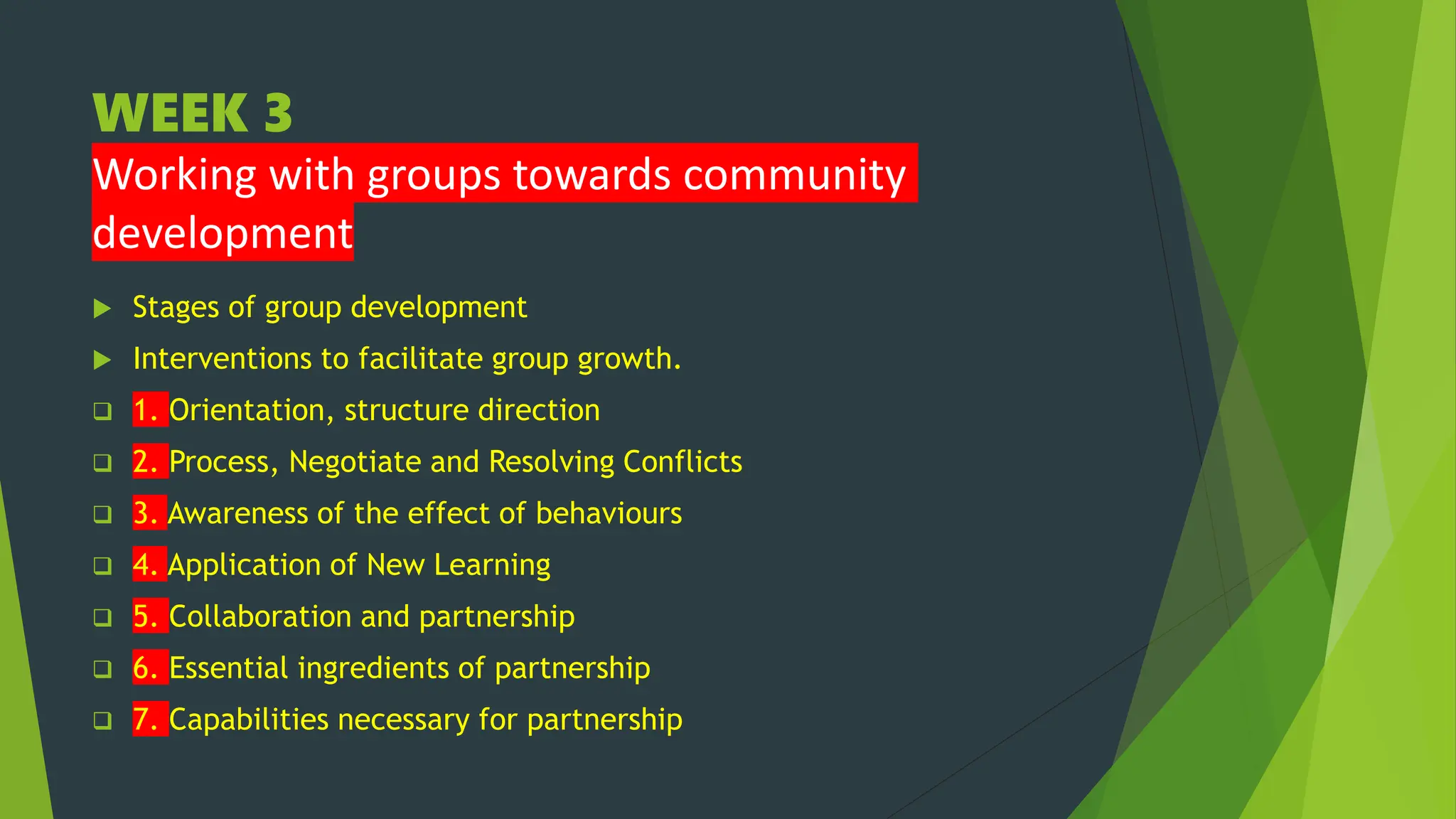
WEEK 3
Working with groups towards community
development
 Stages of group development
 Interventions to facilitate group growth.
 1. Orientation, structure direction
 2. Process, Negotiate and Resolving Conflicts
 3. Awareness of the effect of behaviours
 4. Application of New Learning
 5. Collaboration and partnership
 6. Essential ingredients of partnership
 7. Capabilities necessary for partnership
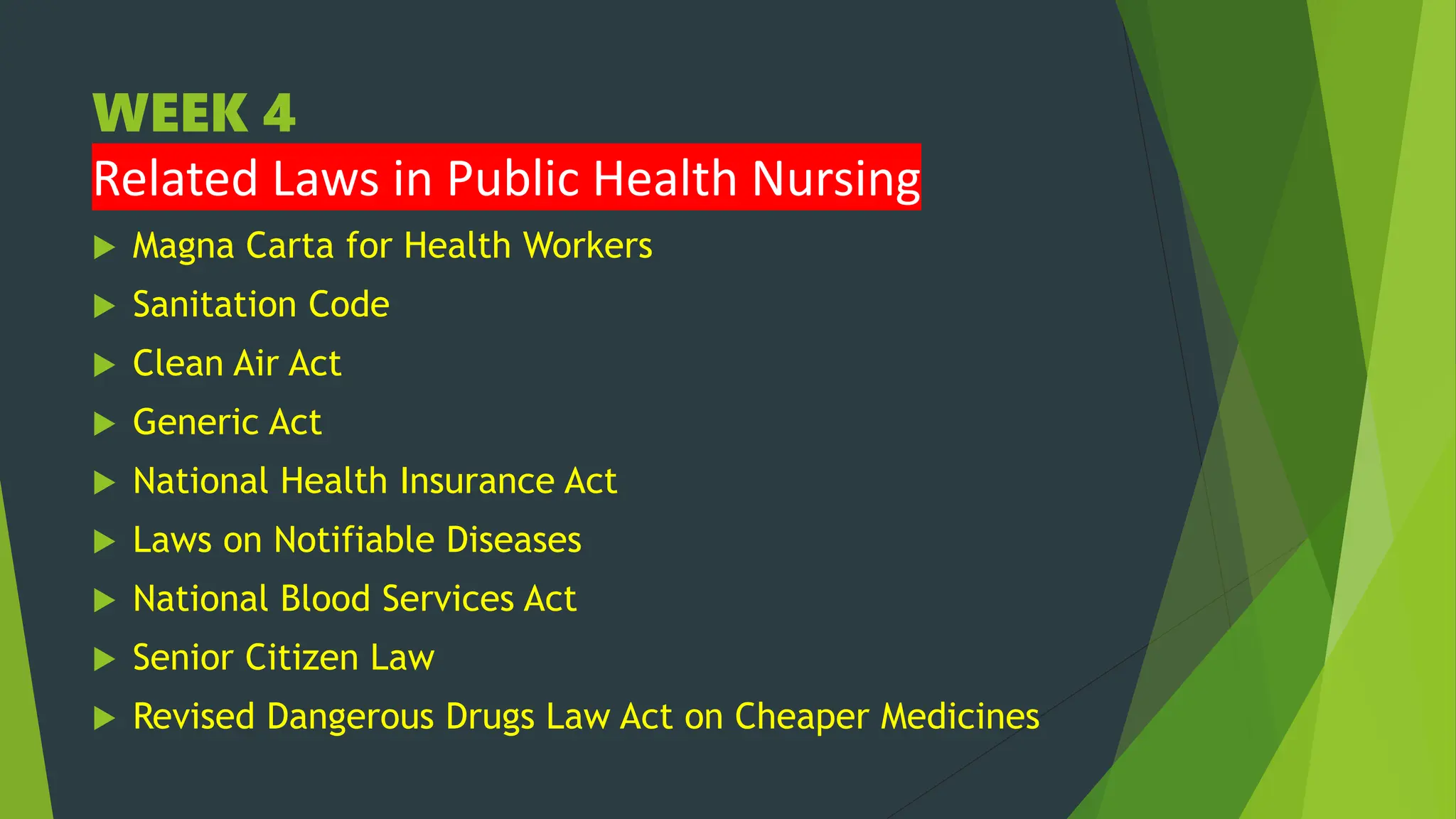
WEEK 4
Related Laws in Public Health Nursing
 Magna Carta for Health Workers
 Sanitation Code
 Clean Air Act
 Generic Act
 National Health Insurance Act
 Laws on Notifiable Diseases
 National Blood Services Act
 Senior Citizen Law
 Revised Dangerous Drugs Law Act on Cheaper Medicines
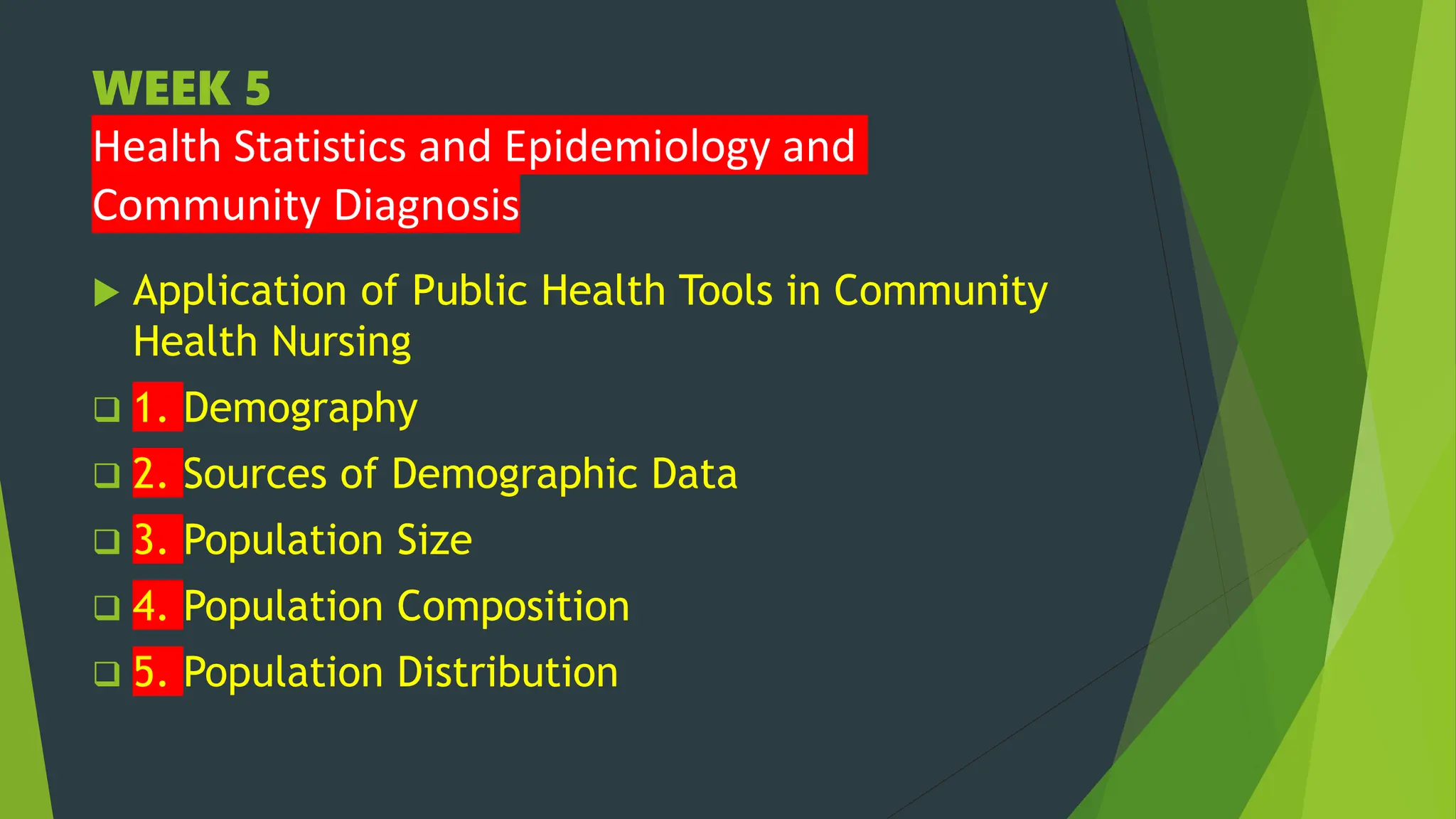
WEEK 5
Health Statistics and Epidemiology and
Community Diagnosis
 Application of Public Health Tools in Community
Health Nursing
 1. Demography
 2. Sources of Demographic Data
 3. Population Size
 4. Population Composition
 5. Population Distribution
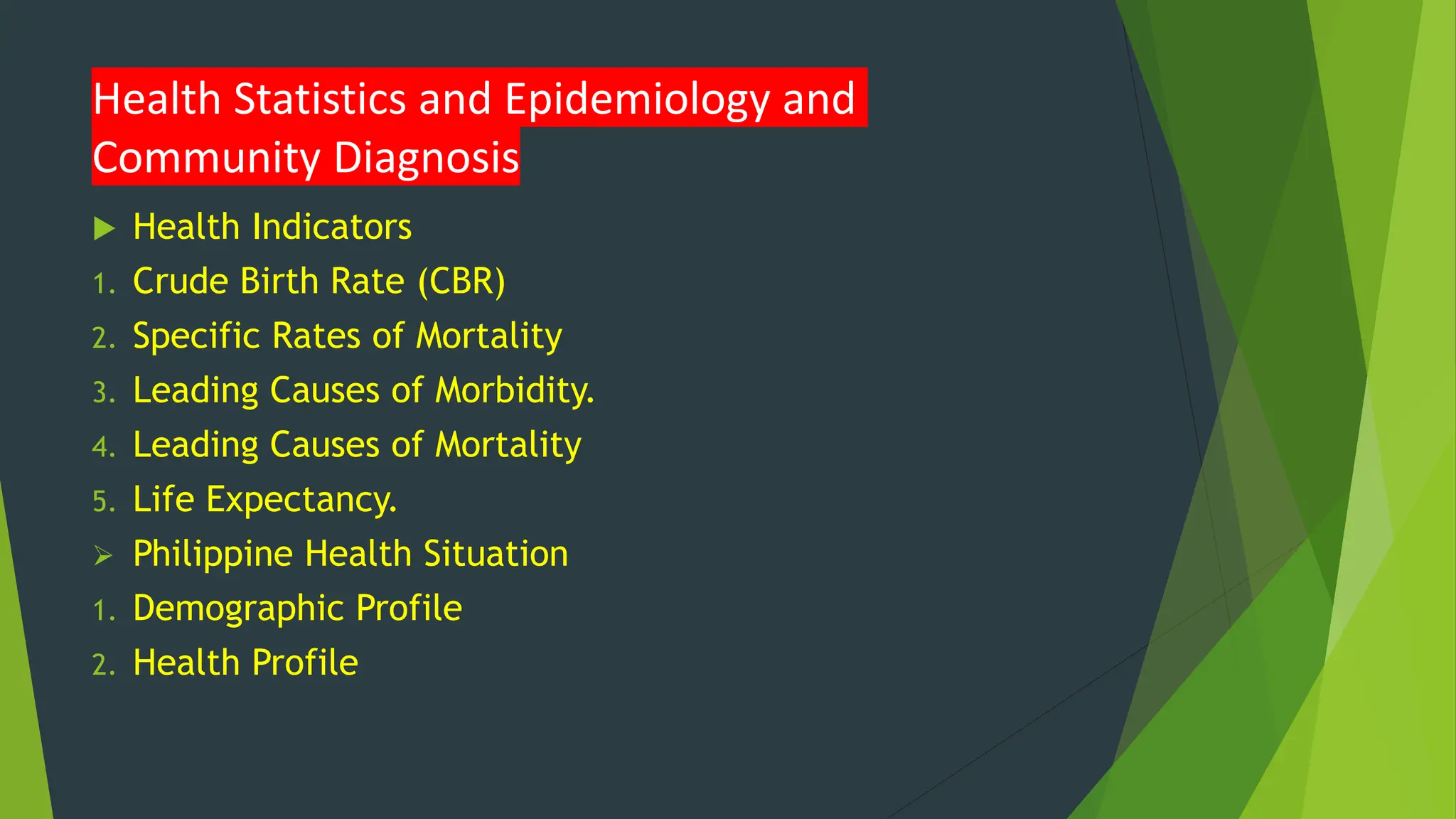
Health Statistics and Epidemiology and
Community Diagnosis
 Health Indicators
1. Crude Birth Rate (CBR)
2. Specific Rates of Mortality
3. Leading Causes of Morbidity.
4. Leading Causes of Mortality
5. Life Expectancy.
 Philippine Health Situation
1. Demographic Profile
2. Health Profile
WEEK 6
Health Statistics and Epidemiology and
Community Diagnosis
 Epidemiology and the Public Health Nurse
 1. Definition
 2. Types of Nursing Problem
 3. Steps in conducting Community Diagnosis
 4. Prioritizing Health Problems
 5. Aspects of Epidemiology
 6. Natural Life History
 7. Epidemiological Triangle
 8. Epidemiological Process and Investigation
 9. A review of the COVID 19 as a pandemic phenomenon
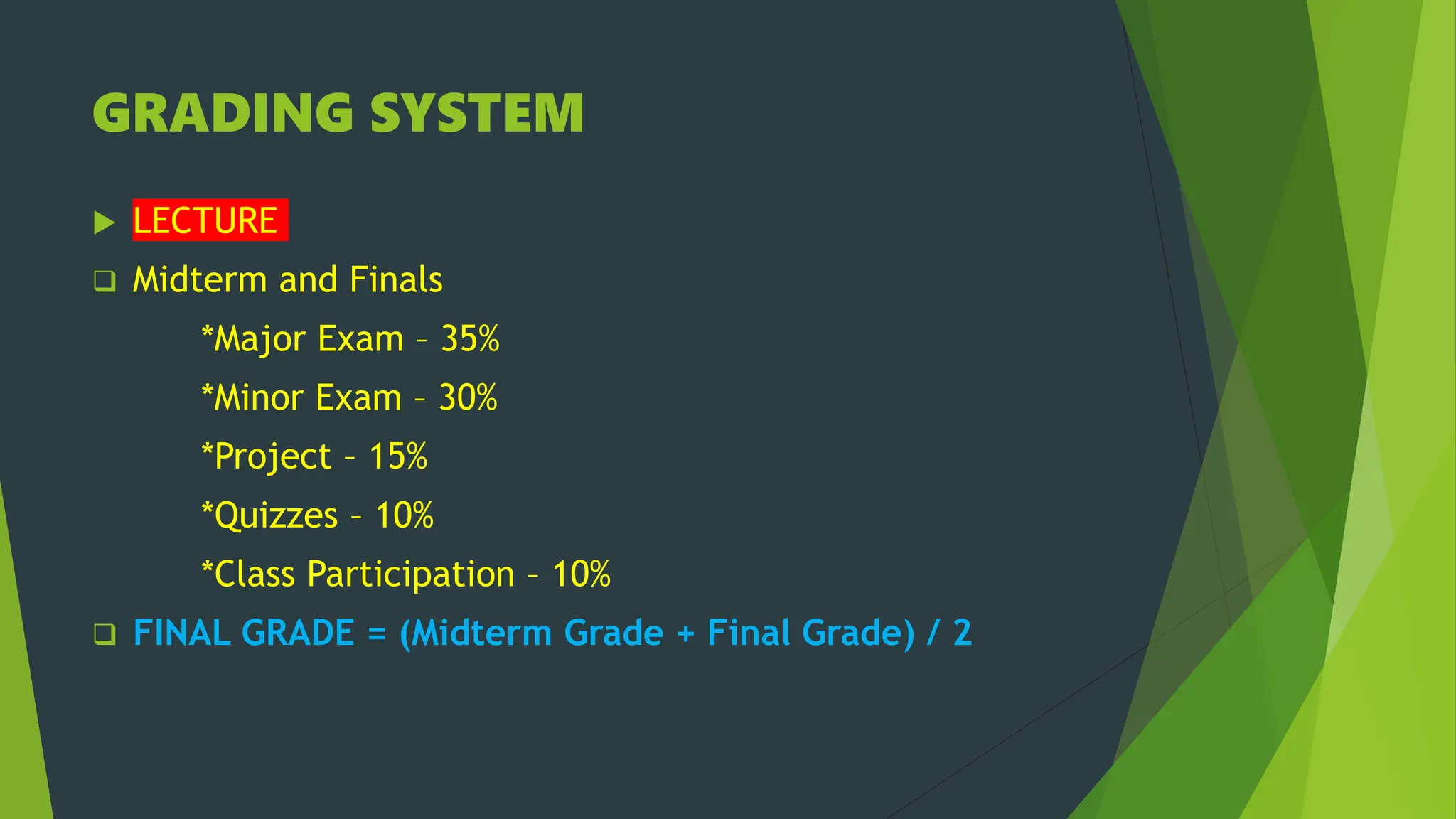
GRADING SYSTEM
 LECTURE
 Midterm and Finals
*Major Exam – 35%
*Minor Exam – 30%
*Project – 15%
*Quizzes – 10%
*Class Participation – 10%
 FINAL GRADE = (Midterm Grade + Final Grade) / 2
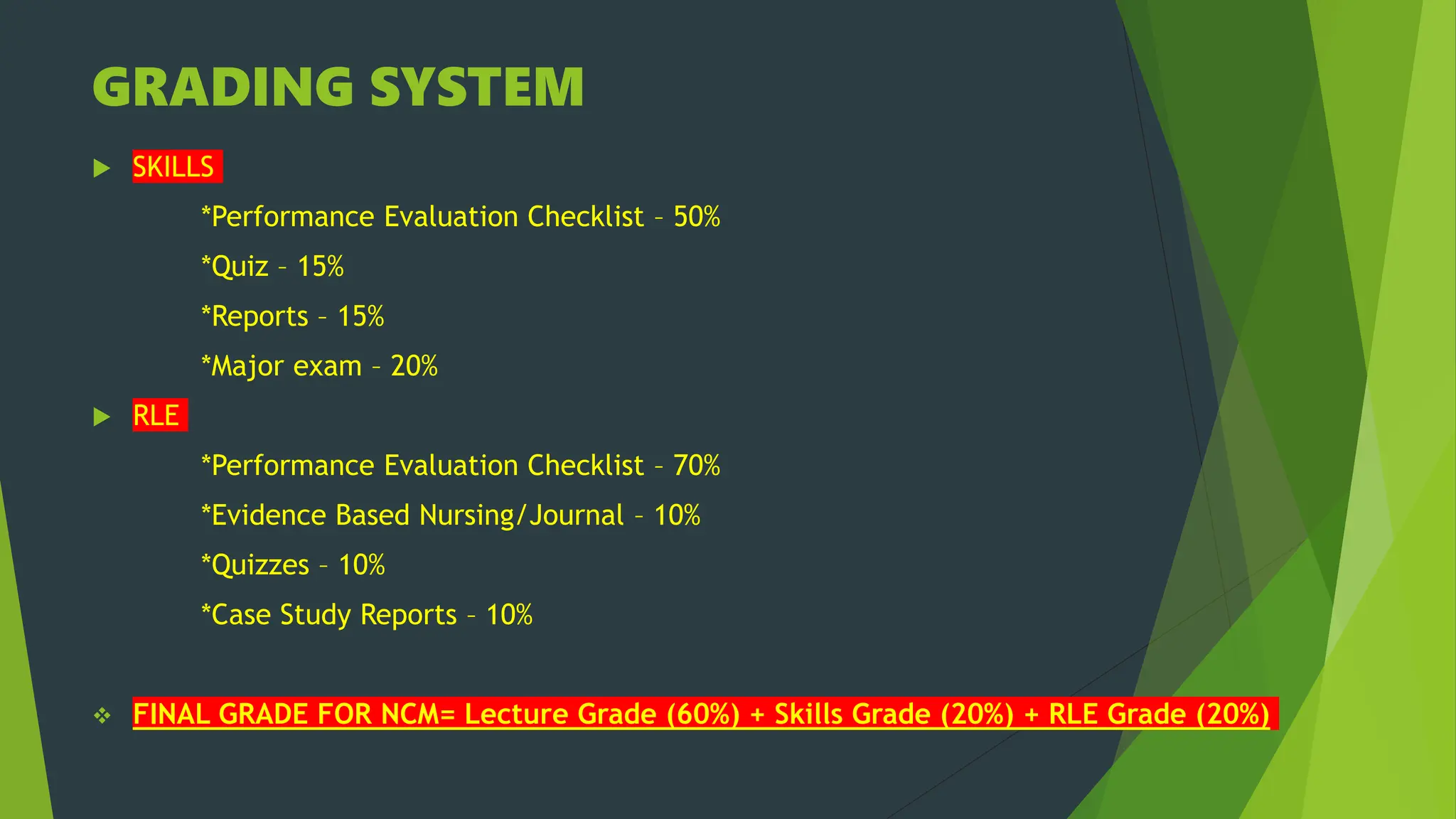
GRADING SYSTEM
 SKILLS
*Performance Evaluation Checklist – 50%
*Quiz – 15%
*Reports – 15%
*Major exam – 20%
 RLE
*Performance Evaluation Checklist – 70%
*Evidence Based Nursing/Journal – 10%
*Quizzes – 10%
*Case Study Reports – 10%
 FINAL GRADE FOR NCM= Lecture Grade (60%) + Skills Grade (20%) + RLE Grade (20%)
OPEN FORUM

COMMUNITY HEALTH NURSING POWERPOINT PRESENTATION

  • 1.
    COMMUNITY HEALTH NURSING 2 (NCM113) FRANCIS ANTHONY S. AURES, RN, MAN
  • 2.
    BSN LEVEL OUTCOME THIRD YEAR  At the end of the third year, given individuals, families, population groups, and communities with physiologic and psychosocial health problems and maladaptive patterns of behavior in varied health care settings, the learners demonstrate safe, appropriate and holistic care utilizing the nursing process and applying research and evidence-based practice.
  • 3.
    SELF INTRODUCTION Name Expectations ofthe course in terms of Knowledge, Skills, and Attitude. What dish are you? And why?
  • 4.
    HOUSE RULES  Beon time for class. Be punctual.  Participate and be interactive.  Open your camera during recitation or when required to do so.  Choose your study space.  One at a time.  Be prepared.  Don’t hesitate to ask questions.  Respect and encourage each other.  Be attentive.  Have Fun.
  • 5.
    Community Health Nursing2 (6 Weeks)  This course covers the concepts and principles in the provision of basic care in terms of health promotion, health maintenance and disease prevention with population groups and community as clients. Topics include Community Health and Development Concepts, working with groups toward community development; community health nursing process; related laws in public health nursing; and health statistics and epidemiology.
  • 6.
    COURSE OUTCOME The studentswill be able to: 1. Define health and illness. 2. List three levels of prevention and be able to give examples for each level. 3. Explain the differences among community health nursing, public health nursing and community based nursing. 4. Cite the distinguishing features of community health nursing. 5. Discuss public health nursing practice in terms of public health’s core functions and essential public health functions. 6. Compare the different fields of community health nursing practice.
  • 7.
    7. Apply competencystandards of the nursing practice in the Philippines in community health nursing practice. 8. Outline the historical development of public health and public health nursing in the Philippines. 9. State the Department of Health (DOH) mission, vision, and objectives. 10. Describe different composition of the health care delivery system and Levels of health care facilities. 11. Identify characteristics of the family that have implications for community health nursing practice. 12. Describe relationship between assessment and formulation of community diagnosis and epidemiology.
  • 8.
    13. Utilize thenursing process in the care of individuals within the family and the care of the family as a whole. 14. Describe the different types of family-nurse contacts. 15. Depict provision of nursing care during a home visit. 16. Apply principles of bag technique during a home visit. 17. Illustrate the principles of community health nursing. 18. Recognize characteristics of a healthy community. 19. Utilize the nursing process in managing community health concerns. 20. Describe relationship between the science of public health and community health nursing. 21. Demonstrate knowledge of the relationship between Primary Health Care (PHC) and public health nursing in the Philippines.
  • 9.
    22. Critically analyzethe concepts of Primary Health Care (PHC). 23. Define family. 24. Differentiate the types of families and state its characteristics. 25. Describe relationship between the family and development. 26. Describe the different types of community. 27. Differentiate the types of community. 28. Discuss the different approaches in community health development. 29. Describe relationship between assessment and formulation of community diagnosis.
  • 10.
    30. Differentiate typesof community diagnosis. 31. Discuss the steps in conducting community diagnosis. 32. Identify the different tools used in community diagnosis. 33. Cite the importance of community diagnosis and its uses. 34. Develop attitude needed to facilitate community development and self-reliance. 35. Discuss relationship of social capital to community development. 36. Relate Community Organizing Participatory Action Research (COPAR) to community development. 37. Discuss concepts of capacity building partnership and collaboration in relation to community competence and sustainable development.
  • 11.
     WEEK 1 ConceptsOrganizing Towards Community Participation in Health  Definition of Terms  Concepts of Community  Elements of Community  Roles of the Nurse in Community Organizing  Goals of Community Organizing  Critical Activities in Community Organizing  Traditional  Transformative  Community Development
  • 12.
     Human ResourceDevelopment Program (HRDP)/Community Organizing Participatory Action Research (COPAR) as tool for community development  Phases and Activities of COPAR 1. Pre-entry Phase 2.Entry Phase 3. Organization Building 4. Sustenance and Stregthening 5. Phase Out 6. Activities of COPAR in every phase
  • 13.
    WEEK 2 Community HealthNursing Process  Steps in community Nursing Process  Planning Health Program for Community Development  Implementation of plan of action for Community Health  Monitoring and evaluation of Community Health Programs
  • 14.
    WEEK 3 Working withgroups towards community development  Stages of group development  Interventions to facilitate group growth.  1. Orientation, structure direction  2. Process, Negotiate and Resolving Conflicts  3. Awareness of the effect of behaviours  4. Application of New Learning  5. Collaboration and partnership  6. Essential ingredients of partnership  7. Capabilities necessary for partnership
  • 15.
    WEEK 4 Related Lawsin Public Health Nursing  Magna Carta for Health Workers  Sanitation Code  Clean Air Act  Generic Act  National Health Insurance Act  Laws on Notifiable Diseases  National Blood Services Act  Senior Citizen Law  Revised Dangerous Drugs Law Act on Cheaper Medicines
  • 16.
    WEEK 5 Health Statisticsand Epidemiology and Community Diagnosis  Application of Public Health Tools in Community Health Nursing  1. Demography  2. Sources of Demographic Data  3. Population Size  4. Population Composition  5. Population Distribution
  • 17.
    Health Statistics andEpidemiology and Community Diagnosis  Health Indicators 1. Crude Birth Rate (CBR) 2. Specific Rates of Mortality 3. Leading Causes of Morbidity. 4. Leading Causes of Mortality 5. Life Expectancy.  Philippine Health Situation 1. Demographic Profile 2. Health Profile
  • 18.
    WEEK 6 Health Statisticsand Epidemiology and Community Diagnosis  Epidemiology and the Public Health Nurse  1. Definition  2. Types of Nursing Problem  3. Steps in conducting Community Diagnosis  4. Prioritizing Health Problems  5. Aspects of Epidemiology  6. Natural Life History  7. Epidemiological Triangle  8. Epidemiological Process and Investigation  9. A review of the COVID 19 as a pandemic phenomenon
  • 19.
    GRADING SYSTEM  LECTURE Midterm and Finals *Major Exam – 35% *Minor Exam – 30% *Project – 15% *Quizzes – 10% *Class Participation – 10%  FINAL GRADE = (Midterm Grade + Final Grade) / 2
  • 20.
    GRADING SYSTEM  SKILLS *PerformanceEvaluation Checklist – 50% *Quiz – 15% *Reports – 15% *Major exam – 20%  RLE *Performance Evaluation Checklist – 70% *Evidence Based Nursing/Journal – 10% *Quizzes – 10% *Case Study Reports – 10%  FINAL GRADE FOR NCM= Lecture Grade (60%) + Skills Grade (20%) + RLE Grade (20%)
  • 21.