International INTERNATIONAL Journal of Electronics and JOURNAL Communication Engineering OF ELECTRONICS & Technology (IJECET), AND 
ISSN 0976 – 
6464(Print), ISSN 0976 – 6472(Online), Volume 5, Issue 7, July (2014), pp. 01-08 © IAEME 
COMMUNICATION  
ENGINEERING  TECHNOLOGY (IJECET) 
ISSN 0976 – 6464(Print) 
ISSN 0976 – 6472(Online) 
Volume 5, Issue 7, July (2014), pp. 01-08 
© IAEME: http://www.iaeme.com/IJECET.asp 
Journal Impact Factor (2014): 7.2836 (Calculated by GISI) 
	
	 
1 
 
IJECET 
© I A E M E 
AIS DYMO: AIS BASED SECURE DYMO ROUTING IN MANET 
Parvinder1  Dr. V.K. Suman2 
1Research Scholar, Shri Venkateshwara University, U.P. 
2Professor  Dean, IIMT-IET, Meerut. 
ABSTRACT 
This paper modifies the DYMO protocol and develops the AIS-DYMO protocol that is 
capable to handle the network layer attack. It means the performance of the network doesn’t get 
degraded under the attack. Various immune algorithms can be used to enhance the performance of 
the DYMO protocol, but the clonal selection algorithm is used in this work to enhance the 
performance of the DYMO protocol. Overall the DYMO protocol is modified to handle the network 
layer attacks by using the clonal selection immune algorithm. 
Keywords: MANET, Routing, Attacks, DYMO, AIS, Clonal selection. 
I. INTRODUCTION 
Mobile Ad-Hoc Networks (MANETs) are comprised of mobile nodes (MNs) that are self-organizing 
and cooperative to ensure efficient and accurate packet routing between nodes (and, 
potentially, base stations).Figure1 shows the structure of MANETS. There are no specific routers, 
servers, access points for MANETs. Because of its fast and easy of deployment, robustness, and low 
cost, Typical MANETs applications could be find in the following areas like Military applications 
(i.e. a temporary network in the battlefield), Search and rescue operations, Temporary networks 
within meeting rooms, airports, Vehicle-to-vehicle communication in smart transportation, Personal 
Area Networks connecting mobile devices like mobile phones, laptops, smart watches, and other 
wearable computers etc. Design issue for developing a routing protocol for wireless environment 
with mobility is very different and more complex than those for wired network with static nodes [1].
International Journal of Electronics and Communication Engineering  Technology (IJECET), ISSN 0976 – 
6464(Print), ISSN 0976 – 6472(Online), Volume 5, Issue 7, July (2014), pp. 01-08 © IAEME 
 
Figure 1: Mobile Ad Hoc Networks-MANETs. [2] 
Routing is the process to send information from one host to another host. Routing means 
route packet to its destination using efficient path. Protocols are set of rules. Ad-Hoc network is 
known as Mobile Ad-Hoc Network (MANET) because of motion of nodes in network. They are 
IBSS (Independent Basic Service Set), because they do not need AP (Access Point) for 
communication in nodes [3]. MANETs is a self-constructing network and form an unaware topology. 
Every node acts as routers in network to route the packet. MANETs are used in those areas where 
wire and wireless infrastructures are unreachable i.e. disaster area, war zone. Due to rapid change of 
topology in MANETs, MANETs routing protocols are required. The routing protocol is required 
whenever the source needs to communicates with destination. 
2 
MANETs routing protocols are classified as:- 
A. Reactive protocols 
B. Proactive protocols 
C. Hybrid protocols 
a. Reactive Routing Protocols 
The reactive routing protocols are based on some sort of query-reply dialog. Reactive 
protocols proceed for establishing route(s) to the destination only when the need arises. They do not 
need periodic transmission of topological information of the network. 
b. Proactive Routing Protocols 
Proactive protocols continuously learn the topology of the network by exchanging 
topological information among the network nodes. Thus, when there is a need for a route to a 
destination, such route information is available immediately. If the network topology changes too 
frequently, the cost of maintaining the network might be very high. If the network activity is low, the 
information about actual topology might even not be used. 
a. Hybrid Routing Protocols 
Often reactive or proactive feature of a particular routing protocol might not be enough; 
instead a mixture might yield better solution. Hence, in the recent days, several hybrid protocols are 
also proposed.
International Journal of Electronics and Communication Engineering  Technology (IJECET), ISSN 0976 – 
6464(Print), ISSN 0976 – 6472(Online), Volume 5, Issue 7, July (2014), pp. 01-08 © IAEME 
 
3 
II. DYMO 
Dynamic MANET On-demand Routing (DYMO) [4] is a reactive routing protocol under 
development by the Mobile Ad hoc Networks Working Group from IETF and is intended for use by 
mobile routers in wireless, multi-hop networks. It offers adaption for topology changes and 
determines unicast routes on-demand. Its main activities are the route discovery and route 
maintenance mechanisms, achieved through its route requisition (RREQ), route reply (RREP) and 
route error (RRER) messages. It employs sequence numbers to ensure loop freedom and also to 
avoid the dissemination of ancient routing information, and its basic operation consists of sending 
RREQ messages through the network for finding the routes it needs. The intermediate nodes 
receiving a RREQ message store the route for the node that originated it and then reforward the 
RREQ. The destination node, upon receiving a RREQ message, replies with a unicast RREP one. 
The same way, every intermediate node receiving a RREP message stores the route for the node that 
originated it. To adapt to topology changes, after receiving a packet that should be sent to a link that 
is no longer available, the node notifies the message sender by sending back a RERR message. IF the 
source node still wants to send packets to given destination, a new route discovery process is to be 
initiated [5]. The DYMO protocol works with source routing, meaning nodes read the routing 
messages to acquire knowledge on the paths involved in the search process, as well as write in the 
search packet the necessary hops needed to reach its destination. This method clearly increases the 
size of the routing packets, with the intention of reducing the number of retransmissions. 
III. ATTACKS In MANET’s 
Due to dynamic, distributed infrastructure less nature of MANETs, and lack of centralized 
authority, the ad hoc networks are vulnerable to various kinds of attacks. The challenges to be faced 
by MANETs are over and above to those to be faced by the traditional wireless networks. The 
accessibility of the wireless channel to both the genuine user and attacker make the MANET 
susceptible to both passive eavesdroppers as well as active malicious attackers. The limited power 
backup and limited computational capability of the individual nodes hinders the implementation of 
complex security algorithms and key exchange mechanisms. There is always a possibility of a 
genuine trusted node to be compromised by the attackers and subsequently used to launch attacks on 
the network. Node mobility makes the network topology dynamic forcing frequent networking 
reconfiguration which creates more chances for attacks [6]. Layer wise attack is further categorized 
into five layers in which an active attack is one where the attacker modifies network packets while 
they are in transit, or sends forged network packets. 
Table 1: Layer wise categorization of attacks
International Journal of Electronics and Communication Engineering  Technology (IJECET), ISSN 0976 – 
6464(Print), ISSN 0976 – 6472(Online), Volume 5, Issue 7, July (2014), pp. 01-08 © IAEME 
 
4 
IV. AIS 
 
Artificial immune systems can be defined as abstract or metaphorical computational systems 
developed using ideas, theories, and components, extracted from the immune system. Most AIS aim 
at solving complex computational or engineering problems, such as pattern recognition, elimination, 
and optimization. This is a crucial distinction between AIS and theoretical immune system models. 
While the former is devoted primarily to computing, the latter is focused on the modelling of the IS 
in order to understand its behaviour, so that contributions can be made to the biological sciences. It is 
not exclusive, however, the use of one approach into the other and, indeed, theoretical models of the 
IS have contributed to the development of AIS [8]. There are various algorithm in AIS. Form all 
clonal selection is as: 
Clonal Selection Algorithm 
Immune Algorithm is derived through the study of immune response. In short, it models how 
antibodies of the immune system learn adaptively the features of the intruding antigen and act upon. 
Clonal Selection Algorithm is a special class of Artificial Immune Systems. The algorithm starts by 
defining a purpose function f(x) which needs to be optimized. Some possible candidate solutions are 
created, antibodies will be used in the purpose function to calculate their affinity and this will 
determine the ones which will be cloned for the next step. The cloned values are changed, mutated 
with a predefined ratio and the affinities are recalculated and sorted. 
V. PROPOSED WORK 
The existing DYMO protocol is not capable of handling any type of attack. It means the 
performance of the protocol gets degraded under attacks. The attacks at the network layer leads to 
the most degradation in the performance. Various network layer attacks are wormhole attack, black 
hole attack, gray hole attack, Sybil attack etc. Any external agent may disturb the nature of any 
particular node that leads to the routing disruption and results in degraded performance. The 
proposed work modifies the DYMO protocol and develops the AIS-DYMO protocol that is capable 
to handle the network layer attack. It means the performance of the network doesn’t get degraded 
under the attack. Various immune algorithms can be used to enhance the performance of the DYMO 
protocol, but the clonal selection algorithm is used in this work to enhance the performance of the 
DYMO protocol. Overall the DYMO protocol is modified to handle the network layer attacks by 
using the clonal selection immune algorithm. 
VI. PROPOSED ALGORITHM 
The working of the AIS-DYMO can be understood by the following algorithm: 
1. Select S and D in the network of node N 
2. Determine the routing path from S to D using the DYMO routing protocol. 
3. If length of path  average length path 
4. Discard the path 
5. go to step 2 
6. end if 
7. Mark each node in the routing path as antibody 
8. When an antigen invades(attack occur) 
9. Avdelay=0; 
10. AVForwarding_ratio=0;
International Journal of Electronics and Communication Engineering  Technology (IJECET), ISSN 0976 – 
6464(Print), ISSN 0976 – 6472(Online), Volume 5, Issue 7, July (2014), pp. 01-08 © IAEME 
 
5 
 
11. For each node in the routing path say i 
12. Avdelay=Avdelay+ current node delay 
13. AVForwarding_ratio=AVForwarding_ratio +current node forwarding ratio 
14. End 
15. Avdelay=Avdelay/number of nodes in routing path 
16. AVForwarding_ratio= AVForwarding_ratio/number of nodes in routing path. 
17. For each node in the routing path say i 
18. If forwarding ratioAVForwarding_ratio || delayAvdelay 
19. Then mark node as antigen 
20. End if 
21. End for 
22. Discard the antigen node 
23. Go to step 2. 
The above algorithm is capable to handle various attacks. The attack which increases the delay or 
attract the data packet to pass through wrong path or the attack in which any node consumes all or 
some data packets. All of these attacks can be easily handled by using above algorithm. 
VII. RESULTS 
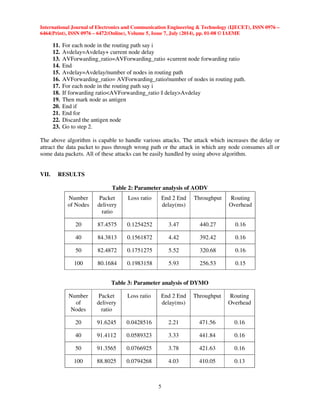
Table 2: Parameter analysis of AODV 
Table 3: Parameter analysis of DYMO 
Number 
of Nodes 
Packet 
delivery 
ratio 
Loss ratio End 2 End 
delay(ms) 
Throughput Routing 
Overhead 
20 87.4575 0.1254252 3.47 440.27 0.16 
40 84.3813 0.1561872 4.42 392.42 0.16 
50 82.4872 0.1751275 5.52 320.68 0.16 
100 80.1684 0.1983158 5.93 256.53 0.15 
Number 
of 
Nodes 
Packet 
delivery 
ratio 
Loss ratio End 2 End 
delay(ms) 
Throughput Routing 
Overhead 
20 91.6245 0.0428516 2.21 471.56 0.16 
40 91.4112 0.0589323 3.33 441.84 0.16 
50 91.3565 0.0766925 3.78 421.63 0.16 
100 88.8025 0.0794268 4.03 410.05 0.13
International Journal of Electronics and Communication Engineering  Technology (IJECET), ISSN 0976 – 
6464(Print), ISSN 0976 – 6472(Online), Volume 5, Issue 7, July (2014), pp. 01-08 © IAEME 
 
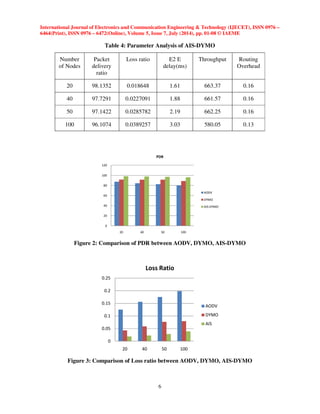
Table 4: Parameter Analysis of AIS-DYMO
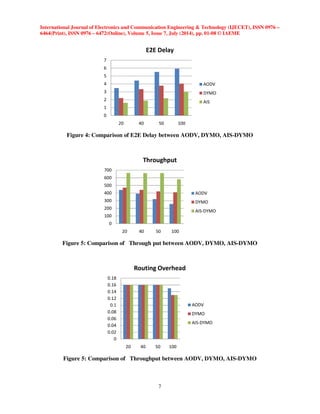
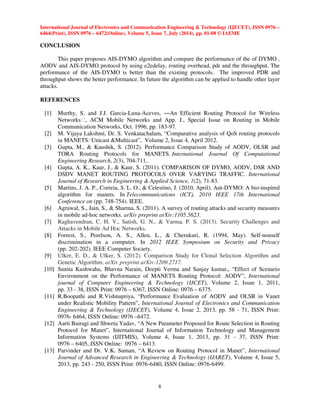
Figure 2: Comparison of PDR between AODV, DYMO, AIS-DYMO 


Figure 3: Comparison of Loss ratio between AODV, DYMO, AIS-DYMO 
6
Number 
of Nodes 
Packet 
delivery 
ratio 
Loss ratio E2 E 
delay(ms) 
Throughput Routing 
Overhead 
20 98.1352 0.018648 1.61 663.37 0.16 
40 97.7291 0.0227091 1.88 661.57 0.16 
50 97.1422 0.0285782 2.19 662.25 0.16 
100 96.1074 0.0389257 3.03 580.05 0.13

40120140507001

  • 1.
    International INTERNATIONAL Journalof Electronics and JOURNAL Communication Engineering OF ELECTRONICS & Technology (IJECET), AND ISSN 0976 – 6464(Print), ISSN 0976 – 6472(Online), Volume 5, Issue 7, July (2014), pp. 01-08 © IAEME COMMUNICATION ENGINEERING TECHNOLOGY (IJECET) ISSN 0976 – 6464(Print) ISSN 0976 – 6472(Online) Volume 5, Issue 7, July (2014), pp. 01-08 © IAEME: http://www.iaeme.com/IJECET.asp Journal Impact Factor (2014): 7.2836 (Calculated by GISI) 1 IJECET © I A E M E AIS DYMO: AIS BASED SECURE DYMO ROUTING IN MANET Parvinder1 Dr. V.K. Suman2 1Research Scholar, Shri Venkateshwara University, U.P. 2Professor Dean, IIMT-IET, Meerut. ABSTRACT This paper modifies the DYMO protocol and develops the AIS-DYMO protocol that is capable to handle the network layer attack. It means the performance of the network doesn’t get degraded under the attack. Various immune algorithms can be used to enhance the performance of the DYMO protocol, but the clonal selection algorithm is used in this work to enhance the performance of the DYMO protocol. Overall the DYMO protocol is modified to handle the network layer attacks by using the clonal selection immune algorithm. Keywords: MANET, Routing, Attacks, DYMO, AIS, Clonal selection. I. INTRODUCTION Mobile Ad-Hoc Networks (MANETs) are comprised of mobile nodes (MNs) that are self-organizing and cooperative to ensure efficient and accurate packet routing between nodes (and, potentially, base stations).Figure1 shows the structure of MANETS. There are no specific routers, servers, access points for MANETs. Because of its fast and easy of deployment, robustness, and low cost, Typical MANETs applications could be find in the following areas like Military applications (i.e. a temporary network in the battlefield), Search and rescue operations, Temporary networks within meeting rooms, airports, Vehicle-to-vehicle communication in smart transportation, Personal Area Networks connecting mobile devices like mobile phones, laptops, smart watches, and other wearable computers etc. Design issue for developing a routing protocol for wireless environment with mobility is very different and more complex than those for wired network with static nodes [1].
  • 2.
    International Journal ofElectronics and Communication Engineering Technology (IJECET), ISSN 0976 – 6464(Print), ISSN 0976 – 6472(Online), Volume 5, Issue 7, July (2014), pp. 01-08 © IAEME Figure 1: Mobile Ad Hoc Networks-MANETs. [2] Routing is the process to send information from one host to another host. Routing means route packet to its destination using efficient path. Protocols are set of rules. Ad-Hoc network is known as Mobile Ad-Hoc Network (MANET) because of motion of nodes in network. They are IBSS (Independent Basic Service Set), because they do not need AP (Access Point) for communication in nodes [3]. MANETs is a self-constructing network and form an unaware topology. Every node acts as routers in network to route the packet. MANETs are used in those areas where wire and wireless infrastructures are unreachable i.e. disaster area, war zone. Due to rapid change of topology in MANETs, MANETs routing protocols are required. The routing protocol is required whenever the source needs to communicates with destination. 2 MANETs routing protocols are classified as:- A. Reactive protocols B. Proactive protocols C. Hybrid protocols a. Reactive Routing Protocols The reactive routing protocols are based on some sort of query-reply dialog. Reactive protocols proceed for establishing route(s) to the destination only when the need arises. They do not need periodic transmission of topological information of the network. b. Proactive Routing Protocols Proactive protocols continuously learn the topology of the network by exchanging topological information among the network nodes. Thus, when there is a need for a route to a destination, such route information is available immediately. If the network topology changes too frequently, the cost of maintaining the network might be very high. If the network activity is low, the information about actual topology might even not be used. a. Hybrid Routing Protocols Often reactive or proactive feature of a particular routing protocol might not be enough; instead a mixture might yield better solution. Hence, in the recent days, several hybrid protocols are also proposed.
  • 3.
    International Journal ofElectronics and Communication Engineering Technology (IJECET), ISSN 0976 – 6464(Print), ISSN 0976 – 6472(Online), Volume 5, Issue 7, July (2014), pp. 01-08 © IAEME 3 II. DYMO Dynamic MANET On-demand Routing (DYMO) [4] is a reactive routing protocol under development by the Mobile Ad hoc Networks Working Group from IETF and is intended for use by mobile routers in wireless, multi-hop networks. It offers adaption for topology changes and determines unicast routes on-demand. Its main activities are the route discovery and route maintenance mechanisms, achieved through its route requisition (RREQ), route reply (RREP) and route error (RRER) messages. It employs sequence numbers to ensure loop freedom and also to avoid the dissemination of ancient routing information, and its basic operation consists of sending RREQ messages through the network for finding the routes it needs. The intermediate nodes receiving a RREQ message store the route for the node that originated it and then reforward the RREQ. The destination node, upon receiving a RREQ message, replies with a unicast RREP one. The same way, every intermediate node receiving a RREP message stores the route for the node that originated it. To adapt to topology changes, after receiving a packet that should be sent to a link that is no longer available, the node notifies the message sender by sending back a RERR message. IF the source node still wants to send packets to given destination, a new route discovery process is to be initiated [5]. The DYMO protocol works with source routing, meaning nodes read the routing messages to acquire knowledge on the paths involved in the search process, as well as write in the search packet the necessary hops needed to reach its destination. This method clearly increases the size of the routing packets, with the intention of reducing the number of retransmissions. III. ATTACKS In MANET’s Due to dynamic, distributed infrastructure less nature of MANETs, and lack of centralized authority, the ad hoc networks are vulnerable to various kinds of attacks. The challenges to be faced by MANETs are over and above to those to be faced by the traditional wireless networks. The accessibility of the wireless channel to both the genuine user and attacker make the MANET susceptible to both passive eavesdroppers as well as active malicious attackers. The limited power backup and limited computational capability of the individual nodes hinders the implementation of complex security algorithms and key exchange mechanisms. There is always a possibility of a genuine trusted node to be compromised by the attackers and subsequently used to launch attacks on the network. Node mobility makes the network topology dynamic forcing frequent networking reconfiguration which creates more chances for attacks [6]. Layer wise attack is further categorized into five layers in which an active attack is one where the attacker modifies network packets while they are in transit, or sends forged network packets. Table 1: Layer wise categorization of attacks
  • 4.
    International Journal ofElectronics and Communication Engineering Technology (IJECET), ISSN 0976 – 6464(Print), ISSN 0976 – 6472(Online), Volume 5, Issue 7, July (2014), pp. 01-08 © IAEME 4 IV. AIS Artificial immune systems can be defined as abstract or metaphorical computational systems developed using ideas, theories, and components, extracted from the immune system. Most AIS aim at solving complex computational or engineering problems, such as pattern recognition, elimination, and optimization. This is a crucial distinction between AIS and theoretical immune system models. While the former is devoted primarily to computing, the latter is focused on the modelling of the IS in order to understand its behaviour, so that contributions can be made to the biological sciences. It is not exclusive, however, the use of one approach into the other and, indeed, theoretical models of the IS have contributed to the development of AIS [8]. There are various algorithm in AIS. Form all clonal selection is as: Clonal Selection Algorithm Immune Algorithm is derived through the study of immune response. In short, it models how antibodies of the immune system learn adaptively the features of the intruding antigen and act upon. Clonal Selection Algorithm is a special class of Artificial Immune Systems. The algorithm starts by defining a purpose function f(x) which needs to be optimized. Some possible candidate solutions are created, antibodies will be used in the purpose function to calculate their affinity and this will determine the ones which will be cloned for the next step. The cloned values are changed, mutated with a predefined ratio and the affinities are recalculated and sorted. V. PROPOSED WORK The existing DYMO protocol is not capable of handling any type of attack. It means the performance of the protocol gets degraded under attacks. The attacks at the network layer leads to the most degradation in the performance. Various network layer attacks are wormhole attack, black hole attack, gray hole attack, Sybil attack etc. Any external agent may disturb the nature of any particular node that leads to the routing disruption and results in degraded performance. The proposed work modifies the DYMO protocol and develops the AIS-DYMO protocol that is capable to handle the network layer attack. It means the performance of the network doesn’t get degraded under the attack. Various immune algorithms can be used to enhance the performance of the DYMO protocol, but the clonal selection algorithm is used in this work to enhance the performance of the DYMO protocol. Overall the DYMO protocol is modified to handle the network layer attacks by using the clonal selection immune algorithm. VI. PROPOSED ALGORITHM The working of the AIS-DYMO can be understood by the following algorithm: 1. Select S and D in the network of node N 2. Determine the routing path from S to D using the DYMO routing protocol. 3. If length of path average length path 4. Discard the path 5. go to step 2 6. end if 7. Mark each node in the routing path as antibody 8. When an antigen invades(attack occur) 9. Avdelay=0; 10. AVForwarding_ratio=0;
  • 5.
    International Journal ofElectronics and Communication Engineering Technology (IJECET), ISSN 0976 – 6464(Print), ISSN 0976 – 6472(Online), Volume 5, Issue 7, July (2014), pp. 01-08 © IAEME 5 11. For each node in the routing path say i 12. Avdelay=Avdelay+ current node delay 13. AVForwarding_ratio=AVForwarding_ratio +current node forwarding ratio 14. End 15. Avdelay=Avdelay/number of nodes in routing path 16. AVForwarding_ratio= AVForwarding_ratio/number of nodes in routing path. 17. For each node in the routing path say i 18. If forwarding ratioAVForwarding_ratio || delayAvdelay 19. Then mark node as antigen 20. End if 21. End for 22. Discard the antigen node 23. Go to step 2. The above algorithm is capable to handle various attacks. The attack which increases the delay or attract the data packet to pass through wrong path or the attack in which any node consumes all or some data packets. All of these attacks can be easily handled by using above algorithm. VII. RESULTS Table 2: Parameter analysis of AODV Table 3: Parameter analysis of DYMO Number of Nodes Packet delivery ratio Loss ratio End 2 End delay(ms) Throughput Routing Overhead 20 87.4575 0.1254252 3.47 440.27 0.16 40 84.3813 0.1561872 4.42 392.42 0.16 50 82.4872 0.1751275 5.52 320.68 0.16 100 80.1684 0.1983158 5.93 256.53 0.15 Number of Nodes Packet delivery ratio Loss ratio End 2 End delay(ms) Throughput Routing Overhead 20 91.6245 0.0428516 2.21 471.56 0.16 40 91.4112 0.0589323 3.33 441.84 0.16 50 91.3565 0.0766925 3.78 421.63 0.16 100 88.8025 0.0794268 4.03 410.05 0.13
  • 6.
    International Journal ofElectronics and Communication Engineering Technology (IJECET), ISSN 0976 – 6464(Print), ISSN 0976 – 6472(Online), Volume 5, Issue 7, July (2014), pp. 01-08 © IAEME Table 4: Parameter Analysis of AIS-DYMO
  • 7.
    Figure 2: Comparisonof PDR between AODV, DYMO, AIS-DYMO Figure 3: Comparison of Loss ratio between AODV, DYMO, AIS-DYMO 6
  • 8.
    Number of Nodes Packet delivery ratio Loss ratio E2 E delay(ms) Throughput Routing Overhead 20 98.1352 0.018648 1.61 663.37 0.16 40 97.7291 0.0227091 1.88 661.57 0.16 50 97.1422 0.0285782 2.19 662.25 0.16 100 96.1074 0.0389257 3.03 580.05 0.13