Https://ThesisScientist.com
Minor Project Report
On
Securing MANET against Wormhole Attack
using Neighbor Node Analysis
SUBMITTED IN PARTIAL FULFILLMENT OF THE REQUIREMENT FOR THE
AWARD OF THE DEGREE OF
MASTER OF TECHNOLOGY
(Computer Science and Engineering)
Submitted by Supervised By
Department of CSE, NGFCET, Palwal Department of CSE, NGFCET, Palwal
Submitted to
Https://ThesisScientist.com
Abstract
MANETs have unique characteristics like dynamic topology, wireless radio medium, limited
resources and lack of centralized administration; as a result, they are vulnerable to different types
of attacks in different layers of protocol stack. Each node in a MANET is capable of acting as a
router. The necessity for a secure MANET networks is powerfully tied to the security and
privacy features. The characteristics of MANETs like infrastructure less network with dynamic
topology pose a number of challenges to security design. There is an increasing threat of attacks
in MANET. Wormhole attack is one of the security attacks on mobile ad hoc networks in which
a pair of colluding nodes make a tunnel using a high speed network. This thesis focuses on
providing a solution for secure transmission through the network and proposes a neighbor node
analysis approach to identify wormhole attack and removes wormhole link in MANET. The
proposed work is simulated using Qualnet 7.0 and is analyzed using certain parameters such as
throughput, loss rate, delay rate.
Keywords
Wormhole Attack, AODV, Routing, Network Security, MANET
Https://ThesisScientist.com
CHAPTER 1
INTRODUCTION
1 Introduction:
The higher demand of wireless communication and wireless devices have tends to research on
self-organizing, self-healing networks beyond the interference of some centralized or pre-
established infrastructure/authority. The networks not present of any centralized or pre-
established structure are known as Ad hoc networks. Ad hoc Networks are the class of wireless
networks that are uses multiple hop radio relay. Mobile Ad-hoc Network (MANET) is a
combination of wireless mobile nodes and connected other in dynamic way. Nodes make a
temporary/short-term network without any fixed infrastructure where nodes are fully free to
move arbitrarily.
FIGURE 1.1 Mobile Ad Hoc Network
The Nodes must behave like routers, take part in discovery and keep routes to other nodes in the
network [1] Wireless links in MANET are highly error level and can go down easily due to
mobility of nodes. Stable routing is a complicated task due to highly dynamic environment in
Mobile Ad-hoc Network [2]. So mobile ad-hoc network (MANET) is a self-organised network
of mobile routers (and associated hosts) associated by wireless links - the union of which form a
Https://ThesisScientist.com
random topology. The routers free to move randomly and organize themselves at random. a
network operates in a separate fashion, or may be link to the higher level of Internet. Minimal
configuration and fast deployment make ad hoc networks flexible for emergency situations like
natural or human prompted disaster areas, military conflicts, and emergency medical situations.
[3]
1.1 Research Motivation
With the speedy area of mobile devices and their extensive use in modem lifestyle, the paradigm
of networking has transfer from fixed networks to mobile wireless networking technologies with
limited or without infrastructure support. This paradigm transfer was designated in [8] [9], where
unworkable researchers describe the future integration of mobile networking technology with the
Internet. Mobile ad hoc networks have fast significance in current pervasive networking due to
their desirable characters such as fast deployment and without infrastructure.
• Lack of routers, nodes in the network have to participate and accept the routing and service of
data requirement.
• so the free architecture of the network where the nodes are independent join in and leave any
time, a rogue node can join the network to reason harm.
• Most widely used ad hoc routing protocols such as Ad hoc On-demand Distance Vector routing
(AODV) [to] and Dynamic Source Routing (DSR) [11] are created under the assumption that all
nodes trust each other and there are no malicious attacker nodes in the network. Therefore, the
presencey of any such nodes imposes the security challenges. Malicious nodes can creat
disturbance through a wide range of attacks including both routing and data forwarding attacks.
• Exacting resource constraints exist in MANETs; for example, most of the nodes in MANETs
rely on exhaustible battery resources and intruders can activity this to compromise routing and
data forwarding service in the network.
• Highly dynamic topology of the network due to nodes' mobility makes it difficult to detect the
attacking node. Therefore, the fundamental motivation of the research described in this thesis
appear from realizing the need to secure mobile ad hoc networks from a wide variety of attacks.
Attacks from intruder or malicious nodes cause various degree of damage to the network
depending on the type of attack used. We note that a considerable research effort has already
Https://ThesisScientist.com
been made to secure MANETs. We can find some examples in literature where various routing
attacks are examined and their proposals are made to detect these individual attacks. However,
our views in this thesis is that most of the work distinguish previously in the literature has
focused on detecting and preventing a single attack; but very few have suggested a generalize
approach that can secure against a wide variety of attacks. We consider that security is a major
service for MANETs, where there is no central administration or control to monitor and identify
attacks or activities that compromise network security. We also note the lack of research on
mechanisms with the capability to detect and prevent a range of possible attacks in MANETs.
Therefore in our opinion, further research is needed on mechanisms that can protect MANETs
against a wide variety of attacks effectively. This is especially true for reactive routing protocols
since they are more widely used.
1.2 Background and Related Work:
Technological advances in field of communications take place at an incredible pace in the last
few decades that has changed the manner we live and communicate; in particular, breakthroughs
in the "wireless world" have revolutionized our behaviour. Developments in technology have not
only brought change in personal behaviour but also from a commercial perspective companies
are adapt to the advancement in wireless networking technology to upgrade customer services.
One of the high advances in the wireless networking technology is the concept of ad hoc
networking. Mobile ad hoc network is attracted the research community since 1990s, due to the
fast growth of wireless devices and Wi-Fi (IEEE 802.11). As part of this, a significant amount of
research in MANETs has looked at giving desirable level of security services. This chapter first
describe the paradigm of mobile ad hoc networking include its characteristics, application and
routing. We can consider security aspects, describing vulnerabilities, classifying possible attacks
and reviewing existing proposals that secure MANETs from attacks. Finally, in these section we
present logic of disturbance detection and prevention (IDP) including, category of IDS, ID
techniques, IDS challenges in MANETs, and review existing IDS architectures and acceptance
from the literature.
Https://ThesisScientist.com
1.3 MANETs Paradigm:
1.3.1 Background& Standards
In 1997 the IETF produce the Mobile Ad hoc Networking Working Group [14] and since then
considerable effort has been put in by the research community for similarity on this arrive
paradigm. The aim of this working group is to similarity the routing protocol by considering their
suitable functionality in MANETs environment. They established two standard track routing
protocol particular as reactive MANET protocols and proactive MANET protocols. One of the
main considerations for the similarity of routing protocols is their performance matter such as
loop freedom, demand based operations, distributed operation and proactive operations [15].
Take into consideration the configuration matter of MANETs, IETF recently figure another
working group called Ad Hoc Networks Auto configuration (auto conf) [16]. The main purpose
of this working group is to describe the matter in addressing model for ad hoc networks that is
how the nodes in ad hoc network constract their address both locally and globally when they
connect to other networks. The auto configure working group has addition in a form of internet
draft [17], where they propose and describe a model for constract IP addresses in ad hoc
networks. The research society perspective on this multi hop ad hoc networking technology has
chang as the technology has developed in the last two line. In [18] they define the term pure
MANETs referring to an ad hoc network with no infrastructure help as compared to one with
bounded infrastructure support.
1.3.2 Ad-Hoc Networks
Ad-Hoc networks have without arrangement where the nodes are free to add and left the
network. The nodes are attached with each other through a wireless link. A node can serve as a
router to send the data to the neighbors’ nodes. Therefore this type of network is also known as
infrastructure low networks. These networks have no centralized administration. Ad-Hoc
networks have the able to handle any malfunctioning in the nodes or many changes that its
experience due to topology changes. Whenever a node in the network is down or leave the
network that reason the link between other nodes is broken. The effected nodes in the network
Https://ThesisScientist.com
simply request for advanced routes and advanced links are established Ad-Hoc network can be
considered in to stable Ad-Hoc network (SANET) and Mobile Ad-Hoc network (MANET).
1.3.3 Static Ad-Hoc Networks:
In static Ad-Hoc networks the geographic place of the nodes or the stations are static. There is no
mobility in the nodes of the networks, that’s why they are known as fixed Ad-Hoc networks.
1.3.4 Mobile Ad-Hoc Networks
Mobile Ad-Hoc network is an uncontrolled system, where nodes/stations are connected with
each other over wireless connection. There is no limit on the nodes to join or leave the network,
therefore the nodes add or leave freely.
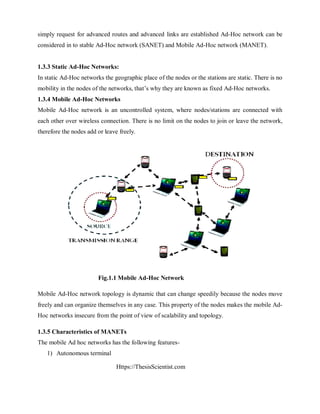
Fig.1.1 Mobile Ad-Hoc Network
Mobile Ad-Hoc network topology is dynamic that can change speedily because the nodes move
freely and can organize themselves in any case. This property of the nodes makes the mobile Ad-
Hoc networks insecure from the point of view of scalability and topology.
1.3.5 Characteristics of MANETs
The mobile Ad hoc networks has the following features-
1) Autonomous terminal
Https://ThesisScientist.com
2) Distributed operation
3) Multi-hop routing
4) Dynamic network topology
5) Fluctuating link capacity
6) Light-weight terminals
 Autonomous Terminal: In MANET, every mobile terminal is an autonomous node,
which may function as both a host and a router. In other words, beside the basic
processing capability as a host, the mobile nodes can also act switching functions as a
router. So usually endpoints and switches are identic in MANET.
 Distributed Operation: Since there is no background network for the central authority. of
the network operations, the control and management of the network is allocation among
the terminals. The nodes winding in a MANET should co-operate amongst themselves
and each node action as a relay as needed to implement functions like security and
routing.
 Multi-hop Routing: Basic types of Ad hoc routing algorithms can be single-hop and
multi-hop, depend on different link layer attributes and routing protocols. Single-hop
MANET is simple than multi-hop in terms of structure and implementation, with the
lower cost of functionality and applicability. When delivering data packets from a source
to its destination out of the traditional wireless transmission area, the packets should be
forwarded by one or more middle nodes.
 Dynamic Network Topology: Since the nodes are mobile, the network topology may
change fastly and unpredictably and the connectivity among the terminals may alter with
time. MANET should accept to the traffic and propagation case as well as the mobility
designs of the mobile network nodes. The mobile nodes in the network dynamically
stablished routing among themselves as they shift about, forming their own network on
the fly. also, a user in the MANET may not only operate within the Ad hoc network, but
may require access to a public static network (e.g. Internet).
 Fluctuating Link Capacity: The nature of high bit-error rates of wireless connection
might be more deep in a MANET. One end-to-end path can be shared by several
sessions. The channel over which the terminals communicate is subjected to noise, dying,
Https://ThesisScientist.com
and interference, and has less bandwidth than a wired network. In some scenarios, the
path between any pair of users can Travers many wireless links and the link themselves
can be heterogeneous.
 Light Weight Terminals: In many cases, the MANET nodes are mobile devices with low
CPU processing capability, small memory size, and lower power storage. Such devices
involve optimized algorithms and mechanisms that implement the joint up and
communicating functions.
Types of Mobile Ad-Hoc Network:
1. Vehicular Ad-Hoc Networks (VANET’s)
2. Intelligent Vehicular Ad-Hoc Networks ( InVANET’s)
3. Internet Based Mobile Ad-Hoc Networks (iMANET’s
1 Vehicular Ad-Hoc Networks (VANET’s):
VANET is a type of Mobile Ad-Hoc network where vehicles are assembled with wireless and
form a network no help of any infrastructure. The equipment is located private vehicles as well
as on the road for giving access to other vehicles in order to form a network and communicate.
2 Intelligent Vehicular Ad-Hoc Networks (In-VANET’s):
Vehicles that form Mobile Ad-Hoc Network for communication using WiMAX IEEE 802.16
and WiFi 802.11. The main focus of designing In-VANET’s is to ignoring vehicle collision so as
to keep passengers as safe as possible. This also helps drivers to keep secure gap between the
vehicles as well as assist them at how much speed other vehicles are coming. In-VANET’s
applications are also employed for military purposes to interact with each other.
3 Internet Based Mobile Ad-Hoc Networks (i-MANET’s):
These are used for connecting the mobile nodes and fixed internet gateways. In these networks
the simple routing algorithms does not apply [2].
Https://ThesisScientist.com
1.4 Applications of MANETs:
Ad hoc networks are fitted for use in situations where an infrastructure is unaccessible or to
deploy one is not total effective [39]. The following are selected of the important applications.
 Business Applications: many possible uses of mobile Ad hoc networks is in any
business environments, where the need for Gray Hole computing might be most
important outside the office environment than inside, such as in a business meeting
outside the office to brief clients on a given work. Work has been going on to introduce
the fundamental aim of game theory and its applications in telecommunications. Game
theory originated from economics and has been applied in various fields. Game theory
contract with multi-person decision making, in which each decision maker tries to
maximize his speciality. The concert of the users is necessary to the operation of Ad hoc
networks; therefore, game theory give a good basis to analyse the networks. People
playing multi-player games usually do so over the Internet, uses a remote host. This
model is call the client-server model. In the class of multiple users, each user just
connected to a common server, and the server forwards the packets to connected users.
 Military Applications: Military applications have motivated recent research on Ad hoc
networks. The capability to quickly set up a network among military units in hostile
territory without any infrastructure help can provide friendly forces with a considerable
tactical advantage on the battlefield. For instance, each soldier can transfer a mobile
device that represents one of the mobile nodes in an Ad hoc network connected all
soldiers, tanks, and other vehicles as shown in Fig 3.3. Recently advances in robotics
have also motivated the plan of automated battlefields in which unmanned fighting
vehicles are send into battle. Supporting military applications requires self-maintained
mechanisms that provide robust and reliable communication in dynamic battle condition.
 Emergency Operations: other promising application field for Ad hoc networks is
emergency services, including search and rescue and disaster recovery operations. for
example of search and rescue, consider airline that attached to small wireless devices to
Https://ThesisScientist.com
the life jackets under each seats. Guess that the plane has mechanical problem and has to
made an emergency landing in the water.
1.5 Short comings of Mobile Ad-Hoc Networks:
The following are some of the important routing issues to be considered when deploying
MANETs.
a) Unpredictability of Environment
b) Unreliability of Wireless Medium
c) Resource-Constrained Nodes
d) Dynamic Topology
e) Transmission Errors
f) Node Failures
g) Link Failures
h) Route Breakages
i) Congested Nodes or Links
 Unpredictability of Environment: Ad hoc networks may be utilize in unknown terrains,
rare conditions, and even hostile environments where tampering or the real destruction of
a node may be imminent. Depend on the environment, node failures may occur freely.
 Unreliability of Wireless Medium: transmission through the wireless medium is
Unreliable and subject to errors. Also, due to varying environmental conditions such as
big levels of electro-magnetic interference (EMI) or inclement weather, the quality of the
wireless connection may be unpredictable.
 Resource-Constrained Nodes: Nodes in a MANET are typically battery powered as
well as fixed in storage and processing capabilities. Moreover, they may be situated in
places where it is not possible to re- charge and thus have limited lifetimes. Because of
these limitations, they must have algorithms which are energy able as well as operating
with limited processing and memory resources. The applicable bandwidth of the wireless
medium may also be finite because nodes may not be able to sacrifice the energy
consumed by operating at fully link speed.
Https://ThesisScientist.com
 Dynamic Topology: The topology in an Ad hoc network may changed frequently due to
the mobility of nodes. As nodes change in and out of range of each other, some links
break while new connection between nodes are created. As a result of these stocks,
MANETs are level to numerous types of faults including the following.
 Transmission Errors: The unaccuracy of the wireless medium and the unpredictability
of the environment may guide to transmitted packets being garbled and thus received
packet fault.
 Node Failures: Nodes may fail at any time due to kind of types of dangerous conditions
in the environment. They may also leave out of the network either voluntarily or when
their energy supply is depleted.
 Link Failures: Node failures as well as changing environmental conditions (e.g.,
increased levels of EMI) may aim links between nodes to break. Connection failures
creator the source node to realize new routes through other links.
 Route Breakages: When the network topology changes due to node/link failures and/or
node/connection additions to the network, routes become out-of-date and thus inaccurate.
Depending upon the network transport protocol, packets forwarded through stale routes
may either ultimately be bead be delayed.
 Congested Nodes or Links: Due to the topology of the network and the nature of the
routing protocol, certain nodes or connection may become over utilized, i.e., congested.
This will guide to either big delays or packet loss.
Https://ThesisScientist.com
1.6 MANETs Routing Protocols
Mobile Ad-Hoc Network is the fast growing technology from the past 20 years. The gain in their
fashion is because of the ease of arrangement, infrastructure low and their dynamic nature.
MANETs created a new set of demands to be effected and to provide efficient better end-to-end
communication. MANETs works on TCP/IP structure to giving the means of communication
between communicating work stations. Work stations are mobile and they have fixed resources,
therefore the old-fashioned TCP/IP model requires to be refurbished or modified, in order to
compensate the MANETs mobility give reliable functionality. Therefore the key research area
for the researchers is routing in another network. Routing protocols in MANETs are a
challenging and adorable tasks, researchers are giving tremendous amount of attention to this key
place.
1.6.1 Classification of MANETs Routing Protocols:
Routing protocols in MANETs are classified into three different categories according to their
functionality
1. Reactive protocols
2. Proactive protocols
3. Hybrid protocols
The hierarchy of these protocols is shown bellow in the figure .
Https://ThesisScientist.com
Fig.1.2 MANETs Routing Protocols
A. Reactive Protocols:
Reactive protocols also called as on demand driven reactive protocols. The fact they are called
reactive protocols is, they don’t initiate route discovery by themselves, until they are requested,
when a source node request to search a route. These protocols setup routes when demanded [3,
4]. When a node needs to conversation with another node in the network, and the source node
does not have a route to the node it wants to contact with, reactive routing protocols will
establish a route for the source to destination node. usually reactive protocols
 Don’t find route until demanded
 When tries to find the destination “on demand”, it uses flowing technique to propagate
the query.
 Do not consume bandwidth for sending information.
 They consume bandwidth only, when the node start transmitting the data to the
destination node.
1. Ad-Hoc On Demand Distance Vector Protocol (AODV):
AODV is define in RFC 3561 [5]. It’s reactive protocol, when a node wishes to start transfer
with another node in the network to which it has no route; AODV will provide topology
information for the node. AODV uses control messages to search a route to the destination node
in the network. That are three types of control messages in AODV which are discussed .
Https://ThesisScientist.com
Route Request Message (RREQ):
Source node that needs to concert with another node in the network transfer RREQ message.
AODV floods RREQ message, using expanding ring technique. There is a time to live (TTL)
value in every RREQ message, the value of TTL states the number of hops the RREQ should be
transferred.
Route Reply Message (RREP):
A node having a requested identity or another intermediate node that has a route to the requested
node creates a route reply RREP message back to the originator node.
Route Error Message (RERR):
Each node in the network kept monitoring the link status to its neighbor’s nodes during active
routes. When the node detects a connection crack in an active route, (RERR) message is
generated by the node in order to notify other nodes that the connection is down.
Route Discovery Mechanism in AODV
When a node “A” wants to initiate transmission with any node “G” as shown in the Fig. 2.4 , it
will creats a route request message (RREQ). This message is propagated through a fixed flood to
other nodes. This control message is forwarded to the neighbors, and those node forward the
control message to their neighbouring nodes. This process of finding destination node goes on
until it search a node that has a fresh enough route to the destination or destination node is placed
itself. Once the destination node is located or an intermediate node with enough new routes is
located, they allocate control message route reply message (RREP) to the source node. When
RREP reaches the source node, a route is established between the source node “A” and
destination node “G”. Once the route is stablished between “A” and “G”, node “A” and “G” can
concern with each other. Fig.1.3 depicts the exchange of control messages between source node
and destination node.
Https://ThesisScientist.com
Fig.1.3 AODV Route Discovery
When there connection is down or a link between destinations is broken that causes one or more
than one links unavailable from the source node or neighbours nodes, the RERR message is send
to the source node. When RREQ message is broadcasted for locating the destination node i.e.
from the node “A” to the neighbors nodes, at node “E” the link is broken between “E” and “G”,
so a route error RERR message is created at node “E” and transmitted to the source node
informing the source node a route fault, where “A” is source node and “G” is the destination
node. The scheme is shown as fig 1.4..
Fig. 1.4 Route Error Message in AODV
Https://ThesisScientist.com
B. Dynamic Source Routing Protocol:
Dynamic source routing protocol compress as DSR is also a reactive protocol. DSR use to update
its route caches by finding fresh routes. It updates its cache with fresh route discovered or when
there exist a direct route between source and destination node. When a node needs to transmit
data, it design a route for the transmission and then starts transmitting data through the described
route. There are two processes for route discovery and maintenance which are defined below.
Route Discovery Process:
When a source node need to start data transmission with any node in the network, it checks its
routing cache. The cache route is not available to the destination in its cache or a route is
expired, it broadcast RREQ. When the destination is placed or any intermediate node that has
new enough route to the destination node, RREP is generated [15]. When the source node get the
RREP it updates its caches and the traffic is routed through the route.
Route Maintenance Process: the transferring of data started, it is the responsibility of the node
that is transfer data to confirm the next hop received the data along with source route. The node
creates a route wrong message, if it does not receive another confirmation to the originator node.
The originator node again performs fresh route discovery process.
1.6.2 Proactive Protocols:
Proactive routing protocols work as the another way around as compared to reactive routing
protocols. That protocols constantly maintain the updated topology of the network. Each node in
the network knows around the other node in advance, in other words the whole network is called
to all the nodes making that network. All the routing facts is usually keep in tables [6]. Whenever
there is a change in the network topology, that tables are updated accordance to the change. The
nodes exchange topology information with each other; they can have route information any time
when they require [6].
1. Optimized Link State Routing Protocol (OLSR):
The Optimized link State Routing (OLSR) protocol is defined in RFC3626 [7]. OLSR is
proactive routing protocol that is also known as table driven protocol by the information that it
updates its routing tables. OLSR has also three types of control messages which are defined.
Hello: This control message is transmitted for sensing the neighbor and for Multiple Point
Distribution Relays (MPR) calculation.
Https://ThesisScientist.com
Topology Control (TC): These are link state signaling that is performed by OLSR. MPRs are
used to optimize theses messaging.
Multiple Interface Declaration (MID): MID messages contains the list of all IP addresses used
by any node in the network. All the nodes running OLSR transmit these messages on more than
one interface.
OLSR Working Multi Point Relaying (MPR)
OLSR discuss the network topology information by flowing the packets throughout the network.
The flood is done in such way that each node that receive the packets retransmits the received
packets. These packets contain a sequence number so as to prevent loops. The receiver nodes
register this sequence number making assure that the packet is retransmitted once. The basic
concept of MPR is to decrease the duplication or loops of retransmissions of the packets.
Only MPR nodes are broadcast route packets. The nodes within the network kept a list of MPR
nodes. MPR nodes are selected with in the local area of the source node. The selection of MPR is
depend on HELLO message sent between the neighbor nodes. The selection of MPR is such that,
a path exist to each of its 2 hop neighbors through MPR node. Routes are established, once it is
complete the source node that wants to initiate transmission can start sending data.
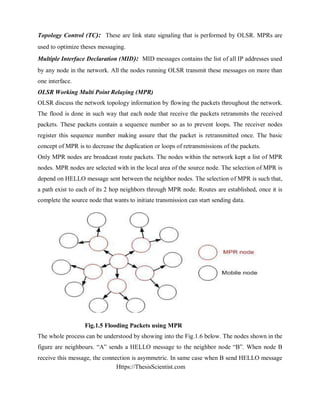
Fig.1.5 Flooding Packets using MPR
The whole process can be understood by showing into the Fig.1.6 below. The nodes shown in the
figure are neighbours. “A” sends a HELLO message to the neighbor node “B”. When node B
receive this message, the connection is asymmetric. In same case when B send HELLO message
Https://ThesisScientist.com
to A. there is two way communications between both of the nodes we call the connection as
symmetric connection. HELLO message have all the information about the neighbors. MPR
node broadcast topology control (TC) message, without link status information at a
predetermined TC interval.s
Fig:1.6 Hello Message Exchange
1.7 Basic Security Concepts:
To understand security method it is vital to know the attribute or basic concepts on which a
network security is tested. These attribute related to security are the desired objectives of
Cryptographic mechanism. Cryptography can be defined in different ways, in [66] it is defined as
Cryptography terminologies, key concepts, types are summarized in [67].
1.7.1 Non-Repudiation
Non-repudiation ensures that an entity in a dispute cannot wrong deny its action or cancel the
validity of the contact. For example, during a transmission non replication service prevents the
sender from denying sending a message which he sent fastly, or a receiver cannot claim to have
received the message wrong.
1.7.2 Availability
Availability is another most important attribute, referring to ensuring that system resources and
services are reachable for use by authorized users of the system. It is imperative to make assure
all the network services remain available for its users given that an intruducer can attempt to
Https://ThesisScientist.com
harm services in the network through denial of service attacks, and that a network without
desired services is as poor as having no network.
1.8 Vulnerability of MANET Routing Protocols:
Vulnerability, threat, and attacks are the terms used often in computer network security.
We begin this subsection with defining these terms [66]:
1.8.1 Confidentiality
Confidentiality is also called as secrecy or privacy. Confidentiality is the process of concealing
information on the network, i.e. it ensures that news content cannot be revealed by not authorized
entities that are normally called as internal or external attacker or intruders. It can also be
described as a security service that ensures only intended receivers could interpretation the
information transmitted on the network. Confidentially is very important security service in
MANETs since wireless links in such networks are effortlessly susceptible to eavesdropping.
1.8.2 Integrity:
Integrity confirms that data packets are unaltered during transition from source to destination i.e.
unapproved user could not manipulate data through insertion, substitution, deletion or forging
data. To keep integrity, data is usually signed by the source and the receiver proves the digital
signature to be sure of integrity of the data. Such mechanism will incur extra overhead for nodes
in MANETs with controlled processing abilities and also because nodes relay data for other
nodes, so integrity cheeks wants to carried out at every hop. In [20] Gavidia et.al realize the cost
of guaranteeing data integrity mechanism for MANETs and proposed a answer based on
probabilistic integrity checks and traffic analysis. They prove that probablistic verification is an
effective technique to restrict the amount of corrupted content and their spread i.e. ensures data
reliability in MANETs.
1.8.3 Authentication:
Authentication is a process that allows node to confirm the identity of the other nodes with it is
communicating. Two types of verification are entity and data authentication [36]. Entity
verification ensures that other communicating parties are who they claim to be and data
authentication is concentrated on providing a guarantee as to the origin of the data.
Https://ThesisScientist.com
1.9 Flaws in MANETS:
MANETs are very adaptable for the nodes i.e. nodes can freely join and leave the network. There
is no main body that keeps watching on the nodes arriving and leaving the network. All these
weaknesses of MANETs make it susceptible to attacks and these are discussed bellow.
1.9.1 Non Secure Boundaries:
MANET is susceptible to different kind of attacks due to no clear secure boundary. The nature of
MANET, nodes have the self-determination to join and leave inside the network. Node can join a
network unconsciously if the network is in the radio range of the node, thus it can communicate
with other nodes in the network. Due to no secure limitations, MANET is more susceptible to
attacks. The attacks may be passive or active, leak of information, false message reply, denial of
service or changing the data integrity. The contacts are compromised and are open to various link
attacks. Attacks on the link interfere between the nodes and then invading the link, destroying
the link after performing misbehave. There is no guard against attacks like firewalls or access
control, which result the susceptibility of MANET to attacks. Spoofing of node’s characteristics,
data tempering, confidential information leakage and impersonating node are the results of such
attacks when security is cooperated [10].
1.9.2 Compromised Node:
Several of the attacks are to get access inside the network in order to get control over the node in
the network expending unfair means to carry out their malicious activities. Mobile nodes in
MANET are free to move, link or leave the network in other words the mobile nodes are self-
sufficient [11]. Due to this autonomous factor for mobile nodes it is complex for the nodes to
prevent mischievous activity it is communicating with. Ad-hoc network mobility makes it easier
for a compromised node to change its position so frequently making it extra difficult and
troublesome to track the malicious activity. It can be grasped that these threats from
compromised nodes inside the network is more complex than attacking threats from outside the
network.
Https://ThesisScientist.com
1.9.3 No Central Management:
MANET is a self-configurable network, which contains of Mobile nodes where the
communication among these mobile nodes is done lacking a central control. Each and every
node act as router and can forward and receive packets [12]. MANET works without any
preexistent infrastructure. This lack of centralized management tips MANET more weak to
attacks. Detecting attacks and monitoring the traffic in extremely dynamic and for large scale
Ad-Hoc network is very complex due to no central management. When there is a central entity
taking carefulness of the network by applying proper security, authentication which node can
joint and which can’t. The node connect which each other on the basis of blind mutual trust on
every other, a central entity can succeed this by applying a filter on the nodes to find out the
suspicious one, and let the other nodes know which node is doubtful.
1.9.4 Problem of Scalability:
In old-style networks, where the network is built and each machine is associated to the other
machine with help of wire. The network topology and the scale of the network, while designing
it is defined and it do not change much through its life. In other words we can say that the
scalability of the network is definite in the beginning phase of the designing of the network. The
case is fairly opposite in MANETs because the nodes are mobile and due to their mobility in
MANETs, the scale of the MANETs is varying. It is too hard to know and predict the numbers of
nodes in the MANETs in the future. The nodes are free to travel in and out of the Ad-Hoc
network which makes the Ad-Hoc network very much ascendable and shrinkable. Keeping this
property of the MANET, the protocols and all the services that a MANET affords must be
flexible to such changes.
Https://ThesisScientist.com
Chapter 2
LITERATURE REVIEW
2.1 Background
2.1.1 MANETs and Wormhole Attacks
A MANET is a network structure lacking a centralized infrastructure, making it vulnerable to
some types of attacks such as wormhole attacks. Wormhole attacks goal to attack a breakable
MANET by using two or more nasty nodes to fool a source node, which is trying to send the
data. Naturally, the malicious node uses a fake route which presents itself as the direct route to
the destination node [3]. Frequently, two nodes are involved: one is used to record the data and
the extra is used to forward the data back into the original network [4]. Contrary to mischievous
attacks, it was advised [8] that if a wormhole attack is not used for malicious means (for
instance, the case where it is produced by security personnel to test a network), the performance
of the network can be enhanced. An example of a wormhole link is depicted in Figure. 2.1 [9]:
Figure 2.1: Wormhole Link
Https://ThesisScientist.com
In Figure. 2.1, nodes X and Y are colluding nodes which form a wormhole connection. These
two nodes are part of the MANET and have the skill to communicate with each other as well as
other normal, behaving nodes such as b or c. However, unlike behaving nodes, X and Y have a
advanced transmission power which gives them the skill to attract to themselves, allowing
malicious acts to take place.
2.1.2 AODV Protocol
AODV [10] is a routing protocol which has been planned to wait for requests before attempting
to catch the most optimal route for use by one node (source) to send messages to another node
(destination). The most best route is determined by the distance or the number of hops between
nodes. The AODV procedure works as follows:
1. A source node is mandatory to signify the need to send packets to a particular destination
node.
2. The source node broadcasts a route request packet (RREQ) to all neighbouring nodes.
3. The middle nodes continues broadcasting the RREQ to other neighbouring nodes until the
destination node is found.
4. When foundation, the destination node broadcasts a route reply packet (RREP) back to the
source node using different routes found by the RREQ broadcast.
5. When the source receives the RREP messages, it selects the route with the lowest hop count to
forward the data packets to the destination node.
2.1.3 Message Delivery Protocols
There are two types of message transfer protocols; namely, unicast and multicast. Unicast
message delivery [11] is a kind of message passing mechanism used in AODV. Unicast involves
two nodes of interest, one node in need to send a message and another node that will receive the
message. Thus, unicast is commonly famous as `one-to-one' message transmission. For example,
next a source node receives a RREP from a destination node, it can simply send the data packets
to the destination node and no other nodes. Also, once the destination node receives a RREQ, it
builds a RREP and unicast the packet to the source node by reviewing the hops of the RREQ.
Multicast message delivery [12] is another type of message delivery system. Unlike unicast,
multicast can include two or more nodes of interest. Therefore, multicast is generally known as
Https://ThesisScientist.com
`one-to-many' message transmission. For example, later a source node receives a RREP from
changed destination nodes of interest, it sends the data all together to all the targeted destination
nodes. In this thesis, firstly unicast transmission is used. Since MANETs are open wireless
networks which are vulnerable to attacks, we will want methods to protect messages and data
packets which are passed over the network. The Diffe-Hellman (DH) algorithm [13] is ideal for
use in AODV since it each permits two nodes in the same network that are not alert of any
predefined or called parameters of other to securely exchange secret keys in an unconfident
network environment. We will be consuming the Advanced Encryption Standard [14] in CBC
mode as the security protocol used to deliver additional security of these secret keys.
2.2 Literature Review on Wormhole Attacks
Some works address the problem of detecting, preventing or justifying wormhole attacks
in MANETs. The following review signifies a few of these solutions To detect malicious nodes
and avoid routing from these nodes strong secure routing has been proposed by K. Sivakumar
and Dr. G. Selvaraj [4]. In this technique called Robust Secure Routing (RSR), the idea of FR
packets was introduced which inform nodes along a route that they should expect specified data
flow within a assumed time frame. The path elements can therefore be on the lookout for the
assumed data flow, and in the event that they do not accept the traffic flow, they can transmit
info to the source informing it that the data flow they expected did not reach. A route tracing
algorithm for detection and prevention of wormhole attack has been planned by P. Anitha and M.
Sivaganesh [11]. The PT algorithm runs on every node in a path during the AODV route
discovery process. It calculates per hop distance built on the RTT value and wormhole link using
frequency appearance count. The matching node detects the wormhole if per hop distance
exceeds the all-out threshold range.
An work return based trust model to detect and evade wormhole attack is planned by Shalini Jain
and Dr.Satbir Jain in [12] where every one node executing the trust model, measures the
accuracy and honesty of the immediate neighboring nodes by monitoring their participation in
the packet sending mechanism. The transfer node verifies the different fields in the forwarded IP
packet for mandatory modifications through a sequence of integrity checks. If the integrity
instructions succeed, it confirms that the node has acted in a benevolent manner and so its
Https://ThesisScientist.com
nonstop trust counter is incremented. Similarly, if the integrity checks flop or the forwarding
node does not transmit the packet at all, its corresponding direct trust size is decremented. This
derived trust is then used to inspiration the routing decisions, which in turn leader a node to
avoid communication through the wormholes.
For detection and prevention of attack in MANET an well-organized multipath algorithm was
proposed by Waseem Ahad and Manju Sharma [10]. This algorithm will casually generate a
number in between 0 to maximum number of nodes and kind the node with same number as
transmitter node as wormhole attack is complete by transmitter and receiver so have to decide
the transmitter and receiver. Then create the route from selected transmitting node to any
destination node with specified average route distance. After this it will send packet giving to
selected destination and start timer to count hops and delay. By repeating the whole method up to
this point will be required as to store ways and their hops and delay. Now for detection of
malicious node, if the hop count for a particular direction decreases abruptly for average hop
count then at least one node in the route must be attacker. Algorithm will check the interruption
of all previous routes which involve any on node of the suspicious path. The node not encounter
previously should be malicious.
An end-to-end detection of wormhole attack (EDWA) in wireless ad hoc networks is planned by
Xia Wang and Johnny Wong [8]. Authors first presented the wormhole detection which is
created on the smallest hop count estimation in the middle of source and destination. If the hop
count of a received shortest route is much lesser than the estimated value an alert of wormhole
attack is higher at the source node. Then the source node will start a wormhole finding procedure
to identify the two end points of the wormhole. Lastly, a legitimate route is selected for data
communication.
In [15], Khalil et al. suggested a protocol (so-called LiteWorp) to discover and avoid wormhole
attacks in a static network. LiteWorp works by instructing each node involved to find 2-hop
routing information from their immediate neighbours. The suggested technique is an extension of
their original protocol in which each node only saves 1-hop routing information. According to
the authors, analyzing the routing info on routes which are 2-hops away will help wormhole
detection. In addition, nodes will also monitor their private neighbour nodes and possibly
become guard nodes for a pair of nodes which are all-out 2-hops apart. Guard nodes are designed
Https://ThesisScientist.com
to monitor neighbouring nodes activity to aid wormhole detection. However, the LiteWorp idea
was only designed for static networks and is impractical for a mobile network such as MANETs.
In [4], Hu et. al packet leashing introduces a way to prevent wormhole attacks. Their idea of
using packet leashes consists of information in a commuting packet that detects and prevents
abnormal transmission. In doing so, some timings are inserted in the packet
when it is forwarded by the sending node to a receiving node (not necessarily from source to
destination). Next, the receiver compares its own timings with the sender's timings resulting in a
calculated latency between the two nodes. The authors pointed out a limitation to this technique
since it is possible that two malicious nodes collude together to break their scheme while still
being within an acceptable distance. They state that a network which includes node positioning
analysis will overcome such vulnerability. Unfortunately, this solution suggests that only a
network with such topology will be able to prevent this detrimental attack.
In [16], a scheme called TrueLink was proposed to prevent wormhole attacks. True Link also
uses a timing based solution to the wormhole problem. Two nodes which are seemingly
neighbours exchange nonces or values which are used only once. This method is monitored
under strict timing restrictions (similar to those used in [4]) so that it is impossible for colluding
malicious nodes to replicate it since the packets routed through the wormhole will be more time
consuming than those forwarded normally. After the exchange of nonces, the two apparent
neighbours send messages to each other authenticating that the nonces were from the respective
nodes. If any intrusion is discovered, there will be a mismatch in messages and the system will
detect the malicious activity. This scheme suffers various limitations. First, unexpected delays
caused by legitimate events such as signal interference may increase the timings past accepted
ranges, thereby causing a drop of genuine packets. Second, it is assumed that an authenticating
mechanism (which may not exist) is already in place. Third, if the security mechanism is not
available, this method will be benign and ineffective to detect malicious attacks on the packets
being forwarded within the network.
In [5], Mamatha et al. proposed an AODV-based scheme for preventing wormhole attacks in
MANETs in which the hash identifier of the original packet is inserted in the data as it gets
forwarded from node to node. The procedure of their scheme is outlined as follows.
1. The system gets the hash (treated as a marker) and includes it in the data frame of the packet.
Https://ThesisScientist.com
2. The packet is then divided into sub-packets with a predetermined size and sent to the
destination node.
3. The intermediate nodes read the data frame to get the destination of the packets and then
continue forwarding to the next neighbouring node based on the AODV protocol.
4. Once the sub-packets are received by the destination, they are reconstructed to form the
original packet and the hash value is calculated.
5. The receiver will continue to extract the hash value stored in the data frame of the packet and
then checks if these values match. If that is the case, the receiver will reply with an
acknowledgement (ACK) frame containing an ACK field to confirm safe receipt of the packet.
However, if there is no match, the ACK frame will contain a Confidentiality Lost field which
will be forwarded to the sender informing it that the hash value was changed. If the
acknowledgement frame is not received by the sender within the allotted time, then the packets
are assumed to be lost. Few limitations of this method are as follows. This method does not
address other major effects of wormhole attacks. For instance, falsified nodes cannot be
prevented from recording the packet chunks. Indeed, packet chunks can be copied or recorded
without modifying the packet itself, thus the hash value will not change. Additionally, if packet
chunks are recorded, they can possibly be reconstructed by malicious nodes. Thus, it is possible
for a wormhole attack to record packets while remaining undetected.
In [17], Singh and Vaisla introduced an approach to detect wormhole attacks, where time is
considered as a key parameter. In their scheme, during the RREQ broadcast phase of route
discovery, each node will save a TREQ (time of request) which will record the time it takes for
the current node to forward a RREQ to its neighbour node. Once the RREQ reaches the
destination, a RREP is sent by the destination node to the sender and a TREP (time of reply) is
recorded at each node as the algorithm retraces its steps back to the sender. Finally, a RTT
(round trip time) of each successive intermediate node is calculated as the difference between the
TREP and the TREQ (RTT = TREP - TREQ). The RTT is calculated at each node to check if the
value is higher or lower than other RTT values calculated along the route. If no attack is
detected, the value of the RTT will be similar for all nodes. However, if the value of the RTT at a
certain node is higher than that of other successive nodes, then a wormhole attack may have
occured at that specific node. The method assumes that the RTT between two colluding attacking
Https://ThesisScientist.com
nodes will be significantly higher than two good nodes. However, calculating only the RTT may
not be sufficient to detect wormhole attacks.
In [9], a method is proposed that does not use timings or delays as a factor in detecting wormhole
attacks in wireless networks. Each node has a disk which its surrounding neighbors may
populate. The method exploits the long range wormholes by using unit disk graphs (UDGs) as an
unit radius disk in the network plane that models the range in which a node can communicate
using an omni-directional antenna. Since long-range links will be more than a unit radius, this
will indicate the presence of a wormhole link in the network. Although their proposed scheme
was shown to effectively detect wormholes in wireless networks, the case when nodes are mobile
was not treated.
In [18], Choi et al. proposed a method which is based on the DSR routing protocol to detect
wormholes in MANETs. Their method consists of a neighbor node monitoring
technique and a wormhole route detection method controlled by means of a timer (so-called
wormhole prevention timer). This scheme does not rely on any speci_c hardware for node
location or time synchronization. However, the assumptions that nodes will continue to monitor
active transmission at the link layer even though some of these nodes may not be intended
receivers is not realistic.
In [19], Hayajneh et al. proposed a technique called DeWorm which utilizes discrepancies in
routing between neighbours of nodes that are along a route of a selected path between the source
and destination nodes. DeWorm takes advantage of the fact that a wormhole link attempts to
attract a large amount of traffic to itself. Moreover, the routes through the wormhole link are
shorter than that of legitimate nodes within the network. Each node along the route, after being
selected during the route discovery phase, will initiate the DeWorm algorithm which relies on
the acquisition of different routes to a target node. This route discovery phase involves nodes
which are 1-hop neighbours of the current node performing the scheme. Additional information
has been added to each packet in order to carry necessary information used by the method.
Therefore, this method su_ers from a large overhead. Due to this large overhead, the
computation used to analyze the necessary information will increase, thereby increasing the
amount of energy consumed. Since the method is not energy efficient, this protocol is not quite
suitable for mobile networks for which the target is energy conservation.
Https://ThesisScientist.com
In an attempt to improve DeWorm, Dhurandher et al. [20] proposed a scheme (so-called E2SIW)
which is based on the AODV protocol. It is designed to be energy efficient and can mitigate
wormhole attacks in MANETs. Their method uses the location coordinates of nodes within the
MANET in order to detect the presence of wormholes. The authors discussed that wormhole
links will be low in hop counts. The hop count needs to be low in order to attract a large amount
of traffic to the wormhole nodes. By using GPS to examine the connectivity information for all
neighbouring nodes of a given node, the method is able to detect exactly how far the nodes are
from each other. Moreover, as the RREQ is being broadcasted, each hop is analyzed by their
respective nodes. Information about nodes which are two hops away are tested and temporary
routes are analyzed as well. Thus, this technique continually monitors the actual position of
nodes as well as the temporary routes during the route discovery phase. By detecting anomalies
within the network throughout and each hop of the discovery process, the method continuously
builds a route which avoids the wormhole link. However, the authors have not disclosed the
overhead for such a scheme since a lot of information is analyzed throughout each step of the
route discovery process.
2.3 Attacks:
There are two mainly protocols are used in MANET networks, Link layer protocol are used to
provide connectivity between different mobile nodes in order to ensure one-hop connectivity by
using multihop wireless channels. On the other hand if we like to extend connectivity to different
multiple hops then MANET network uses network layer protocols. In the coordination process
distributed protocols typically assume that all mobile nodes are cooperating with respect to
communication but actually this assumption is not possible in hostile mobile networks
environment because cooperation is not enforced in MANET. The question arises why? The
reason is because of malicious attackers violating protocol specification in order to disrupt
network operations.
2.3.1 Network Layer operation
There are two main network-layer operations in MANET.
1. Ad hoc routing
2. Data packet forwarding
Https://ThesisScientist.com
They interact with each other and delivering packets from source to destination. The main
function of the ad hoc routing protocols is to provide routing among nodes; they exchange
routing messages between different mobile nodes in order to maintain routing information at
each node. According to the routing states, the second network layer operation data packets are
used to forward data by intermediate next node which is an established route to the destination
node. These both operations are vulnerable to malicious attacks, and which will lead to various
types of malfunction in network layer.
2.3.2 Network Layer Attack
Due to this reason network-layer generally fall into two categories attacks:
1. Routing attacks
2. Packet forwarding attacks
There are different categories of routing attacks that does not follow routing protocol
specification. There are different routing protocols in MANET so therefore different attack
behaviors related to different routing protocols. Some of them are discuss below:
1. According to the context of DSR [1] MANET routing protocol there are following different
attacks which are given below [6]:
 An attacker modifies source routing list with respect to RREQ or RREP packets.
 Switching order of different nodes in the routing list.
 Deleting entries from the list.
 Appending new node entries into the list.
2. According to the context of AODV [2] MANET routing protocol there are also different
attacks which are given below [7]:
 An attacker advertise route with wrong distance metric with respect to actual distance to
the destination.
 Advertise wrong routing updates with a large sequence number with respect to actual
sequence number.
 An attacker invalidates all routing updates from other nodes.
3. According to the context of TORA routing protocol, there are also different attacking
methods:
Https://ThesisScientist.com
 Attackers construct routing paths by interfering with the protocols' mechanisms, e.g.
routes can be forced to use attacking nodes to go through them.
 Attackers can also exhaust network resources by maliciously act of injecting, modifying
and dropping data packets.
In order to divert traffic attackers attack on the routing protocols and divert traffic towards
certain destinations under their control, and then they cause problematic situation in the network
along a route which is not optimal or even nonexistent. The attackers can also create routing
loops in the network, due to this way it creates network congestion in certain areas. There are
also some other attacks like multiple colluding attacks which may cause to prevent source in
order not to find route to the destination and also partition the network in the worst.
2.3.3 Active Attacks
There are also some different active attacks which are really difficult to locate or identify
because these attacks are more sophisticated and they are considered as subtle routing attacks
some of them are given below [8]:
 Attacker may further subvert existing nodes in the network.
 They can also fabricate their identity
 They can also impersonate other legitimate node
 Attackers in pair nodes may create a wormhole [9]
 They also creates shortcut in normal flows between each other
 The attackers target the route maintenance process and advertise operational link is
broken [6]
According to context of routing attacks there are also some other kind of attacks like attacker
launch attacks against packet forwarding operations as well due to this way it will not only
disrupt the routing protocol it also poison the routing states at every node. For example, the
attacker established route and drop packets, or also modify the content of the packets, or
duplicate the packets. Another type of packet forwarding attack is denial-of-service (DoS) attack
through network-layer packet blasting, in this type of attack attacker inserts large amount of junk
packets in network. Due to this action significant portion of the network resources are wasted,
and introduce severe wireless channel contention and network congestion in the network.
Https://ThesisScientist.com
There are identified vulnerabilities of the link-layer protocols, especially in the IEEE standard
802.11 MAC protocols [3], for mobile ad hoc network. It’s true that 802.11 WEP is vulnerable to
different types of cryptography attacks by misusing the cryptographic primitives [10]. The IEEE
802.11 protocol is vulnerable to many DoS attacks due to this way it targeting reservation
schemes and channel contention. The attacker exploits binary exponential back off scheme in
order to deny access to the wireless channel from its local neighbors [11, 17].
2.3.4 Routing Attacks:
Generally there are four different types of MANET routing protocol attacks which is divided in
to two main types which are given below:
1. Routing disruption attacks
2. Resource consumption attacks
Fig. 2.5 Classification of attacks on MANET routing protocols
In case of routing disruption attacks, the main task of attacker is to disrupt routing process by
routing packets in order to introduce wrong paths. In case of resource consumption attacks are
Https://ThesisScientist.com
concerned the main task of the attacker is to introduce some non-cooperative or selfish nodes
that can be used to inject false packets due to this wayload on the network increases and it will
become a cause of consuming network bandwidth.
2.3.5 Attacks using Modification:
In case of modification type of attacks some of the messages in the protocol fields are modified
and then these messages passed among the nodes, due to this way it become the cause of traffic
subversion, as well as traffic redirection and also act as a Denial of Service (DoS) attacks. There
are some of these types of attacks are given below:
A. Route sequence numbers modification: In this type of attack which is mainly
possible against the AODV protocol. In this case an attacker (i.e. malicious node) used to
modify the sequence number in the route request packets.
B. Hop count modification attack: In this type of attacks where it is also mainly
possible against the routing protocol AODV, here attacker mostly change hope count
value and due to this way it will become the cause of attract traffic. They are mainly used
to include new routes in order to reset the value of hop count field to a lower value of a
RREQ packet or sometime even it is used to set to zero.
C. Source route modification attack: In this type of attack which is possible against
DSR routing protocol where attacker (malicious node) modify source address and move
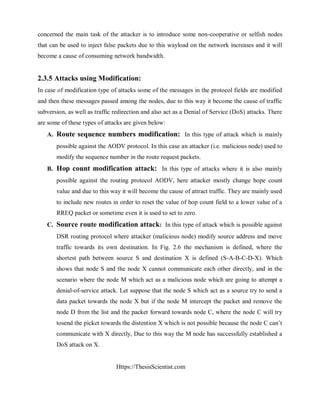
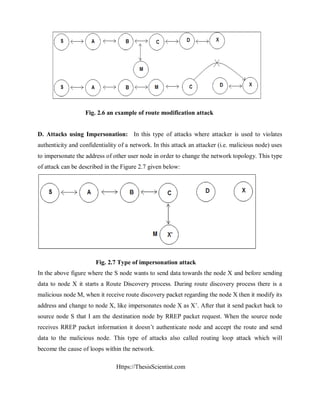
traffic towards its own destination. In Fig. 2.6 the mechanism is defined, where the
shortest path between source S and destination X is defined (S-A-B-C-D-X). Which
shows that node S and the node X cannot communicate each other directly, and in the
scenario where the node M which act as a malicious node which are going to attempt a
denial-of-service attack. Let suppose that the node S which act as a source try to send a
data packet towards the node X but if the node M intercept the packet and remove the
node D from the list and the packet forward towards node C, where the node C will try
tosend the picket towards the distention X which is not possible because the node C can’t
communicate with X directly, Due to this way the M node has successfully established a
DoS attack on X.
Https://ThesisScientist.com
Fig. 2.6 an example of route modification attack
D. Attacks using Impersonation: In this type of attacks where attacker is used to violates
authenticity and confidentiality of a network. In this attack an attacker (i.e. malicious node) uses
to impersonate the address of other user node in order to change the network topology. This type
of attack can be described in the Figure 2.7 given below:
Fig. 2.7 Type of impersonation attack
In the above figure where the S node wants to send data towards the node X and before sending
data to node X it starts a Route Discovery process. During route discovery process there is a
malicious node M, when it receive route discovery packet regarding the node X then it modify its
address and change to node X, like impersonates node X as X’. After that it send packet back to
source node S that I am the destination node by RREP packet request. When the source node
receives RREP packet information it doesn’t authenticate node and accept the route and send
data to the malicious node. This type of attacks also called routing loop attack which will
become the cause of loops within the network.
Https://ThesisScientist.com
E. Attacks using Fabrication: In this type of attacks, where an attacker as a malicious
node try to inject wrong messages or fake routing packets in order to disrupt the routing process.
The fabrication attacks are very much difficult to detect in the mobile ad hoc network. Attacks
using fabrication process are discussed very well in [20] and [21]. In Figure 2.8 where
fabrication attacks is explained by an example. In the example where the source node S wants to
send data towards the destination node X, so therefore at start it sends broadcast message and
request for route towards the destination node X. An attacker as a malicious node M try to
pretends and modify route and returns route reply to the node (S). Furthermore, an attacker’s
nodes use to fabricate RERR requests and advertise a link break nodes in a mobile ad hoc
network by using AODV or DSR routing protocols.
Fig. 2.8 Fabrication attack example
2.8 Special Attacks
There are also some other severe attacks in MANET network which are possible against routing
protocols such as AODV and DSR.
A. Wormhole Attack: The wormhole attack [15] is one of the severe types of attack in
which an attacker introduces two malicious nodes in the network where an attacker used
to forward packets through a private “tunnel”. This complete scenario described in Figure
2.9 which is given below:
Https://ThesisScientist.com
Fig. 2.9 Wormhole attack example
B. Black hole attack: This kind of attack is described very well in detail in [21]. In this
type of attack, node is used to advertise a zero metric to all destinations, which become
cause to all nodes around it in order to route data packets towards it. The AODV protocol
is vulnerable to such kind of attack because of having network centric property, where
each node of the network has to shares their routing tables among each other.
In the above example where there are two malicious nodes M1 and M2 which link through a
private connection. In this type of attack every packet which an attacker receive from network 1
forward to other network where another malicious node exist, simple speaking these two nodes
use to exchange network information and fabricate traffic among each other. The traffic between
the two nodes passes through “wormhole” among each other. Due to this way it will become the
cause of disrupts routing protocols and violating normal flow of routing packets. These types of
attacks are very difficult to detect in a network, and become the cause of severe damages to the
nodes. These types of attacks can be prevented by using mechanism packet leashes [15], which
are used to authenticate nodes among each other by timing information process.
Https://ThesisScientist.com
Chapter 3
Methodologies and Technical Background
In this chapter, we describe the methods that we proposed to address wormhole attacks in
MANETs as follows: (1) we analyze two different single wormhole scenarios and its effects on
MANETs by injecting two colluding malicious nodes which drop data packets; (2) we introduce
our E-HSAM method to enhance the HSAM scheme. The enhancements are twofold (a)
performing for the _rst time a simulation study of the HSAM protocol, (b) introducing a more
efficient approach to securing the routes in the route selection phase of the HSAM protocol; (3)
we design AODV-WADR-TDES as a complement to AODV-WADRAES in order to test the
performance difference when using two different cryptographic algorithms with the same
AODV-WADR scheme. This study is valuable because there exists modern day technology, such
as many smart cards, which do not necessarily support AES [21]; (4) we combine the techniques
and strengths of both E-HSAM and AODV-WADR-AES to design our novel scheme (so-called
TSMI). TSMI is able to ward of collaborative wormhole attacks effectively while maintaining
the performance of both E-HSAM and AODV-WADRAES.
3.1 Prevention against Single Wormhole Attacks
To begin our study of MANETs, we need to examine the effects of single wormhole attacks
before investigating collaborative attacks. We developed two simple scenarios where a MANET
is affected by a single wormhole attack. Both scenarios involve a wormhole which targets the
integrity of data packets.
3.1.1 Single Wormhole: Method 1
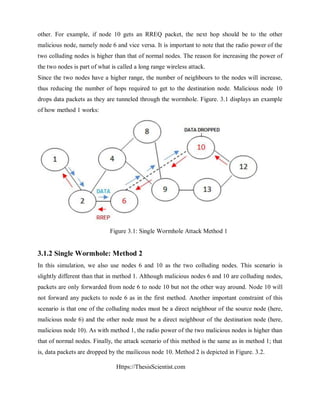
In this scenario, we simulate two different single wormhole attacks. In order to do this, we must
define the two colluding or malicious nodes. In this simulation, we use nodes 6 and 10 as the two
colluding nodes. The idea is to get these two nodes to have direct communication with each
Https://ThesisScientist.com
other. For example, if node 10 gets an RREQ packet, the next hop should be to the other
malicious node, namely node 6 and vice versa. It is important to note that the radio power of the
two colluding nodes is higher than that of normal nodes. The reason for increasing the power of
the two nodes is part of what is called a long range wireless attack.
Since the two nodes have a higher range, the number of neighbours to the nodes will increase,
thus reducing the number of hops required to get to the destination node. Malicious node 10
drops data packets as they are tunneled through the wormhole. Figure. 3.1 displays an example
of how method 1 works:
Figure 3.1: Single Wormhole Attack Method 1
3.1.2 Single Wormhole: Method 2
In this simulation, we also use nodes 6 and 10 as the two colluding nodes. This scenario is
slightly different than that in method 1. Although malicious nodes 6 and 10 are colluding nodes,
packets are only forwarded from node 6 to node 10 but not the other way around. Node 10 will
not forward any packets to node 6 as in the first method. Another important constraint of this
scenario is that one of the colluding nodes must be a direct neighbour of the source node (here,
malicious node 6) and the other node must be a direct neighbour of the destination node (here,
malicious node 10). As with method 1, the radio power of the two malicious nodes is higher than
that of normal nodes. Finally, the attack scenario of this method is the same as in method 1; that
is, data packets are dropped by the mailicous node 10. Method 2 is depicted in Figure. 3.2.
Https://ThesisScientist.com
Figure 3.2: Single Wormhole Attack Method 2
3.2 Prevention Against Collaborative Wormhole Attacks
3.2.1 A Secured Routing Protocol for Preventing Packet Dropping and Message Tampering
Attacks In this section, we introduce an enhancement to an existing secured routing protocol [5]
against packet dropping and message tampering attacks in MANETs called the Highly Secured
Approach against Attacks in MANETs (HSAM). Our goal is to improve the data integrity part of
HSAM. The focus of the method is to create a dynamic methodology which tests a selected route
as data packets are being sent when using the AODV protocol within MANETs. Before a data
packet is about to be sent to the desired destination node, the algorithm splits the packet into
packet chunks and calculates a hash marker for each chunk. Once in chunks, each sub packet is
sent to the destination. If the hash value is incorrect, the route is blacklisted. The number of data
chunks sent as well as unsuccessful transmissions are recorded and a tolerance ratio is calculated.
After all the chunks are sent, the original data packet is reconstructed at the destination node.
Although HSAM deals with the integrity of the data packet, there are still attacks which make
this method vulnerable. For instance, he copying of packets is not addressed, i.e. malicious nodes
could potentially record all the data packet chunks and assemble them together to get the original
packet.
3.2.1.1 Highly Secured Approach Against Attacks in MANETs
As mentioned, the main focus of the Highly Secured Approach Against Attacks in MANETs
(HSAM) method is to create more security for data packets as they are being forwarded within a
MANET. Route discovery is obtained using the regular AODV methods (i.e. sending out RREQs
Https://ThesisScientist.com
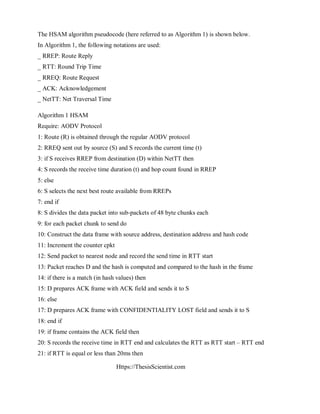
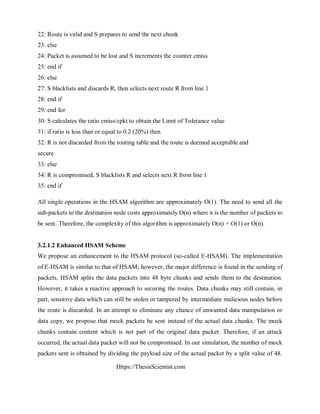
and receiving RREPs). Once a route is ready, data packets are first divided into 48 byte data
frames. Information about the source node and destination node as well as a hash marker and
time of delivery is inserted into the data frame. The hash value will help maintain the data
integrity since a slight change in the data frame will result in a different hash value. After the
data frame is sent, a counter (cpkt) will be incremented to keep track of the number of chunks
sent. The authors referred to this technique as one way hash chain. They also argued that it will
be impossible for an attacker to break it. Next, intermediate nodes will forward the data frame
until it reaches the destination. Once the destination node receives the data frame, the hash will
once again be calculated and matched against the hash code obtained from the data frame. One
of the following two different acknowledgement frames or ACK frame will be created by the
destination node and sent back to the source node:
The hash code matches the code within data frame. An ACK frame containing an ACK field,
which indicates that the hash code is verified and secure, is sent back to the source node The
hash code does not match the code within the data frame. In this case, an ACK frame containing
a Confidentiality Lost field, which indicates that the hash code has been compromised, is sent
back to the source node. Once the ACK frame is received by the source node: If the integrity is
verified (i.e. ACK field is received), the receipt time is calculated and recorded. If the difierence
between the send and receipt time is equal or less than 20ms, then the route is deemed to be
secure and the next 48 byte data chunk will be sent. However, if the time is greater than 20ms,
the packet is assumed to have been lost and a counter (cmiss) will be incremented in order to
keep track of the number of conceivably missed packets.
_ If the hash code does not match with the one within the data frame (i.e. Confidentiality Lost
field received), the route is discarded, blacklisted and the next route is chosen using regular
AODV methods. Assuming that the packet integrity is validated and all the packet chunks have
been sent, a ratio called the Limit of Tolerance will be calculated. The Limit of Tolerance is
based on the Principle Flow of Conservation [22] in order to measure the forwarding
misbehavior of nodes. The ratio, cmiss/cpkt, that is, the number of missed packets over the
number of packet chunks sent, will be calculated and a limit of 0.2 or 20% will be set for its
value. If this ratio is equal or less than 0.2, the route will be deemed safe. Otherwise, the route
will be considered as insecure and the next available route will be used to send the next set of
packet chunks.
Https://ThesisScientist.com
The HSAM algorithm pseudocode (here referred to as Algorithm 1) is shown below.
In Algorithm 1, the following notations are used:
_ RREP: Route Reply
_ RTT: Round Trip Time
_ RREQ: Route Request
_ ACK: Acknowledgement
_ NetTT: Net Traversal Time
Algorithm 1 HSAM
Require: AODV Protocol
1: Route (R) is obtained through the regular AODV protocol
2: RREQ sent out by source (S) and S records the current time (t)
3: if S receives RREP from destination (D) within NetTT then
4: S records the receive time duration (t) and hop count found in RREP
5: else
6: S selects the next best route available from RREPs
7: end if
8: S divides the data packet into sub-packets of 48 byte chunks each
9: for each packet chunk to send do
10: Construct the data frame with source address, destination address and hash code
11: Increment the counter cpkt
12: Send packet to nearest node and record the send time in RTT start
13: Packet reaches D and the hash is computed and compared to the hash in the frame
14: if there is a match (in hash values) then
15: D prepares ACK frame with ACK field and sends it to S
16: else
17: D prepares ACK frame with CONFIDENTIALITY LOST field and sends it to S
18: end if
19: if frame contains the ACK field then
20: S records the receive time in RTT end and calculates the RTT as RTT start – RTT end
21: if RTT is equal or less than 20ms then
Https://ThesisScientist.com
22: Route is valid and S prepares to send the next chunk
23: else
24: Packet is assumed to be lost and S increments the counter cmiss
25: end if
26: else
27: S blacklists and discards R, then selects next route R from line 1
28: end if
29: end for
30: S calculates the ratio cmiss/cpkt to obtain the Limit of Tolerance value
31: if ratio is less than or equal to 0.2 (20%) then
32: R is not discarded from the routing table and the route is deemed acceptable and
secure
33: else
34: R is compromised, S blacklists R and selects next R from line 1
35: end if
All single operations in the HSAM algorithm are approximately O(1). The need to send all the
sub-packets to the destination node costs approximately O(n) where n is the number of packets to
be sent. Therefore, the complexity of this algorithm is approximately O(n) + O(1) or O(n).
3.2.1.2 Enhanced HSAM Scheme
We propose an enhancement to the HSAM protocol (so-called E-HSAM). The implementation
of E-HSAM is similar to that of HSAM; however, the major difference is found in the sending of
packets. HSAM splits the data packets into 48 byte chunks and sends them to the destination.
However, it takes a reactive approach to securing the routes. Data chunks may still contain, in
part, sensitive data which can still be stolen or tampered by intermediate malicious nodes before
the route is discarded. In an attempt to eliminate any chance of unwanted data manipulation or
data copy, we propose that mock packets be sent instead of the actual data chunks. The mock
chunks contain content which is not part of the original data packet. Therefore, if an attack
occurred, the actual data packet will not be compromised. In our simulation, the number of mock
packets sent is obtained by dividing the payload size of the actual packet by a split value of 48.
Https://ThesisScientist.com
The reasoning behind this comes from our treatment of the size of data packets. In order to
obtain a reliable Limit of
Tolerance, there is a need to obtain a sufficient number of cpkt and cmiss. For smaller data
packet sizes, the packet should be split accordingly in order to gather enough cpkt and cmiss to
provide a reliable ratio (rather than just a few cpkt and cmiss). The next difference is how routes
will be avoided by the method. Instead of using a self-developed method to avoid the route
containing malicious nodes, E-HSAM method utilizes a mechanism similar to that used by
AODV for the sending of a RERR packet back to the sender. This mechanism will discard the
suspicious route and automatically increment the routing table sequence number, then choose the
next route. This slight modification to the RERR mechanism effectively avoids the route in
question when data the integrity is compromised and the next available route is to be used.
Algorithm 2 describes the E-HSAM algorithm pseudocode:
Require: AODV Protocol
1: Route (R) is obtained through the regular AODV protocol
2: RREQ sent out by source (S) and S records the current time (t)
3: if S receives RREP from destination (D) within NetTT then
4: S records the receive time duration (t) and hop count found in RREP
5: else
6: S selects the next best route available from RREPs
7: end if
8: S creates mock packets of 48 bytes each
9: S divides the data packet into sub-packets of 48 byte chunks each
10: for each packet chunk to send do
11: Construct the data frame with source address, destination address and hash code
12: Increment the counter cpkt
13: Send packet to nearest node and record the send time in RTTstart
14: Packet reaches D and the hash is computed and compared to the hash in the frame
15: if there is a match (in hash values) then
16: D prepares ACK frame with ACK field and sends it to S
17: else
18: D prepares ACK frame with CONFIDENTIALITY LOST field and sends it to S
Https://ThesisScientist.com
19: end if
20: if frame contains the ACK field then
21: S records the receive time in RTTend and calculates the RTT as RTTstart - RTTend
22: if RTT is equal or less than 20ms then
23: Route is valid and S prepares to send the next chunk
24: else
25: Packet is assumed to be lost and S increments the counter cmiss
26: end if
27: else
28: S blacklists and discards R, broken links are incremented, S selects the
next R from the routing table and restarts the mock packets process
(i.e. repeat line 8)
29: end if
30: end for
31: S calculates the ratio cmiss/cpkt to obtain the Limit of Tolerance value
32: if ratio is less than or equal to 0.2 (20%) then
33: R is not discarded from the routing table and is deemed acceptable and secure
34: The real data packet and hash code are sent to the destination node
using route R
35: else
36: S blacklists and discards R, broken links are incremented, S selects the next R from the
routing table and restarts the mock packets process (i.e. repeat line 8)
37: end if
E-HSAM addresses collaborative attacks which exist in the original HSAM. By sending mock
packet chunks, if an attacker tries to copy the packets, the original data is not revealed since the
mock chunks do not contain any information which could be useful to the involved malicious
nodes. Additionally, the packets are protected from tampering attacks since hash markers are
utilized to identify changes to the mock chunks as well as the actual data. All single operations in
the E-HSAM algorithm are approximately O(1). The need to send all the sub-packets to the
Https://ThesisScientist.com
destination node costs approximately O(n) where n is the number of packets to be sent.
Therefore, the complexity of this algorithm is approximately O(n) + O(1) or O(n).
3.2.1.3 E-HSAM-AES Scheme
In E-HSAM, a hash marker is used for each mock packet chunk in order to detect tampering
attacks resulting from wormhole links. Although adding hash values to a packet provides a level
of security to packet tampering attacks, it is possible to create a stronger safety measure for the
packet. This can be done by embedding the AES algorithm within E-HSAM (so-called E-
HSAM-AES). Although a hash marker is embedded into each mock packet, the
acknowledgement frame that is sent back from the destination node does not contain a hash
marker. Therefore, it is possible to tamper with the marker with the acknowledgement (ACK)
frame without triggering the security mechanism in E-HSAM. For instance, let us assume that
the colluding nodes are able to successfully tamper the mock packets as they traverse towards the
destination node. The destination node will be alerted of this fact by the different hash marker
and will prepare an ACK frame with a Confidentiality Lost field.
As the ACK frames travels back to the sender with the same route, the colluding nodes can
change the Confidentiality Lost field to the accepted ACK field. Since there is no hash marker
accompanying the ACK frame, the sender will not be able to realize that the message has been
tampered with and will assume that the initial transfer is successful. Assuming the wormhole
route is accepted and the actual data packets are sent, the malicious nodes will be free to tamper
with these data packets. To further increase the security of our scheme, we combine the hash
marker with a cryptography method in order to effectively mask the packets. Here, cryptography
is not necessarily applied in the phase where the selected route is evaluated for its suitability to
forward the data (line 22 in Algorithm 2) and when the limit of tolerance is calculated (line 31 in
Algorithm 2) since our technique uses mock packets. By choosing AES as the cryptographic
scheme, we aim to further protect data packets as they traverse through the MANET in route to
the destination node. Algorithm 3 describes the pseudocode of the
E-HSAM-AES algorithm.
Algorithm 3 E-HSAM-AES
Require: AODV Protocol
. Lines 1 to 30 remain the same as E-HSAM
Https://ThesisScientist.com
31: S calculates the ratio cmiss/cpkt to obtain the Limit of Tolerance value
32: if ratio is less than or equal to 0.2 (20%) then
33: R is not discarded from the routing table and is deemed acceptable and secure
34: The real data packet and hash code (encrypted with AES) are sent to the destination node
using route R
35: else
36: S blacklists and discards R, broken links are incremented, S selects the next R from the
routing table and restarts mock packets process (i.e. repeat line 8)
37: end if
All single operations of the E-HSAM-AES algorithm are approximately O(1). The need to send
all the sub-packets to the destination node costs approximately O(n) where n is the number of
packets. Therefore, the complexity of this algorithm is approximately O(n) +O(1) or O(n).
3.2.2 Securing AODV Against Wormhole Attacks in Emergency
MANET Multimedia Communications
In this section, we examine the method of Securing AODV against Wormhole Attacks in
Emergency MANET Multimedia Communications (so-called AODV-WADR-AES) [6]. AODV-
WADR-AES is a scheme which uses the Advanced Encryption Standard (AES) as the
cryptographic algorithm as well as nodal timing analysis to aid in preventing wormhole attacks.
3.2.2.1 AODV-WADR-AES Scheme
In [6], Panaousis et al. introduced AODV-WADR-AES to overcome and mitigate wormhole
attacks in emergency MANETs (e-MANETs) multimedia communications. In their scheme, the
AES and Diffe-Hellman (DH) key exchange methods are used to deter attackers from retrieving
information from control packets while node to node timing analysis is performed. The reason
for using the DH key exchange is to help nodes authenticate each other in an insecure network
[13]. AODV-WADR-AES begins by obtaining routes using the normal AODV protocol. The
method then proceeds by extracting the hop count from the RREP during the route discovery. If
the route obtained is not 3-hops, then normal AODV routing protocol is initiated. Assuming that
a 3-hop route has been selected, the source node attempts to authenticate itself along with the
destination node using an AES encrypted DH key along with timing parameters on the messages
used during identity verification. If authenticated, the source begins transferring the data packets
Https://ThesisScientist.com
to the destination. However, there are some drawbacks associated with this method: (1) the data
packets are not protected during their transmission using AODV-WADR-AES. For example, if a
node
is hijacked by a malicious user, it is possible for the user to tamper with data packets; (2)
AODV-WADR-AES is restricted to analyzing 3-hop routes only. Even though the authors
claimed that this requirement is sufficient, it is possible that wormhole links exist in routes that
have less or more than 3-hops. For instance, if a MANET is initiated and a wormhole link exists
on a route which has more than 3-hops, the algorithm will not be used to analyze this route since
the 3-hop requirement will be violated. Therefore, it is possible for malicious nodes to perform
some of their deeds before being detected by the algorithm.
The following are some de_nitions used within the the algorithm.
 Net Traversal Time (NetTT) in milliseconds (ms): this defines the maximum time allotted
for receiving a RREP from the destination node after the source has broadcasted a RREQ
 Node Traversal Time (NodeTT) in milliseconds (ms): this defines the maximum time
allotted for packets to travel between each hop
 Actual Traversal Time (ATT) in milliseconds (ms): this defines the actual calculated time
for receiving a RREP from the destination node after the source has broadcasted a RREQ
 Actual Traversal Time WADR (ATT WADR) in milliseconds (ms): this defines the
actual calculated time for receiving a modified AODV WADR packet from the
destination after the source has sent an original AODV WADR packet
 Maximum Traversal Time (MTT) in milliseconds (ms): this is defined by 6 x NodeTT
since only destinations that are 3 hops away are considered by this method The main
focus of the AODV-WADR-AES approach is to maintain the security of the data packets
as they are being forwarded within an AODV-based MANET. One main requirement of
this approach is that the destination node should be 3-hops away from the source node.
The authors [6] argued that this restriction is sufficient to prevent wormhole attacks for
two reasons:
1. If a source node (S) detects and prevents a wormhole, any routes passing through S will be
diverted away from the wormhole.
Https://ThesisScientist.com
2. It will be difficult for S, which is more than 3-hops away from the destination, to know which
node in the route is malicious since S will only keep the information about the next hop node
(which is one main features of AODV) AODV-WADR-AES begins with small additions to the
normal operations of the AODV protocol as follows. A source node that is in need of a route to
send its packets to a
destination node will broadcast a RREQ and will record the time which the request was made.
When the source node receives a RREP, it will record the receipt time of the RREP packet. The
two recorded times are used to calculate the actual traversal time (ATT) which will be used
compared against the net traversal time (NetTT) to determine whether the algorithm will be
launched or not. Indeed, if ATT is greater than NetTT, AODV-WADRAES will be ignored and
the normal AODV operations will commence. If ATT is less than NetTT and the hop count is not
3, AODV will operate normally. If ATT is less than NetTT and the hop count is 3, AODV-
WADR-AES will be launched. The next step is to check if the ATT is greater than the maximum
traversal time (MTT). If ATT is less than MTT, the source node will consider that the route is
safe and the normal AODV operations will continue. If ATT is greater than MTT, there is a
greater chance that a wormhole may exist in the network (since the network will experience an
increase in latency between nodes).
Once a wormhole is suspected, a shared secret key is created between the source and destination
nodes. The DH method is used to determine this key. The DH algorithm is ideal for use in
AODV since it allows two nodes which are not aware of any predefined or known parameters of
each other to securely exchange secret keys in an insecure network environment [13].
The source node will _rst send a message to the destination node, stating that DH key exchange
is needed and records the send time. Once a reply is received from the destination node, the
source node will record the receipt time and compare it to the send time. If ATT of the message
is greater than NetTT, a wormhole attack is suspected and the source will delete the route from
its routing table. Additionally, the source will update its blacklist with the next hop node. If ATT
of the message is less than NetTT, the DH key exchange will commence.
Once the DH key is created, the source node will then send an encrypted message to the
destination node and record the time. The destination node will decrypt message, add its unique
ID number associated with itself to it, re-encrypt message and send it back to the source node.
The source node will then record the time of receipt and calculate the actual traversal time of
Https://ThesisScientist.com
receiving a message reply from the destination, i.e. ATT WADR. If ATT WADR is greater than
MTT, a wormhole attack is suspected and the source node will delete the route from its routing
table and will update its blacklist table with the next hop node of the route. If ATT WADR is less
than MTT, the source node will consider that the route is safe and AODV will be performed
normally.
Algorithm 4 describes the pseudo code of the AODV-WADR-AES algorithm.
Algorithm 4 AODV-WADR-AES
Require: AODV Protocol
1: RREQ sent out by source (S) to destination (D) and S records the current time (t)
2: S checks the hop count when RREP is received and records the time (t') of receipt
3: if S receives an RREP within NetTT then
4: if hop count is equal to 3 then
5: S calculates ATT (t' - t)
6: if ATT is higher than MTT then
7: S sends message to D to begin DH key exchange and records time
8: S receives reply from D and records the time
9: if ATT is less than NetTT then
10: DH key exchange commences and secret key created
11: S sends AES encrypted message (message) containing the secret key to
D and records the time
12: D decrypts message, adds its unique ID number to message, re-encrypts
it and sends it back to S
13: if S receives message then
14: S records receiving time and calculates ATT WADR
15: if ATT WADR within MTT then
16: Route is considered safe and the normal AODV operations commence
17: else
18: A wormhole is suspected, S deletes the route R from its routing table and updates its blacklist
with the next hop node of the suspect route
19: end if
20: else
Https://ThesisScientist.com
21: A wormhole is suspected, S deletes R from its routing table and updates its blacklist with the
next hop node of the suspect route
22: end if
23: else
24: A wormhole is suspected, S deletes R from its routing table and updates its blacklist
(blacklist wa) with the next hop node of the suspect route
25: end if
26: else
27: Route is considered safe and normal AODV operations commence
28: end if
29: end if
30: Normal AODV operations commence
31: else
32: Normal AODV operations commence
33: end if
30
All single operations are approximately O(1). The need to forwarding messages and packets to
the destination node costs approximately O(n) where n is the total number of control packets as
well as AODV-WADR-AES messages. Therefore, the complexity of this algorithm can be
measured to approximately O(n) + O(1) or O(n).
3.2.2.2 AODV-WADR-TDES Scheme
AES encryption is widely accepted as the next generation encryption technique [23]. However,
technologies such as smart cards, which can be considered as eMANET nodes, are incompatible
with AES implementations [21]. In light of this incompatibility, a different encryption technique
called the Triple Data Encryption Standard (TDES) is recommended by [24, 25]. As a
complement to the AODV-WADR-AES scheme, we introduce AODVWADR- TDES. The
methods found in AODV-WADR-TDES are similar to AODV-WADRAES. However, the
cryptographic algorithm of choice is TDES. By implementing longer variable key sizes to DES,
three different possible key combinations, the pseudo-randomness of the algorithm increases,
Thereby increasing its security potential. The AODV-WADR-TDES protocol follows similar
steps as the AODV-WADR-AES protocol. However, some differences occur in the manner the
Https://ThesisScientist.com
data packets are delivered, as well as the cryptographic scheme used. In the AODV-WADR-AES
scheme, data packets are sent throughout the network after the constructed route has been
deemed safe to be used. In the AODV-WADR-TDES, a hash algorithm is invoked that
determines a hash value to be included with the data packets and to be used with TDES (in lieu
of AES as cryptographic algorithm) to strengthen the integrity and confidentiality of the data
packets.
3.2.3 A Novel Timed and Secured Monitoring Implementation
Against Wormhole Attacks
With E-HSAM, we have successfully improved the HSAM scheme in order to address some
potential security holes. With AODV-WADR-AES, we have overcome the limitation of dealing
with routes where the source node is only 3-hops away from the destination node. However,
AODV-WADR-AES does not protect the data packets during data transmission. In light of these
shortcomings, we propose a new method called A Timed and Secure Monitoring Implementation
against Wormhole Attacks in MANETs (so-called TSMI) those benefits from the features of
both E-HSAM and AODV-WADR-AES to address some of their weaknesses. In TSMI, E-
HSAM will be monitoring all routes which are not 3-hops between the source and destination
nodes and AODV-WADR-AES will be handling all 3-hop routes. A hash value is also added to
each data packet in AODV-WADR-AES in order to increase the integrity of the data
transmission. Moreover, in TSMI, a blacklist is also introduced in order to quickly sort out
malicious nodes that are caught by either technique (E-HSAM or AODV-WADR-AES). The
TSMI algorithm is described as follows.
Algorithm 5 TSMI
Require: AODV Protocol
1: RREQ sent out by source (S) to destination (D) and S records the current time (t)
2: if S receives an RREP then
3: S checks the hop count and records the time (t') the RREP was received
4: if hop count is 3 then
5: S calculates ATT (t' - t)
6: if ATT is higher than MTT then
7: AODV-WADR-AES algorithm will commence
8: else
Https://ThesisScientist.com
9: Regular AODV operations will commence and the hash value will be included
in the data packet
10: end if
11: else
12: E-HSAM algorithm will commence
13: end if
14: else
15: E-HSAM algorithm will commence
16: end if
The complexity of E-HSAM is approximately O(n) and AODV-WADR-AES is approximately
O(n). In TSMI, a target route will either be 3-hops or a different hop count. Moreover, the
procedures of E-HSAM is independent of AODV-WADR-AES. Therefore, the complexity is
based on the number of hops of the route. However, since both schemes have the same
complexity, the complexity of TSMI is approximately O(n).
Conclusion
Https://ThesisScientist.com
In this thesis, we have: (1) enhanced HSAM with E-HSAM which improves the security of
HSAM as well as its performance; (2) implemented AODV-WADR-TDES as a complement to
AODV-WADR-AES in order to observe the performance differences within MANETs; (3)
designed a novel scheme TSMI which implements the features of E-HSAM and AODVWADR-
AES in order to create a highly secure method which prevents collaborative wormhole attacks in
MANETs. Addressing the potential security weaknesses of HSAM leads to the design of E-
HSAM. By replacing the actual data packets with mock packet chunks, E-HSAM can safely
analyze the routes without worrying about data chunks being copied. Moreover, we are able to
increase the efficiency of the HSAM and make the algorithm adaptable to collaborative
wormhole attacks. Further, we also compared E-HSAM-AES with E-HSAM and HSAM. By
analyzing the idea of AODV-WADR-AES, we are able to discover the strengths and weaknesses
of the encryption methodology used therein. Moreover, we compared the effectiveness of
AODV-WADR-AES against AODV-WADR-TDES which uses the TDES algorithm instead of
AES. Although AODV-WADR-AES yields impressive results, it is only effective if the route
chosen is 3-hops between the source and destination nodes. Moreover, the implementation of
AODV-WADR-AES may not be able to outperform AODV-WADR- TDES in a hardware
environment since TDES performs much better in hardware devices. Combining the features of
E-HSAM and AODV-WADR-AES, allowed us to design a new scheme called TSMI. TSMI is
able to address the potential weaknesses of E-HSAM and AODV-WADR-AES. The results for
TSMI demonstrate its effectiveness in preventing collaborative wormhole attacks. However,
there are limitations to our scheme where the effectiveness begins to decline after 60m/s. Our
method is useful and applicable to MANETs because it is improbable for mobile nodes to move
at 60m/s. Moreover, the trade-off between performance and security outweigh these limitations.
We have a few ideas which pertain to the future work of research in the area of MANETs and
collaborative wormhole attacks. Firstly, in our implementation of AODV-WADR-AES, we
chose to use Cipher Block Chaining (CBC) as our main mode of operation. There are other
modes which are also applicable for use. Such modes include the Cipher Feedback (CFB),
Counter (CTR) and Output Feedback (OFB) modes. However, we do emphasize that ECB
Https://ThesisScientist.com
should not be used because of its simplicity and the use of the same key to encrypt individual
blocks of plaintext.
Future Work
We consider future research works focused on using real time attacks which is needed to
ascertain greater degree of detection of specific vulnerabilities in both Mobile and ad hoc Sensor
networks. Based on the attack classifications in various levels described in this work, it becomes
imperative to identify a representative set of attacks that can consecutively be used in raw attack
generations to evaluate IDS is a more systematic manner. However based on our simulations and
for more accurate representation of data set, there is need to further incorporate error correction
algorithms used to investigate the degree of anomalies and implement this into Riverbed
Modeler. Also we intend to explore more possibilities for detection of sophisticated attacks by
incorporating a cryptographic security scheme using trust certificates and extend the results as
well to other wireless protocols. This would serve as a baseline action for further research
problems in Intrusion detection systems.
Https://ThesisScientist.com
REFERENCES
[1] Achint Gupta, Priyanka V J, Saurabh Upadhyay, “Analysis of wormhole Attack in AODV
based MANET Using Opnet Simulator”, International Journal of Computing, Communications
and Networking Vol. 1, October 2012.
[2] Jatin D. Parmar, Ashish D. Patel, Rutvij H. Jhaveri1, Bhavin I. Shah, “ MANET Routing
Protocols and Wormhole Attack against AODV”, IJCSNS International Journal of Computer
Science and Network Security, Vol. 10, No.4, April 2010.
[3] Reshmi Maulik, Nabendu Chaki, “A Study on Wormhole Attacks in MANET”, International
Journal of Computer Information Systems and Industrial Management Applications ISSN 2150-
7988 Vol. 3, pp. 271-279, 2011.
[4] K. Sivakumar, Dr. G. Selvaraj, “Analysis of Worm Hole Attack In MANET And Avoidance
Using Robust Secure Routing Method”, International Journal of Advanced Research in
Computer Science and Software Engineering Vol. 3, No. 1, January 2013.
[5] Yashpalsinh Gohil, Sumegha Sakhreliya, Sumitra Menaria, “ A Review on Detection and
Prevention of Wormhole Attcaks in MANET”, International Journal of Scientific and Research
Publications, Vol. 3, No. 2, February 2013.
[6] Abari Bhattacharya, Himadri Nath Saha, “ A Study of Secure Routing in MANET various
attacks and their countermeasures”, IEMCON organized in collaboration with IEEE in January
2011.
[7] Susheel Kumar, Vishal Pahal, Sachin Garg, “ Wormhole Attack in Mobile Ad Hoc Networks:
A Review”, IRACST, Vol. 2, April 2012.
[8] Xia Wang, Johnny Wong, “An End-to-end Detection of Wormhole Attack in Wireless Ad
hoc Networks”,
Https://ThesisScientist.com
31st Annual International Computer Software and Applications Conference IEEE, 2007.
[9] Pallavi Sharma, Prof. Aditya Trivedi, “An Approach to Defend Against Wormhole Attack in
Ad Hoc Network Using Digital Signature”, IEEE, 2011.
[10] Waseem Ahad, Manju Sharma, “Efficient Multipath Algorithm in MANETs to Prevent
Wormhole Attack”, CT International Journal of Information &Communication Technology Vol.
1, No. 1, 2013.
[11] P. Anitha, M. Sivaganesh, “Detection And Prevention Of Wormhole Attacks In Manets
Using Path Tracing”, International Journal of Communications Networking System, Vol. 01, No.
02, December 2012.
[12] Shalini Jain, Dr.Satbir Jain, “ Detection and prevention of wormhole attack in mobile adhoc
networks” , International Journal of Computer Theory and Engineering, Vol. 2, No. 1 February,
2010.
[13] I. Woungang, S. Dhurandher, and V. Koo, Comparison of two security protocols for
preventing packet dropping and message tampering attacks on aodv-based mobile ad hoc
networks," in submission to the IEEE 4th International Workshop on Mobility Management in
the Networks of the Future World (MobiWorld 2012), Anaheim, California, USA. December 3-
7, 2012.
[14] Y. Wang and M. Hu, Timing evaluation of the known cryptographic algorithms," in
International Conference on Computational Intelligence and Security (CIS 2009), Beijing, China,
vol. 2, pp. 233 {237, December 11-14, 2009.
[15] I. Khalil, S. Bagchi, and N. Shroff, Liteworp: a lightweight countermeasure for the
wormhole attack in multihop wireless networks," in International Conference on Dependable
Systems and Networks (DSN 2005), West Lafayette, Indiana, USA, pp. 612 { 621, June 28 - July
1, 2005.
[16] J. Eriksson, S. V. Krishnamurthy, and M. Faloutsos, Truelink: A practical countermeasure
to the wormhole attack in wireless networks," in International Conference on Network Protocols
(ICNP 2008), Orlando, Florida, USA, pp. 75{84, October 19-22, 2006.
Https://ThesisScientist.com
[17] A. Singh and K. Vaisla, A mechanism for detecting wormhole attacks on wireless ad hoc
network," International Journal of Computer Science and Network Security, vol. 2, pp. 27{31,
September 2010.
[18] S. Choi, D. young Kim, D.-H. Lee, and J.-I. Jung, Wap: Wormhole attack prevention
algorithm in mobile ad hoc networks," in Proceedings of IEEE International Conference on
Sensor Networks, Ubiquitous and Trustworthy Computing (SUTC 2008), Taichung, Taiwan, pp.
343 {348, June 11-13, 2008.
[19] T. Hayajneh, P. Krishnamurthy, and D. Tipper, Deworm: A simple protocol to detect
wormhole attacks in wireless ad hoc networks," in Proceedings of the 3rd International
Conference on Network and System Security (NSS 2009), Gold Coast, Queensland, Australia,
pp. 73{80, October 19-21, 2009.
[20] S. K. Dhurandher, I. Woungang, A. Gupta, and B. K. Bhargava, E2siw: An energy efficient
scheme immune to wormhole attacks in wireless ad hoc networks," in International Conference
on Advanced Information Networking and Applications Workshops, Fukuoka, Japan, pp.
472{477, March 26-29, 2012. 62
[21] H. O. Alanazi, B. B. Zaidan, A. A. Zaidan, H. A. Jalab, M. Shabbir, and Y. Al-Nabhani,
New comparative study between des, 3des and aes within nine factors," Computer Research
Repository, vol. abs/1003.4085, 2010.
[22] O. Gonzalez, M. Howarth, and G. Pavlou, Detection of packet forwarding misbehavior in
mobile ad-hoc networks," in Proceedings of the 5th international conference on Wired/Wireless
Internet Communications (WWIC 2007), Coimbra, Portugal, pp. 302{ 314, May 23-25, 2007.
[23] B. Preneel, Aes and nessie: Cryptographic algorithms for the 21st century," Eurocacs 2002
Keynote. Budapest, Hungary. March 24-28, 2002
[24] U. N. I. of Standards and T. S. P. (SP), Recommendation for the triple data algorithm,"
Tech. Rep. FIPS SP 800-67, US Department of Commerce / National Bureau of Standards,
Spring_eld, Virginia. May 2004.
[25] S. Lucks and R. Weis, How to make des-based smartcards for the 21-st century:
Cryptographic techniques for advanced security requirements," in Proceedings of the 4th
working conference on smart card research and advanced applications on Smart card research
and advanced applications, Bristol, United Kingdom, pp. 93{114, September 20-22, 2000.
Https://ThesisScientist.com

wormhole attacks in wireless networks

  • 1.
    Https://ThesisScientist.com Minor Project Report On SecuringMANET against Wormhole Attack using Neighbor Node Analysis SUBMITTED IN PARTIAL FULFILLMENT OF THE REQUIREMENT FOR THE AWARD OF THE DEGREE OF MASTER OF TECHNOLOGY (Computer Science and Engineering) Submitted by Supervised By Department of CSE, NGFCET, Palwal Department of CSE, NGFCET, Palwal Submitted to
  • 2.
    Https://ThesisScientist.com Abstract MANETs have uniquecharacteristics like dynamic topology, wireless radio medium, limited resources and lack of centralized administration; as a result, they are vulnerable to different types of attacks in different layers of protocol stack. Each node in a MANET is capable of acting as a router. The necessity for a secure MANET networks is powerfully tied to the security and privacy features. The characteristics of MANETs like infrastructure less network with dynamic topology pose a number of challenges to security design. There is an increasing threat of attacks in MANET. Wormhole attack is one of the security attacks on mobile ad hoc networks in which a pair of colluding nodes make a tunnel using a high speed network. This thesis focuses on providing a solution for secure transmission through the network and proposes a neighbor node analysis approach to identify wormhole attack and removes wormhole link in MANET. The proposed work is simulated using Qualnet 7.0 and is analyzed using certain parameters such as throughput, loss rate, delay rate. Keywords Wormhole Attack, AODV, Routing, Network Security, MANET
  • 3.
    Https://ThesisScientist.com CHAPTER 1 INTRODUCTION 1 Introduction: Thehigher demand of wireless communication and wireless devices have tends to research on self-organizing, self-healing networks beyond the interference of some centralized or pre- established infrastructure/authority. The networks not present of any centralized or pre- established structure are known as Ad hoc networks. Ad hoc Networks are the class of wireless networks that are uses multiple hop radio relay. Mobile Ad-hoc Network (MANET) is a combination of wireless mobile nodes and connected other in dynamic way. Nodes make a temporary/short-term network without any fixed infrastructure where nodes are fully free to move arbitrarily. FIGURE 1.1 Mobile Ad Hoc Network The Nodes must behave like routers, take part in discovery and keep routes to other nodes in the network [1] Wireless links in MANET are highly error level and can go down easily due to mobility of nodes. Stable routing is a complicated task due to highly dynamic environment in Mobile Ad-hoc Network [2]. So mobile ad-hoc network (MANET) is a self-organised network of mobile routers (and associated hosts) associated by wireless links - the union of which form a
  • 4.
    Https://ThesisScientist.com random topology. Therouters free to move randomly and organize themselves at random. a network operates in a separate fashion, or may be link to the higher level of Internet. Minimal configuration and fast deployment make ad hoc networks flexible for emergency situations like natural or human prompted disaster areas, military conflicts, and emergency medical situations. [3] 1.1 Research Motivation With the speedy area of mobile devices and their extensive use in modem lifestyle, the paradigm of networking has transfer from fixed networks to mobile wireless networking technologies with limited or without infrastructure support. This paradigm transfer was designated in [8] [9], where unworkable researchers describe the future integration of mobile networking technology with the Internet. Mobile ad hoc networks have fast significance in current pervasive networking due to their desirable characters such as fast deployment and without infrastructure. • Lack of routers, nodes in the network have to participate and accept the routing and service of data requirement. • so the free architecture of the network where the nodes are independent join in and leave any time, a rogue node can join the network to reason harm. • Most widely used ad hoc routing protocols such as Ad hoc On-demand Distance Vector routing (AODV) [to] and Dynamic Source Routing (DSR) [11] are created under the assumption that all nodes trust each other and there are no malicious attacker nodes in the network. Therefore, the presencey of any such nodes imposes the security challenges. Malicious nodes can creat disturbance through a wide range of attacks including both routing and data forwarding attacks. • Exacting resource constraints exist in MANETs; for example, most of the nodes in MANETs rely on exhaustible battery resources and intruders can activity this to compromise routing and data forwarding service in the network. • Highly dynamic topology of the network due to nodes' mobility makes it difficult to detect the attacking node. Therefore, the fundamental motivation of the research described in this thesis appear from realizing the need to secure mobile ad hoc networks from a wide variety of attacks. Attacks from intruder or malicious nodes cause various degree of damage to the network depending on the type of attack used. We note that a considerable research effort has already
  • 5.
    Https://ThesisScientist.com been made tosecure MANETs. We can find some examples in literature where various routing attacks are examined and their proposals are made to detect these individual attacks. However, our views in this thesis is that most of the work distinguish previously in the literature has focused on detecting and preventing a single attack; but very few have suggested a generalize approach that can secure against a wide variety of attacks. We consider that security is a major service for MANETs, where there is no central administration or control to monitor and identify attacks or activities that compromise network security. We also note the lack of research on mechanisms with the capability to detect and prevent a range of possible attacks in MANETs. Therefore in our opinion, further research is needed on mechanisms that can protect MANETs against a wide variety of attacks effectively. This is especially true for reactive routing protocols since they are more widely used. 1.2 Background and Related Work: Technological advances in field of communications take place at an incredible pace in the last few decades that has changed the manner we live and communicate; in particular, breakthroughs in the "wireless world" have revolutionized our behaviour. Developments in technology have not only brought change in personal behaviour but also from a commercial perspective companies are adapt to the advancement in wireless networking technology to upgrade customer services. One of the high advances in the wireless networking technology is the concept of ad hoc networking. Mobile ad hoc network is attracted the research community since 1990s, due to the fast growth of wireless devices and Wi-Fi (IEEE 802.11). As part of this, a significant amount of research in MANETs has looked at giving desirable level of security services. This chapter first describe the paradigm of mobile ad hoc networking include its characteristics, application and routing. We can consider security aspects, describing vulnerabilities, classifying possible attacks and reviewing existing proposals that secure MANETs from attacks. Finally, in these section we present logic of disturbance detection and prevention (IDP) including, category of IDS, ID techniques, IDS challenges in MANETs, and review existing IDS architectures and acceptance from the literature.
  • 6.
    Https://ThesisScientist.com 1.3 MANETs Paradigm: 1.3.1Background& Standards In 1997 the IETF produce the Mobile Ad hoc Networking Working Group [14] and since then considerable effort has been put in by the research community for similarity on this arrive paradigm. The aim of this working group is to similarity the routing protocol by considering their suitable functionality in MANETs environment. They established two standard track routing protocol particular as reactive MANET protocols and proactive MANET protocols. One of the main considerations for the similarity of routing protocols is their performance matter such as loop freedom, demand based operations, distributed operation and proactive operations [15]. Take into consideration the configuration matter of MANETs, IETF recently figure another working group called Ad Hoc Networks Auto configuration (auto conf) [16]. The main purpose of this working group is to describe the matter in addressing model for ad hoc networks that is how the nodes in ad hoc network constract their address both locally and globally when they connect to other networks. The auto configure working group has addition in a form of internet draft [17], where they propose and describe a model for constract IP addresses in ad hoc networks. The research society perspective on this multi hop ad hoc networking technology has chang as the technology has developed in the last two line. In [18] they define the term pure MANETs referring to an ad hoc network with no infrastructure help as compared to one with bounded infrastructure support. 1.3.2 Ad-Hoc Networks Ad-Hoc networks have without arrangement where the nodes are free to add and left the network. The nodes are attached with each other through a wireless link. A node can serve as a router to send the data to the neighbors’ nodes. Therefore this type of network is also known as infrastructure low networks. These networks have no centralized administration. Ad-Hoc networks have the able to handle any malfunctioning in the nodes or many changes that its experience due to topology changes. Whenever a node in the network is down or leave the network that reason the link between other nodes is broken. The effected nodes in the network
  • 7.
    Https://ThesisScientist.com simply request foradvanced routes and advanced links are established Ad-Hoc network can be considered in to stable Ad-Hoc network (SANET) and Mobile Ad-Hoc network (MANET). 1.3.3 Static Ad-Hoc Networks: In static Ad-Hoc networks the geographic place of the nodes or the stations are static. There is no mobility in the nodes of the networks, that’s why they are known as fixed Ad-Hoc networks. 1.3.4 Mobile Ad-Hoc Networks Mobile Ad-Hoc network is an uncontrolled system, where nodes/stations are connected with each other over wireless connection. There is no limit on the nodes to join or leave the network, therefore the nodes add or leave freely. Fig.1.1 Mobile Ad-Hoc Network Mobile Ad-Hoc network topology is dynamic that can change speedily because the nodes move freely and can organize themselves in any case. This property of the nodes makes the mobile Ad- Hoc networks insecure from the point of view of scalability and topology. 1.3.5 Characteristics of MANETs The mobile Ad hoc networks has the following features- 1) Autonomous terminal
  • 8.
    Https://ThesisScientist.com 2) Distributed operation 3)Multi-hop routing 4) Dynamic network topology 5) Fluctuating link capacity 6) Light-weight terminals  Autonomous Terminal: In MANET, every mobile terminal is an autonomous node, which may function as both a host and a router. In other words, beside the basic processing capability as a host, the mobile nodes can also act switching functions as a router. So usually endpoints and switches are identic in MANET.  Distributed Operation: Since there is no background network for the central authority. of the network operations, the control and management of the network is allocation among the terminals. The nodes winding in a MANET should co-operate amongst themselves and each node action as a relay as needed to implement functions like security and routing.  Multi-hop Routing: Basic types of Ad hoc routing algorithms can be single-hop and multi-hop, depend on different link layer attributes and routing protocols. Single-hop MANET is simple than multi-hop in terms of structure and implementation, with the lower cost of functionality and applicability. When delivering data packets from a source to its destination out of the traditional wireless transmission area, the packets should be forwarded by one or more middle nodes.  Dynamic Network Topology: Since the nodes are mobile, the network topology may change fastly and unpredictably and the connectivity among the terminals may alter with time. MANET should accept to the traffic and propagation case as well as the mobility designs of the mobile network nodes. The mobile nodes in the network dynamically stablished routing among themselves as they shift about, forming their own network on the fly. also, a user in the MANET may not only operate within the Ad hoc network, but may require access to a public static network (e.g. Internet).  Fluctuating Link Capacity: The nature of high bit-error rates of wireless connection might be more deep in a MANET. One end-to-end path can be shared by several sessions. The channel over which the terminals communicate is subjected to noise, dying,
  • 9.
    Https://ThesisScientist.com and interference, andhas less bandwidth than a wired network. In some scenarios, the path between any pair of users can Travers many wireless links and the link themselves can be heterogeneous.  Light Weight Terminals: In many cases, the MANET nodes are mobile devices with low CPU processing capability, small memory size, and lower power storage. Such devices involve optimized algorithms and mechanisms that implement the joint up and communicating functions. Types of Mobile Ad-Hoc Network: 1. Vehicular Ad-Hoc Networks (VANET’s) 2. Intelligent Vehicular Ad-Hoc Networks ( InVANET’s) 3. Internet Based Mobile Ad-Hoc Networks (iMANET’s 1 Vehicular Ad-Hoc Networks (VANET’s): VANET is a type of Mobile Ad-Hoc network where vehicles are assembled with wireless and form a network no help of any infrastructure. The equipment is located private vehicles as well as on the road for giving access to other vehicles in order to form a network and communicate. 2 Intelligent Vehicular Ad-Hoc Networks (In-VANET’s): Vehicles that form Mobile Ad-Hoc Network for communication using WiMAX IEEE 802.16 and WiFi 802.11. The main focus of designing In-VANET’s is to ignoring vehicle collision so as to keep passengers as safe as possible. This also helps drivers to keep secure gap between the vehicles as well as assist them at how much speed other vehicles are coming. In-VANET’s applications are also employed for military purposes to interact with each other. 3 Internet Based Mobile Ad-Hoc Networks (i-MANET’s): These are used for connecting the mobile nodes and fixed internet gateways. In these networks the simple routing algorithms does not apply [2].
  • 10.
    Https://ThesisScientist.com 1.4 Applications ofMANETs: Ad hoc networks are fitted for use in situations where an infrastructure is unaccessible or to deploy one is not total effective [39]. The following are selected of the important applications.  Business Applications: many possible uses of mobile Ad hoc networks is in any business environments, where the need for Gray Hole computing might be most important outside the office environment than inside, such as in a business meeting outside the office to brief clients on a given work. Work has been going on to introduce the fundamental aim of game theory and its applications in telecommunications. Game theory originated from economics and has been applied in various fields. Game theory contract with multi-person decision making, in which each decision maker tries to maximize his speciality. The concert of the users is necessary to the operation of Ad hoc networks; therefore, game theory give a good basis to analyse the networks. People playing multi-player games usually do so over the Internet, uses a remote host. This model is call the client-server model. In the class of multiple users, each user just connected to a common server, and the server forwards the packets to connected users.  Military Applications: Military applications have motivated recent research on Ad hoc networks. The capability to quickly set up a network among military units in hostile territory without any infrastructure help can provide friendly forces with a considerable tactical advantage on the battlefield. For instance, each soldier can transfer a mobile device that represents one of the mobile nodes in an Ad hoc network connected all soldiers, tanks, and other vehicles as shown in Fig 3.3. Recently advances in robotics have also motivated the plan of automated battlefields in which unmanned fighting vehicles are send into battle. Supporting military applications requires self-maintained mechanisms that provide robust and reliable communication in dynamic battle condition.  Emergency Operations: other promising application field for Ad hoc networks is emergency services, including search and rescue and disaster recovery operations. for example of search and rescue, consider airline that attached to small wireless devices to
  • 11.
    Https://ThesisScientist.com the life jacketsunder each seats. Guess that the plane has mechanical problem and has to made an emergency landing in the water. 1.5 Short comings of Mobile Ad-Hoc Networks: The following are some of the important routing issues to be considered when deploying MANETs. a) Unpredictability of Environment b) Unreliability of Wireless Medium c) Resource-Constrained Nodes d) Dynamic Topology e) Transmission Errors f) Node Failures g) Link Failures h) Route Breakages i) Congested Nodes or Links  Unpredictability of Environment: Ad hoc networks may be utilize in unknown terrains, rare conditions, and even hostile environments where tampering or the real destruction of a node may be imminent. Depend on the environment, node failures may occur freely.  Unreliability of Wireless Medium: transmission through the wireless medium is Unreliable and subject to errors. Also, due to varying environmental conditions such as big levels of electro-magnetic interference (EMI) or inclement weather, the quality of the wireless connection may be unpredictable.  Resource-Constrained Nodes: Nodes in a MANET are typically battery powered as well as fixed in storage and processing capabilities. Moreover, they may be situated in places where it is not possible to re- charge and thus have limited lifetimes. Because of these limitations, they must have algorithms which are energy able as well as operating with limited processing and memory resources. The applicable bandwidth of the wireless medium may also be finite because nodes may not be able to sacrifice the energy consumed by operating at fully link speed.
  • 12.
    Https://ThesisScientist.com  Dynamic Topology:The topology in an Ad hoc network may changed frequently due to the mobility of nodes. As nodes change in and out of range of each other, some links break while new connection between nodes are created. As a result of these stocks, MANETs are level to numerous types of faults including the following.  Transmission Errors: The unaccuracy of the wireless medium and the unpredictability of the environment may guide to transmitted packets being garbled and thus received packet fault.  Node Failures: Nodes may fail at any time due to kind of types of dangerous conditions in the environment. They may also leave out of the network either voluntarily or when their energy supply is depleted.  Link Failures: Node failures as well as changing environmental conditions (e.g., increased levels of EMI) may aim links between nodes to break. Connection failures creator the source node to realize new routes through other links.  Route Breakages: When the network topology changes due to node/link failures and/or node/connection additions to the network, routes become out-of-date and thus inaccurate. Depending upon the network transport protocol, packets forwarded through stale routes may either ultimately be bead be delayed.  Congested Nodes or Links: Due to the topology of the network and the nature of the routing protocol, certain nodes or connection may become over utilized, i.e., congested. This will guide to either big delays or packet loss.
  • 13.
    Https://ThesisScientist.com 1.6 MANETs RoutingProtocols Mobile Ad-Hoc Network is the fast growing technology from the past 20 years. The gain in their fashion is because of the ease of arrangement, infrastructure low and their dynamic nature. MANETs created a new set of demands to be effected and to provide efficient better end-to-end communication. MANETs works on TCP/IP structure to giving the means of communication between communicating work stations. Work stations are mobile and they have fixed resources, therefore the old-fashioned TCP/IP model requires to be refurbished or modified, in order to compensate the MANETs mobility give reliable functionality. Therefore the key research area for the researchers is routing in another network. Routing protocols in MANETs are a challenging and adorable tasks, researchers are giving tremendous amount of attention to this key place. 1.6.1 Classification of MANETs Routing Protocols: Routing protocols in MANETs are classified into three different categories according to their functionality 1. Reactive protocols 2. Proactive protocols 3. Hybrid protocols The hierarchy of these protocols is shown bellow in the figure .
  • 14.
    Https://ThesisScientist.com Fig.1.2 MANETs RoutingProtocols A. Reactive Protocols: Reactive protocols also called as on demand driven reactive protocols. The fact they are called reactive protocols is, they don’t initiate route discovery by themselves, until they are requested, when a source node request to search a route. These protocols setup routes when demanded [3, 4]. When a node needs to conversation with another node in the network, and the source node does not have a route to the node it wants to contact with, reactive routing protocols will establish a route for the source to destination node. usually reactive protocols  Don’t find route until demanded  When tries to find the destination “on demand”, it uses flowing technique to propagate the query.  Do not consume bandwidth for sending information.  They consume bandwidth only, when the node start transmitting the data to the destination node. 1. Ad-Hoc On Demand Distance Vector Protocol (AODV): AODV is define in RFC 3561 [5]. It’s reactive protocol, when a node wishes to start transfer with another node in the network to which it has no route; AODV will provide topology information for the node. AODV uses control messages to search a route to the destination node in the network. That are three types of control messages in AODV which are discussed .
  • 15.
    Https://ThesisScientist.com Route Request Message(RREQ): Source node that needs to concert with another node in the network transfer RREQ message. AODV floods RREQ message, using expanding ring technique. There is a time to live (TTL) value in every RREQ message, the value of TTL states the number of hops the RREQ should be transferred. Route Reply Message (RREP): A node having a requested identity or another intermediate node that has a route to the requested node creates a route reply RREP message back to the originator node. Route Error Message (RERR): Each node in the network kept monitoring the link status to its neighbor’s nodes during active routes. When the node detects a connection crack in an active route, (RERR) message is generated by the node in order to notify other nodes that the connection is down. Route Discovery Mechanism in AODV When a node “A” wants to initiate transmission with any node “G” as shown in the Fig. 2.4 , it will creats a route request message (RREQ). This message is propagated through a fixed flood to other nodes. This control message is forwarded to the neighbors, and those node forward the control message to their neighbouring nodes. This process of finding destination node goes on until it search a node that has a fresh enough route to the destination or destination node is placed itself. Once the destination node is located or an intermediate node with enough new routes is located, they allocate control message route reply message (RREP) to the source node. When RREP reaches the source node, a route is established between the source node “A” and destination node “G”. Once the route is stablished between “A” and “G”, node “A” and “G” can concern with each other. Fig.1.3 depicts the exchange of control messages between source node and destination node.
  • 16.
    Https://ThesisScientist.com Fig.1.3 AODV RouteDiscovery When there connection is down or a link between destinations is broken that causes one or more than one links unavailable from the source node or neighbours nodes, the RERR message is send to the source node. When RREQ message is broadcasted for locating the destination node i.e. from the node “A” to the neighbors nodes, at node “E” the link is broken between “E” and “G”, so a route error RERR message is created at node “E” and transmitted to the source node informing the source node a route fault, where “A” is source node and “G” is the destination node. The scheme is shown as fig 1.4.. Fig. 1.4 Route Error Message in AODV
  • 17.
    Https://ThesisScientist.com B. Dynamic SourceRouting Protocol: Dynamic source routing protocol compress as DSR is also a reactive protocol. DSR use to update its route caches by finding fresh routes. It updates its cache with fresh route discovered or when there exist a direct route between source and destination node. When a node needs to transmit data, it design a route for the transmission and then starts transmitting data through the described route. There are two processes for route discovery and maintenance which are defined below. Route Discovery Process: When a source node need to start data transmission with any node in the network, it checks its routing cache. The cache route is not available to the destination in its cache or a route is expired, it broadcast RREQ. When the destination is placed or any intermediate node that has new enough route to the destination node, RREP is generated [15]. When the source node get the RREP it updates its caches and the traffic is routed through the route. Route Maintenance Process: the transferring of data started, it is the responsibility of the node that is transfer data to confirm the next hop received the data along with source route. The node creates a route wrong message, if it does not receive another confirmation to the originator node. The originator node again performs fresh route discovery process. 1.6.2 Proactive Protocols: Proactive routing protocols work as the another way around as compared to reactive routing protocols. That protocols constantly maintain the updated topology of the network. Each node in the network knows around the other node in advance, in other words the whole network is called to all the nodes making that network. All the routing facts is usually keep in tables [6]. Whenever there is a change in the network topology, that tables are updated accordance to the change. The nodes exchange topology information with each other; they can have route information any time when they require [6]. 1. Optimized Link State Routing Protocol (OLSR): The Optimized link State Routing (OLSR) protocol is defined in RFC3626 [7]. OLSR is proactive routing protocol that is also known as table driven protocol by the information that it updates its routing tables. OLSR has also three types of control messages which are defined. Hello: This control message is transmitted for sensing the neighbor and for Multiple Point Distribution Relays (MPR) calculation.
  • 18.
    Https://ThesisScientist.com Topology Control (TC):These are link state signaling that is performed by OLSR. MPRs are used to optimize theses messaging. Multiple Interface Declaration (MID): MID messages contains the list of all IP addresses used by any node in the network. All the nodes running OLSR transmit these messages on more than one interface. OLSR Working Multi Point Relaying (MPR) OLSR discuss the network topology information by flowing the packets throughout the network. The flood is done in such way that each node that receive the packets retransmits the received packets. These packets contain a sequence number so as to prevent loops. The receiver nodes register this sequence number making assure that the packet is retransmitted once. The basic concept of MPR is to decrease the duplication or loops of retransmissions of the packets. Only MPR nodes are broadcast route packets. The nodes within the network kept a list of MPR nodes. MPR nodes are selected with in the local area of the source node. The selection of MPR is depend on HELLO message sent between the neighbor nodes. The selection of MPR is such that, a path exist to each of its 2 hop neighbors through MPR node. Routes are established, once it is complete the source node that wants to initiate transmission can start sending data. Fig.1.5 Flooding Packets using MPR The whole process can be understood by showing into the Fig.1.6 below. The nodes shown in the figure are neighbours. “A” sends a HELLO message to the neighbor node “B”. When node B receive this message, the connection is asymmetric. In same case when B send HELLO message
  • 19.
    Https://ThesisScientist.com to A. thereis two way communications between both of the nodes we call the connection as symmetric connection. HELLO message have all the information about the neighbors. MPR node broadcast topology control (TC) message, without link status information at a predetermined TC interval.s Fig:1.6 Hello Message Exchange 1.7 Basic Security Concepts: To understand security method it is vital to know the attribute or basic concepts on which a network security is tested. These attribute related to security are the desired objectives of Cryptographic mechanism. Cryptography can be defined in different ways, in [66] it is defined as Cryptography terminologies, key concepts, types are summarized in [67]. 1.7.1 Non-Repudiation Non-repudiation ensures that an entity in a dispute cannot wrong deny its action or cancel the validity of the contact. For example, during a transmission non replication service prevents the sender from denying sending a message which he sent fastly, or a receiver cannot claim to have received the message wrong. 1.7.2 Availability Availability is another most important attribute, referring to ensuring that system resources and services are reachable for use by authorized users of the system. It is imperative to make assure all the network services remain available for its users given that an intruducer can attempt to
  • 20.
    Https://ThesisScientist.com harm services inthe network through denial of service attacks, and that a network without desired services is as poor as having no network. 1.8 Vulnerability of MANET Routing Protocols: Vulnerability, threat, and attacks are the terms used often in computer network security. We begin this subsection with defining these terms [66]: 1.8.1 Confidentiality Confidentiality is also called as secrecy or privacy. Confidentiality is the process of concealing information on the network, i.e. it ensures that news content cannot be revealed by not authorized entities that are normally called as internal or external attacker or intruders. It can also be described as a security service that ensures only intended receivers could interpretation the information transmitted on the network. Confidentially is very important security service in MANETs since wireless links in such networks are effortlessly susceptible to eavesdropping. 1.8.2 Integrity: Integrity confirms that data packets are unaltered during transition from source to destination i.e. unapproved user could not manipulate data through insertion, substitution, deletion or forging data. To keep integrity, data is usually signed by the source and the receiver proves the digital signature to be sure of integrity of the data. Such mechanism will incur extra overhead for nodes in MANETs with controlled processing abilities and also because nodes relay data for other nodes, so integrity cheeks wants to carried out at every hop. In [20] Gavidia et.al realize the cost of guaranteeing data integrity mechanism for MANETs and proposed a answer based on probabilistic integrity checks and traffic analysis. They prove that probablistic verification is an effective technique to restrict the amount of corrupted content and their spread i.e. ensures data reliability in MANETs. 1.8.3 Authentication: Authentication is a process that allows node to confirm the identity of the other nodes with it is communicating. Two types of verification are entity and data authentication [36]. Entity verification ensures that other communicating parties are who they claim to be and data authentication is concentrated on providing a guarantee as to the origin of the data.
  • 21.
    Https://ThesisScientist.com 1.9 Flaws inMANETS: MANETs are very adaptable for the nodes i.e. nodes can freely join and leave the network. There is no main body that keeps watching on the nodes arriving and leaving the network. All these weaknesses of MANETs make it susceptible to attacks and these are discussed bellow. 1.9.1 Non Secure Boundaries: MANET is susceptible to different kind of attacks due to no clear secure boundary. The nature of MANET, nodes have the self-determination to join and leave inside the network. Node can join a network unconsciously if the network is in the radio range of the node, thus it can communicate with other nodes in the network. Due to no secure limitations, MANET is more susceptible to attacks. The attacks may be passive or active, leak of information, false message reply, denial of service or changing the data integrity. The contacts are compromised and are open to various link attacks. Attacks on the link interfere between the nodes and then invading the link, destroying the link after performing misbehave. There is no guard against attacks like firewalls or access control, which result the susceptibility of MANET to attacks. Spoofing of node’s characteristics, data tempering, confidential information leakage and impersonating node are the results of such attacks when security is cooperated [10]. 1.9.2 Compromised Node: Several of the attacks are to get access inside the network in order to get control over the node in the network expending unfair means to carry out their malicious activities. Mobile nodes in MANET are free to move, link or leave the network in other words the mobile nodes are self- sufficient [11]. Due to this autonomous factor for mobile nodes it is complex for the nodes to prevent mischievous activity it is communicating with. Ad-hoc network mobility makes it easier for a compromised node to change its position so frequently making it extra difficult and troublesome to track the malicious activity. It can be grasped that these threats from compromised nodes inside the network is more complex than attacking threats from outside the network.
  • 22.
    Https://ThesisScientist.com 1.9.3 No CentralManagement: MANET is a self-configurable network, which contains of Mobile nodes where the communication among these mobile nodes is done lacking a central control. Each and every node act as router and can forward and receive packets [12]. MANET works without any preexistent infrastructure. This lack of centralized management tips MANET more weak to attacks. Detecting attacks and monitoring the traffic in extremely dynamic and for large scale Ad-Hoc network is very complex due to no central management. When there is a central entity taking carefulness of the network by applying proper security, authentication which node can joint and which can’t. The node connect which each other on the basis of blind mutual trust on every other, a central entity can succeed this by applying a filter on the nodes to find out the suspicious one, and let the other nodes know which node is doubtful. 1.9.4 Problem of Scalability: In old-style networks, where the network is built and each machine is associated to the other machine with help of wire. The network topology and the scale of the network, while designing it is defined and it do not change much through its life. In other words we can say that the scalability of the network is definite in the beginning phase of the designing of the network. The case is fairly opposite in MANETs because the nodes are mobile and due to their mobility in MANETs, the scale of the MANETs is varying. It is too hard to know and predict the numbers of nodes in the MANETs in the future. The nodes are free to travel in and out of the Ad-Hoc network which makes the Ad-Hoc network very much ascendable and shrinkable. Keeping this property of the MANET, the protocols and all the services that a MANET affords must be flexible to such changes.
  • 23.
    Https://ThesisScientist.com Chapter 2 LITERATURE REVIEW 2.1Background 2.1.1 MANETs and Wormhole Attacks A MANET is a network structure lacking a centralized infrastructure, making it vulnerable to some types of attacks such as wormhole attacks. Wormhole attacks goal to attack a breakable MANET by using two or more nasty nodes to fool a source node, which is trying to send the data. Naturally, the malicious node uses a fake route which presents itself as the direct route to the destination node [3]. Frequently, two nodes are involved: one is used to record the data and the extra is used to forward the data back into the original network [4]. Contrary to mischievous attacks, it was advised [8] that if a wormhole attack is not used for malicious means (for instance, the case where it is produced by security personnel to test a network), the performance of the network can be enhanced. An example of a wormhole link is depicted in Figure. 2.1 [9]: Figure 2.1: Wormhole Link
  • 24.
    Https://ThesisScientist.com In Figure. 2.1,nodes X and Y are colluding nodes which form a wormhole connection. These two nodes are part of the MANET and have the skill to communicate with each other as well as other normal, behaving nodes such as b or c. However, unlike behaving nodes, X and Y have a advanced transmission power which gives them the skill to attract to themselves, allowing malicious acts to take place. 2.1.2 AODV Protocol AODV [10] is a routing protocol which has been planned to wait for requests before attempting to catch the most optimal route for use by one node (source) to send messages to another node (destination). The most best route is determined by the distance or the number of hops between nodes. The AODV procedure works as follows: 1. A source node is mandatory to signify the need to send packets to a particular destination node. 2. The source node broadcasts a route request packet (RREQ) to all neighbouring nodes. 3. The middle nodes continues broadcasting the RREQ to other neighbouring nodes until the destination node is found. 4. When foundation, the destination node broadcasts a route reply packet (RREP) back to the source node using different routes found by the RREQ broadcast. 5. When the source receives the RREP messages, it selects the route with the lowest hop count to forward the data packets to the destination node. 2.1.3 Message Delivery Protocols There are two types of message transfer protocols; namely, unicast and multicast. Unicast message delivery [11] is a kind of message passing mechanism used in AODV. Unicast involves two nodes of interest, one node in need to send a message and another node that will receive the message. Thus, unicast is commonly famous as `one-to-one' message transmission. For example, next a source node receives a RREP from a destination node, it can simply send the data packets to the destination node and no other nodes. Also, once the destination node receives a RREQ, it builds a RREP and unicast the packet to the source node by reviewing the hops of the RREQ. Multicast message delivery [12] is another type of message delivery system. Unlike unicast, multicast can include two or more nodes of interest. Therefore, multicast is generally known as
  • 25.
    Https://ThesisScientist.com `one-to-many' message transmission.For example, later a source node receives a RREP from changed destination nodes of interest, it sends the data all together to all the targeted destination nodes. In this thesis, firstly unicast transmission is used. Since MANETs are open wireless networks which are vulnerable to attacks, we will want methods to protect messages and data packets which are passed over the network. The Diffe-Hellman (DH) algorithm [13] is ideal for use in AODV since it each permits two nodes in the same network that are not alert of any predefined or called parameters of other to securely exchange secret keys in an unconfident network environment. We will be consuming the Advanced Encryption Standard [14] in CBC mode as the security protocol used to deliver additional security of these secret keys. 2.2 Literature Review on Wormhole Attacks Some works address the problem of detecting, preventing or justifying wormhole attacks in MANETs. The following review signifies a few of these solutions To detect malicious nodes and avoid routing from these nodes strong secure routing has been proposed by K. Sivakumar and Dr. G. Selvaraj [4]. In this technique called Robust Secure Routing (RSR), the idea of FR packets was introduced which inform nodes along a route that they should expect specified data flow within a assumed time frame. The path elements can therefore be on the lookout for the assumed data flow, and in the event that they do not accept the traffic flow, they can transmit info to the source informing it that the data flow they expected did not reach. A route tracing algorithm for detection and prevention of wormhole attack has been planned by P. Anitha and M. Sivaganesh [11]. The PT algorithm runs on every node in a path during the AODV route discovery process. It calculates per hop distance built on the RTT value and wormhole link using frequency appearance count. The matching node detects the wormhole if per hop distance exceeds the all-out threshold range. An work return based trust model to detect and evade wormhole attack is planned by Shalini Jain and Dr.Satbir Jain in [12] where every one node executing the trust model, measures the accuracy and honesty of the immediate neighboring nodes by monitoring their participation in the packet sending mechanism. The transfer node verifies the different fields in the forwarded IP packet for mandatory modifications through a sequence of integrity checks. If the integrity instructions succeed, it confirms that the node has acted in a benevolent manner and so its
  • 26.
    Https://ThesisScientist.com nonstop trust counteris incremented. Similarly, if the integrity checks flop or the forwarding node does not transmit the packet at all, its corresponding direct trust size is decremented. This derived trust is then used to inspiration the routing decisions, which in turn leader a node to avoid communication through the wormholes. For detection and prevention of attack in MANET an well-organized multipath algorithm was proposed by Waseem Ahad and Manju Sharma [10]. This algorithm will casually generate a number in between 0 to maximum number of nodes and kind the node with same number as transmitter node as wormhole attack is complete by transmitter and receiver so have to decide the transmitter and receiver. Then create the route from selected transmitting node to any destination node with specified average route distance. After this it will send packet giving to selected destination and start timer to count hops and delay. By repeating the whole method up to this point will be required as to store ways and their hops and delay. Now for detection of malicious node, if the hop count for a particular direction decreases abruptly for average hop count then at least one node in the route must be attacker. Algorithm will check the interruption of all previous routes which involve any on node of the suspicious path. The node not encounter previously should be malicious. An end-to-end detection of wormhole attack (EDWA) in wireless ad hoc networks is planned by Xia Wang and Johnny Wong [8]. Authors first presented the wormhole detection which is created on the smallest hop count estimation in the middle of source and destination. If the hop count of a received shortest route is much lesser than the estimated value an alert of wormhole attack is higher at the source node. Then the source node will start a wormhole finding procedure to identify the two end points of the wormhole. Lastly, a legitimate route is selected for data communication. In [15], Khalil et al. suggested a protocol (so-called LiteWorp) to discover and avoid wormhole attacks in a static network. LiteWorp works by instructing each node involved to find 2-hop routing information from their immediate neighbours. The suggested technique is an extension of their original protocol in which each node only saves 1-hop routing information. According to the authors, analyzing the routing info on routes which are 2-hops away will help wormhole detection. In addition, nodes will also monitor their private neighbour nodes and possibly become guard nodes for a pair of nodes which are all-out 2-hops apart. Guard nodes are designed
  • 27.
    Https://ThesisScientist.com to monitor neighbouringnodes activity to aid wormhole detection. However, the LiteWorp idea was only designed for static networks and is impractical for a mobile network such as MANETs. In [4], Hu et. al packet leashing introduces a way to prevent wormhole attacks. Their idea of using packet leashes consists of information in a commuting packet that detects and prevents abnormal transmission. In doing so, some timings are inserted in the packet when it is forwarded by the sending node to a receiving node (not necessarily from source to destination). Next, the receiver compares its own timings with the sender's timings resulting in a calculated latency between the two nodes. The authors pointed out a limitation to this technique since it is possible that two malicious nodes collude together to break their scheme while still being within an acceptable distance. They state that a network which includes node positioning analysis will overcome such vulnerability. Unfortunately, this solution suggests that only a network with such topology will be able to prevent this detrimental attack. In [16], a scheme called TrueLink was proposed to prevent wormhole attacks. True Link also uses a timing based solution to the wormhole problem. Two nodes which are seemingly neighbours exchange nonces or values which are used only once. This method is monitored under strict timing restrictions (similar to those used in [4]) so that it is impossible for colluding malicious nodes to replicate it since the packets routed through the wormhole will be more time consuming than those forwarded normally. After the exchange of nonces, the two apparent neighbours send messages to each other authenticating that the nonces were from the respective nodes. If any intrusion is discovered, there will be a mismatch in messages and the system will detect the malicious activity. This scheme suffers various limitations. First, unexpected delays caused by legitimate events such as signal interference may increase the timings past accepted ranges, thereby causing a drop of genuine packets. Second, it is assumed that an authenticating mechanism (which may not exist) is already in place. Third, if the security mechanism is not available, this method will be benign and ineffective to detect malicious attacks on the packets being forwarded within the network. In [5], Mamatha et al. proposed an AODV-based scheme for preventing wormhole attacks in MANETs in which the hash identifier of the original packet is inserted in the data as it gets forwarded from node to node. The procedure of their scheme is outlined as follows. 1. The system gets the hash (treated as a marker) and includes it in the data frame of the packet.
  • 28.
    Https://ThesisScientist.com 2. The packetis then divided into sub-packets with a predetermined size and sent to the destination node. 3. The intermediate nodes read the data frame to get the destination of the packets and then continue forwarding to the next neighbouring node based on the AODV protocol. 4. Once the sub-packets are received by the destination, they are reconstructed to form the original packet and the hash value is calculated. 5. The receiver will continue to extract the hash value stored in the data frame of the packet and then checks if these values match. If that is the case, the receiver will reply with an acknowledgement (ACK) frame containing an ACK field to confirm safe receipt of the packet. However, if there is no match, the ACK frame will contain a Confidentiality Lost field which will be forwarded to the sender informing it that the hash value was changed. If the acknowledgement frame is not received by the sender within the allotted time, then the packets are assumed to be lost. Few limitations of this method are as follows. This method does not address other major effects of wormhole attacks. For instance, falsified nodes cannot be prevented from recording the packet chunks. Indeed, packet chunks can be copied or recorded without modifying the packet itself, thus the hash value will not change. Additionally, if packet chunks are recorded, they can possibly be reconstructed by malicious nodes. Thus, it is possible for a wormhole attack to record packets while remaining undetected. In [17], Singh and Vaisla introduced an approach to detect wormhole attacks, where time is considered as a key parameter. In their scheme, during the RREQ broadcast phase of route discovery, each node will save a TREQ (time of request) which will record the time it takes for the current node to forward a RREQ to its neighbour node. Once the RREQ reaches the destination, a RREP is sent by the destination node to the sender and a TREP (time of reply) is recorded at each node as the algorithm retraces its steps back to the sender. Finally, a RTT (round trip time) of each successive intermediate node is calculated as the difference between the TREP and the TREQ (RTT = TREP - TREQ). The RTT is calculated at each node to check if the value is higher or lower than other RTT values calculated along the route. If no attack is detected, the value of the RTT will be similar for all nodes. However, if the value of the RTT at a certain node is higher than that of other successive nodes, then a wormhole attack may have occured at that specific node. The method assumes that the RTT between two colluding attacking
  • 29.
    Https://ThesisScientist.com nodes will besignificantly higher than two good nodes. However, calculating only the RTT may not be sufficient to detect wormhole attacks. In [9], a method is proposed that does not use timings or delays as a factor in detecting wormhole attacks in wireless networks. Each node has a disk which its surrounding neighbors may populate. The method exploits the long range wormholes by using unit disk graphs (UDGs) as an unit radius disk in the network plane that models the range in which a node can communicate using an omni-directional antenna. Since long-range links will be more than a unit radius, this will indicate the presence of a wormhole link in the network. Although their proposed scheme was shown to effectively detect wormholes in wireless networks, the case when nodes are mobile was not treated. In [18], Choi et al. proposed a method which is based on the DSR routing protocol to detect wormholes in MANETs. Their method consists of a neighbor node monitoring technique and a wormhole route detection method controlled by means of a timer (so-called wormhole prevention timer). This scheme does not rely on any speci_c hardware for node location or time synchronization. However, the assumptions that nodes will continue to monitor active transmission at the link layer even though some of these nodes may not be intended receivers is not realistic. In [19], Hayajneh et al. proposed a technique called DeWorm which utilizes discrepancies in routing between neighbours of nodes that are along a route of a selected path between the source and destination nodes. DeWorm takes advantage of the fact that a wormhole link attempts to attract a large amount of traffic to itself. Moreover, the routes through the wormhole link are shorter than that of legitimate nodes within the network. Each node along the route, after being selected during the route discovery phase, will initiate the DeWorm algorithm which relies on the acquisition of different routes to a target node. This route discovery phase involves nodes which are 1-hop neighbours of the current node performing the scheme. Additional information has been added to each packet in order to carry necessary information used by the method. Therefore, this method su_ers from a large overhead. Due to this large overhead, the computation used to analyze the necessary information will increase, thereby increasing the amount of energy consumed. Since the method is not energy efficient, this protocol is not quite suitable for mobile networks for which the target is energy conservation.
  • 30.
    Https://ThesisScientist.com In an attemptto improve DeWorm, Dhurandher et al. [20] proposed a scheme (so-called E2SIW) which is based on the AODV protocol. It is designed to be energy efficient and can mitigate wormhole attacks in MANETs. Their method uses the location coordinates of nodes within the MANET in order to detect the presence of wormholes. The authors discussed that wormhole links will be low in hop counts. The hop count needs to be low in order to attract a large amount of traffic to the wormhole nodes. By using GPS to examine the connectivity information for all neighbouring nodes of a given node, the method is able to detect exactly how far the nodes are from each other. Moreover, as the RREQ is being broadcasted, each hop is analyzed by their respective nodes. Information about nodes which are two hops away are tested and temporary routes are analyzed as well. Thus, this technique continually monitors the actual position of nodes as well as the temporary routes during the route discovery phase. By detecting anomalies within the network throughout and each hop of the discovery process, the method continuously builds a route which avoids the wormhole link. However, the authors have not disclosed the overhead for such a scheme since a lot of information is analyzed throughout each step of the route discovery process. 2.3 Attacks: There are two mainly protocols are used in MANET networks, Link layer protocol are used to provide connectivity between different mobile nodes in order to ensure one-hop connectivity by using multihop wireless channels. On the other hand if we like to extend connectivity to different multiple hops then MANET network uses network layer protocols. In the coordination process distributed protocols typically assume that all mobile nodes are cooperating with respect to communication but actually this assumption is not possible in hostile mobile networks environment because cooperation is not enforced in MANET. The question arises why? The reason is because of malicious attackers violating protocol specification in order to disrupt network operations. 2.3.1 Network Layer operation There are two main network-layer operations in MANET. 1. Ad hoc routing 2. Data packet forwarding
  • 31.
    Https://ThesisScientist.com They interact witheach other and delivering packets from source to destination. The main function of the ad hoc routing protocols is to provide routing among nodes; they exchange routing messages between different mobile nodes in order to maintain routing information at each node. According to the routing states, the second network layer operation data packets are used to forward data by intermediate next node which is an established route to the destination node. These both operations are vulnerable to malicious attacks, and which will lead to various types of malfunction in network layer. 2.3.2 Network Layer Attack Due to this reason network-layer generally fall into two categories attacks: 1. Routing attacks 2. Packet forwarding attacks There are different categories of routing attacks that does not follow routing protocol specification. There are different routing protocols in MANET so therefore different attack behaviors related to different routing protocols. Some of them are discuss below: 1. According to the context of DSR [1] MANET routing protocol there are following different attacks which are given below [6]:  An attacker modifies source routing list with respect to RREQ or RREP packets.  Switching order of different nodes in the routing list.  Deleting entries from the list.  Appending new node entries into the list. 2. According to the context of AODV [2] MANET routing protocol there are also different attacks which are given below [7]:  An attacker advertise route with wrong distance metric with respect to actual distance to the destination.  Advertise wrong routing updates with a large sequence number with respect to actual sequence number.  An attacker invalidates all routing updates from other nodes. 3. According to the context of TORA routing protocol, there are also different attacking methods:
  • 32.
    Https://ThesisScientist.com  Attackers constructrouting paths by interfering with the protocols' mechanisms, e.g. routes can be forced to use attacking nodes to go through them.  Attackers can also exhaust network resources by maliciously act of injecting, modifying and dropping data packets. In order to divert traffic attackers attack on the routing protocols and divert traffic towards certain destinations under their control, and then they cause problematic situation in the network along a route which is not optimal or even nonexistent. The attackers can also create routing loops in the network, due to this way it creates network congestion in certain areas. There are also some other attacks like multiple colluding attacks which may cause to prevent source in order not to find route to the destination and also partition the network in the worst. 2.3.3 Active Attacks There are also some different active attacks which are really difficult to locate or identify because these attacks are more sophisticated and they are considered as subtle routing attacks some of them are given below [8]:  Attacker may further subvert existing nodes in the network.  They can also fabricate their identity  They can also impersonate other legitimate node  Attackers in pair nodes may create a wormhole [9]  They also creates shortcut in normal flows between each other  The attackers target the route maintenance process and advertise operational link is broken [6] According to context of routing attacks there are also some other kind of attacks like attacker launch attacks against packet forwarding operations as well due to this way it will not only disrupt the routing protocol it also poison the routing states at every node. For example, the attacker established route and drop packets, or also modify the content of the packets, or duplicate the packets. Another type of packet forwarding attack is denial-of-service (DoS) attack through network-layer packet blasting, in this type of attack attacker inserts large amount of junk packets in network. Due to this action significant portion of the network resources are wasted, and introduce severe wireless channel contention and network congestion in the network.
  • 33.
    Https://ThesisScientist.com There are identifiedvulnerabilities of the link-layer protocols, especially in the IEEE standard 802.11 MAC protocols [3], for mobile ad hoc network. It’s true that 802.11 WEP is vulnerable to different types of cryptography attacks by misusing the cryptographic primitives [10]. The IEEE 802.11 protocol is vulnerable to many DoS attacks due to this way it targeting reservation schemes and channel contention. The attacker exploits binary exponential back off scheme in order to deny access to the wireless channel from its local neighbors [11, 17]. 2.3.4 Routing Attacks: Generally there are four different types of MANET routing protocol attacks which is divided in to two main types which are given below: 1. Routing disruption attacks 2. Resource consumption attacks Fig. 2.5 Classification of attacks on MANET routing protocols In case of routing disruption attacks, the main task of attacker is to disrupt routing process by routing packets in order to introduce wrong paths. In case of resource consumption attacks are
  • 34.
    Https://ThesisScientist.com concerned the maintask of the attacker is to introduce some non-cooperative or selfish nodes that can be used to inject false packets due to this wayload on the network increases and it will become a cause of consuming network bandwidth. 2.3.5 Attacks using Modification: In case of modification type of attacks some of the messages in the protocol fields are modified and then these messages passed among the nodes, due to this way it become the cause of traffic subversion, as well as traffic redirection and also act as a Denial of Service (DoS) attacks. There are some of these types of attacks are given below: A. Route sequence numbers modification: In this type of attack which is mainly possible against the AODV protocol. In this case an attacker (i.e. malicious node) used to modify the sequence number in the route request packets. B. Hop count modification attack: In this type of attacks where it is also mainly possible against the routing protocol AODV, here attacker mostly change hope count value and due to this way it will become the cause of attract traffic. They are mainly used to include new routes in order to reset the value of hop count field to a lower value of a RREQ packet or sometime even it is used to set to zero. C. Source route modification attack: In this type of attack which is possible against DSR routing protocol where attacker (malicious node) modify source address and move traffic towards its own destination. In Fig. 2.6 the mechanism is defined, where the shortest path between source S and destination X is defined (S-A-B-C-D-X). Which shows that node S and the node X cannot communicate each other directly, and in the scenario where the node M which act as a malicious node which are going to attempt a denial-of-service attack. Let suppose that the node S which act as a source try to send a data packet towards the node X but if the node M intercept the packet and remove the node D from the list and the packet forward towards node C, where the node C will try tosend the picket towards the distention X which is not possible because the node C can’t communicate with X directly, Due to this way the M node has successfully established a DoS attack on X.
  • 35.
    Https://ThesisScientist.com Fig. 2.6 anexample of route modification attack D. Attacks using Impersonation: In this type of attacks where attacker is used to violates authenticity and confidentiality of a network. In this attack an attacker (i.e. malicious node) uses to impersonate the address of other user node in order to change the network topology. This type of attack can be described in the Figure 2.7 given below: Fig. 2.7 Type of impersonation attack In the above figure where the S node wants to send data towards the node X and before sending data to node X it starts a Route Discovery process. During route discovery process there is a malicious node M, when it receive route discovery packet regarding the node X then it modify its address and change to node X, like impersonates node X as X’. After that it send packet back to source node S that I am the destination node by RREP packet request. When the source node receives RREP packet information it doesn’t authenticate node and accept the route and send data to the malicious node. This type of attacks also called routing loop attack which will become the cause of loops within the network.
  • 36.
    Https://ThesisScientist.com E. Attacks usingFabrication: In this type of attacks, where an attacker as a malicious node try to inject wrong messages or fake routing packets in order to disrupt the routing process. The fabrication attacks are very much difficult to detect in the mobile ad hoc network. Attacks using fabrication process are discussed very well in [20] and [21]. In Figure 2.8 where fabrication attacks is explained by an example. In the example where the source node S wants to send data towards the destination node X, so therefore at start it sends broadcast message and request for route towards the destination node X. An attacker as a malicious node M try to pretends and modify route and returns route reply to the node (S). Furthermore, an attacker’s nodes use to fabricate RERR requests and advertise a link break nodes in a mobile ad hoc network by using AODV or DSR routing protocols. Fig. 2.8 Fabrication attack example 2.8 Special Attacks There are also some other severe attacks in MANET network which are possible against routing protocols such as AODV and DSR. A. Wormhole Attack: The wormhole attack [15] is one of the severe types of attack in which an attacker introduces two malicious nodes in the network where an attacker used to forward packets through a private “tunnel”. This complete scenario described in Figure 2.9 which is given below:
  • 37.
    Https://ThesisScientist.com Fig. 2.9 Wormholeattack example B. Black hole attack: This kind of attack is described very well in detail in [21]. In this type of attack, node is used to advertise a zero metric to all destinations, which become cause to all nodes around it in order to route data packets towards it. The AODV protocol is vulnerable to such kind of attack because of having network centric property, where each node of the network has to shares their routing tables among each other. In the above example where there are two malicious nodes M1 and M2 which link through a private connection. In this type of attack every packet which an attacker receive from network 1 forward to other network where another malicious node exist, simple speaking these two nodes use to exchange network information and fabricate traffic among each other. The traffic between the two nodes passes through “wormhole” among each other. Due to this way it will become the cause of disrupts routing protocols and violating normal flow of routing packets. These types of attacks are very difficult to detect in a network, and become the cause of severe damages to the nodes. These types of attacks can be prevented by using mechanism packet leashes [15], which are used to authenticate nodes among each other by timing information process.
  • 38.
    Https://ThesisScientist.com Chapter 3 Methodologies andTechnical Background In this chapter, we describe the methods that we proposed to address wormhole attacks in MANETs as follows: (1) we analyze two different single wormhole scenarios and its effects on MANETs by injecting two colluding malicious nodes which drop data packets; (2) we introduce our E-HSAM method to enhance the HSAM scheme. The enhancements are twofold (a) performing for the _rst time a simulation study of the HSAM protocol, (b) introducing a more efficient approach to securing the routes in the route selection phase of the HSAM protocol; (3) we design AODV-WADR-TDES as a complement to AODV-WADRAES in order to test the performance difference when using two different cryptographic algorithms with the same AODV-WADR scheme. This study is valuable because there exists modern day technology, such as many smart cards, which do not necessarily support AES [21]; (4) we combine the techniques and strengths of both E-HSAM and AODV-WADR-AES to design our novel scheme (so-called TSMI). TSMI is able to ward of collaborative wormhole attacks effectively while maintaining the performance of both E-HSAM and AODV-WADRAES. 3.1 Prevention against Single Wormhole Attacks To begin our study of MANETs, we need to examine the effects of single wormhole attacks before investigating collaborative attacks. We developed two simple scenarios where a MANET is affected by a single wormhole attack. Both scenarios involve a wormhole which targets the integrity of data packets. 3.1.1 Single Wormhole: Method 1 In this scenario, we simulate two different single wormhole attacks. In order to do this, we must define the two colluding or malicious nodes. In this simulation, we use nodes 6 and 10 as the two colluding nodes. The idea is to get these two nodes to have direct communication with each
  • 39.
    Https://ThesisScientist.com other. For example,if node 10 gets an RREQ packet, the next hop should be to the other malicious node, namely node 6 and vice versa. It is important to note that the radio power of the two colluding nodes is higher than that of normal nodes. The reason for increasing the power of the two nodes is part of what is called a long range wireless attack. Since the two nodes have a higher range, the number of neighbours to the nodes will increase, thus reducing the number of hops required to get to the destination node. Malicious node 10 drops data packets as they are tunneled through the wormhole. Figure. 3.1 displays an example of how method 1 works: Figure 3.1: Single Wormhole Attack Method 1 3.1.2 Single Wormhole: Method 2 In this simulation, we also use nodes 6 and 10 as the two colluding nodes. This scenario is slightly different than that in method 1. Although malicious nodes 6 and 10 are colluding nodes, packets are only forwarded from node 6 to node 10 but not the other way around. Node 10 will not forward any packets to node 6 as in the first method. Another important constraint of this scenario is that one of the colluding nodes must be a direct neighbour of the source node (here, malicious node 6) and the other node must be a direct neighbour of the destination node (here, malicious node 10). As with method 1, the radio power of the two malicious nodes is higher than that of normal nodes. Finally, the attack scenario of this method is the same as in method 1; that is, data packets are dropped by the mailicous node 10. Method 2 is depicted in Figure. 3.2.
  • 40.
    Https://ThesisScientist.com Figure 3.2: SingleWormhole Attack Method 2 3.2 Prevention Against Collaborative Wormhole Attacks 3.2.1 A Secured Routing Protocol for Preventing Packet Dropping and Message Tampering Attacks In this section, we introduce an enhancement to an existing secured routing protocol [5] against packet dropping and message tampering attacks in MANETs called the Highly Secured Approach against Attacks in MANETs (HSAM). Our goal is to improve the data integrity part of HSAM. The focus of the method is to create a dynamic methodology which tests a selected route as data packets are being sent when using the AODV protocol within MANETs. Before a data packet is about to be sent to the desired destination node, the algorithm splits the packet into packet chunks and calculates a hash marker for each chunk. Once in chunks, each sub packet is sent to the destination. If the hash value is incorrect, the route is blacklisted. The number of data chunks sent as well as unsuccessful transmissions are recorded and a tolerance ratio is calculated. After all the chunks are sent, the original data packet is reconstructed at the destination node. Although HSAM deals with the integrity of the data packet, there are still attacks which make this method vulnerable. For instance, he copying of packets is not addressed, i.e. malicious nodes could potentially record all the data packet chunks and assemble them together to get the original packet. 3.2.1.1 Highly Secured Approach Against Attacks in MANETs As mentioned, the main focus of the Highly Secured Approach Against Attacks in MANETs (HSAM) method is to create more security for data packets as they are being forwarded within a MANET. Route discovery is obtained using the regular AODV methods (i.e. sending out RREQs
  • 41.
    Https://ThesisScientist.com and receiving RREPs).Once a route is ready, data packets are first divided into 48 byte data frames. Information about the source node and destination node as well as a hash marker and time of delivery is inserted into the data frame. The hash value will help maintain the data integrity since a slight change in the data frame will result in a different hash value. After the data frame is sent, a counter (cpkt) will be incremented to keep track of the number of chunks sent. The authors referred to this technique as one way hash chain. They also argued that it will be impossible for an attacker to break it. Next, intermediate nodes will forward the data frame until it reaches the destination. Once the destination node receives the data frame, the hash will once again be calculated and matched against the hash code obtained from the data frame. One of the following two different acknowledgement frames or ACK frame will be created by the destination node and sent back to the source node: The hash code matches the code within data frame. An ACK frame containing an ACK field, which indicates that the hash code is verified and secure, is sent back to the source node The hash code does not match the code within the data frame. In this case, an ACK frame containing a Confidentiality Lost field, which indicates that the hash code has been compromised, is sent back to the source node. Once the ACK frame is received by the source node: If the integrity is verified (i.e. ACK field is received), the receipt time is calculated and recorded. If the difierence between the send and receipt time is equal or less than 20ms, then the route is deemed to be secure and the next 48 byte data chunk will be sent. However, if the time is greater than 20ms, the packet is assumed to have been lost and a counter (cmiss) will be incremented in order to keep track of the number of conceivably missed packets. _ If the hash code does not match with the one within the data frame (i.e. Confidentiality Lost field received), the route is discarded, blacklisted and the next route is chosen using regular AODV methods. Assuming that the packet integrity is validated and all the packet chunks have been sent, a ratio called the Limit of Tolerance will be calculated. The Limit of Tolerance is based on the Principle Flow of Conservation [22] in order to measure the forwarding misbehavior of nodes. The ratio, cmiss/cpkt, that is, the number of missed packets over the number of packet chunks sent, will be calculated and a limit of 0.2 or 20% will be set for its value. If this ratio is equal or less than 0.2, the route will be deemed safe. Otherwise, the route will be considered as insecure and the next available route will be used to send the next set of packet chunks.
  • 42.
    Https://ThesisScientist.com The HSAM algorithmpseudocode (here referred to as Algorithm 1) is shown below. In Algorithm 1, the following notations are used: _ RREP: Route Reply _ RTT: Round Trip Time _ RREQ: Route Request _ ACK: Acknowledgement _ NetTT: Net Traversal Time Algorithm 1 HSAM Require: AODV Protocol 1: Route (R) is obtained through the regular AODV protocol 2: RREQ sent out by source (S) and S records the current time (t) 3: if S receives RREP from destination (D) within NetTT then 4: S records the receive time duration (t) and hop count found in RREP 5: else 6: S selects the next best route available from RREPs 7: end if 8: S divides the data packet into sub-packets of 48 byte chunks each 9: for each packet chunk to send do 10: Construct the data frame with source address, destination address and hash code 11: Increment the counter cpkt 12: Send packet to nearest node and record the send time in RTT start 13: Packet reaches D and the hash is computed and compared to the hash in the frame 14: if there is a match (in hash values) then 15: D prepares ACK frame with ACK field and sends it to S 16: else 17: D prepares ACK frame with CONFIDENTIALITY LOST field and sends it to S 18: end if 19: if frame contains the ACK field then 20: S records the receive time in RTT end and calculates the RTT as RTT start – RTT end 21: if RTT is equal or less than 20ms then
  • 43.
    Https://ThesisScientist.com 22: Route isvalid and S prepares to send the next chunk 23: else 24: Packet is assumed to be lost and S increments the counter cmiss 25: end if 26: else 27: S blacklists and discards R, then selects next route R from line 1 28: end if 29: end for 30: S calculates the ratio cmiss/cpkt to obtain the Limit of Tolerance value 31: if ratio is less than or equal to 0.2 (20%) then 32: R is not discarded from the routing table and the route is deemed acceptable and secure 33: else 34: R is compromised, S blacklists R and selects next R from line 1 35: end if All single operations in the HSAM algorithm are approximately O(1). The need to send all the sub-packets to the destination node costs approximately O(n) where n is the number of packets to be sent. Therefore, the complexity of this algorithm is approximately O(n) + O(1) or O(n). 3.2.1.2 Enhanced HSAM Scheme We propose an enhancement to the HSAM protocol (so-called E-HSAM). The implementation of E-HSAM is similar to that of HSAM; however, the major difference is found in the sending of packets. HSAM splits the data packets into 48 byte chunks and sends them to the destination. However, it takes a reactive approach to securing the routes. Data chunks may still contain, in part, sensitive data which can still be stolen or tampered by intermediate malicious nodes before the route is discarded. In an attempt to eliminate any chance of unwanted data manipulation or data copy, we propose that mock packets be sent instead of the actual data chunks. The mock chunks contain content which is not part of the original data packet. Therefore, if an attack occurred, the actual data packet will not be compromised. In our simulation, the number of mock packets sent is obtained by dividing the payload size of the actual packet by a split value of 48.
  • 44.
    Https://ThesisScientist.com The reasoning behindthis comes from our treatment of the size of data packets. In order to obtain a reliable Limit of Tolerance, there is a need to obtain a sufficient number of cpkt and cmiss. For smaller data packet sizes, the packet should be split accordingly in order to gather enough cpkt and cmiss to provide a reliable ratio (rather than just a few cpkt and cmiss). The next difference is how routes will be avoided by the method. Instead of using a self-developed method to avoid the route containing malicious nodes, E-HSAM method utilizes a mechanism similar to that used by AODV for the sending of a RERR packet back to the sender. This mechanism will discard the suspicious route and automatically increment the routing table sequence number, then choose the next route. This slight modification to the RERR mechanism effectively avoids the route in question when data the integrity is compromised and the next available route is to be used. Algorithm 2 describes the E-HSAM algorithm pseudocode: Require: AODV Protocol 1: Route (R) is obtained through the regular AODV protocol 2: RREQ sent out by source (S) and S records the current time (t) 3: if S receives RREP from destination (D) within NetTT then 4: S records the receive time duration (t) and hop count found in RREP 5: else 6: S selects the next best route available from RREPs 7: end if 8: S creates mock packets of 48 bytes each 9: S divides the data packet into sub-packets of 48 byte chunks each 10: for each packet chunk to send do 11: Construct the data frame with source address, destination address and hash code 12: Increment the counter cpkt 13: Send packet to nearest node and record the send time in RTTstart 14: Packet reaches D and the hash is computed and compared to the hash in the frame 15: if there is a match (in hash values) then 16: D prepares ACK frame with ACK field and sends it to S 17: else 18: D prepares ACK frame with CONFIDENTIALITY LOST field and sends it to S
  • 45.
    Https://ThesisScientist.com 19: end if 20:if frame contains the ACK field then 21: S records the receive time in RTTend and calculates the RTT as RTTstart - RTTend 22: if RTT is equal or less than 20ms then 23: Route is valid and S prepares to send the next chunk 24: else 25: Packet is assumed to be lost and S increments the counter cmiss 26: end if 27: else 28: S blacklists and discards R, broken links are incremented, S selects the next R from the routing table and restarts the mock packets process (i.e. repeat line 8) 29: end if 30: end for 31: S calculates the ratio cmiss/cpkt to obtain the Limit of Tolerance value 32: if ratio is less than or equal to 0.2 (20%) then 33: R is not discarded from the routing table and is deemed acceptable and secure 34: The real data packet and hash code are sent to the destination node using route R 35: else 36: S blacklists and discards R, broken links are incremented, S selects the next R from the routing table and restarts the mock packets process (i.e. repeat line 8) 37: end if E-HSAM addresses collaborative attacks which exist in the original HSAM. By sending mock packet chunks, if an attacker tries to copy the packets, the original data is not revealed since the mock chunks do not contain any information which could be useful to the involved malicious nodes. Additionally, the packets are protected from tampering attacks since hash markers are utilized to identify changes to the mock chunks as well as the actual data. All single operations in the E-HSAM algorithm are approximately O(1). The need to send all the sub-packets to the
  • 46.
    Https://ThesisScientist.com destination node costsapproximately O(n) where n is the number of packets to be sent. Therefore, the complexity of this algorithm is approximately O(n) + O(1) or O(n). 3.2.1.3 E-HSAM-AES Scheme In E-HSAM, a hash marker is used for each mock packet chunk in order to detect tampering attacks resulting from wormhole links. Although adding hash values to a packet provides a level of security to packet tampering attacks, it is possible to create a stronger safety measure for the packet. This can be done by embedding the AES algorithm within E-HSAM (so-called E- HSAM-AES). Although a hash marker is embedded into each mock packet, the acknowledgement frame that is sent back from the destination node does not contain a hash marker. Therefore, it is possible to tamper with the marker with the acknowledgement (ACK) frame without triggering the security mechanism in E-HSAM. For instance, let us assume that the colluding nodes are able to successfully tamper the mock packets as they traverse towards the destination node. The destination node will be alerted of this fact by the different hash marker and will prepare an ACK frame with a Confidentiality Lost field. As the ACK frames travels back to the sender with the same route, the colluding nodes can change the Confidentiality Lost field to the accepted ACK field. Since there is no hash marker accompanying the ACK frame, the sender will not be able to realize that the message has been tampered with and will assume that the initial transfer is successful. Assuming the wormhole route is accepted and the actual data packets are sent, the malicious nodes will be free to tamper with these data packets. To further increase the security of our scheme, we combine the hash marker with a cryptography method in order to effectively mask the packets. Here, cryptography is not necessarily applied in the phase where the selected route is evaluated for its suitability to forward the data (line 22 in Algorithm 2) and when the limit of tolerance is calculated (line 31 in Algorithm 2) since our technique uses mock packets. By choosing AES as the cryptographic scheme, we aim to further protect data packets as they traverse through the MANET in route to the destination node. Algorithm 3 describes the pseudocode of the E-HSAM-AES algorithm. Algorithm 3 E-HSAM-AES Require: AODV Protocol . Lines 1 to 30 remain the same as E-HSAM
  • 47.
    Https://ThesisScientist.com 31: S calculatesthe ratio cmiss/cpkt to obtain the Limit of Tolerance value 32: if ratio is less than or equal to 0.2 (20%) then 33: R is not discarded from the routing table and is deemed acceptable and secure 34: The real data packet and hash code (encrypted with AES) are sent to the destination node using route R 35: else 36: S blacklists and discards R, broken links are incremented, S selects the next R from the routing table and restarts mock packets process (i.e. repeat line 8) 37: end if All single operations of the E-HSAM-AES algorithm are approximately O(1). The need to send all the sub-packets to the destination node costs approximately O(n) where n is the number of packets. Therefore, the complexity of this algorithm is approximately O(n) +O(1) or O(n). 3.2.2 Securing AODV Against Wormhole Attacks in Emergency MANET Multimedia Communications In this section, we examine the method of Securing AODV against Wormhole Attacks in Emergency MANET Multimedia Communications (so-called AODV-WADR-AES) [6]. AODV- WADR-AES is a scheme which uses the Advanced Encryption Standard (AES) as the cryptographic algorithm as well as nodal timing analysis to aid in preventing wormhole attacks. 3.2.2.1 AODV-WADR-AES Scheme In [6], Panaousis et al. introduced AODV-WADR-AES to overcome and mitigate wormhole attacks in emergency MANETs (e-MANETs) multimedia communications. In their scheme, the AES and Diffe-Hellman (DH) key exchange methods are used to deter attackers from retrieving information from control packets while node to node timing analysis is performed. The reason for using the DH key exchange is to help nodes authenticate each other in an insecure network [13]. AODV-WADR-AES begins by obtaining routes using the normal AODV protocol. The method then proceeds by extracting the hop count from the RREP during the route discovery. If the route obtained is not 3-hops, then normal AODV routing protocol is initiated. Assuming that a 3-hop route has been selected, the source node attempts to authenticate itself along with the destination node using an AES encrypted DH key along with timing parameters on the messages used during identity verification. If authenticated, the source begins transferring the data packets
  • 48.
    Https://ThesisScientist.com to the destination.However, there are some drawbacks associated with this method: (1) the data packets are not protected during their transmission using AODV-WADR-AES. For example, if a node is hijacked by a malicious user, it is possible for the user to tamper with data packets; (2) AODV-WADR-AES is restricted to analyzing 3-hop routes only. Even though the authors claimed that this requirement is sufficient, it is possible that wormhole links exist in routes that have less or more than 3-hops. For instance, if a MANET is initiated and a wormhole link exists on a route which has more than 3-hops, the algorithm will not be used to analyze this route since the 3-hop requirement will be violated. Therefore, it is possible for malicious nodes to perform some of their deeds before being detected by the algorithm. The following are some de_nitions used within the the algorithm.  Net Traversal Time (NetTT) in milliseconds (ms): this defines the maximum time allotted for receiving a RREP from the destination node after the source has broadcasted a RREQ  Node Traversal Time (NodeTT) in milliseconds (ms): this defines the maximum time allotted for packets to travel between each hop  Actual Traversal Time (ATT) in milliseconds (ms): this defines the actual calculated time for receiving a RREP from the destination node after the source has broadcasted a RREQ  Actual Traversal Time WADR (ATT WADR) in milliseconds (ms): this defines the actual calculated time for receiving a modified AODV WADR packet from the destination after the source has sent an original AODV WADR packet  Maximum Traversal Time (MTT) in milliseconds (ms): this is defined by 6 x NodeTT since only destinations that are 3 hops away are considered by this method The main focus of the AODV-WADR-AES approach is to maintain the security of the data packets as they are being forwarded within an AODV-based MANET. One main requirement of this approach is that the destination node should be 3-hops away from the source node. The authors [6] argued that this restriction is sufficient to prevent wormhole attacks for two reasons: 1. If a source node (S) detects and prevents a wormhole, any routes passing through S will be diverted away from the wormhole.
  • 49.
    Https://ThesisScientist.com 2. It willbe difficult for S, which is more than 3-hops away from the destination, to know which node in the route is malicious since S will only keep the information about the next hop node (which is one main features of AODV) AODV-WADR-AES begins with small additions to the normal operations of the AODV protocol as follows. A source node that is in need of a route to send its packets to a destination node will broadcast a RREQ and will record the time which the request was made. When the source node receives a RREP, it will record the receipt time of the RREP packet. The two recorded times are used to calculate the actual traversal time (ATT) which will be used compared against the net traversal time (NetTT) to determine whether the algorithm will be launched or not. Indeed, if ATT is greater than NetTT, AODV-WADRAES will be ignored and the normal AODV operations will commence. If ATT is less than NetTT and the hop count is not 3, AODV will operate normally. If ATT is less than NetTT and the hop count is 3, AODV- WADR-AES will be launched. The next step is to check if the ATT is greater than the maximum traversal time (MTT). If ATT is less than MTT, the source node will consider that the route is safe and the normal AODV operations will continue. If ATT is greater than MTT, there is a greater chance that a wormhole may exist in the network (since the network will experience an increase in latency between nodes). Once a wormhole is suspected, a shared secret key is created between the source and destination nodes. The DH method is used to determine this key. The DH algorithm is ideal for use in AODV since it allows two nodes which are not aware of any predefined or known parameters of each other to securely exchange secret keys in an insecure network environment [13]. The source node will _rst send a message to the destination node, stating that DH key exchange is needed and records the send time. Once a reply is received from the destination node, the source node will record the receipt time and compare it to the send time. If ATT of the message is greater than NetTT, a wormhole attack is suspected and the source will delete the route from its routing table. Additionally, the source will update its blacklist with the next hop node. If ATT of the message is less than NetTT, the DH key exchange will commence. Once the DH key is created, the source node will then send an encrypted message to the destination node and record the time. The destination node will decrypt message, add its unique ID number associated with itself to it, re-encrypt message and send it back to the source node. The source node will then record the time of receipt and calculate the actual traversal time of
  • 50.
    Https://ThesisScientist.com receiving a messagereply from the destination, i.e. ATT WADR. If ATT WADR is greater than MTT, a wormhole attack is suspected and the source node will delete the route from its routing table and will update its blacklist table with the next hop node of the route. If ATT WADR is less than MTT, the source node will consider that the route is safe and AODV will be performed normally. Algorithm 4 describes the pseudo code of the AODV-WADR-AES algorithm. Algorithm 4 AODV-WADR-AES Require: AODV Protocol 1: RREQ sent out by source (S) to destination (D) and S records the current time (t) 2: S checks the hop count when RREP is received and records the time (t') of receipt 3: if S receives an RREP within NetTT then 4: if hop count is equal to 3 then 5: S calculates ATT (t' - t) 6: if ATT is higher than MTT then 7: S sends message to D to begin DH key exchange and records time 8: S receives reply from D and records the time 9: if ATT is less than NetTT then 10: DH key exchange commences and secret key created 11: S sends AES encrypted message (message) containing the secret key to D and records the time 12: D decrypts message, adds its unique ID number to message, re-encrypts it and sends it back to S 13: if S receives message then 14: S records receiving time and calculates ATT WADR 15: if ATT WADR within MTT then 16: Route is considered safe and the normal AODV operations commence 17: else 18: A wormhole is suspected, S deletes the route R from its routing table and updates its blacklist with the next hop node of the suspect route 19: end if 20: else
  • 51.
    Https://ThesisScientist.com 21: A wormholeis suspected, S deletes R from its routing table and updates its blacklist with the next hop node of the suspect route 22: end if 23: else 24: A wormhole is suspected, S deletes R from its routing table and updates its blacklist (blacklist wa) with the next hop node of the suspect route 25: end if 26: else 27: Route is considered safe and normal AODV operations commence 28: end if 29: end if 30: Normal AODV operations commence 31: else 32: Normal AODV operations commence 33: end if 30 All single operations are approximately O(1). The need to forwarding messages and packets to the destination node costs approximately O(n) where n is the total number of control packets as well as AODV-WADR-AES messages. Therefore, the complexity of this algorithm can be measured to approximately O(n) + O(1) or O(n). 3.2.2.2 AODV-WADR-TDES Scheme AES encryption is widely accepted as the next generation encryption technique [23]. However, technologies such as smart cards, which can be considered as eMANET nodes, are incompatible with AES implementations [21]. In light of this incompatibility, a different encryption technique called the Triple Data Encryption Standard (TDES) is recommended by [24, 25]. As a complement to the AODV-WADR-AES scheme, we introduce AODVWADR- TDES. The methods found in AODV-WADR-TDES are similar to AODV-WADRAES. However, the cryptographic algorithm of choice is TDES. By implementing longer variable key sizes to DES, three different possible key combinations, the pseudo-randomness of the algorithm increases, Thereby increasing its security potential. The AODV-WADR-TDES protocol follows similar steps as the AODV-WADR-AES protocol. However, some differences occur in the manner the
  • 52.
    Https://ThesisScientist.com data packets aredelivered, as well as the cryptographic scheme used. In the AODV-WADR-AES scheme, data packets are sent throughout the network after the constructed route has been deemed safe to be used. In the AODV-WADR-TDES, a hash algorithm is invoked that determines a hash value to be included with the data packets and to be used with TDES (in lieu of AES as cryptographic algorithm) to strengthen the integrity and confidentiality of the data packets. 3.2.3 A Novel Timed and Secured Monitoring Implementation Against Wormhole Attacks With E-HSAM, we have successfully improved the HSAM scheme in order to address some potential security holes. With AODV-WADR-AES, we have overcome the limitation of dealing with routes where the source node is only 3-hops away from the destination node. However, AODV-WADR-AES does not protect the data packets during data transmission. In light of these shortcomings, we propose a new method called A Timed and Secure Monitoring Implementation against Wormhole Attacks in MANETs (so-called TSMI) those benefits from the features of both E-HSAM and AODV-WADR-AES to address some of their weaknesses. In TSMI, E- HSAM will be monitoring all routes which are not 3-hops between the source and destination nodes and AODV-WADR-AES will be handling all 3-hop routes. A hash value is also added to each data packet in AODV-WADR-AES in order to increase the integrity of the data transmission. Moreover, in TSMI, a blacklist is also introduced in order to quickly sort out malicious nodes that are caught by either technique (E-HSAM or AODV-WADR-AES). The TSMI algorithm is described as follows. Algorithm 5 TSMI Require: AODV Protocol 1: RREQ sent out by source (S) to destination (D) and S records the current time (t) 2: if S receives an RREP then 3: S checks the hop count and records the time (t') the RREP was received 4: if hop count is 3 then 5: S calculates ATT (t' - t) 6: if ATT is higher than MTT then 7: AODV-WADR-AES algorithm will commence 8: else
  • 53.
    Https://ThesisScientist.com 9: Regular AODVoperations will commence and the hash value will be included in the data packet 10: end if 11: else 12: E-HSAM algorithm will commence 13: end if 14: else 15: E-HSAM algorithm will commence 16: end if The complexity of E-HSAM is approximately O(n) and AODV-WADR-AES is approximately O(n). In TSMI, a target route will either be 3-hops or a different hop count. Moreover, the procedures of E-HSAM is independent of AODV-WADR-AES. Therefore, the complexity is based on the number of hops of the route. However, since both schemes have the same complexity, the complexity of TSMI is approximately O(n). Conclusion
  • 54.
    Https://ThesisScientist.com In this thesis,we have: (1) enhanced HSAM with E-HSAM which improves the security of HSAM as well as its performance; (2) implemented AODV-WADR-TDES as a complement to AODV-WADR-AES in order to observe the performance differences within MANETs; (3) designed a novel scheme TSMI which implements the features of E-HSAM and AODVWADR- AES in order to create a highly secure method which prevents collaborative wormhole attacks in MANETs. Addressing the potential security weaknesses of HSAM leads to the design of E- HSAM. By replacing the actual data packets with mock packet chunks, E-HSAM can safely analyze the routes without worrying about data chunks being copied. Moreover, we are able to increase the efficiency of the HSAM and make the algorithm adaptable to collaborative wormhole attacks. Further, we also compared E-HSAM-AES with E-HSAM and HSAM. By analyzing the idea of AODV-WADR-AES, we are able to discover the strengths and weaknesses of the encryption methodology used therein. Moreover, we compared the effectiveness of AODV-WADR-AES against AODV-WADR-TDES which uses the TDES algorithm instead of AES. Although AODV-WADR-AES yields impressive results, it is only effective if the route chosen is 3-hops between the source and destination nodes. Moreover, the implementation of AODV-WADR-AES may not be able to outperform AODV-WADR- TDES in a hardware environment since TDES performs much better in hardware devices. Combining the features of E-HSAM and AODV-WADR-AES, allowed us to design a new scheme called TSMI. TSMI is able to address the potential weaknesses of E-HSAM and AODV-WADR-AES. The results for TSMI demonstrate its effectiveness in preventing collaborative wormhole attacks. However, there are limitations to our scheme where the effectiveness begins to decline after 60m/s. Our method is useful and applicable to MANETs because it is improbable for mobile nodes to move at 60m/s. Moreover, the trade-off between performance and security outweigh these limitations. We have a few ideas which pertain to the future work of research in the area of MANETs and collaborative wormhole attacks. Firstly, in our implementation of AODV-WADR-AES, we chose to use Cipher Block Chaining (CBC) as our main mode of operation. There are other modes which are also applicable for use. Such modes include the Cipher Feedback (CFB), Counter (CTR) and Output Feedback (OFB) modes. However, we do emphasize that ECB
  • 55.
    Https://ThesisScientist.com should not beused because of its simplicity and the use of the same key to encrypt individual blocks of plaintext. Future Work We consider future research works focused on using real time attacks which is needed to ascertain greater degree of detection of specific vulnerabilities in both Mobile and ad hoc Sensor networks. Based on the attack classifications in various levels described in this work, it becomes imperative to identify a representative set of attacks that can consecutively be used in raw attack generations to evaluate IDS is a more systematic manner. However based on our simulations and for more accurate representation of data set, there is need to further incorporate error correction algorithms used to investigate the degree of anomalies and implement this into Riverbed Modeler. Also we intend to explore more possibilities for detection of sophisticated attacks by incorporating a cryptographic security scheme using trust certificates and extend the results as well to other wireless protocols. This would serve as a baseline action for further research problems in Intrusion detection systems.
  • 56.
    Https://ThesisScientist.com REFERENCES [1] Achint Gupta,Priyanka V J, Saurabh Upadhyay, “Analysis of wormhole Attack in AODV based MANET Using Opnet Simulator”, International Journal of Computing, Communications and Networking Vol. 1, October 2012. [2] Jatin D. Parmar, Ashish D. Patel, Rutvij H. Jhaveri1, Bhavin I. Shah, “ MANET Routing Protocols and Wormhole Attack against AODV”, IJCSNS International Journal of Computer Science and Network Security, Vol. 10, No.4, April 2010. [3] Reshmi Maulik, Nabendu Chaki, “A Study on Wormhole Attacks in MANET”, International Journal of Computer Information Systems and Industrial Management Applications ISSN 2150- 7988 Vol. 3, pp. 271-279, 2011. [4] K. Sivakumar, Dr. G. Selvaraj, “Analysis of Worm Hole Attack In MANET And Avoidance Using Robust Secure Routing Method”, International Journal of Advanced Research in Computer Science and Software Engineering Vol. 3, No. 1, January 2013. [5] Yashpalsinh Gohil, Sumegha Sakhreliya, Sumitra Menaria, “ A Review on Detection and Prevention of Wormhole Attcaks in MANET”, International Journal of Scientific and Research Publications, Vol. 3, No. 2, February 2013. [6] Abari Bhattacharya, Himadri Nath Saha, “ A Study of Secure Routing in MANET various attacks and their countermeasures”, IEMCON organized in collaboration with IEEE in January 2011. [7] Susheel Kumar, Vishal Pahal, Sachin Garg, “ Wormhole Attack in Mobile Ad Hoc Networks: A Review”, IRACST, Vol. 2, April 2012. [8] Xia Wang, Johnny Wong, “An End-to-end Detection of Wormhole Attack in Wireless Ad hoc Networks”,
  • 57.
    Https://ThesisScientist.com 31st Annual InternationalComputer Software and Applications Conference IEEE, 2007. [9] Pallavi Sharma, Prof. Aditya Trivedi, “An Approach to Defend Against Wormhole Attack in Ad Hoc Network Using Digital Signature”, IEEE, 2011. [10] Waseem Ahad, Manju Sharma, “Efficient Multipath Algorithm in MANETs to Prevent Wormhole Attack”, CT International Journal of Information &Communication Technology Vol. 1, No. 1, 2013. [11] P. Anitha, M. Sivaganesh, “Detection And Prevention Of Wormhole Attacks In Manets Using Path Tracing”, International Journal of Communications Networking System, Vol. 01, No. 02, December 2012. [12] Shalini Jain, Dr.Satbir Jain, “ Detection and prevention of wormhole attack in mobile adhoc networks” , International Journal of Computer Theory and Engineering, Vol. 2, No. 1 February, 2010. [13] I. Woungang, S. Dhurandher, and V. Koo, Comparison of two security protocols for preventing packet dropping and message tampering attacks on aodv-based mobile ad hoc networks," in submission to the IEEE 4th International Workshop on Mobility Management in the Networks of the Future World (MobiWorld 2012), Anaheim, California, USA. December 3- 7, 2012. [14] Y. Wang and M. Hu, Timing evaluation of the known cryptographic algorithms," in International Conference on Computational Intelligence and Security (CIS 2009), Beijing, China, vol. 2, pp. 233 {237, December 11-14, 2009. [15] I. Khalil, S. Bagchi, and N. Shroff, Liteworp: a lightweight countermeasure for the wormhole attack in multihop wireless networks," in International Conference on Dependable Systems and Networks (DSN 2005), West Lafayette, Indiana, USA, pp. 612 { 621, June 28 - July 1, 2005. [16] J. Eriksson, S. V. Krishnamurthy, and M. Faloutsos, Truelink: A practical countermeasure to the wormhole attack in wireless networks," in International Conference on Network Protocols (ICNP 2008), Orlando, Florida, USA, pp. 75{84, October 19-22, 2006.
  • 58.
    Https://ThesisScientist.com [17] A. Singhand K. Vaisla, A mechanism for detecting wormhole attacks on wireless ad hoc network," International Journal of Computer Science and Network Security, vol. 2, pp. 27{31, September 2010. [18] S. Choi, D. young Kim, D.-H. Lee, and J.-I. Jung, Wap: Wormhole attack prevention algorithm in mobile ad hoc networks," in Proceedings of IEEE International Conference on Sensor Networks, Ubiquitous and Trustworthy Computing (SUTC 2008), Taichung, Taiwan, pp. 343 {348, June 11-13, 2008. [19] T. Hayajneh, P. Krishnamurthy, and D. Tipper, Deworm: A simple protocol to detect wormhole attacks in wireless ad hoc networks," in Proceedings of the 3rd International Conference on Network and System Security (NSS 2009), Gold Coast, Queensland, Australia, pp. 73{80, October 19-21, 2009. [20] S. K. Dhurandher, I. Woungang, A. Gupta, and B. K. Bhargava, E2siw: An energy efficient scheme immune to wormhole attacks in wireless ad hoc networks," in International Conference on Advanced Information Networking and Applications Workshops, Fukuoka, Japan, pp. 472{477, March 26-29, 2012. 62 [21] H. O. Alanazi, B. B. Zaidan, A. A. Zaidan, H. A. Jalab, M. Shabbir, and Y. Al-Nabhani, New comparative study between des, 3des and aes within nine factors," Computer Research Repository, vol. abs/1003.4085, 2010. [22] O. Gonzalez, M. Howarth, and G. Pavlou, Detection of packet forwarding misbehavior in mobile ad-hoc networks," in Proceedings of the 5th international conference on Wired/Wireless Internet Communications (WWIC 2007), Coimbra, Portugal, pp. 302{ 314, May 23-25, 2007. [23] B. Preneel, Aes and nessie: Cryptographic algorithms for the 21st century," Eurocacs 2002 Keynote. Budapest, Hungary. March 24-28, 2002 [24] U. N. I. of Standards and T. S. P. (SP), Recommendation for the triple data algorithm," Tech. Rep. FIPS SP 800-67, US Department of Commerce / National Bureau of Standards, Spring_eld, Virginia. May 2004. [25] S. Lucks and R. Weis, How to make des-based smartcards for the 21-st century: Cryptographic techniques for advanced security requirements," in Proceedings of the 4th working conference on smart card research and advanced applications on Smart card research and advanced applications, Bristol, United Kingdom, pp. 93{114, September 20-22, 2000.
  • 59.