HOW?
TRANSPORT THROUGH CELL MEMBRANE
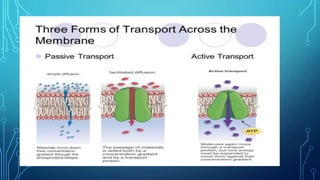
Transport through the cell membrane, either
directly through the lipid bilayer or through the proteins, occurs
by one of two
• Diffusion
• Active transport
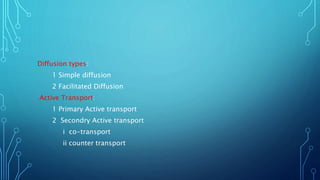
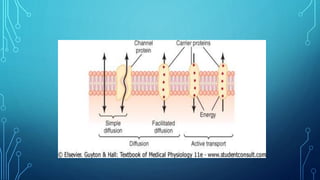
Diffusion types:
1 Simple diffusion
2 Facilitated Diffusion
Active Transport:
1 Primary Active transport
2 Secondry Active transport
i co-transport
ii counter transport
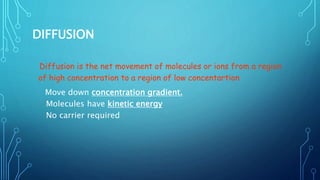
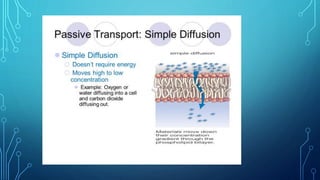
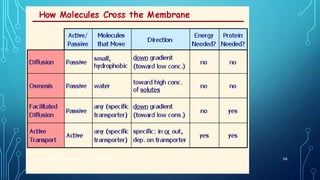
DIFFUSION
Diffusion is the net movement of molecules or ions from a region
of high concentration to a region of low concentartion
Move down concentration gradient.
Molecules have kinetic energy
No carrier required
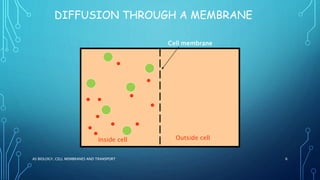
DIFFUSION THROUGH A MEMBRANE
AS BIOLOGY, CELL MEMBRANES AND TRANSPORT 6
Cell membrane
Inside cell Outside cell
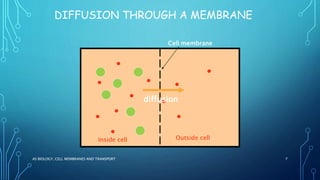
DIFFUSION THROUGH A MEMBRANE
AS BIOLOGY, CELL MEMBRANES AND TRANSPORT 7
Cell membrane
Inside cell Outside cell
diffusion
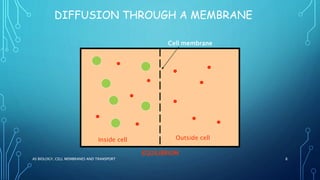
DIFFUSION THROUGH A MEMBRANE
AS BIOLOGY, CELL MEMBRANES AND TRANSPORT 8
Cell membrane
Inside cell Outside cell
EQUILIBRIUM
SIMPLE DIFFUSION
• Two pathways:
(1): through the interstices of
the lipid bilayer if the diffusing substance is lipid soluble
(2): through watery channels
WHAT DETERMINES THE RATE OF
DIFFUSION?
1. The steepness of the concentration gradient. The bigger
the difference between the two sides of the membrane
the quicker the rate of diffusion.
2.Temperature. Higher temperatures give molecules or ions
more kinetic energy. Molecules move around faster, so
diffusion is faster.
3.The surface area. The greater the surface area the faster
the diffusion can take place. This is because the more
molecules or ions can cross the membrane at any one
moment.
AS BIOLOGY, CELL MEMBRANES AND TRANSPORT 10
• The type of molecule or ion diffusing. Large molecules need more energy
to get them to move so they tend to diffuse more slowly.
Permeability
• Non-polar molecules vs polar
•   Radius (size) of the solute
• Membrane thickness
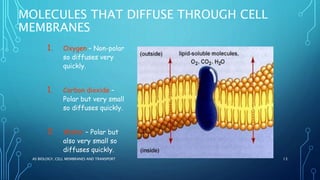
MOLECULES THAT DIFFUSE THROUGH CELL
MEMBRANES
1. Oxygen – Non-polar
so diffuses very
quickly.
1. Carbon dioxide –
Polar but very small
so diffuses quickly.
2. Water – Polar but
also very small so
diffuses quickly.
AS BIOLOGY, CELL MEMBRANES AND TRANSPORT 13
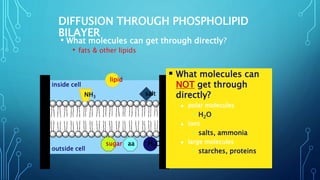
DIFFUSION THROUGH PHOSPHOLIPID
BILAYER
• What molecules can get through directly?
• fats & other lipids
inside cell
outside cell
lipid
salt
aa H2O
sugar
NH3
 What molecules can
NOT get through
directly?
 polar molecules
 H2O
 ions
 salts, ammonia
 large molecules
 starches, proteins
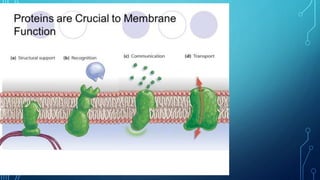
PROTEIN CHANNELS
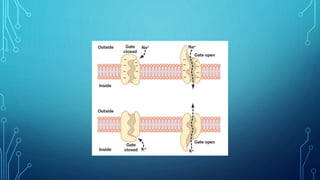
• The protein channels are distinguished by two important
characteristics:
(1): they are often selectively permeable to certain substances,
(2): many of the channels can be opened or closed by gates.
1:SELECTIVE PERMEABILITY
• Protein channels are highly selective
• Depends on channel diameter, shape, nature of the electrical
charges and chemical bonds along its inside surfaces.
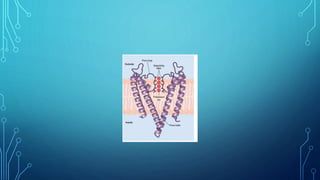
SODIUM CHANNEL
• 0.3 by 0.5 nanometer in diameter
• inner surfaces of this channel are negatively charged, pull small
dehydrated sodium ions into these channels
POTASSIUM CHANNEL
• 0.3 by 0.3 nanometer in diameter
• no strong attractive force is pulling ions into the channels
• potassium ions are not pulled away from the water molecules
that hydrate them.
GATING OF PROTEIN CHANNELS
• A means of controlling ion permeability of the
channels
• conformational change opening and closing of gates
are controlled in two ways:
1. Voltage gating.
2. Chemical (ligand) gating.
CARRIER-MEDIATED TRANSPORT
• Includes facilitated diffusion and primary and secondary active
transport.
Stereospecificity. d-glucose is transported by
facilitated diffusion, but the l-isomer is not.
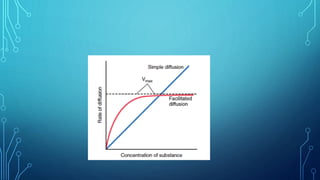
Saturation. The transport rate increases as the
concentration of the solute increases, until the
carriers are saturated. The transport maximum (Tm)
is analogous to the maximum velocity (Vmax) in
enzyme kinetics.
Competition. Structurally related solutes compete for
transport sites on carrier molecules. galactose is a
competitive inhibitor of glucose
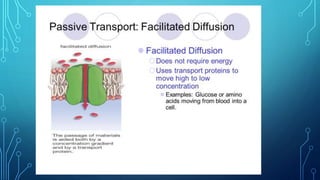
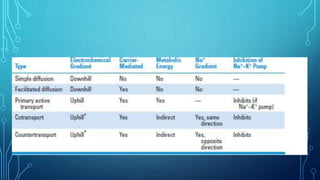
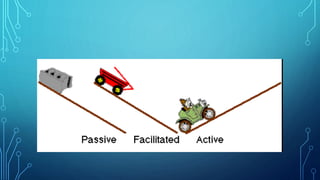
FACILITATED DIFFUSION
• down an electrochemical gradient
• Not requires metabolic energy.
• More rapid than simple diffusion.
• Carrier mediated and therefore exhibits stereospecificity,
saturation, and competition.
•  Glucose transport(GLUT) in muscle and adipose cells, amino
acids
OSMOSIS AND OSMOTIC PRESSURE
DIFFUSION POTENTIAL
•   A is the potential difference generated across a membrane
because of a concentration difference of an ion.
MEMBRANE TRANSPORT
DR ASMA BAJWA
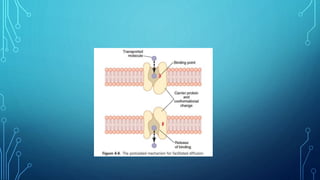
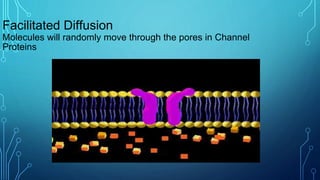
Facilitated Diffusion
Molecules will randomly move through the pores in Channel
Proteins
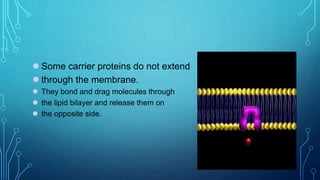
 Some carrier proteins do not extend
 through the membrane.
 They bond and drag molecules through
 the lipid bilayer and release them on
 the opposite side.
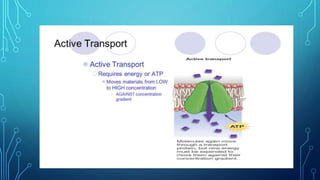
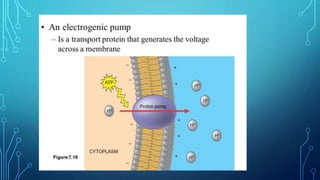
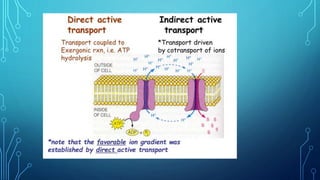
PRIMARY ACTIVE TRANSPORT
• Against an electrochemical gradient
• Requires direct input of metabolic energy in the form of
adenosine triphosphate (ATP) and
• Carrier mediated and therefore exhibits stereospecificity,
saturation, and competition.
• Example: Na-K pump, H-ATPase Pump, Ca-ATPAase Pump
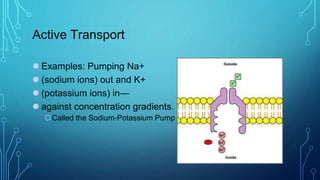
Active Transport
 Examples: Pumping Na+
 (sodium ions) out and K+
 (potassium ions) in—
 against concentration gradients.
Called the Sodium-Potassium Pump
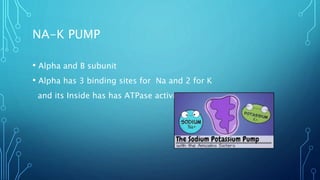
NA-K PUMP
• Alpha and B subunit
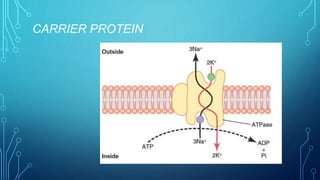
• Alpha has 3 binding sites for Na and 2 for K
and its Inside has has ATPase activity
CARRIER PROTEIN
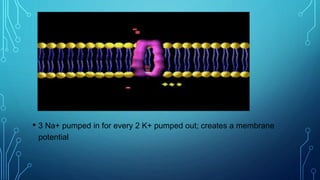
• 3 Na+ pumped in for every 2 K+ pumped out; creates a membrane
potential
FUNCTION
• Maintains cell volume
• Maintains inside charge ….electrogenic nature
• RMP
• Maintains Na and K concentration
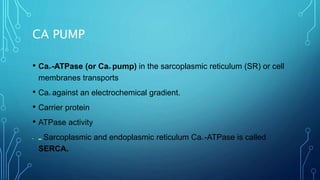
CA PUMP
• Ca2+-ATPase (or Ca2+ pump) in the sarcoplasmic reticulum (SR) or cell
membranes transports
• Ca2+ against an electrochemical gradient.
• Carrier protein
• ATPase activity
• ■■ Sarcoplasmic and endoplasmic reticulum Ca2+-ATPase is called
SERCA.
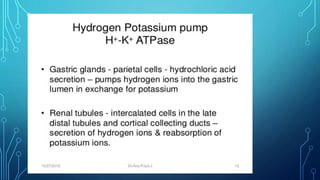
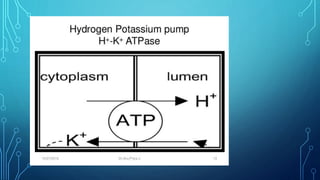
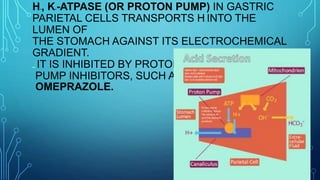
H+, K+-ATPASE (OR PROTON PUMP) IN GASTRIC
PARIETAL CELLS TRANSPORTS H+ INTO THE
LUMEN OF
THE STOMACH AGAINST ITS ELECTROCHEMICAL
GRADIENT.
■■ IT IS INHIBITED BY PROTON
PUMP INHIBITORS, SUCH AS
OMEPRAZOLE.
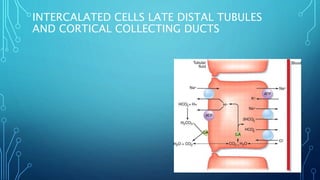
INTERCALATED CELLS LATE DISTAL TUBULES
AND CORTICAL COLLECTING DUCTS
ENERGETICS OF PRIMARY ACTIVE
TRANSPORT
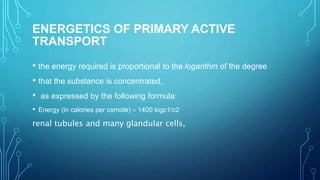
• the energy required is proportional to the logarithm of the degree
• that the substance is concentrated,
• as expressed by the following formula:
• Energy (in calories per osmole) = 1400 logc1/c2
renal tubules and many glandular cells,
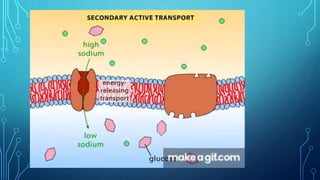
SECONDARY ACTIVE TRANSPORT
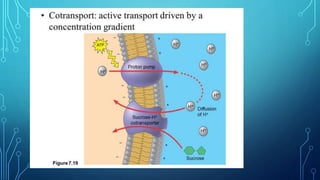
• The transport of two or more solutes is coupled.
• One of the solutes (usually Na+) is transported “downhill” and provides
energy for the
“uphill” transport of the other solute(s).
• Metabolic energy is not provided directly but indirectly from the Na+
gradient that is
maintained across cell membranes. Thus, inhibition of Na+, K+-ATPase will
decrease
transport of Na+ out of the cell, decrease the transmembrane Na+ gradient,
and eventually
inhibit secondary active transport.
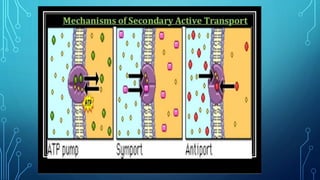
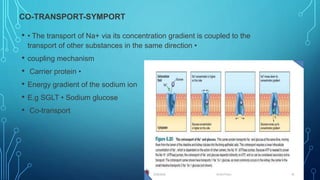
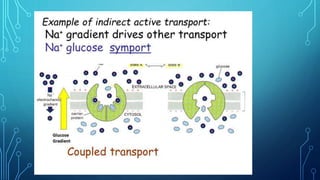
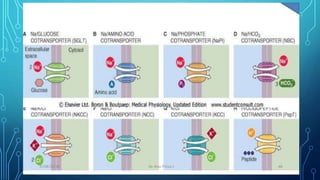
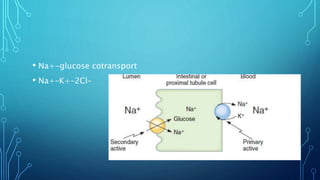
CO-TRANSPORT-SYMPORT
• • The transport of Na+ via its concentration gradient is coupled to the
transport of other substances in the same direction •
• coupling mechanism
• Carrier protein •
• Energy gradient of the sodium ion
• E.g SGLT • Sodium glucose
• Co-transport
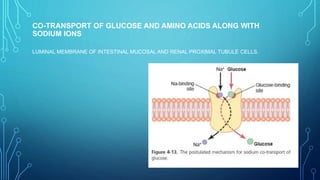
CO-TRANSPORT OF GLUCOSE AND AMINO ACIDS ALONG WITH
SODIUM IONS
LUMINAL MEMBRANE OF INTESTINAL MUCOSAL AND RENAL PROXIMAL TUBULE CELLS.
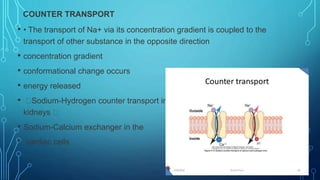
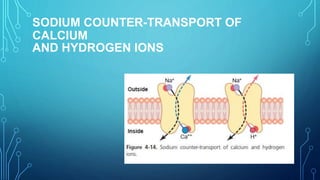
COUNTER TRANSPORT
• • The transport of Na+ via its concentration gradient is coupled to the
transport of other substance in the opposite direction
• concentration gradient
• conformational change occurs
• energy released
• Sodium-Hydrogen counter transport in the proximal tubule of the
kidneys
• Sodium-Calcium exchanger in the
• cardiac cells
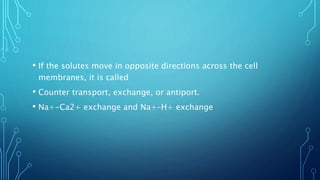
• If the solutes move in opposite directions across the cell
membranes, it is called
• Counter transport, exchange, or antiport.
• Na+-Ca2+ exchange and Na+–H+ exchange
SODIUM COUNTER-TRANSPORT OF
CALCIUM
AND HYDROGEN IONS
• Na+-glucose cotransport
• Na+–K+–2Cl–
AS BIOLOGY, CELL MEMBRANES AND TRANSPORT 66

Membrane transport

  • 1.
  • 2.
    TRANSPORT THROUGH CELLMEMBRANE Transport through the cell membrane, either directly through the lipid bilayer or through the proteins, occurs by one of two • Diffusion • Active transport
  • 3.
    Diffusion types: 1 Simplediffusion 2 Facilitated Diffusion Active Transport: 1 Primary Active transport 2 Secondry Active transport i co-transport ii counter transport
  • 5.
    DIFFUSION Diffusion is thenet movement of molecules or ions from a region of high concentration to a region of low concentartion Move down concentration gradient. Molecules have kinetic energy No carrier required
  • 6.
    DIFFUSION THROUGH AMEMBRANE AS BIOLOGY, CELL MEMBRANES AND TRANSPORT 6 Cell membrane Inside cell Outside cell
  • 7.
    DIFFUSION THROUGH AMEMBRANE AS BIOLOGY, CELL MEMBRANES AND TRANSPORT 7 Cell membrane Inside cell Outside cell diffusion
  • 8.
    DIFFUSION THROUGH AMEMBRANE AS BIOLOGY, CELL MEMBRANES AND TRANSPORT 8 Cell membrane Inside cell Outside cell EQUILIBRIUM
  • 9.
    SIMPLE DIFFUSION • Twopathways: (1): through the interstices of the lipid bilayer if the diffusing substance is lipid soluble (2): through watery channels
  • 10.
    WHAT DETERMINES THERATE OF DIFFUSION? 1. The steepness of the concentration gradient. The bigger the difference between the two sides of the membrane the quicker the rate of diffusion. 2.Temperature. Higher temperatures give molecules or ions more kinetic energy. Molecules move around faster, so diffusion is faster. 3.The surface area. The greater the surface area the faster the diffusion can take place. This is because the more molecules or ions can cross the membrane at any one moment. AS BIOLOGY, CELL MEMBRANES AND TRANSPORT 10
  • 11.
    • The typeof molecule or ion diffusing. Large molecules need more energy to get them to move so they tend to diffuse more slowly. Permeability • Non-polar molecules vs polar •   Radius (size) of the solute • Membrane thickness
  • 13.
    MOLECULES THAT DIFFUSETHROUGH CELL MEMBRANES 1. Oxygen – Non-polar so diffuses very quickly. 1. Carbon dioxide – Polar but very small so diffuses quickly. 2. Water – Polar but also very small so diffuses quickly. AS BIOLOGY, CELL MEMBRANES AND TRANSPORT 13
  • 14.
    DIFFUSION THROUGH PHOSPHOLIPID BILAYER •What molecules can get through directly? • fats & other lipids inside cell outside cell lipid salt aa H2O sugar NH3  What molecules can NOT get through directly?  polar molecules  H2O  ions  salts, ammonia  large molecules  starches, proteins
  • 15.
    PROTEIN CHANNELS • Theprotein channels are distinguished by two important characteristics: (1): they are often selectively permeable to certain substances, (2): many of the channels can be opened or closed by gates.
  • 16.
    1:SELECTIVE PERMEABILITY • Proteinchannels are highly selective • Depends on channel diameter, shape, nature of the electrical charges and chemical bonds along its inside surfaces.
  • 18.
    SODIUM CHANNEL • 0.3by 0.5 nanometer in diameter • inner surfaces of this channel are negatively charged, pull small dehydrated sodium ions into these channels
  • 19.
    POTASSIUM CHANNEL • 0.3by 0.3 nanometer in diameter • no strong attractive force is pulling ions into the channels • potassium ions are not pulled away from the water molecules that hydrate them.
  • 21.
    GATING OF PROTEINCHANNELS • A means of controlling ion permeability of the channels • conformational change opening and closing of gates are controlled in two ways: 1. Voltage gating. 2. Chemical (ligand) gating.
  • 22.
    CARRIER-MEDIATED TRANSPORT • Includesfacilitated diffusion and primary and secondary active transport.
  • 23.
    Stereospecificity. d-glucose istransported by facilitated diffusion, but the l-isomer is not. Saturation. The transport rate increases as the concentration of the solute increases, until the carriers are saturated. The transport maximum (Tm) is analogous to the maximum velocity (Vmax) in enzyme kinetics. Competition. Structurally related solutes compete for transport sites on carrier molecules. galactose is a competitive inhibitor of glucose
  • 24.
    FACILITATED DIFFUSION • downan electrochemical gradient • Not requires metabolic energy. • More rapid than simple diffusion. • Carrier mediated and therefore exhibits stereospecificity, saturation, and competition. •  Glucose transport(GLUT) in muscle and adipose cells, amino acids
  • 27.
  • 28.
    DIFFUSION POTENTIAL •   Ais the potential difference generated across a membrane because of a concentration difference of an ion.
  • 29.
  • 34.
    Facilitated Diffusion Molecules willrandomly move through the pores in Channel Proteins
  • 35.
     Some carrierproteins do not extend  through the membrane.  They bond and drag molecules through  the lipid bilayer and release them on  the opposite side.
  • 37.
    PRIMARY ACTIVE TRANSPORT •Against an electrochemical gradient • Requires direct input of metabolic energy in the form of adenosine triphosphate (ATP) and • Carrier mediated and therefore exhibits stereospecificity, saturation, and competition. • Example: Na-K pump, H-ATPase Pump, Ca-ATPAase Pump
  • 38.
    Active Transport  Examples:Pumping Na+  (sodium ions) out and K+  (potassium ions) in—  against concentration gradients. Called the Sodium-Potassium Pump
  • 39.
    NA-K PUMP • Alphaand B subunit • Alpha has 3 binding sites for Na and 2 for K and its Inside has has ATPase activity
  • 40.
  • 41.
    • 3 Na+pumped in for every 2 K+ pumped out; creates a membrane potential
  • 42.
    FUNCTION • Maintains cellvolume • Maintains inside charge ….electrogenic nature • RMP • Maintains Na and K concentration
  • 43.
    CA PUMP • Ca2+-ATPase(or Ca2+ pump) in the sarcoplasmic reticulum (SR) or cell membranes transports • Ca2+ against an electrochemical gradient. • Carrier protein • ATPase activity • ■■ Sarcoplasmic and endoplasmic reticulum Ca2+-ATPase is called SERCA.
  • 48.
    H+, K+-ATPASE (ORPROTON PUMP) IN GASTRIC PARIETAL CELLS TRANSPORTS H+ INTO THE LUMEN OF THE STOMACH AGAINST ITS ELECTROCHEMICAL GRADIENT. ■■ IT IS INHIBITED BY PROTON PUMP INHIBITORS, SUCH AS OMEPRAZOLE.
  • 49.
    INTERCALATED CELLS LATEDISTAL TUBULES AND CORTICAL COLLECTING DUCTS
  • 52.
    ENERGETICS OF PRIMARYACTIVE TRANSPORT • the energy required is proportional to the logarithm of the degree • that the substance is concentrated, • as expressed by the following formula: • Energy (in calories per osmole) = 1400 logc1/c2 renal tubules and many glandular cells,
  • 53.
    SECONDARY ACTIVE TRANSPORT •The transport of two or more solutes is coupled. • One of the solutes (usually Na+) is transported “downhill” and provides energy for the “uphill” transport of the other solute(s). • Metabolic energy is not provided directly but indirectly from the Na+ gradient that is maintained across cell membranes. Thus, inhibition of Na+, K+-ATPase will decrease transport of Na+ out of the cell, decrease the transmembrane Na+ gradient, and eventually inhibit secondary active transport.
  • 55.
    CO-TRANSPORT-SYMPORT • • Thetransport of Na+ via its concentration gradient is coupled to the transport of other substances in the same direction • • coupling mechanism • Carrier protein • • Energy gradient of the sodium ion • E.g SGLT • Sodium glucose • Co-transport
  • 57.
    CO-TRANSPORT OF GLUCOSEAND AMINO ACIDS ALONG WITH SODIUM IONS LUMINAL MEMBRANE OF INTESTINAL MUCOSAL AND RENAL PROXIMAL TUBULE CELLS.
  • 58.
    COUNTER TRANSPORT • •The transport of Na+ via its concentration gradient is coupled to the transport of other substance in the opposite direction • concentration gradient • conformational change occurs • energy released • Sodium-Hydrogen counter transport in the proximal tubule of the kidneys • Sodium-Calcium exchanger in the • cardiac cells
  • 59.
    • If thesolutes move in opposite directions across the cell membranes, it is called • Counter transport, exchange, or antiport. • Na+-Ca2+ exchange and Na+–H+ exchange
  • 60.
  • 62.
  • 66.
    AS BIOLOGY, CELLMEMBRANES AND TRANSPORT 66