THERMAL
COMFORT
HEAT,VENTILATION ,ENERGY
THERMAL
COMFORT
According to the international standard EN ISO
7730, thermal comfort is: “that condition of mind
which expresses satisfaction with the thermal
environment”. In simple words, is the comfortable
condition where a person is not feeling too hot or
too cold.
Human thermal comfort cannot be expressed in
degrees and can’t be defined by an average
range of temperatures.
The Health and Safety Executive estimates that
reasonable comfort can be established when a
minimum of 80% indoor occupants are feeling
comfortable with the thermal environment.
THERMAL
COMFORT
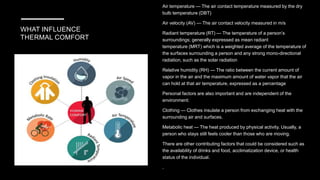
WHAT INFLUENCE
THERMAL COMFORT
Air temperature — The air contact temperature measured by the dry
bulb temperature (DBT)
Air velocity (AV) — The air contact velocity measured in m/s
Radiant temperature (RT) — The temperature of a person’s
surroundings; generally expressed as mean radiant
temperature (MRT) which is a weighted average of the temperature of
the surfaces surrounding a person and any strong mono-directional
radiation, such as the solar radiation
Relative humidity (RH) — The ratio between the current amount of
vapor in the air and the maximum amount of water vapor that the air
can hold at that air temperature, expressed as a percentage
Personal factors are also important and are independent of the
environment:
Clothing — Clothes insulate a person from exchanging heat with the
surrounding air and surfaces.
Metabolic heat — The heat produced by physical activity. Usually, a
person who stays still feels cooler than those who are moving.
There are other contributing factors that could be considered such as
the availability of drinks and food, acclimatization device, or health
status of the individual.
.
HOW TO CALCULATE
THERMAL COMFORT
Thermal comfort can be measured as
the predicted mean vote (PMV),
which is a scale from – 3 (cold) to + 3
(hot) (Table 1). The value is derived
from a complex equation that factors
in a range of criteria, including
clothing insulation, metabolic rate, air
velocity, vapour pressure, and the
mean radiant temperature (MRT).
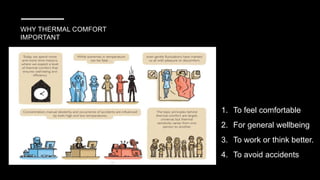
WHY THERMAL COMFORT
IMPORTANT
1. To feel comfortable
2. For general wellbeing
3. To work or think better.
4. To avoid accidents
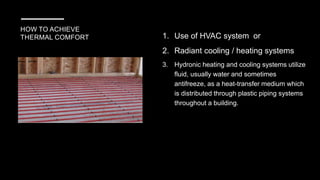
HOW TO ACHIEVE
THERMAL COMFORT 1. Use of HVAC system or
2. Radiant cooling / heating systems
3. Hydronic heating and cooling systems utilize
fluid, usually water and sometimes
antifreeze, as a heat-transfer medium which
is distributed through plastic piping systems
throughout a building.
HOW TO ACHIEVE
THERMAL COMFORT
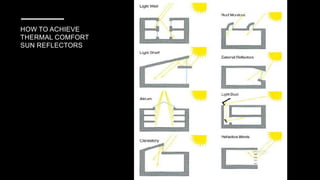
SUN REFLECTORS
HOW TO ACHIEVE
THERMAL COMFORT
BUILDING AI SYSTEM
1. Artificial intelligence (AI) has the
power not only to automate
buildings but also to make them
truly adaptive, smart, and agile,
with the use of AI analytics helping
to improve operations, reduce
inefficiencies, and lower costs
across building platforms in a wide
range of industries
HOW TO ACHIEVE THERMAL
COMFORT
BIOCLIMATIC
ARCHITECTURE –
- NATURAL VENTILATION
- BUILDING INSULATION
- BUILDING ORIENTATION
- BUILDING MATERIAL
- VEGETATION
- WINDOW DESIGN
Bioclimatic architecture aims to achieve thermal
comfort for all relying on passive means
.Therefore, bioclimatic design saves energy and
reduces heating and air conditioning expenses.
IN CLASS EXERCISE
STUDENT ARE REQUIRE TO EXPLAIN
AND DISCUSSED ON THE TOPIC
BELOW FOR 5 MINUTES PER PERSON

thermal comfort.pptx

  • 1.
  • 2.
    THERMAL COMFORT According to theinternational standard EN ISO 7730, thermal comfort is: “that condition of mind which expresses satisfaction with the thermal environment”. In simple words, is the comfortable condition where a person is not feeling too hot or too cold. Human thermal comfort cannot be expressed in degrees and can’t be defined by an average range of temperatures. The Health and Safety Executive estimates that reasonable comfort can be established when a minimum of 80% indoor occupants are feeling comfortable with the thermal environment.
  • 3.
  • 4.
    WHAT INFLUENCE THERMAL COMFORT Airtemperature — The air contact temperature measured by the dry bulb temperature (DBT) Air velocity (AV) — The air contact velocity measured in m/s Radiant temperature (RT) — The temperature of a person’s surroundings; generally expressed as mean radiant temperature (MRT) which is a weighted average of the temperature of the surfaces surrounding a person and any strong mono-directional radiation, such as the solar radiation Relative humidity (RH) — The ratio between the current amount of vapor in the air and the maximum amount of water vapor that the air can hold at that air temperature, expressed as a percentage Personal factors are also important and are independent of the environment: Clothing — Clothes insulate a person from exchanging heat with the surrounding air and surfaces. Metabolic heat — The heat produced by physical activity. Usually, a person who stays still feels cooler than those who are moving. There are other contributing factors that could be considered such as the availability of drinks and food, acclimatization device, or health status of the individual. .
  • 6.
    HOW TO CALCULATE THERMALCOMFORT Thermal comfort can be measured as the predicted mean vote (PMV), which is a scale from – 3 (cold) to + 3 (hot) (Table 1). The value is derived from a complex equation that factors in a range of criteria, including clothing insulation, metabolic rate, air velocity, vapour pressure, and the mean radiant temperature (MRT).
  • 7.
    WHY THERMAL COMFORT IMPORTANT 1.To feel comfortable 2. For general wellbeing 3. To work or think better. 4. To avoid accidents
  • 8.
    HOW TO ACHIEVE THERMALCOMFORT 1. Use of HVAC system or 2. Radiant cooling / heating systems 3. Hydronic heating and cooling systems utilize fluid, usually water and sometimes antifreeze, as a heat-transfer medium which is distributed through plastic piping systems throughout a building.
  • 9.
    HOW TO ACHIEVE THERMALCOMFORT SUN REFLECTORS
  • 10.
    HOW TO ACHIEVE THERMALCOMFORT BUILDING AI SYSTEM 1. Artificial intelligence (AI) has the power not only to automate buildings but also to make them truly adaptive, smart, and agile, with the use of AI analytics helping to improve operations, reduce inefficiencies, and lower costs across building platforms in a wide range of industries
  • 11.
    HOW TO ACHIEVETHERMAL COMFORT BIOCLIMATIC ARCHITECTURE – - NATURAL VENTILATION - BUILDING INSULATION - BUILDING ORIENTATION - BUILDING MATERIAL - VEGETATION - WINDOW DESIGN Bioclimatic architecture aims to achieve thermal comfort for all relying on passive means .Therefore, bioclimatic design saves energy and reduces heating and air conditioning expenses. IN CLASS EXERCISE STUDENT ARE REQUIRE TO EXPLAIN AND DISCUSSED ON THE TOPIC BELOW FOR 5 MINUTES PER PERSON