4 Steps To Powerful
Communication
July 2016
RAAF Townsville
Unleash Your Super Powers
http://www.uqpower.com.au
““Heidi we’ve seen moreHeidi we’ve seen more
change in the lastchange in the last 33 yearsyears
than in the lastthan in the last 3030..
How do I lead now?”How do I lead now?”
www.UQPower.com.au
Change is happening exponentially
But people think linearly
UQPower.com.au#StartWithU
Despite all this change one constant has remained
the same – the ability to influence, engage, inspire,
relate and build rapport. Ie:
The ability to
communicate
The One Constant
So how do you effectively communicate
in times of VUCA (volatility, uncertainty,
complexity and ambiguity)?
Spotlight on USpotlight on U
What’s your biggestWhat’s your biggest
communication challenge?communication challenge?
As a workplace futurist and culture architect, Iget excited about the development of
leaders and the creation of cultures that are adaptive and sustainable for the new
world of work. A workplaces culture is impacted by 3 key areas:
I’m passionate about
Work / play / living
City based dwellers
Massively mobile
Constantly connected
Cloud Computing
Energy
Disconnection
Depression
Generosity Economy
Resilience
Co-working
Collaboration
End of retirement
Global nomads
Questioning consumers
High transparency
Education reengineering
Quadruple bottom line
You Build 4 Solid Foundations
PersuasiveProductive
Physiology Psychology
The effectiveness of your relationships, your ability to build
trust, your ability to assert yourself and handle conflict and
your ability to craft a powerful message in person or in writing
depends upon you mastering four key communication
foundations:
1 - VISION – Purposefully Aligned
2 - IQ – Intellectually Focused
3 - Body – Physically Energised
4 - EQ - Interpersonally Connected
Become Fluent in All Four Quadrants
Build Solid Foundations
How many times have
you met someone with
a brilliant mind and high
IQ that are useless at
communicating with
staff or building
relationships?
You have to #startwithU by believing in U and your message.
If you don’t believe, no one else will, every one can spot a
phoney!
Step 1 – Get clear on your outcome
Words have energy. Some are light and filled with possibility
and some are heavy and block progress.
Be mindful when choosing your words.
Recently I was speaking to a client who had decided to resign
from her role. She described it as something she was
“dreading” because she would have to have a difficult
conversation with her current boss.
After a brief discussion focusing on the positives associated
with her decision to leave, she shifted her language around the
move to it being a “huge opportunity for a fresh start with new
amazing people.” And with this change in language came a
sense of excitement, possibility and energy.
What do you hope to achieve?
There are 7 steps to having a difficult conversation:
1 – Set the scene
2 – Describe your feelings
3 – Clarify importance
4 – Own your part
5 – Offer solutions
6 – How to move forward
7 – Invite their response
PAIR SHARE
Difficult Conversations
You have to speak of what you want, not what you don’t want.
Your focus must be on the positive outcome you desire not the
negative of what you don’t want.
Be specific
X
•Don’t run across the road.
•Don’t be late to today’s
meeting.
•Don’t overspend your budget
this month.
•I hope I don‘t mess up my
speech today.
• Walk carefully across the road.
• I’d appreciate you arriving on
time for today’s meeting
• Let’s focus on achieving our
targets this month.
• I’m determined to present
confidently and clearly today.
Discuss with your partner – where do you use language that
limits your choice and is focused on what you don’t want rather
than what you do want? Be specific.
EMPOWER YOURSELF THROUGH YOUR WORDS
Reframe Your Words
X
•I can’t do it
•I really should
•I have to
•I’ll give it a try
• I’m choosing not to
• I would like to
• I really want to
• I will do this
Step 2 - IQ – Get Focused
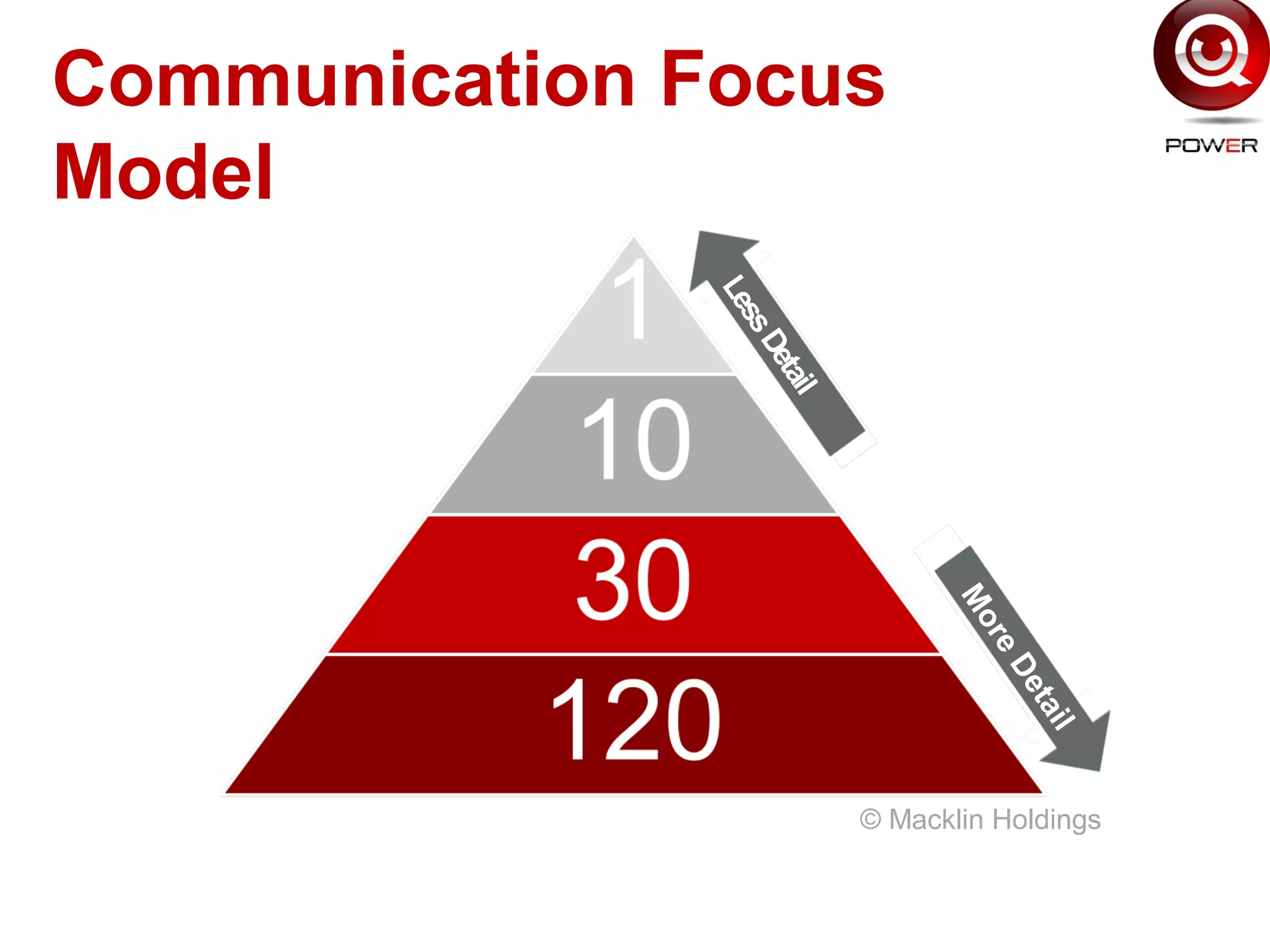
Communication Focus
Model
MoreDetail
LessDetail
MoreDetail
LessDetail
© Macklin Holdings
Stand in 2 circles one inside the other
•My life story…
•A passion I have outside of work is…
•Teams work when…
•Something I’m looking forward to is…
Speed Questions
The most powerful communication
tool at your disposal is not your
mouth, it’s your entire body.
Become fluent in body language
as your second language and
watch your results soar.
Step 3 – Body is bigger than words
Are You “Batteries Not Included”
UQPower.com.au#StartWithU
AKA a “Drainer” of energy?
UQPower.com.au#StartWithU
Are you “Batteries Included”?
UQPower.com.au#StartWithU
AKA a “Giver” of Energy?
UQPower.com.au#StartWithU
What kind of leader do you want to be?
UQPower.com.au#StartWithU
Understanding your body language and other physical
queues is very important when you are
communicating with others.
Your non-verbal communication skills are just as
important as your verbal skills.
The most important thing to ensure is congruence –
that your messages match your body.
Powerful Body Language
Human
Communication
- 7% of meaning is in the words that are spoken
- 38% of meaning is paralinguistic – the way we say it
- 55% of meaning is in body language & expression
Content 7%
Verbal cues
Tone 38%
Vocal cues
Body language 55%
or facial expressions
“When it comes to body language,
there are some who have better vocabularies
than others.”
Doug Larson
Introduce yourself to someone:
Like it’s a waste of your time
Test It In Your Body
Introduce yourself to someone:
Like you really really want to impress
them but are a phoney.
Change Your Body
Introduce yourself to someone:
Like they are your long lost best friend
Lead With Love
body language practice
www.UQPower.com.au
“It’s important we get this right.
Things must change around here.”
The most powerful way to engage with and relate to others is
to listen first and ask second.
Too many people spend too much time on what they want to
TELL others rather than taking the time to stop, LISTEN and
ASK.
Step 4 – EQ - Listen Then Ask
Extreme Listening Challenge
Listen Then Ask Challenge
Person A – share with Person B something you’d like
to see improved at work.
Person B – listen first then only respond with questions
(no solving, telling or sharing your stuff)
Feedback
What’s one thing you What will you work on
learnt today? improving?
• Download this presentation at
•
www.UQPower.com.au
www.linkedin.com/in/heidialexandrapollard

4 steps to communication success

  • 1.
    4 Steps ToPowerful Communication July 2016 RAAF Townsville Unleash Your Super Powers http://www.uqpower.com.au
  • 2.
    ““Heidi we’ve seenmoreHeidi we’ve seen more change in the lastchange in the last 33 yearsyears than in the lastthan in the last 3030.. How do I lead now?”How do I lead now?”
  • 3.
    www.UQPower.com.au Change is happeningexponentially But people think linearly UQPower.com.au#StartWithU
  • 4.
    Despite all thischange one constant has remained the same – the ability to influence, engage, inspire, relate and build rapport. Ie: The ability to communicate The One Constant
  • 5.
    So how doyou effectively communicate in times of VUCA (volatility, uncertainty, complexity and ambiguity)?
  • 6.
    Spotlight on USpotlighton U What’s your biggestWhat’s your biggest communication challenge?communication challenge?
  • 7.
    As a workplacefuturist and culture architect, Iget excited about the development of leaders and the creation of cultures that are adaptive and sustainable for the new world of work. A workplaces culture is impacted by 3 key areas: I’m passionate about Work / play / living City based dwellers Massively mobile Constantly connected Cloud Computing Energy Disconnection Depression Generosity Economy Resilience Co-working Collaboration End of retirement Global nomads Questioning consumers High transparency Education reengineering Quadruple bottom line
  • 8.
    You Build 4Solid Foundations PersuasiveProductive Physiology Psychology
  • 9.
    The effectiveness ofyour relationships, your ability to build trust, your ability to assert yourself and handle conflict and your ability to craft a powerful message in person or in writing depends upon you mastering four key communication foundations: 1 - VISION – Purposefully Aligned 2 - IQ – Intellectually Focused 3 - Body – Physically Energised 4 - EQ - Interpersonally Connected Become Fluent in All Four Quadrants
  • 10.
    Build Solid Foundations Howmany times have you met someone with a brilliant mind and high IQ that are useless at communicating with staff or building relationships?
  • 11.
    You have to#startwithU by believing in U and your message. If you don’t believe, no one else will, every one can spot a phoney! Step 1 – Get clear on your outcome
  • 12.
    Words have energy.Some are light and filled with possibility and some are heavy and block progress. Be mindful when choosing your words. Recently I was speaking to a client who had decided to resign from her role. She described it as something she was “dreading” because she would have to have a difficult conversation with her current boss. After a brief discussion focusing on the positives associated with her decision to leave, she shifted her language around the move to it being a “huge opportunity for a fresh start with new amazing people.” And with this change in language came a sense of excitement, possibility and energy. What do you hope to achieve?
  • 13.
    There are 7steps to having a difficult conversation: 1 – Set the scene 2 – Describe your feelings 3 – Clarify importance 4 – Own your part 5 – Offer solutions 6 – How to move forward 7 – Invite their response PAIR SHARE Difficult Conversations
  • 14.
    You have tospeak of what you want, not what you don’t want. Your focus must be on the positive outcome you desire not the negative of what you don’t want. Be specific X •Don’t run across the road. •Don’t be late to today’s meeting. •Don’t overspend your budget this month. •I hope I don‘t mess up my speech today. • Walk carefully across the road. • I’d appreciate you arriving on time for today’s meeting • Let’s focus on achieving our targets this month. • I’m determined to present confidently and clearly today.
  • 15.
    Discuss with yourpartner – where do you use language that limits your choice and is focused on what you don’t want rather than what you do want? Be specific. EMPOWER YOURSELF THROUGH YOUR WORDS Reframe Your Words X •I can’t do it •I really should •I have to •I’ll give it a try • I’m choosing not to • I would like to • I really want to • I will do this
  • 16.
    Step 2 -IQ – Get Focused
  • 17.
  • 18.
    Stand in 2circles one inside the other •My life story… •A passion I have outside of work is… •Teams work when… •Something I’m looking forward to is… Speed Questions
  • 19.
    The most powerfulcommunication tool at your disposal is not your mouth, it’s your entire body. Become fluent in body language as your second language and watch your results soar. Step 3 – Body is bigger than words
  • 20.
    Are You “BatteriesNot Included” UQPower.com.au#StartWithU
  • 21.
    AKA a “Drainer”of energy? UQPower.com.au#StartWithU
  • 22.
    Are you “BatteriesIncluded”? UQPower.com.au#StartWithU
  • 23.
    AKA a “Giver”of Energy? UQPower.com.au#StartWithU
  • 24.
    What kind ofleader do you want to be? UQPower.com.au#StartWithU
  • 25.
    Understanding your bodylanguage and other physical queues is very important when you are communicating with others. Your non-verbal communication skills are just as important as your verbal skills. The most important thing to ensure is congruence – that your messages match your body. Powerful Body Language
  • 26.
    Human Communication - 7% ofmeaning is in the words that are spoken - 38% of meaning is paralinguistic – the way we say it - 55% of meaning is in body language & expression Content 7% Verbal cues Tone 38% Vocal cues Body language 55% or facial expressions
  • 27.
    “When it comesto body language, there are some who have better vocabularies than others.” Doug Larson
  • 28.
    Introduce yourself tosomeone: Like it’s a waste of your time Test It In Your Body
  • 29.
    Introduce yourself tosomeone: Like you really really want to impress them but are a phoney. Change Your Body
  • 30.
    Introduce yourself tosomeone: Like they are your long lost best friend Lead With Love
  • 31.
    body language practice www.UQPower.com.au “It’simportant we get this right. Things must change around here.”
  • 32.
    The most powerfulway to engage with and relate to others is to listen first and ask second. Too many people spend too much time on what they want to TELL others rather than taking the time to stop, LISTEN and ASK. Step 4 – EQ - Listen Then Ask
  • 33.
  • 34.
    Listen Then AskChallenge Person A – share with Person B something you’d like to see improved at work. Person B – listen first then only respond with questions (no solving, telling or sharing your stuff)
  • 35.
    Feedback What’s one thingyou What will you work on learnt today? improving?
  • 36.
    • Download thispresentation at • www.UQPower.com.au www.linkedin.com/in/heidialexandrapollard

Editor's Notes

  • #2 Meet Ruth
  • #6 Meet Ruth
  • #27 11.20am Building Rapport and Engaging People  The rapport phase is the opening of any successful facilitation or presentation. Quality interactions are only achieved when are truly engaging and building rapport with your audience. Building rapport and creating a climate of trust and understanding allows you to prepare the audience for the delivery of your content. Rapport is vital in all forms of communication and essential for conducting effective presentations and facilitating successful workshops, sessions, group work. In the role of facilitator, your task is to persuade and influence so the audience prefers your solution or idea over what they may have been doing in the past. John Grinder and Richard Bandler researched how expert communicators were able to build rapport. They found that people like people who are like themselves. Rapport is established by pacing. Pacing is the process of matching and mirroring the verbal, para-verbal and body language of the other person to create likeness and similarities which creates rapport. Being in rapport means being alike both verbally and non verbally. Professor Albert Mehrabian has pioneered the understanding of communications since the 1960s – today he spends his time researching, writing, and consulting as Professor of Psychology at UCLA. His work featured strongly in establishing early understanding of body language and non-verbal communications. His research provided the basis for the widely quoted and often much over-simplified statistic for the effectiveness of spoken communications. Here is a more precise (and necessarily detailed) representation of Mehrabian's findings than is typically cited or applied: 7% of message pertaining to feelings and attitudes is in the words that are spoken. 38% of message pertaining to feelings and attitudes is paralinguistic (the way that the words are said). 55% of message pertaining to feelings and attitudes is in facial expression (and body language). The main thing to remember is that the formula applies to communications of feelings and attitudes not just any communication. One of the best ways to build rapport if you don’t know the attendees is to use universals. Universals are statements that are ‘true’ for all members in the audience, general statements that are universally accepted. Here you are setting the scene or the big picture. For example: We live in a world that….. Have you ever found yourself in a situation where…..? Have you noticed how ……..is happening more often today?
  • #28 11.50am VISUAL BODY LANGUAGE Show teenage Katy Perry Clip Make eye contact 1.50pm Neutral Body Stance Practical There are no right or wrong stances for presenting or pitching. However it is important to remember that your body is a large communication vessel for sending messages to your audience and for switching your own brain on. In order to make sure the audience trusts you you need to build resonance!! AND you want your pitch to be meaningful and profitable. Imagine therefore the audience is in pain and your role in pitching is to teach them something but leave a void that they will need and want to pay for to have Enigma fix.
  • #36 Then in your small group share your ideas, choose the best concept and design a pitch to sell it to the larger group. You have just 2 minutes as a team to do this.
  • #37 Meet Ruth