Communicating 
Effective Communication 
Effectively
Why is Effective 
Communication 
Important?
Effective communication helps you to 
avoid misunderstandings at work. 
• If you can avoid misunderstandings, you will 
be able to know what others (your boss, 
your clients, or other people) are truly 
asking you or telling you. 
• If you can understand what others are 
saying, you will not come to the wrong 
conclusions or take the wrong actions about 
what you hear. You will make fewer 
unnecessary mistakes. 
• By making fewer unnecessary mistakes, you 
will be more at peace, worry less about the 
consequences of your words and actions. 
• By worrying less about your words and 
actions, you will have more peace of mind, 
both at work and away from work. 
• By having more peace of mind, you will lead 
a more satisfying life.
Effective communication helps you 
express what you want to express. 
• When you express your needs, desires, and opinions, 
your chances of getting what you want grow 
exponentially. As Woody Allen would say: "80% of 
success is showing up". Paraphrasing that: "80% of 
getting is asking". 
• When you ask for what you want, you are living life full 
out, you are not withholding, you are not pretending. 
You are experiencing the joy of full and authentic self-expression. 
• Full self-expression, expressing who you truly are and 
what you truly think leads to a more satisfying life.
Effective communication allows for 
deeper connection with others. 
• Mutual understanding leads to better 
connection with people. 
• Better connection with people fulfills our 
human need for belonging and love. 
• Fulfilling one of our most important needs 
(belonging) leads to a more satisfying life.
The Usual Dilemma
How Much Do People Remember?
Let’s Break That Cone Down! 
• Apparently, based on research, with 
everything that is happening around us there 
is a window of two weeks that we are able to 
remember certain things and this cone goes 
over a lot about how we learn and the 
percentages of what we do and how it relates 
to how we learn and how we remember and 
do things
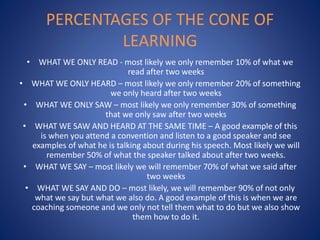
PERCENTAGES OF THE CONE OF 
LEARNING 
• WHAT WE ONLY READ - most likely we only remember 10% of what we 
read after two weeks 
• WHAT WE ONLY HEARD – most likely we only remember 20% of something 
we only heard after two weeks 
• WHAT WE ONLY SAW – most likely we only remember 30% of something 
that we only saw after two weeks 
• WHAT WE SAW AND HEARD AT THE SAME TIME – A good example of this 
is when you attend a convention and listen to a good speaker and see 
examples of what he is talking about during his speech. Most likely we will 
remember 50% of what the speaker talked about after two weeks. 
• WHAT WE SAY – most likely we will remember 70% of what we said after 
two weeks 
• WHAT WE SAY AND DO – most likely, we will remember 90% of not only 
what we say but what we also do. A good example of this is when we are 
coaching someone and we only not tell them what to do but we also show 
them how to do it.
Why is this Cone of Learning Relevant 
With What We Do? 
• As much as we can, we want to make 
sure, that we effectively 
communicate with our clients or our 
VAs and this cone will help us figure 
out what we can do to make them 
listen and remember.
MOD’s Challenge to YOU 
• Yes it might be a challenge to follow the most 
effective part of the cone with the type of job 
that we have where in most of the time we 
only hear people on the other end of the line 
and vise versa so how can we apply it and is it 
even possible? Lets work on this as a team 
and provide suggestions on how we can make 
this possible.
Five Ways To Make People Hang On 
Your Every Word 
From: www.forbes.com 
For the Mean Time.. This Article might also be of help
1. Get comfortable. 
It’s stating the obvious, but for most people, 
presenting is difficult when it’s uncomfortable. 
Staring down a board of directors with bad news, 
for example, might be one of those times. Or 
proposing a new business line to the senior team. 
You’ll do better if you can find a way to be as 
calm as possible, given the stressful situation. For 
many people, this means practicing so you feel you 
have the information down pat. For others, it’s 
figuring out what gets you in the zone — deep 
breathing, music, laughter, warm-up conversations 
in the room, etc. I recommend setting a situational 
intention to focus your conscious thoughts behind 
the emotion you want to impart to others.
2. Accept discomfort. 
If the stakes are high, no matter how much 
you try to get comfortable, some butterflies are 
going to remain. Instead of trying to eradicate the 
feeling or letting it spiral, accept the anxiousness. 
Acknowledge it, and realize that it has no bearing 
on your performance. At all. You can physically 
perform just as well, nervous or not. 
Plus, nerves can even help you emote and 
show energy. After all, nervousness is excitement 
directed inward.
3. Speak to the individuals, not the 
group. 
Common public speaking advice is to know your 
audience. But in typical corporate presentations, which are to 
groups and teams, you do know them. The problem is that they 
are all over the map in what they care about so it can be hard to 
tailor comments. A frequent misstep is to try to cover everyone’s 
concerns or speak to the middle. 
Learning to top-line your points to hit the right ones is a 
critical skill. For mixed groups, my general advice is to speak to 
the highest level in the room in the level of detail they care to 
know. Let the others ask questions to fill in the gaps or clarify 
specifics. Meetings gravitate to the highest level naturally. 
Remember, you are speaking to individuals with 
individual concerns. Don’t litter your comments with what you 
care about the most, and beware of falling in love with your 
content. It’s about the other person, not about you.
4. Bring double the passion, and half 
the content. 
If you want to be memorable, put equal 
focus on bringing energy and passion to your 
presentation. Show how much you care through 
stories, examples, imagery, and dialogue. People 
forget what you said but remember how you 
made them feel. Your presence plays a large role 
in that. 
Plus, there’s power in a passionate 
purpose. We invest psychically in people we feel 
have the wherewithal to make change happen.
5. Ignite discussion, don’t replace it. 
Most corporate presentations aren’t speeches at 
all — they’re discussions. You’re aim is not to use up the 
air time with your points, but to incite discussion and 
facilitate outcomes. If people are talking then they’re 
engaged. 
Any presentation can be constructed as facilitation. 
Create your main points, ask a pointed question, and 
manage comments. Then repeat. This skill takes practice, 
so learn it any way you can, whether through a training or 
observation of others. 
People will feel far better about your ideas if they 
felt that you wanted and accepted their input. Plus, any 
idea that feels like it’s ours we’re more likely to buy into. 
And isn’t buy-in of our ideas the ultimate goal?

Communicating Communicating Effectively

  • 1.
  • 2.
    Why is Effective Communication Important?
  • 3.
    Effective communication helpsyou to avoid misunderstandings at work. • If you can avoid misunderstandings, you will be able to know what others (your boss, your clients, or other people) are truly asking you or telling you. • If you can understand what others are saying, you will not come to the wrong conclusions or take the wrong actions about what you hear. You will make fewer unnecessary mistakes. • By making fewer unnecessary mistakes, you will be more at peace, worry less about the consequences of your words and actions. • By worrying less about your words and actions, you will have more peace of mind, both at work and away from work. • By having more peace of mind, you will lead a more satisfying life.
  • 4.
    Effective communication helpsyou express what you want to express. • When you express your needs, desires, and opinions, your chances of getting what you want grow exponentially. As Woody Allen would say: "80% of success is showing up". Paraphrasing that: "80% of getting is asking". • When you ask for what you want, you are living life full out, you are not withholding, you are not pretending. You are experiencing the joy of full and authentic self-expression. • Full self-expression, expressing who you truly are and what you truly think leads to a more satisfying life.
  • 5.
    Effective communication allowsfor deeper connection with others. • Mutual understanding leads to better connection with people. • Better connection with people fulfills our human need for belonging and love. • Fulfilling one of our most important needs (belonging) leads to a more satisfying life.
  • 6.
  • 7.
    How Much DoPeople Remember?
  • 8.
    Let’s Break ThatCone Down! • Apparently, based on research, with everything that is happening around us there is a window of two weeks that we are able to remember certain things and this cone goes over a lot about how we learn and the percentages of what we do and how it relates to how we learn and how we remember and do things
  • 9.
    PERCENTAGES OF THECONE OF LEARNING • WHAT WE ONLY READ - most likely we only remember 10% of what we read after two weeks • WHAT WE ONLY HEARD – most likely we only remember 20% of something we only heard after two weeks • WHAT WE ONLY SAW – most likely we only remember 30% of something that we only saw after two weeks • WHAT WE SAW AND HEARD AT THE SAME TIME – A good example of this is when you attend a convention and listen to a good speaker and see examples of what he is talking about during his speech. Most likely we will remember 50% of what the speaker talked about after two weeks. • WHAT WE SAY – most likely we will remember 70% of what we said after two weeks • WHAT WE SAY AND DO – most likely, we will remember 90% of not only what we say but what we also do. A good example of this is when we are coaching someone and we only not tell them what to do but we also show them how to do it.
  • 10.
    Why is thisCone of Learning Relevant With What We Do? • As much as we can, we want to make sure, that we effectively communicate with our clients or our VAs and this cone will help us figure out what we can do to make them listen and remember.
  • 11.
    MOD’s Challenge toYOU • Yes it might be a challenge to follow the most effective part of the cone with the type of job that we have where in most of the time we only hear people on the other end of the line and vise versa so how can we apply it and is it even possible? Lets work on this as a team and provide suggestions on how we can make this possible.
  • 12.
    Five Ways ToMake People Hang On Your Every Word From: www.forbes.com For the Mean Time.. This Article might also be of help
  • 13.
    1. Get comfortable. It’s stating the obvious, but for most people, presenting is difficult when it’s uncomfortable. Staring down a board of directors with bad news, for example, might be one of those times. Or proposing a new business line to the senior team. You’ll do better if you can find a way to be as calm as possible, given the stressful situation. For many people, this means practicing so you feel you have the information down pat. For others, it’s figuring out what gets you in the zone — deep breathing, music, laughter, warm-up conversations in the room, etc. I recommend setting a situational intention to focus your conscious thoughts behind the emotion you want to impart to others.
  • 14.
    2. Accept discomfort. If the stakes are high, no matter how much you try to get comfortable, some butterflies are going to remain. Instead of trying to eradicate the feeling or letting it spiral, accept the anxiousness. Acknowledge it, and realize that it has no bearing on your performance. At all. You can physically perform just as well, nervous or not. Plus, nerves can even help you emote and show energy. After all, nervousness is excitement directed inward.
  • 15.
    3. Speak tothe individuals, not the group. Common public speaking advice is to know your audience. But in typical corporate presentations, which are to groups and teams, you do know them. The problem is that they are all over the map in what they care about so it can be hard to tailor comments. A frequent misstep is to try to cover everyone’s concerns or speak to the middle. Learning to top-line your points to hit the right ones is a critical skill. For mixed groups, my general advice is to speak to the highest level in the room in the level of detail they care to know. Let the others ask questions to fill in the gaps or clarify specifics. Meetings gravitate to the highest level naturally. Remember, you are speaking to individuals with individual concerns. Don’t litter your comments with what you care about the most, and beware of falling in love with your content. It’s about the other person, not about you.
  • 16.
    4. Bring doublethe passion, and half the content. If you want to be memorable, put equal focus on bringing energy and passion to your presentation. Show how much you care through stories, examples, imagery, and dialogue. People forget what you said but remember how you made them feel. Your presence plays a large role in that. Plus, there’s power in a passionate purpose. We invest psychically in people we feel have the wherewithal to make change happen.
  • 17.
    5. Ignite discussion,don’t replace it. Most corporate presentations aren’t speeches at all — they’re discussions. You’re aim is not to use up the air time with your points, but to incite discussion and facilitate outcomes. If people are talking then they’re engaged. Any presentation can be constructed as facilitation. Create your main points, ask a pointed question, and manage comments. Then repeat. This skill takes practice, so learn it any way you can, whether through a training or observation of others. People will feel far better about your ideas if they felt that you wanted and accepted their input. Plus, any idea that feels like it’s ours we’re more likely to buy into. And isn’t buy-in of our ideas the ultimate goal?