Management Development Program For Middle Management Module 4 – Communicating  for Success
Module 4 Learning Objectives At the end of this module, the participants will: Learn the different types of communication and elements. Use effective listening skills to ensure clear communication. Use high gain questions to gather information. Use adequate body language to communicate the right message.
Communication to Success What is effective communication Methods and elements of communication The five Ws for good communication Listening skills Asking questions Body Language Assessment
Assessment
What is Effective Communication? Effective communication hinges on people understanding your meaning and replying in terms that move the exchange forward – preferably in the direction you would like to go.  Why do we Communicate? Communication is a two-way process. You communicate to get  things done, pass on and obtain information, reach decisions, achieve joint understanding and develop relationships.
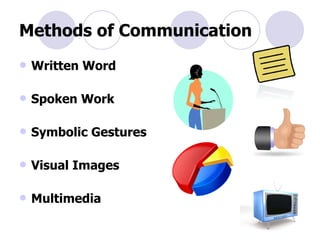
Methods of Communication Written Word Spoken Work Symbolic Gestures Visual Images Multimedia
Let’s Have Some Fun Individual exercise Write down all the methods of communication used in the hotel Wait for further instructions
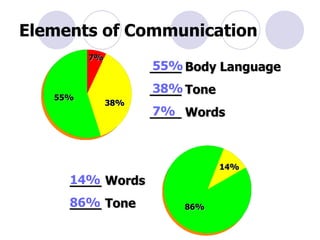
Elements of Communication 55% 38% 7% ____ Body Language ____ Tone ____ Words 14% 86% ____ Words  ____ Tone 7% 38% 55% 14% 86%
 
The Five Ws for a Good Communication W ho should be told? W hen should they be told? W hat should they be told? W here the message should be conveyed? W ho should control the communication process? W
What is Listening Receiving Hearing words & tones Seeing behavioral non-verbal cues Perceiving feelings Transmitting Encouraging the speaker: To show you are listening To show you are interested Paraphrasing: To show you understand Interpreting the message Helping them communicate
How to Listen? Maintain eye contact Lean in towards the speaker Give encouragement Take notes Listen now, report later; plan to tell someone what you heard – you will remember it better. Be present; watch the tendency of day dream. Be a “whole Body” listener; listen with your ears, your eyes and your heart Build a rapport by pacing the speaker; approximate the speaker’s gestures, expressions and voice patterns, to create a comfortable communication. Control your emotions; if not they will prevent you from listening effectively. Avoid distractions.
Blocks to Listening Not trained to listen Outside distractions Making interpretations and judgments Wanting to speak and therefore interrupting Preparing a reply whilst the other person is talking Holding a different view Hearing what you expect to hear rather than the intended message  Different backgrounds, cultures, experiences Wrong, inappropriate language (eg: jargon) Inconsistency between words and behavior (non-verbal) Heard it all before – switch off
Reasons for Listening To be polite To obtain precise information (directions, instructions) Interest for the person or the topic To help our understanding of the other person’s situation or idea To find faults in what’s being said For new ideas and approaches
Types of Listeners Appreciating Empathizing Comprehending Discerning Evaluating
Asking Questions Closed-Ended Questions Open-Ended Questions HIGH GAIN QUESTIONS
Brainteaser Unscramble the letters below to make the name of a place. SDCBEEEHKRRAATOUIN Answer: Sheraton Dubai Creek
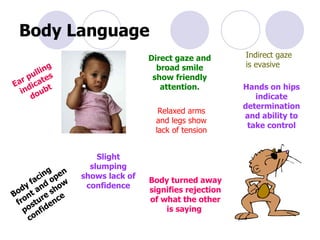
Body Language Body facing front and open posture show confidence  Body turned away signifies rejection of what the other is saying  Hands on hips indicate determination and ability to take control Direct gaze and broad smile show friendly attention. Indirect gaze is evasive   Relaxed arms and legs show lack of tension Ear pulling indicates doubt Slight slumping shows lack of confidence
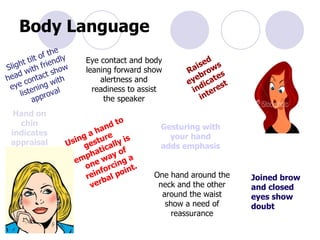
Body Language Hand on chin indicates appraisal Slight tilt of the head with friendly eye contact show listening with approval Eye contact and body leaning forward show alertness and readiness to assist the speaker Raised eyebrows indicates interest Gesturing with your hand adds emphasis Using a hand to gesture emphatically is one way of reinforcing a verbal point. One hand around the neck and the other around the waist show a need of reassurance Joined brow and closed eyes show doubt
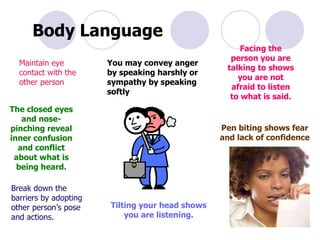
Body Language Pen biting shows fear and lack of confidence The closed eyes and nose-pinching reveal inner confusion and conflict about what is being heard. Facing the person you are talking to shows you are not afraid to listen to what is said. Tilting your head shows you are listening. Break down the barriers by adopting other person’s pose and actions.  Maintain eye contact with the other person  You may convey anger by speaking harshly or sympathy by speaking softly
Skill Building Activity Working with 2 partners 1 manager, 1 associate, 1 observer Review your role description Plan and conduct the activity Rate the interaction on the assessment sheet Discuss the effectiveness of your interaction with the group.
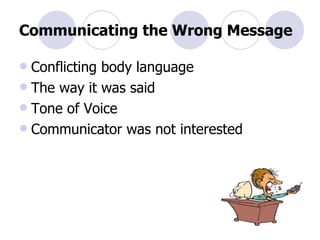
Communicating the Wrong Message Conflicting body language The way it was said Tone of Voice Communicator was not interested
Assessment
Questions ? ? ? ? ? ?
See You Next Module…

Communication

  • 1.
    Management Development ProgramFor Middle Management Module 4 – Communicating for Success
  • 2.
    Module 4 LearningObjectives At the end of this module, the participants will: Learn the different types of communication and elements. Use effective listening skills to ensure clear communication. Use high gain questions to gather information. Use adequate body language to communicate the right message.
  • 3.
    Communication to SuccessWhat is effective communication Methods and elements of communication The five Ws for good communication Listening skills Asking questions Body Language Assessment
  • 4.
  • 5.
    What is EffectiveCommunication? Effective communication hinges on people understanding your meaning and replying in terms that move the exchange forward – preferably in the direction you would like to go. Why do we Communicate? Communication is a two-way process. You communicate to get things done, pass on and obtain information, reach decisions, achieve joint understanding and develop relationships.
  • 6.
    Methods of CommunicationWritten Word Spoken Work Symbolic Gestures Visual Images Multimedia
  • 7.
    Let’s Have SomeFun Individual exercise Write down all the methods of communication used in the hotel Wait for further instructions
  • 8.
    Elements of Communication55% 38% 7% ____ Body Language ____ Tone ____ Words 14% 86% ____ Words ____ Tone 7% 38% 55% 14% 86%
  • 9.
  • 10.
    The Five Wsfor a Good Communication W ho should be told? W hen should they be told? W hat should they be told? W here the message should be conveyed? W ho should control the communication process? W
  • 11.
    What is ListeningReceiving Hearing words & tones Seeing behavioral non-verbal cues Perceiving feelings Transmitting Encouraging the speaker: To show you are listening To show you are interested Paraphrasing: To show you understand Interpreting the message Helping them communicate
  • 12.
    How to Listen?Maintain eye contact Lean in towards the speaker Give encouragement Take notes Listen now, report later; plan to tell someone what you heard – you will remember it better. Be present; watch the tendency of day dream. Be a “whole Body” listener; listen with your ears, your eyes and your heart Build a rapport by pacing the speaker; approximate the speaker’s gestures, expressions and voice patterns, to create a comfortable communication. Control your emotions; if not they will prevent you from listening effectively. Avoid distractions.
  • 13.
    Blocks to ListeningNot trained to listen Outside distractions Making interpretations and judgments Wanting to speak and therefore interrupting Preparing a reply whilst the other person is talking Holding a different view Hearing what you expect to hear rather than the intended message Different backgrounds, cultures, experiences Wrong, inappropriate language (eg: jargon) Inconsistency between words and behavior (non-verbal) Heard it all before – switch off
  • 14.
    Reasons for ListeningTo be polite To obtain precise information (directions, instructions) Interest for the person or the topic To help our understanding of the other person’s situation or idea To find faults in what’s being said For new ideas and approaches
  • 15.
    Types of ListenersAppreciating Empathizing Comprehending Discerning Evaluating
  • 16.
    Asking Questions Closed-EndedQuestions Open-Ended Questions HIGH GAIN QUESTIONS
  • 17.
    Brainteaser Unscramble theletters below to make the name of a place. SDCBEEEHKRRAATOUIN Answer: Sheraton Dubai Creek
  • 18.
    Body Language Bodyfacing front and open posture show confidence Body turned away signifies rejection of what the other is saying Hands on hips indicate determination and ability to take control Direct gaze and broad smile show friendly attention. Indirect gaze is evasive Relaxed arms and legs show lack of tension Ear pulling indicates doubt Slight slumping shows lack of confidence
  • 19.
    Body Language Handon chin indicates appraisal Slight tilt of the head with friendly eye contact show listening with approval Eye contact and body leaning forward show alertness and readiness to assist the speaker Raised eyebrows indicates interest Gesturing with your hand adds emphasis Using a hand to gesture emphatically is one way of reinforcing a verbal point. One hand around the neck and the other around the waist show a need of reassurance Joined brow and closed eyes show doubt
  • 20.
    Body Language Penbiting shows fear and lack of confidence The closed eyes and nose-pinching reveal inner confusion and conflict about what is being heard. Facing the person you are talking to shows you are not afraid to listen to what is said. Tilting your head shows you are listening. Break down the barriers by adopting other person’s pose and actions. Maintain eye contact with the other person You may convey anger by speaking harshly or sympathy by speaking softly
  • 21.
    Skill Building ActivityWorking with 2 partners 1 manager, 1 associate, 1 observer Review your role description Plan and conduct the activity Rate the interaction on the assessment sheet Discuss the effectiveness of your interaction with the group.
  • 22.
    Communicating the WrongMessage Conflicting body language The way it was said Tone of Voice Communicator was not interested
  • 23.
  • 24.
  • 25.
    See You NextModule…