


zekeLabs
Dimensionality Reduction
“Goal - Become a Data Scientist”
“A Dream becomes a Goal when action is taken towards its achievement” - Bo Bennett
“The Plan”
“A Goal without a Plan is just a wish”
● Real Data
● PCA
● Eigenvectors
● Covariance Matrix
● Matrix Decomposition
● Covariance Matrix Decomposition
● SVD
● PCA vs SVD
● LDA
● PCA vs LDA
Overview of
Dimensionality
Reduction
Techniques
Real Data
● Real world data and information therein may be
○ Noisy
■ Some dimensions may not carry any useful information
■ Variation in that dimension is purely due to noise in the observations
○ Redundant
■ One variables may carry the same information as the other variable
■ Information covered by a set of variable may overlap
● How to reduce the dimensions?
PCA
● Dimensionality reduction technique
● Linear projection of Data into Orthogonal Basis System
● Minimum redundancy and preserves variance in the data
● Smallest reconstruction error
● Applications include Image-compression, Data Visualisation
Eigenvectors
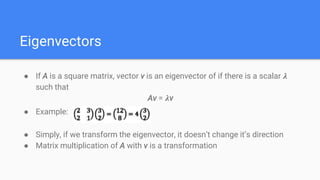
● If A is a square matrix, vector v is an eigenvector of if there is a scalar 𝝀
such that
Av = 𝝀v
● Example:
● Simply, if we transform the eigenvector, it doesn’t change it’s direction
● Matrix multiplication of A with v is a transformation
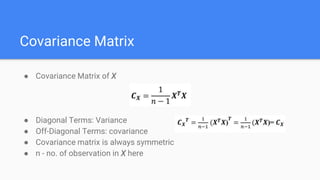
Covariance Matrix
● Covariance Matrix of X
● Diagonal Terms: Variance
● Off-Diagonal Terms: covariance
● Covariance matrix is always symmetric
● n - no. of observation in X here
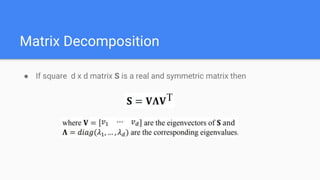
Matrix Decomposition
● If square d x d matrix S is a real and symmetric matrix then
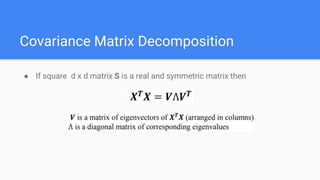
Covariance Matrix Decomposition
● If square d x d matrix S is a real and symmetric matrix then
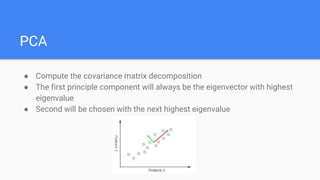
PCA
● Compute the covariance matrix decomposition
● The first principle component will always be the eigenvector with highest
eigenvalue
● Second will be chosen with the next highest eigenvalue
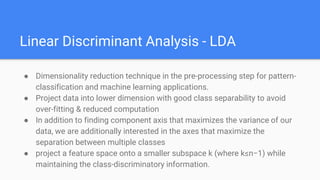
Linear Discriminant Analysis - LDA
● Dimensionality reduction technique in the pre-processing step for pattern-
classification and machine learning applications.
● Project data into lower dimension with good class separability to avoid
over-fitting & reduced computation
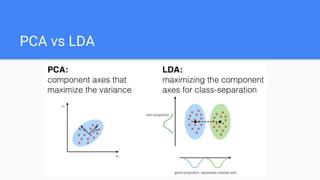
● In addition to finding component axis that maximizes the variance of our
data, we are additionally interested in the axes that maximize the
separation between multiple classes
● project a feature space onto a smaller subspace k (where k≤n−1) while
maintaining the class-discriminatory information.
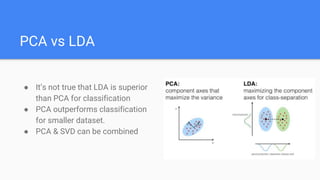
PCA vs LDA
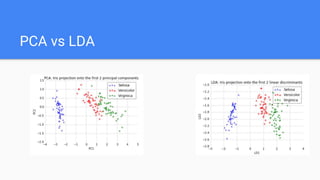
● It’s not true that LDA is superior
than PCA for classification
● PCA outperforms classification
for smaller dataset.
● PCA & SVD can be combined
PCA vs LDA
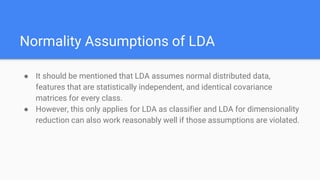
Normality Assumptions of LDA
● It should be mentioned that LDA assumes normal distributed data,
features that are statistically independent, and identical covariance
matrices for every class.
● However, this only applies for LDA as classifier and LDA for dimensionality
reduction can also work reasonably well if those assumptions are violated.
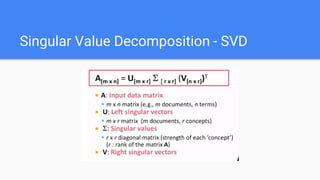
Singular Value Decomposition - SVD
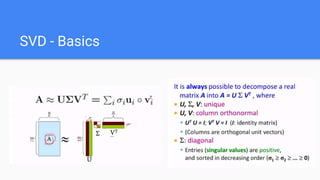
SVD - Basics
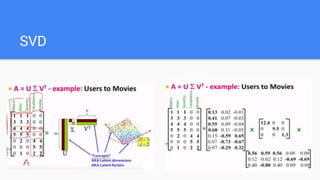
SVD
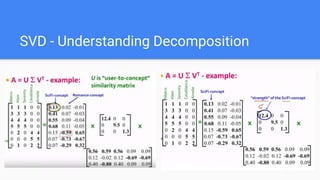
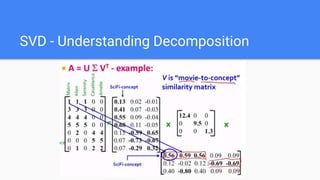
SVD - Understanding Decomposition
PCA vs SVD
● The eigenvectors of C are the same as the right singular vectors of X
● The eigenvectors of covariance matrix are same as vector V
● Working directly with X will produce much more accurate results
● Working directly with X is faster
LDA
● LDA - Linear Discriminant Analysis
○ Compute the d-dimensional mean vectors for the different classes from the dataset
○ Compute the scatter matrices (in-between-class and within-class scatter matrix)
○ Compute the eigenvectors and corresponding eigenvalues for the scatter matrices
○ Sort the eigenvectors by decreasing eigenvalues and choose kk eigenvectors
PCA vs LDA

Dimentionality reduction

  • 1.
  • 2.
    “Goal - Becomea Data Scientist” “A Dream becomes a Goal when action is taken towards its achievement” - Bo Bennett “The Plan” “A Goal without a Plan is just a wish”
  • 3.
    ● Real Data ●PCA ● Eigenvectors ● Covariance Matrix ● Matrix Decomposition ● Covariance Matrix Decomposition ● SVD ● PCA vs SVD ● LDA ● PCA vs LDA Overview of Dimensionality Reduction Techniques
  • 4.
    Real Data ● Realworld data and information therein may be ○ Noisy ■ Some dimensions may not carry any useful information ■ Variation in that dimension is purely due to noise in the observations ○ Redundant ■ One variables may carry the same information as the other variable ■ Information covered by a set of variable may overlap ● How to reduce the dimensions?
  • 5.
    PCA ● Dimensionality reductiontechnique ● Linear projection of Data into Orthogonal Basis System ● Minimum redundancy and preserves variance in the data ● Smallest reconstruction error ● Applications include Image-compression, Data Visualisation
  • 6.
    Eigenvectors ● If Ais a square matrix, vector v is an eigenvector of if there is a scalar 𝝀 such that Av = 𝝀v ● Example: ● Simply, if we transform the eigenvector, it doesn’t change it’s direction ● Matrix multiplication of A with v is a transformation
  • 7.
    Covariance Matrix ● CovarianceMatrix of X ● Diagonal Terms: Variance ● Off-Diagonal Terms: covariance ● Covariance matrix is always symmetric ● n - no. of observation in X here
  • 8.
    Matrix Decomposition ● Ifsquare d x d matrix S is a real and symmetric matrix then
  • 9.
    Covariance Matrix Decomposition ●If square d x d matrix S is a real and symmetric matrix then
  • 10.
    PCA ● Compute thecovariance matrix decomposition ● The first principle component will always be the eigenvector with highest eigenvalue ● Second will be chosen with the next highest eigenvalue
  • 11.
    Linear Discriminant Analysis- LDA ● Dimensionality reduction technique in the pre-processing step for pattern- classification and machine learning applications. ● Project data into lower dimension with good class separability to avoid over-fitting & reduced computation ● In addition to finding component axis that maximizes the variance of our data, we are additionally interested in the axes that maximize the separation between multiple classes ● project a feature space onto a smaller subspace k (where k≤n−1) while maintaining the class-discriminatory information.
  • 12.
    PCA vs LDA ●It’s not true that LDA is superior than PCA for classification ● PCA outperforms classification for smaller dataset. ● PCA & SVD can be combined
  • 13.
  • 14.
    Normality Assumptions ofLDA ● It should be mentioned that LDA assumes normal distributed data, features that are statistically independent, and identical covariance matrices for every class. ● However, this only applies for LDA as classifier and LDA for dimensionality reduction can also work reasonably well if those assumptions are violated.
  • 15.
  • 16.
  • 17.
  • 18.
    SVD - UnderstandingDecomposition
  • 19.
    SVD - UnderstandingDecomposition
  • 20.
    PCA vs SVD ●The eigenvectors of C are the same as the right singular vectors of X ● The eigenvectors of covariance matrix are same as vector V ● Working directly with X will produce much more accurate results ● Working directly with X is faster
  • 21.
    LDA ● LDA -Linear Discriminant Analysis ○ Compute the d-dimensional mean vectors for the different classes from the dataset ○ Compute the scatter matrices (in-between-class and within-class scatter matrix) ○ Compute the eigenvectors and corresponding eigenvalues for the scatter matrices ○ Sort the eigenvectors by decreasing eigenvalues and choose kk eigenvectors
  • 22.