INSTITUTO DE FORMACIÓN DOCENTE
CONTINUA
LENGUAS VIVAS BARILOCHE
Profesorado de Inglés – Opción pedagógica a
distancia.
PRÁCTICA DOCENTE II
My final reflection – Primary level Practicum
 Tutora: Aurelia Velázquez
 Alumna: Liliana Romero
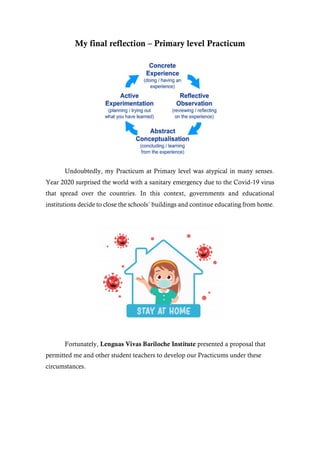
My final reflection – Primary level Practicum
Undoubtedly, my Practicum at Primary level was atypical in many senses.
Year 2020 surprised the world with a sanitary emergency due to the Covid-19 virus
that spread over the countries. In this context, governments and educational
institutions decide to close the schools´ buildings and continue educating from home.
Fortunately, Lenguas Vivas Bariloche Institute presented a proposal that
permitted me and other student teachers to develop our Practicums under these
circumstances.
My Practicum started in September as a preparatory phase that consisted of
working in pairs to design activities for 4th
grade students and outline a synchronous
lesson of about 40 minutes to be potentially hold on an online platform. From this
moment, I realized that this experience would demand me the developing of new
skills, researching a lot and displaying my imaginative and creative skills as much as
possible.
As soon as I started planning my first activities, I started to enjoy this
Practicum period and grow with it. I planned two didactics units on my own. Each
of them required the design and selection of materials, resources and activities to
guide the EFL learning of different groups of students: second graders in the case of
Didactic Unit 1 and sixth graders in the case of Didactic Unit 2. For setting the
learning aims and developing plans accordingly, I considered the language level of
the groups, their possible interests and the topics selected to teach them.
Along the two planning periods, I needed to look for ideas everywhere: surfing
the net, exploring English course-books, YouTube channels; English teachers´
Facebook groups, materials provided in the subject Specific Didactic for Primary
level, among others. After this process of discovering and brainstorming, I was able
to develop many learning opportunities through videos, customized games, songs,
tales, audio files, PowerPoint presentations, poems, pictures, and other materials and
resources, considering skills integration and the variety of learning styles and
intelligences. As examples of the activities developed I can mention ‘dropping words
into columns, completing spaces in blank, guided writing, collaborative work (to play
a game or accomplish a task), putting words in order to form sentences, reading
poems, true or false activities and completing mind maps’.
Even though I didn´t implement the units planned on real students and
consequently I didn´t have a real response on the part of a group of children, I
received guidance and feedback from my tutor Aurelia Velázquez. Her comments
and suggestions were a paramount to obtain a critical and objective view on my
performance and identify the areas that may need changes or improvements.
After going through my tutor´s comments and making a personal analysis of
what I did, I concluded that some materials and activities require little adjustments
for an effective implementation on potential primary learners. For instance, during
week 3-Didactic Unit 1, I designed two short stories to work on reading
comprehension skills and values with second graders. Despite having included
pictures, audio files and using voice to aid comprehension, I agree with my tutor´s
comments that the stories were rather long for the level, and the same regarding the
reading comprehension activity designed about them.
To solve the first of the aforementioned problems what I would do is to reduce
the length of the reading section by deleting the second story. I consider that a short
story paragraph would be enough for my purposes. Secondly, to work on children´s
reading comprehension I think that I can design a different activity to the one I did;
I asked them to circle the correct word in different sentences. A more engaging task
can be an interactive game where children have to spin a wheel or open boxes
containing different multiple-choice questions or sentences about the story. For
example, questions about elements of the plot like place and time (where and when),
characters, central idea of the story or conclusion. Another simpler option can be to
give students different parts of the story to drag them into a story cheeseburger like
the following, but omitting information about the author and genre, and replacing
the words ‘setting’ and ‘plot’ for ‘where’, ‘when’ and questions like ‘what was the
problem?’ ‘what did the characters do?’
Alternatively, children can draw their favourite part of the story and describe
it with a sentence. Following the structure: PP + verb to be + adjective, they can
apply the grammar structures and vocabulary learnt in the unit to describe the
characters´ personal qualities.
With regard to Didactic Unit 2, I consider that the length of the main reading
activity (Into the wild) was not the ideal for a 6th grade level. In this case, I focussed
my efforts on developing a material as much complete as possible for the children,
but I forgot to consider the ideal balance between quantity and quality of learning.
Hence, a possible adaptation for this part of the unit can be to take away some of the
contents included in the PowerPoint presentation and teach them gradually along the
following weeks. For example, I can remove the information related to animal´s
habitats and animal´s diets and work on these contents during weeks 2 and 3. This
way, children won´t feel overwhelmed with too much information in just a single
week.
On the other hand, I consider that the video tutorial given on Activity 2-week
1 may also need some adjustments. I think that I could redo it by focusing only on
activity 2 from week 1 (in the video I also introduced children to activity 1).
Additionally, I can perform demonstrations in a more dynamic way by avoiding
aspects that are not directly connected with the activity itself.
Beyond the aspects to improve, I consider that the while reading activity
‘completing mind-maps’ is adequate for the level and does not require reading much.
Moreover, the activity fosters collaborative work, creative skills and digital literacy:
meaningful aspects in children´s learning.
Overall, I consider that I ´ve made my best effort during this Practicum period,
I´ve enjoyed the process and I´ve learnt a lot with it. I am totally convinced that
despite of all the negative consequences that the present Pandemic brought to the
world, it also imposed important challenges that made people grow in many aspects.
On the part of the educational system, families, teachers and schools had to make
great efforts to continue guaranteeing education, developing creativity and in the best
of the cases digital skills to apply technological resources to teaching and learning.
Fortunately, as I have described all along this writing, being part of Lenguas Vivas
Bariloche distance-learning institute, as a student teacher, I can include myself in the
second group that managed to take the most of the integration of TIC on education.

RL_P2_My final reflection Primary level

  • 1.
    INSTITUTO DE FORMACIÓNDOCENTE CONTINUA LENGUAS VIVAS BARILOCHE Profesorado de Inglés – Opción pedagógica a distancia. PRÁCTICA DOCENTE II My final reflection – Primary level Practicum  Tutora: Aurelia Velázquez  Alumna: Liliana Romero
  • 2.
    My final reflection– Primary level Practicum Undoubtedly, my Practicum at Primary level was atypical in many senses. Year 2020 surprised the world with a sanitary emergency due to the Covid-19 virus that spread over the countries. In this context, governments and educational institutions decide to close the schools´ buildings and continue educating from home. Fortunately, Lenguas Vivas Bariloche Institute presented a proposal that permitted me and other student teachers to develop our Practicums under these circumstances.
  • 3.
    My Practicum startedin September as a preparatory phase that consisted of working in pairs to design activities for 4th grade students and outline a synchronous lesson of about 40 minutes to be potentially hold on an online platform. From this moment, I realized that this experience would demand me the developing of new skills, researching a lot and displaying my imaginative and creative skills as much as possible. As soon as I started planning my first activities, I started to enjoy this Practicum period and grow with it. I planned two didactics units on my own. Each of them required the design and selection of materials, resources and activities to guide the EFL learning of different groups of students: second graders in the case of Didactic Unit 1 and sixth graders in the case of Didactic Unit 2. For setting the learning aims and developing plans accordingly, I considered the language level of the groups, their possible interests and the topics selected to teach them.
  • 4.
    Along the twoplanning periods, I needed to look for ideas everywhere: surfing the net, exploring English course-books, YouTube channels; English teachers´ Facebook groups, materials provided in the subject Specific Didactic for Primary level, among others. After this process of discovering and brainstorming, I was able to develop many learning opportunities through videos, customized games, songs, tales, audio files, PowerPoint presentations, poems, pictures, and other materials and resources, considering skills integration and the variety of learning styles and intelligences. As examples of the activities developed I can mention ‘dropping words into columns, completing spaces in blank, guided writing, collaborative work (to play a game or accomplish a task), putting words in order to form sentences, reading poems, true or false activities and completing mind maps’. Even though I didn´t implement the units planned on real students and consequently I didn´t have a real response on the part of a group of children, I received guidance and feedback from my tutor Aurelia Velázquez. Her comments and suggestions were a paramount to obtain a critical and objective view on my performance and identify the areas that may need changes or improvements. After going through my tutor´s comments and making a personal analysis of what I did, I concluded that some materials and activities require little adjustments for an effective implementation on potential primary learners. For instance, during week 3-Didactic Unit 1, I designed two short stories to work on reading comprehension skills and values with second graders. Despite having included pictures, audio files and using voice to aid comprehension, I agree with my tutor´s
  • 5.
    comments that thestories were rather long for the level, and the same regarding the reading comprehension activity designed about them. To solve the first of the aforementioned problems what I would do is to reduce the length of the reading section by deleting the second story. I consider that a short story paragraph would be enough for my purposes. Secondly, to work on children´s reading comprehension I think that I can design a different activity to the one I did; I asked them to circle the correct word in different sentences. A more engaging task can be an interactive game where children have to spin a wheel or open boxes containing different multiple-choice questions or sentences about the story. For example, questions about elements of the plot like place and time (where and when), characters, central idea of the story or conclusion. Another simpler option can be to give students different parts of the story to drag them into a story cheeseburger like the following, but omitting information about the author and genre, and replacing the words ‘setting’ and ‘plot’ for ‘where’, ‘when’ and questions like ‘what was the problem?’ ‘what did the characters do?’
  • 6.
    Alternatively, children candraw their favourite part of the story and describe it with a sentence. Following the structure: PP + verb to be + adjective, they can apply the grammar structures and vocabulary learnt in the unit to describe the characters´ personal qualities. With regard to Didactic Unit 2, I consider that the length of the main reading activity (Into the wild) was not the ideal for a 6th grade level. In this case, I focussed my efforts on developing a material as much complete as possible for the children, but I forgot to consider the ideal balance between quantity and quality of learning. Hence, a possible adaptation for this part of the unit can be to take away some of the contents included in the PowerPoint presentation and teach them gradually along the following weeks. For example, I can remove the information related to animal´s habitats and animal´s diets and work on these contents during weeks 2 and 3. This way, children won´t feel overwhelmed with too much information in just a single week. On the other hand, I consider that the video tutorial given on Activity 2-week 1 may also need some adjustments. I think that I could redo it by focusing only on activity 2 from week 1 (in the video I also introduced children to activity 1). Additionally, I can perform demonstrations in a more dynamic way by avoiding aspects that are not directly connected with the activity itself. Beyond the aspects to improve, I consider that the while reading activity ‘completing mind-maps’ is adequate for the level and does not require reading much. Moreover, the activity fosters collaborative work, creative skills and digital literacy: meaningful aspects in children´s learning.
  • 7.
    Overall, I considerthat I ´ve made my best effort during this Practicum period, I´ve enjoyed the process and I´ve learnt a lot with it. I am totally convinced that despite of all the negative consequences that the present Pandemic brought to the world, it also imposed important challenges that made people grow in many aspects. On the part of the educational system, families, teachers and schools had to make great efforts to continue guaranteeing education, developing creativity and in the best of the cases digital skills to apply technological resources to teaching and learning. Fortunately, as I have described all along this writing, being part of Lenguas Vivas Bariloche distance-learning institute, as a student teacher, I can include myself in the second group that managed to take the most of the integration of TIC on education.