Unicode
• A standard character encoding designed to
support all of the world's languages
• Unicode represents characters differently than
ASCII
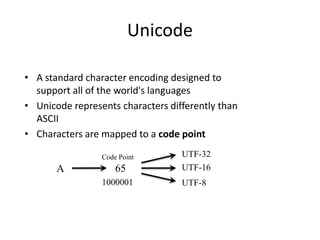
• Characters are mapped to a code point
A 65
Code Point
1000001
UTF-32
UTF-16
UTF-8
UTF-32
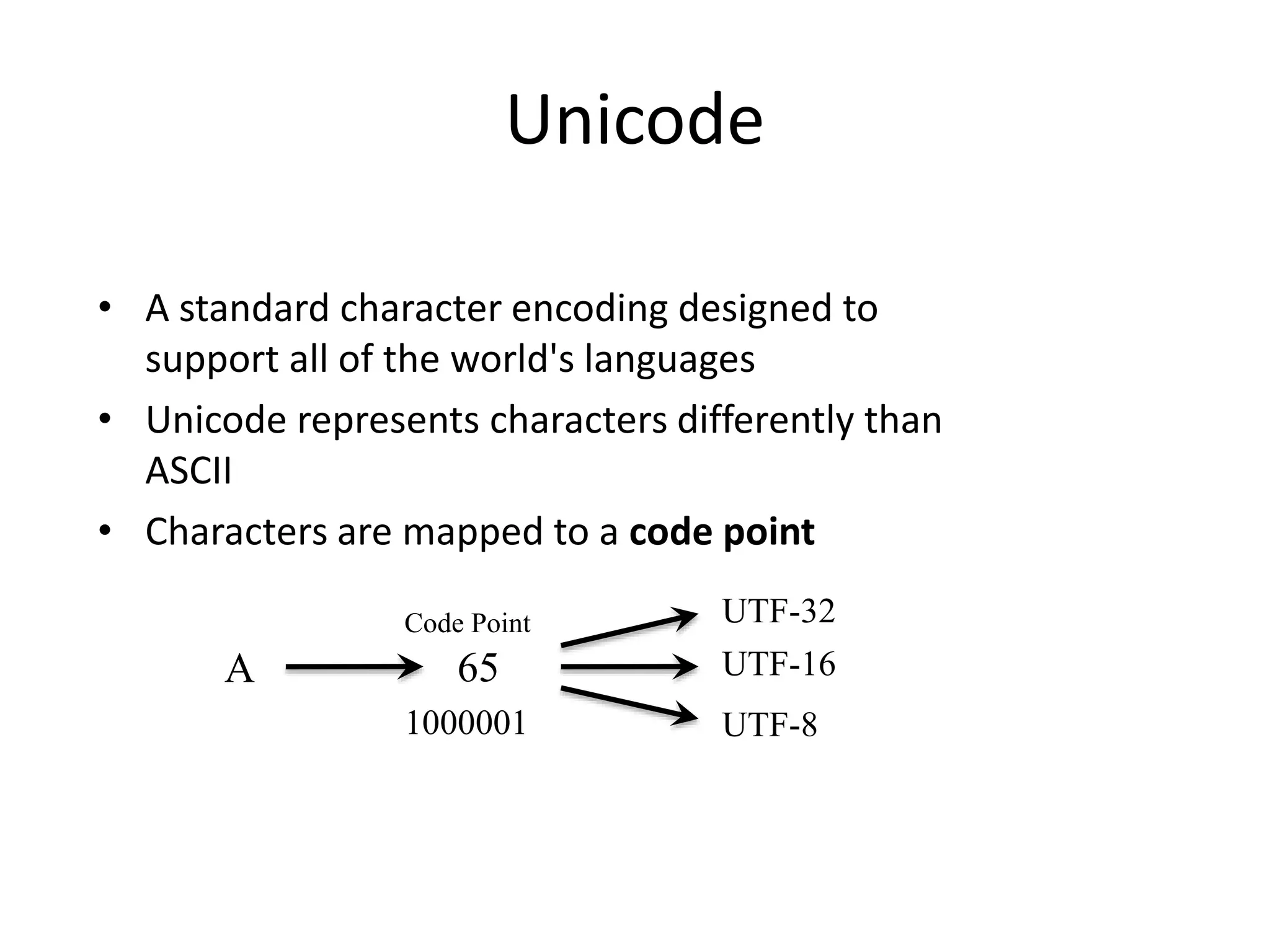
• Uses 4 bytes (32 bits)
• Example:
– A (100 0001)
0 1 0 0 0 0 0 1
0 0 0 0 0 0 0 0
0 0 0 0 0 0 0 0
0 0 0 0 0 0 0 0
UTF-32
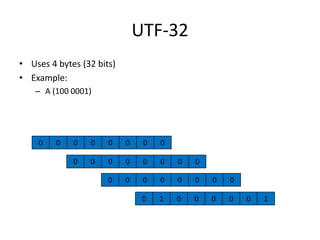
• Problem:
1 KB
in
ASCII
4 KB
in
UTF-32
UTF-16
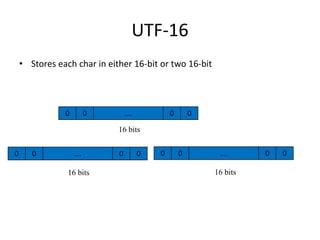
• Stores each char in either 16-bit or two 16-bit
0 0 …. 0 0
0 0 …. 0 0 0 0 …. 0 0
16 bits
16 bits16 bits
UTF-16
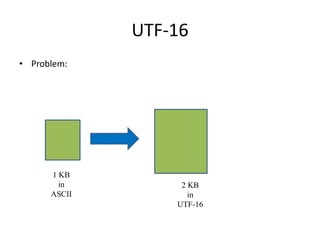
• Problem:
1 KB
in
ASCII
2 KB
in
UTF-16
UTF-8
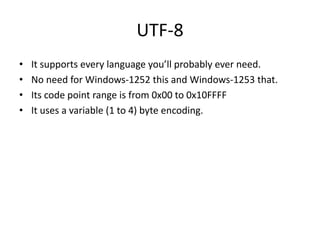
• It supports every language you’ll probably ever need.
• No need for Windows-1252 this and Windows-1253 that.
• Its code point range is from 0x00 to 0x10FFFF
• It uses a variable (1 to 4) byte encoding.
UTF-8 (1-byte)
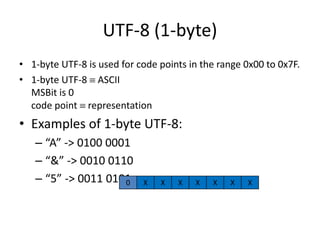
• 1-byte UTF-8 is used for code points in the range 0x00 to 0x7F.
• 1-byte UTF-8  ASCII
MSBit is 0
code point  representation
• Examples of 1-byte UTF-8:
– “A” -> 0100 0001
– “&” -> 0010 0110
– “5” -> 0011 01010 X X X X X X X
UTF-8 (2-byte)
• 2-byte UTF-8
code point != representation
• The code point is broken apart into two pieces.
• The five MSBits of the code point are assigned to the first byte
and the six LSBits are assigned to the second byte.
UTF-8 (2-byte)
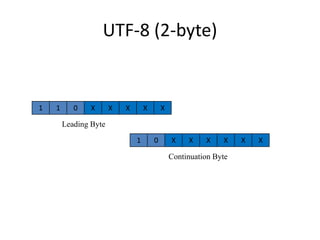
For the first byte of 2-byte UTF-8:
• The three MSBits are set to 110
• The remaining bits are the five MSBits of the code point.
For the second byte of 2-byte UTF-8
• The two MSBits are set to 10
• The remaining bits are the six LSBits of the code point.
UTF-8 (2-byte)
1 1 0 X X X X X
1 0 X X X X X X
Leading Byte
Continuation Byte
UTF-8 (3-byte)
• 3-byte UTF-8 is used for code points in the range 0x0800 to
0xFFFF.
• 3-byte UTF-8
code point != representation
• The code point is broken apart into three pieces.
UTF-8 (3-byte)
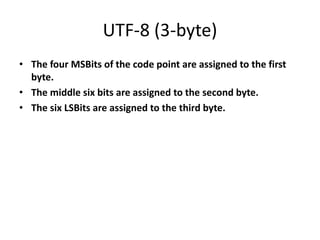
• The four MSBits of the code point are assigned to the first
byte.
• The middle six bits are assigned to the second byte.
• The six LSBits are assigned to the third byte.
UTF-8 (3-byte)
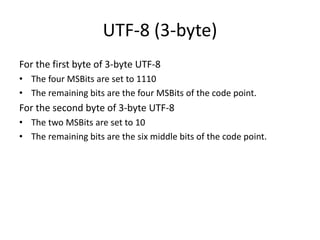
For the first byte of 3-byte UTF-8
• The four MSBits are set to 1110
• The remaining bits are the four MSBits of the code point.
For the second byte of 3-byte UTF-8
• The two MSBits are set to 10
• The remaining bits are the six middle bits of the code point.
UTF-8 (3-byte)
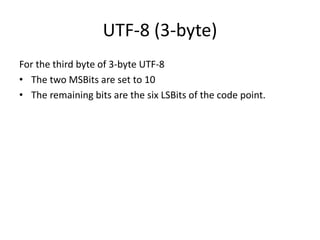
For the third byte of 3-byte UTF-8
• The two MSBits are set to 10
• The remaining bits are the six LSBits of the code point.
UTF-8 (3-byte)
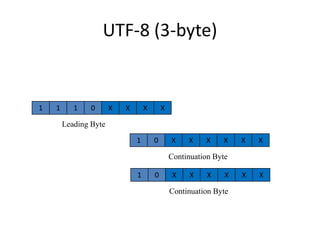
1 1 1 0 X X X X
1 0 X X X X X X
Leading Byte
Continuation Byte
1 0 X X X X X X
Continuation Byte
UTF-8 (4-byte)
• 4-byte UTF-8 is used for code points in the range 0x10000 to
0x10FFFF.
• 4-byte UTF-8
code point != representation
• The code point is broken apart into four pieces.
UTF-8 (4-byte)
• The three MSBits of the code point are assigned to the first
byte.
• The next six MSBits are assigned to the second byte.
• Another of the next six MSBits are assigned to the third byte.
• The six LSBits are assigned to the fourth byte.
UTF-8 (4-byte)
For the first byte of 4-byte UTF-8
• The five MSBits are set to 11110
• The remaining bits are the three MSBits of the code point.
For the second byte of 4-byte UTF-8
• The two MSBits are set to 10
• The remaining bits are the next six middle bits of the code point.
UTF-8 (4-byte)
For the third byte of 4-byte UTF-8
• The two MSBits are set to 10
• The remaining bits are the next six middle bits of the code point.
For the fourth byte of 4-byte UTF-8
• The two MSBits are set to 10
• The remaining bits are the six LSBits of the code point.
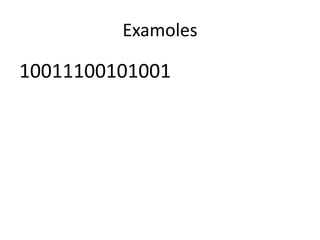
Examoles
10011100101001

4 character encoding-unicode

  • 1.
    Unicode • A standardcharacter encoding designed to support all of the world's languages • Unicode represents characters differently than ASCII • Characters are mapped to a code point A 65 Code Point 1000001 UTF-32 UTF-16 UTF-8
  • 2.
    UTF-32 • Uses 4bytes (32 bits) • Example: – A (100 0001) 0 1 0 0 0 0 0 1 0 0 0 0 0 0 0 0 0 0 0 0 0 0 0 0 0 0 0 0 0 0 0 0
  • 3.
  • 4.
    UTF-16 • Stores eachchar in either 16-bit or two 16-bit 0 0 …. 0 0 0 0 …. 0 0 0 0 …. 0 0 16 bits 16 bits16 bits
  • 5.
  • 6.
    UTF-8 • It supportsevery language you’ll probably ever need. • No need for Windows-1252 this and Windows-1253 that. • Its code point range is from 0x00 to 0x10FFFF • It uses a variable (1 to 4) byte encoding.
  • 7.
    UTF-8 (1-byte) • 1-byteUTF-8 is used for code points in the range 0x00 to 0x7F. • 1-byte UTF-8  ASCII MSBit is 0 code point  representation • Examples of 1-byte UTF-8: – “A” -> 0100 0001 – “&” -> 0010 0110 – “5” -> 0011 01010 X X X X X X X
  • 8.
    UTF-8 (2-byte) • 2-byteUTF-8 code point != representation • The code point is broken apart into two pieces. • The five MSBits of the code point are assigned to the first byte and the six LSBits are assigned to the second byte.
  • 9.
    UTF-8 (2-byte) For thefirst byte of 2-byte UTF-8: • The three MSBits are set to 110 • The remaining bits are the five MSBits of the code point. For the second byte of 2-byte UTF-8 • The two MSBits are set to 10 • The remaining bits are the six LSBits of the code point.
  • 10.
    UTF-8 (2-byte) 1 10 X X X X X 1 0 X X X X X X Leading Byte Continuation Byte
  • 11.
    UTF-8 (3-byte) • 3-byteUTF-8 is used for code points in the range 0x0800 to 0xFFFF. • 3-byte UTF-8 code point != representation • The code point is broken apart into three pieces.
  • 12.
    UTF-8 (3-byte) • Thefour MSBits of the code point are assigned to the first byte. • The middle six bits are assigned to the second byte. • The six LSBits are assigned to the third byte.
  • 13.
    UTF-8 (3-byte) For thefirst byte of 3-byte UTF-8 • The four MSBits are set to 1110 • The remaining bits are the four MSBits of the code point. For the second byte of 3-byte UTF-8 • The two MSBits are set to 10 • The remaining bits are the six middle bits of the code point.
  • 14.
    UTF-8 (3-byte) For thethird byte of 3-byte UTF-8 • The two MSBits are set to 10 • The remaining bits are the six LSBits of the code point.
  • 15.
    UTF-8 (3-byte) 1 11 0 X X X X 1 0 X X X X X X Leading Byte Continuation Byte 1 0 X X X X X X Continuation Byte
  • 16.
    UTF-8 (4-byte) • 4-byteUTF-8 is used for code points in the range 0x10000 to 0x10FFFF. • 4-byte UTF-8 code point != representation • The code point is broken apart into four pieces.
  • 17.
    UTF-8 (4-byte) • Thethree MSBits of the code point are assigned to the first byte. • The next six MSBits are assigned to the second byte. • Another of the next six MSBits are assigned to the third byte. • The six LSBits are assigned to the fourth byte.
  • 18.
    UTF-8 (4-byte) For thefirst byte of 4-byte UTF-8 • The five MSBits are set to 11110 • The remaining bits are the three MSBits of the code point. For the second byte of 4-byte UTF-8 • The two MSBits are set to 10 • The remaining bits are the next six middle bits of the code point.
  • 19.
    UTF-8 (4-byte) For thethird byte of 4-byte UTF-8 • The two MSBits are set to 10 • The remaining bits are the next six middle bits of the code point. For the fourth byte of 4-byte UTF-8 • The two MSBits are set to 10 • The remaining bits are the six LSBits of the code point.
  • 20.