Cryptography
Lecture 2
Byte-wise shift cipher
• Work with an alphabet of bytes
rather than (English, lowercase)
letters
– Works natively for arbitrary data!
• Use XOR instead of modular addition
– Essential properties still hold
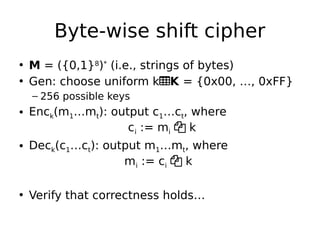
Byte-wise shift cipher
• M = ({0,1}8
)*
(i.e., strings of bytes)
• Gen: choose uniform kK = {0x00, …, 0xFF}
– 256 possible keys
• Enck(m1…mt): output c1…ct, where
ci := mi  k
• Deck(c1…ct): output m1…mt, where
mi := ci  k
• Verify that correctness holds…
ASCII
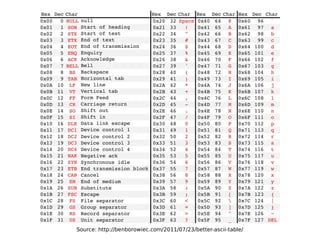
• Characters often represented in ASCII
– 1 byte/char = 2 hex digits/char
Source: http://benborowiec.com/2011/07/23/better-ascii-table/
Code for byte-wise shift
cipher
// read key from key.txt (hex) and message from ptext.txt (ASCII);
// output ciphertext to ctext.txt (hex)
#include <stdio.h>
main(){
FILE *keyfile, *pfile, *cfile;
int i;
unsigned char key, ch;
keyfile = fopen("key.txt", "r"), pfile = fopen("ptext.txt", "r"), cfile = fopen("ctext.txt", "w");
if (fscanf(keyfile, "%2hhX", &key)==EOF) printf("Error reading key.n");
for (i=0; ; i++){
if (fscanf(pfile, "%c", &ch)==EOF) break;
fprintf(cfile, "%02X", ch^key);
}
fclose(keyfile), fclose(pfile), fclose(cfile);
}
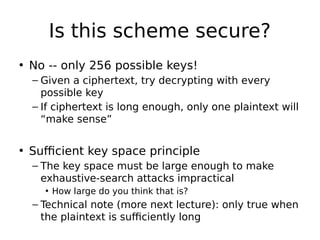
Is this scheme secure?
• No -- only 256 possible keys!
– Given a ciphertext, try decrypting with every
possible key
– If ciphertext is long enough, only one plaintext will
“make sense”
• Sufficient key space principle
– The key space must be large enough to make
exhaustive-search attacks impractical
• How large do you think that is?
– Technical note (more next lecture): only true when
the plaintext is sufficiently long
Can we improve the attack?
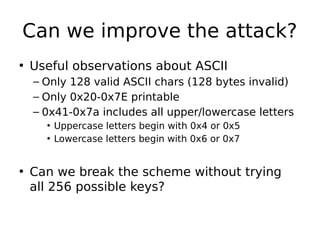
• Useful observations about ASCII
– Only 128 valid ASCII chars (128 bytes invalid)
– Only 0x20-0x7E printable
– 0x41-0x7a includes all upper/lowercase letters
• Uppercase letters begin with 0x4 or 0x5
• Lowercase letters begin with 0x6 or 0x7
• Can we break the scheme without trying
all 256 possible keys?
The Vigenère cipher
• The key is multiple characters, not
just one
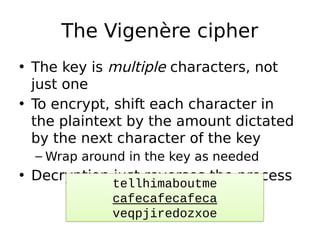
• To encrypt, shift each character in
the plaintext by the amount dictated
by the next character of the key
– Wrap around in the key as needed
• Decryption just reverses the process
tellhimaboutme
cafecafecafeca
veqpjiredozxoe
The Vigenère cipher
• Size of key space?
– If keys are 14-character strings over the
English alphabet, then key space has
size 2614

266
– If variable length keys, even more…
– Brute-force search becomes infeasible
• Does that mean the Vigenère cipher
is secure?
Attacking the Vigenère
cipher
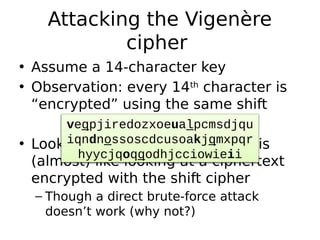
• Assume a 14-character key
• Observation: every 14th
character is
“encrypted” using the same shift
• Looking at every 14th
character is
(almost) like looking at a ciphertext
encrypted with the shift cipher
– Though a direct brute-force attack
doesn’t work (why not?)
veqpjiredozxoeualpcmsdjqu
iqndnossoscdcusoakjqmxpqr
hyycjqoqqodhjcciowieii
veqpjiredozxoeualpcmsdjqu
iqndnossoscdcusoakjqmxpqr
hyycjqoqqodhjcciowieii
veqpjiredozxoeualpcmsdjqu
iqndnossoscdcusoakjqmxpqr
hyycjqoqqodhjcciowieii
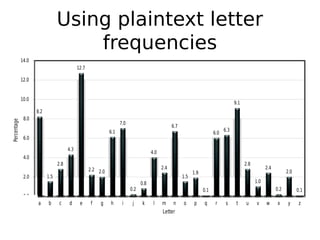
Using plaintext letter
frequencies
8.2
1.5
2.8
4.3
12.7
2.2 2.0
6.1
7.0
0.2
0.8
4.0
2.4
6.7
1.5
1.9
0.1
6.0
6.3
9.1
2.8
1.0
2.4
0.2
2.0
0.1
0.0
2.0
4.0
6.0
8.0
10.0
12.0
14.0
a b c d e f g h i j k l m n o p q r s t u v w x y z
Percentage
Letter
Attacking the Vigenère
cipher
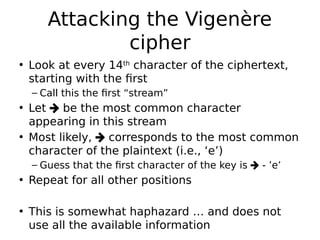
• Look at every 14th
character of the ciphertext,
starting with the first
– Call this the first “stream”
• Let  be the most common character
appearing in this stream
• Most likely,  corresponds to the most common
character of the plaintext (i.e., ‘e’)
– Guess that the first character of the key is  - ’e’
• Repeat for all other positions
• This is somewhat haphazard … and does not
use all the available information
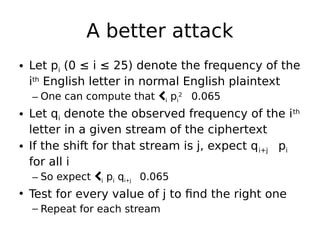
A better attack
• Let pi (0 ≤ i ≤ 25) denote the frequency of the
ith
English letter in normal English plaintext
– One can compute that i pi
2

0.065
• Let qi denote the observed frequency of the ith
letter in a given stream of the ciphertext
• If the shift for that stream is j, expect qi+j 
pi
for all i
– So expect i pi qi+j 
0.065
• Test for every value of j to find the right one
– Repeat for each stream
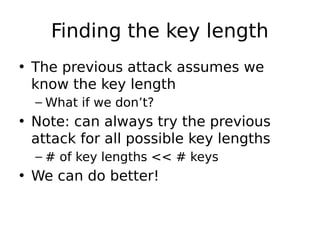
Finding the key length
• The previous attack assumes we
know the key length
– What if we don’t?
• Note: can always try the previous
attack for all possible key lengths
– # of key lengths << # keys
• We can do better!
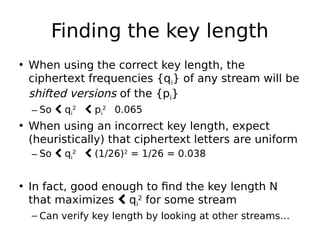
Finding the key length
• When using the correct key length, the
ciphertext frequencies {qi} of any stream will be
shifted versions of the {pi}
– So  qi
2

 pi
2

0.065
• When using an incorrect key length, expect
(heuristically) that ciphertext letters are uniform
– So  qi
2

 (1/26)2
= 1/26 = 0.038
• In fact, good enough to find the key length N
that maximizes  qi
2
for some stream
– Can verify key length by looking at other streams…
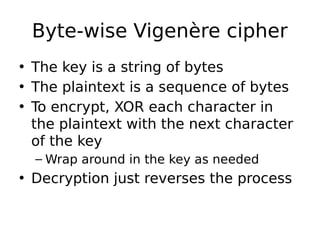
Byte-wise Vigenère cipher
• The key is a string of bytes
• The plaintext is a sequence of bytes
• To encrypt, XOR each character in
the plaintext with the next character
of the key
– Wrap around in the key as needed
• Decryption just reverses the process
Example
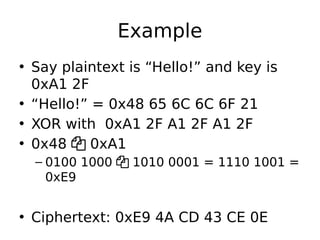
• Say plaintext is “Hello!” and key is
0xA1 2F
• “Hello!” = 0x48 65 6C 6C 6F 21
• XOR with 0xA1 2F A1 2F A1 2F
• 0x48  0xA1
– 0100 1000  1010 0001 = 1110 1001 =
0xE9
• Ciphertext: 0xE9 4A CD 43 CE 0E
Attacking the (variant) Vigenère
cipher
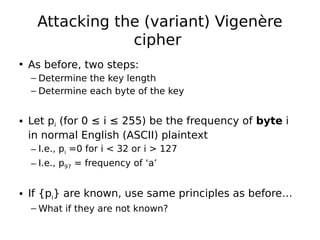
• As before, two steps:
– Determine the key length
– Determine each byte of the key
• Let pi (for 0 ≤ i ≤ 255) be the frequency of byte i
in normal English (ASCII) plaintext
– I.e., pi =0 for i < 32 or i > 127
– I.e., p97 = frequency of ‘a’
• If {pi} are known, use same principles as before…
– What if they are not known?
Determining the key length
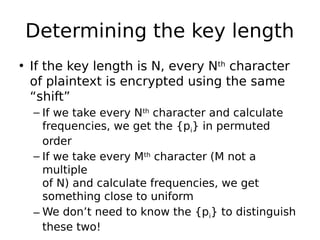
• If the key length is N, every Nth
character
of plaintext is encrypted using the same
“shift”
– If we take every Nth
character and calculate
frequencies, we get the {pi} in permuted
order
– If we take every Mth
character (M not a
multiple
of N) and calculate frequencies, we get
something close to uniform
– We don’t need to know the {pi} to distinguish
these two!
Determining the key length
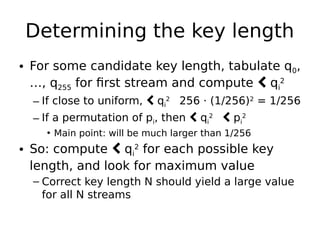
• For some candidate key length, tabulate q0,
…, q255 for first stream and compute  qi
2
– If close to uniform,  qi
2

256 · (1/256)2
= 1/256
– If a permutation of pi, then  qi
2

 pi
2
• Main point: will be much larger than 1/256
• So: compute  qi
2
for each possible key
length, and look for maximum value
– Correct key length N should yield a large value
for all N streams
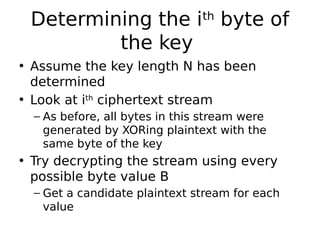
Determining the ith
byte of
the key
• Assume the key length N has been
determined
• Look at ith
ciphertext stream
– As before, all bytes in this stream were
generated by XORing plaintext with the
same byte of the key
• Try decrypting the stream using every
possible byte value B
– Get a candidate plaintext stream for each
value
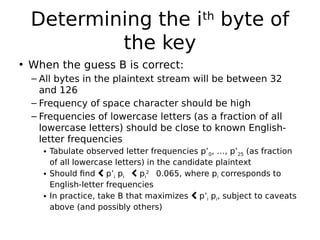
Determining the ith
byte of
the key
• When the guess B is correct:
– All bytes in the plaintext stream will be between 32
and 126
– Frequency of space character should be high
– Frequencies of lowercase letters (as a fraction of all
lowercase letters) should be close to known English-
letter frequencies
• Tabulate observed letter frequencies p’0, …, p’25 (as fraction
of all lowercase letters) in the candidate plaintext
• Should find  p’i pi 
 pi
2

0.065, where pi corresponds to
English-letter frequencies
• In practice, take B that maximizes  p’i pi, subject to caveats
above (and possibly others)
Complexity of the attack?
• Say the key length is known to be
between
1 and L
• Determining the key length: O(L)
• Determining all bytes of the key: O(L)
• Total work: O(L)
• Brute-force key search: > 256L
The attack in practice
• Attack is more reliable as the
ciphertext length grows
• Attack still works for short(er)
ciphertexts, but more “tweaking”
and manual involvement may be
needed
First programming
assignment
• Decrypt ciphertext (provided online)
that was generated using the
Vigenère cipher

lec2.pdf

  • 1.
  • 2.
    Byte-wise shift cipher •Work with an alphabet of bytes rather than (English, lowercase) letters – Works natively for arbitrary data! • Use XOR instead of modular addition – Essential properties still hold
  • 3.
    Byte-wise shift cipher •M = ({0,1}8 )* (i.e., strings of bytes) • Gen: choose uniform kK = {0x00, …, 0xFF} – 256 possible keys • Enck(m1…mt): output c1…ct, where ci := mi  k • Deck(c1…ct): output m1…mt, where mi := ci  k • Verify that correctness holds…
  • 4.
    ASCII • Characters oftenrepresented in ASCII – 1 byte/char = 2 hex digits/char
  • 5.
  • 6.
    Code for byte-wiseshift cipher // read key from key.txt (hex) and message from ptext.txt (ASCII); // output ciphertext to ctext.txt (hex) #include <stdio.h> main(){ FILE *keyfile, *pfile, *cfile; int i; unsigned char key, ch; keyfile = fopen("key.txt", "r"), pfile = fopen("ptext.txt", "r"), cfile = fopen("ctext.txt", "w"); if (fscanf(keyfile, "%2hhX", &key)==EOF) printf("Error reading key.n"); for (i=0; ; i++){ if (fscanf(pfile, "%c", &ch)==EOF) break; fprintf(cfile, "%02X", ch^key); } fclose(keyfile), fclose(pfile), fclose(cfile); }
  • 7.
    Is this schemesecure? • No -- only 256 possible keys! – Given a ciphertext, try decrypting with every possible key – If ciphertext is long enough, only one plaintext will “make sense” • Sufficient key space principle – The key space must be large enough to make exhaustive-search attacks impractical • How large do you think that is? – Technical note (more next lecture): only true when the plaintext is sufficiently long
  • 8.
    Can we improvethe attack? • Useful observations about ASCII – Only 128 valid ASCII chars (128 bytes invalid) – Only 0x20-0x7E printable – 0x41-0x7a includes all upper/lowercase letters • Uppercase letters begin with 0x4 or 0x5 • Lowercase letters begin with 0x6 or 0x7 • Can we break the scheme without trying all 256 possible keys?
  • 9.
    The Vigenère cipher •The key is multiple characters, not just one • To encrypt, shift each character in the plaintext by the amount dictated by the next character of the key – Wrap around in the key as needed • Decryption just reverses the process tellhimaboutme cafecafecafeca veqpjiredozxoe
  • 10.
    The Vigenère cipher •Size of key space? – If keys are 14-character strings over the English alphabet, then key space has size 2614  266 – If variable length keys, even more… – Brute-force search becomes infeasible • Does that mean the Vigenère cipher is secure?
  • 11.
    Attacking the Vigenère cipher •Assume a 14-character key • Observation: every 14th character is “encrypted” using the same shift • Looking at every 14th character is (almost) like looking at a ciphertext encrypted with the shift cipher – Though a direct brute-force attack doesn’t work (why not?) veqpjiredozxoeualpcmsdjqu iqndnossoscdcusoakjqmxpqr hyycjqoqqodhjcciowieii veqpjiredozxoeualpcmsdjqu iqndnossoscdcusoakjqmxpqr hyycjqoqqodhjcciowieii veqpjiredozxoeualpcmsdjqu iqndnossoscdcusoakjqmxpqr hyycjqoqqodhjcciowieii
  • 12.
    Using plaintext letter frequencies 8.2 1.5 2.8 4.3 12.7 2.22.0 6.1 7.0 0.2 0.8 4.0 2.4 6.7 1.5 1.9 0.1 6.0 6.3 9.1 2.8 1.0 2.4 0.2 2.0 0.1 0.0 2.0 4.0 6.0 8.0 10.0 12.0 14.0 a b c d e f g h i j k l m n o p q r s t u v w x y z Percentage Letter
  • 13.
    Attacking the Vigenère cipher •Look at every 14th character of the ciphertext, starting with the first – Call this the first “stream” • Let  be the most common character appearing in this stream • Most likely,  corresponds to the most common character of the plaintext (i.e., ‘e’) – Guess that the first character of the key is  - ’e’ • Repeat for all other positions • This is somewhat haphazard … and does not use all the available information
  • 14.
    A better attack •Let pi (0 ≤ i ≤ 25) denote the frequency of the ith English letter in normal English plaintext – One can compute that i pi 2  0.065 • Let qi denote the observed frequency of the ith letter in a given stream of the ciphertext • If the shift for that stream is j, expect qi+j  pi for all i – So expect i pi qi+j  0.065 • Test for every value of j to find the right one – Repeat for each stream
  • 15.
    Finding the keylength • The previous attack assumes we know the key length – What if we don’t? • Note: can always try the previous attack for all possible key lengths – # of key lengths << # keys • We can do better!
  • 16.
    Finding the keylength • When using the correct key length, the ciphertext frequencies {qi} of any stream will be shifted versions of the {pi} – So  qi 2   pi 2  0.065 • When using an incorrect key length, expect (heuristically) that ciphertext letters are uniform – So  qi 2   (1/26)2 = 1/26 = 0.038 • In fact, good enough to find the key length N that maximizes  qi 2 for some stream – Can verify key length by looking at other streams…
  • 17.
    Byte-wise Vigenère cipher •The key is a string of bytes • The plaintext is a sequence of bytes • To encrypt, XOR each character in the plaintext with the next character of the key – Wrap around in the key as needed • Decryption just reverses the process
  • 18.
    Example • Say plaintextis “Hello!” and key is 0xA1 2F • “Hello!” = 0x48 65 6C 6C 6F 21 • XOR with 0xA1 2F A1 2F A1 2F • 0x48  0xA1 – 0100 1000  1010 0001 = 1110 1001 = 0xE9 • Ciphertext: 0xE9 4A CD 43 CE 0E
  • 19.
    Attacking the (variant)Vigenère cipher • As before, two steps: – Determine the key length – Determine each byte of the key • Let pi (for 0 ≤ i ≤ 255) be the frequency of byte i in normal English (ASCII) plaintext – I.e., pi =0 for i < 32 or i > 127 – I.e., p97 = frequency of ‘a’ • If {pi} are known, use same principles as before… – What if they are not known?
  • 20.
    Determining the keylength • If the key length is N, every Nth character of plaintext is encrypted using the same “shift” – If we take every Nth character and calculate frequencies, we get the {pi} in permuted order – If we take every Mth character (M not a multiple of N) and calculate frequencies, we get something close to uniform – We don’t need to know the {pi} to distinguish these two!
  • 21.
    Determining the keylength • For some candidate key length, tabulate q0, …, q255 for first stream and compute  qi 2 – If close to uniform,  qi 2  256 · (1/256)2 = 1/256 – If a permutation of pi, then  qi 2   pi 2 • Main point: will be much larger than 1/256 • So: compute  qi 2 for each possible key length, and look for maximum value – Correct key length N should yield a large value for all N streams
  • 22.
    Determining the ith byteof the key • Assume the key length N has been determined • Look at ith ciphertext stream – As before, all bytes in this stream were generated by XORing plaintext with the same byte of the key • Try decrypting the stream using every possible byte value B – Get a candidate plaintext stream for each value
  • 23.
    Determining the ith byteof the key • When the guess B is correct: – All bytes in the plaintext stream will be between 32 and 126 – Frequency of space character should be high – Frequencies of lowercase letters (as a fraction of all lowercase letters) should be close to known English- letter frequencies • Tabulate observed letter frequencies p’0, …, p’25 (as fraction of all lowercase letters) in the candidate plaintext • Should find  p’i pi   pi 2  0.065, where pi corresponds to English-letter frequencies • In practice, take B that maximizes  p’i pi, subject to caveats above (and possibly others)
  • 24.
    Complexity of theattack? • Say the key length is known to be between 1 and L • Determining the key length: O(L) • Determining all bytes of the key: O(L) • Total work: O(L) • Brute-force key search: > 256L
  • 25.
    The attack inpractice • Attack is more reliable as the ciphertext length grows • Attack still works for short(er) ciphertexts, but more “tweaking” and manual involvement may be needed
  • 26.
    First programming assignment • Decryptciphertext (provided online) that was generated using the Vigenère cipher