WWW.DOCIRCUITS.COM	


                                                                                                                             Basic	
  Electronics	
  with	
  DoCircuits	


Topic:	
  Semiconductor	
  diode-­‐	
  Crystal	
  diode	
  

Keywords:	
  Diode,	
  Rectifier,	
  Center	
  tap	
  

Q1.	
  	
  
         A	
  crystal	
  diode	
  having	
  an	
  internal	
  resistance	
  rt	
  =	
  10	
  Ω	
  is	
  used	
  for	
  center	
  
tapped	
  full	
  wave	
  rectification.	
  	
  If	
  the	
  applied	
  voltage	
  is	
  V	
  =	
  50	
  sin	
  (πt)	
  and	
  the	
  
load	
  resistance	
  is	
  RL	
  =	
  1	
  kΩ,	
  determine	
  the	
  followings:	
  

Draw	
  the	
  input	
  and	
  output	
  voltage	
  and	
  current	
  waveforms.	


  The	
  efficiency	
  of	
  the	
  circuit.	
  

The	
  Ripple	
  factor.	


Ans:	


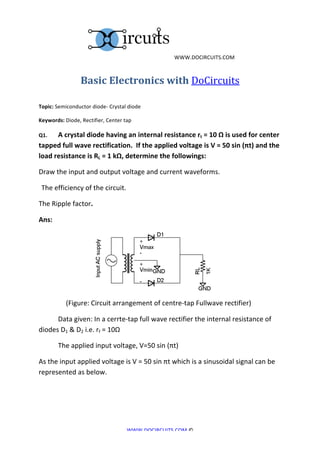
  (Figure:	
  Circuit	
  arrangement	
  of	
  centre-­‐tap	
  Fullwave	
  rectifier)	


    Data	
  given:	
  In	
  a	
  cerrte-­‐tap	
  full	
  wave	
  rectifier	
  the	
  internal	
  resistance	
  of	
  
diodes	
  D1	
  &	
  D2	
  i.e.	
  rf	
  =	
  10Ω	


                                                       The	
  applied	
  input	
  voltage,	
  V=50	
  sin	
  (πt)	
  

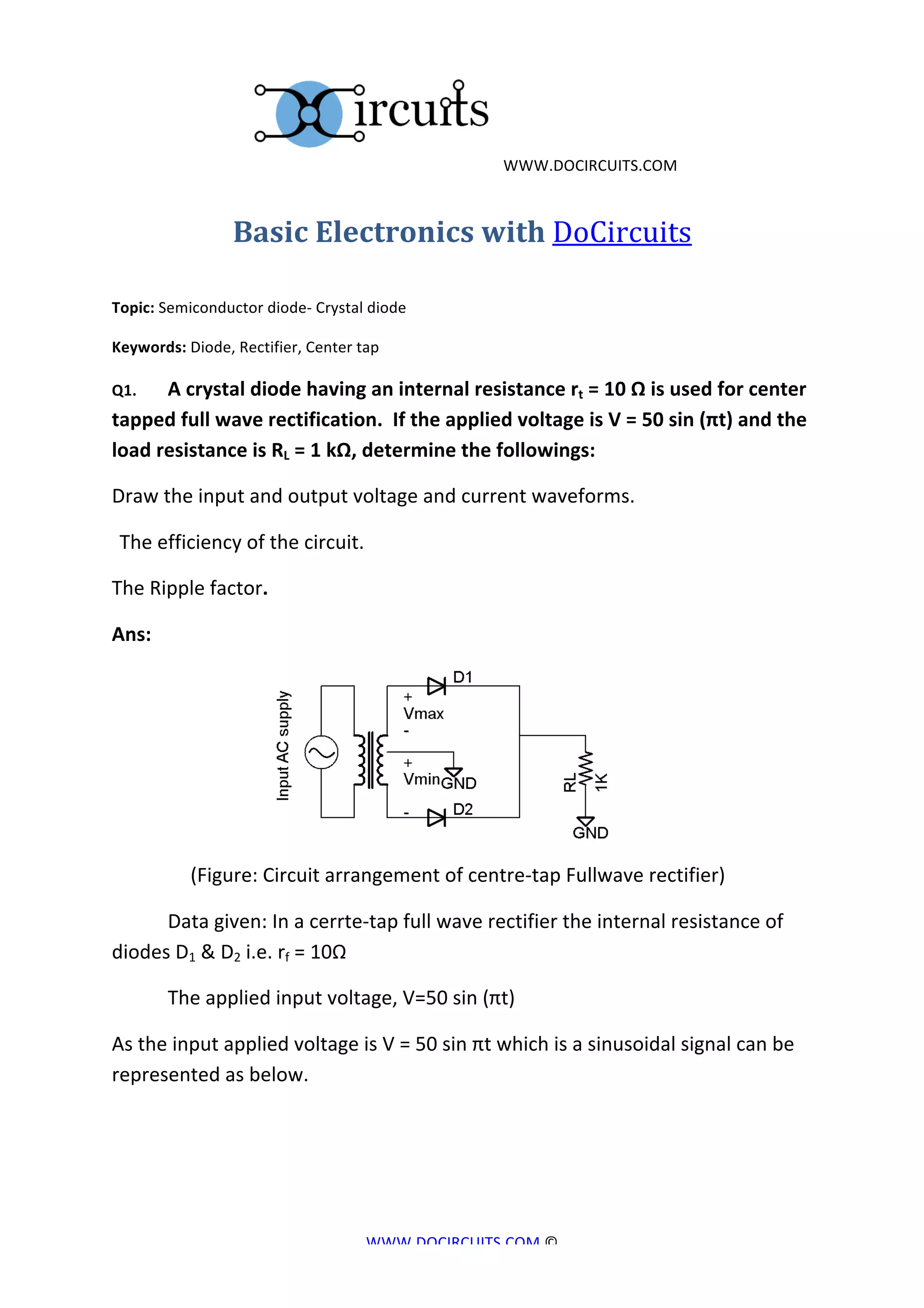
As	
  the	
  input	
  applied	
  voltage	
  is	
  V	
  =	
  50	
  sin	
  πt	
  which	
  is	
  a	
  sinusoidal	
  signal	
  can	
  be	
  
represented	
  as	
  below.	


                                                                                                                                                                       WWW.DOCIRCUITS.COM	
  ©	
  
 	
  WWW.DOCIRCUITS.COM	


Operation:	
  During	
  +ve	
  	
  half	
  cycle	
  (i.e.	
  o-­‐π)	
  the	
  diode	
  D1	
  will	
  conduct	
  due	
  to	
  
forward	
  bias	
  and	
  diode	
  D2	
  will	
  be	
  OFF	
  due	
  to	
  reverse	
  bias	
  so	
  that	
  the	
  	
  current	
  
will	
  flow	
  at	
  the	
  upper	
  half	
  portion	
  of	
  the	
  circuit.	
  	
  As	
  a	
  result	
  a	
  voltage	
  will	
  
develop	
  across	
  load	
  RL.	
  

Similarly	
  during	
  –	
  ve	
  half	
  cycle	
  (i.e.	
  π-­‐2π)	
  the	
  diode	
  D2	
  will	
  conduct	
  due	
  to	
  
forward	
  bias	
  and	
  diode	
  D1	
  will	
  conduct	
  due	
  to	
  forward	
  bias	
  and	
  diode	
  D1	
  will	
  be	
  
OFFdue	
  to	
  reverse	
  bias	
  so	
  that	
  the	
  current	
  will	
  flow	
  at	
  the	
  lower	
  half	
  portion	
  of	
  
the	
  circuit.	
  	
  As	
  a	
  result	
  a	
  voltage	
  will	
  develop	
  across	
  load	
  RL.	
  

It	
  is	
  observed	
  that	
  the	
  current	
  which	
  will	
  flow	
  through	
  load	
  RL	
  is	
  unidirectional	
  
during	
  both	
  half	
  cycle	
  hence	
  an	
  pulsating	
  during	
  both	
  half	
  cycle	
  hence	
  an	
  
pulsating	
  dc	
  voltage	
  obtained	
  across	
  load	
  RL.	
  

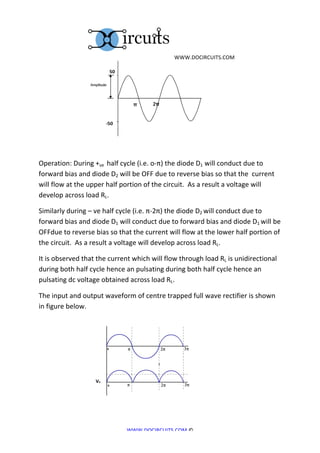
The	
  input	
  and	
  output	
  waveform	
  of	
  centre	
  trapped	
  full	
  wave	
  rectifier	
  is	
  shown	
  
in	
  figure	
  below.	


                                                                                                                           WWW.DOCIRCUITS.COM	
  ©	
  
 	
  WWW.DOCIRCUITS.COM	


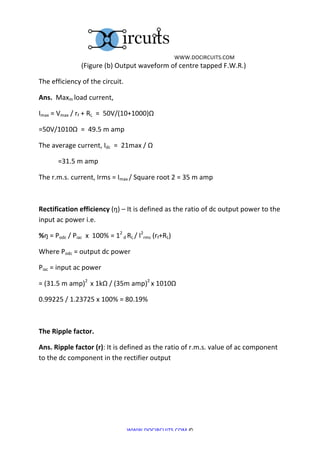
  (Figure	
  (b)	
  Output	
  waveform	
  of	
  centre	
  tapped	
  F.W.R.)	
  

The	
  efficiency	
  of	
  the	
  circuit.	
  

Ans.	
  	
  Maxm	
  load	
  current,	
  

Imax	
  =	
  Vmax	
  /	
  rf	
  +	
  RL	
  	
  =	
  	
  50V/(10+1000)Ω	
  

=50V/1010Ω	
  	
  =	
  	
  49.5	
  m	
  amp	
  

The	
  average	
  current,	
  Idc	
  	
  =	
  	
  21max	
  /	
  Ω	


              =31.5	
  m	
  amp	
  

The	
  r.m.s.	
  current,	
  Irms	
  =	
  Imax	
  /	
  Square	
  root	
  2	
  =	
  35	
  m	
  amp	


Rectification	
  efficiency	
  (ŋ)	
  –	
  It	
  is	
  defined	
  as	
  the	
  ratio	
  of	
  dc	
  output	
  power	
  to	
  the	
  
input	
  ac	
  power	
  i.e.	
  

%ŋ	
  =	
  Podc	
  /	
  Piac	
  	
  x	
  	
  100%	
  =	
  12	
  d	
  RL	
  /	
  I2rms	
  (rf+RL)	
  

Where	
  Podc	
  =	
  output	
  dc	
  power	
  

Piac	
  =	
  input	
  ac	
  power	
  

=	
  (31.5	
  m	
  amp)2	
  	
  x	
  1kΩ	
  /	
  (35m	
  amp)2	
  x	
  1010Ω	
  

0.99225	
  /	
  1.23725	
  x	
  100%	
  =	
  80.19%	


The	
  Ripple	
  factor.	
  

Ans.	
  Ripple	
  factor	
  (r):	
  It	
  is	
  defined	
  as	
  the	
  ratio	
  of	
  r.m.s.	
  value	
  of	
  ac	
  component	
  
to	
  the	
  dc	
  component	
  in	
  the	
  rectifier	
  output	


                                                                          WWW.DOCIRCUITS.COM	
  ©	
  
 	
  WWW.DOCIRCUITS.COM	
  
Practice	
  :	
  Try	
  this	
  out	
  in	
  the	
  virtual	
  lab	
  

URL	
  :	
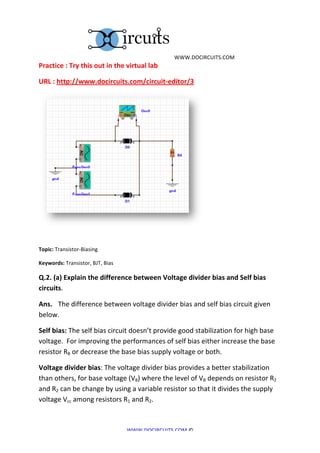
  http://www.docircuits.com/circuit-­‐editor/3	


Topic:	
  Transistor-­‐Biasing	
  

Keywords:	
  Transistor,	
  BJT,	
  Bias	
  

Q.2.	
  (a)	
  Explain	
  the	
  difference	
  between	
  Voltage	
  divider	
  bias	
  and	
  Self	
  bias	
  
circuits.	
  

Ans.	
   The	
  difference	
  between	
  voltage	
  divider	
  bias	
  and	
  self	
  bias	
  circuit	
  given	
  
below.	
  

Self	
  bias:	
  The	
  self	
  bias	
  circuit	
  doesn’t	
  provide	
  good	
  stabilization	
  for	
  high	
  base	
  
voltage.	
  	
  For	
  improving	
  the	
  performances	
  of	
  self	
  bias	
  either	
  increase	
  the	
  base	
  
resistor	
  RB	
  or	
  decrease	
  the	
  base	
  bias	
  supply	
  voltage	
  or	
  both.	
  

Voltage	
  divider	
  bias:	
  The	
  voltage	
  divider	
  bias	
  provides	
  a	
  better	
  stabilization	
  
than	
  others,	
  for	
  base	
  voltage	
  (VB)	
  where	
  the	
  level	
  of	
  VB	
  depends	
  on	
  resistor	
  R2	
  
and	
  R2	
  can	
  be	
  change	
  by	
  using	
  a	
  variable	
  resistor	
  so	
  that	
  it	
  divides	
  the	
  supply	
  
voltage	
  Vcc	
  among	
  resistors	
  R1	
  and	
  R2.	


                                                   WWW.DOCIRCUITS.COM	
  ©	
  
 	
  WWW.DOCIRCUITS.COM	
  
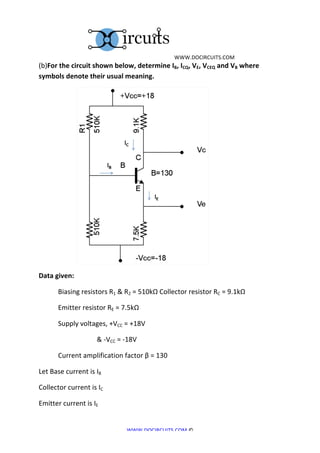
(b)For	
  the	
  circuit	
  shown	
  below,	
  determine	
  IB,	
  ICQ,	
  VE,	
  VCEQ	
  and	
  VB	
  where	
  
symbols	
  denote	
  their	
  usual	
  meaning.	


Data	
  given:	


                                           Biasing	
  resistors	
  R1	
  &	
  R2	
  =	
  510kΩ	
  Collector	
  resistor	
  RC	
  =	
  9.1kΩ	


                                           Emitter	
  resistor	
  RE	
  =	
  7.5kΩ	


                                           Supply	
  voltages,	
  +VCC	
  =	
  +18V	


     &	
  -­‐VCC	
  =	
  -­‐18V	


                                           Current	
  amplification	
  factor	
  β	
  =	
  130	
  

Let	
  Base	
  current	
  is	
  IB	


Collector	
  current	
  is	
  IC	


Emitter	
  current	
  is	
  IE	


                                                                                                                       WWW.DOCIRCUITS.COM	
  ©	
  
 	
  WWW.DOCIRCUITS.COM	
  
Collector	
  voltage	
  is	
  VC	


&	
  emitter	
  voltage	
  is	
  VE.	
  

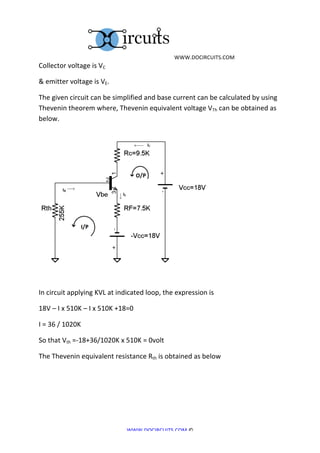
The	
  given	
  circuit	
  can	
  be	
  simplified	
  and	
  base	
  current	
  can	
  be	
  calculated	
  by	
  using	
  
Thevenin	
  theorem	
  where,	
  Thevenin	
  equivalent	
  voltage	
  VTh	
  can	
  be	
  obtained	
  as	
  
below.	


In	
  circuit	
  applying	
  KVL	
  at	
  indicated	
  loop,	
  the	
  expression	
  is	


18V	
  –	
  I	
  x	
  510K	
  –	
  I	
  x	
  510K	
  +18=0	
  

I	
  =	
  36	
  /	
  1020K	
  

So	
  that	
  Vth	
  =-­‐18+36/1020K	
  x	
  510K	
  =	
  0volt	
  

The	
  Thevenin	
  equivalent	
  resistance	
  Rth	
  is	
  obtained	
  as	
  below	


                                                        WWW.DOCIRCUITS.COM	
  ©	
  
 	
  WWW.DOCIRCUITS.COM	


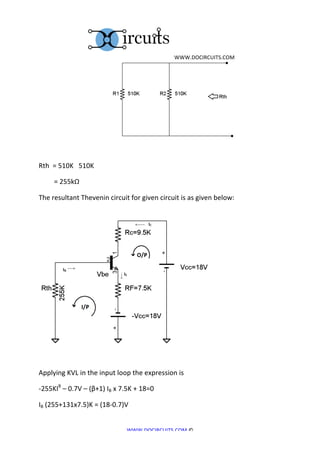
Rth	
  	
  =	
  510K	
  	
  	
  510K	


  =	
  255kΩ	
  

The	
  resultant	
  Thevenin	
  circuit	
  for	
  given	
  circuit	
  is	
  as	
  given	
  below:	


Applying	
  KVL	
  in	
  the	
  input	
  loop	
  the	
  expression	
  is	


-­‐255KIB	
  –	
  0.7V	
  –	
  (β+1)	
  IB	
  x	
  7.5K	
  +	
  18=0	
  

IB	
  (255+131x7.5)K	
  =	
  (18-­‐0.7)V	


                                                                                                                                                                           WWW.DOCIRCUITS.COM	
  ©	
  
 	
  WWW.DOCIRCUITS.COM	
  
IB	
  =	
  17.3V	
  /	
  1237.5K	
  =	
  13.97	
  µamp.	
  

Therefore	
  Collector	
  current	
  IC	
  =	
  βIB	
  =	
  130	
  x	
  0.1397	
  

=1.817	
  MA	
  

Therefore	
  Emitter	
  voltage	
  VE=	
  -­‐18+1.817	
  Max	
  7.5KΩ	
  

=-­‐4.37	
  Volt.	
  

Applying	
  KVL	
  to	
  the	
  output	
  loop;	
  the	
  expression	
  is	
  

18V	
  –	
  1.817mA	
  x	
  9.1	
  KΩ	
  -­‐	
  VCE	


-­‐1.817mA	
  x	
  7.5kΩ+18V=0	
  

VCE	
  =	
  36V	
  –	
  1.817	
  mAx16.6	
  kΩ=5.83	
  Volt.	
  

The	
  collector	
  voltage	
  VC	
  =	
  VCE	
  +	
  VE	


=5.83	
  volt	
  +	
  (-­‐4.374_	
  =	
  1.46	
  volt.	
  

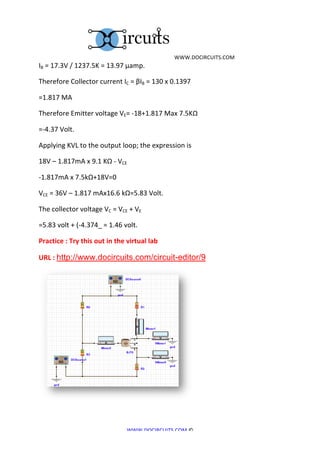
Practice	
  :	
  Try	
  this	
  out	
  in	
  the	
  virtual	
  lab	
  

URL	
  :	
  http://www.docircuits.com/circuit-editor/9


                                                         WWW.DOCIRCUITS.COM	
  ©	
  
 	
  WWW.DOCIRCUITS.COM	
  
Topic:	
  Operational	
  amp	
  

Keywords:	
  Operational	
  Amplifier,	
  Inverting	
  

Q3	
  (a)	
  	
  	
  Write	
  ideal	
  characteristics	
  of	
  an	
  opamp.	
  

Ans:	
  The	
  ideal	
  characteristics	
  of	
  an	
  op-­‐amp	
  is	
  given	
  below:	
  

Open	
  loop	
  again,	
  A	
  is	
  infinite.	
  

Input	
  resistance	
  R1	
  is	
  infinite	
  

Output	
  resistance	
  Ro	
  is	
  zero.	
  

Output	
  signal	
  ins	
  zero	
  when	
  input	
  signal	
  is	
  zero.	
  

CMRR	
  (Common	
  Mode	
  Rejection	
  Ratio)	
  zero.	
  

Bandwidth,	
  BW	
  is	
  infinite.	
  

Slew	
  Rate	
  (SR)	
  is	
  infinite.	


(b)	
  	
   Draw	
  circuits	
  for	
  both	
  inverting	
  and	
  non-­‐inverting	
  amplifiers	
  using	
  
opamp.	
  	
  Derive	
  an	
  expression	
  for	
  the	
  gain	
  of	
  an	
  inverting	
  amplifier.	
  

Ans.	
  	
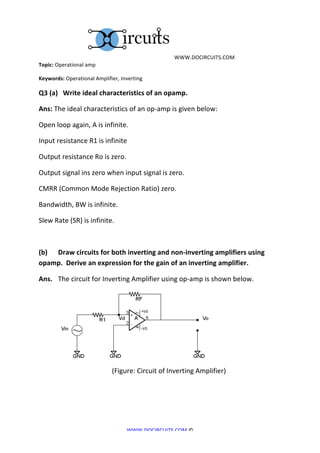
   The	
  circuit	
  for	
  Inverting	
  Amplifier	
  using	
  op-­‐amp	
  is	
  shown	
  below.	


  (Figure:	
  Circuit	
  of	
  Inverting	
  Amplifier)	


                                                                                                          WWW.DOCIRCUITS.COM	
  ©	
  
 	
  WWW.DOCIRCUITS.COM	


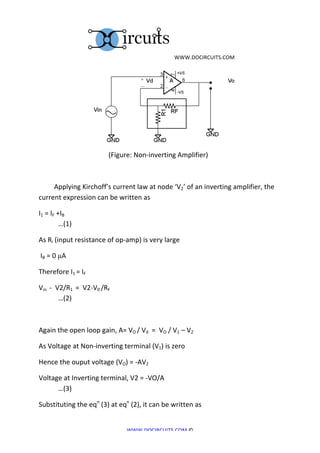
  (Figure:	
  Non-­‐inverting	
  Amplifier)	


  Applying	
  Kirchoff’s	
  current	
  law	
  at	
  node	
  ‘V2’	
  of	
  an	
  inverting	
  amplifier,	
  the	
  
current	
  expression	
  can	
  be	
  written	
  as	
  

I1	
  =	
  IF	
  +IB	


                …(1)	


As	
  Ri	
  (input	
  resistance	
  of	
  op-­‐amp)	
  is	
  very	
  large	


  IB	
  =	
  0	
  µA	
  

Therefore	
  I1	
  =	
  IF	


Vin	
  	
  -­‐	
  	
  V2/R1	
  	
  =	
  	
  V2-­‐V0	
  /RF	


                     …(2)	


Again	
  the	
  open	
  loop	
  gain,	
  A=	
  VO	
  /	
  Vd	
  	
  =	
  	
  VO	
  /	
  V1	
  –	
  V2	
  

As	
  Voltage	
  at	
  Non-­‐inverting	
  terminal	
  (V1)	
  is	
  zero	


Hence	
  the	
  ouput	
  voltage	
  (VO)	
  =	
  -­‐AV2	


Voltage	
  at	
  Inverting	
  terminal,	
  V2	
  =	
  -­‐VO/A	


    …(3)	
  

Substituting	
  the	
  eqn	
  (3)	
  at	
  eqn	
  (2),	
  it	
  can	
  be	
  written	
  as	


                                                                                                                                             WWW.DOCIRCUITS.COM	
  ©	
  
 	
  WWW.DOCIRCUITS.COM	


Vin	
  +	
  VO	
  /	
  A	
  /	
  R1	
  =	
  	
  	
  -­‐VO	
  –	
  VO	
  /A	
  /	
  RF	


So	
  the	
  closed	
  loop	
  gain	
  of	
  the	
  ckt.	
  i.e.	
  

AF	
  =	
  VO	
  /	
  Vin	
  	
  =	
  	
  	
  -­‐A	
  RF	
  /	
  R1	
  +	
  RF	
  +	
  ARI	


  (Exact)	


          …(4)	
  

As	
  A	
  =	
  106	
  (For	
  an	
  ideal	
  op-­‐amp)	
  

Therefore	
  AR1	
  >>	
  R1	
  +	
  RF	


Therefore	
  AF	
  =	
  -­‐RF	
  /	
  R1	


  (Ideal)	
  

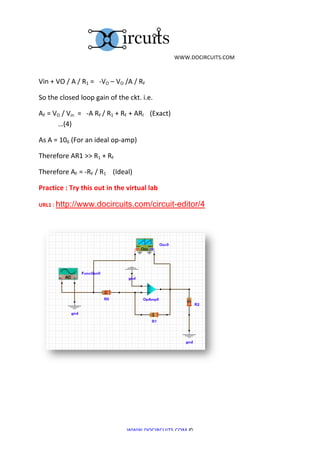
Practice	
  :	
  Try	
  this	
  out	
  in	
  the	
  virtual	
  lab	
  

URL1	
  :	
  http://www.docircuits.com/circuit-editor/4


                                                                              WWW.DOCIRCUITS.COM	
  ©	
  
 	
  WWW.DOCIRCUITS.COM	
  
URL2	
  :	
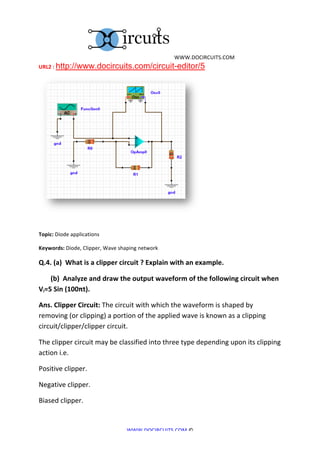
  http://www.docircuits.com/circuit-editor/5


Topic:	
  Diode	
  applications	
  

Keywords:	
  Diode,	
  Clipper,	
  Wave	
  shaping	
  network	
  

Q.4.	
  (a)	
  	
  What	
  is	
  a	
  clipper	
  circuit	
  ?	
  Explain	
  with	
  an	
  example.	


  (b)	
  	
  Analyze	
  and	
  draw	
  the	
  output	
  waveform	
  of	
  the	
  following	
  circuit	
  when	
  
Vi=5	
  Sin	
  (100πt).	


Ans.	
  Clipper	
  Circuit:	
  The	
  circuit	
  with	
  which	
  the	
  waveform	
  is	
  shaped	
  by	
  
removing	
  (or	
  clipping)	
  a	
  portion	
  of	
  the	
  applied	
  wave	
  is	
  known	
  as	
  a	
  clipping	
  
circuit/clipper/clipper	
  circuit.	
  

The	
  clipper	
  circuit	
  may	
  be	
  classified	
  into	
  three	
  type	
  depending	
  upon	
  its	
  clipping	
  
action	
  i.e.	
  

Positive	
  clipper.	
  

Negative	
  clipper.	
  

Biased	
  clipper.	


                                                  WWW.DOCIRCUITS.COM	
  ©	
  
 	
  WWW.DOCIRCUITS.COM	
  
The	
  Half	
  wave	
  rectifier	
  is	
  an	
  example	
  of	
  a	
  clipper	
  which	
  eliminates	
  one	
  of	
  the	
  
alterations	
  of	
  an	
  ac	
  signal.	
  

Explanation:	


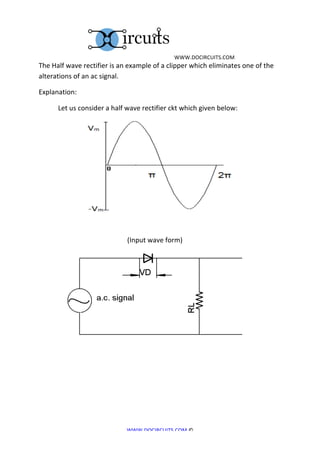
                                           Let	
  us	
  consider	
  a	
  half	
  wave	
  rectifier	
  ckt	
  which	
  given	
  below:	


  (Input	
  wave	
  form)	


                                                                                                                                              WWW.DOCIRCUITS.COM	
  ©	
  
 	
  WWW.DOCIRCUITS.COM	


  (Output	
  wave	
  form)	


  (Figure	
  –	
  b)	
  

Consider	
  diode	
  is	
  an	
  ideal	
  diode	
  [i.e	
  it	
  becomes	
  short	
  circuit	
  when	
  it	
  will	
  
forward	
  bias	
  i.e	
  VD	
  >	
  0	
  volt	
  and	
  open	
  circuit	
  when	
  it	
  will	
  reverse	
  bias	
  VD<0V,	
  
where	
  VD	
  is	
  the	
  voltage	
  across	
  diode]	
  

So	
  during	
  the	
  +Ve	
  half	
  cycle	
  of	
  an	
  i/p	
  ac	
  signal	
  (ie	
  from	
  0	
  to	
  π)	
  the	
  diode	
  will	
  be	
  
forward	
  bias	
  &	
  make	
  it	
  short	
  circuited.	
  	
  So	
  that	
  there	
  will	
  be	
  a	
  current	
  which	
  
flow	
  through	
  ‘RL’	
  

So	
  that	
  we	
  can	
  obtain	
  an	
  output	
  voltage	
  which	
  shown	
  in	
  figure	
  (b).	
  

But	
  during	
  negative	
  half	
  cycle	
  of	
  an	
  signal	
  (ie	
  from	
  ‘π’	
  to	
  2π)	
  the	
  diode	
  
becomes	
  reverse	
  bias	
  so	
  it	
  makes	
  an	
  open	
  circuited.	
  	
  As	
  a	
  result	
  the	
  current	
  
flow	
  through	
  diode	
  is	
  zero.	
  	
  Hence	
  the	
  output	
  voltage	
  is	
  zero	
  during	
  this	
  
period.	
  

N.B.:	
  From	
  the	
  input	
  &	
  Output	
  waveform	
  it	
  is	
  clear	
  that	
  by	
  help	
  of	
  the	
  above	
  
circuit	
  we	
  can	
  obtain	
  the	
  output	
  during	
  +ve	
  cycle	
  only	
  not	
  in	
  negative	
  cycle.	
  	
  
Hence	
  this	
  circuit	
  is	
  called	
  as	
  “Series	
  negative	
  clipper”	
  circuit.	


                                                                                                                                                                                   WWW.DOCIRCUITS.COM	
  ©	
  
 	
  WWW.DOCIRCUITS.COM	
  
Practice	
  :	
  Try	
  this	
  out	
  in	
  the	
  virtual	
  lab	
  

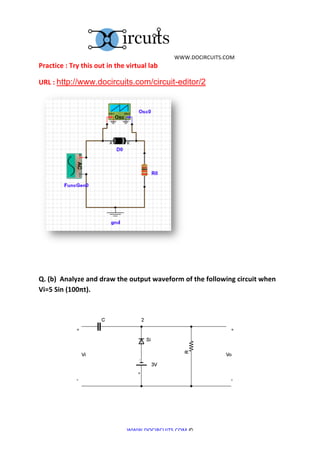
URL	
  :	
  http://www.docircuits.com/circuit-editor/2


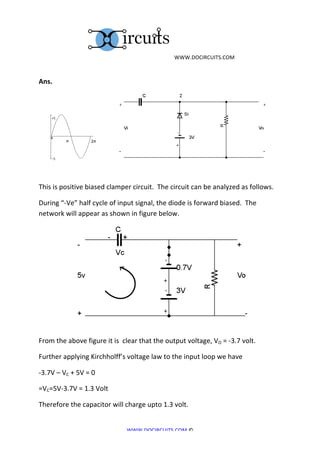
Q.	
  (b)	
  	
  Analyze	
  and	
  draw	
  the	
  output	
  waveform	
  of	
  the	
  following	
  circuit	
  when	
  
Vi=5	
  Sin	
  (100πt).	


                                                                                       WWW.DOCIRCUITS.COM	
  ©	
  
 	
  WWW.DOCIRCUITS.COM	


Ans.	


This	
  is	
  positive	
  biased	
  clamper	
  circuit.	
  	
  The	
  circuit	
  can	
  be	
  analyzed	
  as	
  follows.	
  

During	
  “-­‐Ve”	
  half	
  cycle	
  of	
  input	
  signal,	
  the	
  diode	
  is	
  forward	
  biased.	
  	
  The	
  
network	
  will	
  appear	
  as	
  shown	
  in	
  figure	
  below.	


From	
  the	
  above	
  figure	
  it	
  is	
  	
  clear	
  that	
  the	
  output	
  voltage,	
  VO	
  =	
  -­‐3.7	
  volt.	
  

Further	
  applying	
  Kirchholff’s	
  voltage	
  law	
  to	
  the	
  input	
  loop	
  we	
  have	
  

-­‐3.7V	
  –	
  VC	
  +	
  5V	
  =	
  0	
  

=VC=5V-­‐3.7V	
  =	
  1.3	
  Volt	
  

Therefore	
  the	
  capacitor	
  will	
  charge	
  upto	
  1.3	
  volt.	


                                                                                                                                  WWW.DOCIRCUITS.COM	
  ©	
  
 	
  WWW.DOCIRCUITS.COM	
  
During	
  the	
  positive	
  half	
  cycle	
  of	
  the	
  input	
  signal,	
  the	
  diode	
  is	
  reverse	
  biased	
  
and	
  will	
  behave	
  as	
  open	
  circuits	
  as	
  shown	
  in	
  figure	
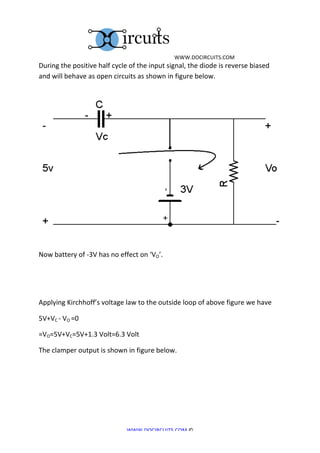
  below.	


Now	
  battery	
  of	
  -­‐3V	
  has	
  no	
  effect	
  on	
  ‘VO’.	


Applying	
  Kirchhoff’s	
  voltage	
  law	
  to	
  the	
  outside	
  loop	
  of	
  above	
  figure	
  we	
  have	
  

5V+VC	
  -­‐	
  VO	
  =0	
  

=VO=5V+VC=5V+1.3	
  Volt=6.3	
  Volt	
  

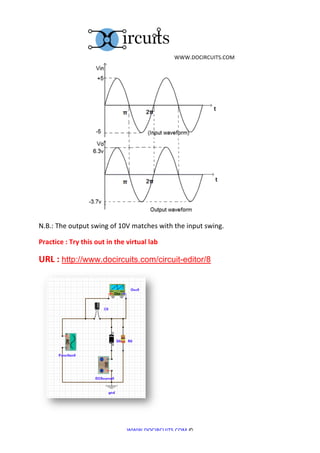
The	
  clamper	
  output	
  is	
  shown	
  in	
  figure	
  below.	


                                                 WWW.DOCIRCUITS.COM	
  ©	
  
 	
  WWW.DOCIRCUITS.COM	


N.B.:	
  The	
  output	
  swing	
  of	
  10V	
  matches	
  with	
  the	
  input	
  swing.	
  

Practice	
  :	
  Try	
  this	
  out	
  in	
  the	
  virtual	
  lab	
  

URL	
  :	
  http://www.docircuits.com/circuit-editor/8


                                                                                                           WWW.DOCIRCUITS.COM	
  ©	
  
 	
  WWW.DOCIRCUITS.COM	


Topic:	
  Opamp	
  

Keywords:	
  Op-­‐amp,	
  summing	
  amplifier	
  

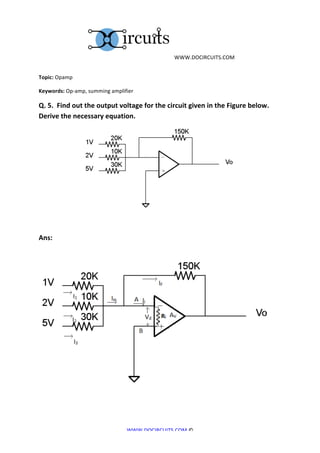
Q.	
  5.	
  	
  Find	
  out	
  the	
  output	
  voltage	
  for	
  the	
  circuit	
  given	
  in	
  the	
  Figure	
  below.	
  	
  
Derive	
  the	
  necessary	
  equation.	


Ans:	


                                                                                                           WWW.DOCIRCUITS.COM	
  ©	
  
 	
  WWW.DOCIRCUITS.COM	
  
Consider	
  	
  the	
  different	
  voltage	
  &	
  current	
  with	
  different	
  nodes	
  &	
  different	
  
paths	
  as	
  shown	
  in	
  figure	
  above.	
  

The	
  above	
  circuit	
  can	
  be	
  simplified	
  by	
  using	
  virtual	
  ground	
  concept	
  for	
  getting	
  
its	
  output	
  voltage	
  VO.	
  

As	
  per	
  virtual	
  ground	
  concept	
  

Let	
  (i)	
  AV	
  =∞=Vd=0	
  Volt	
  

=VA	
  –	
  VB	
  =	
  O	
  Volt	
  

But	
  from	
  above	
  circuit	
  as	
  VB=0	
  volt	
  

Hence	
  VA	
  =	
  0	
  Volt.	
  

Again	
  Ri	
  =∞Ω.	
  So	
  Ii	
  =	
  0mAmP	
  

Applying	
  KCI	
  at	
  node	
  A	
  we	
  can	
  obtain	


Iin	
  =	
  IF	


=I1+I2+I3=IF	


=1V	
  –	
  VA	
  /	
  20K	
  	
  +	
  2V-­‐VA/10K	
  +	
  5V	
  –	
  VA/30K	
  =	
  VA-­‐V0/150K	
  

=1V/20K	
  +	
  2V/10K+5V/30K=-­‐VO/150K[as	
  VA=0V]	
  

=V0=-­‐150K	
  [1V/20K	
  +	
  2V	
  /	
  10K	
  +	
  5V/30K]	
  

=-­‐	
  150K/20K	
  x	
  1	
  -­‐150K/10K	
  x	
  2V	
  -­‐150K/30K	
  x	
  5V	
  

=-­‐7.5V	
  –	
  30V	
  –	
  25V=-­‐62.5	
  Volt	


                                                   WWW.DOCIRCUITS.COM	
  ©	
  
 	
  WWW.DOCIRCUITS.COM	
  
Practice	
  :	
  Try	
  this	
  out	
  in	
  the	
  virtual	
  lab	
  

URL	
  :	
  http://www.docircuits.com/circuit-editor/7


Topic:	
  Transistor	
  Biasing	
  

Keywords:	
  Transistor,	
  BJT,	
  Bias	


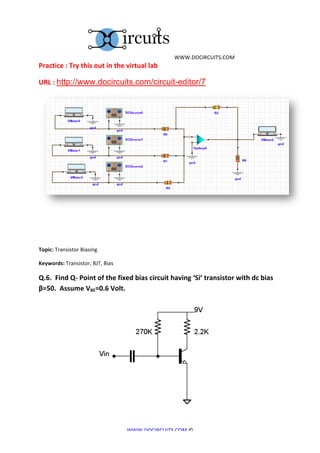
Q.6.	
  	
  Find	
  Q-­‐	
  Point	
  of	
  the	
  fixed	
  bias	
  circuit	
  having	
  ‘Si’	
  transistor	
  with	
  dc	
  bias	
  
β=50.	
  	
  Assume	
  VBE=0.6	
  Volt.	


                                                                                                                                           WWW.DOCIRCUITS.COM	
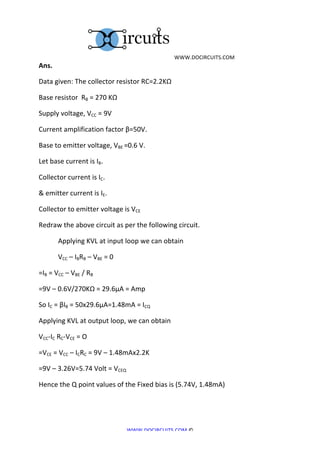
  ©	
  
 	
  WWW.DOCIRCUITS.COM	
  
Ans.	
  

Data	
  given:	
  The	
  collector	
  resistor	
  RC=2.2KΩ	
  

Base	
  resistor	
  	
  RB	
  =	
  270	
  KΩ	
  

Supply	
  voltage,	
  VCC	
  =	
  9V	
  

Current	
  amplification	
  factor	
  β=50V.	
  

Base	
  to	
  emitter	
  voltage,	
  VBE	
  =0.6	
  V.	
  

Let	
  base	
  current	
  is	
  IB.	


Collector	
  current	
  is	
  IC.	
  

&	
  emitter	
  current	
  is	
  IE.	
  

Collector	
  to	
  emitter	
  voltage	
  is	
  VCE	
  

Redraw	
  the	
  above	
  circuit	
  as	
  per	
  the	
  following	
  circuit.	


             Applying	
  KVL	
  at	
  input	
  loop	
  we	
  can	
  obtain	


             VCC	
  –	
  IBRB	
  –	
  VBE	
  =	
  0	
  

=IB	
  =	
  VCC	
  –	
  VBE	
  /	
  RB	


=9V	
  –	
  0.6V/270KΩ	
  =	
  29.6µA	
  =	
  Amp	
  

So	
  IC	
  =	
  βIB	
  =	
  50x29.6µA=1.48mA	
  =	
  ICQ	


Applying	
  KVL	
  at	
  output	
  loop,	
  we	
  can	
  obtain	


VCC-­‐IC	
  RC-­‐VCE	
  =	
  O	
  

=VCE	
  =	
  VCC	
  –	
  ICRC	
  =	
  9V	
  –	
  1.48mAx2.2K	
  

=9V	
  –	
  3.26V=5.74	
  Volt	
  =	
  VCEQ	


Hence	
  the	
  Q	
  point	
  values	
  of	
  the	
  Fixed	
  bias	
  is	
  (5.74V,	
  1.48mA)	


                                                            WWW.DOCIRCUITS.COM	
  ©	
  
 	
  WWW.DOCIRCUITS.COM	


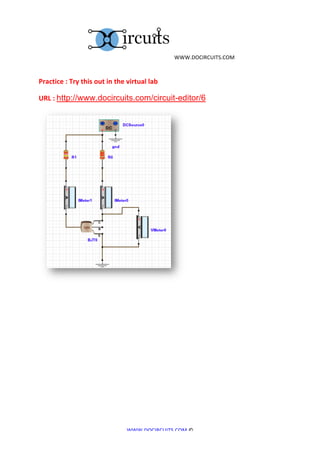
Practice	
  :	
  Try	
  this	
  out	
  in	
  the	
  virtual	
  lab	
  

URL	
  :	
  http://www.docircuits.com/circuit-editor/6


                                                   WWW.DOCIRCUITS.COM	
  ©	
  

Electronics Circuits : EBOOK

  • 1.
       WWW.DOCIRCUITS.COM   Basic  Electronics  with  DoCircuits     Topic:  Semiconductor  diode-­‐  Crystal  diode   Keywords:  Diode,  Rectifier,  Center  tap   Q1.     A  crystal  diode  having  an  internal  resistance  rt  =  10  Ω  is  used  for  center   tapped  full  wave  rectification.    If  the  applied  voltage  is  V  =  50  sin  (πt)  and  the   load  resistance  is  RL  =  1  kΩ,  determine  the  followings:   Draw  the  input  and  output  voltage  and  current  waveforms.      The  efficiency  of  the  circuit.   The  Ripple  factor.         Ans:                                                                                                                      (Figure:  Circuit  arrangement  of  centre-­‐tap  Fullwave  rectifier)     Data  given:  In  a  cerrte-­‐tap  full  wave  rectifier  the  internal  resistance  of   diodes  D1  &  D2  i.e.  rf  =  10Ω     The  applied  input  voltage,  V=50  sin  (πt)   As  the  input  applied  voltage  is  V  =  50  sin  πt  which  is  a  sinusoidal  signal  can  be   represented  as  below.   WWW.DOCIRCUITS.COM  ©  
  • 2.
       WWW.DOCIRCUITS.COM                                                                   Operation:  During  +ve    half  cycle  (i.e.  o-­‐π)  the  diode  D1  will  conduct  due  to   forward  bias  and  diode  D2  will  be  OFF  due  to  reverse  bias  so  that  the    current   will  flow  at  the  upper  half  portion  of  the  circuit.    As  a  result  a  voltage  will   develop  across  load  RL.   Similarly  during  –  ve  half  cycle  (i.e.  π-­‐2π)  the  diode  D2  will  conduct  due  to   forward  bias  and  diode  D1  will  conduct  due  to  forward  bias  and  diode  D1  will  be   OFFdue  to  reverse  bias  so  that  the  current  will  flow  at  the  lower  half  portion  of   the  circuit.    As  a  result  a  voltage  will  develop  across  load  RL.   It  is  observed  that  the  current  which  will  flow  through  load  RL  is  unidirectional   during  both  half  cycle  hence  an  pulsating  during  both  half  cycle  hence  an   pulsating  dc  voltage  obtained  across  load  RL.   The  input  and  output  waveform  of  centre  trapped  full  wave  rectifier  is  shown   in  figure  below.                                                 WWW.DOCIRCUITS.COM  ©  
  • 3.
       WWW.DOCIRCUITS.COM                                                    (Figure  (b)  Output  waveform  of  centre  tapped  F.W.R.)   The  efficiency  of  the  circuit.   Ans.    Maxm  load  current,   Imax  =  Vmax  /  rf  +  RL    =    50V/(10+1000)Ω   =50V/1010Ω    =    49.5  m  amp   The  average  current,  Idc    =    21max  /  Ω     =31.5  m  amp   The  r.m.s.  current,  Irms  =  Imax  /  Square  root  2  =  35  m  amp     Rectification  efficiency  (ŋ)  –  It  is  defined  as  the  ratio  of  dc  output  power  to  the   input  ac  power  i.e.   %ŋ  =  Podc  /  Piac    x    100%  =  12  d  RL  /  I2rms  (rf+RL)   Where  Podc  =  output  dc  power   Piac  =  input  ac  power   =  (31.5  m  amp)2    x  1kΩ  /  (35m  amp)2  x  1010Ω   0.99225  /  1.23725  x  100%  =  80.19%     The  Ripple  factor.   Ans.  Ripple  factor  (r):  It  is  defined  as  the  ratio  of  r.m.s.  value  of  ac  component   to  the  dc  component  in  the  rectifier  output           WWW.DOCIRCUITS.COM  ©  
  • 4.
       WWW.DOCIRCUITS.COM   Practice  :  Try  this  out  in  the  virtual  lab   URL  :  http://www.docircuits.com/circuit-­‐editor/3       Topic:  Transistor-­‐Biasing   Keywords:  Transistor,  BJT,  Bias   Q.2.  (a)  Explain  the  difference  between  Voltage  divider  bias  and  Self  bias   circuits.   Ans.   The  difference  between  voltage  divider  bias  and  self  bias  circuit  given   below.   Self  bias:  The  self  bias  circuit  doesn’t  provide  good  stabilization  for  high  base   voltage.    For  improving  the  performances  of  self  bias  either  increase  the  base   resistor  RB  or  decrease  the  base  bias  supply  voltage  or  both.   Voltage  divider  bias:  The  voltage  divider  bias  provides  a  better  stabilization   than  others,  for  base  voltage  (VB)  where  the  level  of  VB  depends  on  resistor  R2   and  R2  can  be  change  by  using  a  variable  resistor  so  that  it  divides  the  supply   voltage  Vcc  among  resistors  R1  and  R2.   WWW.DOCIRCUITS.COM  ©  
  • 5.
       WWW.DOCIRCUITS.COM   (b)For  the  circuit  shown  below,  determine  IB,  ICQ,  VE,  VCEQ  and  VB  where   symbols  denote  their  usual  meaning.                                                 Data  given:     Biasing  resistors  R1  &  R2  =  510kΩ  Collector  resistor  RC  =  9.1kΩ     Emitter  resistor  RE  =  7.5kΩ     Supply  voltages,  +VCC  =  +18V         &  -­‐VCC  =  -­‐18V     Current  amplification  factor  β  =  130   Let  Base  current  is  IB     Collector  current  is  IC     Emitter  current  is  IE     WWW.DOCIRCUITS.COM  ©  
  • 6.
       WWW.DOCIRCUITS.COM   Collector  voltage  is  VC     &  emitter  voltage  is  VE.   The  given  circuit  can  be  simplified  and  base  current  can  be  calculated  by  using   Thevenin  theorem  where,  Thevenin  equivalent  voltage  VTh  can  be  obtained  as   below.       In  circuit  applying  KVL  at  indicated  loop,  the  expression  is     18V  –  I  x  510K  –  I  x  510K  +18=0   I  =  36  /  1020K   So  that  Vth  =-­‐18+36/1020K  x  510K  =  0volt   The  Thevenin  equivalent  resistance  Rth  is  obtained  as  below   WWW.DOCIRCUITS.COM  ©  
  • 7.
       WWW.DOCIRCUITS.COM                                                                                           Rth    =  510K      510K                    =  255kΩ   The  resultant  Thevenin  circuit  for  given  circuit  is  as  given  below:       Applying  KVL  in  the  input  loop  the  expression  is     -­‐255KIB  –  0.7V  –  (β+1)  IB  x  7.5K  +  18=0   IB  (255+131x7.5)K  =  (18-­‐0.7)V   WWW.DOCIRCUITS.COM  ©  
  • 8.
       WWW.DOCIRCUITS.COM   IB  =  17.3V  /  1237.5K  =  13.97  µamp.   Therefore  Collector  current  IC  =  βIB  =  130  x  0.1397   =1.817  MA   Therefore  Emitter  voltage  VE=  -­‐18+1.817  Max  7.5KΩ   =-­‐4.37  Volt.   Applying  KVL  to  the  output  loop;  the  expression  is   18V  –  1.817mA  x  9.1  KΩ  -­‐  VCE     -­‐1.817mA  x  7.5kΩ+18V=0   VCE  =  36V  –  1.817  mAx16.6  kΩ=5.83  Volt.   The  collector  voltage  VC  =  VCE  +  VE     =5.83  volt  +  (-­‐4.374_  =  1.46  volt.   Practice  :  Try  this  out  in  the  virtual  lab   URL  :  http://www.docircuits.com/circuit-editor/9   WWW.DOCIRCUITS.COM  ©  
  • 9.
       WWW.DOCIRCUITS.COM   Topic:  Operational  amp   Keywords:  Operational  Amplifier,  Inverting   Q3  (a)      Write  ideal  characteristics  of  an  opamp.   Ans:  The  ideal  characteristics  of  an  op-­‐amp  is  given  below:   Open  loop  again,  A  is  infinite.   Input  resistance  R1  is  infinite   Output  resistance  Ro  is  zero.   Output  signal  ins  zero  when  input  signal  is  zero.   CMRR  (Common  Mode  Rejection  Ratio)  zero.   Bandwidth,  BW  is  infinite.   Slew  Rate  (SR)  is  infinite.     (b)     Draw  circuits  for  both  inverting  and  non-­‐inverting  amplifiers  using   opamp.    Derive  an  expression  for  the  gain  of  an  inverting  amplifier.   Ans.     The  circuit  for  Inverting  Amplifier  using  op-­‐amp  is  shown  below.                                                                                                                  (Figure:  Circuit  of  Inverting  Amplifier)   WWW.DOCIRCUITS.COM  ©  
  • 10.
       WWW.DOCIRCUITS.COM                                                                                                                                                                            (Figure:  Non-­‐inverting  Amplifier)                      Applying  Kirchoff’s  current  law  at  node  ‘V2’  of  an  inverting  amplifier,  the   current  expression  can  be  written  as   I1  =  IF  +IB                         …(1)                       As  Ri  (input  resistance  of  op-­‐amp)  is  very  large    IB  =  0  µA   Therefore  I1  =  IF                           Vin    -­‐    V2/R1    =    V2-­‐V0  /RF                       …(2)     Again  the  open  loop  gain,  A=  VO  /  Vd    =    VO  /  V1  –  V2   As  Voltage  at  Non-­‐inverting  terminal  (V1)  is  zero     Hence  the  ouput  voltage  (VO)  =  -­‐AV2     Voltage  at  Inverting  terminal,  V2  =  -­‐VO/A             …(3)   Substituting  the  eqn  (3)  at  eqn  (2),  it  can  be  written  as     WWW.DOCIRCUITS.COM  ©  
  • 11.
       WWW.DOCIRCUITS.COM     Vin  +  VO  /  A  /  R1  =      -­‐VO  –  VO  /A  /  RF     So  the  closed  loop  gain  of  the  ckt.  i.e.   AF  =  VO  /  Vin    =      -­‐A  RF  /  R1  +  RF  +  ARI        (Exact)             …(4)   As  A  =  106  (For  an  ideal  op-­‐amp)   Therefore  AR1  >>  R1  +  RF     Therefore  AF  =  -­‐RF  /  R1        (Ideal)   Practice  :  Try  this  out  in  the  virtual  lab   URL1  :  http://www.docircuits.com/circuit-editor/4       WWW.DOCIRCUITS.COM  ©  
  • 12.
       WWW.DOCIRCUITS.COM   URL2  :  http://www.docircuits.com/circuit-editor/5 Topic:  Diode  applications   Keywords:  Diode,  Clipper,  Wave  shaping  network   Q.4.  (a)    What  is  a  clipper  circuit  ?  Explain  with  an  example.                    (b)    Analyze  and  draw  the  output  waveform  of  the  following  circuit  when   Vi=5  Sin  (100πt).       Ans.  Clipper  Circuit:  The  circuit  with  which  the  waveform  is  shaped  by   removing  (or  clipping)  a  portion  of  the  applied  wave  is  known  as  a  clipping   circuit/clipper/clipper  circuit.   The  clipper  circuit  may  be  classified  into  three  type  depending  upon  its  clipping   action  i.e.   Positive  clipper.   Negative  clipper.   Biased  clipper.   WWW.DOCIRCUITS.COM  ©  
  • 13.
       WWW.DOCIRCUITS.COM   The  Half  wave  rectifier  is  an  example  of  a  clipper  which  eliminates  one  of  the   alterations  of  an  ac  signal.   Explanation:     Let  us  consider  a  half  wave  rectifier  ckt  which  given  below:                                                                                                                                                                  (Input  wave  form)                                     WWW.DOCIRCUITS.COM  ©  
  • 14.
       WWW.DOCIRCUITS.COM                                                                                                                                                                                                              (Output  wave  form)                                                                                                          (Figure  –  b)   Consider  diode  is  an  ideal  diode  [i.e  it  becomes  short  circuit  when  it  will   forward  bias  i.e  VD  >  0  volt  and  open  circuit  when  it  will  reverse  bias  VD<0V,   where  VD  is  the  voltage  across  diode]   So  during  the  +Ve  half  cycle  of  an  i/p  ac  signal  (ie  from  0  to  π)  the  diode  will  be   forward  bias  &  make  it  short  circuited.    So  that  there  will  be  a  current  which   flow  through  ‘RL’   So  that  we  can  obtain  an  output  voltage  which  shown  in  figure  (b).   But  during  negative  half  cycle  of  an  signal  (ie  from  ‘π’  to  2π)  the  diode   becomes  reverse  bias  so  it  makes  an  open  circuited.    As  a  result  the  current   flow  through  diode  is  zero.    Hence  the  output  voltage  is  zero  during  this   period.   N.B.:  From  the  input  &  Output  waveform  it  is  clear  that  by  help  of  the  above   circuit  we  can  obtain  the  output  during  +ve  cycle  only  not  in  negative  cycle.     Hence  this  circuit  is  called  as  “Series  negative  clipper”  circuit.         WWW.DOCIRCUITS.COM  ©  
  • 15.
       WWW.DOCIRCUITS.COM   Practice  :  Try  this  out  in  the  virtual  lab   URL  :  http://www.docircuits.com/circuit-editor/2 Q.  (b)    Analyze  and  draw  the  output  waveform  of  the  following  circuit  when   Vi=5  Sin  (100πt).                                                   WWW.DOCIRCUITS.COM  ©  
  • 16.
       WWW.DOCIRCUITS.COM     Ans.                                                                                             This  is  positive  biased  clamper  circuit.    The  circuit  can  be  analyzed  as  follows.   During  “-­‐Ve”  half  cycle  of  input  signal,  the  diode  is  forward  biased.    The   network  will  appear  as  shown  in  figure  below.                                               From  the  above  figure  it  is    clear  that  the  output  voltage,  VO  =  -­‐3.7  volt.   Further  applying  Kirchholff’s  voltage  law  to  the  input  loop  we  have   -­‐3.7V  –  VC  +  5V  =  0   =VC=5V-­‐3.7V  =  1.3  Volt   Therefore  the  capacitor  will  charge  upto  1.3  volt.   WWW.DOCIRCUITS.COM  ©  
  • 17.
       WWW.DOCIRCUITS.COM   During  the  positive  half  cycle  of  the  input  signal,  the  diode  is  reverse  biased   and  will  behave  as  open  circuits  as  shown  in  figure  below.           Now  battery  of  -­‐3V  has  no  effect  on  ‘VO’.       Applying  Kirchhoff’s  voltage  law  to  the  outside  loop  of  above  figure  we  have   5V+VC  -­‐  VO  =0   =VO=5V+VC=5V+1.3  Volt=6.3  Volt   The  clamper  output  is  shown  in  figure  below.   WWW.DOCIRCUITS.COM  ©  
  • 18.
       WWW.DOCIRCUITS.COM                                                                                           N.B.:  The  output  swing  of  10V  matches  with  the  input  swing.   Practice  :  Try  this  out  in  the  virtual  lab   URL  :  http://www.docircuits.com/circuit-editor/8 WWW.DOCIRCUITS.COM  ©  
  • 19.
       WWW.DOCIRCUITS.COM   Topic:  Opamp   Keywords:  Op-­‐amp,  summing  amplifier   Q.  5.    Find  out  the  output  voltage  for  the  circuit  given  in  the  Figure  below.     Derive  the  necessary  equation.                                                           Ans:                     WWW.DOCIRCUITS.COM  ©  
  • 20.
       WWW.DOCIRCUITS.COM   Consider    the  different  voltage  &  current  with  different  nodes  &  different   paths  as  shown  in  figure  above.   The  above  circuit  can  be  simplified  by  using  virtual  ground  concept  for  getting   its  output  voltage  VO.   As  per  virtual  ground  concept   Let  (i)  AV  =∞=Vd=0  Volt   =VA  –  VB  =  O  Volt   But  from  above  circuit  as  VB=0  volt   Hence  VA  =  0  Volt.   Again  Ri  =∞Ω.  So  Ii  =  0mAmP   Applying  KCI  at  node  A  we  can  obtain     Iin  =  IF     =I1+I2+I3=IF     =1V  –  VA  /  20K    +  2V-­‐VA/10K  +  5V  –  VA/30K  =  VA-­‐V0/150K   =1V/20K  +  2V/10K+5V/30K=-­‐VO/150K[as  VA=0V]   =V0=-­‐150K  [1V/20K  +  2V  /  10K  +  5V/30K]   =-­‐  150K/20K  x  1  -­‐150K/10K  x  2V  -­‐150K/30K  x  5V   =-­‐7.5V  –  30V  –  25V=-­‐62.5  Volt             WWW.DOCIRCUITS.COM  ©  
  • 21.
       WWW.DOCIRCUITS.COM   Practice  :  Try  this  out  in  the  virtual  lab   URL  :  http://www.docircuits.com/circuit-editor/7     Topic:  Transistor  Biasing   Keywords:  Transistor,  BJT,  Bias     Q.6.    Find  Q-­‐  Point  of  the  fixed  bias  circuit  having  ‘Si’  transistor  with  dc  bias   β=50.    Assume  VBE=0.6  Volt.                                                                         WWW.DOCIRCUITS.COM  ©  
  • 22.
       WWW.DOCIRCUITS.COM   Ans.   Data  given:  The  collector  resistor  RC=2.2KΩ   Base  resistor    RB  =  270  KΩ   Supply  voltage,  VCC  =  9V   Current  amplification  factor  β=50V.   Base  to  emitter  voltage,  VBE  =0.6  V.   Let  base  current  is  IB.     Collector  current  is  IC.   &  emitter  current  is  IE.   Collector  to  emitter  voltage  is  VCE   Redraw  the  above  circuit  as  per  the  following  circuit.     Applying  KVL  at  input  loop  we  can  obtain       VCC  –  IBRB  –  VBE  =  0   =IB  =  VCC  –  VBE  /  RB     =9V  –  0.6V/270KΩ  =  29.6µA  =  Amp   So  IC  =  βIB  =  50x29.6µA=1.48mA  =  ICQ     Applying  KVL  at  output  loop,  we  can  obtain     VCC-­‐IC  RC-­‐VCE  =  O   =VCE  =  VCC  –  ICRC  =  9V  –  1.48mAx2.2K   =9V  –  3.26V=5.74  Volt  =  VCEQ     Hence  the  Q  point  values  of  the  Fixed  bias  is  (5.74V,  1.48mA)     WWW.DOCIRCUITS.COM  ©  
  • 23.
       WWW.DOCIRCUITS.COM     Practice  :  Try  this  out  in  the  virtual  lab   URL  :  http://www.docircuits.com/circuit-editor/6                           WWW.DOCIRCUITS.COM  ©