 Wood is still a hugely popular. It is aesthetically pleasing, provides
us with a contraction method which is renewable and sustainable.
Tree StructureIntroduction
Timber
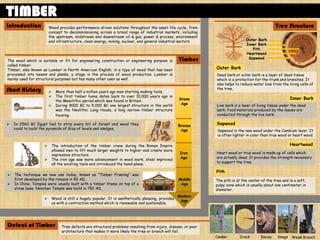
Short History  More than half a million years ago man starting making tools.
 The first timber home dates back to over 10,000 years ago in
the Mesolithic period which was found in Britain.
 During 9000 BC to 5,000 BC one largest structure in the world
was the Neolithic Long House, a long narrow timber structure
housing.
 In 2560 BC Egypt had to strip every bit of forest and wood they
could to build the pyramids of Giza of levels and sledges,
 The introduction of the timber crane during the Roman Empire
allowed men to lift much larger weights to higher and create more
impressive structure.
 The iron age saw more advancement in wood work, steel improved
all the existing tools and introduced the hand-plane.
 The technique we now use today, known as “Timber Framing” was
first developed by the romans in 50 AD.
 In China, Temples were usually built with a timber frame on top of a
stone base. Nanchan Temple was build in 782 AD.
Wood provides performance-driven solutions throughout the asset life cycle, from
concept to decommissioning across a broad range of industrial markets, including
the upstream, midstream and downstream oil & gas, power & process, environment
and infrastructure, clean energy, mining, nuclear, and general industrial sectors.
The wood which is suitable or fit for engineering construction or engineering purpose is
called timber.
Timber, also known as Lumber in North American English, is a type of wood that has been
processed into beams and planks, a stage in the process of wood production. Lumber is
mainly used for structural purposes but has many other uses as well.
TIMBER
Stone
Age
Bronze
Age
Iron
Age
Middle
Age
Modern
Age
Outer Bark
Inner Bark
Pith
Heartwood
Sapwood
Dead bark or outer bark is a layer of dead tissue
which is a protection for the trunk and branches. It
also helps to reduce water loss from the living cells of
the tree.
Outer Bark
Live bark is a layer of living tissue under the dead
bark. Food materials produced by the leaves are
conducted through the live bark.
Inner Bark
Sapwood is the new wood under the Cambium layer. It
is often lighter in color than true wood or heart wood.
Heartwood
Sapwood
Heart wood or true wood is made up of cells which
are actually dead. It provides the strength necessary
to support the tree.
Pith
The pith is at the center of the tree and is a soft,
pulpy zone which is usually about one centimeter in
diameter.
Defect of Timber Tree defects are structural problems resulting from injury, disease, or poor
architecture that makes it more likely the tree or branch will fail.
Canker Crack Decay Snags Weak Branch
Advantage
Uses of timberSeasoning of timber
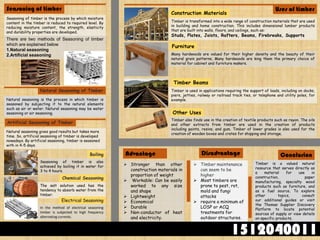
There are two methods of Seasoning of timber
which are explained below
1.Natural seasoning
2.Artificial seasoning
Disadvantage
Seasoning of timber is the process by which moisture
content in the timber is reduced to required level. By
reducing moisture content, the strength, elasticity
and durability properties are developed.
Natural seasoning is the process in which timber is
seasoned by subjecting it to the natural elements
such as air or water. Natural seasoning may be water
seasoning or air seasoning.
Natural Seasoning of Timber
Natural seasoning gives good results but takes more
time. So, artificial seasoning of timber is developed
nowadays. By artificial seasoning, timber is seasoned
with in 4-5 days.
Artificial Seasoning of Timber
Boiling
Seasoning of timber is also
achieved by boiling it in water for
3 to 4 hours.
The salt solution used has the
tendency to absorb water from the
timber.
Chemical Seasoning
Electrical Seasoning
In the method of electrical seasoning
timber is subjected to high frequency
alternating currents.
Timber is a valued natural
resource that serves directly as
a material for use in
construction, paper
manufacturing, specialty wood
products such as furniture, and
as a fuel source. To explore
other topics, consult
our additional guides or visit
the Thomas Supplier Discovery
Platform to locate potential
sources of supply or view details
on specific products.
Timber is transformed into a wide range of construction materials that are used
in building and home construction. This includes dimensional lumber products
that are built into walls, floors, and ceilings, such as:
Studs, Plates, Joists, Rafters, Beams, Firebreaks, Supports
Construction Materials
Furniture
Many hardwoods are valued for their higher density and the beauty of their
natural grain patterns, Many hardwoods are king them the primary choice of
material for cabinet and furniture makers.
Timber Beams
Timber is used in applications requiring the support of loads, including on docks,
piers, jetties, railway or railroad track ties, or telephone and utility poles, for
example.
Other Uses
Timber also finds use in the creation of textile products such as rayon. The oils
and other extracts from timber are used in the creation of products
including paints, resins, and gum. Timber of lower grades is also used for the
creation of wooden boxes and crates for shipping and storage.
 Stronger than other
construction materials in
proportion of weight
 Workable: Can be easily
worked to any size
and shape
 Lightweight
 Economical
 Durable
 Non-conductor of heat
and electricity.
 Timber maintenance
can seem to be
higher
 Most timbers are
prone to pest, rot,
mold and fungi
attacks
 require a minimum of
LOSP or ACQ
treatments for
outdoor structures.
Conclusion
1512040011

Timber

  • 1.
     Wood isstill a hugely popular. It is aesthetically pleasing, provides us with a contraction method which is renewable and sustainable. Tree StructureIntroduction Timber Short History  More than half a million years ago man starting making tools.  The first timber home dates back to over 10,000 years ago in the Mesolithic period which was found in Britain.  During 9000 BC to 5,000 BC one largest structure in the world was the Neolithic Long House, a long narrow timber structure housing.  In 2560 BC Egypt had to strip every bit of forest and wood they could to build the pyramids of Giza of levels and sledges,  The introduction of the timber crane during the Roman Empire allowed men to lift much larger weights to higher and create more impressive structure.  The iron age saw more advancement in wood work, steel improved all the existing tools and introduced the hand-plane.  The technique we now use today, known as “Timber Framing” was first developed by the romans in 50 AD.  In China, Temples were usually built with a timber frame on top of a stone base. Nanchan Temple was build in 782 AD. Wood provides performance-driven solutions throughout the asset life cycle, from concept to decommissioning across a broad range of industrial markets, including the upstream, midstream and downstream oil & gas, power & process, environment and infrastructure, clean energy, mining, nuclear, and general industrial sectors. The wood which is suitable or fit for engineering construction or engineering purpose is called timber. Timber, also known as Lumber in North American English, is a type of wood that has been processed into beams and planks, a stage in the process of wood production. Lumber is mainly used for structural purposes but has many other uses as well. TIMBER Stone Age Bronze Age Iron Age Middle Age Modern Age Outer Bark Inner Bark Pith Heartwood Sapwood Dead bark or outer bark is a layer of dead tissue which is a protection for the trunk and branches. It also helps to reduce water loss from the living cells of the tree. Outer Bark Live bark is a layer of living tissue under the dead bark. Food materials produced by the leaves are conducted through the live bark. Inner Bark Sapwood is the new wood under the Cambium layer. It is often lighter in color than true wood or heart wood. Heartwood Sapwood Heart wood or true wood is made up of cells which are actually dead. It provides the strength necessary to support the tree. Pith The pith is at the center of the tree and is a soft, pulpy zone which is usually about one centimeter in diameter. Defect of Timber Tree defects are structural problems resulting from injury, disease, or poor architecture that makes it more likely the tree or branch will fail. Canker Crack Decay Snags Weak Branch
  • 2.
    Advantage Uses of timberSeasoningof timber There are two methods of Seasoning of timber which are explained below 1.Natural seasoning 2.Artificial seasoning Disadvantage Seasoning of timber is the process by which moisture content in the timber is reduced to required level. By reducing moisture content, the strength, elasticity and durability properties are developed. Natural seasoning is the process in which timber is seasoned by subjecting it to the natural elements such as air or water. Natural seasoning may be water seasoning or air seasoning. Natural Seasoning of Timber Natural seasoning gives good results but takes more time. So, artificial seasoning of timber is developed nowadays. By artificial seasoning, timber is seasoned with in 4-5 days. Artificial Seasoning of Timber Boiling Seasoning of timber is also achieved by boiling it in water for 3 to 4 hours. The salt solution used has the tendency to absorb water from the timber. Chemical Seasoning Electrical Seasoning In the method of electrical seasoning timber is subjected to high frequency alternating currents. Timber is a valued natural resource that serves directly as a material for use in construction, paper manufacturing, specialty wood products such as furniture, and as a fuel source. To explore other topics, consult our additional guides or visit the Thomas Supplier Discovery Platform to locate potential sources of supply or view details on specific products. Timber is transformed into a wide range of construction materials that are used in building and home construction. This includes dimensional lumber products that are built into walls, floors, and ceilings, such as: Studs, Plates, Joists, Rafters, Beams, Firebreaks, Supports Construction Materials Furniture Many hardwoods are valued for their higher density and the beauty of their natural grain patterns, Many hardwoods are king them the primary choice of material for cabinet and furniture makers. Timber Beams Timber is used in applications requiring the support of loads, including on docks, piers, jetties, railway or railroad track ties, or telephone and utility poles, for example. Other Uses Timber also finds use in the creation of textile products such as rayon. The oils and other extracts from timber are used in the creation of products including paints, resins, and gum. Timber of lower grades is also used for the creation of wooden boxes and crates for shipping and storage.  Stronger than other construction materials in proportion of weight  Workable: Can be easily worked to any size and shape  Lightweight  Economical  Durable  Non-conductor of heat and electricity.  Timber maintenance can seem to be higher  Most timbers are prone to pest, rot, mold and fungi attacks  require a minimum of LOSP or ACQ treatments for outdoor structures. Conclusion 1512040011