Personality
Disorders
Sankalpa Gunathilaka
MBBS(Sri Lanka)
Dip.in Psychology and Counselling
Content
• What is ‘Personality’ an introduction
• Personality changes
• Personality disorders
• Aetiology
• Classification
• Cluster A –B- C
• Assessment
• Management
• Complication
• References
What is ‘Personality’ ?
 Enduring patterns of thoughts, attitudes, mood and behaviors which help to define us as
individuals.
 Every personality is unique.
 But every personality has common features.
 Upon these common features; different aspects of personality can be identified
=Personality Traits
Personality changes
 Personality is enduring and stable
 But small changes often may take place gradually over a period of many years. These gradual
changes are not termed as ‘personality changes’
 Rather Personality changes can be termed as modifications in one’s personality that occurs
more abruptly or in a step-wise manner.
 Personality changes may occur due to :
 Injury to or organic disease of the brain.
 Residual effect of severe mental disorder (eg –Schizophrenia)
 Exceptionally severe stressful experiences.
The curious case of Phineas Gage
Personality disorder
What is personality disorder ?
Deeply ingrained, enduring and inflexible patterns of behavior to broad range of personal and
social situations.
 They show either extreme or significant deviation from the way of an average individual in
a given culture.
 Deviations in:
o Cognition(perceive, feel, think)
o Affectivity
o Control over impulses and gratification of needs
o Manner of relating to others
o Manner of handling stress
o Handling interpersonal situations
 These behavior patterns are stable and can be seen in multiple domains of behavior and
psychological functioning
 And frequently associated with subjective distress and problems in social functioning
 Cause harm to person and to others.
 Development conditions
 Onset: Childhood or Adolescent – continue into adult life
 But no clear point of onset (differ from mental illness).
 Making a diagnosis is unusual before adulthood
 Prevalence : 5% of adult population & 40% of psychiatry inpatients
 Personality disorders differ from personality changes in timing and mode of emergence
Personality disorder Personality changes
Development condition Acquired condition
Onset : Childhood/ Adolescent Onset: usually in Adult life
Not secondary to brain damage/disorder
(But can coexist)
Following a brain damage/ disorder /
exceptionally stressful conditions
Aetiology
• Causes for personality disorders are uncertain.
• Linked with Genetic factors and Various kind of early
life experiences
• Only minority of those who experience adverse life
events develop personality disorders
• Some personality disorders are linked with the
etiology of psychiatric illness.
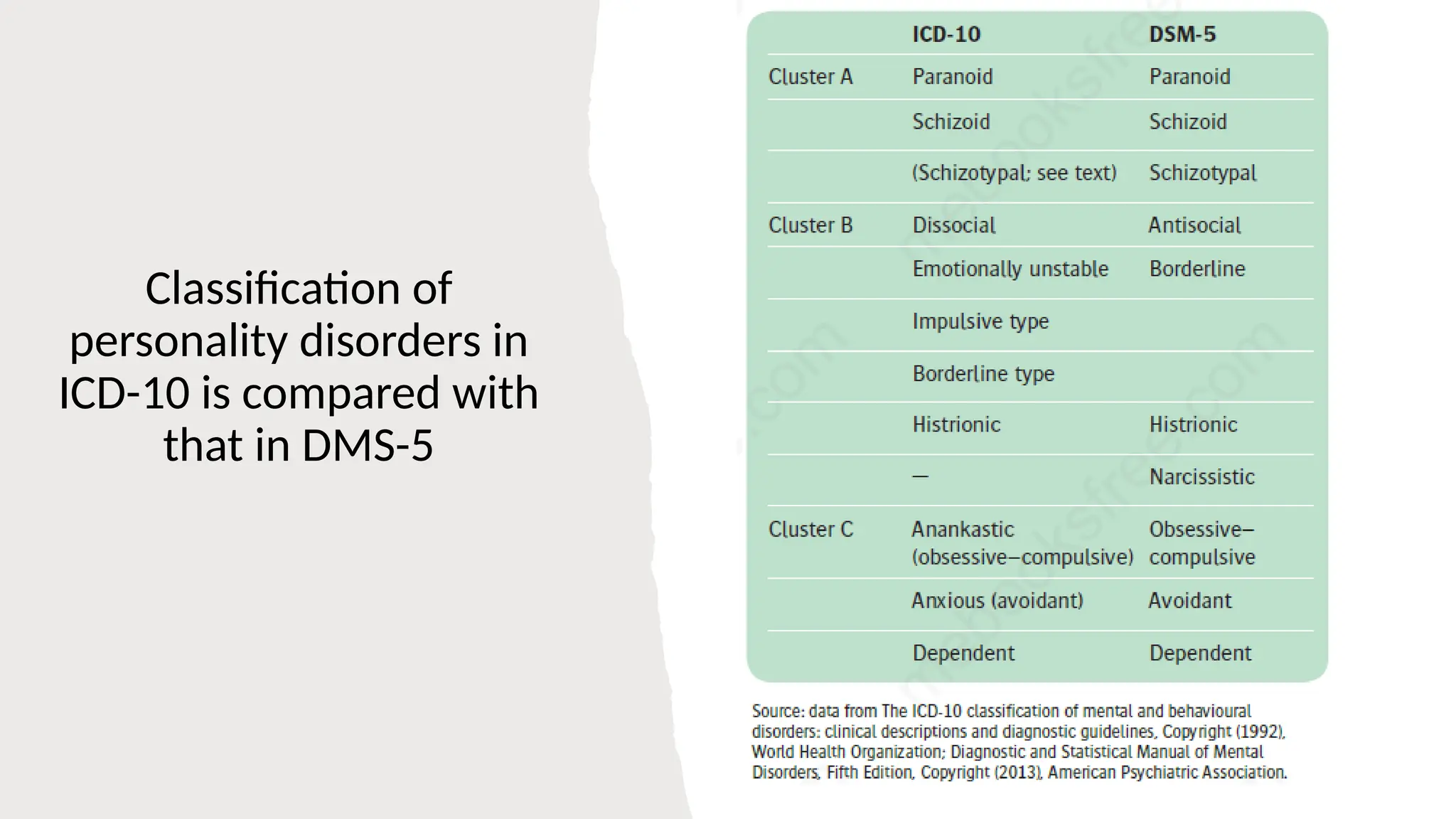
Classification of
personality disorders in
ICD-10 is compared with
that in DMS-5
Classification of Personality disorders
Personality disorders are classified into three ‘clusters’
Cluster A
(odd/eccentric)
Cluster B
(dramatic/emotional)
Cluster C
(fearful/anxious)
• Paranoid
• Schizoid
• Schizotypal*
*(in DSM-5.Not in ICD-10)
• Avoidant
• Dependent
• Anankastic(Obsessive-
compulsion in DSM-5)
• Histrionic
• Dissocial(Antisocial in DSM-5)
• Borderline
• Narcissistic
 Suspicious
• Look upon others as they are about to deceive or exploit the person
• So difficult to make friends
• Avoid involvement in group activities
• Resentful
 Mistrustful and Jealous.
 Sensitive
 Marked sense of self importance – but easily feel shame and humiliation
 Take offense easily – see criticism where non was intended
 First degree relatives of Schizophrenic patients > normal populations.
Paranoid Personality Disorder
 Suspicious ideas can be more intense
• mistaken as Persecutory delusions.
Schizoid Personality disorder
 Emotionally cold
• Detached and aloof
 Introspective.
 Lack of enjoyment in activities most people enjoy
• Leads to the separation from others
 Show little interest in sexual activities
 Do not form intimate relationships
 Show little family feeling – remain unmarried
 Follow a solitary course through life(seclusive)
 Interested in intellectual matters
 Have a complex inner world of excessive fantasy
 Socially anxious
• Lack of friends
• They feel different from others and do not fit in (differ from
Schizoid individuals)
 Behave eccentrically
• Unusual choices of clothes
• Odd mannerisms
 Experience cognitive and perceptual distortions (NOT delusions)
• Ideas of reference
• Magical thinking
• Suspicious beliefs
Schizotypal Personality disorder
This appears to be related to Schizophrenia. So not
classified as a personality disorder in ICD-10
CLUSTER B
Histrionic Personality Disorder
• warm and nice dressing
• Shallow and labile affect ( rapid changing of mood)
• outwardly confident
• Self dramatisation ( blackmail) and acting
• Suggestibility
• seeks excitement and wants to be centre of attention
• inappropriate seductiveness
• very concerned with physical attractiveness
• Self centred and vain
•marked capacity for self deception
Borderline personality disorder
• act impulsiveness without thinking the consequences
• inability to control anger
• conflict with others
• labile mood
• feelings of emptiness
• efforts to avoid abundance
• intense and unstable relationships
• uncertainty about self image
• Self harm – common
• Alcohol /substance abuse Also common
• Confused by strength and unpredictability of their needs
• Strong and fluctuating emotions
• Transient stress reaction /paranoid /dissociative symptoms
Narcissistic personality disorder
• Grandiose Sense of self importance
• Fantasies of success , power , Beauty and ideal love
• Need for excessive admiration
• Lacks empathy
• Arrogant
• Envious
Dissocial Personality Disorder
( Antisocial)
• Blames others
• Unconcern for others
• Gross and persistent irresponsibility
• Failure to have sustained relationships
• Incapacity to experience guilt and remorse
• Low threshold for violence
• Low tolerance for frustration
• Impulsive and irritable
• Fail to learn from adverse experiences
• Recklessness
• Risk of alcohol/ substance use
CLUSTER C
Anankastic personality Disorder
• Preoccupation with detail and rules
• Perfectionism interferes with completing the tasks
• Feeling of excessive doubts
• Rigid and stubborn
• Overemphasis on the work And productivity in the expense
of leisure
• Common among professionals
Dependent personality disorder
• Allows others to make important decisions
• Unwillingness to make reasonable demands on others
• Feels helpless when alone
• Fear of being abandoned
• Shifts quickly to a new relationship when the older one ends
• Lacks initiative
Avoidant personality disorder
• Feeling of tension and apprehension
• Preoccupation with being criticised
• Believe that they are socially inept and inferior to others
• Restrictions in Lifestyle because of the need for security
• Avoid risk and social involvement
• Feeling of inadequacy in New interpersonal situations
Assessment
• History
• MSE
• MRI if organic causes suspected ( frontal lobe tumors)
• Collateral history
• Psychometric assessments
• Comorbidities – depression; Anxiety disorder ; substance
abuse ; somatisation; Eating disorders
Mx
• Treatment of comorbid Disorders ( Anxiety; depression)
• Psychotherapy ( individual or group or Therapeutic community)
• Supportive – help to develop insight
• Analytical- Analyse and enlighten them
• Behavioural-
• Low dose antipsychotics If needed
• Antidepressants – may used in BPD ( SSRI)
• Lithium / antiepileptics – may used in episodic behavioural issues and
aggression
• Dialectical behavioural therapy for BPD
Complications
• Adverse effects On relationships/ Society
• Depressive illnesses
• Alcohol and substance abuse
• Deliberate self harm and suicide
• Violence towards others and other criminal activities
• Subjective distress
• Poor response to treatment of Psychiatric disorders
• Paranoid: Continue to have marital, Social and occupational
difficulties
• Schizoid : Relationship problems
• Dissocial : abuse of alcohol/ drugs , forensic hx
• Histrionic : improve with age,abuse of alcohol/drugs results
in bad outcome
• BPD : may improve with age, abuse of substance may result
in poor outcome , increased risk of Depression and suicide
• Anankastic : may develop OCD
• Dependant : If they lose dependant person ,can go into poor
prognosis
References
 Shorter oxford text book of psychiatry 7th
edition
 The ICD-10 classification of mental and behavioral
disorders: Clinical descriptions and diagnostic
guidelines
(www.who.int/docs/default-source/classification/other-classifications/
bluebook.pdf?sfvrsn=374758f7_2)
Thank
you !

Personality Disorders and personality.pptx

  • 1.
  • 2.
    Content • What is‘Personality’ an introduction • Personality changes • Personality disorders • Aetiology • Classification • Cluster A –B- C • Assessment • Management • Complication • References
  • 3.
    What is ‘Personality’?  Enduring patterns of thoughts, attitudes, mood and behaviors which help to define us as individuals.  Every personality is unique.  But every personality has common features.  Upon these common features; different aspects of personality can be identified =Personality Traits
  • 4.
    Personality changes  Personalityis enduring and stable  But small changes often may take place gradually over a period of many years. These gradual changes are not termed as ‘personality changes’  Rather Personality changes can be termed as modifications in one’s personality that occurs more abruptly or in a step-wise manner.  Personality changes may occur due to :  Injury to or organic disease of the brain.  Residual effect of severe mental disorder (eg –Schizophrenia)  Exceptionally severe stressful experiences. The curious case of Phineas Gage
  • 5.
    Personality disorder What ispersonality disorder ? Deeply ingrained, enduring and inflexible patterns of behavior to broad range of personal and social situations.  They show either extreme or significant deviation from the way of an average individual in a given culture.  Deviations in: o Cognition(perceive, feel, think) o Affectivity o Control over impulses and gratification of needs o Manner of relating to others o Manner of handling stress o Handling interpersonal situations  These behavior patterns are stable and can be seen in multiple domains of behavior and psychological functioning  And frequently associated with subjective distress and problems in social functioning
  • 6.
     Cause harmto person and to others.  Development conditions  Onset: Childhood or Adolescent – continue into adult life  But no clear point of onset (differ from mental illness).  Making a diagnosis is unusual before adulthood  Prevalence : 5% of adult population & 40% of psychiatry inpatients  Personality disorders differ from personality changes in timing and mode of emergence Personality disorder Personality changes Development condition Acquired condition Onset : Childhood/ Adolescent Onset: usually in Adult life Not secondary to brain damage/disorder (But can coexist) Following a brain damage/ disorder / exceptionally stressful conditions
  • 7.
    Aetiology • Causes forpersonality disorders are uncertain. • Linked with Genetic factors and Various kind of early life experiences • Only minority of those who experience adverse life events develop personality disorders • Some personality disorders are linked with the etiology of psychiatric illness.
  • 8.
    Classification of personality disordersin ICD-10 is compared with that in DMS-5
  • 9.
    Classification of Personalitydisorders Personality disorders are classified into three ‘clusters’ Cluster A (odd/eccentric) Cluster B (dramatic/emotional) Cluster C (fearful/anxious) • Paranoid • Schizoid • Schizotypal* *(in DSM-5.Not in ICD-10) • Avoidant • Dependent • Anankastic(Obsessive- compulsion in DSM-5) • Histrionic • Dissocial(Antisocial in DSM-5) • Borderline • Narcissistic
  • 10.
     Suspicious • Lookupon others as they are about to deceive or exploit the person • So difficult to make friends • Avoid involvement in group activities • Resentful  Mistrustful and Jealous.  Sensitive  Marked sense of self importance – but easily feel shame and humiliation  Take offense easily – see criticism where non was intended  First degree relatives of Schizophrenic patients > normal populations. Paranoid Personality Disorder  Suspicious ideas can be more intense • mistaken as Persecutory delusions.
  • 11.
    Schizoid Personality disorder Emotionally cold • Detached and aloof  Introspective.  Lack of enjoyment in activities most people enjoy • Leads to the separation from others  Show little interest in sexual activities  Do not form intimate relationships  Show little family feeling – remain unmarried  Follow a solitary course through life(seclusive)  Interested in intellectual matters  Have a complex inner world of excessive fantasy
  • 12.
     Socially anxious •Lack of friends • They feel different from others and do not fit in (differ from Schizoid individuals)  Behave eccentrically • Unusual choices of clothes • Odd mannerisms  Experience cognitive and perceptual distortions (NOT delusions) • Ideas of reference • Magical thinking • Suspicious beliefs Schizotypal Personality disorder This appears to be related to Schizophrenia. So not classified as a personality disorder in ICD-10
  • 13.
  • 14.
    Histrionic Personality Disorder •warm and nice dressing • Shallow and labile affect ( rapid changing of mood) • outwardly confident • Self dramatisation ( blackmail) and acting • Suggestibility • seeks excitement and wants to be centre of attention • inappropriate seductiveness • very concerned with physical attractiveness • Self centred and vain •marked capacity for self deception
  • 15.
    Borderline personality disorder •act impulsiveness without thinking the consequences • inability to control anger • conflict with others • labile mood • feelings of emptiness • efforts to avoid abundance • intense and unstable relationships • uncertainty about self image • Self harm – common • Alcohol /substance abuse Also common • Confused by strength and unpredictability of their needs • Strong and fluctuating emotions • Transient stress reaction /paranoid /dissociative symptoms
  • 16.
    Narcissistic personality disorder •Grandiose Sense of self importance • Fantasies of success , power , Beauty and ideal love • Need for excessive admiration • Lacks empathy • Arrogant • Envious
  • 17.
    Dissocial Personality Disorder (Antisocial) • Blames others • Unconcern for others • Gross and persistent irresponsibility • Failure to have sustained relationships • Incapacity to experience guilt and remorse • Low threshold for violence • Low tolerance for frustration • Impulsive and irritable • Fail to learn from adverse experiences • Recklessness • Risk of alcohol/ substance use
  • 18.
  • 19.
    Anankastic personality Disorder •Preoccupation with detail and rules • Perfectionism interferes with completing the tasks • Feeling of excessive doubts • Rigid and stubborn • Overemphasis on the work And productivity in the expense of leisure • Common among professionals
  • 20.
    Dependent personality disorder •Allows others to make important decisions • Unwillingness to make reasonable demands on others • Feels helpless when alone • Fear of being abandoned • Shifts quickly to a new relationship when the older one ends • Lacks initiative
  • 21.
    Avoidant personality disorder •Feeling of tension and apprehension • Preoccupation with being criticised • Believe that they are socially inept and inferior to others • Restrictions in Lifestyle because of the need for security • Avoid risk and social involvement • Feeling of inadequacy in New interpersonal situations
  • 22.
    Assessment • History • MSE •MRI if organic causes suspected ( frontal lobe tumors) • Collateral history • Psychometric assessments • Comorbidities – depression; Anxiety disorder ; substance abuse ; somatisation; Eating disorders
  • 23.
    Mx • Treatment ofcomorbid Disorders ( Anxiety; depression) • Psychotherapy ( individual or group or Therapeutic community) • Supportive – help to develop insight • Analytical- Analyse and enlighten them • Behavioural- • Low dose antipsychotics If needed • Antidepressants – may used in BPD ( SSRI) • Lithium / antiepileptics – may used in episodic behavioural issues and aggression • Dialectical behavioural therapy for BPD
  • 24.
    Complications • Adverse effectsOn relationships/ Society • Depressive illnesses • Alcohol and substance abuse • Deliberate self harm and suicide • Violence towards others and other criminal activities • Subjective distress • Poor response to treatment of Psychiatric disorders
  • 25.
    • Paranoid: Continueto have marital, Social and occupational difficulties • Schizoid : Relationship problems • Dissocial : abuse of alcohol/ drugs , forensic hx • Histrionic : improve with age,abuse of alcohol/drugs results in bad outcome • BPD : may improve with age, abuse of substance may result in poor outcome , increased risk of Depression and suicide • Anankastic : may develop OCD • Dependant : If they lose dependant person ,can go into poor prognosis
  • 26.
    References  Shorter oxfordtext book of psychiatry 7th edition  The ICD-10 classification of mental and behavioral disorders: Clinical descriptions and diagnostic guidelines (www.who.int/docs/default-source/classification/other-classifications/ bluebook.pdf?sfvrsn=374758f7_2)
  • 27.