 Born: c.190bc
Place of birth : Nicaea, Bithynia, now
(Iznik,Turkey)
 School: School of Athens
 Nationality: Greek
 Occupation:
Astronomer,Mathematician,Geographer
 Popularity: father of trigonometry
 Died: c.120bc
 Place of death: Island of the Rhodes
 Hipparchus was famous of his works for his
incidental discovery of precession of the
equinoxes
 He is known to have been working astronomer
at least from 162 to 127 BC
 Hipparchus is considered the greatest ancient
astronomical observer and by some,the greatest
astronomer of antiquity
 Plutarch table hipparchus 103049 compound
propositions that can be formed from ten simple
proposition.
 He was the first whose quantitative and
accurate models for the motion of the Sun
and Moon survive.
 Works of Hipparchus observations and
techniques are adopted by the Babylonians
and people of the Mesopotamia over
centuries
 he developed trigonometry constructed
trigonometric tables and he solved several
problems of spherical trigonometry
 With his solar and lunar theories and his
trigonometry ,he may have been the first to
develop a reliable method to predict solar
eclipses.
 His other reputed achievements include the
discovery and measurement of Earth`s
precession, the compilation of the Star
catalogue of the western world.
 Astrolable
 Armillary sphere
 Which he used during the creation of much of
the star catalogue.
It would be three centuries before Claudius
Ptolemaeus` synthesis of astronomy would
supersede the work of Hipparchus
 Hipparchus was the first mathematician
known to be have posessed a trigonometric
table , which he needed when computing the
eccentricity of the orbits of the moon and
sun.
 Hipparchus's work on geography was a criticism, in
three books, of Eratosthenes. In his discussion of
Eratosthenes's geography he is concerned with
mathematical errors in determining the latitudes of,
and distances between, places. He evidently desired
to establish a coordinate system of parallels of
longitude and latitude for determining geographical
positions, such as he employed for fixing the positions
of the fixed stars. The data at his disposal, however,
especially those concerning terrestrial longitude,
were not sufficient to carrier out his scheme
 The rather cumbersome formal name for
ESA`s Hipparchus SpaceAstrometry Mission
was high precision parallax collecting
satellite;it was deliberately named in this way
to give an acronym,HiPParCoS,that comet
the name of Hipparchus.
 The lunar crater Hipparchus and the asteroid
4000 Hipparchus are more directly named
after him.
 The astronomer`s monument at the Griffith
Observatory in Los Angeles California, United
States of America features a relief of
Hipparchus as one of the six greatest
Astronomers of all time and the only one
from Antiquit.
 2 books on precession
 Titled on sizes and distance
 On the displacement of the Solistical and
equicnotial points.
 On the length of the year
 Do you know that Hipparchus use the
Dioptra which invented by heron ?
 To measure the apparent diameter of the sun
and moon.
 He was the first to be able to measure the
geographical lattitude and time by observing
fixed stars.
 He`s interest is to observe constellations and
zodiac signs.
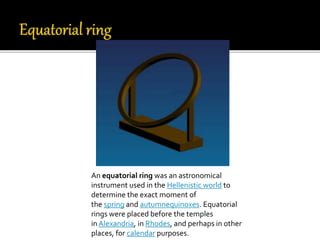
An equatorial ring was an astronomical
instrument used in the Hellenistic world to
determine the exact moment of
the spring and autumnequinoxes. Equatorial
rings were placed before the temples
in Alexandria, in Rhodes, and perhaps in other
places, for calendar purposes.

Hipparchus

  • 2.
     Born: c.190bc Placeof birth : Nicaea, Bithynia, now (Iznik,Turkey)  School: School of Athens  Nationality: Greek  Occupation: Astronomer,Mathematician,Geographer  Popularity: father of trigonometry  Died: c.120bc  Place of death: Island of the Rhodes
  • 3.
     Hipparchus wasfamous of his works for his incidental discovery of precession of the equinoxes  He is known to have been working astronomer at least from 162 to 127 BC  Hipparchus is considered the greatest ancient astronomical observer and by some,the greatest astronomer of antiquity  Plutarch table hipparchus 103049 compound propositions that can be formed from ten simple proposition.
  • 4.
     He wasthe first whose quantitative and accurate models for the motion of the Sun and Moon survive.  Works of Hipparchus observations and techniques are adopted by the Babylonians and people of the Mesopotamia over centuries  he developed trigonometry constructed trigonometric tables and he solved several problems of spherical trigonometry
  • 5.
     With hissolar and lunar theories and his trigonometry ,he may have been the first to develop a reliable method to predict solar eclipses.
  • 6.
     His otherreputed achievements include the discovery and measurement of Earth`s precession, the compilation of the Star catalogue of the western world.
  • 7.
     Astrolable  Armillarysphere  Which he used during the creation of much of the star catalogue. It would be three centuries before Claudius Ptolemaeus` synthesis of astronomy would supersede the work of Hipparchus
  • 8.
     Hipparchus wasthe first mathematician known to be have posessed a trigonometric table , which he needed when computing the eccentricity of the orbits of the moon and sun.
  • 9.
     Hipparchus's workon geography was a criticism, in three books, of Eratosthenes. In his discussion of Eratosthenes's geography he is concerned with mathematical errors in determining the latitudes of, and distances between, places. He evidently desired to establish a coordinate system of parallels of longitude and latitude for determining geographical positions, such as he employed for fixing the positions of the fixed stars. The data at his disposal, however, especially those concerning terrestrial longitude, were not sufficient to carrier out his scheme
  • 10.
     The rathercumbersome formal name for ESA`s Hipparchus SpaceAstrometry Mission was high precision parallax collecting satellite;it was deliberately named in this way to give an acronym,HiPParCoS,that comet the name of Hipparchus.  The lunar crater Hipparchus and the asteroid 4000 Hipparchus are more directly named after him.
  • 11.
     The astronomer`smonument at the Griffith Observatory in Los Angeles California, United States of America features a relief of Hipparchus as one of the six greatest Astronomers of all time and the only one from Antiquit.
  • 12.
     2 bookson precession  Titled on sizes and distance  On the displacement of the Solistical and equicnotial points.  On the length of the year
  • 13.
     Do youknow that Hipparchus use the Dioptra which invented by heron ?  To measure the apparent diameter of the sun and moon.  He was the first to be able to measure the geographical lattitude and time by observing fixed stars.  He`s interest is to observe constellations and zodiac signs.
  • 14.
    An equatorial ringwas an astronomical instrument used in the Hellenistic world to determine the exact moment of the spring and autumnequinoxes. Equatorial rings were placed before the temples in Alexandria, in Rhodes, and perhaps in other places, for calendar purposes.