LESSON 1: PHYSICS IN DAILY
LIFE
OBJECTIVES
At the end of this lesson, we will be able to:
•Describe how thermodynamics works in a refrigerator.
•Explain the role of evaporation and condensation in cooling.
•Identify ways thermodynamics improves life at home.
What is Thermodynamics?
• is the branch or fundamental of physics that deals with heat,
work, temperature, and energy, and how they relate to each
other within a system
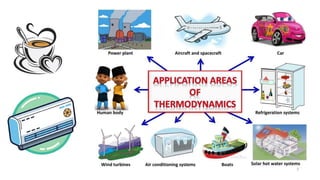
• Thermodynamics is the study of heat, energy, and work.
• It is the mechanism that allows your air-conditioner to work,
causes hot coffee to turn cold, and most especially, powers
your refrigerator!
The Three Laws of Thermodynamics
• 1st Law – Law of Conservation of Energy
🧃 Energy cannot be created or destroyed, only changed from one form
to another.
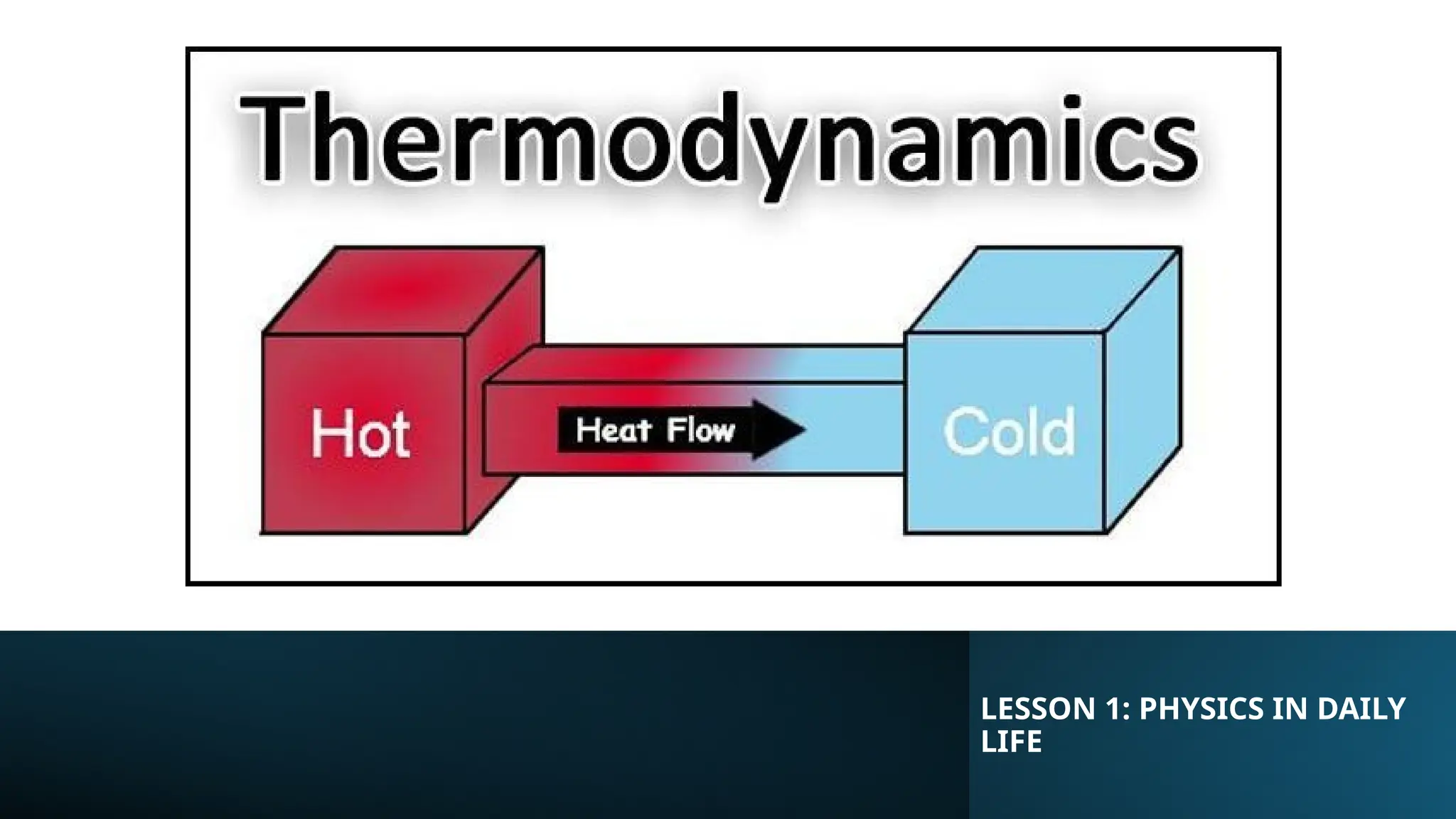
• 2nd Law – Law of Entropy / Direction of Heat Flow
☕ Heat always flows from hot to cold unless energy (work) is used to
reverse it.
• 3rd Law – Law of Absolute Zero
🧊 It is impossible to reach a temperature of absolute zero (–273.15°C),
where all motion stops.
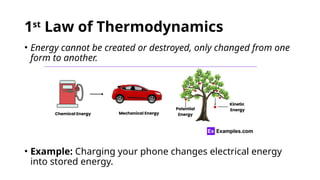
1st
Law of Thermodynamics
• Energy cannot be created or destroyed, only changed from one
form to another.
• Example: Charging your phone changes electrical energy
into stored energy.
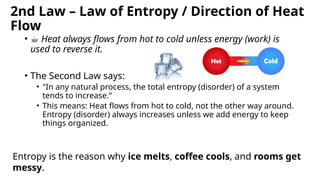
2nd Law – Law of Entropy / Direction of Heat
Flow
• ☕ Heat always flows from hot to cold unless energy (work) is
used to reverse it.
• The Second Law says:
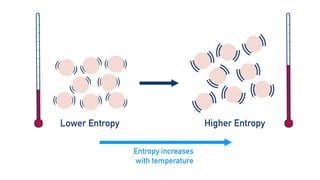
• "In any natural process, the total entropy (disorder) of a system
tends to increase.“
• This means: Heat flows from hot to cold, not the other way around.
Entropy (disorder) always increases unless we add energy to keep
things organized.
Entropy is the reason why ice melts, coffee cools, and rooms get
messy.
3rd Law – Law of
Absolute Zero
• 🧊 It is impossible to reach a temperature of
absolute zero (–273.15°C), where all motion stops.
Example: Even your freezer can’t make things
perfectly still or "infinitely cold."
• The Third Law tells us that perfect cold
(absolute zero) is impossible to reach and that
some motion and disorder always exist, even in
extremely cold systems.
How a Refrigerator Works
(Basic Idea of Thermodynamics)
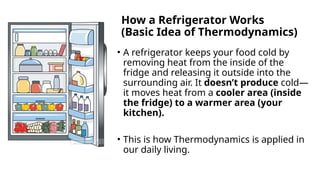
• A refrigerator keeps your food cold by
removing heat from the inside of the
fridge and releasing it outside into the
surrounding air. It doesn’t produce cold—
it moves heat from a cooler area (inside
the fridge) to a warmer area (your
kitchen).
• This is how Thermodynamics is applied in
our daily living.
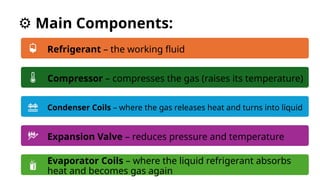
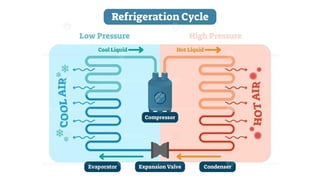
⚙️Main Components:
Refrigerant – the working fluid
Compressor – compresses the gas (raises its temperature)
Condenser Coils – where the gas releases heat and turns into liquid
Expansion Valve – reduces pressure and temperature
Evaporator Coils – where the liquid refrigerant absorbs
heat and becomes gas again
Cycle of Operation
(Thermodynamic Cycle – Reverse Carnot Cycle):
• 1. Compression (Compressor):
• The compressor squeezes the refrigerant gas, increasing its pressure
and temperature.
• Thermodynamic Principle: First Law of Thermodynamics (energy
input as work increases internal energy).
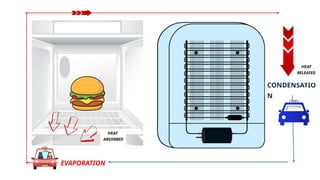
• 2.Condensation (Condenser Coils at the Back):
• The hot, high-pressure gas flows through the condenser coils.
• It releases heat to the kitchen air and condenses into a high-pressure
liquid.
• Physics involved: Heat transfer through conduction and convection.
• Thermodynamics: Heat flows from hot to cold (Second Law of
Thermodynamics).
Cycle of Operation
(Thermodynamic Cycle – Reverse Carnot Cycle):
• 3. Expansion (Expansion Valve):
• The liquid refrigerant passes through a small nozzle or valve.
• It rapidly expands, causing its pressure and temperature to drop.
• Thermodynamics: Expansion = drop in pressure and temperature
(Joule–Thomson effect).
• 4. Evaporation (Evaporator Coils Inside the Fridge):
• The cold, low-pressure liquid refrigerant absorbs heat from inside the
fridge and evaporates into a gas.
• This removes heat from your food and cools the fridge.
• Thermodynamics: This process is endothermic (absorbs heat).
• Physics: Latent heat of vaporization helps absorb a lot of heat with
little temperature change.
Cycle of Operation
(Thermodynamic Cycle – Reverse Carnot Cycle):
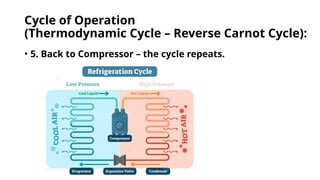
• 5. Back to Compressor – the cycle repeats.
THERMODYNAMICS IN SIMPLE
TERMS
•Compressor squeezes the refrigerant → it gets hot and high pressure
•This hot gas goes through the condenser coils at the back → it releases
heat to the room
•It turns into a liquid and passes through the expansion valve → it becomes
cold
•The cold liquid goes inside the evaporator coils (inside the fridge) → it
absorbs heat from the food and air
•Now it turns back into a gas and goes to the compressor again — the cycle
repeats
COOL AIR LEFT
INSIDE THE REF
HOT AIR
RELEASED
OUTSIDE
EVAPORATION
CONDENSATION
LET’S TAKE IT THIS WAY
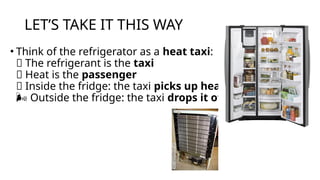
• Think of the refrigerator as a heat taxi:
🚕 The refrigerant is the taxi
🔥 Heat is the passenger
🧊 Inside the fridge: the taxi picks up heat
Outside the fridge: the taxi
️
🌬️ drops it off
EVAPORATION
CONDENSATIO
N
HEAT
RELEASED
HEAT
ABSORBED
Thermodynamic Laws at Play:
•First Law of Thermodynamics (Energy Conservation):
•The fridge does not destroy heat; it moves it using electrical work input
(from the plug).
•Second Law of Thermodynamics:
•Heat flows naturally from hot to cold, but in a refrigerator, we force it to
flow from cold to hot using external work (compressor).
•That’s why refrigerators consume electricity.
ANY QUESTIONS?

Thermodynamics General Sciencesssssssssssssssssssssssssssssssssss

  • 1.
    LESSON 1: PHYSICSIN DAILY LIFE
  • 2.
    OBJECTIVES At the endof this lesson, we will be able to: •Describe how thermodynamics works in a refrigerator. •Explain the role of evaporation and condensation in cooling. •Identify ways thermodynamics improves life at home.
  • 4.
    What is Thermodynamics? •is the branch or fundamental of physics that deals with heat, work, temperature, and energy, and how they relate to each other within a system • Thermodynamics is the study of heat, energy, and work. • It is the mechanism that allows your air-conditioner to work, causes hot coffee to turn cold, and most especially, powers your refrigerator!
  • 5.
    The Three Lawsof Thermodynamics • 1st Law – Law of Conservation of Energy 🧃 Energy cannot be created or destroyed, only changed from one form to another. • 2nd Law – Law of Entropy / Direction of Heat Flow ☕ Heat always flows from hot to cold unless energy (work) is used to reverse it. • 3rd Law – Law of Absolute Zero 🧊 It is impossible to reach a temperature of absolute zero (–273.15°C), where all motion stops.
  • 6.
    1st Law of Thermodynamics •Energy cannot be created or destroyed, only changed from one form to another. • Example: Charging your phone changes electrical energy into stored energy.
  • 7.
    2nd Law –Law of Entropy / Direction of Heat Flow • ☕ Heat always flows from hot to cold unless energy (work) is used to reverse it. • The Second Law says: • "In any natural process, the total entropy (disorder) of a system tends to increase.“ • This means: Heat flows from hot to cold, not the other way around. Entropy (disorder) always increases unless we add energy to keep things organized. Entropy is the reason why ice melts, coffee cools, and rooms get messy.
  • 9.
    3rd Law –Law of Absolute Zero • 🧊 It is impossible to reach a temperature of absolute zero (–273.15°C), where all motion stops. Example: Even your freezer can’t make things perfectly still or "infinitely cold." • The Third Law tells us that perfect cold (absolute zero) is impossible to reach and that some motion and disorder always exist, even in extremely cold systems.
  • 10.
    How a RefrigeratorWorks (Basic Idea of Thermodynamics) • A refrigerator keeps your food cold by removing heat from the inside of the fridge and releasing it outside into the surrounding air. It doesn’t produce cold— it moves heat from a cooler area (inside the fridge) to a warmer area (your kitchen). • This is how Thermodynamics is applied in our daily living.
  • 11.
    ⚙️Main Components: Refrigerant –the working fluid Compressor – compresses the gas (raises its temperature) Condenser Coils – where the gas releases heat and turns into liquid Expansion Valve – reduces pressure and temperature Evaporator Coils – where the liquid refrigerant absorbs heat and becomes gas again
  • 12.
    Cycle of Operation (ThermodynamicCycle – Reverse Carnot Cycle): • 1. Compression (Compressor): • The compressor squeezes the refrigerant gas, increasing its pressure and temperature. • Thermodynamic Principle: First Law of Thermodynamics (energy input as work increases internal energy). • 2.Condensation (Condenser Coils at the Back): • The hot, high-pressure gas flows through the condenser coils. • It releases heat to the kitchen air and condenses into a high-pressure liquid. • Physics involved: Heat transfer through conduction and convection. • Thermodynamics: Heat flows from hot to cold (Second Law of Thermodynamics).
  • 13.
    Cycle of Operation (ThermodynamicCycle – Reverse Carnot Cycle): • 3. Expansion (Expansion Valve): • The liquid refrigerant passes through a small nozzle or valve. • It rapidly expands, causing its pressure and temperature to drop. • Thermodynamics: Expansion = drop in pressure and temperature (Joule–Thomson effect). • 4. Evaporation (Evaporator Coils Inside the Fridge): • The cold, low-pressure liquid refrigerant absorbs heat from inside the fridge and evaporates into a gas. • This removes heat from your food and cools the fridge. • Thermodynamics: This process is endothermic (absorbs heat). • Physics: Latent heat of vaporization helps absorb a lot of heat with little temperature change.
  • 14.
    Cycle of Operation (ThermodynamicCycle – Reverse Carnot Cycle): • 5. Back to Compressor – the cycle repeats.
  • 16.
    THERMODYNAMICS IN SIMPLE TERMS •Compressorsqueezes the refrigerant → it gets hot and high pressure •This hot gas goes through the condenser coils at the back → it releases heat to the room •It turns into a liquid and passes through the expansion valve → it becomes cold •The cold liquid goes inside the evaporator coils (inside the fridge) → it absorbs heat from the food and air •Now it turns back into a gas and goes to the compressor again — the cycle repeats
  • 17.
    COOL AIR LEFT INSIDETHE REF HOT AIR RELEASED OUTSIDE EVAPORATION CONDENSATION
  • 19.
    LET’S TAKE ITTHIS WAY • Think of the refrigerator as a heat taxi: 🚕 The refrigerant is the taxi 🔥 Heat is the passenger 🧊 Inside the fridge: the taxi picks up heat Outside the fridge: the taxi ️ 🌬️ drops it off
  • 20.
  • 21.
    Thermodynamic Laws atPlay: •First Law of Thermodynamics (Energy Conservation): •The fridge does not destroy heat; it moves it using electrical work input (from the plug). •Second Law of Thermodynamics: •Heat flows naturally from hot to cold, but in a refrigerator, we force it to flow from cold to hot using external work (compressor). •That’s why refrigerators consume electricity.
  • 22.