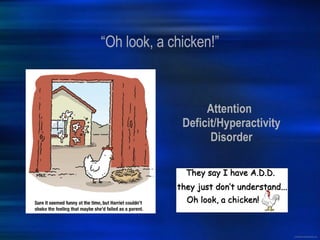
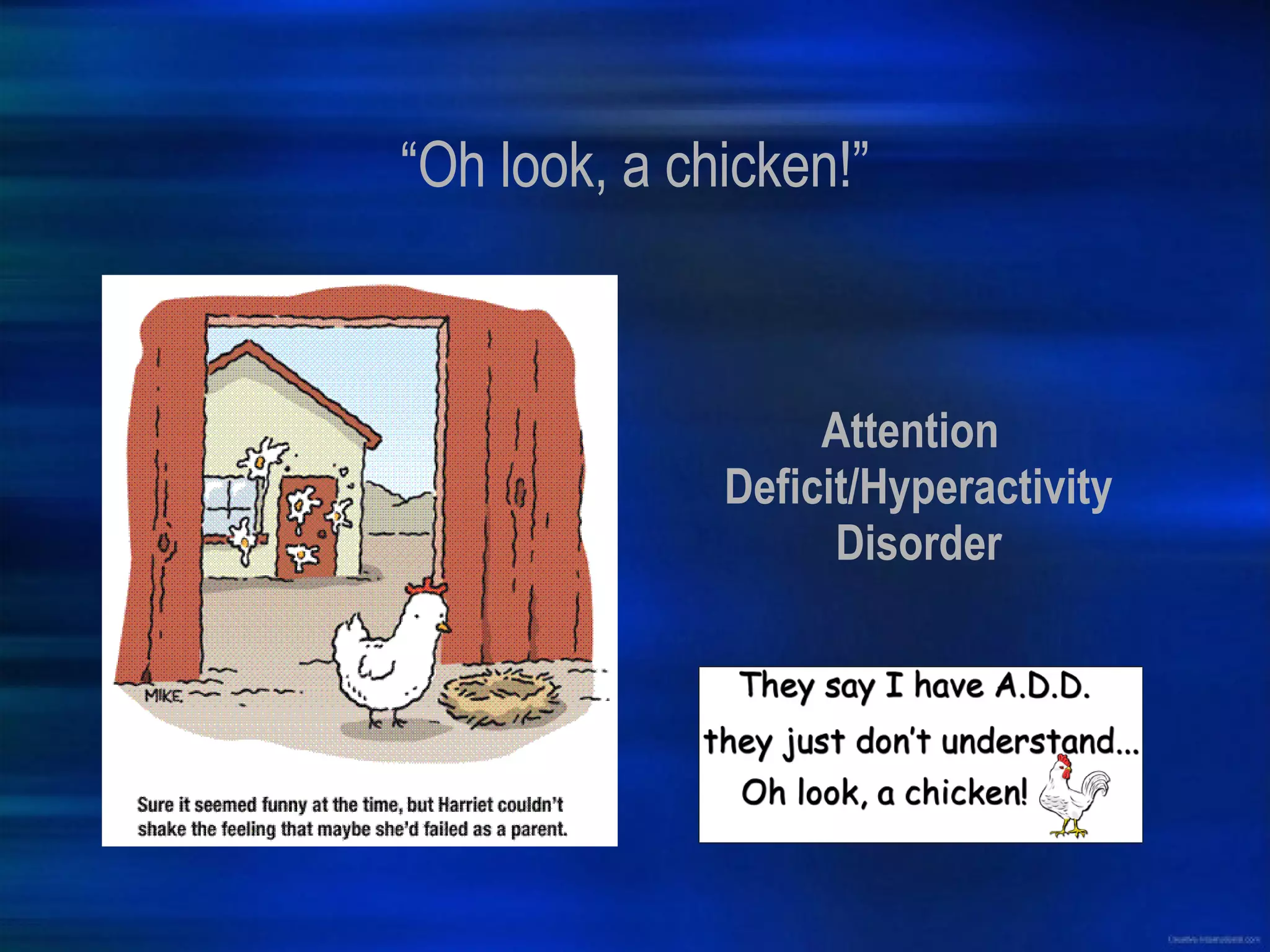






“Oh look, a chicken!” Attention Deficit/Hyperactivity Disorder
Characteristics of ADHD Not  truly “attention deficit”; actually “attention inconsistency” Easy distractibility (inattentiveness) Low tolerance for frustration or boredom Tendency to say or do whatever comes to mind (impulsivity) Overflow of energy!
Historically speaking… Identified in early 20 th  century (1902) by George Frederic Still Studied 20 children 3 boys for every girl Defiant, excessively emotional, passionate, lawless, spiteful Behaviors appeared before age 8 Not  the result of poor parenting Studied in WW I veterans who had received head injuries Originally called “minimal brain dysfunction” Causes are not clearly identified May be physiological (caused by differences in brain “ High incidence” - anywhere from 3%-7%
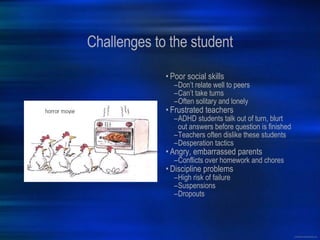
Challenges to the student Poor social skills Don’t relate well to peers Can’t take turns Often solitary and lonely Frustrated teachers ADHD students talk out of turn, blurt out answers before question is finished Teachers often dislike these students Desperation tactics Angry, embarrassed parents Conflicts over homework and chores Discipline problems High risk of failure Suspensions Dropouts
Challenges later in life Substance abuse Alcohol – trying to “slow the world down” Cocaine – actually “focuses” for those with ADHD – approximately 15% of cocaine users report this Difficulty with employment “ Short fuse” Trouble with the law
The Plus Side High energy For those with the “H” component, often very active, energetic and full of enthusiasm Creative Exceptional tendency to “think outside the box” Intuitive Emotionally aware Exuberant
In the classroom – a raw deal? Distractibility Can be easily distracted, or can be  hyperfocused Because of this, may not handle transitions well Impulsivity Hyperactivity Poor organizational skills Missing, late homework Lack of needed materials Poor reading and/or math skills Poor study skills Poor handwriting
How can we help them get to “well done!”? Physical Seating Near teacher Near peer assistant Directional Signal when off-task Cue transitions Alert students a little while before an activity is going to change Allows them to “get used” to the idea, and to come out of hyperfocus, if need be. Keep a consistent schedule
How can we help them get to “well done!”? Organizational Help student to choose the organizer that best fits his/her style Paper – school planner Electronic – PDA Provide a consistent place for materials Extra set of books for home Peer assistant Someone student can call when they did not write down an assignment correctly or have a question. Give directions, assignments, and other important information both verbally and in writing
How can we help them get to “well done!”? Instructional Provide external motivation Avoid busywork Students w/ADHD often have trouble doing homework in the first place – will resent assignments which do not clearly relate to the lesson.  Make sure the assignment is relevant to what is being taught Tell students why it will help them master the material. "Chunk" material to avoid overwhelming students Use multiple instructional techniques Use graphic organizers to communicate most important points of lessons Allow additional time for tests and assignments Avoid timed tests
Life with AD(H)D – No Joke Excerpt from: All About Attention Deficit Disorder Symptoms, Diagnosis and Treatment:  Children and Adults By Thomas W. Phelan, Ph.D.
Famous People with ADHD Harry Belafonte Orlando Bloom Terry Bradshaw Richard Branson – Virgin Airways Stephen J. Cannell Patrick Dempsey Whoopi Goldberg William Hewlett – Co-founder of Hewlett-Packard Jewel Keira Knightly Jay Leno David Neeleman -- JetBlue Edward James Olmos Ty Pennington Charles Schwab – also has dyslexia Jackie Stewart – Indy car driver Henry Winkler
References Editorial Staff.  (2008) Famous people with dyslexia and other learning disabilities and/or AD/HD.  Retrieved June 17, 2008, from http://www.schwablearning.org. Hallowell, E. M & Ratey, J. J.  (1994).  Driven to distraction:  Recognizing and coping with attention deficit disorder from childhood through adulthood.  New York, NY: Touchstone. Phelan, T. W.  (2000).  All about attention deficit disorder (second edition).  Symptoms, diagnosis and treatment: Children and adults.  Glen Ellyn, IL: Child Management Inc. Smith, D. D.  (2007).  Introduction to special education: Making a difference (sixth edition).  Boston, MA: Allyn and Bacon. Solden, S.  (1995).  Women with attention deficit disorder: Embracing disorganization at home and in the workplace.  Grass Valley, CA: Underwood Books.
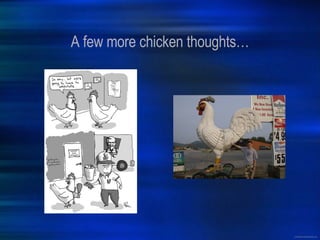
A few more chicken thoughts…

ADHD

  • 1.
    “Oh look, achicken!” Attention Deficit/Hyperactivity Disorder
  • 2.
    Characteristics of ADHDNot truly “attention deficit”; actually “attention inconsistency” Easy distractibility (inattentiveness) Low tolerance for frustration or boredom Tendency to say or do whatever comes to mind (impulsivity) Overflow of energy!
  • 3.
    Historically speaking… Identifiedin early 20 th century (1902) by George Frederic Still Studied 20 children 3 boys for every girl Defiant, excessively emotional, passionate, lawless, spiteful Behaviors appeared before age 8 Not the result of poor parenting Studied in WW I veterans who had received head injuries Originally called “minimal brain dysfunction” Causes are not clearly identified May be physiological (caused by differences in brain “ High incidence” - anywhere from 3%-7%
  • 4.
    Challenges to thestudent Poor social skills Don’t relate well to peers Can’t take turns Often solitary and lonely Frustrated teachers ADHD students talk out of turn, blurt out answers before question is finished Teachers often dislike these students Desperation tactics Angry, embarrassed parents Conflicts over homework and chores Discipline problems High risk of failure Suspensions Dropouts
  • 5.
    Challenges later inlife Substance abuse Alcohol – trying to “slow the world down” Cocaine – actually “focuses” for those with ADHD – approximately 15% of cocaine users report this Difficulty with employment “ Short fuse” Trouble with the law
  • 6.
    The Plus SideHigh energy For those with the “H” component, often very active, energetic and full of enthusiasm Creative Exceptional tendency to “think outside the box” Intuitive Emotionally aware Exuberant
  • 7.
    In the classroom– a raw deal? Distractibility Can be easily distracted, or can be hyperfocused Because of this, may not handle transitions well Impulsivity Hyperactivity Poor organizational skills Missing, late homework Lack of needed materials Poor reading and/or math skills Poor study skills Poor handwriting
  • 8.
    How can wehelp them get to “well done!”? Physical Seating Near teacher Near peer assistant Directional Signal when off-task Cue transitions Alert students a little while before an activity is going to change Allows them to “get used” to the idea, and to come out of hyperfocus, if need be. Keep a consistent schedule
  • 9.
    How can wehelp them get to “well done!”? Organizational Help student to choose the organizer that best fits his/her style Paper – school planner Electronic – PDA Provide a consistent place for materials Extra set of books for home Peer assistant Someone student can call when they did not write down an assignment correctly or have a question. Give directions, assignments, and other important information both verbally and in writing
  • 10.
    How can wehelp them get to “well done!”? Instructional Provide external motivation Avoid busywork Students w/ADHD often have trouble doing homework in the first place – will resent assignments which do not clearly relate to the lesson. Make sure the assignment is relevant to what is being taught Tell students why it will help them master the material. "Chunk" material to avoid overwhelming students Use multiple instructional techniques Use graphic organizers to communicate most important points of lessons Allow additional time for tests and assignments Avoid timed tests
  • 11.
    Life with AD(H)D– No Joke Excerpt from: All About Attention Deficit Disorder Symptoms, Diagnosis and Treatment: Children and Adults By Thomas W. Phelan, Ph.D.
  • 12.
    Famous People withADHD Harry Belafonte Orlando Bloom Terry Bradshaw Richard Branson – Virgin Airways Stephen J. Cannell Patrick Dempsey Whoopi Goldberg William Hewlett – Co-founder of Hewlett-Packard Jewel Keira Knightly Jay Leno David Neeleman -- JetBlue Edward James Olmos Ty Pennington Charles Schwab – also has dyslexia Jackie Stewart – Indy car driver Henry Winkler
  • 13.
    References Editorial Staff. (2008) Famous people with dyslexia and other learning disabilities and/or AD/HD. Retrieved June 17, 2008, from http://www.schwablearning.org. Hallowell, E. M & Ratey, J. J. (1994). Driven to distraction: Recognizing and coping with attention deficit disorder from childhood through adulthood. New York, NY: Touchstone. Phelan, T. W. (2000). All about attention deficit disorder (second edition). Symptoms, diagnosis and treatment: Children and adults. Glen Ellyn, IL: Child Management Inc. Smith, D. D. (2007). Introduction to special education: Making a difference (sixth edition). Boston, MA: Allyn and Bacon. Solden, S. (1995). Women with attention deficit disorder: Embracing disorganization at home and in the workplace. Grass Valley, CA: Underwood Books.
  • 14.
    A few morechicken thoughts…

Editor's Notes

  • #2 “Oh look, a chicken!” Slogan from t-shirt for people with ADD. While the cartoon is funny, it actually presents some of the issues that face people with ADHD. Acting on impulse is developed to a fine art in people with ADHD, sometimes without regard for the consequences.