Lecture notes 7: FAS
Definition:Fetal alcohol syndrome referstothe growth,mental,andphysical problemsthatmay
occur in a babywhena motherdrinksalcohol duringpregnancy.
Types inthe Spectrum
 Fetal Alcohol Syndrome (FAS),
 partial Fetal Alcohol Syndrome (pFAS),
 Alcohol-RelatedBirthDefects(ARBD)
 Alcohol-RelatedNeurodevelopmental Disorder(ARND)
Clinical Features
• Failure to thrive due to being premature
• Developmental delays
• Organ dysfunction
• Epilepsy
• Poor growth while the baby is in the womb and after
birth
• Decreasedmuscle tone and poor coordination
• Heart defects
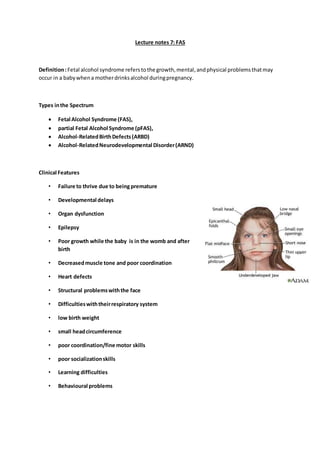
• Structural problemswiththe face
• Difficultieswiththeirrespiratory system
• low birth weight
• small headcircumference
• poor coordination/fine motor skills
• poor socializationskills
• Learning difficulties
• Behavioural problems
7 Domains
• Cognition
• Adaptation
• Executive function
• Memory
• Communication
• Attention
• Achievement
Criteriafor Diagnosis
a) growth deficiency:lowbirthweightand/ordeceleratingweightovertime notdue to
nutrition
b) characteristic pattern of facial anomalies: shortpalpebral fissures,flattenedphiltrum, thin
upperlip,flatmidface
c) central nervoussystem dysfunction:microcephalyand/orneurobehavioural dysfunction
(hyperactivity,finemotorproblems,attentiondeficits,learningdisabilities,cognitive
disabilities,difficultiesinadaptive functioning,etc.
Spina Bifida
Definition:Disordercausedbythe incompleteclosingof the embryonicneural tube. Some
vertebrae overlyingthe spinalcord are not fullyformedandremainunfusedandopen. If the
openingislarge enough,thisallowsaportionof the spinal cordto protrude throughthe opening
inthe bones.
Other definitions:
Meningo- Meninges
Myelo- Nerve Sheaths
Cele- Tumor/Cyst/Sac
Embryology
• Spinabifidaiscausedbythe failure of the neural tube toclose duringthe firstmonth
of embryonicdevelopment(oftenbefore the motherknows she ispregnant).
• Under normal circumstances,the closure of the neural tube occursaroundthe 23rd (rostral
closure) and27th (caudal closure) dayafter fertilization.
Etiology:
• Maternal diabetes
• Familyhistory
• Obesity
• Increasedbodytemperature
fromfeveror external sourcessuchas
hot tubsand electricblanketsmay
increase the chancesof deliveryof a
babywitha spinabifida.
• Medicationssuchas
some anticonvulsants.
• PregnantwomentakingValproicacid
have an increasedriskof having
childrenwithspinabifida
• Geneticbasis.
• Folicaciddeficiency
Types
 SpinaBifidaOcculta
 SpinaBifidaCysticaWithMeningocele(Aperta)
 SpinaBifidaCysticaWithMyelomeningocele. (Aperta)
Spina BifidaOcculta
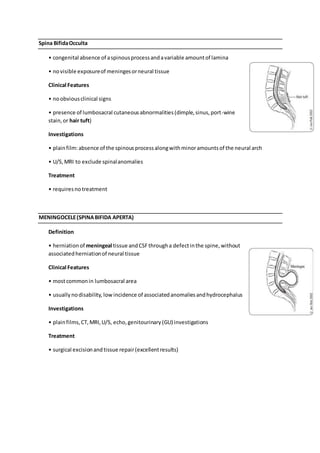
• congenital absence of aspinousprocessandavariable amountof lamina
• novisible exposureof meningesorneural tissue
Clinical Features
• noobviousclinical signs
• presence of lumbosacral cutaneousabnormalities(dimple,sinus,port-wine
stain,or hair tuft)
Investigations
• plainfilm:absence of the spinousprocessalongwithminoramountsof the neural arch
• U/S,MRI to exclude spinalanomalies
Treatment
• requiresno treatment
MENINGOCELE(SPINABIFIDA APERTA)
Definition
• herniationof meningeal tissue andCSFthrougha defectinthe spine,without
associatedherniationof neural tissue
Clinical Features
• mostcommonin lumbosacral area
• usuallynodisability, lowincidence of associatedanomaliesandhydrocephalus
Investigations
• plainfilms,CT,MRI,U/S, echo,genitourinary(GU) investigations
Treatment
• surgical excisionandtissue repair(excellentresults)
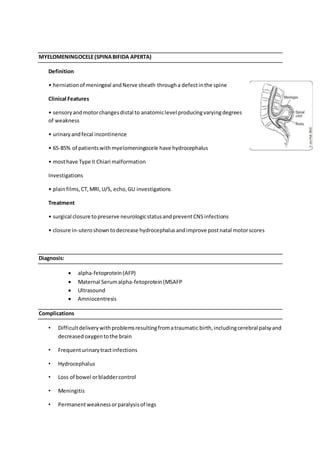
MYELOMENINGOCELE(SPINABIFIDA APERTA)
Definition
• herniationof meningeal andNerve sheath througha defectinthe spine
Clinical Features
• sensoryandmotorchangesdistal to anatomiclevel producingvaryingdegrees
of weakness
• urinaryandfecal incontinence
• 65-85% of patientswithmyelomeningocele have hydrocephalus
• mosthave Type II Chiari malformation
Investigations
• plainfilms,CT,MRI,U/S, echo,GU investigations
Treatment
• surgical closure topreserve neurologicstatusandpreventCNSinfections
• closure in-uteroshowntodecrease hydrocephalusandimprove postnatal motorscores
Diagnosis:
 alpha-fetoprotein(AFP)
 Maternal Serumalpha-fetoprotein(MSAFP
 Ultrasound
 Amniocentresis
Complications
• Difficultdeliverywithproblemsresultingfromatraumatic birth,includingcerebral palsyand
decreasedoxygentothe brain
• Frequenturinarytractinfections
• Hydrocephalus
• Loss of bowel orbladdercontrol
• Meningitis
• Permanentweaknessorparalysisof legs

7.fas spina bifida

  • 1.
    Lecture notes 7:FAS Definition:Fetal alcohol syndrome referstothe growth,mental,andphysical problemsthatmay occur in a babywhena motherdrinksalcohol duringpregnancy. Types inthe Spectrum  Fetal Alcohol Syndrome (FAS),  partial Fetal Alcohol Syndrome (pFAS),  Alcohol-RelatedBirthDefects(ARBD)  Alcohol-RelatedNeurodevelopmental Disorder(ARND) Clinical Features • Failure to thrive due to being premature • Developmental delays • Organ dysfunction • Epilepsy • Poor growth while the baby is in the womb and after birth • Decreasedmuscle tone and poor coordination • Heart defects • Structural problemswiththe face • Difficultieswiththeirrespiratory system • low birth weight • small headcircumference • poor coordination/fine motor skills • poor socializationskills • Learning difficulties • Behavioural problems
  • 2.
    7 Domains • Cognition •Adaptation • Executive function • Memory • Communication • Attention • Achievement Criteriafor Diagnosis a) growth deficiency:lowbirthweightand/ordeceleratingweightovertime notdue to nutrition b) characteristic pattern of facial anomalies: shortpalpebral fissures,flattenedphiltrum, thin upperlip,flatmidface c) central nervoussystem dysfunction:microcephalyand/orneurobehavioural dysfunction (hyperactivity,finemotorproblems,attentiondeficits,learningdisabilities,cognitive disabilities,difficultiesinadaptive functioning,etc.
  • 3.
    Spina Bifida Definition:Disordercausedbythe incompleteclosingofthe embryonicneural tube. Some vertebrae overlyingthe spinalcord are not fullyformedandremainunfusedandopen. If the openingislarge enough,thisallowsaportionof the spinal cordto protrude throughthe opening inthe bones. Other definitions: Meningo- Meninges Myelo- Nerve Sheaths Cele- Tumor/Cyst/Sac Embryology • Spinabifidaiscausedbythe failure of the neural tube toclose duringthe firstmonth of embryonicdevelopment(oftenbefore the motherknows she ispregnant). • Under normal circumstances,the closure of the neural tube occursaroundthe 23rd (rostral closure) and27th (caudal closure) dayafter fertilization. Etiology: • Maternal diabetes • Familyhistory • Obesity • Increasedbodytemperature fromfeveror external sourcessuchas hot tubsand electricblanketsmay increase the chancesof deliveryof a babywitha spinabifida. • Medicationssuchas some anticonvulsants. • PregnantwomentakingValproicacid have an increasedriskof having childrenwithspinabifida • Geneticbasis. • Folicaciddeficiency Types  SpinaBifidaOcculta  SpinaBifidaCysticaWithMeningocele(Aperta)  SpinaBifidaCysticaWithMyelomeningocele. (Aperta)
  • 4.
    Spina BifidaOcculta • congenitalabsence of aspinousprocessandavariable amountof lamina • novisible exposureof meningesorneural tissue Clinical Features • noobviousclinical signs • presence of lumbosacral cutaneousabnormalities(dimple,sinus,port-wine stain,or hair tuft) Investigations • plainfilm:absence of the spinousprocessalongwithminoramountsof the neural arch • U/S,MRI to exclude spinalanomalies Treatment • requiresno treatment MENINGOCELE(SPINABIFIDA APERTA) Definition • herniationof meningeal tissue andCSFthrougha defectinthe spine,without associatedherniationof neural tissue Clinical Features • mostcommonin lumbosacral area • usuallynodisability, lowincidence of associatedanomaliesandhydrocephalus Investigations • plainfilms,CT,MRI,U/S, echo,genitourinary(GU) investigations Treatment • surgical excisionandtissue repair(excellentresults)
  • 5.
    MYELOMENINGOCELE(SPINABIFIDA APERTA) Definition • herniationofmeningeal andNerve sheath througha defectinthe spine Clinical Features • sensoryandmotorchangesdistal to anatomiclevel producingvaryingdegrees of weakness • urinaryandfecal incontinence • 65-85% of patientswithmyelomeningocele have hydrocephalus • mosthave Type II Chiari malformation Investigations • plainfilms,CT,MRI,U/S, echo,GU investigations Treatment • surgical closure topreserve neurologicstatusandpreventCNSinfections • closure in-uteroshowntodecrease hydrocephalusandimprove postnatal motorscores Diagnosis:  alpha-fetoprotein(AFP)  Maternal Serumalpha-fetoprotein(MSAFP  Ultrasound  Amniocentresis Complications • Difficultdeliverywithproblemsresultingfromatraumatic birth,includingcerebral palsyand decreasedoxygentothe brain • Frequenturinarytractinfections • Hydrocephalus • Loss of bowel orbladdercontrol • Meningitis • Permanentweaknessorparalysisof legs