Good Energy Management  starts with Energy Audit
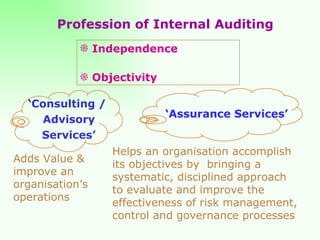
Independence Objectivity ‘ Consulting /  Advisory Services’ ‘ Assurance Services’ Adds Value & improve an organisation’s operations Helps an organisation accomplish its objectives by  bringing a systematic, disciplined approach to evaluate and improve the effectiveness of risk management, control and governance processes Profession of Internal Auditing
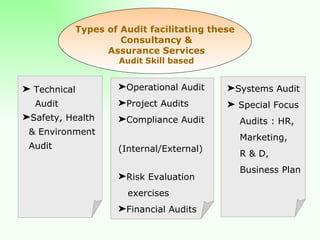
Technical  Audit  Safety, Health  & Environment Audit Operational Audit Project Audits Compliance Audit  (Internal/External) Risk Evaluation  exercises Financial Audits Systems Audit Special Focus  Audits : HR, Marketing, R & D,  Business Plan Types of Audit facilitating these  Consultancy & Assurance Services Audit Skill based
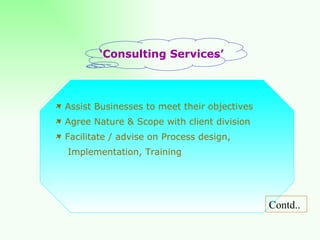
‘ Consulting Services’ Assist Businesses to meet their objectives Agree Nature & Scope with client division Facilitate / advise on Process design,  Implementation, Training Contd..
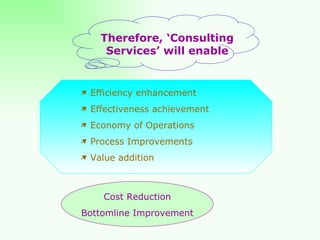
Therefore, ‘Consulting Services’ will enable Efficiency enhancement Effectiveness achievement Economy of Operations Process Improvements Value addition Cost Reduction Bottomline Improvement
Cost Reduction Bottomline Improvement Technical &  Operational Audit - An Important Management Tool
Technical  Audit What? Where? When? Who? How?
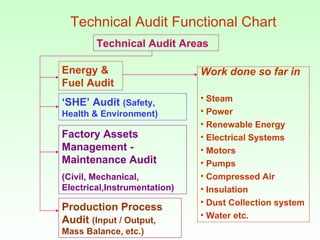
Technical Audit Functional Chart Technical Audit Areas Energy & Fuel Audit ‘ SHE’ Audit  (Safety, Health & Environment) Factory Assets Management - Maintenance Audit  (Civil, Mechanical, Electrical,Instrumentation) Production Process Audit  (Input / Output, Mass Balance, etc.) Work done so far in  Steam Power Renewable Energy Electrical Systems  Motors Pumps Compressed Air Insulation Dust Collection system  Water etc.
Energy Audit Energy Audit involves a systematic study undertaken on major energy consuming sections and equipment including construction of heat and mass balance with a view to identify the flow of energy, utilization efficiency of energy in each of the steps and pinpoint energy wastages .
Purpose A well conducted energy audit would reveal the areas of wastage of energy and it would be possible to suggest countermeasures for saving of energy. The Energy Conservation Act  requires that energy audit report to contain recommendations for improving energy efficiency with cost – benefit analysis and an action plan to reduce energy consumption.
BENEFITS Efficient use of energy provides the least cost.  It also provides environmental friendly option for capacity creation in the shortest time frame. “  One unit of energy saved at consumer end , avoids three units of fresh capacity addition.”
Energy Auditors- Responsibilities & Duties Carry out a detailed energy audit. Quantify energy consumption and establish base line energy information. Construct energy and material balance. Perform efficiency evaluation of energy & utility systems. Compare energy norms with existing energy consumption levels.
Responsibilities & Duties Identify and prioritise energy saving measures. Analysis of technical and financial feasibility of energy saving measures. Recommend energy efficient technologies and alternate energy sources. Report writing, Presentation and followup for implementation

3b 2 Energy Audit

  • 1.
    Good Energy Management starts with Energy Audit
  • 2.
    Independence Objectivity ‘Consulting / Advisory Services’ ‘ Assurance Services’ Adds Value & improve an organisation’s operations Helps an organisation accomplish its objectives by bringing a systematic, disciplined approach to evaluate and improve the effectiveness of risk management, control and governance processes Profession of Internal Auditing
  • 3.
    Technical Audit Safety, Health & Environment Audit Operational Audit Project Audits Compliance Audit (Internal/External) Risk Evaluation exercises Financial Audits Systems Audit Special Focus Audits : HR, Marketing, R & D, Business Plan Types of Audit facilitating these Consultancy & Assurance Services Audit Skill based
  • 4.
    ‘ Consulting Services’Assist Businesses to meet their objectives Agree Nature & Scope with client division Facilitate / advise on Process design, Implementation, Training Contd..
  • 5.
    Therefore, ‘Consulting Services’will enable Efficiency enhancement Effectiveness achievement Economy of Operations Process Improvements Value addition Cost Reduction Bottomline Improvement
  • 6.
    Cost Reduction BottomlineImprovement Technical & Operational Audit - An Important Management Tool
  • 7.
    Technical AuditWhat? Where? When? Who? How?
  • 8.
    Technical Audit FunctionalChart Technical Audit Areas Energy & Fuel Audit ‘ SHE’ Audit (Safety, Health & Environment) Factory Assets Management - Maintenance Audit (Civil, Mechanical, Electrical,Instrumentation) Production Process Audit (Input / Output, Mass Balance, etc.) Work done so far in Steam Power Renewable Energy Electrical Systems Motors Pumps Compressed Air Insulation Dust Collection system Water etc.
  • 9.
    Energy Audit EnergyAudit involves a systematic study undertaken on major energy consuming sections and equipment including construction of heat and mass balance with a view to identify the flow of energy, utilization efficiency of energy in each of the steps and pinpoint energy wastages .
  • 10.
    Purpose A wellconducted energy audit would reveal the areas of wastage of energy and it would be possible to suggest countermeasures for saving of energy. The Energy Conservation Act requires that energy audit report to contain recommendations for improving energy efficiency with cost – benefit analysis and an action plan to reduce energy consumption.
  • 11.
    BENEFITS Efficient useof energy provides the least cost. It also provides environmental friendly option for capacity creation in the shortest time frame. “ One unit of energy saved at consumer end , avoids three units of fresh capacity addition.”
  • 12.
    Energy Auditors- Responsibilities& Duties Carry out a detailed energy audit. Quantify energy consumption and establish base line energy information. Construct energy and material balance. Perform efficiency evaluation of energy & utility systems. Compare energy norms with existing energy consumption levels.
  • 13.
    Responsibilities & DutiesIdentify and prioritise energy saving measures. Analysis of technical and financial feasibility of energy saving measures. Recommend energy efficient technologies and alternate energy sources. Report writing, Presentation and followup for implementation