PSYCHODYNAMIC APPROACH
Psychodynamic is the study of the interrelationship of
various parts of the mind, personality ,or psyche as
they related to mental ,emotional, or motivational
forces especially at the unconscious level
(Wikipedia)
Freud (1900,1905) developed a
topographical model of the mind,
whereby he described the features
of minds structure and function
Freud
According to psychodynamic theory, there are three
levels of the mind:
 The Conscious
 The Preconscious
 The Unconscious
The Levels of the Mind
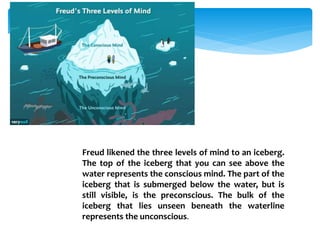
Freud likened the three levels of mind to an iceberg.
The top of the iceberg that you can see above the
water represents the conscious mind. The part of the
iceberg that is submerged below the water, but is
still visible, is the preconscious. The bulk of the
iceberg that lies unseen beneath the waterline
represents the unconscious.
The conscious mind contains all of the thoughts,
memories, feelings, and wishes of which we are
aware at any given moment. This is the aspect of our
mental processing that we can think and talk about
rationally. This also includes our memory, which is not
always part of consciousness but can be retrieved
easily and brought into awareness.
Conscious
The preconscious consists of anything that could
potentially be brought into the conscious mind.
Preconscious
Unconscious
 According to Freud (1915), the unconscious mind is the
primary source of human behavior. Like an iceberg, the
most important part of the mind is the part you cannot see.
 Our feelings, motives, and decisions are actually powerfully
influenced by our past experiences, and stored in the
unconscious.
Structural Model
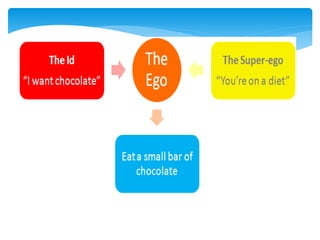
 Structural Model, which explains the three parts of a person's
personality
 id
 ego
 superego
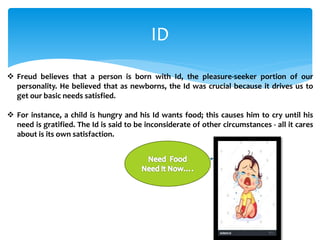
ID
 Freud believes that a person is born with Id, the pleasure-seeker portion of our
personality. He believed that as newborns, the Id was crucial because it drives us to
get our basic needs satisfied.
 For instance, a child is hungry and his Id wants food; this causes him to cry until his
need is gratified. The Id is said to be inconsiderate of other circumstances - all it cares
about is its own satisfaction.
EGO
 In a span of three years, the baby grows and starts to learn
new things as he interacts with the environment. During this
time his Ego develops.
 The ego is rooted on the principle of reality as it is the part of
one's personality. It aims to satisfy Id but considers the
situation at hand, thus balancing the Id and the Superego. .
SUPER EGO
 When the child reaches the age of five, he begins to learn about the moral
and ethical rules and restraints imposed by his parents, teachers and other
people. This is the time the Superego develops.
 It is based on the moral principle as it tells us whether something is right or
wrong.
Freud theory

Freud theory

  • 2.
    PSYCHODYNAMIC APPROACH Psychodynamic isthe study of the interrelationship of various parts of the mind, personality ,or psyche as they related to mental ,emotional, or motivational forces especially at the unconscious level (Wikipedia)
  • 3.
    Freud (1900,1905) developeda topographical model of the mind, whereby he described the features of minds structure and function Freud
  • 4.
    According to psychodynamictheory, there are three levels of the mind:  The Conscious  The Preconscious  The Unconscious The Levels of the Mind
  • 5.
    Freud likened thethree levels of mind to an iceberg. The top of the iceberg that you can see above the water represents the conscious mind. The part of the iceberg that is submerged below the water, but is still visible, is the preconscious. The bulk of the iceberg that lies unseen beneath the waterline represents the unconscious.
  • 6.
    The conscious mindcontains all of the thoughts, memories, feelings, and wishes of which we are aware at any given moment. This is the aspect of our mental processing that we can think and talk about rationally. This also includes our memory, which is not always part of consciousness but can be retrieved easily and brought into awareness. Conscious
  • 7.
    The preconscious consistsof anything that could potentially be brought into the conscious mind. Preconscious
  • 8.
    Unconscious  According toFreud (1915), the unconscious mind is the primary source of human behavior. Like an iceberg, the most important part of the mind is the part you cannot see.  Our feelings, motives, and decisions are actually powerfully influenced by our past experiences, and stored in the unconscious.
  • 9.
    Structural Model  StructuralModel, which explains the three parts of a person's personality  id  ego  superego
  • 10.
    ID  Freud believesthat a person is born with Id, the pleasure-seeker portion of our personality. He believed that as newborns, the Id was crucial because it drives us to get our basic needs satisfied.  For instance, a child is hungry and his Id wants food; this causes him to cry until his need is gratified. The Id is said to be inconsiderate of other circumstances - all it cares about is its own satisfaction.
  • 11.
    EGO  In aspan of three years, the baby grows and starts to learn new things as he interacts with the environment. During this time his Ego develops.  The ego is rooted on the principle of reality as it is the part of one's personality. It aims to satisfy Id but considers the situation at hand, thus balancing the Id and the Superego. .
  • 12.
    SUPER EGO  Whenthe child reaches the age of five, he begins to learn about the moral and ethical rules and restraints imposed by his parents, teachers and other people. This is the time the Superego develops.  It is based on the moral principle as it tells us whether something is right or wrong.