


Investigatory project
On
Transformers
Submitted in partial fulfillment of the requirements for the
AISSCE CBSE board examination
In
PHYSICS
For academic year
2017-18
Done by :
Name : Vishvjeet Yadav
Reg. No. :
Under the guidance of
Ms. Priyanka singh
Physics Teacher
Department of Physics
The Sagar school
Tijara , Alwar , Rajasthan
Certificate
Certified that the project work entitled as Transformers carried out
by Vishvjeet Yadav , Roll No . of class 12th is a bonafied
work in partial fulfillment of AISSCE in the subject Physics
prescribed by the Central Board Of Secondary Education , during the
year 2017-18 . It is Certified that all the corrections and suggestions
indicated for internal assessment have been incorporated in the
report deposited in the departmental library .
The project report have been approved as it satisfies the academic
requirements in respect of the project work prescribed for the said
examination.
Name and signature of the student : ____________________________________________
Signature of Teacher : _______________ Signature of Principal:________________
Name of the examiner & signature with date : _________________________________
 ACKNOWLEDGEMENT
In theaccomplishment ofthisproject successfully, many people have
best ownedupon me theirblessingsand theheartpledged support, this
time I amutilizingtothankallthepeople whohavebeen concerned
with project.
Primarily Iwould thankgod for being ableto complete thisproject
with success. Then I wouldliketo thankmy principal Mr.DeepakRaj
andphysics teacher Ms.Priyanka Singh , whose valuableguidance has
been theonesthathelpedme patch thisproject andmake it fullproof
success hissuggestions andhisinstructionshasservedasthemajor
contributortowards thecompletion of theproject.
Then I wouldlike tothankmy parents andfriendswho havehelpedme
with theirvaluablesuggestionsandguidance hasbeen helpfulin
variousphasesof thecompletion of theproject.
Lastbut notthe leastI wouldliketo thankmy familyand classmates
who havehelpedme alot.
INDEX
1.CERTIFICATEOF EXCELLENCE
2. ACKNOWLEDGEMENT
3. AIM OF PROJECT
4. INTRODUCTION
5. THEORY
6. APPARATUSREQUIRED
7. PROCEDUREFOLLOWED
8. OBSERVATION
9. CONCLUSION
10. PRECAUTION
11. BIBLIOGRAPHY
 INTRODUCTION
The transformer is a device used for converting a low
alternatingvoltage to a high alternatingvoltage or vice-
versa.
A Transformer based on the Principle of mutual induction
according to this principle, the amount of magnetic flux
linked with a coil changing, an e.m.f is induced in the
neighboring coil. A transformer is an electrical device
which is used for changing the A.C. voltages. A
transformer is most widely used device in both low and
high current circuit.
In a transformer, the electrical energy transfer from one
circuit to anothercircuit takes place without the use of
moving parts.
Types of Transformer :-
1)A transformer which increases the voltages is called a
step- up transformer.
2)A transformer which decreases the A.C. voltages is
called a step-down transformer.
Transformer is, therefore, an essential piece of apparatus
both for high and low current circuits.
OBJECTIVE
To investigate the relation between the
ratio of –
1. Input and output voltage.
2. Number of turnings in the secondary
coil and primary coil of a self made
transformer.
Theory
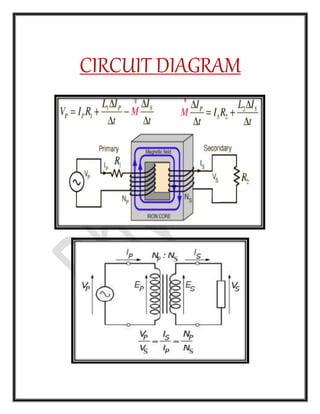
 When an altering e.m.f. is suppliedto the primary coil
p1p2, an alternating current starts falling in it. The
altering current in the primary produces a changing
magnetic flux, which induces altering voltage in the
primary as well as in the secondary. In a good-
transformer, whole of the magnetic flux linked with
primary is also linked with the secondary, and then
the inducede.m.f. inducedin each turn of the
secondary is equal to that induced in each turn of the
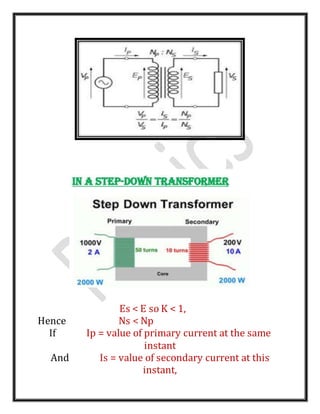
primary. Thus if Ep and Es be the instantaneous values
of the e.m.f.’s inducedin the primary and the
secondary and Np and Ns are the no. of turns of the
primary secondary coils of the transformer
and
dф / dt = rate of change of flux in each turn of the coil
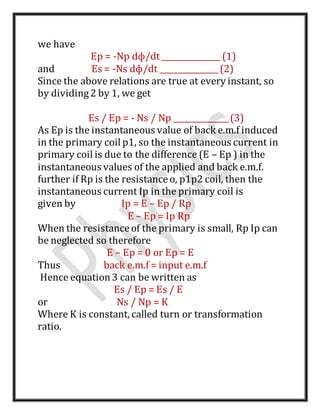
we have
Ep = -Np dф/dt_______________ (1)
and Es = -Ns dф/dt _______________(2)
Since the above relations are true at every instant, so
by dividing2 by 1, we get
Es / Ep = - Ns / Np ______________(3)
As Ep is the instantaneous value of back e.m.f induced
in the primary coil p1, so the instantaneous current in
primary coil is due to the difference (E – Ep ) in the
instantaneous values of the applied and back e.m.f.
further if Rp is the resistanceo, p1p2 coil, then the
instantaneous current Ip in the primary coil is
given by Ip = E – Ep / Rp
E – Ep = Ip Rp
When the resistanceof the primary is small, Rp Ip can
be neglected so therefore
E – Ep = 0 or Ep = E
Thus back e.m.f = input e.m.f
Hence equation3 can be written as
Es / Ep = Es / E
or Ns / Np = K
Where K is constant, called turn or transformation
ratio.
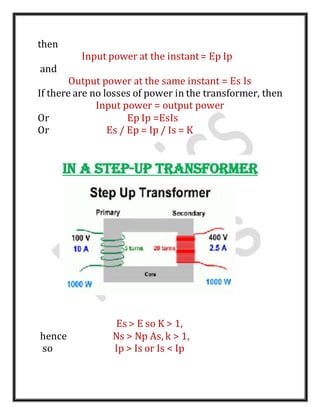
Es < E so K < 1,
Hence Ns < Np
If Ip = value of primary current at the same
instant
And Is = value of secondary current at this
instant,
then
Input power at the instant= Ep Ip
and
Output power at the same instant = Es Is
If there are no losses of power in the transformer, then
Input power = output power
Or Ep Ip =EsIs
Or Es / Ep = Ip / Is = K
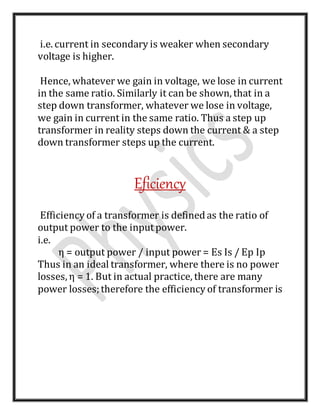
Es > E so K > 1,
hence Ns > Np As, k > 1,
so Ip > Is or Is < Ip
i.e. current in secondary is weaker when secondary
voltage is higher.
Hence, whatever we gain in voltage, we lose in current
in the same ratio. Similarly it can be shown, that in a
step down transformer, whatever we lose in voltage,
we gain in current in the same ratio. Thus a step up
transformer in reality steps down the current & a step
down transformer steps up the current.
Eficiency
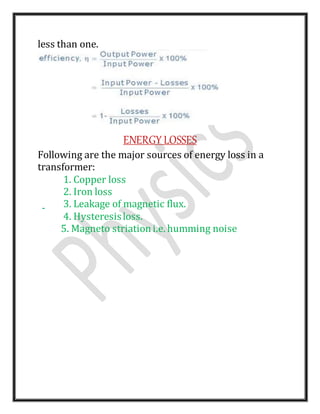
Efficiency of a transformer is definedas the ratio of
output power to the inputpower.
i.e.
η = output power / input power = Es Is / Ep Ip
Thus in an ideal transformer, where there is no power
losses, η = 1. But in actual practice, there are many
power losses;therefore the efficiency of transformer is
less than one.
ENERGY LOSSES
Following are the major sources of energy loss in a
transformer:
1. Copper loss
2. Iron loss
3. Leakage of magnetic flux.
4. Hysteresisloss.
5. Magneto striationi.e. humming noise
CIRCUIT DIAGRAM
PROCEDURE
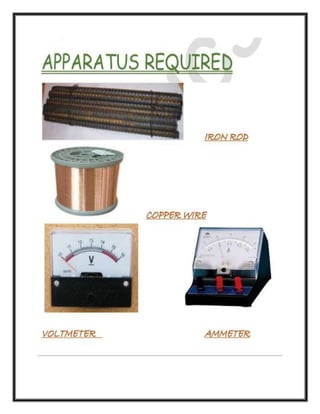
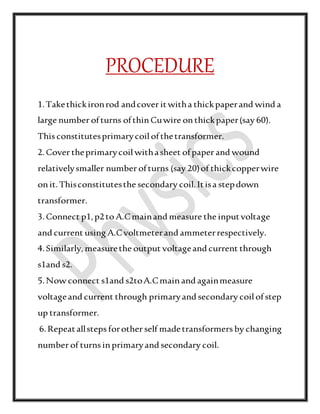
1.Takethickironrod andcover itwitha thickpaperand wind a
large number ofturns ofthinCuwire onthickpaper(say 60).
This constitutesprimarycoilofthetransformer.
2.Cover theprimarycoilwithasheet ofpaper and wound
relativelysmaller number ofturns (say 20)of thickcopperwire
onit.Thisconstitutesthe secondary coil.Itisa stepdown
transformer.
3.Connect p1,p2to A.Cmainand measure the inputvoltage
and current using A.Cvoltmeterand ammeterrespectively.
4.Similarly,measurethe output voltageand current through
s1and s2.
5.Now connect s1and s2toA.Cmainand againmeasure
voltageand current through primaryand secondary coilofstep
up transformer.
6.Repeatallsteps forother self madetransformers by changing
number of turns inprimaryand secondary coil.
USES OF TRANSFORMER
A transformer is used in almost all a.c. operations-
In voltage regulator for T.V., refrigerator,
computer, air conditioner, etc.
A step down transformer is used for welding
purposes.
A step down transformer is used for obtaining
large current.
A step up transformer is used for the production
of X-Rays and NEON advertisement.
Transformers are used in voltage regulators and
stabilizedpower supplies.
Transformers are used in the transmissions of a.c.
over long distances.
Small transformers are usedin Radiosets,
telephones, loud speakers and electric bells etc
SOURCES OF ERROR
1.Values of current can be changed due to heating
effect.
2. Eddy current can change the readings.
Conclusion
1. The output voltage of the transformer across the
secondary coil depends upon the ratio (Ns/Np) with
respect to the input voltage
2. The output voltage of the transformer across the
secondary coil depends upon the ratio (Ns/N p) with
respect to the input voltage
3. There is a loss of power between input and output
coil of a transformer.
PRECAUTIONS
1. Keep safe yourself from high voltage.
2. While taking the readings of current and voltage
the A.C should remain constant.
1) NCERT Textbook of Class 12th
2) NCERT Physics Lab Manual
3) 12th Class Pradeep Book
physics cbse 12th classs investigatory project

physics cbse 12th classs investigatory project

  • 1.
    Investigatory project On Transformers Submitted inpartial fulfillment of the requirements for the AISSCE CBSE board examination In PHYSICS For academic year 2017-18 Done by : Name : Vishvjeet Yadav Reg. No. : Under the guidance of Ms. Priyanka singh Physics Teacher Department of Physics The Sagar school
  • 2.
    Tijara , Alwar, Rajasthan Certificate Certified that the project work entitled as Transformers carried out by Vishvjeet Yadav , Roll No . of class 12th is a bonafied work in partial fulfillment of AISSCE in the subject Physics prescribed by the Central Board Of Secondary Education , during the year 2017-18 . It is Certified that all the corrections and suggestions indicated for internal assessment have been incorporated in the report deposited in the departmental library . The project report have been approved as it satisfies the academic requirements in respect of the project work prescribed for the said examination. Name and signature of the student : ____________________________________________ Signature of Teacher : _______________ Signature of Principal:________________
  • 3.
    Name of theexaminer & signature with date : _________________________________  ACKNOWLEDGEMENT In theaccomplishment ofthisproject successfully, many people have best ownedupon me theirblessingsand theheartpledged support, this time I amutilizingtothankallthepeople whohavebeen concerned with project. Primarily Iwould thankgod for being ableto complete thisproject with success. Then I wouldliketo thankmy principal Mr.DeepakRaj andphysics teacher Ms.Priyanka Singh , whose valuableguidance has been theonesthathelpedme patch thisproject andmake it fullproof success hissuggestions andhisinstructionshasservedasthemajor contributortowards thecompletion of theproject. Then I wouldlike tothankmy parents andfriendswho havehelpedme with theirvaluablesuggestionsandguidance hasbeen helpfulin variousphasesof thecompletion of theproject.
  • 4.
    Lastbut notthe leastIwouldliketo thankmy familyand classmates who havehelpedme alot. INDEX 1.CERTIFICATEOF EXCELLENCE 2. ACKNOWLEDGEMENT 3. AIM OF PROJECT 4. INTRODUCTION 5. THEORY 6. APPARATUSREQUIRED 7. PROCEDUREFOLLOWED 8. OBSERVATION 9. CONCLUSION 10. PRECAUTION
  • 5.
    11. BIBLIOGRAPHY  INTRODUCTION Thetransformer is a device used for converting a low alternatingvoltage to a high alternatingvoltage or vice- versa. A Transformer based on the Principle of mutual induction according to this principle, the amount of magnetic flux linked with a coil changing, an e.m.f is induced in the neighboring coil. A transformer is an electrical device which is used for changing the A.C. voltages. A transformer is most widely used device in both low and high current circuit. In a transformer, the electrical energy transfer from one circuit to anothercircuit takes place without the use of moving parts. Types of Transformer :- 1)A transformer which increases the voltages is called a step- up transformer. 2)A transformer which decreases the A.C. voltages is called a step-down transformer.
  • 6.
    Transformer is, therefore,an essential piece of apparatus both for high and low current circuits. OBJECTIVE To investigate the relation between the ratio of – 1. Input and output voltage. 2. Number of turnings in the secondary coil and primary coil of a self made transformer.
  • 7.
    Theory  When analtering e.m.f. is suppliedto the primary coil p1p2, an alternating current starts falling in it. The altering current in the primary produces a changing magnetic flux, which induces altering voltage in the primary as well as in the secondary. In a good- transformer, whole of the magnetic flux linked with primary is also linked with the secondary, and then the inducede.m.f. inducedin each turn of the secondary is equal to that induced in each turn of the primary. Thus if Ep and Es be the instantaneous values of the e.m.f.’s inducedin the primary and the secondary and Np and Ns are the no. of turns of the primary secondary coils of the transformer and dф / dt = rate of change of flux in each turn of the coil
  • 8.
    we have Ep =-Np dф/dt_______________ (1) and Es = -Ns dф/dt _______________(2) Since the above relations are true at every instant, so by dividing2 by 1, we get Es / Ep = - Ns / Np ______________(3) As Ep is the instantaneous value of back e.m.f induced in the primary coil p1, so the instantaneous current in primary coil is due to the difference (E – Ep ) in the instantaneous values of the applied and back e.m.f. further if Rp is the resistanceo, p1p2 coil, then the instantaneous current Ip in the primary coil is given by Ip = E – Ep / Rp E – Ep = Ip Rp When the resistanceof the primary is small, Rp Ip can be neglected so therefore E – Ep = 0 or Ep = E Thus back e.m.f = input e.m.f Hence equation3 can be written as Es / Ep = Es / E or Ns / Np = K Where K is constant, called turn or transformation ratio.
  • 9.
    Es < Eso K < 1, Hence Ns < Np If Ip = value of primary current at the same instant And Is = value of secondary current at this instant,
  • 10.
    then Input power atthe instant= Ep Ip and Output power at the same instant = Es Is If there are no losses of power in the transformer, then Input power = output power Or Ep Ip =EsIs Or Es / Ep = Ip / Is = K Es > E so K > 1, hence Ns > Np As, k > 1, so Ip > Is or Is < Ip
  • 11.
    i.e. current insecondary is weaker when secondary voltage is higher. Hence, whatever we gain in voltage, we lose in current in the same ratio. Similarly it can be shown, that in a step down transformer, whatever we lose in voltage, we gain in current in the same ratio. Thus a step up transformer in reality steps down the current & a step down transformer steps up the current. Eficiency Efficiency of a transformer is definedas the ratio of output power to the inputpower. i.e. η = output power / input power = Es Is / Ep Ip Thus in an ideal transformer, where there is no power losses, η = 1. But in actual practice, there are many power losses;therefore the efficiency of transformer is
  • 12.
    less than one. ENERGYLOSSES Following are the major sources of energy loss in a transformer: 1. Copper loss 2. Iron loss 3. Leakage of magnetic flux. 4. Hysteresisloss. 5. Magneto striationi.e. humming noise
  • 14.
  • 15.
    PROCEDURE 1.Takethickironrod andcover itwithathickpaperand wind a large number ofturns ofthinCuwire onthickpaper(say 60). This constitutesprimarycoilofthetransformer. 2.Cover theprimarycoilwithasheet ofpaper and wound relativelysmaller number ofturns (say 20)of thickcopperwire onit.Thisconstitutesthe secondary coil.Itisa stepdown transformer. 3.Connect p1,p2to A.Cmainand measure the inputvoltage and current using A.Cvoltmeterand ammeterrespectively. 4.Similarly,measurethe output voltageand current through s1and s2. 5.Now connect s1and s2toA.Cmainand againmeasure voltageand current through primaryand secondary coilofstep up transformer. 6.Repeatallsteps forother self madetransformers by changing number of turns inprimaryand secondary coil.
  • 16.
    USES OF TRANSFORMER Atransformer is used in almost all a.c. operations- In voltage regulator for T.V., refrigerator, computer, air conditioner, etc. A step down transformer is used for welding purposes. A step down transformer is used for obtaining large current. A step up transformer is used for the production of X-Rays and NEON advertisement. Transformers are used in voltage regulators and stabilizedpower supplies. Transformers are used in the transmissions of a.c. over long distances. Small transformers are usedin Radiosets, telephones, loud speakers and electric bells etc
  • 17.
    SOURCES OF ERROR 1.Valuesof current can be changed due to heating effect. 2. Eddy current can change the readings. Conclusion 1. The output voltage of the transformer across the secondary coil depends upon the ratio (Ns/Np) with respect to the input voltage 2. The output voltage of the transformer across the secondary coil depends upon the ratio (Ns/N p) with respect to the input voltage 3. There is a loss of power between input and output coil of a transformer. PRECAUTIONS
  • 18.
    1. Keep safeyourself from high voltage. 2. While taking the readings of current and voltage the A.C should remain constant. 1) NCERT Textbook of Class 12th
  • 19.
    2) NCERT PhysicsLab Manual 3) 12th Class Pradeep Book