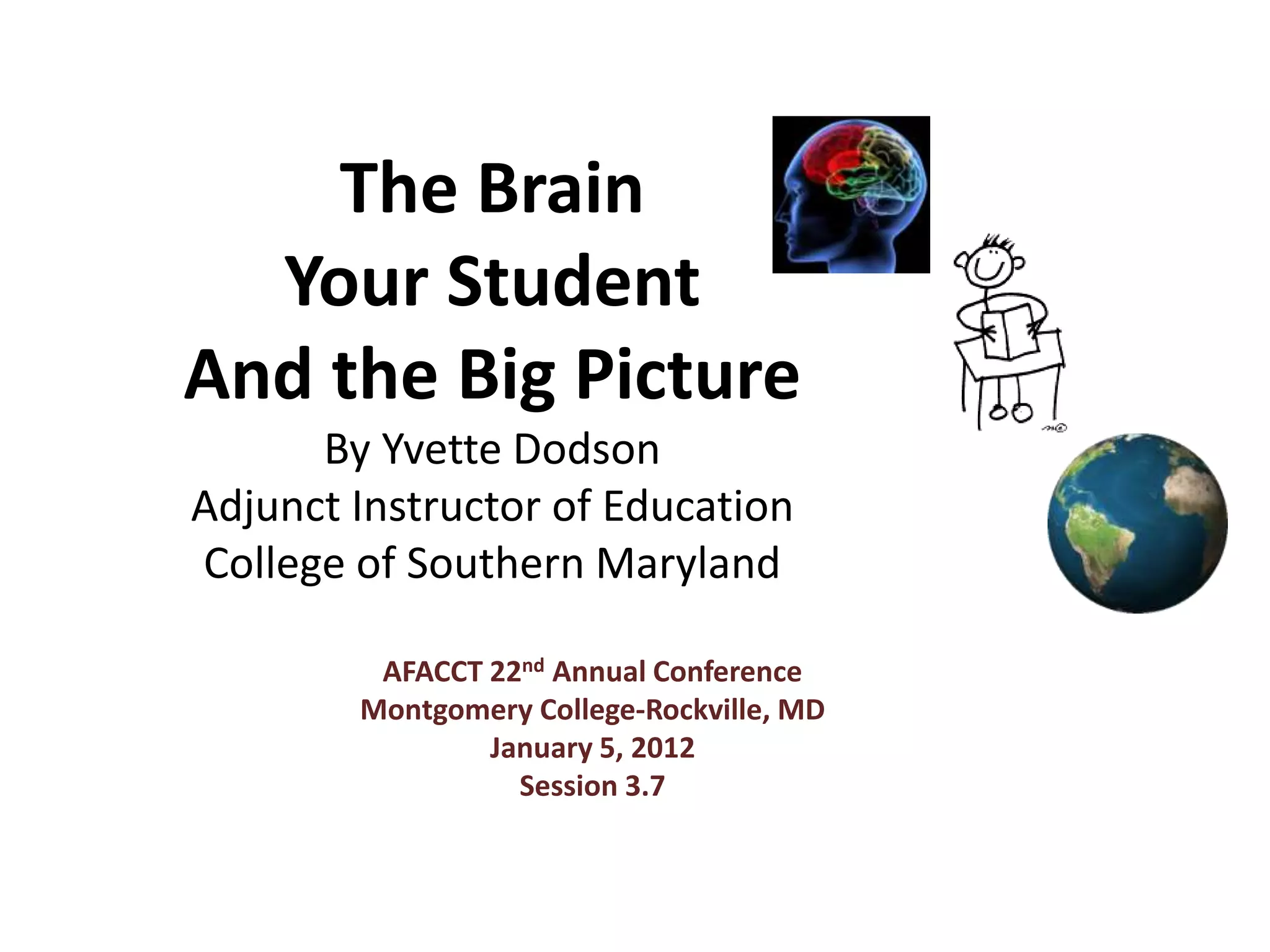
The Brain
  Your Student
And the Big Picture
      By Yvette Dodson
Adjunct Instructor of Education
College of Southern Maryland

         AFACCT 22nd Annual Conference
        Montgomery College-Rockville, MD
                January 5, 2012
                  Session 3.7
Introduction

•   Purpose
•   Education in crisis or culture in crisis?
•   College Readiness
•   Global Production
•   Brain Based Theory
•   Developmental Psychology
•   Teaching Strategies and techniques for lectures
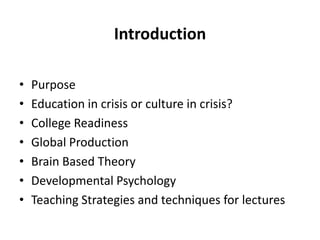
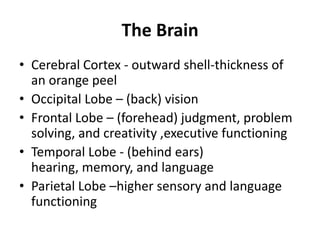
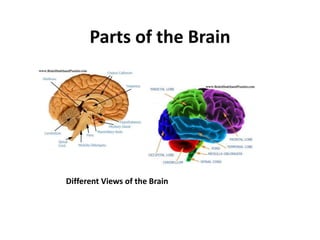
The Brain
• Cerebral Cortex - outward shell-thickness of
  an orange peel
• Occipital Lobe – (back) vision
• Frontal Lobe – (forehead) judgment, problem
  solving, and creativity ,executive functioning
• Temporal Lobe - (behind ears)
  hearing, memory, and language
• Parietal Lobe –higher sensory and language
  functioning
Parts of the Brain


Different Views of the Brain
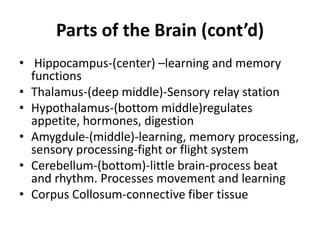
Parts of the Brain (cont’d)
• Hippocampus-(center) –learning and memory
  functions
• Thalamus-(deep middle)-Sensory relay station
• Hypothalamus-(bottom middle)regulates
  appetite, hormones, digestion
• Amygdule-(middle)-learning, memory processing,
  sensory processing-fight or flight system
• Cerebellum-(bottom)-little brain-process beat
  and rhythm. Processes movement and learning
• Corpus Collosum-connective fiber tissue
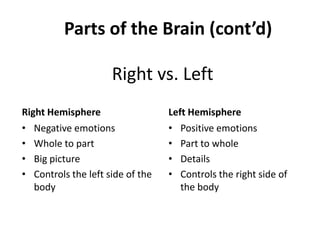
Parts of the Brain (cont’d)

                     Right vs. Left
Right Hemisphere                  Left Hemisphere
• Negative emotions               • Positive emotions
• Whole to part                   • Part to whole
• Big picture                     • Details
• Controls the left side of the   • Controls the right side of
   body                              the body
Nutrition
• Hydration
• Glucose levels-low glucose levels negatively effect the
  hippocampus (learning and memory)
• Vitamin supplements for birth-7 years old
• Protein- aids in the production of
  dopamine, norepinephrine for quick reactions, thinking and
  memory
• Iron, zinc, iodine, selenium-mood regulation, energy, and
  concentration. Anemia-low iron-low energy levels
  especially in afternoon.(blackstrap molasses is a rich source
  of iron) Vitamin c aides in the body’s absorption of iron.
  Caffeine inhibits absorption of iron.
• Vitamins A, B, C, and E-vision, strength, memory
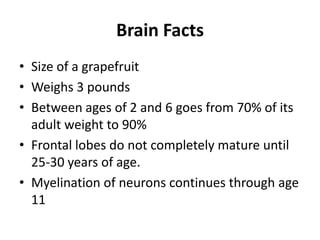
Brain Facts
• Size of a grapefruit
• Weighs 3 pounds
• Between ages of 2 and 6 goes from 70% of its
  adult weight to 90%
• Frontal lobes do not completely mature until
  25-30 years of age.
• Myelination of neurons continues through age
  11
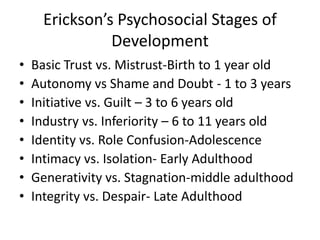
Erickson’s Psychosocial Stages of
                Development
•   Basic Trust vs. Mistrust-Birth to 1 year old
•   Autonomy vs Shame and Doubt - 1 to 3 years
•   Initiative vs. Guilt – 3 to 6 years old
•   Industry vs. Inferiority – 6 to 11 years old
•   Identity vs. Role Confusion-Adolescence
•   Intimacy vs. Isolation- Early Adulthood
•   Generativity vs. Stagnation-middle adulthood
•   Integrity vs. Despair- Late Adulthood
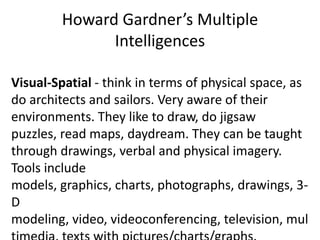
Howard Gardner’s Multiple
               Intelligences

Visual-Spatial - think in terms of physical space, as
do architects and sailors. Very aware of their
environments. They like to draw, do jigsaw
puzzles, read maps, daydream. They can be taught
through drawings, verbal and physical imagery.
Tools include
models, graphics, charts, photographs, drawings, 3-
D
modeling, video, videoconferencing, television, mul
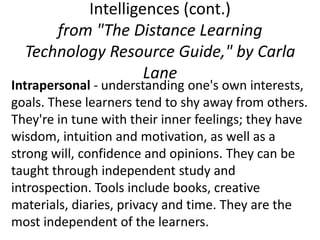
Intelligences (cont.)
      from "The Distance Learning
  Technology Resource Guide," by Carla
                   Lane
Intrapersonal - understanding one's own interests,
goals. These learners tend to shy away from others.
They're in tune with their inner feelings; they have
wisdom, intuition and motivation, as well as a
strong will, confidence and opinions. They can be
taught through independent study and
introspection. Tools include books, creative
materials, diaries, privacy and time. They are the
most independent of the learners.
Multiple Intelligences (cont.)
                 Carla Lane


Linguistic - using words effectively. These learners
have highly developed auditory skills and often
think in words. They like reading, playing word
games, making up poetry or stories. They can be
taught by encouraging them to say and see words,
read books together. Tools include computers,
games, multimedia, books, tape recorders, and
lecture.
Multiple Intelligences (cont)


Logical -Mathematical - reasoning, calculating.
Think conceptually, abstractly and are able to see
and explore patterns and relationships. They like to
experiment, solve puzzles, ask cosmic questions.
They can be taught through logic
games, investigations, mysteries. They need to learn
and form concepts before they can deal with
Multiple Intelligences (cont.)
• Bodily-kinesthetic - use the body effectively, like a dancer
  or a surgeon. Keen sense of body awareness. They like
  movement, making things, touching. They communicate
  well through body language and be taught through physical
  activity, hands-on learning, acting out, role playing. Tools
  include equipment and real objects.
• Musical - show sensitivity to rhythm and sound. They love
  music, but they are also sensitive to sounds in their
  environments. They may study better with music in the
  background. They can be taught by turning lessons into
  lyrics, speaking rhythmically, tapping out time. Tools
  include musical instruments, music, radio, stereo, CD-ROM,
  multimedia.
Multiple Intelligences
• Interpersonal - understanding, interacting with others. These
  students learn through interaction. They have many friends,
  empathy for others, street smarts. They can be taught through
  group activities, seminars, dialogues. Tools include the telephone,
  audio conferencing, time and attention from the instructor, video
  conferencing, writing, computer conferencing, E-mail.
• Intrapersonal - understanding one's own interests, goals. These
  learners tend to shy away from others. They're in tune with their
  inner feelings; they have wisdom, intuition and motivation, as well
  as a strong will, confidence and opinions. They can be taught
  through independent study and introspection. Tools include books,
  creative materials, diaries, privacy and time. They are the most
  independent of the learners.
Creating a Learning Environment
•   Safety
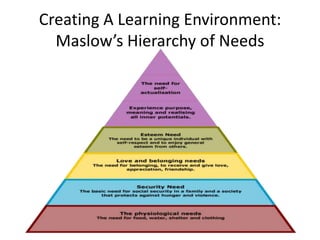
     – Maslow’s hierarchy of needs
•   How Mood States Effect Learning
     – Too much anxiety produces too much cortisol and blocks learning (fire truck at the
       intersection analogy)
     – A little bit of anxiety produces enough cortisol for motivation to learn and recall
     – Memory is regulated by adrenaline, serotonin, and acetylcholine
•   Classroom Rituals
     – Drills
     – reviews
•   Physical Environment
     – Room temp. (optimal learning between 68 and 72 degrees)
     – Lighting (the more natural sunlight the better. Produces melatonin responsible for setting your
       circadian rhythm and serotonin responsible for feelings of contentment.)
     – Color
Creating A Learning Environment:
  Maslow’s Hierarchy of Needs
What color means
                 (Allen,2004)
• Red-courage passion, love , excitement, danger, anger,
  fire, strength-increases blood pressure
• Yellow-cowardice, deceit, sunlight, optimism, warmth,
  enlightenment, communication-stimulates the brain
  and makes you alert and decisive
• Orange-Cheerfulness, stimulation, sunset, excitement-
  good for digestive system, positive emotion
• Blue- honesty, truth, loyalty, masculinity, formality,
  tranquility, sobriety-lowers blood pressure, soothing
  effect, inspires mental control and creativity.
What Color Means
              (Allen,2004)
• Green –nature, serenity, hope, safety, peace,
  passivity, security, -good for heart, creates
  feeling of comfort, relaxes muscles.
• Violet-royalty, nobility, snobbery, power,
  drama, dignity-alleviates symptoms of
  sunburn, suppresses hunger, balances
  metabolism
• White-purity, cleanliness, fresh-feelings of
  peace and comfort, dispels shock and despair
What Color Means
              (Allen,2004)
• Black-mourning sorrow, depression, mystery-
  associated with silence and death
• Gray-penance, gloom, storm, intelligence, high
  tech, sophisticated-self reliance, loneliness
• Brown-
  earth, wood, warmth, comfort, security, suppo
  rt-associated with withholding emotion and
  retreating from the world
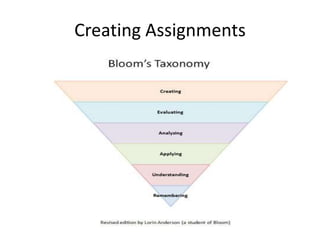
Creating Assignments
Creating assignments
• Engage learners in critical thinking skills by
  connecting their experiences with the new
  information prior to presenting new
  information
• Ask questions that provoke students to
  synthesize, analyze, evaluate, apply and create
Creating Assignments(cont)
•   Priming (“priming the pump”) getting students ready to learn the concepts
     –    Introduce terms and concepts weeks prior to presenting them
     –    Strategically placing informational charts or lists in the room to generate discussion
     –    Fill in the blank prompts
     –    KWL chart (What do we know about the subject, What do we want to know about the subject, what did we learn as a result of
          this lesson
•   Social learning
     –    Peer quiz correction
     –    Peer discussion of topics
     –    Group presentations
•   Movement/Music
     –    Breaks are best for settling new information as opposed to lecturing straight through.
     –    Get students to move and change positions instead of sitting in the same place all lecture
     –    15-18 minutes of direct instruction then change the activity or lecture format
     –    Charade review of terms and concepts
     –    Cerebellum is responsible for movement and memory –movement and music help strengthen the learning path way being
          created
•   Critical Thinking
     –    Bloom’s taxonomy
     –    Ask questions that connect a students prior knowledge with the new knowledge to entangle the learner in the concept
     –    Ask questions that compare and contrast, evaluate, analyze, or syntheisis new information with practical application
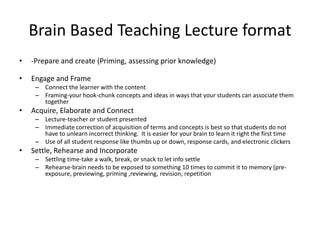
Brain Based Teaching Lecture format
•   -Prepare and create (Priming, assessing prior knowledge)

•   Engage and Frame
     – Connect the learner with the content
     – Framing-your hook-chunk concepts and ideas in ways that your students can associate them
       together
•   Acquire, Elaborate and Connect
     – Lecture-teacher or student presented
     – Immediate correction of acquisition of terms and concepts is best so that students do not
       have to unlearn incorrect thinking. It is easier for your brain to learn it right the first time
     – Use of all student response like thumbs up or down, response cards, and electronic clickers
•   Settle, Rehearse and Incorporate
     – Settling time-take a walk, break, or snack to let info settle
     – Rehearse-brain needs to be exposed to something 10 times to commit it to memory (pre-
       exposure, previewing, priming ,reviewing, revision, repetition
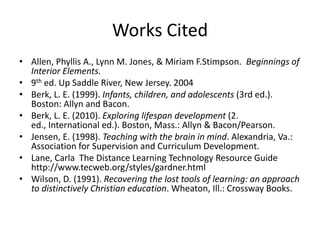
Works Cited
• Allen, Phyllis A., Lynn M. Jones, & Miriam F.Stimpson. Beginnings of
  Interior Elements.
• 9th ed. Up Saddle River, New Jersey. 2004
• Berk, L. E. (1999). Infants, children, and adolescents (3rd ed.).
  Boston: Allyn and Bacon.
• Berk, L. E. (2010). Exploring lifespan development (2.
  ed., International ed.). Boston, Mass.: Allyn & Bacon/Pearson.
• Jensen, E. (1998). Teaching with the brain in mind. Alexandria, Va.:
  Association for Supervision and Curriculum Development.
• Lane, Carla The Distance Learning Technology Resource Guide
  http://www.tecweb.org/styles/gardner.html
• Wilson, D. (1991). Recovering the lost tools of learning: an approach
  to distinctively Christian education. Wheaton, Ill.: Crossway Books.

3.7.dodson

  • 1.
    The Brain Your Student And the Big Picture By Yvette Dodson Adjunct Instructor of Education College of Southern Maryland AFACCT 22nd Annual Conference Montgomery College-Rockville, MD January 5, 2012 Session 3.7
  • 2.
    Introduction • Purpose • Education in crisis or culture in crisis? • College Readiness • Global Production • Brain Based Theory • Developmental Psychology • Teaching Strategies and techniques for lectures
  • 3.
    The Brain • CerebralCortex - outward shell-thickness of an orange peel • Occipital Lobe – (back) vision • Frontal Lobe – (forehead) judgment, problem solving, and creativity ,executive functioning • Temporal Lobe - (behind ears) hearing, memory, and language • Parietal Lobe –higher sensory and language functioning
  • 4.
    Parts of theBrain Different Views of the Brain
  • 5.
    Parts of theBrain (cont’d) • Hippocampus-(center) –learning and memory functions • Thalamus-(deep middle)-Sensory relay station • Hypothalamus-(bottom middle)regulates appetite, hormones, digestion • Amygdule-(middle)-learning, memory processing, sensory processing-fight or flight system • Cerebellum-(bottom)-little brain-process beat and rhythm. Processes movement and learning • Corpus Collosum-connective fiber tissue
  • 6.
    Parts of theBrain (cont’d) Right vs. Left Right Hemisphere Left Hemisphere • Negative emotions • Positive emotions • Whole to part • Part to whole • Big picture • Details • Controls the left side of the • Controls the right side of body the body
  • 7.
    Nutrition • Hydration • Glucoselevels-low glucose levels negatively effect the hippocampus (learning and memory) • Vitamin supplements for birth-7 years old • Protein- aids in the production of dopamine, norepinephrine for quick reactions, thinking and memory • Iron, zinc, iodine, selenium-mood regulation, energy, and concentration. Anemia-low iron-low energy levels especially in afternoon.(blackstrap molasses is a rich source of iron) Vitamin c aides in the body’s absorption of iron. Caffeine inhibits absorption of iron. • Vitamins A, B, C, and E-vision, strength, memory
  • 8.
    Brain Facts • Sizeof a grapefruit • Weighs 3 pounds • Between ages of 2 and 6 goes from 70% of its adult weight to 90% • Frontal lobes do not completely mature until 25-30 years of age. • Myelination of neurons continues through age 11
  • 9.
    Erickson’s Psychosocial Stagesof Development • Basic Trust vs. Mistrust-Birth to 1 year old • Autonomy vs Shame and Doubt - 1 to 3 years • Initiative vs. Guilt – 3 to 6 years old • Industry vs. Inferiority – 6 to 11 years old • Identity vs. Role Confusion-Adolescence • Intimacy vs. Isolation- Early Adulthood • Generativity vs. Stagnation-middle adulthood • Integrity vs. Despair- Late Adulthood
  • 10.
    Howard Gardner’s Multiple Intelligences Visual-Spatial - think in terms of physical space, as do architects and sailors. Very aware of their environments. They like to draw, do jigsaw puzzles, read maps, daydream. They can be taught through drawings, verbal and physical imagery. Tools include models, graphics, charts, photographs, drawings, 3- D modeling, video, videoconferencing, television, mul
  • 11.
    Intelligences (cont.) from "The Distance Learning Technology Resource Guide," by Carla Lane Intrapersonal - understanding one's own interests, goals. These learners tend to shy away from others. They're in tune with their inner feelings; they have wisdom, intuition and motivation, as well as a strong will, confidence and opinions. They can be taught through independent study and introspection. Tools include books, creative materials, diaries, privacy and time. They are the most independent of the learners.
  • 12.
    Multiple Intelligences (cont.) Carla Lane Linguistic - using words effectively. These learners have highly developed auditory skills and often think in words. They like reading, playing word games, making up poetry or stories. They can be taught by encouraging them to say and see words, read books together. Tools include computers, games, multimedia, books, tape recorders, and lecture.
  • 13.
    Multiple Intelligences (cont) Logical-Mathematical - reasoning, calculating. Think conceptually, abstractly and are able to see and explore patterns and relationships. They like to experiment, solve puzzles, ask cosmic questions. They can be taught through logic games, investigations, mysteries. They need to learn and form concepts before they can deal with
  • 14.
    Multiple Intelligences (cont.) •Bodily-kinesthetic - use the body effectively, like a dancer or a surgeon. Keen sense of body awareness. They like movement, making things, touching. They communicate well through body language and be taught through physical activity, hands-on learning, acting out, role playing. Tools include equipment and real objects. • Musical - show sensitivity to rhythm and sound. They love music, but they are also sensitive to sounds in their environments. They may study better with music in the background. They can be taught by turning lessons into lyrics, speaking rhythmically, tapping out time. Tools include musical instruments, music, radio, stereo, CD-ROM, multimedia.
  • 15.
    Multiple Intelligences • Interpersonal- understanding, interacting with others. These students learn through interaction. They have many friends, empathy for others, street smarts. They can be taught through group activities, seminars, dialogues. Tools include the telephone, audio conferencing, time and attention from the instructor, video conferencing, writing, computer conferencing, E-mail. • Intrapersonal - understanding one's own interests, goals. These learners tend to shy away from others. They're in tune with their inner feelings; they have wisdom, intuition and motivation, as well as a strong will, confidence and opinions. They can be taught through independent study and introspection. Tools include books, creative materials, diaries, privacy and time. They are the most independent of the learners.
  • 16.
    Creating a LearningEnvironment • Safety – Maslow’s hierarchy of needs • How Mood States Effect Learning – Too much anxiety produces too much cortisol and blocks learning (fire truck at the intersection analogy) – A little bit of anxiety produces enough cortisol for motivation to learn and recall – Memory is regulated by adrenaline, serotonin, and acetylcholine • Classroom Rituals – Drills – reviews • Physical Environment – Room temp. (optimal learning between 68 and 72 degrees) – Lighting (the more natural sunlight the better. Produces melatonin responsible for setting your circadian rhythm and serotonin responsible for feelings of contentment.) – Color
  • 17.
    Creating A LearningEnvironment: Maslow’s Hierarchy of Needs
  • 18.
    What color means (Allen,2004) • Red-courage passion, love , excitement, danger, anger, fire, strength-increases blood pressure • Yellow-cowardice, deceit, sunlight, optimism, warmth, enlightenment, communication-stimulates the brain and makes you alert and decisive • Orange-Cheerfulness, stimulation, sunset, excitement- good for digestive system, positive emotion • Blue- honesty, truth, loyalty, masculinity, formality, tranquility, sobriety-lowers blood pressure, soothing effect, inspires mental control and creativity.
  • 19.
    What Color Means (Allen,2004) • Green –nature, serenity, hope, safety, peace, passivity, security, -good for heart, creates feeling of comfort, relaxes muscles. • Violet-royalty, nobility, snobbery, power, drama, dignity-alleviates symptoms of sunburn, suppresses hunger, balances metabolism • White-purity, cleanliness, fresh-feelings of peace and comfort, dispels shock and despair
  • 20.
    What Color Means (Allen,2004) • Black-mourning sorrow, depression, mystery- associated with silence and death • Gray-penance, gloom, storm, intelligence, high tech, sophisticated-self reliance, loneliness • Brown- earth, wood, warmth, comfort, security, suppo rt-associated with withholding emotion and retreating from the world
  • 21.
  • 22.
    Creating assignments • Engagelearners in critical thinking skills by connecting their experiences with the new information prior to presenting new information • Ask questions that provoke students to synthesize, analyze, evaluate, apply and create
  • 23.
    Creating Assignments(cont) • Priming (“priming the pump”) getting students ready to learn the concepts – Introduce terms and concepts weeks prior to presenting them – Strategically placing informational charts or lists in the room to generate discussion – Fill in the blank prompts – KWL chart (What do we know about the subject, What do we want to know about the subject, what did we learn as a result of this lesson • Social learning – Peer quiz correction – Peer discussion of topics – Group presentations • Movement/Music – Breaks are best for settling new information as opposed to lecturing straight through. – Get students to move and change positions instead of sitting in the same place all lecture – 15-18 minutes of direct instruction then change the activity or lecture format – Charade review of terms and concepts – Cerebellum is responsible for movement and memory –movement and music help strengthen the learning path way being created • Critical Thinking – Bloom’s taxonomy – Ask questions that connect a students prior knowledge with the new knowledge to entangle the learner in the concept – Ask questions that compare and contrast, evaluate, analyze, or syntheisis new information with practical application
  • 24.
    Brain Based TeachingLecture format • -Prepare and create (Priming, assessing prior knowledge) • Engage and Frame – Connect the learner with the content – Framing-your hook-chunk concepts and ideas in ways that your students can associate them together • Acquire, Elaborate and Connect – Lecture-teacher or student presented – Immediate correction of acquisition of terms and concepts is best so that students do not have to unlearn incorrect thinking. It is easier for your brain to learn it right the first time – Use of all student response like thumbs up or down, response cards, and electronic clickers • Settle, Rehearse and Incorporate – Settling time-take a walk, break, or snack to let info settle – Rehearse-brain needs to be exposed to something 10 times to commit it to memory (pre- exposure, previewing, priming ,reviewing, revision, repetition
  • 25.
    Works Cited • Allen,Phyllis A., Lynn M. Jones, & Miriam F.Stimpson. Beginnings of Interior Elements. • 9th ed. Up Saddle River, New Jersey. 2004 • Berk, L. E. (1999). Infants, children, and adolescents (3rd ed.). Boston: Allyn and Bacon. • Berk, L. E. (2010). Exploring lifespan development (2. ed., International ed.). Boston, Mass.: Allyn & Bacon/Pearson. • Jensen, E. (1998). Teaching with the brain in mind. Alexandria, Va.: Association for Supervision and Curriculum Development. • Lane, Carla The Distance Learning Technology Resource Guide http://www.tecweb.org/styles/gardner.html • Wilson, D. (1991). Recovering the lost tools of learning: an approach to distinctively Christian education. Wheaton, Ill.: Crossway Books.