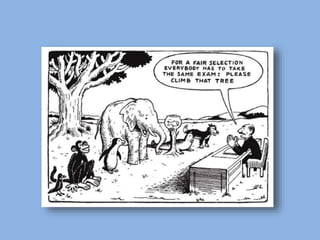
Course outline
• What is good learning?
• What do we all understand by assessment?
• Researching assessment practices in our own
context.
MA Education
Learning & Assessment
Success Criteria
A written assignment (4500 words)
“The Assignment requires you to systematically analyse relevant
academic, policy and practice sources and conclude with issues
raised in relation to your learning and assessment practice in an
education setting”. …… yikes!
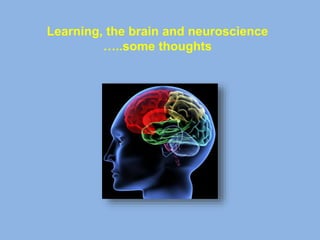
Learning, the brain and neuroscience
…..some thoughts
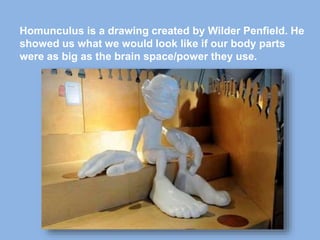
Homunculus is a drawing created by Wilder Penfield. He
showed us what we would look like if our body parts
were as big as the brain space/power they use.
During pregnancy, a woman’s brain will shrink.
It will take up to 6 months to regain its size.
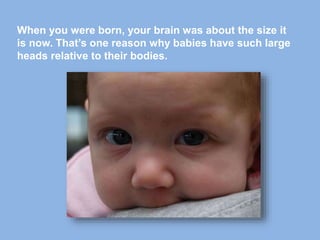
When you were born, your brain was about the size it
is now. That’s one reason why babies have such large
heads relative to their bodies.
Experts estimate that, over the course of a
lifetime, modern human brains will retain
up to 1 quadrillion pieces of information
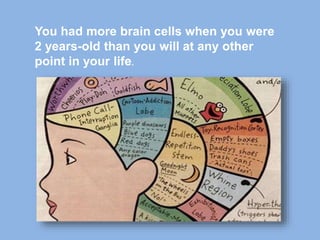
You had more brain cells when you were
2 years-old than you will at any other
point in your life.
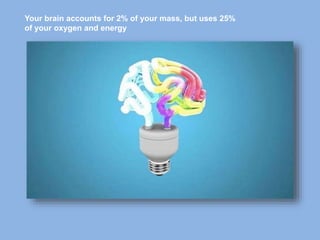
Your brain accounts for 2% of your mass, but uses 25%
of your oxygen and energy
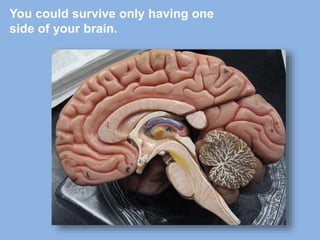
You could survive only having one
side of your brain.
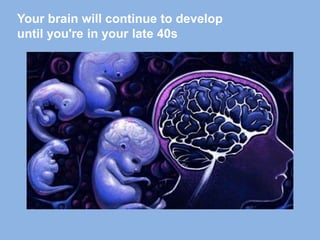
Your brain will continue to develop
until you're in your late 40s
Every day, you have about 70,000
thoughts
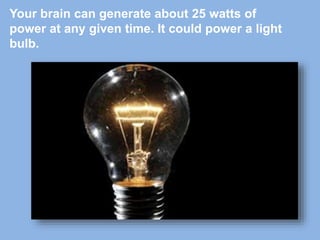
Your brain can generate about 25 watts of
power at any given time. It could power a light
bulb.
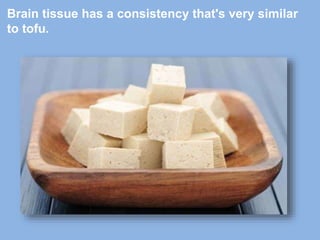
Brain tissue has a consistency that's very similar
to tofu.
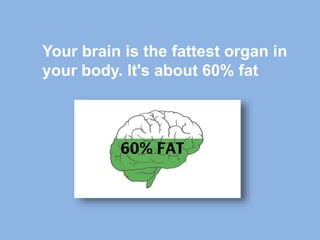
Your brain is the fattest organ in
your body. It's about 60% fat
Your brain doesn’t have pain receptors. It
can’t feel anything.
Information can go in between parts of your
brain at a speed of 260mph.
Deep and Surface are classifications of
approaches to learning derived from original
research done by educational psychologists.
Marton and Säljö (1976) and since elaborated
by Ramsden (1992), Biggs (1987, 1993) and
Entwistle (1981), amongst others.
Learning
• Learning as a quantitative increase in
knowledge. Learning is acquiring
information or “knowing a lot”.
• Learning as memorising. Learning is
storing information that can be
reproduced.
• Learning as acquiring facts, skills and
methods that can be retained and used
as necessary.
Surface learning
 Learning as making sense or abstracting
meaning. Learning involves relating parts
of the subject matter to each other and to
the real world.
 Learning as interpreting and
understanding reality in a different
way. Learning involves comprehending
the world by re-interpreting knowledge.
Deep learning
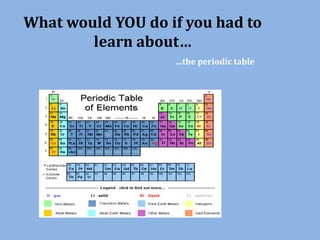
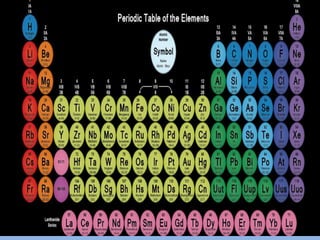
What would YOU do if you had to
learn about…
…the periodic table
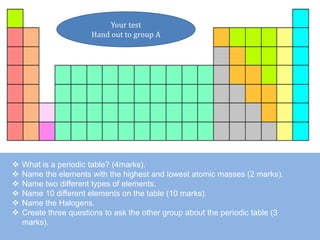
 What is a periodic table? (4marks).
 Name the elements with the highest and lowest atomic masses (2 marks).
 Name two different types of elements.
 Name 10 different elements on the table (10 marks).
 Name the Halogens.
 Create three questions to ask the other group about the periodic table (3
marks).
Your test
Hand out to group A
1. What did the learning feel like?
2. Was it cheating giving the group the specific
questions that they would be tested on?
3. Was anything missing that would have allowed
better learning?
4. Did anyone want to give up on the task?
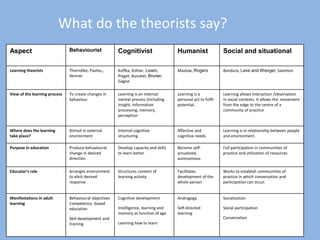
What do the theorists say?
Aspect Behaviourist Cognitivist Humanist Social and situational
Learning theorists Thorndike, Pavlov,,
Skinner
Koffka, Kohler, Lewin,
Piaget, Ausubel, Bruner,
Gagne
Maslow, Rogers Bandura, Lave and Wenger, Salomon
View of the learning process To create changes in
behaviour
Learning is an Internal
mental process (including
insight, information
processing, memory,
perception
Learning is a
personal act to fulfil
potential.
Learning allows Interaction /observation
in social contexts. It allows the movement
from the edge to the centre of a
community of practice
Where does the learning
take place?
Stimuli in external
environment
Internal cognitive
structuring
Affective and
cognitive needs
Learning is in relationship between people
and environment.
Purpose in education Produce behavioural
change in desired
direction
Develop capacity and skills
to learn better
Become self-
actualized,
autonomous
Full participation in communities of
practice and utilization of resources
Educator's role Arranges environment
to elicit desired
response
Structures content of
learning activity
Facilitates
development of the
whole person
Works to establish communities of
practice in which conversation and
participation can occur.
Manifestations in adult
learning
Behavioural objectives
Competency -based
education
Skill development and
training
Cognitive development
Intelligence, learning and
memory as function of age
Learning how to learn
Andragogy
Self-directed
learning
Socialization
Social participation
Conversation
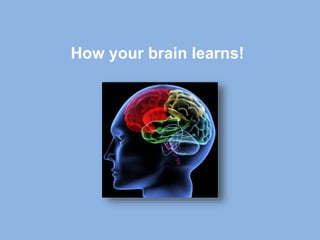
How your brain learns!
Brain as a triadic structure
Lower
[Reptilian] Brain
controls basic
sensory motor
functions
Limbic
[Mammalian
Brain]
controls
emotions,
memory, and
biorhythms
Neo-cortex
[‘thinking brain’]
controls
cognition,
reasoning,
language, and
higher
intelligence
The Reptilian Brain
At the top end of the spinal cord, the reptilian brain is the part of the
brain responsible for:
• Survival fight or flight responses; lashing out; screams. Monitoring
motor functions - breathing; balance and instinctual responses.
• Territoriality - defensiveness about possessions; friendships; personal
space.
• Mating rituals - attention seeking; showing off.
• Hierarchies - the need to be or be associated with, the gang leader.
• Rote behaviours - behaviours which are repetitive, predictable, and
rarely constructive
Higher order thinking skills are displaced by survival, ritualistic and rote
behaviours…This means that the learner under stress will resort to rote
and ritualistic responses. A learner in your classroom who is under
stress or anxiety will not learn easily……
The Limbic System
The middle brain or limbic system controls the emotions,
maintenance functions and, most significantly, is the site of the
long-term memory…This part of the brain runs our emotions and
our immune system, dictates sleeping cycles, eating patterns and
sexuality…The recticular system filters in useful and valued
information and filters out useless information. This is the part of
the brain which validates new knowledge and, as such, is sited in
the area of the brain associated with the long-term memory and
emotions.
For the brain to validate learning there must be an emotional
connection. The learning must be associated with a purpose
which the learner has set. Strong, personal and real learning
goals are therefore imperative for accelerated learning. The brain
values emotions and emotional associations more than higher
order thinking skills. This is important in understanding memory
and particularly in siting new knowledge in the long-term memory.
What should we see in a school
that assesses well?
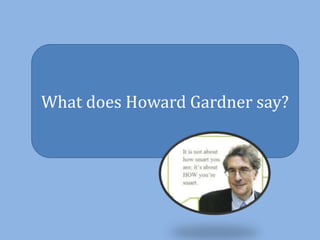
What does Howard Gardner say?
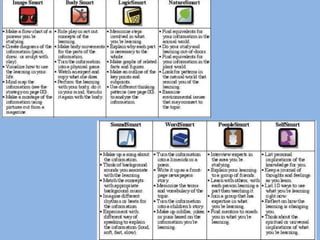
Multiple Intelligences
According to Howard Gardner (1983), there are multiple intelligences,
and people are more proficient in some areas than in others.
Gardner described seven different types of intelligence: logical-
mathematical; linguistic; musical; spatial; bodily-kinesthetic; inter-
personal; and intra-personal.
[VAK] Visual, Auditory & Kinesthetic …. Preferred learning styles.
But …. Some recent research (Dylan Wiliam)
Emotional Intelligence [Daniel Goleman 1996]
We are happiest and most
successful when we learn, develop,
and work in ways that make best
use of our natural intelligences
(our strengths and style and brain-
type in other words).
What does Guy Claxton say?
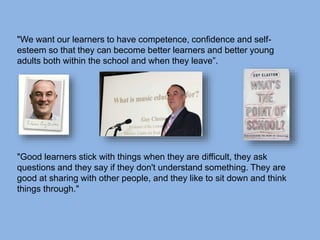
"We want our learners to have competence, confidence and self-
esteem so that they can become better learners and better young
adults both within the school and when they leave”.
"Good learners stick with things when they are difficult, they ask
questions and they say if they don't understand something. They are
good at sharing with other people, and they like to sit down and think
things through."
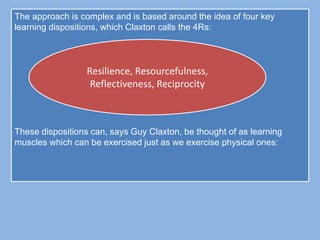
The approach is complex and is based around the idea of four key
learning dispositions, which Claxton calls the 4Rs:
These dispositions can, says Guy Claxton, be thought of as learning
muscles which can be exercised just as we exercise physical ones:
Resilience, Resourcefulness,
Reflectiveness, Reciprocity
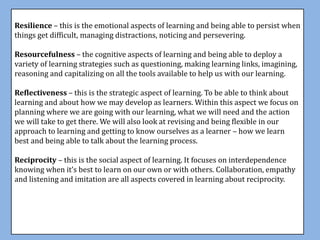
Resilience – this is the emotional aspects of learning and being able to persist when
things get difficult, managing distractions, noticing and persevering.
Resourcefulness – the cognitive aspects of learning and being able to deploy a
variety of learning strategies such as questioning, making learning links, imagining,
reasoning and capitalizing on all the tools available to help us with our learning.
Reflectiveness – this is the strategic aspect of learning. To be able to think about
learning and about how we may develop as learners. Within this aspect we focus on
planning where we are going with our learning, what we will need and the action
we will take to get there. We will also look at revising and being flexible in our
approach to learning and getting to know ourselves as a learner – how we learn
best and being able to talk about the learning process.
Reciprocity – this is the social aspect of learning. It focuses on interdependence
knowing when it’s best to learn on our own or with others. Collaboration, empathy
and listening and imitation are all aspects covered in learning about reciprocity.
• What does the research say makes the
greatest difference to learning (Hattie
2003; 2009; 2012)
• How well do students “know how well
they are performing and what they
need to do to improve” (Attfield)
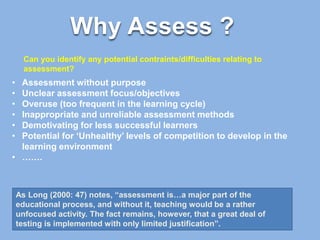
Why Assess ?
• Assessment without purpose
• Unclear assessment focus/objectives
• Overuse (too frequent in the learning cycle)
• Inappropriate and unreliable assessment methods
• Demotivating for less successful learners
• Potential for ‘Unhealthy’ levels of competition to develop in the
learning environment
• …….
As Long (2000: 47) notes, “assessment is…a major part of the
educational process, and without it, teaching would be a rather
unfocused activity. The fact remains, however, that a great deal of
testing is implemented with only limited justification”.
Can you identify any potential contraints/difficulties relating to
assessment?
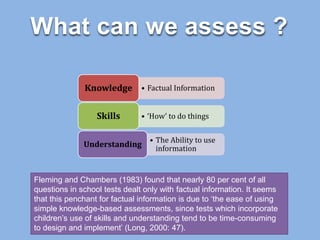
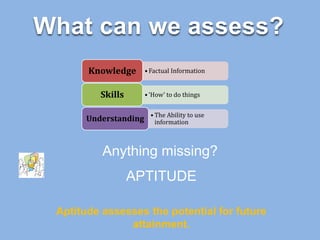
What can we assess ?
• Factual InformationKnowledge
• ‘How’ to do thingsSkills
• The Ability to use
information
Understanding
Fleming and Chambers (1983) found that nearly 80 per cent of all
questions in school tests dealt only with factual information. It seems
that this penchant for factual information is due to ‘the ease of using
simple knowledge-based assessments, since tests which incorporate
children’s use of skills and understanding tend to be time-consuming
to design and implement’ (Long, 2000: 47).
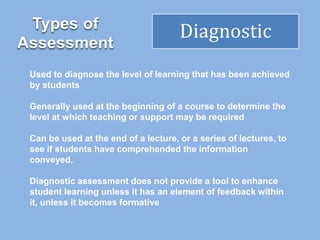
Types of
Assessment
Diagnostic
Used to diagnose the level of learning that has been achieved
by students
Generally used at the beginning of a course to determine the
level at which teaching or support may be required
Can be used at the end of a lecture, or a series of lectures, to
see if students have comprehended the information
conveyed.
Diagnostic assessment does not provide a tool to enhance
student learning unless it has an element of feedback within
it, unless it becomes formative
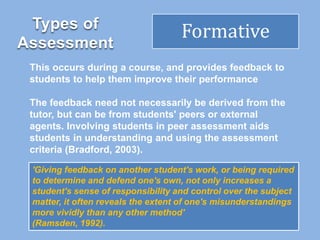
Types of
Assessment
Formative
This occurs during a course, and provides feedback to
students to help them improve their performance
The feedback need not necessarily be derived from the
tutor, but can be from students' peers or external
agents. Involving students in peer assessment aids
students in understanding and using the assessment
criteria (Bradford, 2003).
'Giving feedback on another student's work, or being required
to determine and defend one's own, not only increases a
student's sense of responsibility and control over the subject
matter, it often reveals the extent of one's misunderstandings
more vividly than any other method'
(Ramsden, 1992).
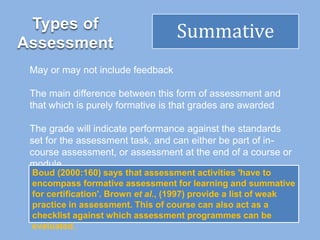
Types of
Assessment
Summative
May or may not include feedback
The main difference between this form of assessment and
that which is purely formative is that grades are awarded
The grade will indicate performance against the standards
set for the assessment task, and can either be part of in-
course assessment, or assessment at the end of a course or
module.
Boud (2000:160) says that assessment activities 'have to
encompass formative assessment for learning and summative
for certification'. Brown et al., (1997) provide a list of weak
practice in assessment. This of course can also act as a
checklist against which assessment programmes can be
evaluated.
What can we assess?
• Factual InformationKnowledge
• ‘How’ to do thingsSkills
• The Ability to use
informationUnderstanding
Anything missing?
APTITUDE
Aptitude assesses the potential for future
attainment.

BHS Learning and Assessment 2014-2015

  • 1.
    Course outline • Whatis good learning? • What do we all understand by assessment? • Researching assessment practices in our own context. MA Education Learning & Assessment
  • 2.
    Success Criteria A writtenassignment (4500 words) “The Assignment requires you to systematically analyse relevant academic, policy and practice sources and conclude with issues raised in relation to your learning and assessment practice in an education setting”. …… yikes!
  • 3.
    Learning, the brainand neuroscience …..some thoughts
  • 4.
    Homunculus is adrawing created by Wilder Penfield. He showed us what we would look like if our body parts were as big as the brain space/power they use.
  • 5.
    During pregnancy, awoman’s brain will shrink. It will take up to 6 months to regain its size.
  • 6.
    When you wereborn, your brain was about the size it is now. That’s one reason why babies have such large heads relative to their bodies.
  • 7.
    Experts estimate that,over the course of a lifetime, modern human brains will retain up to 1 quadrillion pieces of information
  • 8.
    You had morebrain cells when you were 2 years-old than you will at any other point in your life.
  • 9.
    Your brain accountsfor 2% of your mass, but uses 25% of your oxygen and energy
  • 10.
    You could surviveonly having one side of your brain.
  • 11.
    Your brain willcontinue to develop until you're in your late 40s
  • 12.
    Every day, youhave about 70,000 thoughts
  • 13.
    Your brain cangenerate about 25 watts of power at any given time. It could power a light bulb.
  • 14.
    Brain tissue hasa consistency that's very similar to tofu.
  • 15.
    Your brain isthe fattest organ in your body. It's about 60% fat
  • 16.
    Your brain doesn’thave pain receptors. It can’t feel anything.
  • 17.
    Information can goin between parts of your brain at a speed of 260mph.
  • 18.
    Deep and Surfaceare classifications of approaches to learning derived from original research done by educational psychologists. Marton and Säljö (1976) and since elaborated by Ramsden (1992), Biggs (1987, 1993) and Entwistle (1981), amongst others. Learning
  • 19.
    • Learning asa quantitative increase in knowledge. Learning is acquiring information or “knowing a lot”. • Learning as memorising. Learning is storing information that can be reproduced. • Learning as acquiring facts, skills and methods that can be retained and used as necessary. Surface learning
  • 20.
     Learning asmaking sense or abstracting meaning. Learning involves relating parts of the subject matter to each other and to the real world.  Learning as interpreting and understanding reality in a different way. Learning involves comprehending the world by re-interpreting knowledge. Deep learning
  • 21.
    What would YOUdo if you had to learn about… …the periodic table
  • 23.
     What isa periodic table? (4marks).  Name the elements with the highest and lowest atomic masses (2 marks).  Name two different types of elements.  Name 10 different elements on the table (10 marks).  Name the Halogens.  Create three questions to ask the other group about the periodic table (3 marks). Your test Hand out to group A
  • 24.
    1. What didthe learning feel like? 2. Was it cheating giving the group the specific questions that they would be tested on? 3. Was anything missing that would have allowed better learning? 4. Did anyone want to give up on the task?
  • 25.
    What do thetheorists say? Aspect Behaviourist Cognitivist Humanist Social and situational Learning theorists Thorndike, Pavlov,, Skinner Koffka, Kohler, Lewin, Piaget, Ausubel, Bruner, Gagne Maslow, Rogers Bandura, Lave and Wenger, Salomon View of the learning process To create changes in behaviour Learning is an Internal mental process (including insight, information processing, memory, perception Learning is a personal act to fulfil potential. Learning allows Interaction /observation in social contexts. It allows the movement from the edge to the centre of a community of practice Where does the learning take place? Stimuli in external environment Internal cognitive structuring Affective and cognitive needs Learning is in relationship between people and environment. Purpose in education Produce behavioural change in desired direction Develop capacity and skills to learn better Become self- actualized, autonomous Full participation in communities of practice and utilization of resources Educator's role Arranges environment to elicit desired response Structures content of learning activity Facilitates development of the whole person Works to establish communities of practice in which conversation and participation can occur. Manifestations in adult learning Behavioural objectives Competency -based education Skill development and training Cognitive development Intelligence, learning and memory as function of age Learning how to learn Andragogy Self-directed learning Socialization Social participation Conversation
  • 26.
  • 27.
    Brain as atriadic structure Lower [Reptilian] Brain controls basic sensory motor functions Limbic [Mammalian Brain] controls emotions, memory, and biorhythms Neo-cortex [‘thinking brain’] controls cognition, reasoning, language, and higher intelligence
  • 28.
    The Reptilian Brain Atthe top end of the spinal cord, the reptilian brain is the part of the brain responsible for: • Survival fight or flight responses; lashing out; screams. Monitoring motor functions - breathing; balance and instinctual responses. • Territoriality - defensiveness about possessions; friendships; personal space. • Mating rituals - attention seeking; showing off. • Hierarchies - the need to be or be associated with, the gang leader. • Rote behaviours - behaviours which are repetitive, predictable, and rarely constructive Higher order thinking skills are displaced by survival, ritualistic and rote behaviours…This means that the learner under stress will resort to rote and ritualistic responses. A learner in your classroom who is under stress or anxiety will not learn easily……
  • 29.
    The Limbic System Themiddle brain or limbic system controls the emotions, maintenance functions and, most significantly, is the site of the long-term memory…This part of the brain runs our emotions and our immune system, dictates sleeping cycles, eating patterns and sexuality…The recticular system filters in useful and valued information and filters out useless information. This is the part of the brain which validates new knowledge and, as such, is sited in the area of the brain associated with the long-term memory and emotions. For the brain to validate learning there must be an emotional connection. The learning must be associated with a purpose which the learner has set. Strong, personal and real learning goals are therefore imperative for accelerated learning. The brain values emotions and emotional associations more than higher order thinking skills. This is important in understanding memory and particularly in siting new knowledge in the long-term memory.
  • 30.
    What should wesee in a school that assesses well?
  • 31.
    What does HowardGardner say?
  • 32.
    Multiple Intelligences According toHoward Gardner (1983), there are multiple intelligences, and people are more proficient in some areas than in others. Gardner described seven different types of intelligence: logical- mathematical; linguistic; musical; spatial; bodily-kinesthetic; inter- personal; and intra-personal. [VAK] Visual, Auditory & Kinesthetic …. Preferred learning styles. But …. Some recent research (Dylan Wiliam) Emotional Intelligence [Daniel Goleman 1996]
  • 34.
    We are happiestand most successful when we learn, develop, and work in ways that make best use of our natural intelligences (our strengths and style and brain- type in other words).
  • 35.
    What does GuyClaxton say?
  • 36.
    "We want ourlearners to have competence, confidence and self- esteem so that they can become better learners and better young adults both within the school and when they leave”. "Good learners stick with things when they are difficult, they ask questions and they say if they don't understand something. They are good at sharing with other people, and they like to sit down and think things through."
  • 37.
    The approach iscomplex and is based around the idea of four key learning dispositions, which Claxton calls the 4Rs: These dispositions can, says Guy Claxton, be thought of as learning muscles which can be exercised just as we exercise physical ones: Resilience, Resourcefulness, Reflectiveness, Reciprocity
  • 38.
    Resilience – thisis the emotional aspects of learning and being able to persist when things get difficult, managing distractions, noticing and persevering. Resourcefulness – the cognitive aspects of learning and being able to deploy a variety of learning strategies such as questioning, making learning links, imagining, reasoning and capitalizing on all the tools available to help us with our learning. Reflectiveness – this is the strategic aspect of learning. To be able to think about learning and about how we may develop as learners. Within this aspect we focus on planning where we are going with our learning, what we will need and the action we will take to get there. We will also look at revising and being flexible in our approach to learning and getting to know ourselves as a learner – how we learn best and being able to talk about the learning process. Reciprocity – this is the social aspect of learning. It focuses on interdependence knowing when it’s best to learn on our own or with others. Collaboration, empathy and listening and imitation are all aspects covered in learning about reciprocity.
  • 39.
    • What doesthe research say makes the greatest difference to learning (Hattie 2003; 2009; 2012) • How well do students “know how well they are performing and what they need to do to improve” (Attfield)
  • 40.
    Why Assess ? •Assessment without purpose • Unclear assessment focus/objectives • Overuse (too frequent in the learning cycle) • Inappropriate and unreliable assessment methods • Demotivating for less successful learners • Potential for ‘Unhealthy’ levels of competition to develop in the learning environment • ……. As Long (2000: 47) notes, “assessment is…a major part of the educational process, and without it, teaching would be a rather unfocused activity. The fact remains, however, that a great deal of testing is implemented with only limited justification”. Can you identify any potential contraints/difficulties relating to assessment?
  • 41.
    What can weassess ? • Factual InformationKnowledge • ‘How’ to do thingsSkills • The Ability to use information Understanding Fleming and Chambers (1983) found that nearly 80 per cent of all questions in school tests dealt only with factual information. It seems that this penchant for factual information is due to ‘the ease of using simple knowledge-based assessments, since tests which incorporate children’s use of skills and understanding tend to be time-consuming to design and implement’ (Long, 2000: 47).
  • 42.
    Types of Assessment Diagnostic Used todiagnose the level of learning that has been achieved by students Generally used at the beginning of a course to determine the level at which teaching or support may be required Can be used at the end of a lecture, or a series of lectures, to see if students have comprehended the information conveyed. Diagnostic assessment does not provide a tool to enhance student learning unless it has an element of feedback within it, unless it becomes formative
  • 43.
    Types of Assessment Formative This occursduring a course, and provides feedback to students to help them improve their performance The feedback need not necessarily be derived from the tutor, but can be from students' peers or external agents. Involving students in peer assessment aids students in understanding and using the assessment criteria (Bradford, 2003). 'Giving feedback on another student's work, or being required to determine and defend one's own, not only increases a student's sense of responsibility and control over the subject matter, it often reveals the extent of one's misunderstandings more vividly than any other method' (Ramsden, 1992).
  • 44.
    Types of Assessment Summative May ormay not include feedback The main difference between this form of assessment and that which is purely formative is that grades are awarded The grade will indicate performance against the standards set for the assessment task, and can either be part of in- course assessment, or assessment at the end of a course or module. Boud (2000:160) says that assessment activities 'have to encompass formative assessment for learning and summative for certification'. Brown et al., (1997) provide a list of weak practice in assessment. This of course can also act as a checklist against which assessment programmes can be evaluated.
  • 46.
    What can weassess? • Factual InformationKnowledge • ‘How’ to do thingsSkills • The Ability to use informationUnderstanding Anything missing? APTITUDE Aptitude assesses the potential for future attainment.