QCR520 Approaches - Poetry: the lesson plan -
Understanding our BRAINs I cdnuolt blveiee taht I cluod aulaclty uesdnatnrd waht I was rdanieg. The phaonmneal pweor of the hmuan mnid! Aoccdrnig to a rscheearch at Cmabrigde Uinervtisy, it deosn't mttaer inwaht oredr the ltteers in a wrod are, the olny iprmoatnt tihng is taht the frist and lsat ltteer be in the rghit pclae. The rset can be a taotl mses and you can sitll raed it wouthit a porbelm. Tihs is bcuseae the huamn mnid deos not raed ervey lteter by istlef, but the wrod as a wlohe. Amzanig huh? Yaeh, and I awlyas thought slpeling was ipmorantt.
Understanding our BRAINs
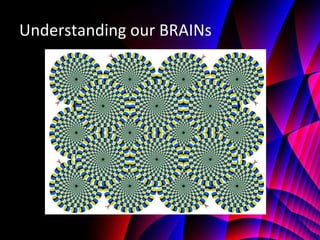
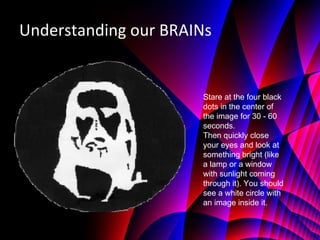
Understanding our BRAINs Stare at the four black dots in the center of the image for 30 - 60 seconds.  Then quickly close your eyes and look at something bright (like a lamp or a window  with sunlight coming through it). You should see a white circle with an image inside it.
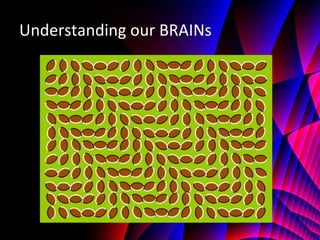
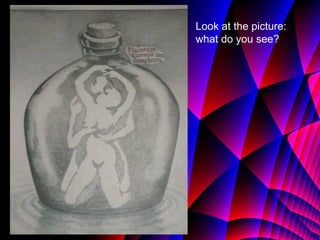
Look at the picture: what do you see?
Understanding our BRAINs The number of brain cells do not increase. 100 billion neurons X 20 000 dendrites Brain power improves when the number of interconnections between the brain cells increase. Information is retrieved through neural pathways. We need to get “wired up”. Brain cells die from lack of use. “ The mind is a terrible thing to waste” Use it or lose it!
Understanding our BRAINs Each brain is uniquely organised. The brain organises chaos and makes sense out of nonsense. The search for meaning is innate. Curiosity is natural with interest. Meaning is more important than information. Meaning comes from patterning/categorising. Patterning results in learning and remembering.
How we Learn Internalising sequence of action until automatic so conscious mind does not need to think about it Suggests need for rote rehearsal [drilling with understanding] e.g. walking, typing, driving, multiplication tables Unconscious incompetence (not aware I cannot} Conscious incompetence (aware I cannot) Conscious competence (aware I can) Unconscious competence (not aware I can) Learning the wrong thing requires re-wiring
How we Learn To aid patterning – build on prior knowledge Provide different ways to access new material to cater to different learning styles Allow time for processing Review, retrace and reactivate learning paths; provide tools for recall e.g. mind-maps Provide modelling and hands-on Short Quizs vs Major Exams
What is learning? Saljo’s five types of learning Acquiring info    an increase in knowledge  Memorising    store info to be reproduced  Acquire facts, skills and methods for later use.  Making sense – relating subject matter to the world. Re-interpretation   Understanding realty in a different way
Bloom’s Taxonomy Knowledge   ( the remembering (recalling) of appropriate, previously learned information) Comprehension   ( Grasping (understanding) the meaning of informational materials) Application  ( The use of previously learned information in new and concrete situations to solve problems ) Analysis  ( The breaking down of informational materials into their component parts, examining (and trying to understand the organizational structure of) Synthesis   ( Creatively or divergently applying prior knowledge and skills to produce a new or original whole) Evaluation   ( Judging the value of material based on personal values/opinions, without real right or wrong answers)
The Lesson Plan Introducing Poetry Teaching a poem Teaching poetic device Teaching a theme Teaching a poet or theme in poet’s work Teaching a genre Teaching creative writing Teaching local poetry Teaching particular period Teaching a style Teaching language/diction
Elements of a Lesson Plan Level  Duration/Topic Prior Knowledge Specific Instructional Objectives / Learning Outcomes Resources Activities / Duration
The Thinking Brain Why this poem? What can I use this poem to teach? What prior knowledge do the students have? How can I introduce this topic and contextualise the poem? How can I make the learning meaningful? How can I extend their learning beyond just knowledge acquisition?
The Emotional Brain Emotions are critical to patterning and drive our attention, meaning and memory. Freedom    Enthusiasm    Excitement Learning must be fun! Endorphins released when happy aid connection. Learning engages the whole body.
If they like the subject … or the teacher, they will enjoy studying. Engagement       Interest     Emotional investment     attention     memory
Gardner’s Mulitple Intelligences Linguistic intelligence   ("word smart") - words Logical-mathematical intelligence   ("number/reasoning smart")  - numbers / logic Spatial intelligence   ("picture smart")  - pictures Bodily-Kinesthetic intelligence   ("body smart") – physical experience Musical intelligence   ("music smart") - music Interpersonal intelligence   ("people smart") – a social experience Intrapersonal intelligence   ("self smart") – self reflection Naturalist intelligence   ("nature smart") – experience in the natural world
The Emotional Brain Enriched stimulated meaningful hands-on environment Allowing for variety of choices and active control and decision-making Ensure relevance by creating authentic situations or invoking personal interest or current events Not to do things for the sake of doing things Purposeful activity Create mystery/suspense Interactive notebooks Using music and movement
Thinking about a lesson Begin by first  thinking  carefully about what the lesson is supposed to accomplish.  Think of a lesson plan as a way of organising communicating Knowing "how to" is far more important than knowing "about" when it comes to lesson plans, There is no one "best way" to plan lessons.
The Herbartian Method 1.  Preparation 2.  Presentation 3.  Association 4.  Generalisation 5.  Application
The Madeline Hunter Lesson Design Model 1. Anticipatory Set (focus)  - A short activity or prompt that focuses the students' attention before the actual lesson begins. Used when students enter the room or in a transition. A hand-out given to students at the door, review question written on the board, "two problems" on the overhead are examples of the anticipatory set. 2. Purpose (objective)  - The purpose of today's lesson, why the students need to learn it, what they will be able to "do", and how they will show learning as a result are made clear by the teacher. 3. Input  - The vocabulary, skills, and concepts the teacher will impart to the students - the "stuff" the kids need to know in order to be successful.
The Madeline Hunter Lesson Design Model 4. Modeling (show)  - The teacher shows in graphic form or demonstrates what the finished product looks like. 5. Guided Practice (follow me)  - The teacher leads the students through the steps necessary to perform the skill - hear/see/do. using the trimodal approach  6. Checking For Understanding (CFU)  - The teacher uses a variety of questioning strategies to determine "Got it yet?" and to pace the lesson. 7. Independent Practice  - The teacher releases students to practice on their own based on #3-#6. 8. Closure  - A review or wrap-up of the lesson - "Tell me/show me what you have learned today".
The Emotional Brain How can I create curiosity? How can I make the learning purposeful? How can I make the learning experential? How can I provide hands-on learning? How can I cater to different learning styles?
The Social Brain The brain develops better by interacting with other brains. Learning by engaging in experience. Lively dialogue and interaction. Complex learning Is enhanced by challenge and inhibited by threat. Build trust and security.
How do we gain their attention?
Teacher Prep Classroom Management Preparing Materials/Equipment Simple to Difficult Contextualising with Intro Activity Class    Group    Pair    Individual Guided Practice    Independent Work Rounding up the lesson Evaluating Learning
Teacher-Centred Models Lecture Demonstration Discussion Scaffolding and Modelling
Student-centred Models Groupwork Case Studies Problem-solving Learning Centers Role Play Computer simulations Peer Tutoring
The Social Brain How can I create a safe conducive environment of learning? How should the learning be structured? How should the classroom be organised?
Reflections Where are your students going? How are they going to get there? How will you know when they've arrived? What process one uses to get to a destination depends on available resources and time.
For Tomorrow Bearing in mind what was covered in class, Plan a lesson on the song that you have prepared. We will begin tomorrow’s lessons with your lesson plans!  Do provide a rationale for what you have chosen to do.  

Qcr520 lesson 10 teaching poetry

  • 1.
    QCR520 Approaches -Poetry: the lesson plan -
  • 2.
    Understanding our BRAINsI cdnuolt blveiee taht I cluod aulaclty uesdnatnrd waht I was rdanieg. The phaonmneal pweor of the hmuan mnid! Aoccdrnig to a rscheearch at Cmabrigde Uinervtisy, it deosn't mttaer inwaht oredr the ltteers in a wrod are, the olny iprmoatnt tihng is taht the frist and lsat ltteer be in the rghit pclae. The rset can be a taotl mses and you can sitll raed it wouthit a porbelm. Tihs is bcuseae the huamn mnid deos not raed ervey lteter by istlef, but the wrod as a wlohe. Amzanig huh? Yaeh, and I awlyas thought slpeling was ipmorantt.
  • 3.
  • 4.
  • 5.
  • 6.
    Understanding our BRAINsStare at the four black dots in the center of the image for 30 - 60 seconds. Then quickly close your eyes and look at something bright (like a lamp or a window with sunlight coming through it). You should see a white circle with an image inside it.
  • 7.
    Look at thepicture: what do you see?
  • 8.
    Understanding our BRAINsThe number of brain cells do not increase. 100 billion neurons X 20 000 dendrites Brain power improves when the number of interconnections between the brain cells increase. Information is retrieved through neural pathways. We need to get “wired up”. Brain cells die from lack of use. “ The mind is a terrible thing to waste” Use it or lose it!
  • 9.
    Understanding our BRAINsEach brain is uniquely organised. The brain organises chaos and makes sense out of nonsense. The search for meaning is innate. Curiosity is natural with interest. Meaning is more important than information. Meaning comes from patterning/categorising. Patterning results in learning and remembering.
  • 10.
    How we LearnInternalising sequence of action until automatic so conscious mind does not need to think about it Suggests need for rote rehearsal [drilling with understanding] e.g. walking, typing, driving, multiplication tables Unconscious incompetence (not aware I cannot} Conscious incompetence (aware I cannot) Conscious competence (aware I can) Unconscious competence (not aware I can) Learning the wrong thing requires re-wiring
  • 11.
    How we LearnTo aid patterning – build on prior knowledge Provide different ways to access new material to cater to different learning styles Allow time for processing Review, retrace and reactivate learning paths; provide tools for recall e.g. mind-maps Provide modelling and hands-on Short Quizs vs Major Exams
  • 12.
    What is learning?Saljo’s five types of learning Acquiring info  an increase in knowledge Memorising  store info to be reproduced Acquire facts, skills and methods for later use. Making sense – relating subject matter to the world. Re-interpretation  Understanding realty in a different way
  • 13.
    Bloom’s Taxonomy Knowledge ( the remembering (recalling) of appropriate, previously learned information) Comprehension ( Grasping (understanding) the meaning of informational materials) Application ( The use of previously learned information in new and concrete situations to solve problems ) Analysis ( The breaking down of informational materials into their component parts, examining (and trying to understand the organizational structure of) Synthesis ( Creatively or divergently applying prior knowledge and skills to produce a new or original whole) Evaluation ( Judging the value of material based on personal values/opinions, without real right or wrong answers)
  • 14.
    The Lesson PlanIntroducing Poetry Teaching a poem Teaching poetic device Teaching a theme Teaching a poet or theme in poet’s work Teaching a genre Teaching creative writing Teaching local poetry Teaching particular period Teaching a style Teaching language/diction
  • 15.
    Elements of aLesson Plan Level Duration/Topic Prior Knowledge Specific Instructional Objectives / Learning Outcomes Resources Activities / Duration
  • 16.
    The Thinking BrainWhy this poem? What can I use this poem to teach? What prior knowledge do the students have? How can I introduce this topic and contextualise the poem? How can I make the learning meaningful? How can I extend their learning beyond just knowledge acquisition?
  • 17.
    The Emotional BrainEmotions are critical to patterning and drive our attention, meaning and memory. Freedom  Enthusiasm  Excitement Learning must be fun! Endorphins released when happy aid connection. Learning engages the whole body.
  • 18.
    If they likethe subject … or the teacher, they will enjoy studying. Engagement  Interest  Emotional investment  attention  memory
  • 19.
    Gardner’s Mulitple IntelligencesLinguistic intelligence ("word smart") - words Logical-mathematical intelligence ("number/reasoning smart") - numbers / logic Spatial intelligence ("picture smart") - pictures Bodily-Kinesthetic intelligence ("body smart") – physical experience Musical intelligence ("music smart") - music Interpersonal intelligence ("people smart") – a social experience Intrapersonal intelligence ("self smart") – self reflection Naturalist intelligence ("nature smart") – experience in the natural world
  • 20.
    The Emotional BrainEnriched stimulated meaningful hands-on environment Allowing for variety of choices and active control and decision-making Ensure relevance by creating authentic situations or invoking personal interest or current events Not to do things for the sake of doing things Purposeful activity Create mystery/suspense Interactive notebooks Using music and movement
  • 21.
    Thinking about alesson Begin by first thinking carefully about what the lesson is supposed to accomplish. Think of a lesson plan as a way of organising communicating Knowing "how to" is far more important than knowing "about" when it comes to lesson plans, There is no one "best way" to plan lessons.
  • 22.
    The Herbartian Method1.  Preparation 2.  Presentation 3.  Association 4.  Generalisation 5. Application
  • 23.
    The Madeline HunterLesson Design Model 1. Anticipatory Set (focus) - A short activity or prompt that focuses the students' attention before the actual lesson begins. Used when students enter the room or in a transition. A hand-out given to students at the door, review question written on the board, "two problems" on the overhead are examples of the anticipatory set. 2. Purpose (objective) - The purpose of today's lesson, why the students need to learn it, what they will be able to "do", and how they will show learning as a result are made clear by the teacher. 3. Input - The vocabulary, skills, and concepts the teacher will impart to the students - the "stuff" the kids need to know in order to be successful.
  • 24.
    The Madeline HunterLesson Design Model 4. Modeling (show) - The teacher shows in graphic form or demonstrates what the finished product looks like. 5. Guided Practice (follow me) - The teacher leads the students through the steps necessary to perform the skill - hear/see/do. using the trimodal approach 6. Checking For Understanding (CFU) - The teacher uses a variety of questioning strategies to determine "Got it yet?" and to pace the lesson. 7. Independent Practice - The teacher releases students to practice on their own based on #3-#6. 8. Closure - A review or wrap-up of the lesson - "Tell me/show me what you have learned today".
  • 25.
    The Emotional BrainHow can I create curiosity? How can I make the learning purposeful? How can I make the learning experential? How can I provide hands-on learning? How can I cater to different learning styles?
  • 26.
    The Social BrainThe brain develops better by interacting with other brains. Learning by engaging in experience. Lively dialogue and interaction. Complex learning Is enhanced by challenge and inhibited by threat. Build trust and security.
  • 27.
    How do wegain their attention?
  • 28.
    Teacher Prep ClassroomManagement Preparing Materials/Equipment Simple to Difficult Contextualising with Intro Activity Class  Group  Pair  Individual Guided Practice  Independent Work Rounding up the lesson Evaluating Learning
  • 29.
    Teacher-Centred Models LectureDemonstration Discussion Scaffolding and Modelling
  • 30.
    Student-centred Models GroupworkCase Studies Problem-solving Learning Centers Role Play Computer simulations Peer Tutoring
  • 31.
    The Social BrainHow can I create a safe conducive environment of learning? How should the learning be structured? How should the classroom be organised?
  • 32.
    Reflections Where areyour students going? How are they going to get there? How will you know when they've arrived? What process one uses to get to a destination depends on available resources and time.
  • 33.
    For Tomorrow Bearingin mind what was covered in class, Plan a lesson on the song that you have prepared. We will begin tomorrow’s lessons with your lesson plans! Do provide a rationale for what you have chosen to do. 