A new state law has changed the guidelines for high school students in order to have
them be better prepared for the rigors of college. This presentation covered
suggestions on what can be done in the meantime to help our students succeed.
Cutting out the easy stuff – I discussed the development of pre-lecture outlines to
guide the students through their reading of required chapters in the textbook. More
information on this topic later.
3
4
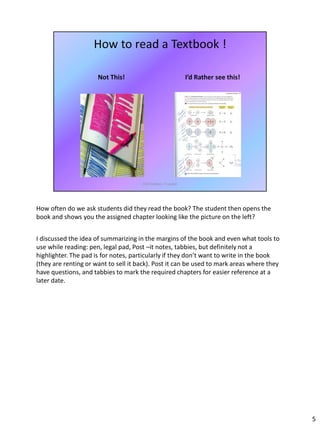
How often do we ask students did they read the book? The student then opens the
book and shows you the assigned chapter looking like the picture on the left?
I discussed the idea of summarizing in the margins of the book and even what tools to
use while reading: pen, legal pad, Post –it notes, tabbies, but definitely not a
highlighter. The pad is for notes, particularly if they don’t want to write in the book
(they are renting or want to sell it back). Post it can be used to mark areas where they
have questions, and tabbies to mark the required chapters for easier reference at a
later date.
5
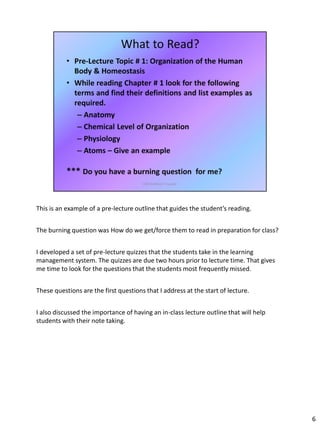
This is an example of a pre-lecture outline that guides the student’s reading.
The burning question was How do we get/force them to read in preparation for class?
I developed a set of pre-lecture quizzes that the students take in the learning
management system. The quizzes are due two hours prior to lecture time. That gives
me time to look for the questions that the students most frequently missed.
These questions are the first questions that I address at the start of lecture.
I also discussed the importance of having an in-class lecture outline that will help
students with their note taking.
6
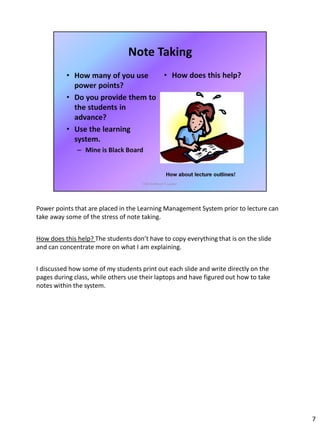
Power points that are placed in the Learning Management System prior to lecture can
take away some of the stress of note taking.
How does this help? The students don’t have to copy everything that is on the slide
and can concentrate more on what I am explaining.
I discussed how some of my students print out each slide and write directly on the
pages during class, while others use their laptops and have figured out how to take
notes within the system.
7
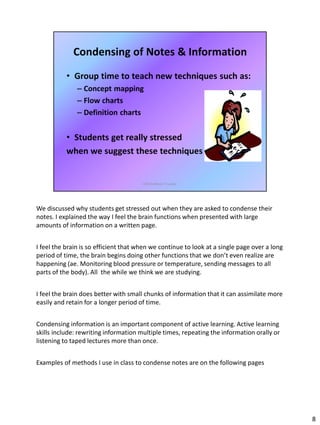
We discussed why students get stressed out when they are asked to condense their
notes. I explained the way I feel the brain functions when presented with large
amounts of information on a written page.
I feel the brain is so efficient that when we continue to look at a single page over a long
period of time, the brain begins doing other functions that we don’t even realize are
happening (ae. Monitoring blood pressure or temperature, sending messages to all
parts of the body). All the while we think we are studying.
I feel the brain does better with small chunks of information that it can assimilate more
easily and retain for a longer period of time.
Condensing information is an important component of active learning. Active learning
skills include: rewriting information multiple times, repeating the information orally or
listening to taped lectures more than once.
Examples of methods I use in class to condense notes are on the following pages
8
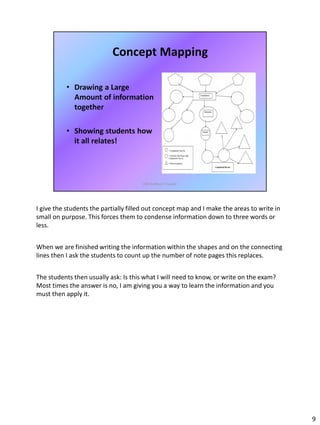
I give the students the partially filled out concept map and I make the areas to write in
small on purpose. This forces them to condense information down to three words or
less.
When we are finished writing the information within the shapes and on the connecting
lines then I ask the students to count up the number of note pages this replaces.
The students then usually ask: Is this what I will need to know, or write on the exam?
Most times the answer is no, I am giving you a way to learn the information and you
must then apply it.
9
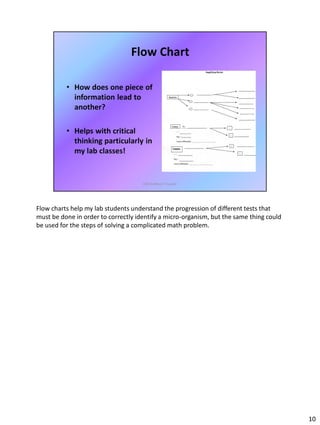
Flow charts help my lab students understand the progression of different tests that
must be done in order to correctly identify a micro-organism, but the same thing could
be used for the steps of solving a complicated math problem.
10
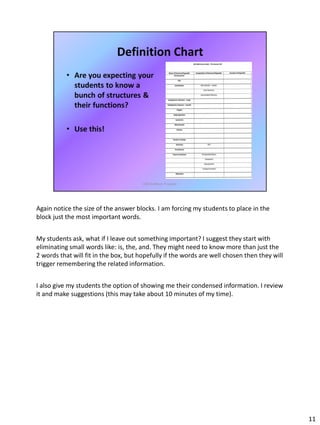
Again notice the size of the answer blocks. I am forcing my students to place in the
block just the most important words.
My students ask, what if I leave out something important? I suggest they start with
eliminating small words like: is, the, and. They might need to know more than just the
2 words that will fit in the box, but hopefully if the words are well chosen then they will
trigger remembering the related information.
I also give my students the option of showing me their condensed information. I review
it and make suggestions (this may take about 10 minutes of my time).
11
12
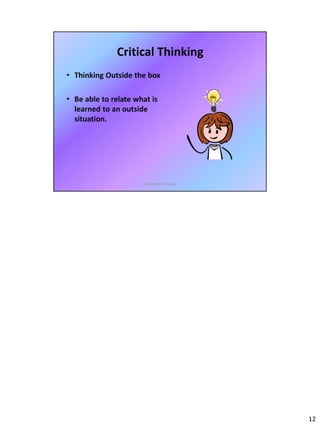
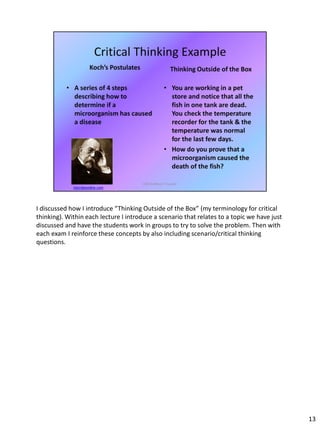
I discussed how I introduce “Thinking Outside of the Box” (my terminology for critical
thinking). Within each lecture I introduce a scenario that relates to a topic we have just
discussed and have the students work in groups to try to solve the problem. Then with
each exam I reinforce these concepts by also including scenario/critical thinking
questions.
13
14
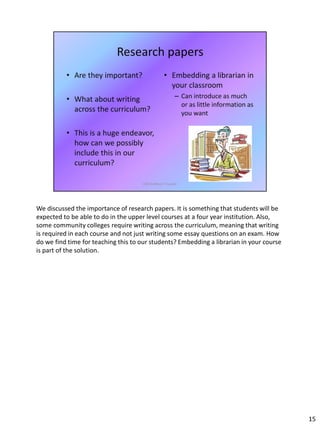
We discussed the importance of research papers. It is something that students will be
expected to be able to do in the upper level courses at a four year institution. Also,
some community colleges require writing across the curriculum, meaning that writing
is required in each course and not just writing some essay questions on an exam. How
do we find time for teaching this to our students? Embedding a librarian in your course
is part of the solution.
15
16
17

3 2 lauber16

  • 2.
    A new statelaw has changed the guidelines for high school students in order to have them be better prepared for the rigors of college. This presentation covered suggestions on what can be done in the meantime to help our students succeed.
  • 3.
    Cutting out theeasy stuff – I discussed the development of pre-lecture outlines to guide the students through their reading of required chapters in the textbook. More information on this topic later. 3
  • 4.
  • 5.
    How often dowe ask students did they read the book? The student then opens the book and shows you the assigned chapter looking like the picture on the left? I discussed the idea of summarizing in the margins of the book and even what tools to use while reading: pen, legal pad, Post –it notes, tabbies, but definitely not a highlighter. The pad is for notes, particularly if they don’t want to write in the book (they are renting or want to sell it back). Post it can be used to mark areas where they have questions, and tabbies to mark the required chapters for easier reference at a later date. 5
  • 6.
    This is anexample of a pre-lecture outline that guides the student’s reading. The burning question was How do we get/force them to read in preparation for class? I developed a set of pre-lecture quizzes that the students take in the learning management system. The quizzes are due two hours prior to lecture time. That gives me time to look for the questions that the students most frequently missed. These questions are the first questions that I address at the start of lecture. I also discussed the importance of having an in-class lecture outline that will help students with their note taking. 6
  • 7.
    Power points thatare placed in the Learning Management System prior to lecture can take away some of the stress of note taking. How does this help? The students don’t have to copy everything that is on the slide and can concentrate more on what I am explaining. I discussed how some of my students print out each slide and write directly on the pages during class, while others use their laptops and have figured out how to take notes within the system. 7
  • 8.
    We discussed whystudents get stressed out when they are asked to condense their notes. I explained the way I feel the brain functions when presented with large amounts of information on a written page. I feel the brain is so efficient that when we continue to look at a single page over a long period of time, the brain begins doing other functions that we don’t even realize are happening (ae. Monitoring blood pressure or temperature, sending messages to all parts of the body). All the while we think we are studying. I feel the brain does better with small chunks of information that it can assimilate more easily and retain for a longer period of time. Condensing information is an important component of active learning. Active learning skills include: rewriting information multiple times, repeating the information orally or listening to taped lectures more than once. Examples of methods I use in class to condense notes are on the following pages 8
  • 9.
    I give thestudents the partially filled out concept map and I make the areas to write in small on purpose. This forces them to condense information down to three words or less. When we are finished writing the information within the shapes and on the connecting lines then I ask the students to count up the number of note pages this replaces. The students then usually ask: Is this what I will need to know, or write on the exam? Most times the answer is no, I am giving you a way to learn the information and you must then apply it. 9
  • 10.
    Flow charts helpmy lab students understand the progression of different tests that must be done in order to correctly identify a micro-organism, but the same thing could be used for the steps of solving a complicated math problem. 10
  • 11.
    Again notice thesize of the answer blocks. I am forcing my students to place in the block just the most important words. My students ask, what if I leave out something important? I suggest they start with eliminating small words like: is, the, and. They might need to know more than just the 2 words that will fit in the box, but hopefully if the words are well chosen then they will trigger remembering the related information. I also give my students the option of showing me their condensed information. I review it and make suggestions (this may take about 10 minutes of my time). 11
  • 12.
  • 13.
    I discussed howI introduce “Thinking Outside of the Box” (my terminology for critical thinking). Within each lecture I introduce a scenario that relates to a topic we have just discussed and have the students work in groups to try to solve the problem. Then with each exam I reinforce these concepts by also including scenario/critical thinking questions. 13
  • 14.
  • 15.
    We discussed theimportance of research papers. It is something that students will be expected to be able to do in the upper level courses at a four year institution. Also, some community colleges require writing across the curriculum, meaning that writing is required in each course and not just writing some essay questions on an exam. How do we find time for teaching this to our students? Embedding a librarian in your course is part of the solution. 15
  • 16.
  • 17.