Briefing on Process Control and
Dynamics Laboratory
20 January 2010
Introduction
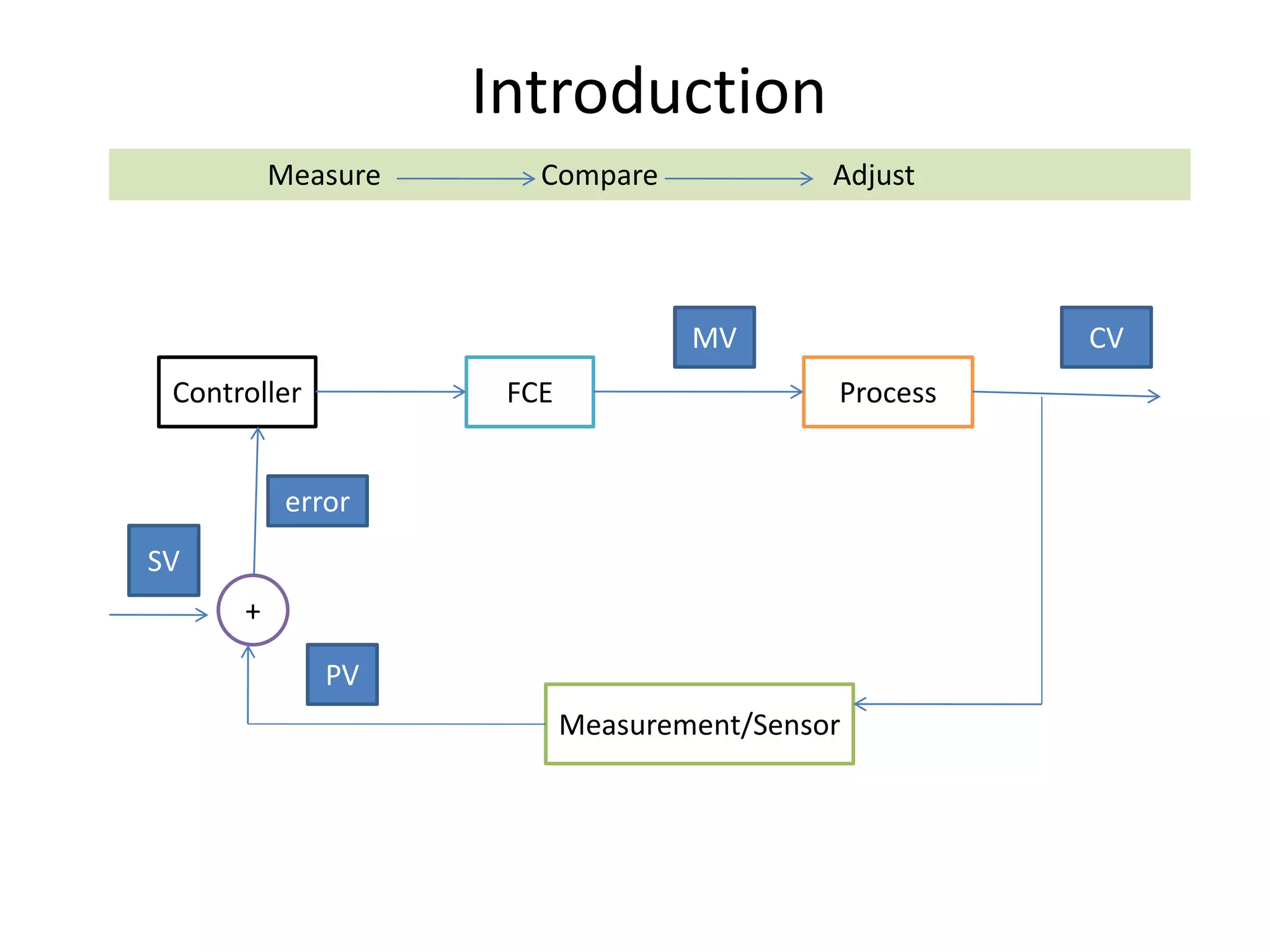
Process
Controller FCE
Measurement/Sensor
+
error
SV
PV
MV CV
Measure Compare Adjust
PV = Process Value/Controlled Variable
SV = Setpoint/Desired Value
MV = Manipulated Value/Controller Output
Error = Deviation
Objective : To bring PV = SV by manipulating FCE(Final
Control Element) via MV
Upset / Disturbance
Setpoint change : at the SV
Load Variables : all other variables that cause upset and affect control (e.g: input
fow rate, output flow rate, environment, heater power variation
Control is easier( unnecessary) if there is no UPSET
Control is more difficult if UPSET is due to LOAD upset than setpoint
upset.
Laboratory
Experiment 1: Gas Pressure Control
Experiment 2: Level Flow Control
Experiment 3: Flow Control
Experiment 4: On Off & Temperature Control
Experiment 5: pH Control using Open Loop
Method
Experiment 6: pH Control using Closed Loop
Method
What is expected from you ?
1. Understand the feedback control loop system
2. Able to illustrate control system
instrumentation (transducer,transmitter, FCE
etc.)
3. Able to analyze responses at different value of
PID
4. Tuning- Find the best PID for the process
5. Find PID using open loop method
(Ziegler and Nichols Formula)
What you will see in the lab?
• PID , where:
• PB = 100/Kc ; TI= time integral ; TD = time
derivative
• P-control only
• PI control
• PID
System Behavior
Underdamped
An underdamped response is one that
oscillates within a decaying envelope.
The more underdamped the system,
the more oscillations and longer it
takes to reach steady-state. Here
Damping Ratio is always < 1
Critically damped
A critically damped response is the
response that reaches the steady-state
value the fastest without being
underdamped. It is related to critical
points in the sense that it straddles
the boundary of underdamped and
overdamped responses. Here,
damping ratio is always less than or
equal to one (≤1) . There should be no
oscillation about the steady state
value in the ideal case.
Overdamped
An overdamped response is the
response that does not oscillate about
the steady-state value but takes longer
to reach than the critically damped
case. Here Damping Ratio is >1
Ziegler and Nichols formula
• Please refer to the handout given.
Laboratory Report
• Introduction/Theory of the experiment
• Procedure:
-summarize the procedure
- PFD is shown
• Discuss the responses form the chart graph.

3603939.ppt

  • 1.
    Briefing on ProcessControl and Dynamics Laboratory 20 January 2010
  • 2.
  • 3.
    PV = ProcessValue/Controlled Variable SV = Setpoint/Desired Value MV = Manipulated Value/Controller Output Error = Deviation Objective : To bring PV = SV by manipulating FCE(Final Control Element) via MV
  • 4.
    Upset / Disturbance Setpointchange : at the SV Load Variables : all other variables that cause upset and affect control (e.g: input fow rate, output flow rate, environment, heater power variation Control is easier( unnecessary) if there is no UPSET Control is more difficult if UPSET is due to LOAD upset than setpoint upset.
  • 5.
    Laboratory Experiment 1: GasPressure Control Experiment 2: Level Flow Control Experiment 3: Flow Control Experiment 4: On Off & Temperature Control Experiment 5: pH Control using Open Loop Method Experiment 6: pH Control using Closed Loop Method
  • 6.
    What is expectedfrom you ? 1. Understand the feedback control loop system 2. Able to illustrate control system instrumentation (transducer,transmitter, FCE etc.) 3. Able to analyze responses at different value of PID 4. Tuning- Find the best PID for the process 5. Find PID using open loop method (Ziegler and Nichols Formula)
  • 7.
    What you willsee in the lab? • PID , where: • PB = 100/Kc ; TI= time integral ; TD = time derivative • P-control only • PI control • PID
  • 8.
    System Behavior Underdamped An underdampedresponse is one that oscillates within a decaying envelope. The more underdamped the system, the more oscillations and longer it takes to reach steady-state. Here Damping Ratio is always < 1 Critically damped A critically damped response is the response that reaches the steady-state value the fastest without being underdamped. It is related to critical points in the sense that it straddles the boundary of underdamped and overdamped responses. Here, damping ratio is always less than or equal to one (≤1) . There should be no oscillation about the steady state value in the ideal case. Overdamped An overdamped response is the response that does not oscillate about the steady-state value but takes longer to reach than the critically damped case. Here Damping Ratio is >1
  • 9.
    Ziegler and Nicholsformula • Please refer to the handout given.
  • 10.
    Laboratory Report • Introduction/Theoryof the experiment • Procedure: -summarize the procedure - PFD is shown • Discuss the responses form the chart graph.