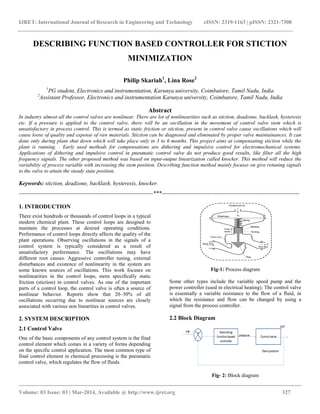
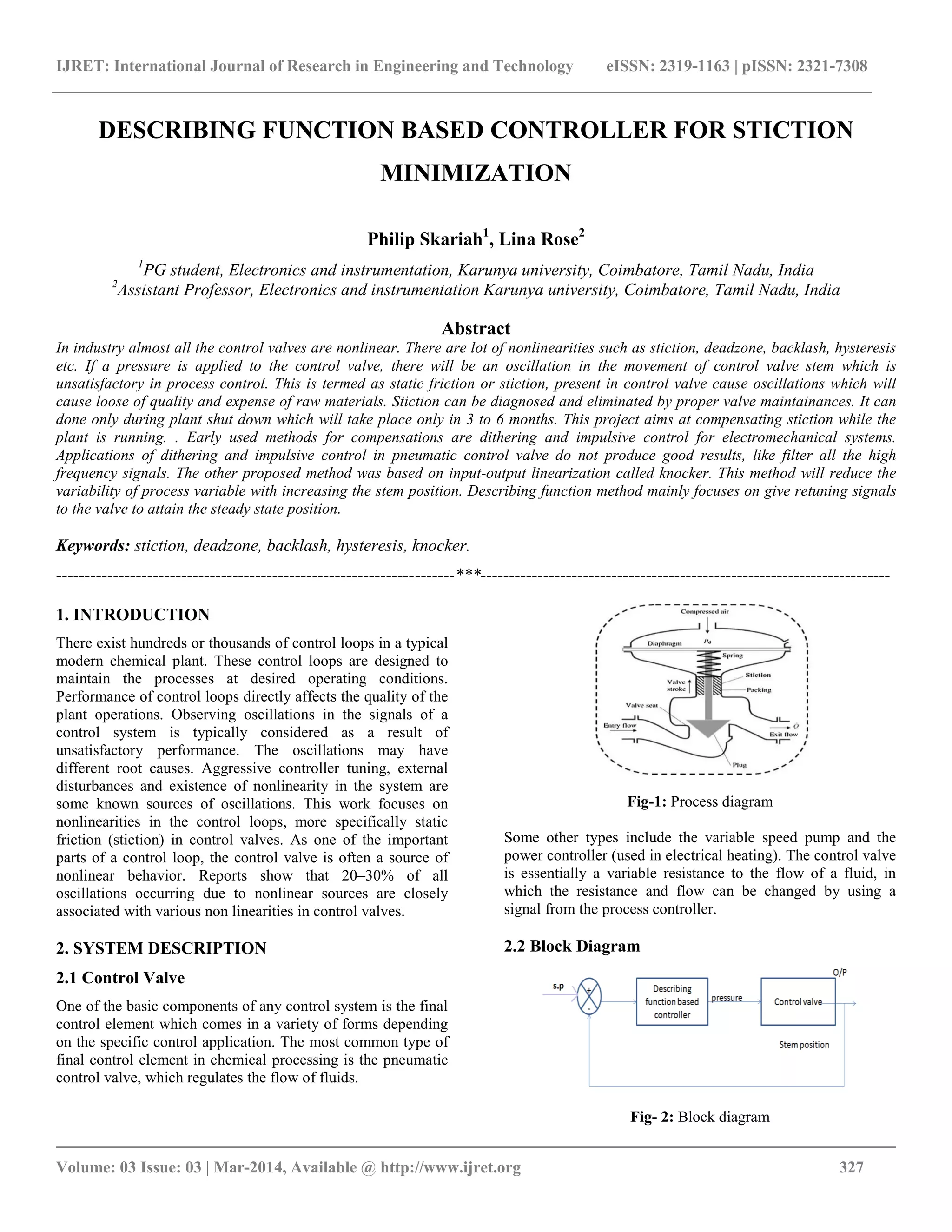
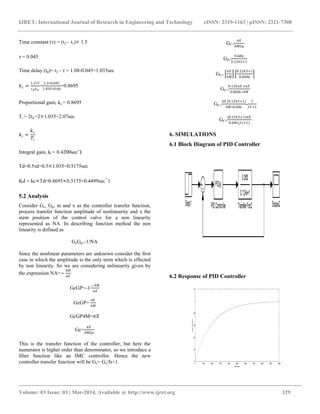
IJRET: International Journal of Research in Engineering and Technology eISSN: 2319-1163 | pISSN: 2321-7308
__________________________________________________________________________________________
Volume: 03 Issue: 03 | Mar-2014, Available @ http://www.ijret.org 327
DESCRIBING FUNCTION BASED CONTROLLER FOR STICTION
MINIMIZATION
Philip Skariah1
, Lina Rose2
1
PG student, Electronics and instrumentation, Karunya university, Coimbatore, Tamil Nadu, India
2
Assistant Professor, Electronics and instrumentation Karunya university, Coimbatore, Tamil Nadu, India
Abstract
In industry almost all the control valves are nonlinear. There are lot of nonlinearities such as stiction, deadzone, backlash, hysteresis
etc. If a pressure is applied to the control valve, there will be an oscillation in the movement of control valve stem which is
unsatisfactory in process control. This is termed as static friction or stiction, present in control valve cause oscillations which will
cause loose of quality and expense of raw materials. Stiction can be diagnosed and eliminated by proper valve maintainances. It can
done only during plant shut down which will take place only in 3 to 6 months. This project aims at compensating stiction while the
plant is running. . Early used methods for compensations are dithering and impulsive control for electromechanical systems.
Applications of dithering and impulsive control in pneumatic control valve do not produce good results, like filter all the high
frequency signals. The other proposed method was based on input-output linearization called knocker. This method will reduce the
variability of process variable with increasing the stem position. Describing function method mainly focuses on give retuning signals
to the valve to attain the steady state position.
Keywords: stiction, deadzone, backlash, hysteresis, knocker.
----------------------------------------------------------------------***------------------------------------------------------------------------
1. INTRODUCTION
There exist hundreds or thousands of control loops in a typical
modern chemical plant. These control loops are designed to
maintain the processes at desired operating conditions.
Performance of control loops directly affects the quality of the
plant operations. Observing oscillations in the signals of a
control system is typically considered as a result of
unsatisfactory performance. The oscillations may have
different root causes. Aggressive controller tuning, external
disturbances and existence of nonlinearity in the system are
some known sources of oscillations. This work focuses on
nonlinearities in the control loops, more specifically static
friction (stiction) in control valves. As one of the important
parts of a control loop, the control valve is often a source of
nonlinear behavior. Reports show that 20–30% of all
oscillations occurring due to nonlinear sources are closely
associated with various non linearities in control valves.
2. SYSTEM DESCRIPTION
2.1 Control Valve
One of the basic components of any control system is the final
control element which comes in a variety of forms depending
on the specific control application. The most common type of
final control element in chemical processing is the pneumatic
control valve, which regulates the flow of fluids.
Fig-1: Process diagram
Some other types include the variable speed pump and the
power controller (used in electrical heating). The control valve
is essentially a variable resistance to the flow of a fluid, in
which the resistance and flow can be changed by using a
signal from the process controller.
2.2 Block Diagram
Fig- 2: Block diagram
IJRET: International Journal of Research in Engineering and Technology eISSN: 2319-1163 | pISSN: 2321-7308
__________________________________________________________________________________________
Volume: 03 Issue: 03 | Mar-2014, Available @ http://www.ijret.org 328
The controller using here is PID controller, which is
describing function based PID controller and the process is
control valve. If stiction is present in the valve then we won’t
get desired output that is stem position, which is converted
into voltage by using sliding m mode potentiometer that
voltage is compared with set point value and reduced the error
by describing function method.
3. MATHEMATICAL MODELLING
Modelling steps is based on Newton’s second law. Newton’s
2nd
law is given by
Where,
m= mass of moving part
x =stem position
Pressure = pressure exerted
Sa=diaphragm area
P= applied pressure
Spring=force applied on spring = Kmx
Where,
Km=spring constant
Friction=frictional force
4. CONTROLLER IMPLEMENTATION
4.1 PID Controller
A proportional-integral-derivative controller (PID controller)
is a generic control loop feedback mechanism (controller)
widely used in industrial control systems. A PID controller
calculates an "error" value as the difference between a
measured process variable and a desired set point. Adjusting
the process control input the controller attempts to minimize
the error. The PID controller calculation algorithm involves
three separate constant parameter the proportional,the integral
and derivative values denoted P, I, and D. P depends on the
present error, I on the past errors, and D is a prediction of
future errors..[1] The sum of these three actions is used to
adjust the process via a control element such as the position of
a control valve, a damper, or the power supplied process. PID
controller has been considered to be the best controller. By
tuning the parameters the PID controller can provide control
action designed for specific process requirements. Note that
the use of the PID algorithm for control does not guarantee
optimal control of the system or system stability.
4.2 Describing Function Method
Final control element used in industries is control valve. One
third of poorly performing control loops are caused by
nonlinearities present in the control valves, one of which is
static friction, due to the effect of nonlinearities oscillations
will be present in the process variables. Since industrial plants
include numerous interacting loops, the oscillations will be
transmitting to the entire system. Repairing the faulty valves
will be the only solution to this problem, which is possible
only during process shut down. But, as shutting down the
process to isolate the faulty valve for maintenance purposes is
not economical, this solution does not count as the primary
one. So, there is a need for a method to compensate the
destructive effect of the stiction phenomenon in the control
valve, when maintenance is not available.
Describing function provides a linear approximation to the
non linear elements, based on the assumption that input to the
non linear element is sinusoid of known constant amplitude.
The signals are given depending upon the controller output.
Fig-3: Block diagram of non-linearity
It is an appropriate procedure for analyzing certain non linear
control problems. It is a mathematical tool for analyzing limit
cycle in the closed loop controllers, this method predicts
weather limit cycle oscillation will exist or not and gives
numerical estimates of oscillation frequency and amplitude
when limit cycle are predicted. Basically this method is an
approximation extension of frequency response method to non
linear system. Gc(s) and G1(s) are linear elements and n(x) is
non linear element. Describing function provides a linear
approximation to the non linear elements, based on the
assumption that input to the non linear element is sinusoid of
known constant amplitude. To find steady state value and
amplitude the fundamental harmonic is compared with phase
relation. This relation is used for the describing function for
the nonlinear element.
5. CONTROLLER DESIGN
5.1 PID Controller Design
From the Zeigler Nichols open loop tuning
28.3% of the steady state value = t1 = 0.283k = 1.05sec
63.2% of the steady state value = t2 = 0.63k = 1.08sec
mx Forces 
pressure spring frictionmx F F F  
IJRET: International Journal of Research in Engineering and Technology eISSN: 2319-1163 | pISSN: 2321-7308
__________________________________________________________________________________________
Volume: 03 Issue: 03 | Mar-2014, Available @ http://www.ijret.org 329
Time constant (τ) = (t2 – t1) 1.5
τ = 0.045
Time delay (td)= t2 – τ = 1.08-0.045=1.035sec
𝑘 𝑐 =
1.2∗𝑇
𝑡 𝑑 𝑘 𝑝
=
1.2∗0.045
1.035∗0.06
=0.8695
Proportional gain, kc = 0.8695
Ti = 2td =2 1.035=2.07sec
𝑘𝑖 =
𝑘 𝑐
𝑇𝑖
Integral gain, ki = 0.4200sec¯1
Td=0.5τd=0.5 1.035=0.5175sec
Kd = kc Td=0.8695 0.5175=0.4499sec¯1
5.2 Analysis
Consider Gc, Gp, m and x as the controller transfer function,
process transfer function amplitude of nonlinearity and x the
stem position of the control valve for a non linearity
represented as NA. In describing function method the non
linearity is defined as
GcGp=-1/NA
Since the nonlinear parameters are unknown consider the first
case in which the amplitude is the only term which is effected
by non linearity. So we are considering nnlinearity given by
the expression NA=−
4𝑀
𝜋𝑋
GcGP=-1/
−4𝑀
𝜋𝑋
GcGP=
𝜋𝑋
4𝑀
GcGP4M=𝜋𝑋
Gc=
𝜋𝑋
4𝑀𝐺𝑝
This is the transfer function of the controller, but here the
numerator is higher order than denominator, so we introduce a
filter function like an IMC controller. Hence the new
controller transfer function will be Gc= Gc/fs+1.
GC=
𝜋𝑋
4𝑀𝐺p
GP=
0.606
0.124 𝑆+1
GC=
𝜋𝑋
4𝑀
0.124 𝑆+1
0.0606
GC=
0.124 𝜋𝑋+𝜋𝑋
0.0606∗4𝑀
GC=
𝜋𝑋 (0.124 𝑆+1)
4𝑀∗0.606
*
1
𝑓𝑆+1
GC=
(0.124 𝑆+1)𝜋𝑋
0.606(𝑓𝑠+1)
6. SIMULATIONS
6.1 Block Diagram of PID Controller
6.2 Response of PID Controller
0 1000 2000 3000 4000 5000 6000 7000 8000 9000 10000
0
0.2
0.4
0.6
0.8
1
1.2
timeinsec
stemposition
IJRET: International Journal of Research in Engineering and Technology eISSN: 2319-1163 | pISSN: 2321-7308
__________________________________________________________________________________________
Volume: 03 Issue: 03 | Mar-2014, Available @ http://www.ijret.org 330
6.3 Block Diagram of Describing Function
6.4 Response of Describing Function
7. RESULTS
Table-1: Comparison of describing function with PID
controller
Controller
Rise time
(sec)
Settling
time(sec)
Over
shoot (%)
PID 1.91 6.5 5.73
Describing
function
based
0.056 0.02 0
8. CONCLUSIONS
Nonlinearities in the control valve where studied in which
stiction is found to be the most affecting nonlinearity for a
control valve. Hence stiction reduction methods were
introduced. Based on the modelling equation the transfer
function of the process is calculated and controller was
designed. A PID controller is designed and the values of the
proportional derivative and integral are obtained. The
controller based on the describing function was also
determined depending on the parameters of nonlinearity. Both
the controller responses were compared. Describing function
based controller provides a response which is of reduced
oscillations
REFERENCES
[1]. S.Sivagamasundari, D.Sivakumar ;A New Methodology
to Compensate Stiction in Pneumatic Control Valves;
International Journal of Soft Computing and Engineering
(IJSCE) ISSN: 2231-2307, Volume-2, Issue-6, January 2013
[2]. B. Halimi, Y. Suh Kune, Analysis of nonlinearities
compensation for control valves, in: Proceedings of
International Congress on Advances in Nuclear Power Plants
(ICAPP 2010), June 13–17, San Diego, CA, USA, 2010.
[3]. Z.X. Ivan, S. Lakshminarayanan, A new unified approach
to valve stiction quantification and compensation, Industrial
and Engineering Chemistry Research 48 (2009) 3474–3483.
[4]. T. Hägglund, A friction compensator for pneumatic
control valves, Journal of Process Control 12 (2002) 897–904
[5]. T. Miao, D.E. Seborg, Automatic detection of excessively
oscillatory control loops, in: Proceedings of the 1999
IEEE International Conference on Control Applications,
Hawaii, USA, 1999.
[6]. M. Ale Mohammad, B. Huang, Frequency analysis and
experimental validation for stiction phenomenon in multi-loop
processes, Journal of Process Control 21 (4) (2011) 437–447.
[7]. K. Hamiti*, A. Voda-Besanqon** and H. Roux-
Buisson*;POSITION CONTROL OF A PNEUMATIC
ACTUATOR UNDER THE INFLUENCE OF STICTION
Control Eng. Practice, Vol. 4, No. 8, pp. 1079-1088,1996
Copyright © 1996 Elsevier Science Ltd Printed in Great
Britain.
[8]. D.P.Atherton; INTRODUCTION TO DESCRIBING
FUNCTION METHOD Control system robotics and
automation-vol3
[9].W.B. Dunbar, R.A. de Califon and J.B. Kosmatka;
Coulomb and viscous friction fault detection with application
to a pneumatic actuator; University of California, San Diego
Dept. of Mechanical and Aerospace Engineering 9500 Gilman
Drive, La Jolla, CA 92093-0411, U.S.A
dunbar@cds.caltech.edu, jkosmatkg@ucsd.edu
0 1000 2000 3000 4000 5000 6000 7000 8000 9000 10000
0
0.5
1
1.5
timeinsec
stemposition(mm)
IJRET: International Journal of Research in Engineering and Technology eISSN: 2319-1163 | pISSN: 2321-7308
__________________________________________________________________________________________
Volume: 03 Issue: 03 | Mar-2014, Available @ http://www.ijret.org 331
BIOGRAPHIES
Philip Skariah is a M.Tech (Control and
Instrumentation) student at Karunya
university Coimbatore. He received his B.E
degree in Electronics and Instrumentation
from Sathyabama university Chennai. His
interested area is process control, and he has
good work experience in process control field like calibration
of control valves and different types of transmitters.
Lina Rose is currently working as assistant
professor under Electronics and
Instrumentation department in Karunya
university Coimbatore. She received her
M.Tech degree from same institution and
B.E from Sahrdaya College of Engineering
and Technology Thrissur. Her intrested area is process control.
She has good hands on work experience in Test and
Measurement Industry using NI Lab VIEW and MATLAB
software.

Describing function based controller for stiction

  • 1.
    IJRET: International Journalof Research in Engineering and Technology eISSN: 2319-1163 | pISSN: 2321-7308 __________________________________________________________________________________________ Volume: 03 Issue: 03 | Mar-2014, Available @ http://www.ijret.org 327 DESCRIBING FUNCTION BASED CONTROLLER FOR STICTION MINIMIZATION Philip Skariah1 , Lina Rose2 1 PG student, Electronics and instrumentation, Karunya university, Coimbatore, Tamil Nadu, India 2 Assistant Professor, Electronics and instrumentation Karunya university, Coimbatore, Tamil Nadu, India Abstract In industry almost all the control valves are nonlinear. There are lot of nonlinearities such as stiction, deadzone, backlash, hysteresis etc. If a pressure is applied to the control valve, there will be an oscillation in the movement of control valve stem which is unsatisfactory in process control. This is termed as static friction or stiction, present in control valve cause oscillations which will cause loose of quality and expense of raw materials. Stiction can be diagnosed and eliminated by proper valve maintainances. It can done only during plant shut down which will take place only in 3 to 6 months. This project aims at compensating stiction while the plant is running. . Early used methods for compensations are dithering and impulsive control for electromechanical systems. Applications of dithering and impulsive control in pneumatic control valve do not produce good results, like filter all the high frequency signals. The other proposed method was based on input-output linearization called knocker. This method will reduce the variability of process variable with increasing the stem position. Describing function method mainly focuses on give retuning signals to the valve to attain the steady state position. Keywords: stiction, deadzone, backlash, hysteresis, knocker. ----------------------------------------------------------------------***------------------------------------------------------------------------ 1. INTRODUCTION There exist hundreds or thousands of control loops in a typical modern chemical plant. These control loops are designed to maintain the processes at desired operating conditions. Performance of control loops directly affects the quality of the plant operations. Observing oscillations in the signals of a control system is typically considered as a result of unsatisfactory performance. The oscillations may have different root causes. Aggressive controller tuning, external disturbances and existence of nonlinearity in the system are some known sources of oscillations. This work focuses on nonlinearities in the control loops, more specifically static friction (stiction) in control valves. As one of the important parts of a control loop, the control valve is often a source of nonlinear behavior. Reports show that 20–30% of all oscillations occurring due to nonlinear sources are closely associated with various non linearities in control valves. 2. SYSTEM DESCRIPTION 2.1 Control Valve One of the basic components of any control system is the final control element which comes in a variety of forms depending on the specific control application. The most common type of final control element in chemical processing is the pneumatic control valve, which regulates the flow of fluids. Fig-1: Process diagram Some other types include the variable speed pump and the power controller (used in electrical heating). The control valve is essentially a variable resistance to the flow of a fluid, in which the resistance and flow can be changed by using a signal from the process controller. 2.2 Block Diagram Fig- 2: Block diagram
  • 2.
    IJRET: International Journalof Research in Engineering and Technology eISSN: 2319-1163 | pISSN: 2321-7308 __________________________________________________________________________________________ Volume: 03 Issue: 03 | Mar-2014, Available @ http://www.ijret.org 328 The controller using here is PID controller, which is describing function based PID controller and the process is control valve. If stiction is present in the valve then we won’t get desired output that is stem position, which is converted into voltage by using sliding m mode potentiometer that voltage is compared with set point value and reduced the error by describing function method. 3. MATHEMATICAL MODELLING Modelling steps is based on Newton’s second law. Newton’s 2nd law is given by Where, m= mass of moving part x =stem position Pressure = pressure exerted Sa=diaphragm area P= applied pressure Spring=force applied on spring = Kmx Where, Km=spring constant Friction=frictional force 4. CONTROLLER IMPLEMENTATION 4.1 PID Controller A proportional-integral-derivative controller (PID controller) is a generic control loop feedback mechanism (controller) widely used in industrial control systems. A PID controller calculates an "error" value as the difference between a measured process variable and a desired set point. Adjusting the process control input the controller attempts to minimize the error. The PID controller calculation algorithm involves three separate constant parameter the proportional,the integral and derivative values denoted P, I, and D. P depends on the present error, I on the past errors, and D is a prediction of future errors..[1] The sum of these three actions is used to adjust the process via a control element such as the position of a control valve, a damper, or the power supplied process. PID controller has been considered to be the best controller. By tuning the parameters the PID controller can provide control action designed for specific process requirements. Note that the use of the PID algorithm for control does not guarantee optimal control of the system or system stability. 4.2 Describing Function Method Final control element used in industries is control valve. One third of poorly performing control loops are caused by nonlinearities present in the control valves, one of which is static friction, due to the effect of nonlinearities oscillations will be present in the process variables. Since industrial plants include numerous interacting loops, the oscillations will be transmitting to the entire system. Repairing the faulty valves will be the only solution to this problem, which is possible only during process shut down. But, as shutting down the process to isolate the faulty valve for maintenance purposes is not economical, this solution does not count as the primary one. So, there is a need for a method to compensate the destructive effect of the stiction phenomenon in the control valve, when maintenance is not available. Describing function provides a linear approximation to the non linear elements, based on the assumption that input to the non linear element is sinusoid of known constant amplitude. The signals are given depending upon the controller output. Fig-3: Block diagram of non-linearity It is an appropriate procedure for analyzing certain non linear control problems. It is a mathematical tool for analyzing limit cycle in the closed loop controllers, this method predicts weather limit cycle oscillation will exist or not and gives numerical estimates of oscillation frequency and amplitude when limit cycle are predicted. Basically this method is an approximation extension of frequency response method to non linear system. Gc(s) and G1(s) are linear elements and n(x) is non linear element. Describing function provides a linear approximation to the non linear elements, based on the assumption that input to the non linear element is sinusoid of known constant amplitude. To find steady state value and amplitude the fundamental harmonic is compared with phase relation. This relation is used for the describing function for the nonlinear element. 5. CONTROLLER DESIGN 5.1 PID Controller Design From the Zeigler Nichols open loop tuning 28.3% of the steady state value = t1 = 0.283k = 1.05sec 63.2% of the steady state value = t2 = 0.63k = 1.08sec mx Forces  pressure spring frictionmx F F F  
  • 3.
    IJRET: International Journalof Research in Engineering and Technology eISSN: 2319-1163 | pISSN: 2321-7308 __________________________________________________________________________________________ Volume: 03 Issue: 03 | Mar-2014, Available @ http://www.ijret.org 329 Time constant (τ) = (t2 – t1) 1.5 τ = 0.045 Time delay (td)= t2 – τ = 1.08-0.045=1.035sec 𝑘 𝑐 = 1.2∗𝑇 𝑡 𝑑 𝑘 𝑝 = 1.2∗0.045 1.035∗0.06 =0.8695 Proportional gain, kc = 0.8695 Ti = 2td =2 1.035=2.07sec 𝑘𝑖 = 𝑘 𝑐 𝑇𝑖 Integral gain, ki = 0.4200sec¯1 Td=0.5τd=0.5 1.035=0.5175sec Kd = kc Td=0.8695 0.5175=0.4499sec¯1 5.2 Analysis Consider Gc, Gp, m and x as the controller transfer function, process transfer function amplitude of nonlinearity and x the stem position of the control valve for a non linearity represented as NA. In describing function method the non linearity is defined as GcGp=-1/NA Since the nonlinear parameters are unknown consider the first case in which the amplitude is the only term which is effected by non linearity. So we are considering nnlinearity given by the expression NA=− 4𝑀 𝜋𝑋 GcGP=-1/ −4𝑀 𝜋𝑋 GcGP= 𝜋𝑋 4𝑀 GcGP4M=𝜋𝑋 Gc= 𝜋𝑋 4𝑀𝐺𝑝 This is the transfer function of the controller, but here the numerator is higher order than denominator, so we introduce a filter function like an IMC controller. Hence the new controller transfer function will be Gc= Gc/fs+1. GC= 𝜋𝑋 4𝑀𝐺p GP= 0.606 0.124 𝑆+1 GC= 𝜋𝑋 4𝑀 0.124 𝑆+1 0.0606 GC= 0.124 𝜋𝑋+𝜋𝑋 0.0606∗4𝑀 GC= 𝜋𝑋 (0.124 𝑆+1) 4𝑀∗0.606 * 1 𝑓𝑆+1 GC= (0.124 𝑆+1)𝜋𝑋 0.606(𝑓𝑠+1) 6. SIMULATIONS 6.1 Block Diagram of PID Controller 6.2 Response of PID Controller 0 1000 2000 3000 4000 5000 6000 7000 8000 9000 10000 0 0.2 0.4 0.6 0.8 1 1.2 timeinsec stemposition
  • 4.
    IJRET: International Journalof Research in Engineering and Technology eISSN: 2319-1163 | pISSN: 2321-7308 __________________________________________________________________________________________ Volume: 03 Issue: 03 | Mar-2014, Available @ http://www.ijret.org 330 6.3 Block Diagram of Describing Function 6.4 Response of Describing Function 7. RESULTS Table-1: Comparison of describing function with PID controller Controller Rise time (sec) Settling time(sec) Over shoot (%) PID 1.91 6.5 5.73 Describing function based 0.056 0.02 0 8. CONCLUSIONS Nonlinearities in the control valve where studied in which stiction is found to be the most affecting nonlinearity for a control valve. Hence stiction reduction methods were introduced. Based on the modelling equation the transfer function of the process is calculated and controller was designed. A PID controller is designed and the values of the proportional derivative and integral are obtained. The controller based on the describing function was also determined depending on the parameters of nonlinearity. Both the controller responses were compared. Describing function based controller provides a response which is of reduced oscillations REFERENCES [1]. S.Sivagamasundari, D.Sivakumar ;A New Methodology to Compensate Stiction in Pneumatic Control Valves; International Journal of Soft Computing and Engineering (IJSCE) ISSN: 2231-2307, Volume-2, Issue-6, January 2013 [2]. B. Halimi, Y. Suh Kune, Analysis of nonlinearities compensation for control valves, in: Proceedings of International Congress on Advances in Nuclear Power Plants (ICAPP 2010), June 13–17, San Diego, CA, USA, 2010. [3]. Z.X. Ivan, S. Lakshminarayanan, A new unified approach to valve stiction quantification and compensation, Industrial and Engineering Chemistry Research 48 (2009) 3474–3483. [4]. T. Hägglund, A friction compensator for pneumatic control valves, Journal of Process Control 12 (2002) 897–904 [5]. T. Miao, D.E. Seborg, Automatic detection of excessively oscillatory control loops, in: Proceedings of the 1999 IEEE International Conference on Control Applications, Hawaii, USA, 1999. [6]. M. Ale Mohammad, B. Huang, Frequency analysis and experimental validation for stiction phenomenon in multi-loop processes, Journal of Process Control 21 (4) (2011) 437–447. [7]. K. Hamiti*, A. Voda-Besanqon** and H. Roux- Buisson*;POSITION CONTROL OF A PNEUMATIC ACTUATOR UNDER THE INFLUENCE OF STICTION Control Eng. Practice, Vol. 4, No. 8, pp. 1079-1088,1996 Copyright © 1996 Elsevier Science Ltd Printed in Great Britain. [8]. D.P.Atherton; INTRODUCTION TO DESCRIBING FUNCTION METHOD Control system robotics and automation-vol3 [9].W.B. Dunbar, R.A. de Califon and J.B. Kosmatka; Coulomb and viscous friction fault detection with application to a pneumatic actuator; University of California, San Diego Dept. of Mechanical and Aerospace Engineering 9500 Gilman Drive, La Jolla, CA 92093-0411, U.S.A dunbar@cds.caltech.edu, jkosmatkg@ucsd.edu 0 1000 2000 3000 4000 5000 6000 7000 8000 9000 10000 0 0.5 1 1.5 timeinsec stemposition(mm)
  • 5.
    IJRET: International Journalof Research in Engineering and Technology eISSN: 2319-1163 | pISSN: 2321-7308 __________________________________________________________________________________________ Volume: 03 Issue: 03 | Mar-2014, Available @ http://www.ijret.org 331 BIOGRAPHIES Philip Skariah is a M.Tech (Control and Instrumentation) student at Karunya university Coimbatore. He received his B.E degree in Electronics and Instrumentation from Sathyabama university Chennai. His interested area is process control, and he has good work experience in process control field like calibration of control valves and different types of transmitters. Lina Rose is currently working as assistant professor under Electronics and Instrumentation department in Karunya university Coimbatore. She received her M.Tech degree from same institution and B.E from Sahrdaya College of Engineering and Technology Thrissur. Her intrested area is process control. She has good hands on work experience in Test and Measurement Industry using NI Lab VIEW and MATLAB software.