Presented By :- Miss Pragati Khade
Dada Patil Mahavidyalaya
Simple Interest is an easy method of calculating the interest
for a loan/principal amount.
Simple interest is a concept which is used in most of the
sectors such as banking, finance, automobile, and so on.
Simple Interest (S.I) is the method of calculating the
interest amount for some principal amount of money.
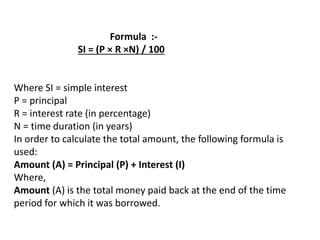
Formula :-
SI = (P × R ×N) / 100
Where SI = simple interest
P = principal
R = interest rate (in percentage)
N = time duration (in years)
In order to calculate the total amount, the following formula is
used:
Amount (A) = Principal (P) + Interest (I)
Where,
Amount (A) is the total money paid back at the end of the time
period for which it was borrowed.
1. Rishav takes a loan of Rs 10000 from a bank for a period of
1 year. The rate of interest is 10% per annum. Find the
interest and the amount he has to the pay at the end of a
year.
Solution :- Here, the loan sum = P = Rs 10000
Rate of interest per year = R = 10%
Time for which it is borrowed = N = 1 year
Thus, simple interest for a year,
SI = (P × R ×T) / 100
= (10000 × 10 ×1) / 100
= Rs 1000
Amount that Rishav has to pay to the bank at the end of the
year
= Principal + Interest
=10000 + 1000
= Rs 11,000
2. Mohit pays Rs 9000 as an amount on the sum of Rs 7000 that
he had borrowed for 2 years. Find the rate of interest.
Solution:
Given A = Rs 9000
P = Rs 7000
SI = A – P = 9000 – 7000 = Rs 2000
T = 2 years
R = ?
SI = (P × R ×T) / 100
R = (SI × 100) /(P× T)
R = (2000 × 100 /7000 × 2) =14.29 %
Thus, R = 14.29%
3 . Namita borrowed Rs 50,000 for 3 years at the rate of 3.5% per
annum. Find the interest accumulated at the end of 3 years.
Solution :- Given
P = Rs 50,000
R = 3.5%
T = 3 years
SI = (P × R ×T) / 100
= (50,000× 3.5 ×3) / 100
= Rs 5250
4. A sum of Money Doubles itself in 10 Years . Find the Rate of
Simple Interest .
 When we observe our bank statements, we generally
notice that some interest amount is credited to our account
every year.
 This interest varies with each year for the same principal
amount. We can see that interest increases for successive
years.
 Hence, we can conclude that the interest charged by the
bank is not simple interest, this interest is known
as compound interest or CI.
Compound Interest Definition
Compound interest is the interest calculated on the
principal and the interest accumulated over the previous period.
It is different from the simple interest where interest is not
added to the principal while calculating the interest during the
next period.
Compound interest finds its usage in most of the
transactions in the banking and finance sectors and also in other
areas as well.
Some of its applications are:
 Increase or decrease in population.
 The growth of bacteria.
 Rise or Depreciation in the value of an item.
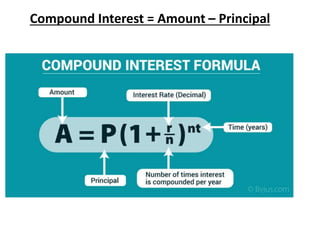
Compound Interest = Amount – Principal
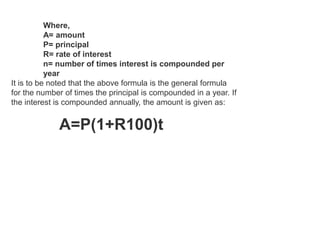
Where,
A= amount
P= principal
R= rate of interest
n= number of times interest is compounded per
year
It is to be noted that the above formula is the general formula
for the number of times the principal is compounded in a year. If
the interest is compounded annually, the amount is given as:
A=P(1+R100)t
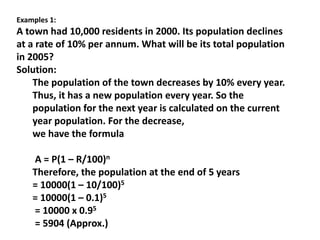
Examples 1:
A town had 10,000 residents in 2000. Its population declines
at a rate of 10% per annum. What will be its total population
in 2005?
Solution:
The population of the town decreases by 10% every year.
Thus, it has a new population every year. So the
population for the next year is calculated on the current
year population. For the decrease,
we have the formula
A = P(1 – R/100)n
Therefore, the population at the end of 5 years
= 10000(1 – 10/100)5
= 10000(1 – 0.1)5
= 10000 x 0.95
= 5904 (Approx.)
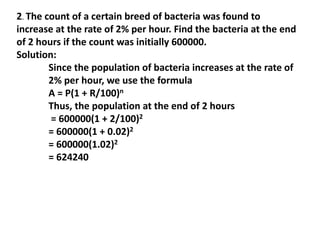
2. The count of a certain breed of bacteria was found to
increase at the rate of 2% per hour. Find the bacteria at the end
of 2 hours if the count was initially 600000.
Solution:
Since the population of bacteria increases at the rate of
2% per hour, we use the formula
A = P(1 + R/100)n
Thus, the population at the end of 2 hours
= 600000(1 + 2/100)2
= 600000(1 + 0.02)2
= 600000(1.02)2
= 624240
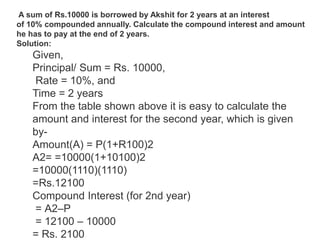
A sum of Rs.10000 is borrowed by Akshit for 2 years at an interest
of 10% compounded annually. Calculate the compound interest and amount
he has to pay at the end of 2 years.
Solution:
Given,
Principal/ Sum = Rs. 10000,
Rate = 10%, and
Time = 2 years
From the table shown above it is easy to calculate the
amount and interest for the second year, which is given
by-
Amount(A) = P(1+R100)2
A2= =10000(1+10100)2
=10000(1110)(1110)
=Rs.12100
Compound Interest (for 2nd year)
= A2–P
= 12100 – 10000
= Rs. 2100
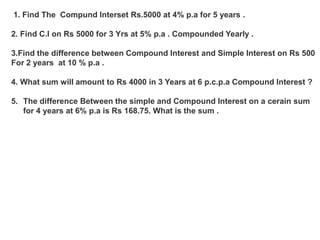
1. Find The Compund Interset Rs.5000 at 4% p.a for 5 years .
2. Find C.I on Rs 5000 for 3 Yrs at 5% p.a . Compounded Yearly .
3.Find the difference between Compound Interest and Simple Interest on Rs 500
For 2 years at 10 % p.a .
4. What sum will amount to Rs 4000 in 3 Years at 6 p.c.p.a Compound Interest ?
5. The difference Between the simple and Compound Interest on a cerain sum
for 4 years at 6% p.a is Rs 168.75. What is the sum .
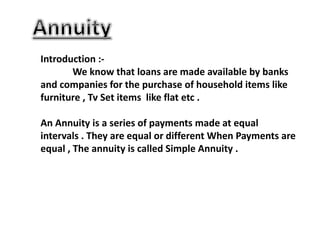
Introduction :-
We know that loans are made available by banks
and companies for the purchase of household items like
furniture , Tv Set items like flat etc .
An Annuity is a series of payments made at equal
intervals . They are equal or different When Payments are
equal , The annuity is called Simple Annuity .
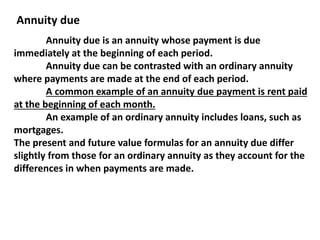
Annuity due
Annuity due is an annuity whose payment is due
immediately at the beginning of each period.
Annuity due can be contrasted with an ordinary annuity
where payments are made at the end of each period.
A common example of an annuity due payment is rent paid
at the beginning of each month.
An example of an ordinary annuity includes loans, such as
mortgages.
The present and future value formulas for an annuity due differ
slightly from those for an ordinary annuity as they account for the
differences in when payments are made.
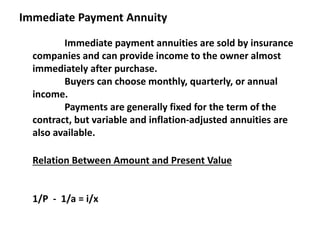
Immediate Payment Annuity
Immediate payment annuities are sold by insurance
companies and can provide income to the owner almost
immediately after purchase.
Buyers can choose monthly, quarterly, or annual
income.
Payments are generally fixed for the term of the
contract, but variable and inflation-adjusted annuities are
also available.
Relation Between Amount and Present Value
1/P - 1/a = i/x
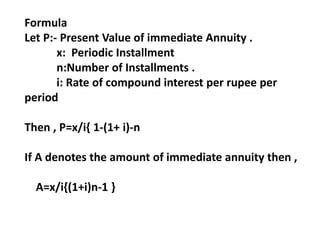
Formula
Let P:- Present Value of immediate Annuity .
x: Periodic Installment
n:Number of Installments .
i: Rate of compound interest per rupee per
period
Then , P=x/i{ 1-(1+ i)-n
If A denotes the amount of immediate annuity then ,
A=x/i{(1+i)n-1 }
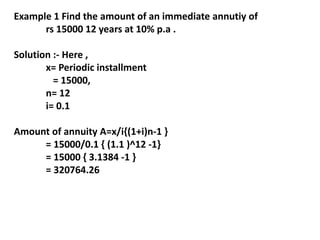
Example 1 Find the amount of an immediate annutiy of
rs 15000 12 years at 10% p.a .
Solution :- Here ,
x= Periodic installment
= 15000,
n= 12
i= 0.1
Amount of annuity A=x/i{(1+i)n-1 }
= 15000/0.1 { (1.1 )^12 -1}
= 15000 { 3.1384 -1 }
= 320764.26
2. ULIP is a scheme of unit trust of india under which a person can
deposit upto Rs 10000/-Per year . The status of ULIP is 10 Years
or 15 years , A person takes a membership of ULIP by paying
10000 for 10 years . Assuming the rate of compound interst to be
12% . Find the amount he will receive at the end of 10 years .
Solution :- Here x = 10000
n = 10
i= 0.12
To find amount A
Now A=x/i [ (1 + I ) ^n -1 ]
= 10000/ 0.12 [ (1.12) ^ 10 -1 ]
= Rs 175483
3 . Find the amount of an annuity of Rs 400 payable quarterly for
3 years at 16 % p.a .
Solution :- Here installment x= 400
Period is 1 quarter
16% p.a means 4% per Quarter
i.e 4 paise per rupee
Thus , i=0.04
N : number of installment
= 3 x 4
=12
To find amount A
We have
A=x/i [ (1 + I ) ^n -1 ]
= 400/0.04 [ ( 1.04)^12 -1 ]
= 10,000 [1.60103 -1 ]
= 10000 x 0.60103
= Rs 6010 approx
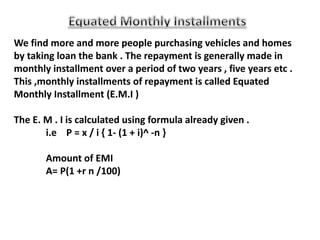
We find more and more people purchasing vehicles and homes
by taking loan the bank . The repayment is generally made in
monthly installment over a period of two years , five years etc .
This ,monthly installments of repayment is called Equated
Monthly Installment (E.M.I )
The E. M . I is calculated using formula already given .
i.e P = x / i { 1- (1 + i)^ -n }
Amount of EMI
A= P(1 +r n /100)
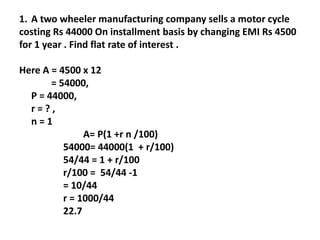
1. A two wheeler manufacturing company sells a motor cycle
costing Rs 44000 On installment basis by changing EMI Rs 4500
for 1 year . Find flat rate of interest .
Here A = 4500 x 12
= 54000,
P = 44000,
r = ? ,
n = 1
A= P(1 +r n /100)
54000= 44000(1 + r/100)
54/44 = 1 + r/100
r/100 = 54/44 -1
= 10/44
r = 1000/44
22.7
2 .What is EMI of loan of RS 25000 if repaid in 4 years . At the rate
of interest 5 % p.a . On the outstanding amount at the beginning
of each year ?
Solution :- P=25000 , r=5 , n=4 years = 48 months
i = interest per rupee per month
= 12/1200
= 1/100
=0.01
Now P = x/i [ 1-( 1 + i)^ -n ]
25000 = x/0.01 [ 1- (1 + 0.01 ) ^ -48 ]
25000 = x/0.01 [ 1 –(1.01 )^ -48 ]
250 =x[ 1- 0.6203 ]
250 = x[ 0.3797]
x= 250 / 0.3797
x = 658.3459
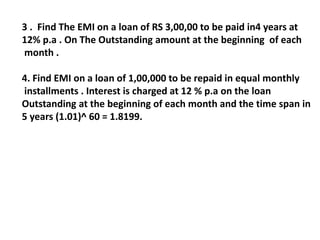
3 . Find The EMI on a loan of RS 3,00,00 to be paid in4 years at
12% p.a . On The Outstanding amount at the beginning of each
month .
4. Find EMI on a loan of 1,00,000 to be repaid in equal monthly
installments . Interest is charged at 12 % p.a on the loan
Outstanding at the beginning of each month and the time span in
5 years (1.01)^ 60 = 1.8199.
Ch 3 . intrerest and annutiy

Ch 3 . intrerest and annutiy

  • 1.
    Presented By :-Miss Pragati Khade Dada Patil Mahavidyalaya
  • 2.
    Simple Interest isan easy method of calculating the interest for a loan/principal amount. Simple interest is a concept which is used in most of the sectors such as banking, finance, automobile, and so on. Simple Interest (S.I) is the method of calculating the interest amount for some principal amount of money.
  • 3.
    Formula :- SI =(P × R ×N) / 100 Where SI = simple interest P = principal R = interest rate (in percentage) N = time duration (in years) In order to calculate the total amount, the following formula is used: Amount (A) = Principal (P) + Interest (I) Where, Amount (A) is the total money paid back at the end of the time period for which it was borrowed.
  • 4.
    1. Rishav takesa loan of Rs 10000 from a bank for a period of 1 year. The rate of interest is 10% per annum. Find the interest and the amount he has to the pay at the end of a year. Solution :- Here, the loan sum = P = Rs 10000 Rate of interest per year = R = 10% Time for which it is borrowed = N = 1 year Thus, simple interest for a year, SI = (P × R ×T) / 100 = (10000 × 10 ×1) / 100 = Rs 1000 Amount that Rishav has to pay to the bank at the end of the year = Principal + Interest =10000 + 1000 = Rs 11,000
  • 5.
    2. Mohit paysRs 9000 as an amount on the sum of Rs 7000 that he had borrowed for 2 years. Find the rate of interest. Solution: Given A = Rs 9000 P = Rs 7000 SI = A – P = 9000 – 7000 = Rs 2000 T = 2 years R = ? SI = (P × R ×T) / 100 R = (SI × 100) /(P× T) R = (2000 × 100 /7000 × 2) =14.29 % Thus, R = 14.29%
  • 6.
    3 . Namitaborrowed Rs 50,000 for 3 years at the rate of 3.5% per annum. Find the interest accumulated at the end of 3 years. Solution :- Given P = Rs 50,000 R = 3.5% T = 3 years SI = (P × R ×T) / 100 = (50,000× 3.5 ×3) / 100 = Rs 5250 4. A sum of Money Doubles itself in 10 Years . Find the Rate of Simple Interest .
  • 7.
     When weobserve our bank statements, we generally notice that some interest amount is credited to our account every year.  This interest varies with each year for the same principal amount. We can see that interest increases for successive years.  Hence, we can conclude that the interest charged by the bank is not simple interest, this interest is known as compound interest or CI.
  • 8.
    Compound Interest Definition Compoundinterest is the interest calculated on the principal and the interest accumulated over the previous period. It is different from the simple interest where interest is not added to the principal while calculating the interest during the next period. Compound interest finds its usage in most of the transactions in the banking and finance sectors and also in other areas as well. Some of its applications are:  Increase or decrease in population.  The growth of bacteria.  Rise or Depreciation in the value of an item.
  • 9.
    Compound Interest =Amount – Principal
  • 10.
    Where, A= amount P= principal R=rate of interest n= number of times interest is compounded per year It is to be noted that the above formula is the general formula for the number of times the principal is compounded in a year. If the interest is compounded annually, the amount is given as: A=P(1+R100)t
  • 11.
    Examples 1: A townhad 10,000 residents in 2000. Its population declines at a rate of 10% per annum. What will be its total population in 2005? Solution: The population of the town decreases by 10% every year. Thus, it has a new population every year. So the population for the next year is calculated on the current year population. For the decrease, we have the formula A = P(1 – R/100)n Therefore, the population at the end of 5 years = 10000(1 – 10/100)5 = 10000(1 – 0.1)5 = 10000 x 0.95 = 5904 (Approx.)
  • 12.
    2. The countof a certain breed of bacteria was found to increase at the rate of 2% per hour. Find the bacteria at the end of 2 hours if the count was initially 600000. Solution: Since the population of bacteria increases at the rate of 2% per hour, we use the formula A = P(1 + R/100)n Thus, the population at the end of 2 hours = 600000(1 + 2/100)2 = 600000(1 + 0.02)2 = 600000(1.02)2 = 624240
  • 13.
    A sum ofRs.10000 is borrowed by Akshit for 2 years at an interest of 10% compounded annually. Calculate the compound interest and amount he has to pay at the end of 2 years. Solution: Given, Principal/ Sum = Rs. 10000, Rate = 10%, and Time = 2 years From the table shown above it is easy to calculate the amount and interest for the second year, which is given by- Amount(A) = P(1+R100)2 A2= =10000(1+10100)2 =10000(1110)(1110) =Rs.12100 Compound Interest (for 2nd year) = A2–P = 12100 – 10000 = Rs. 2100
  • 14.
    1. Find TheCompund Interset Rs.5000 at 4% p.a for 5 years . 2. Find C.I on Rs 5000 for 3 Yrs at 5% p.a . Compounded Yearly . 3.Find the difference between Compound Interest and Simple Interest on Rs 500 For 2 years at 10 % p.a . 4. What sum will amount to Rs 4000 in 3 Years at 6 p.c.p.a Compound Interest ? 5. The difference Between the simple and Compound Interest on a cerain sum for 4 years at 6% p.a is Rs 168.75. What is the sum .
  • 15.
    Introduction :- We knowthat loans are made available by banks and companies for the purchase of household items like furniture , Tv Set items like flat etc . An Annuity is a series of payments made at equal intervals . They are equal or different When Payments are equal , The annuity is called Simple Annuity .
  • 16.
    Annuity due Annuity dueis an annuity whose payment is due immediately at the beginning of each period. Annuity due can be contrasted with an ordinary annuity where payments are made at the end of each period. A common example of an annuity due payment is rent paid at the beginning of each month. An example of an ordinary annuity includes loans, such as mortgages. The present and future value formulas for an annuity due differ slightly from those for an ordinary annuity as they account for the differences in when payments are made.
  • 17.
    Immediate Payment Annuity Immediatepayment annuities are sold by insurance companies and can provide income to the owner almost immediately after purchase. Buyers can choose monthly, quarterly, or annual income. Payments are generally fixed for the term of the contract, but variable and inflation-adjusted annuities are also available. Relation Between Amount and Present Value 1/P - 1/a = i/x
  • 18.
    Formula Let P:- PresentValue of immediate Annuity . x: Periodic Installment n:Number of Installments . i: Rate of compound interest per rupee per period Then , P=x/i{ 1-(1+ i)-n If A denotes the amount of immediate annuity then , A=x/i{(1+i)n-1 }
  • 19.
    Example 1 Findthe amount of an immediate annutiy of rs 15000 12 years at 10% p.a . Solution :- Here , x= Periodic installment = 15000, n= 12 i= 0.1 Amount of annuity A=x/i{(1+i)n-1 } = 15000/0.1 { (1.1 )^12 -1} = 15000 { 3.1384 -1 } = 320764.26
  • 20.
    2. ULIP isa scheme of unit trust of india under which a person can deposit upto Rs 10000/-Per year . The status of ULIP is 10 Years or 15 years , A person takes a membership of ULIP by paying 10000 for 10 years . Assuming the rate of compound interst to be 12% . Find the amount he will receive at the end of 10 years . Solution :- Here x = 10000 n = 10 i= 0.12 To find amount A Now A=x/i [ (1 + I ) ^n -1 ] = 10000/ 0.12 [ (1.12) ^ 10 -1 ] = Rs 175483
  • 21.
    3 . Findthe amount of an annuity of Rs 400 payable quarterly for 3 years at 16 % p.a . Solution :- Here installment x= 400 Period is 1 quarter 16% p.a means 4% per Quarter i.e 4 paise per rupee Thus , i=0.04 N : number of installment = 3 x 4 =12 To find amount A We have A=x/i [ (1 + I ) ^n -1 ]
  • 22.
    = 400/0.04 [( 1.04)^12 -1 ] = 10,000 [1.60103 -1 ] = 10000 x 0.60103 = Rs 6010 approx
  • 23.
    We find moreand more people purchasing vehicles and homes by taking loan the bank . The repayment is generally made in monthly installment over a period of two years , five years etc . This ,monthly installments of repayment is called Equated Monthly Installment (E.M.I ) The E. M . I is calculated using formula already given . i.e P = x / i { 1- (1 + i)^ -n } Amount of EMI A= P(1 +r n /100)
  • 24.
    1. A twowheeler manufacturing company sells a motor cycle costing Rs 44000 On installment basis by changing EMI Rs 4500 for 1 year . Find flat rate of interest . Here A = 4500 x 12 = 54000, P = 44000, r = ? , n = 1 A= P(1 +r n /100) 54000= 44000(1 + r/100) 54/44 = 1 + r/100 r/100 = 54/44 -1 = 10/44 r = 1000/44 22.7
  • 25.
    2 .What isEMI of loan of RS 25000 if repaid in 4 years . At the rate of interest 5 % p.a . On the outstanding amount at the beginning of each year ? Solution :- P=25000 , r=5 , n=4 years = 48 months i = interest per rupee per month = 12/1200 = 1/100 =0.01 Now P = x/i [ 1-( 1 + i)^ -n ] 25000 = x/0.01 [ 1- (1 + 0.01 ) ^ -48 ] 25000 = x/0.01 [ 1 –(1.01 )^ -48 ] 250 =x[ 1- 0.6203 ] 250 = x[ 0.3797] x= 250 / 0.3797 x = 658.3459
  • 26.
    3 . FindThe EMI on a loan of RS 3,00,00 to be paid in4 years at 12% p.a . On The Outstanding amount at the beginning of each month . 4. Find EMI on a loan of 1,00,000 to be repaid in equal monthly installments . Interest is charged at 12 % p.a on the loan Outstanding at the beginning of each month and the time span in 5 years (1.01)^ 60 = 1.8199.