Looking for Real Roots of Real Polynomials
In this section we give three theorems concerning
real roots of real polynomials.
Looking for Real Roots of Real Polynomials
In this section we give three theorems concerning
real roots of real polynomials. They give three
different approaches concerning looking for roots.
Looking for Real Roots of Real Polynomials
In this section we give three theorems concerning
real roots of real polynomials. They give three
different approaches concerning looking for roots.
Looking for Real Roots of Real Polynomials
Descartes' Rule of Signss gives the possible
number of real roots by eyeballing the polynomial.
In this section we give three theorems concerning
real roots of real polynomials. They give three
different approaches concerning looking for roots.
Looking for Real Roots of Real Polynomials
Descartes' Rule of Signss gives the possible
number of real roots by eyeballing the polynomial.
Theorem on the Bounds gives the interval of real
numbers where the roots must reside.
In this section we give three theorems concerning
real roots of real polynomials. They give three
different approaches concerning looking for roots.
Looking for Real Roots of Real Polynomials
Descartes' Rule of Signss gives the possible
number of real roots by eyeballing the polynomial.
Theorem on the Bounds gives the interval of real
numbers where the roots must reside.
Theorem on Rational Roots gives the possible
rational roots for polynomials with integer coefficients.
In this section we give three theorems concerning
real roots of real polynomials. They give three
different approaches concerning looking for roots.
Looking for Real Roots of Real Polynomials
Descartes' Rule of Signss gives the possible
number of real roots by eyeballing the polynomial.
Theorem on the Bounds gives the interval of real
numbers where the roots must reside.
Descartes' Rule and Theorem on the Bounds
are existence-theorems in mathematics,
i.e. they establish the existence of something but
don’t say what they might be.
Theorem on Rational Roots gives the possible
rational roots for polynomials with integer coefficients.
In this section we give three theorems concerning
real roots of real polynomials. They give three
different approaches concerning looking for roots.
Looking for Real Roots of Real Polynomials
Descartes' Rule of Signss gives the possible
number of real roots by eyeballing the polynomial.
Theorem on the Bounds gives the interval of real
numbers where the roots must reside.
Descartes' Rule and Theorem on the Bounds
are existence-theorems in mathematics,
i.e. they establish the existence of something but
don’t say what they might be. Theorem on Rational
Roots tells us precisely what to check.
Theorem on Rational Roots gives the possible
rational roots for polynomials with integer coefficients.
Looking for Real Roots of Real Polynomials
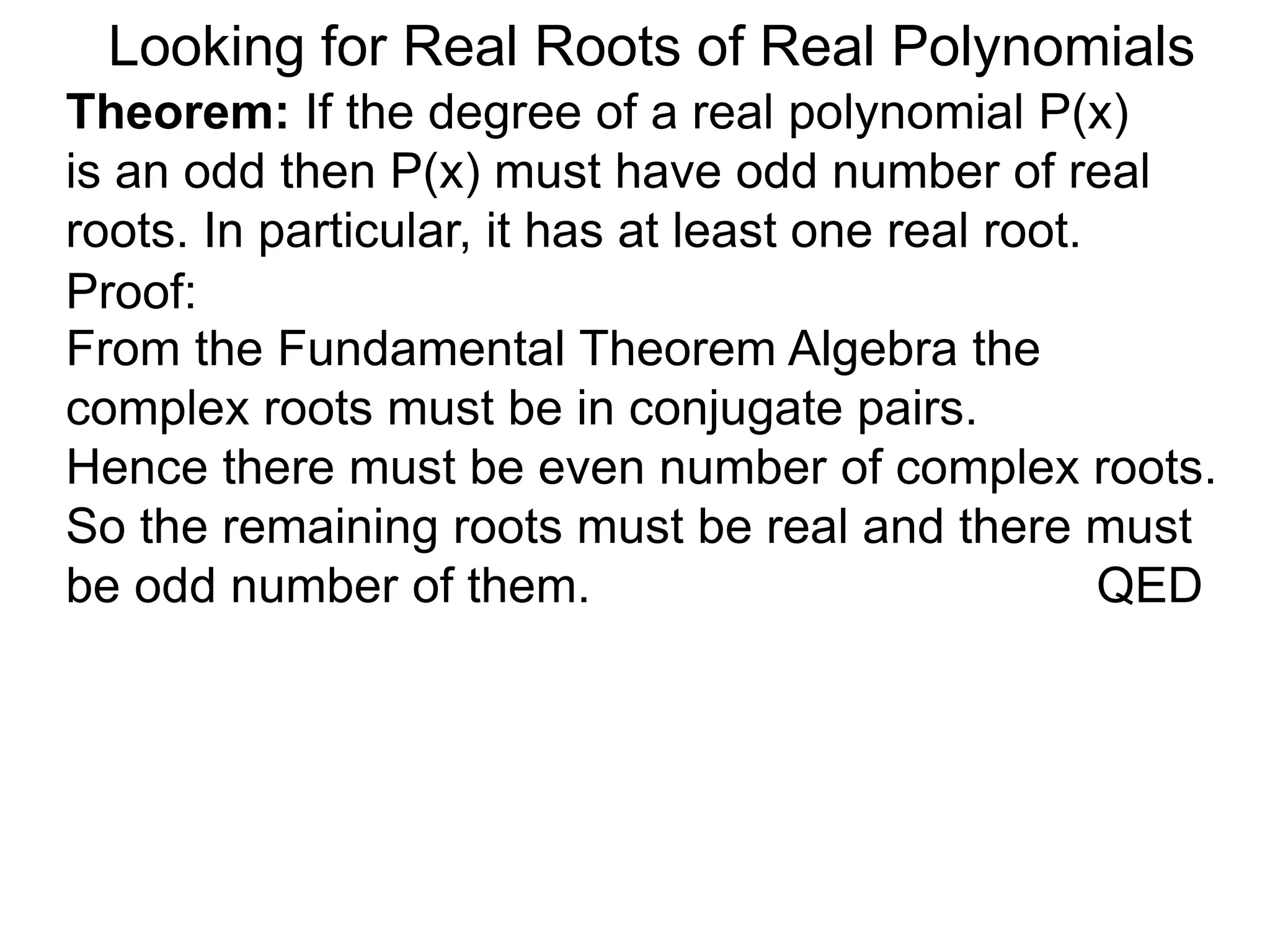
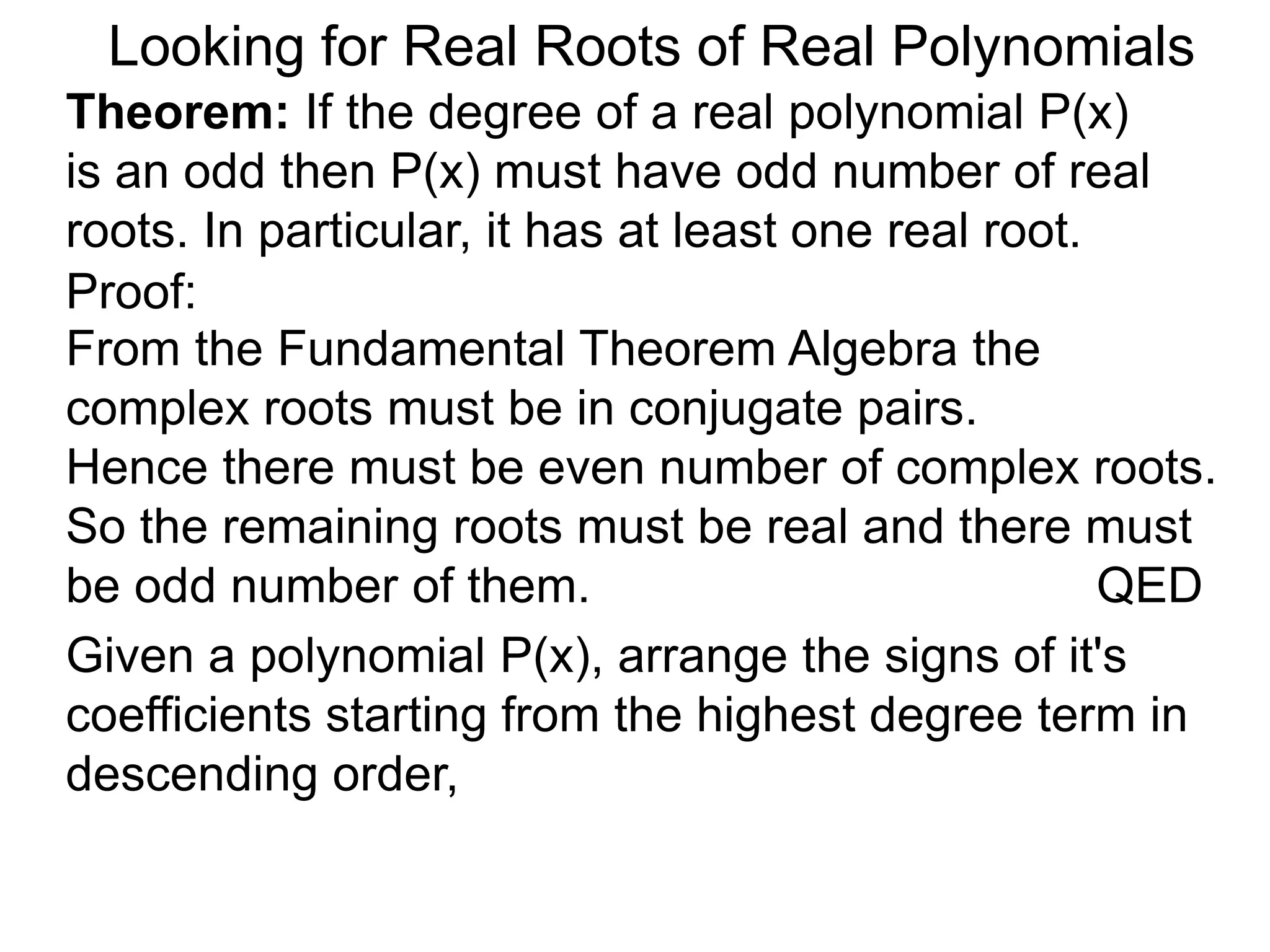
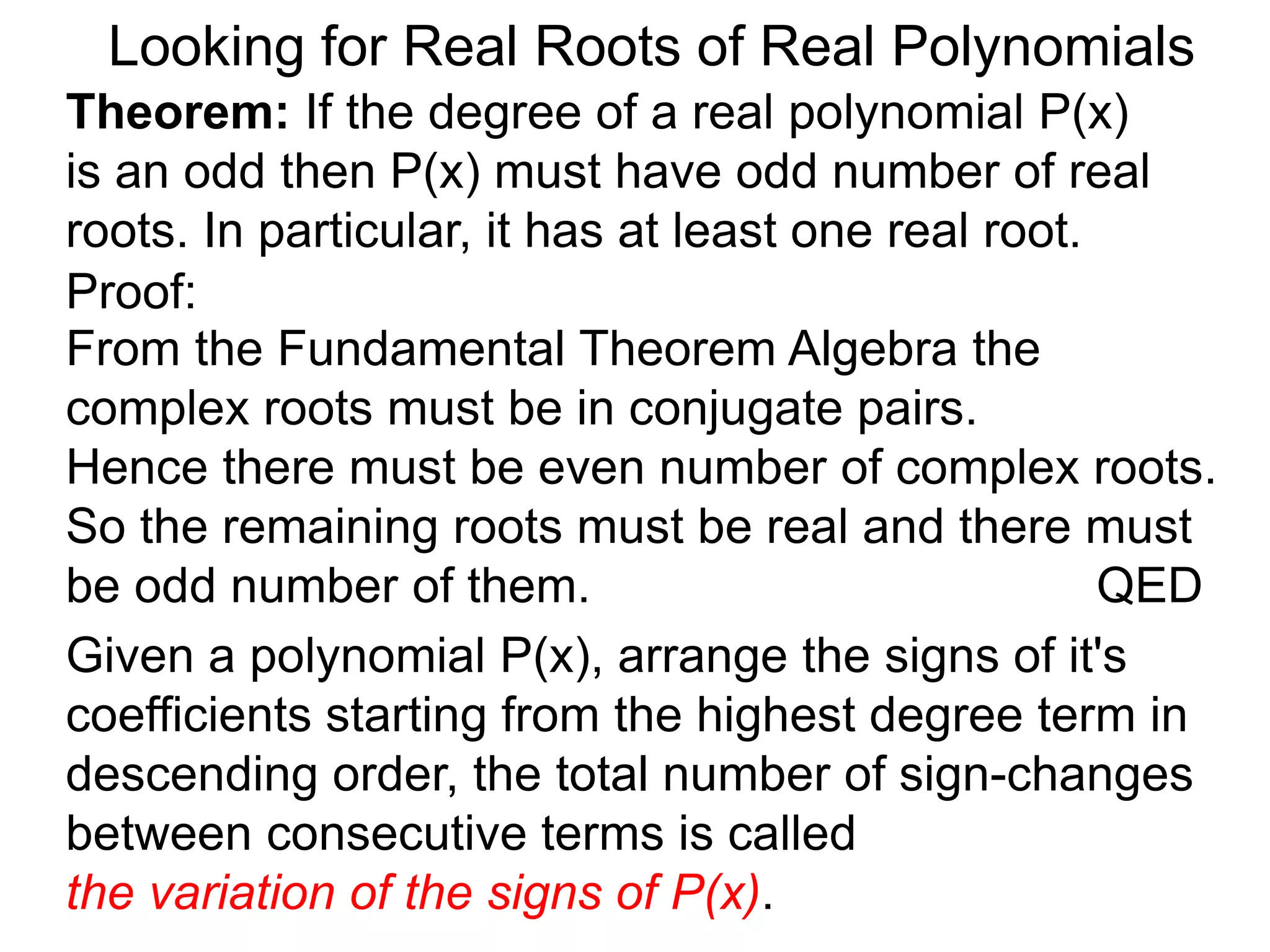
Theorem: If the degree of a real polynomial P(x)
is odd then P(x) must have an odd number of real
roots.
Looking for Real Roots of Real Polynomials
Theorem: If the degree of a real polynomial P(x)
is odd then P(x) must have an odd number of real
roots. In particular, it has at least one real root.
Looking for Real Roots of Real Polynomials
Theorem: If the degree of a real polynomial P(x)
is odd then P(x) must have an odd number of real
roots. In particular, it has at least one real root.
Proof:
From the Fundamental Theorem Algebra the
complex roots must be in conjugate pairs.
Looking for Real Roots of Real Polynomials
Theorem: If the degree of a real polynomial P(x)
is odd then P(x) must have an odd number of real
roots. In particular, it has at least one real root.
Proof:
From the Fundamental Theorem Algebra the
complex roots must be in conjugate pairs.
Hence there must be even number of complex roots.
Looking for Real Roots of Real Polynomials
Theorem: If the degree of a real polynomial P(x)
is odd then P(x) must have an odd number of real
roots. In particular, it has at least one real root.
Proof:
From the Fundamental Theorem Algebra the
complex roots must be in conjugate pairs.
Hence there must be even number of complex roots.
So the remaining roots must be real and there must
be an odd number of them. QED
Looking for Real Roots of Real Polynomials
Theorem: If the degree of a real polynomial P(x)
is odd then P(x) must have an odd number of real
roots. In particular, it has at least one real root.
Proof:
Given a polynomial P(x), arrange the signs of it's
coefficients starting from the highest degree term in
descending order,
From the Fundamental Theorem Algebra the
complex roots must be in conjugate pairs.
Hence there must be even number of complex roots.
So the remaining roots must be real and there must
be an odd number of them. QED
Looking for Real Roots of Real Polynomials
Theorem: If the degree of a real polynomial P(x)
is odd then P(x) must have an odd number of real
roots. In particular, it has at least one real root.
Proof:
Given a polynomial P(x), arrange the signs of it's
coefficients starting from the highest degree term in
descending order, the total number of sign-changes
between consecutive terms is called
the variation of the signs of P(x).
From the Fundamental Theorem Algebra the
complex roots must be in conjugate pairs.
Hence there must be even number of complex roots.
So the remaining roots must be real and there must
be an odd number of them. QED
Looking for Real Roots of Real Polynomials
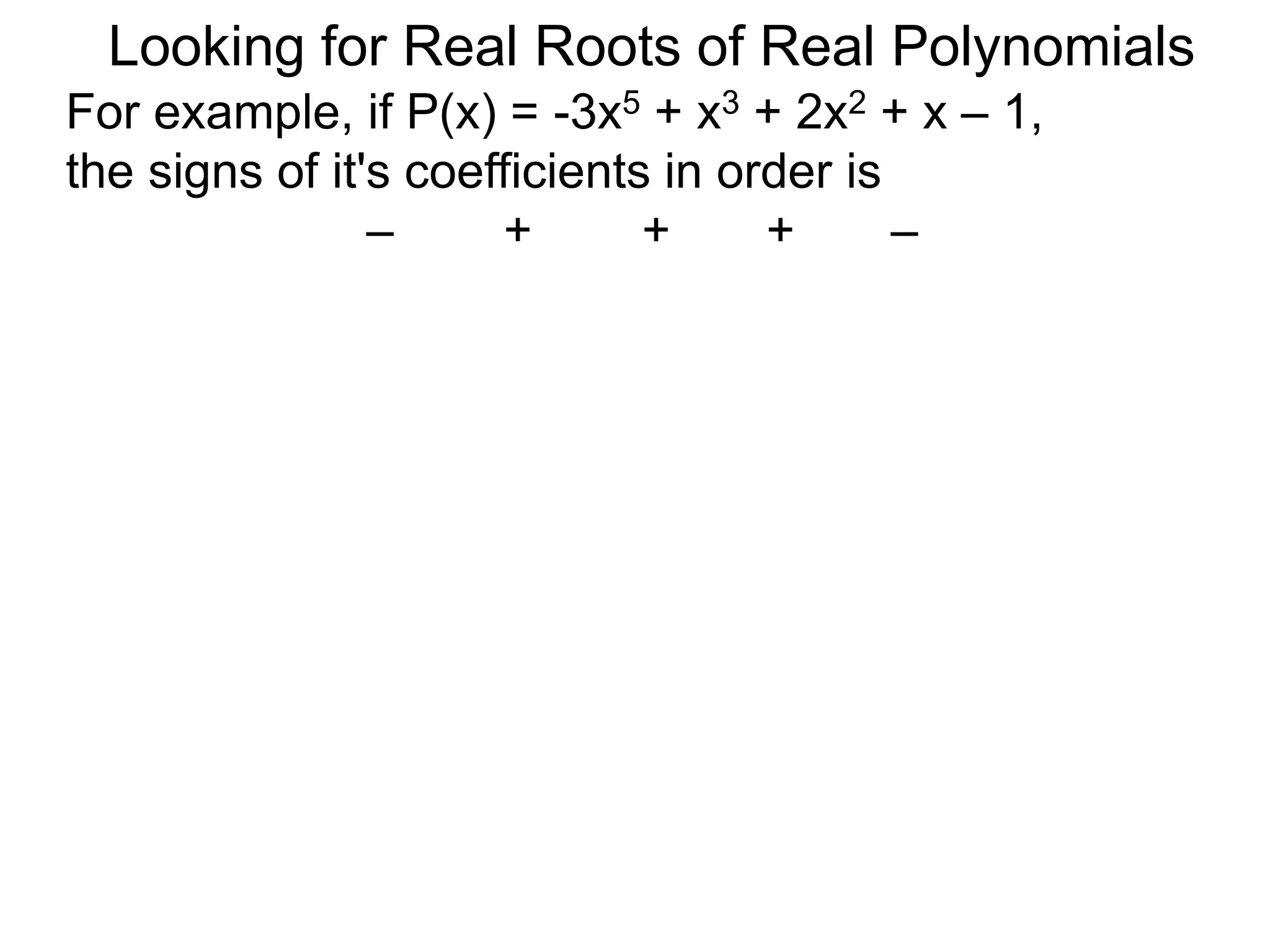
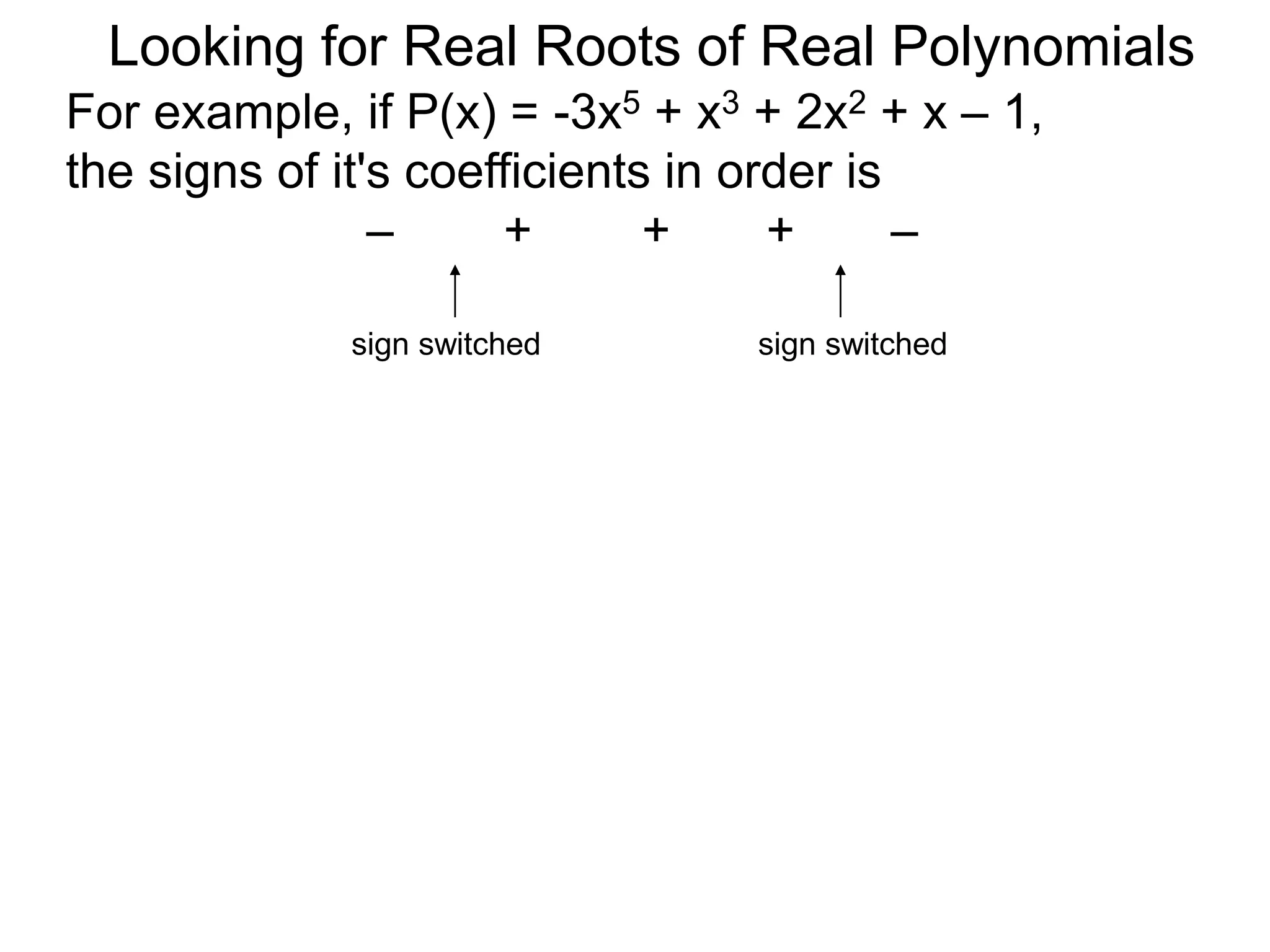
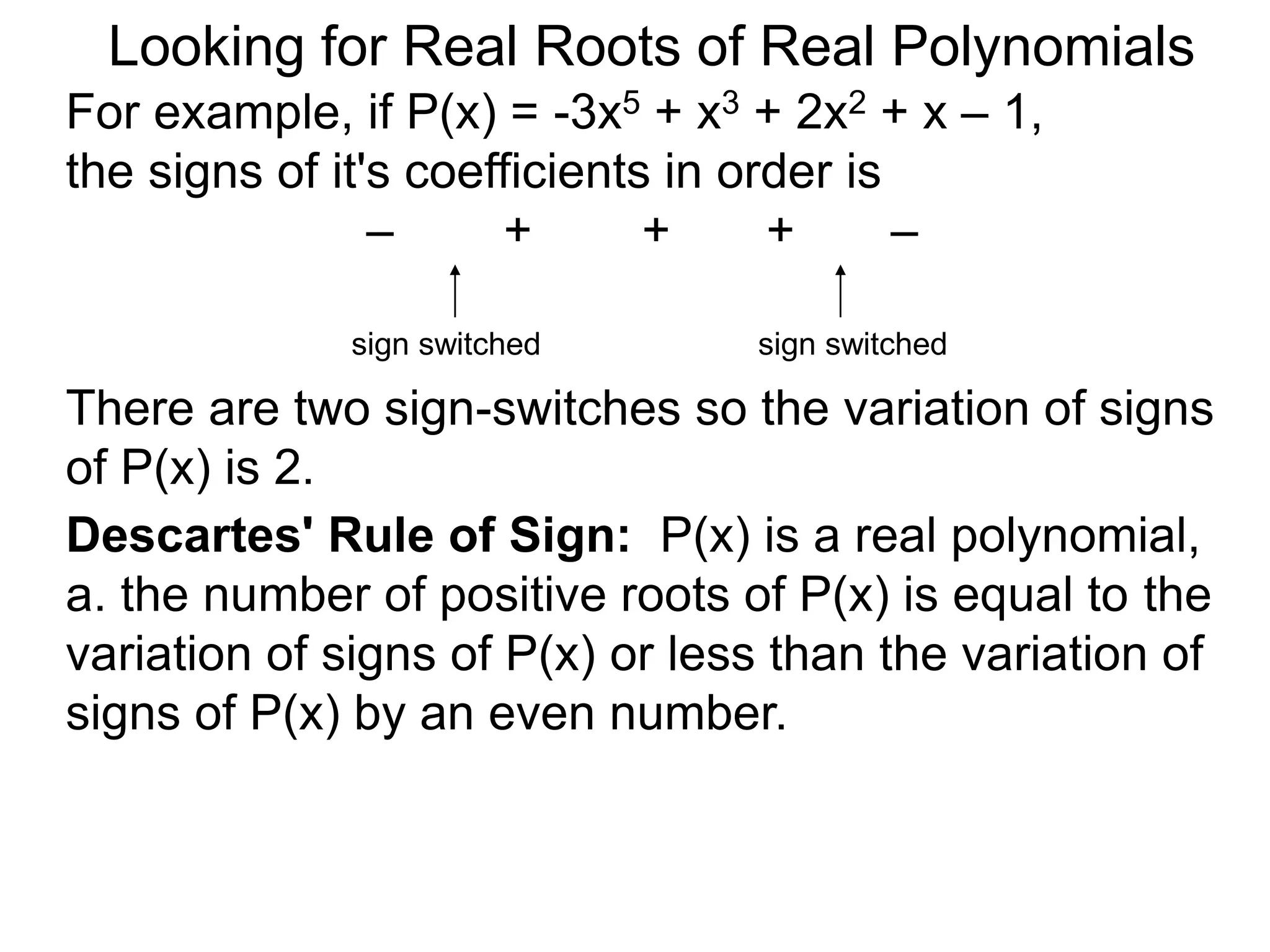
For example, if P(x) = –3x5 + x3 + 2x2 + x – 1,
the signs of its coefficients in order are
– + + + –
Looking for Real Roots of Real Polynomials
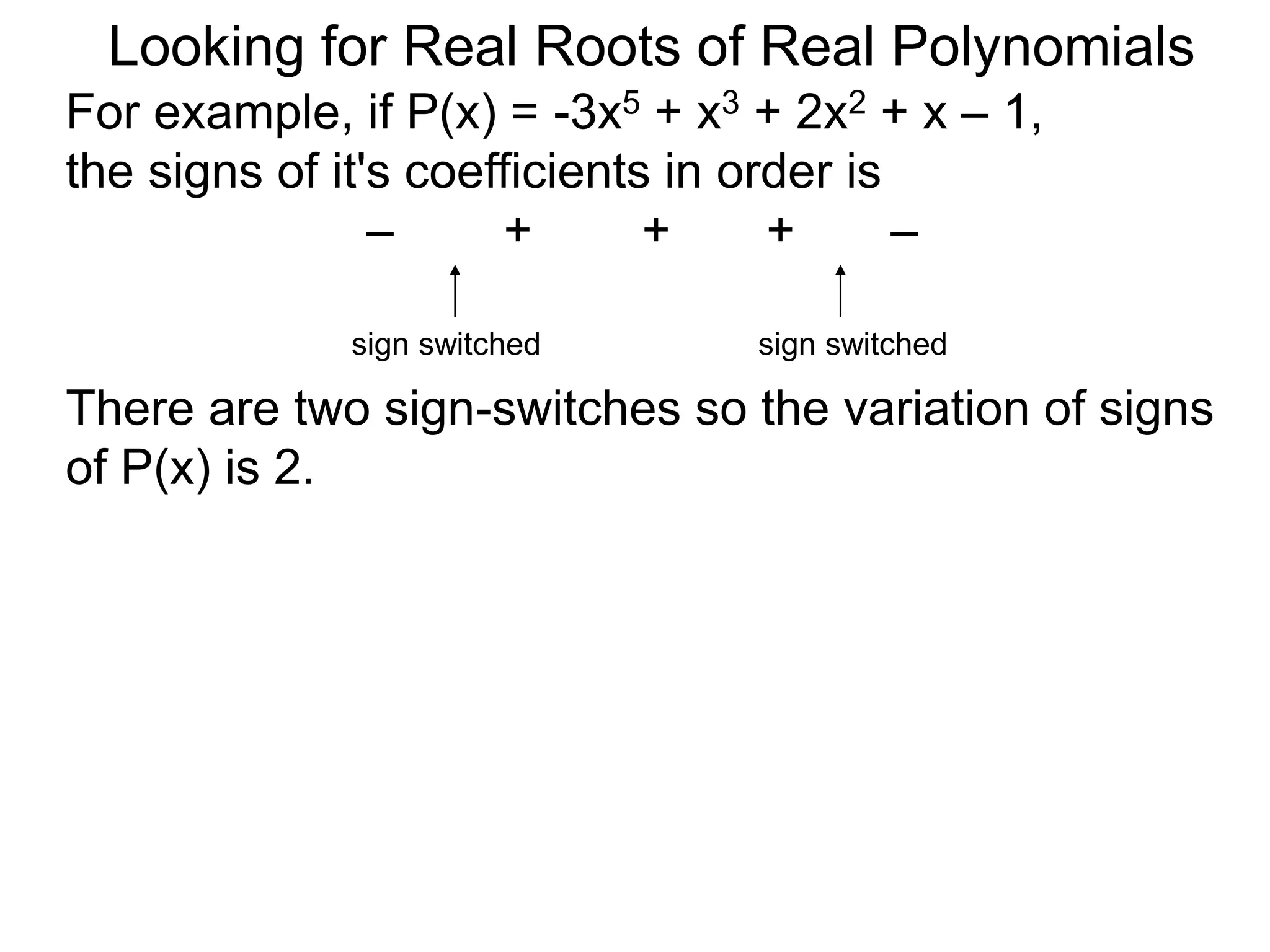
For example, if P(x) = –3x5 + x3 + 2x2 + x – 1,
the signs of its coefficients in order are
– + + + –
sign switched sign switched
Looking for Real Roots of Real Polynomials
For example, if P(x) = –3x5 + x3 + 2x2 + x – 1,
the signs of its coefficients in order are
– + + + –
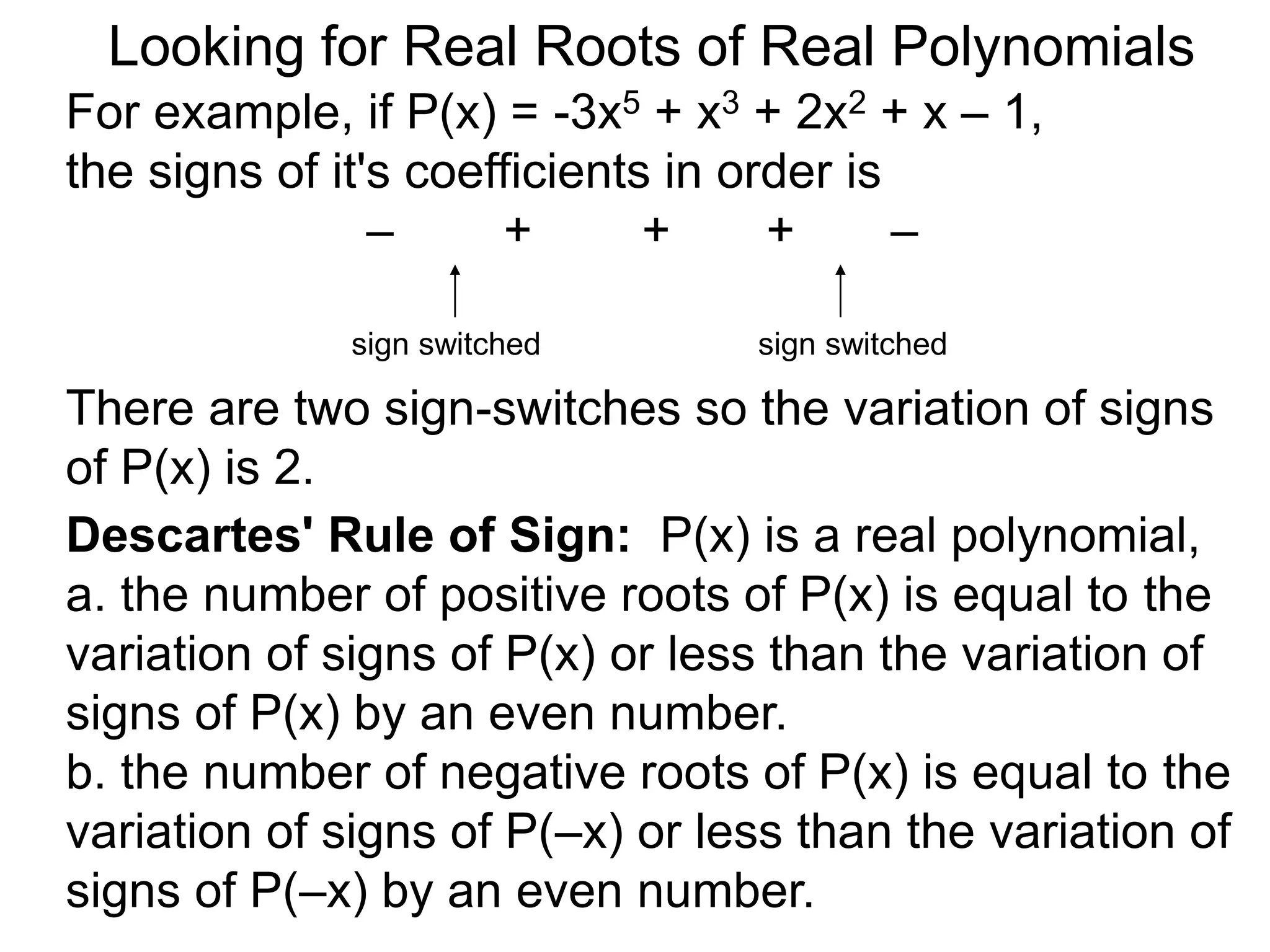
There are two sign-switches so the variation of
signss of P(x) is 2.
sign switched sign switched
Looking for Real Roots of Real Polynomials
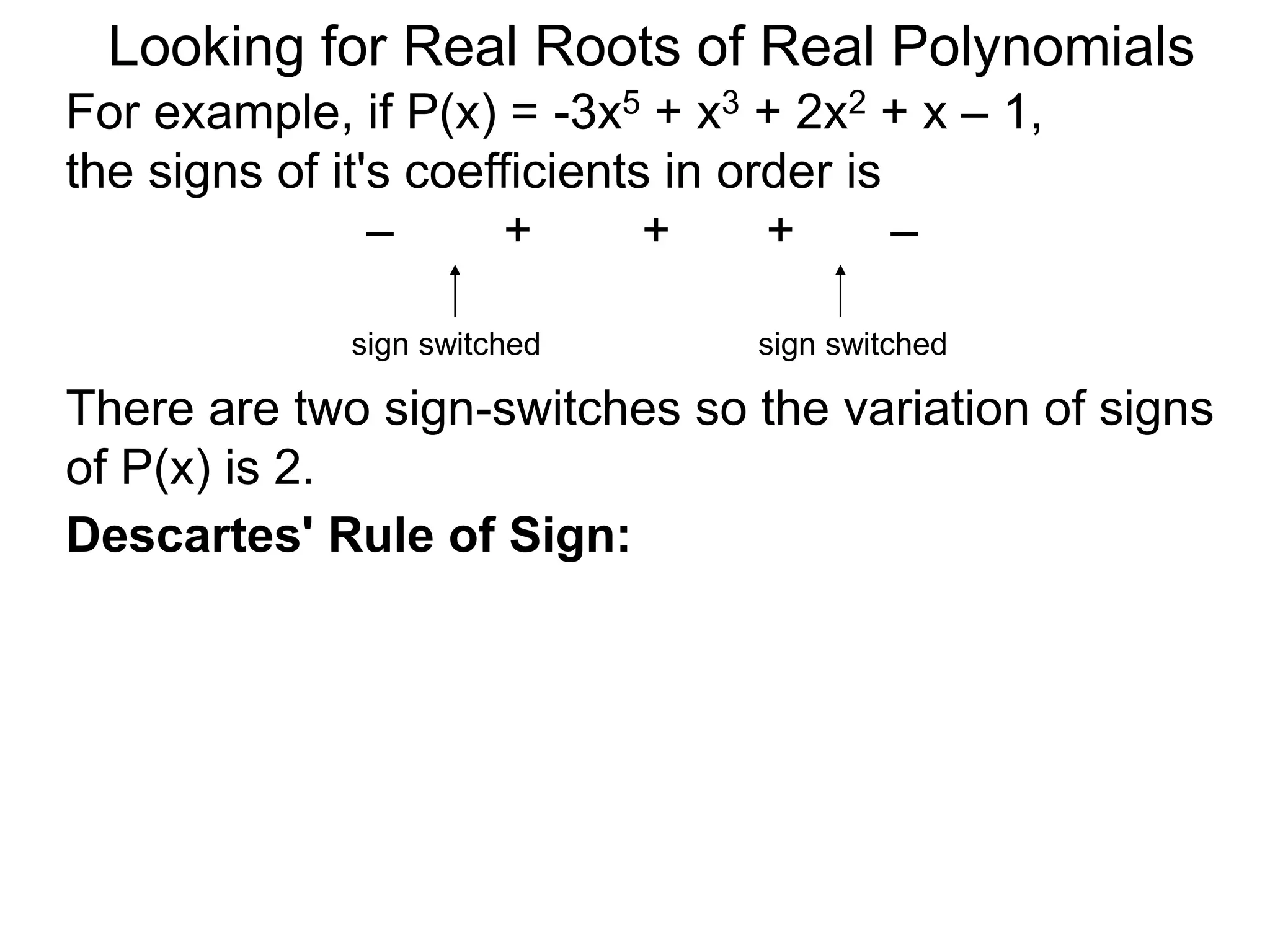
For example, if P(x) = –3x5 + x3 + 2x2 + x – 1,
the signs of its coefficients in order are
– + + + –
There are two sign-switches so the variation of
signss of P(x) is 2.
sign switched sign switched
Descartes' Rule of Signs:
Looking for Real Roots of Real Polynomials
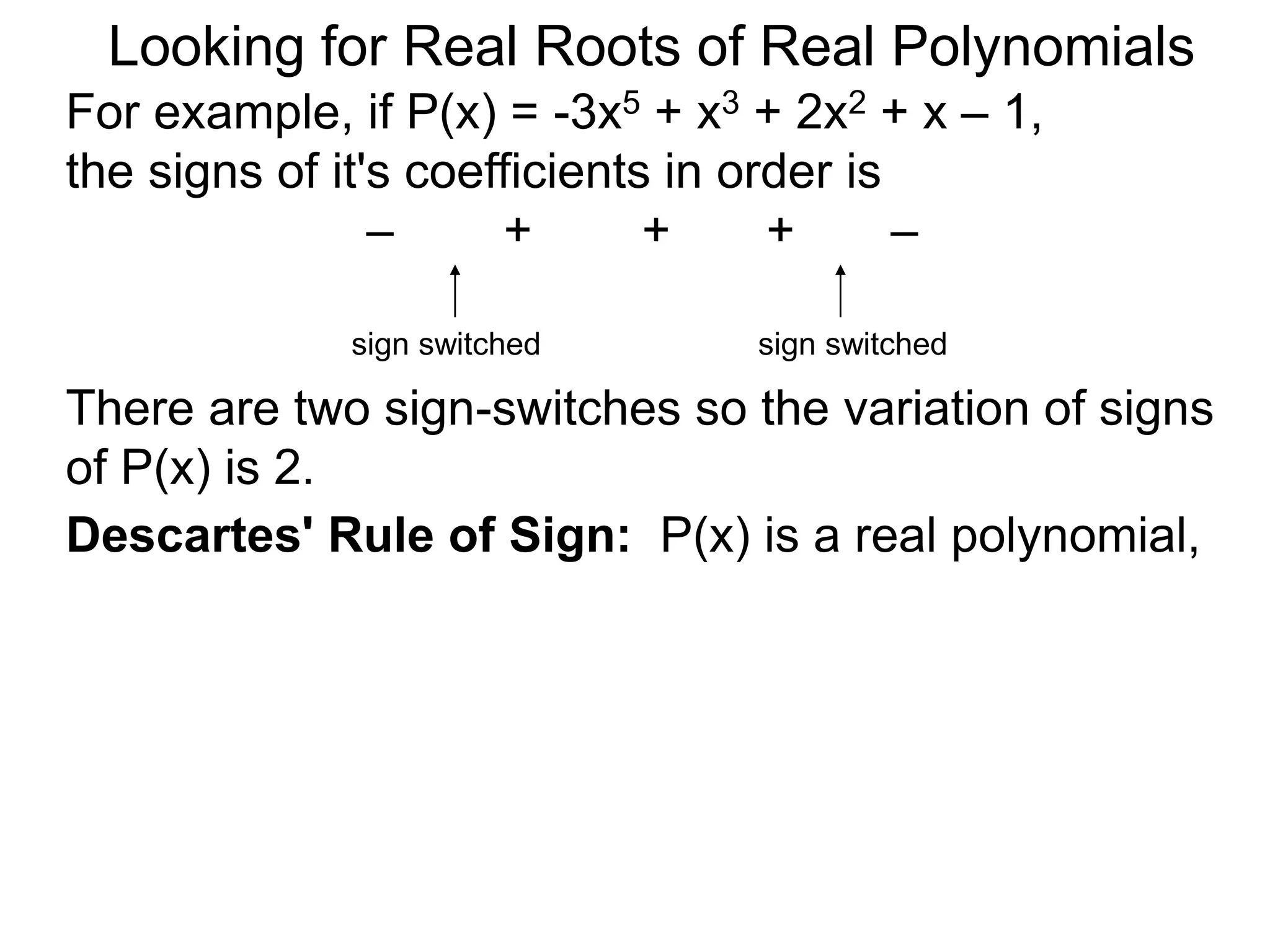
For example, if P(x) = –3x5 + x3 + 2x2 + x – 1,
the signs of its coefficients in order are
– + + + –
There are two sign-switches so the variation of
signss of P(x) is 2.
sign switched sign switched
Descartes' Rule of Signs: P(x) is a real
polynomial,
Looking for Real Roots of Real Polynomials
For example, if P(x) = –3x5 + x3 + 2x2 + x – 1,
the signs of its coefficients in order are
– + + + –
There are two sign-switches so the variation of
signss of P(x) is 2.
sign switched sign switched
Descartes' Rule of Signs: P(x) is a real polynomial,
a. the number of positive roots of P(x) is equal to the
variation of signss of P(x) or less than the variation of
signss of P(x) by an even number.
Looking for Real Roots of Real Polynomials
For example, if P(x) = –3x5 + x3 + 2x2 + x – 1,
the signs of its coefficients in order are
– + + + –
There are two sign-switches so the variation of
signss of P(x) is 2.
sign switched sign switched
Descartes' Rule of Signs: P(x) is a real polynomial,
a. the number of positive roots of P(x) is equal to the
variation of signss of P(x) or less than the variation of
signss of P(x) by an even number.
b. the number of negative roots of P(x) is equal to the
variation of signss of P(–x) or less than the variation
of signss of P(–x) by an even number.
Looking for Real Roots of Real Polynomials
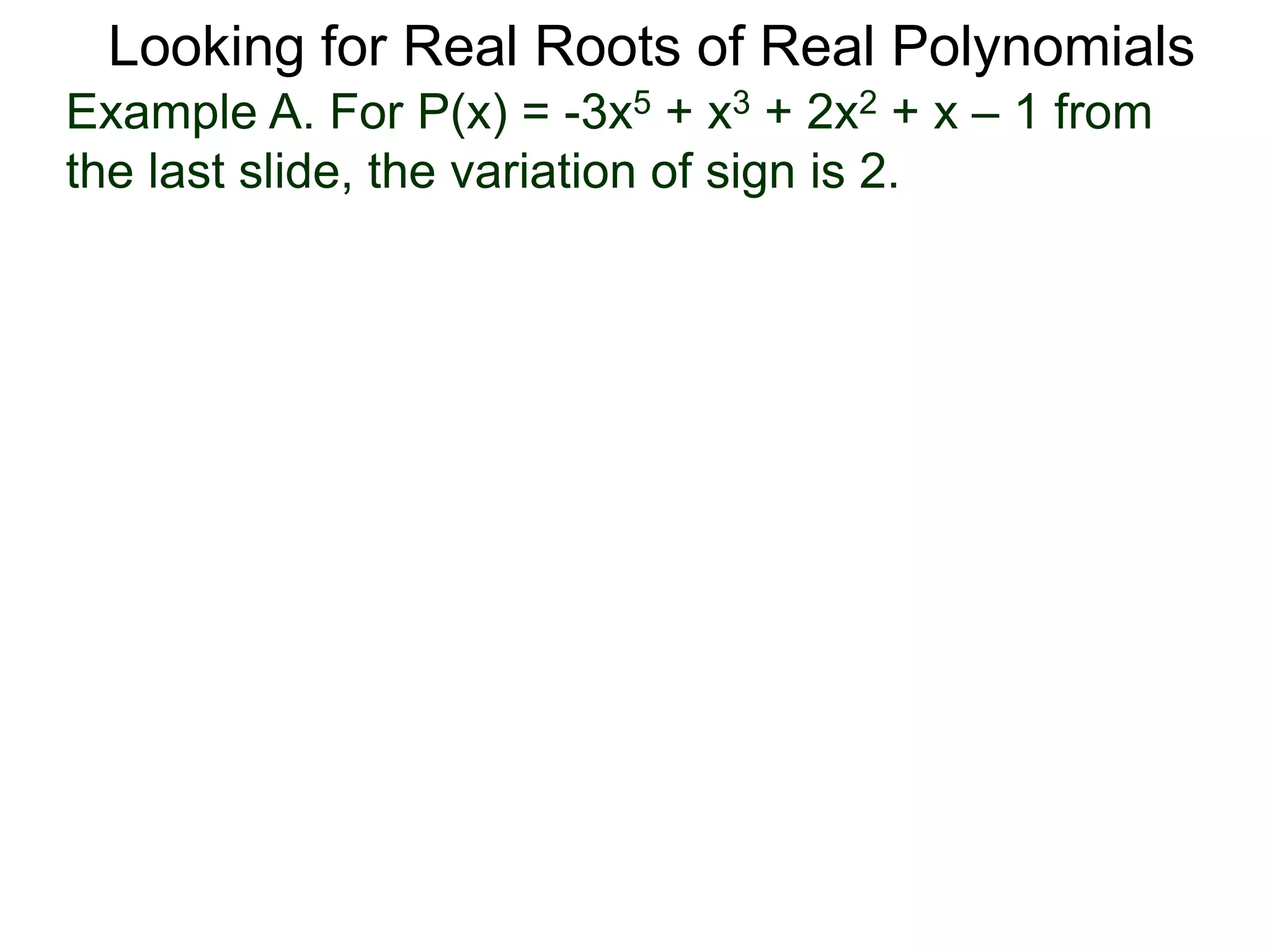
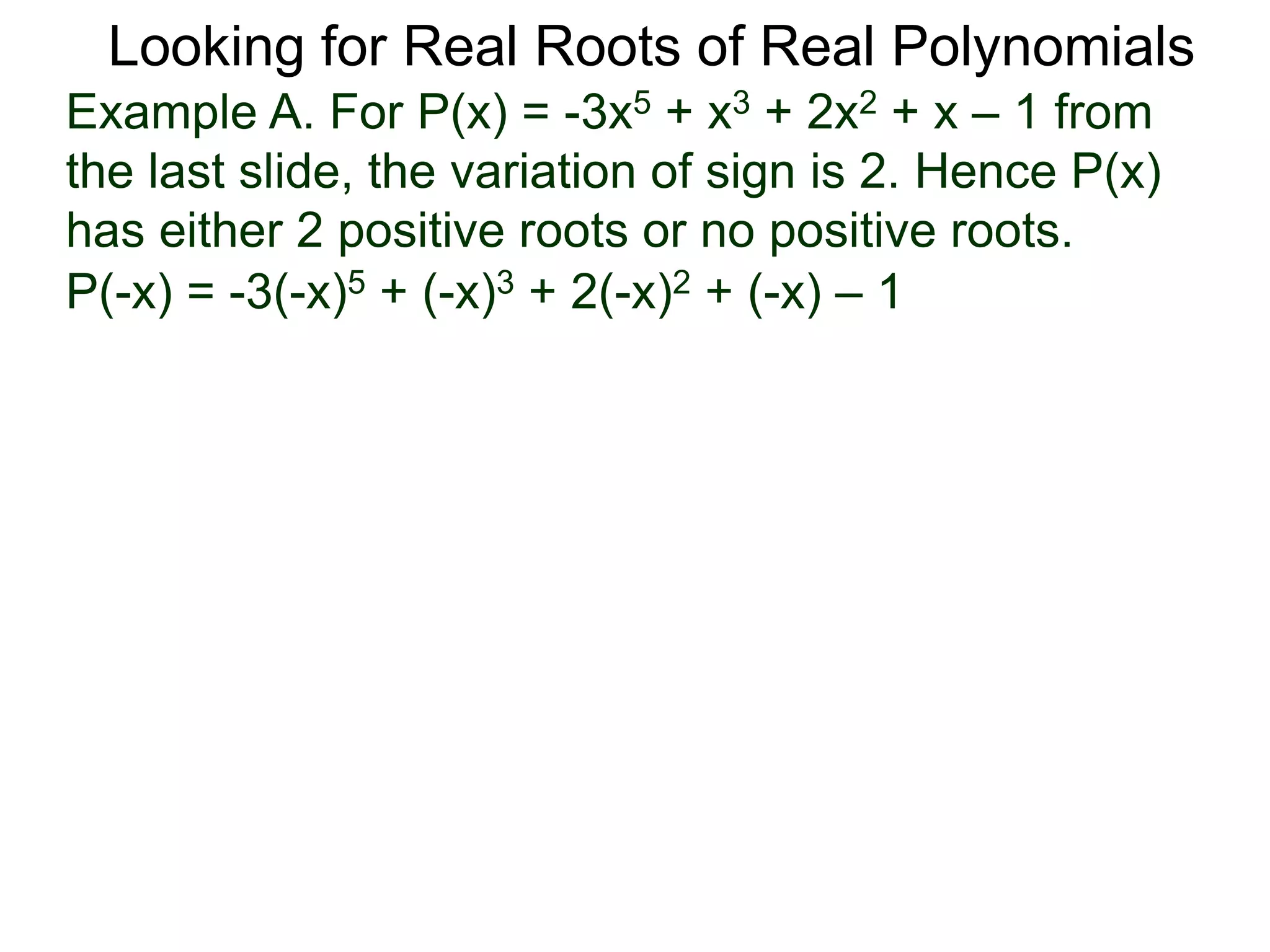
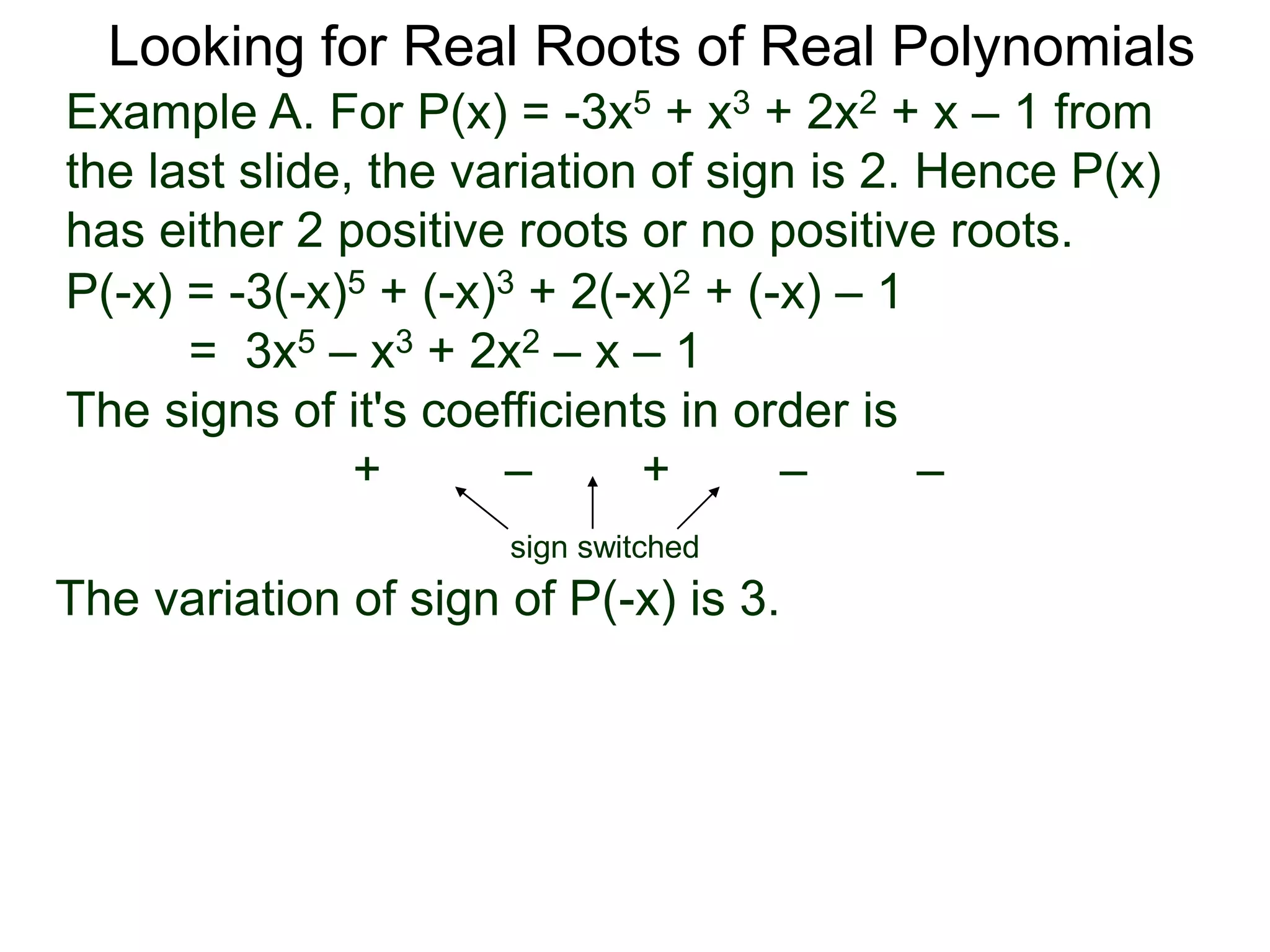
Example A. For P(x) = –3x5 + x3 + 2x2 + x – 1 from
the last slide, the variation of signs is 2.
Looking for Real Roots of Real Polynomials
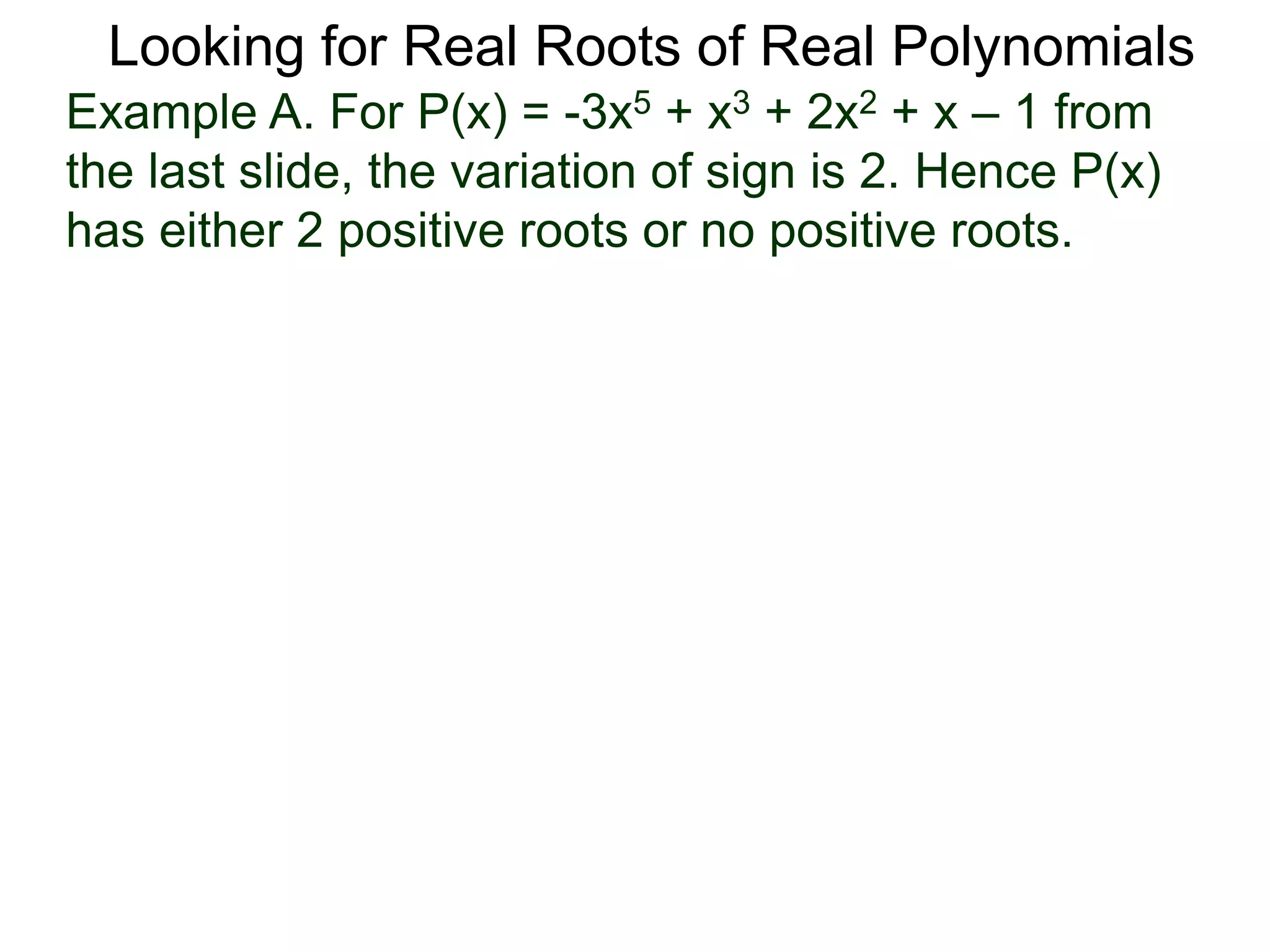
Example A. For P(x) = –3x5 + x3 + 2x2 + x – 1 from
the last slide, the variation of signs is 2. Hence P(x)
has either 2 positive roots or no positive roots.
Looking for Real Roots of Real Polynomials
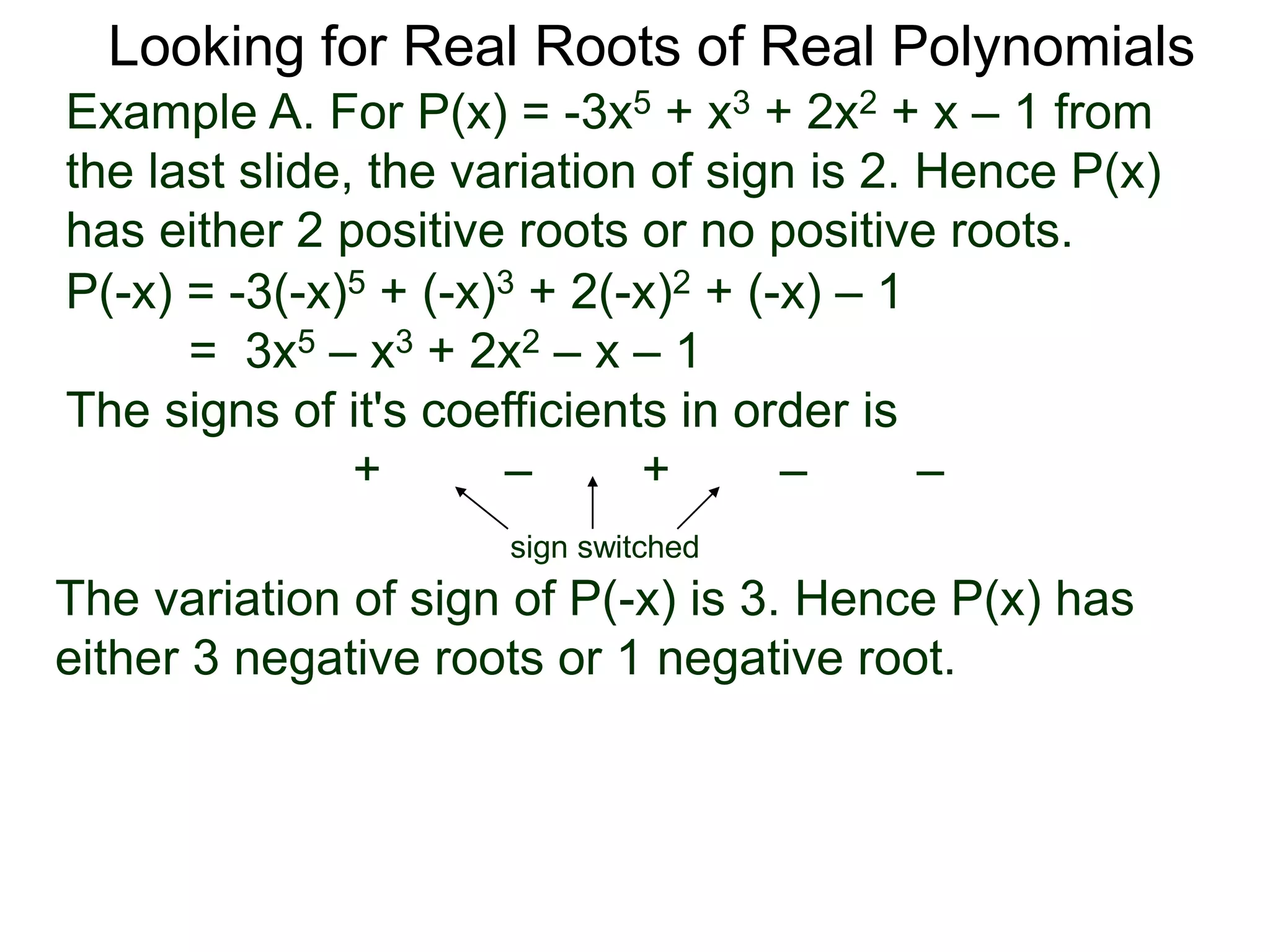
Example A. For P(x) = –3x5 + x3 + 2x2 + x – 1 from
the last slide, the variation of signs is 2. Hence P(x)
has either 2 positive roots or no positive roots.
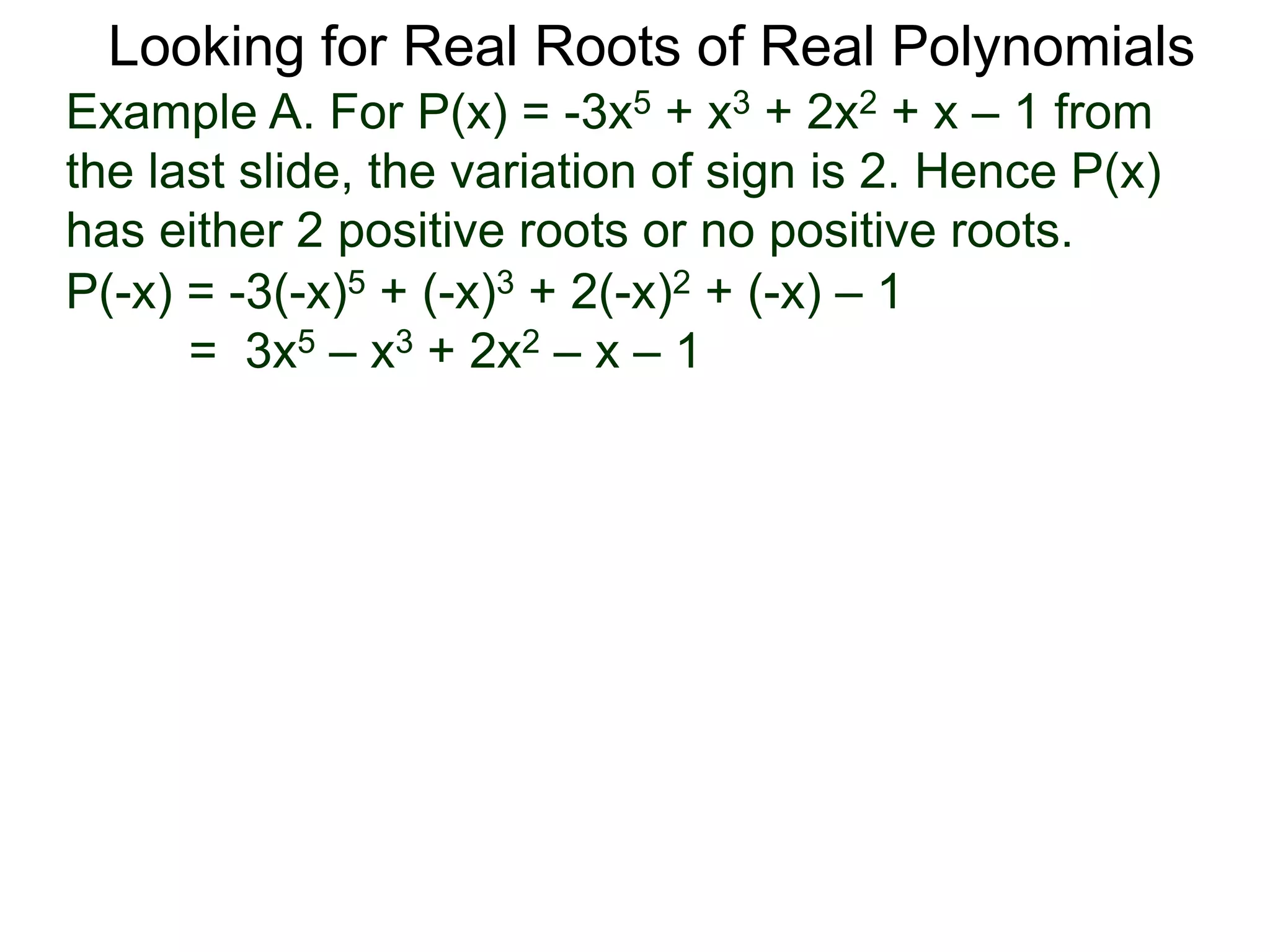
P(-x) = -3(-x)5 + (-x)3 + 2(-x)2 + (-x) – 1
Looking for Real Roots of Real Polynomials
Example A. For P(x) = –3x5 + x3 + 2x2 + x – 1 from
the last slide, the variation of signs is 2. Hence P(x)
has either 2 positive roots or no positive roots.
P(-x) = -3(-x)5 + (-x)3 + 2(-x)2 + (-x) – 1
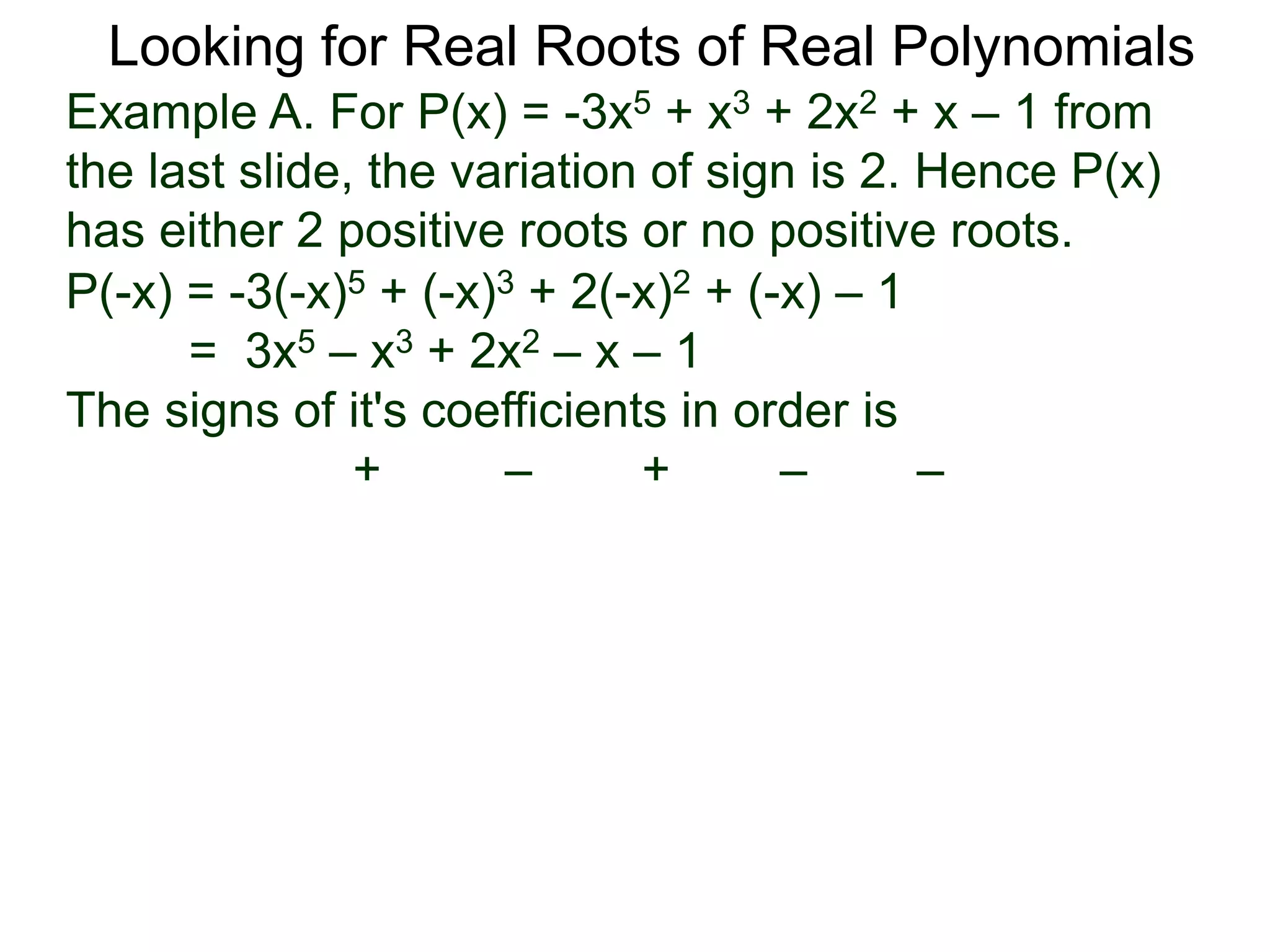
= 3x5 – x3 + 2x2 – x – 1
Looking for Real Roots of Real Polynomials
Example A. For P(x) = –3x5 + x3 + 2x2 + x – 1 from
the last slide, the variation of signs is 2. Hence P(x)
has either 2 positive roots or no positive roots.
P(-x) = -3(-x)5 + (-x)3 + 2(-x)2 + (-x) – 1
= 3x5 – x3 + 2x2 – x – 1
The signs of its coefficients in order are
+ – + – –
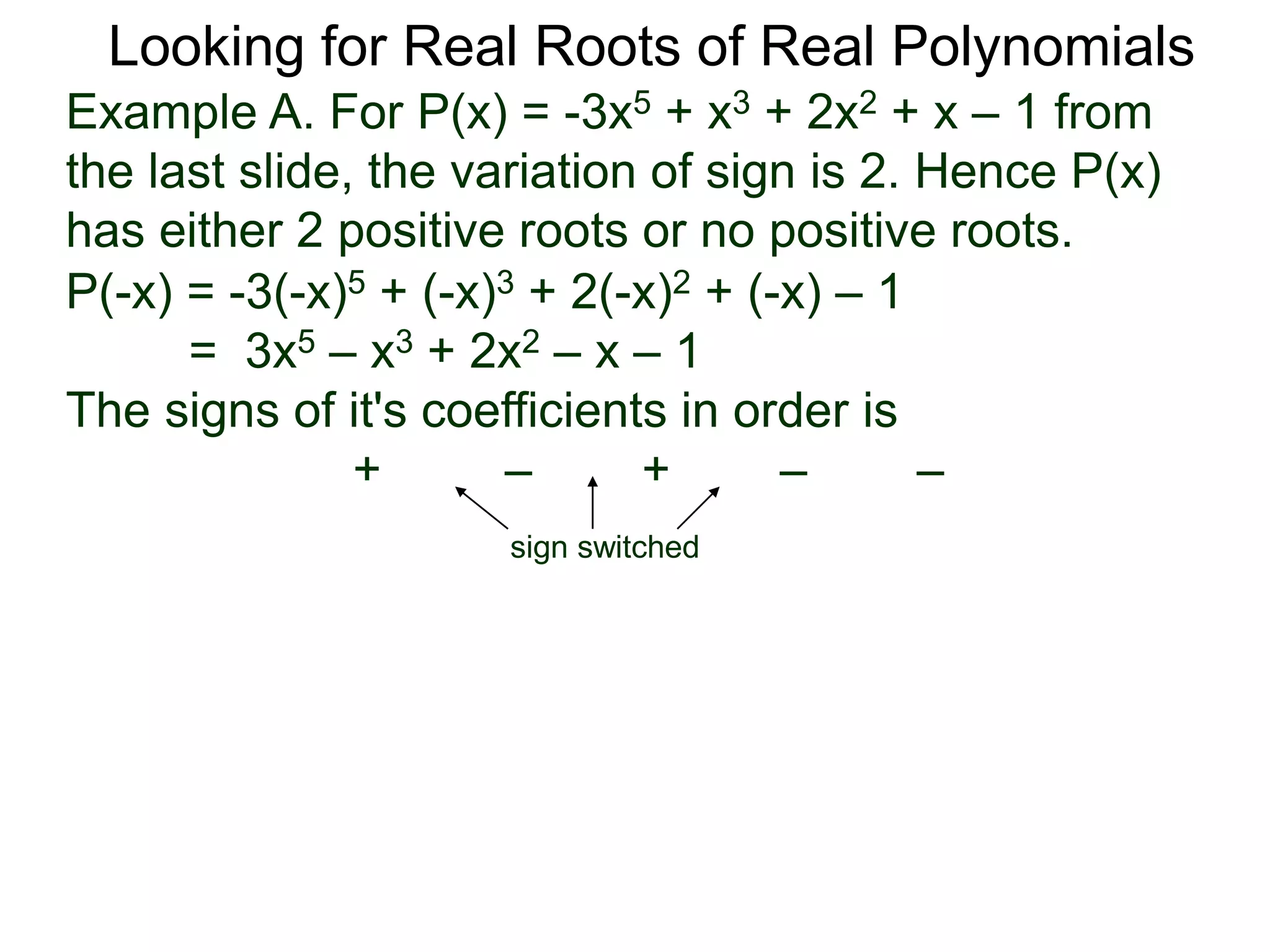
Looking for Real Roots of Real Polynomials
Example A. For P(x) = –3x5 + x3 + 2x2 + x – 1 from
the last slide, the variation of signs is 2. Hence P(x)
has either 2 positive roots or no positive roots.
P(-x) = -3(-x)5 + (-x)3 + 2(-x)2 + (-x) – 1
= 3x5 – x3 + 2x2 – x – 1
The signs of its coefficients in order are
+ – + – –
sign switched
Looking for Real Roots of Real Polynomials
Example A. For P(x) = –3x5 + x3 + 2x2 + x – 1 from
the last slide, the variation of signs is 2. Hence P(x)
has either 2 positive roots or no positive roots.
P(-x) = -3(-x)5 + (-x)3 + 2(-x)2 + (-x) – 1
= 3x5 – x3 + 2x2 – x – 1
The signs of its coefficients in order are
+ – + – –
sign switched
the variation of signs of P(-x) is 3.
Looking for Real Roots of Real Polynomials
Example A. For P(x) = –3x5 + x3 + 2x2 + x – 1 from
the last slide, the variation of signs is 2. Hence P(x)
has either 2 positive roots or no positive roots.
P(-x) = -3(-x)5 + (-x)3 + 2(-x)2 + (-x) – 1
= 3x5 – x3 + 2x2 – x – 1
The signs of its coefficients in order are
+ – + – –
sign switched
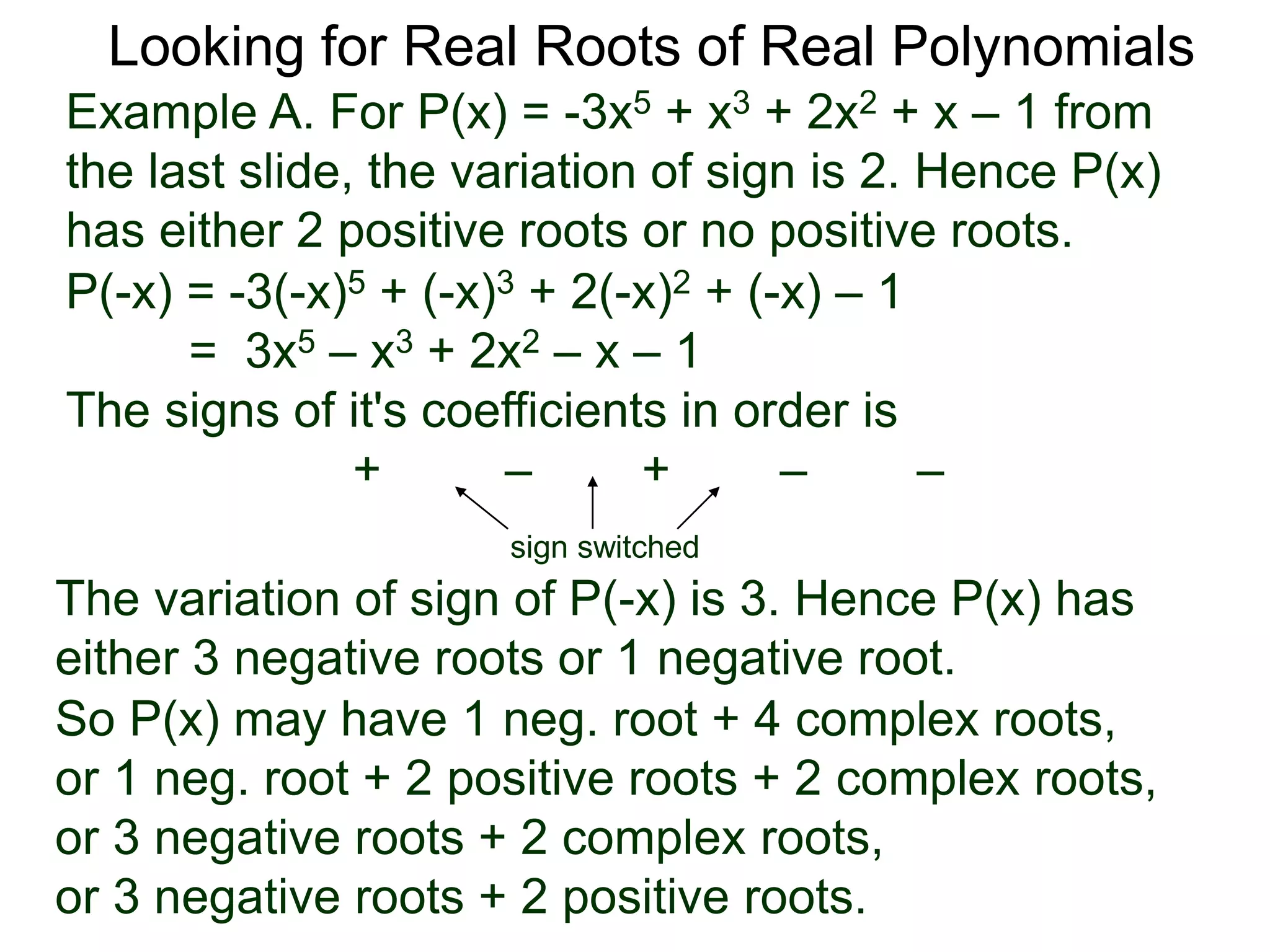
the variation of signs of P(-x) is 3. Hence P(x) has
either 3 negative roots or 1 negative root.
Looking for Real Roots of Real Polynomials
Example A. For P(x) = –3x5 + x3 + 2x2 + x – 1 from
the last slide, the variation of signs is 2. Hence P(x)
has either 2 positive roots or no positive roots.
P(-x) = -3(-x)5 + (-x)3 + 2(-x)2 + (-x) – 1
= 3x5 – x3 + 2x2 – x – 1
The signs of its coefficients in order are
+ – + – –
sign switched
the variation of signs of P(-x) is 3. Hence P(x) has
either 3 negative roots or 1 negative root.
So P(x) may have 1 neg. root + 4 complex roots,
or 1 neg. root + 2 positive roots + 2 complex roots,
or 3 negative roots + 2 complex roots,
or 3 negative roots + 2 positive roots.
Looking for Real Roots of Real Polynomials
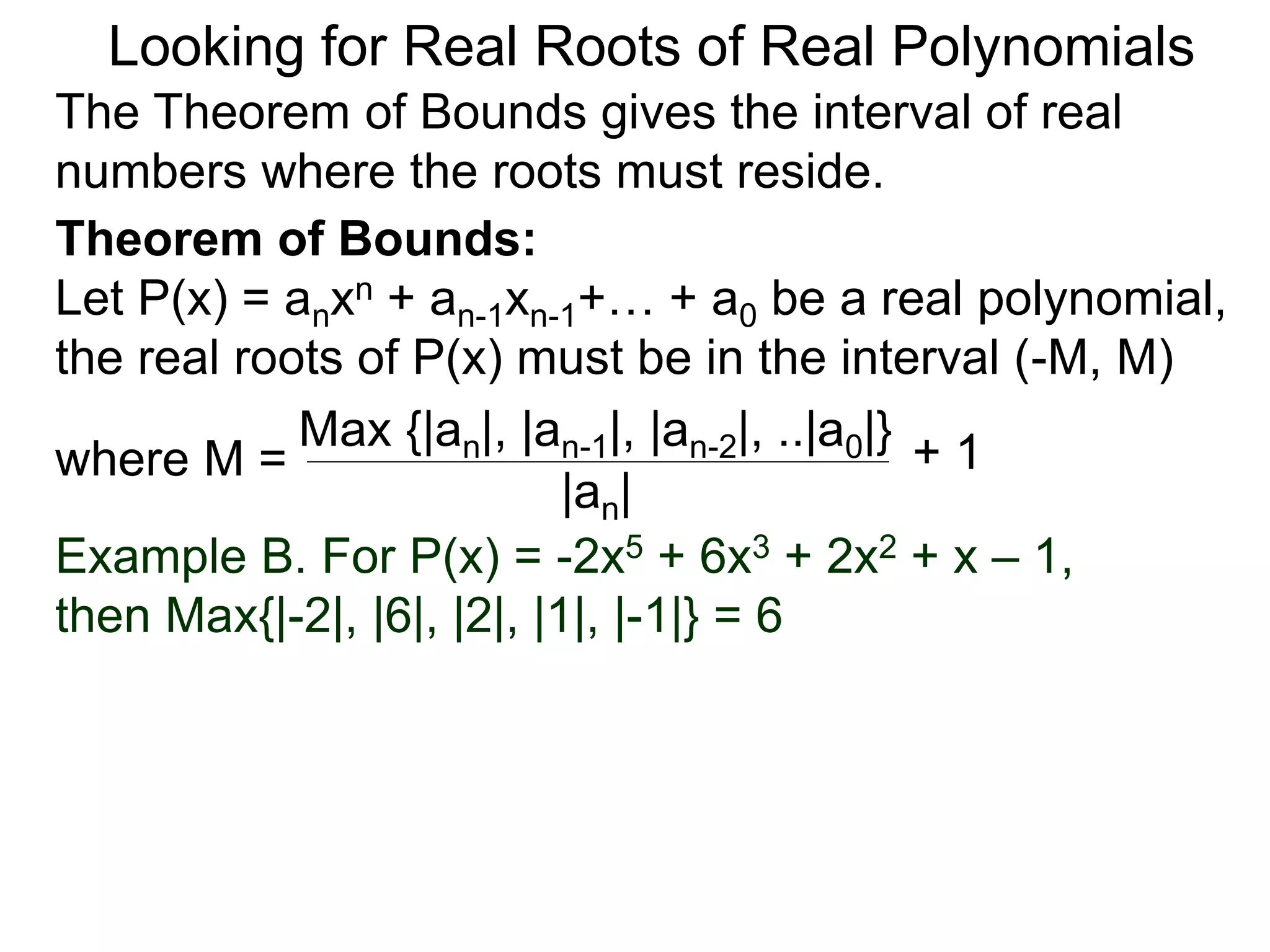
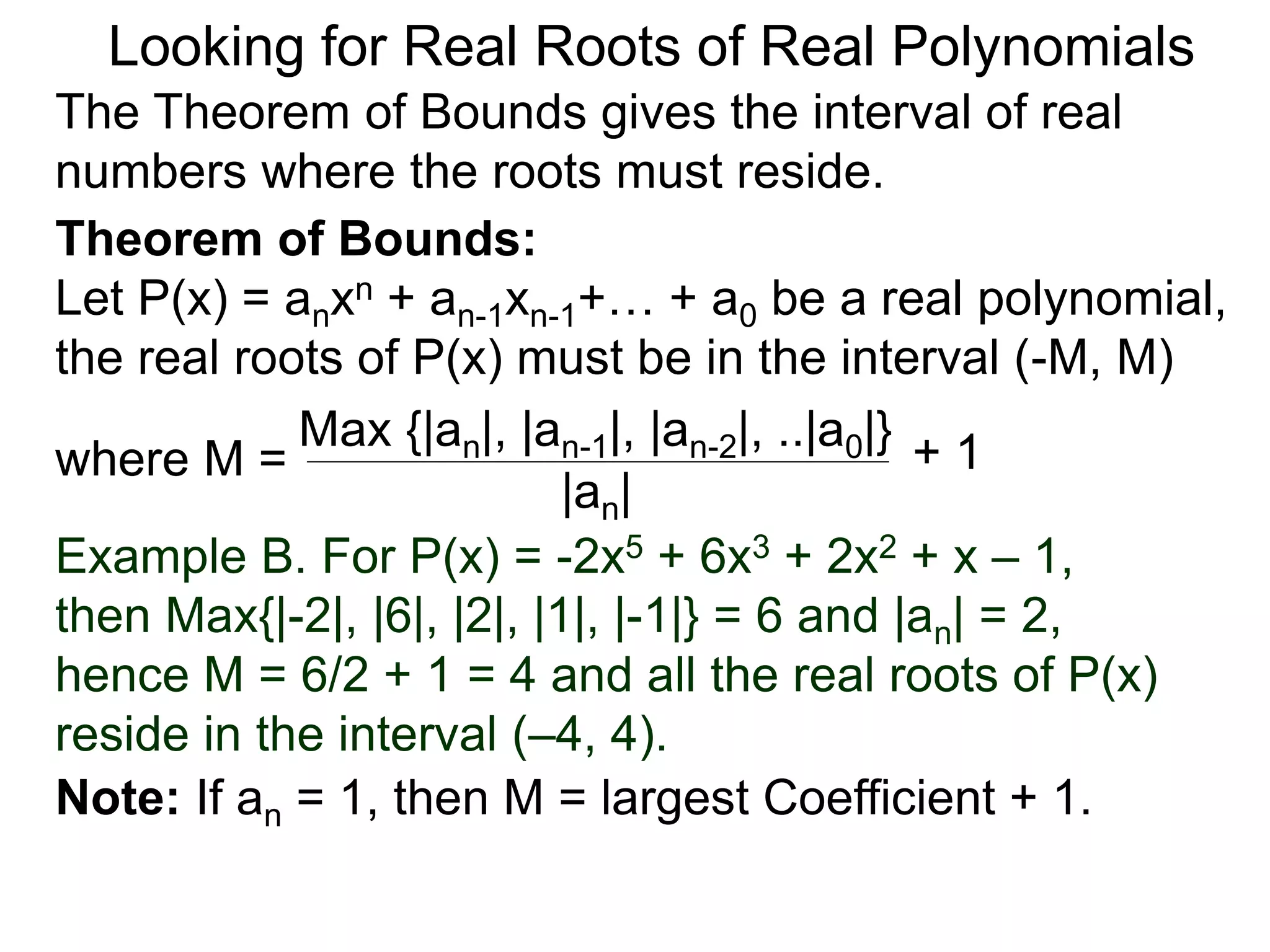
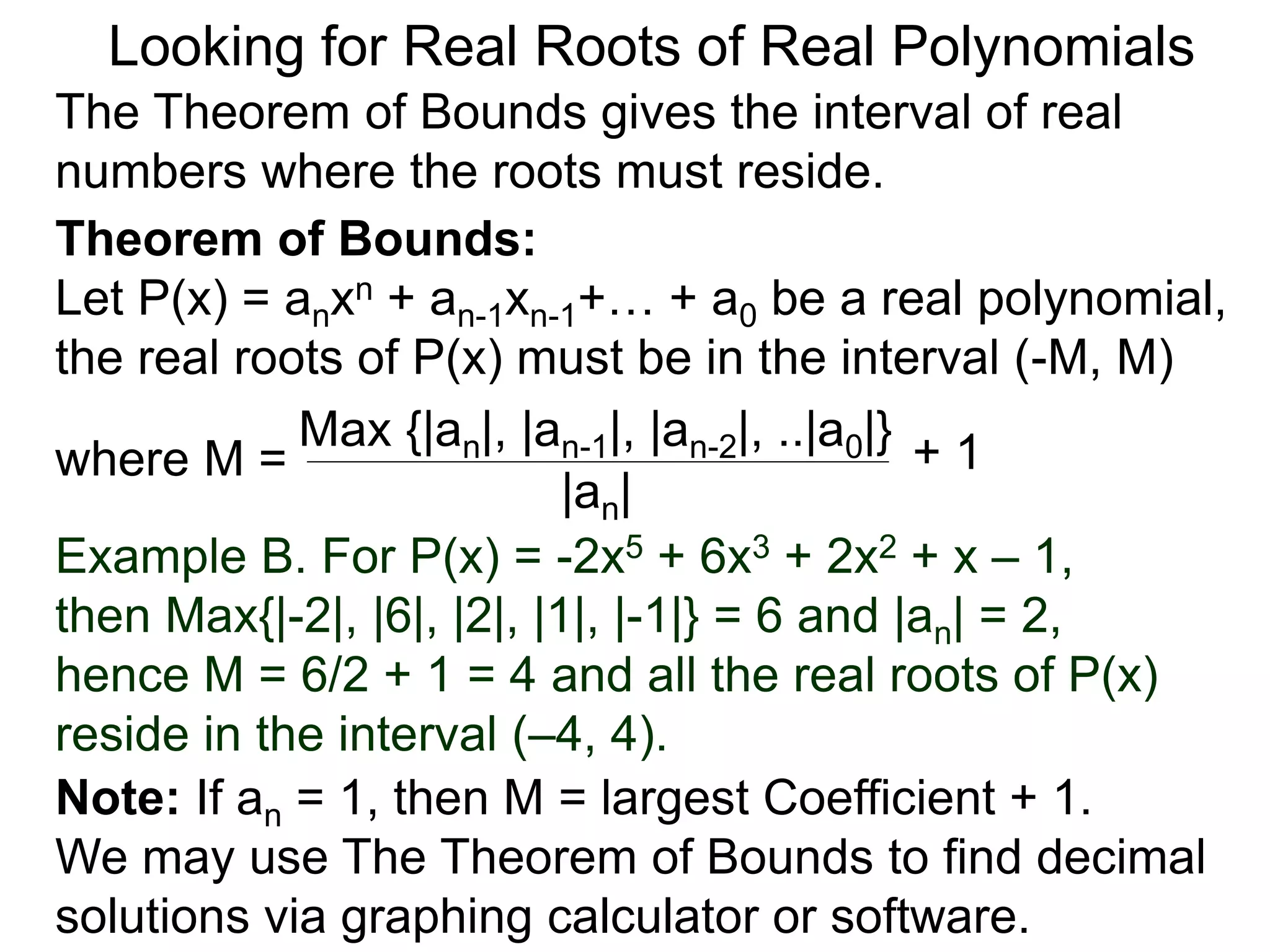
The Theorem of Bounds gives the interval of real
numbers where the roots must reside.
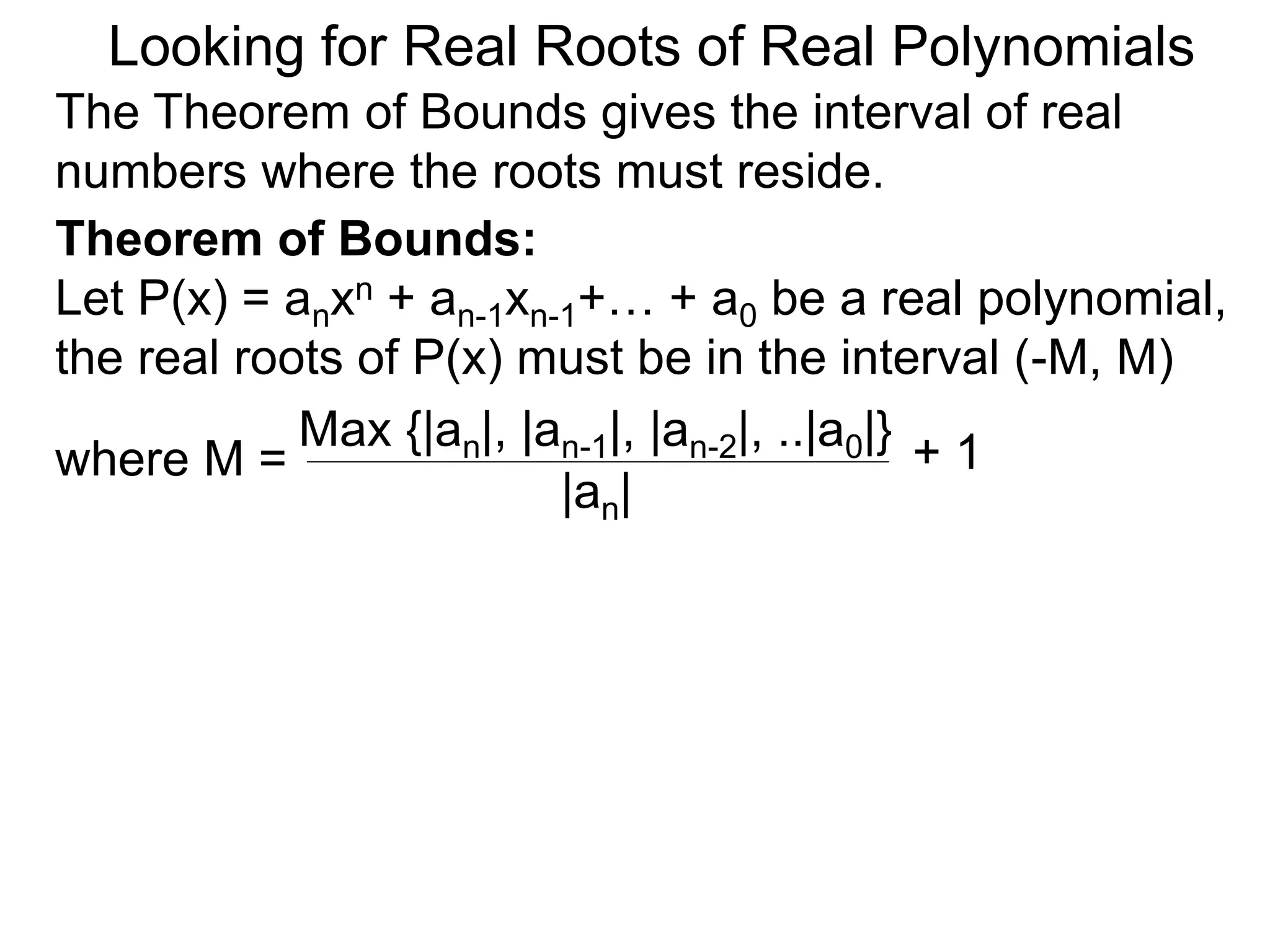
Theorem of Bounds:
Looking for Real Roots of Real Polynomials
The Theorem of Bounds gives the interval of real
numbers where the roots must reside.
Theorem of Bounds:
Let P(x) = anxn + an-1xn-1+… + a0 be a real polynomial,
Looking for Real Roots of Real Polynomials
The Theorem of Bounds gives the interval of real
numbers where the roots must reside.
Theorem of Bounds:
Let P(x) = anxn + an-1xn-1+… + a0 be a real polynomial,
the real roots of P(x) must be in the interval (–M, M)
where M =
Looking for Real Roots of Real Polynomials
The Theorem of Bounds gives the interval of real
numbers where the roots must reside.
Max {|an|, |an-1|, |an-2|, ..|a0|}
|an|
+ 1
Theorem of Bounds:
Let P(x) = anxn + an-1xn-1+… + a0 be a real polynomial,
the real roots of P(x) must be in the interval (–M, M)
where M =
Looking for Real Roots of Real Polynomials
The Theorem of Bounds gives the interval of real
numbers where the roots must reside.
Max {|an|, |an-1|, |an-2|, ..|a0|}
|an|
+ 1
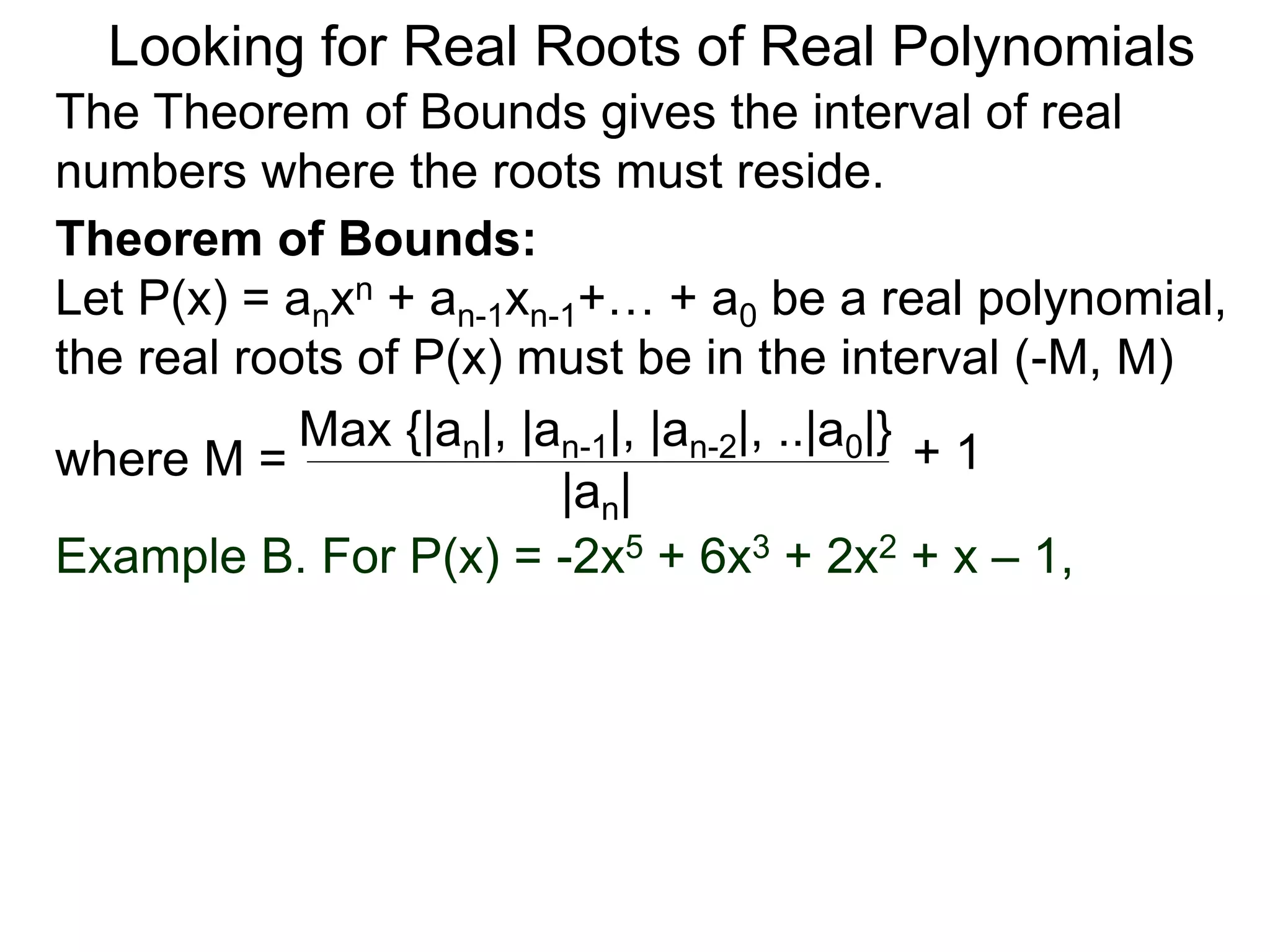
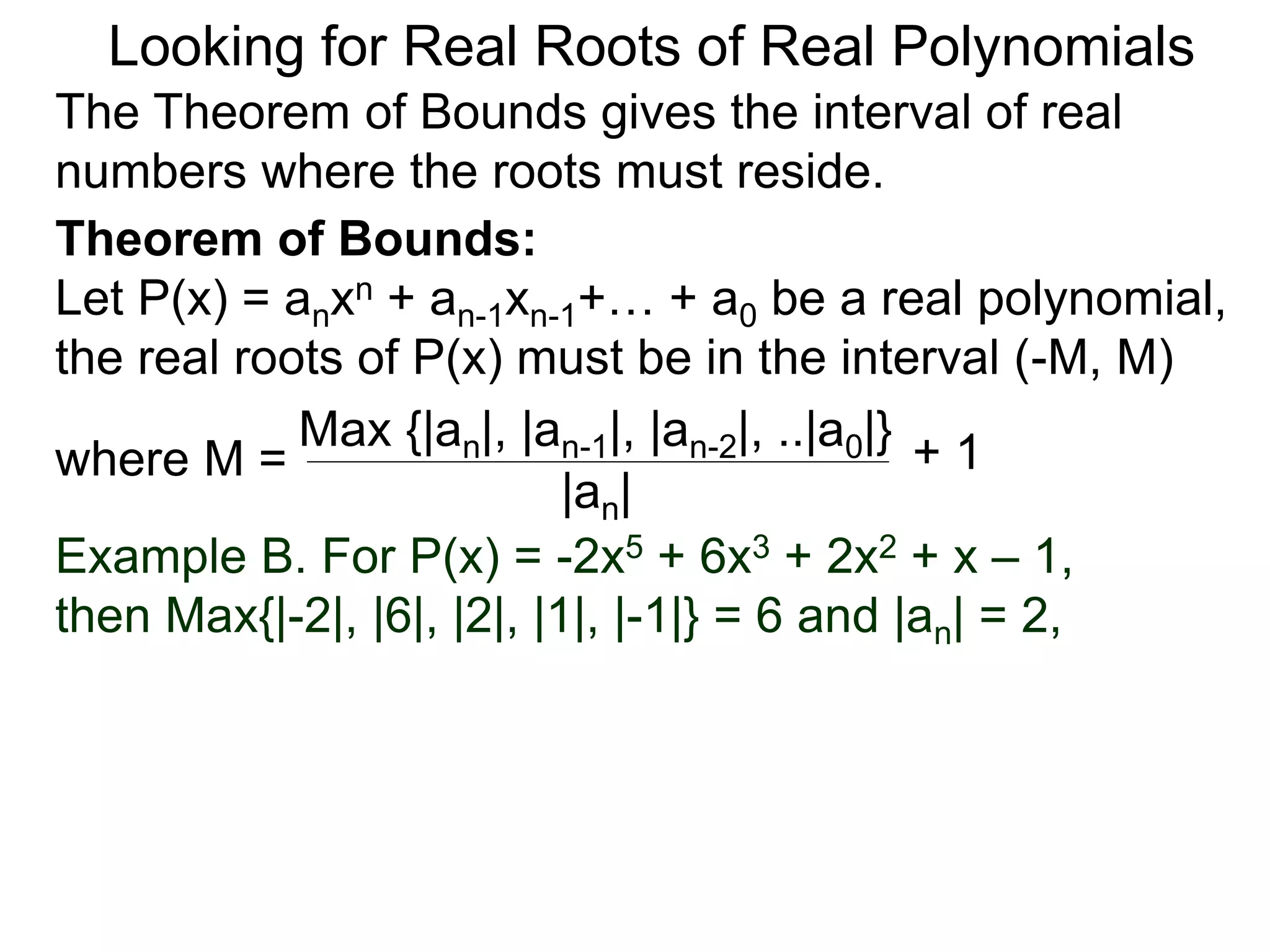
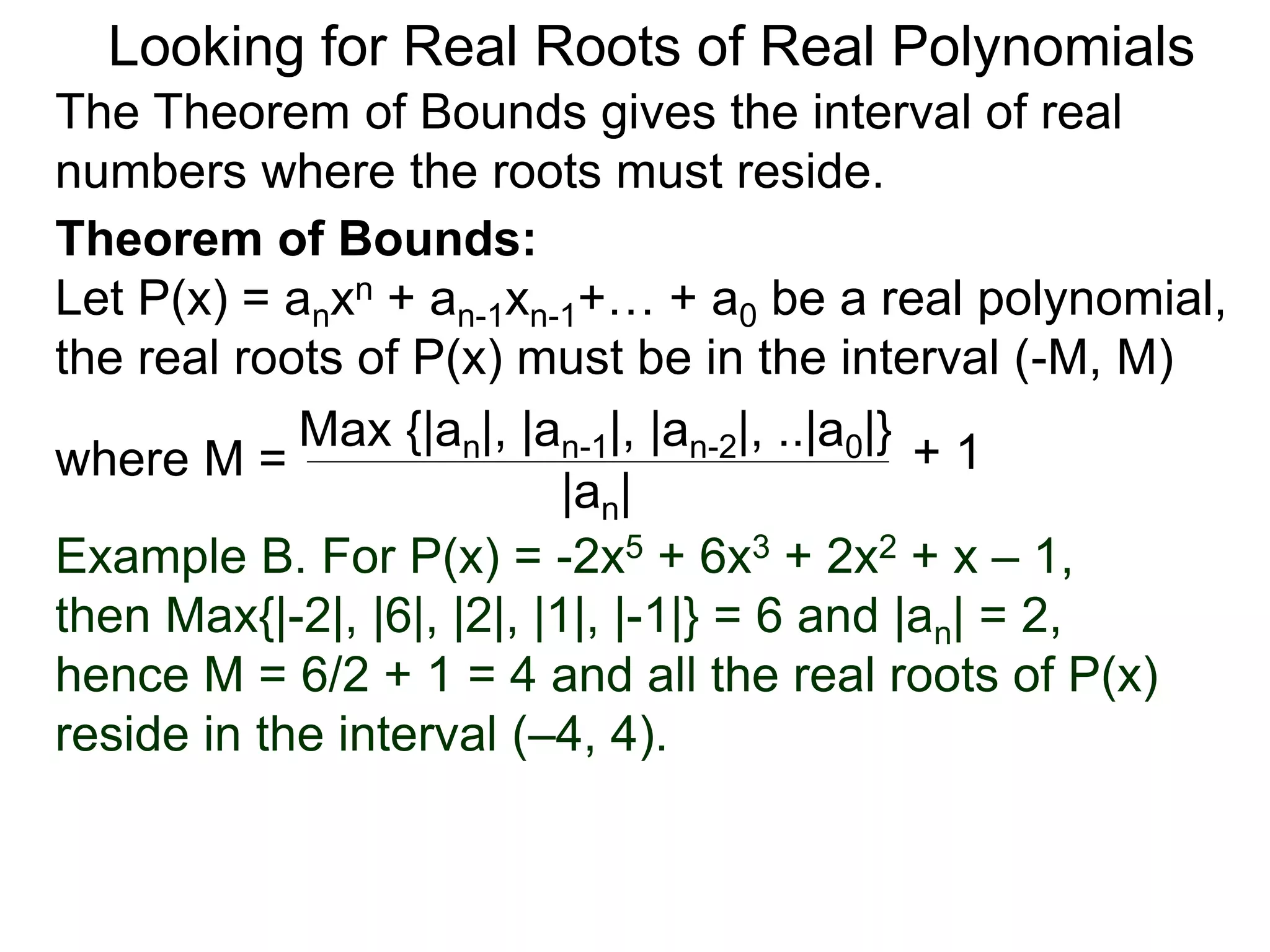
Example B. For P(x) = -2x5 + 6x3 + 2x2 + x – 1,
Theorem of Bounds:
Let P(x) = anxn + an-1xn-1+… + a0 be a real polynomial,
the real roots of P(x) must be in the interval (–M, M)
where M =
Looking for Real Roots of Real Polynomials
The Theorem of Bounds gives the interval of real
numbers where the roots must reside.
Max {|an|, |an-1|, |an-2|, ..|a0|}
|an|
+ 1
Example B. For P(x) = -2x5 + 6x3 + 2x2 + x – 1,
then Max{|-2|, |6|, |2|, |1|, |-1|} = 6
Theorem of Bounds:
Let P(x) = anxn + an-1xn-1+… + a0 be a real polynomial,
the real roots of P(x) must be in the interval (–M, M)
where M =
Looking for Real Roots of Real Polynomials
The Theorem of Bounds gives the interval of real
numbers where the roots must reside.
Max {|an|, |an-1|, |an-2|, ..|a0|}
|an|
+ 1
Example B. For P(x) = -2x5 + 6x3 + 2x2 + x – 1,
then Max{|-2|, |6|, |2|, |1|, |-1|} = 6 and |an| = 2,
Theorem of Bounds:
Let P(x) = anxn + an-1xn-1+… + a0 be a real polynomial,
the real roots of P(x) must be in the interval (–M, M)
where M =
Looking for Real Roots of Real Polynomials
The Theorem of Bounds gives the interval of real
numbers where the roots must reside.
Max {|an|, |an-1|, |an-2|, ..|a0|}
|an|
+ 1
Example B. For P(x) = -2x5 + 6x3 + 2x2 + x – 1,
then Max{|-2|, |6|, |2|, |1|, |-1|} = 6 and |an| = 2,
hence M = 6/2 + 1 = 4 and all the real roots of P(x)
reside in the interval (–4, 4).
Theorem of Bounds:
Let P(x) = anxn + an-1xn-1+… + a0 be a real polynomial,
the real roots of P(x) must be in the interval (–M, M)
where M =
Looking for Real Roots of Real Polynomials
The Theorem of Bounds gives the interval of real
numbers where the roots must reside.
Max {|an|, |an-1|, |an-2|, ..|a0|}
|an|
+ 1
Example B. For P(x) = -2x5 + 6x3 + 2x2 + x – 1,
then Max{|-2|, |6|, |2|, |1|, |-1|} = 6 and |an| = 2,
hence M = 6/2 + 1 = 4 and all the real roots of P(x)
reside in the interval (–4, 4).
Note: If an = 1, then M = largest Coefficient + 1.
Theorem of Bounds:
Let P(x) = anxn + an-1xn-1+… + a0 be a real polynomial,
the real roots of P(x) must be in the interval (–M, M)
where M =
Looking for Real Roots of Real Polynomials
The Theorem of Bounds gives the interval of real
numbers where the roots must reside.
Max {|an|, |an-1|, |an-2|, ..|a0|}
|an|
+ 1
Example B. For P(x) = -2x5 + 6x3 + 2x2 + x – 1,
then Max{|-2|, |6|, |2|, |1|, |-1|} = 6 and |an| = 2,
hence M = 6/2 + 1 = 4 and all the real roots of P(x)
reside in the interval (–4, 4).
Note: If an = 1, then M = largest Coefficient + 1.
We may use The Theorem of Bounds to find decimal
solutions via a graphing calculator or software.
Looking for Real Roots of Real Polynomials
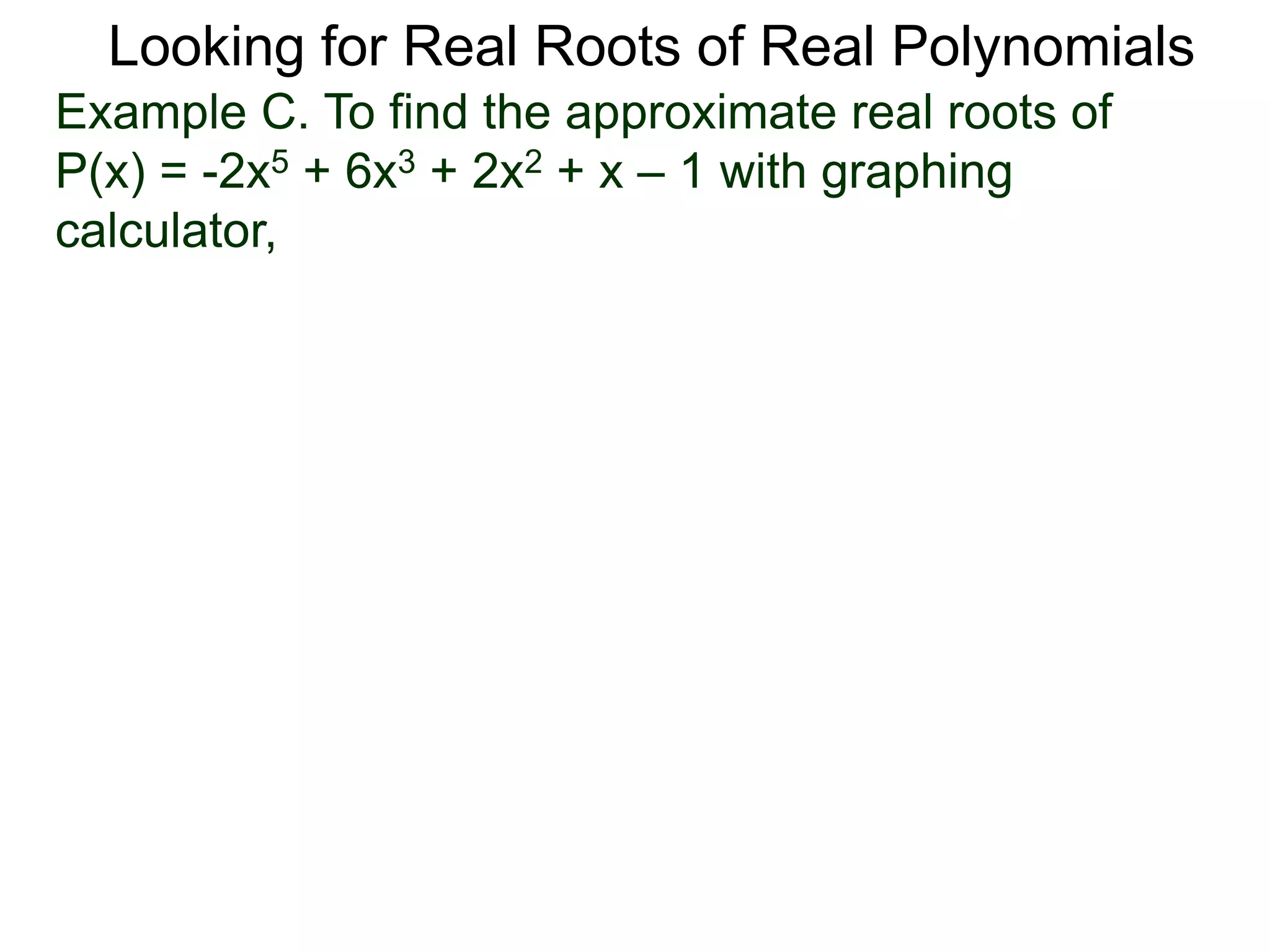
Example C. To find the approximate real roots of
P(x) = -2x5 + 6x3 + 2x2 + x – 1 with a graphing
calculator,
Looking for Real Roots of Real Polynomials
Example C. To find the approximate real roots of
P(x) = -2x5 + 6x3 + 2x2 + x – 1 with a graphing
calculator, set the plot range of x to be [–4, 4],
the plot range of y, to be say [20, –20].
Looking for Real Roots of Real Polynomials
Example C. To find the approximate real roots of
P(x) = -2x5 + 6x3 + 2x2 + x – 1 with a graphing
calculator, set the plot range of x to be [–4, 4],
the plot range of y, to be say [20, –20].
Looking for Real Roots of Real Polynomials
We get three roots.
y = -2x5 + 6x3 + 2x2 + x – 1
Example C. To find the approximate real roots of
P(x) = -2x5 + 6x3 + 2x2 + x – 1 with a graphing
calculator, set the plot range of x to be [–4, 4],
the plot range of y, to be say [20, –20].
Looking for Real Roots of Real Polynomials
We get three roots. From the tracer-operation,
their approximate values are x ≈ –1.65, 0.40, and 1.89.
y = -2x5 + 6x3 + 2x2 + x – 1
-1.65 0.40 1.89
Example C. To find the approximate real roots of
P(x) = -2x5 + 6x3 + 2x2 + x – 1 with a graphing
calculator, set the plot range of x to be [–4, 4],
the plot range of y, to be say [20, –20].
Looking for Real Roots of Real Polynomials
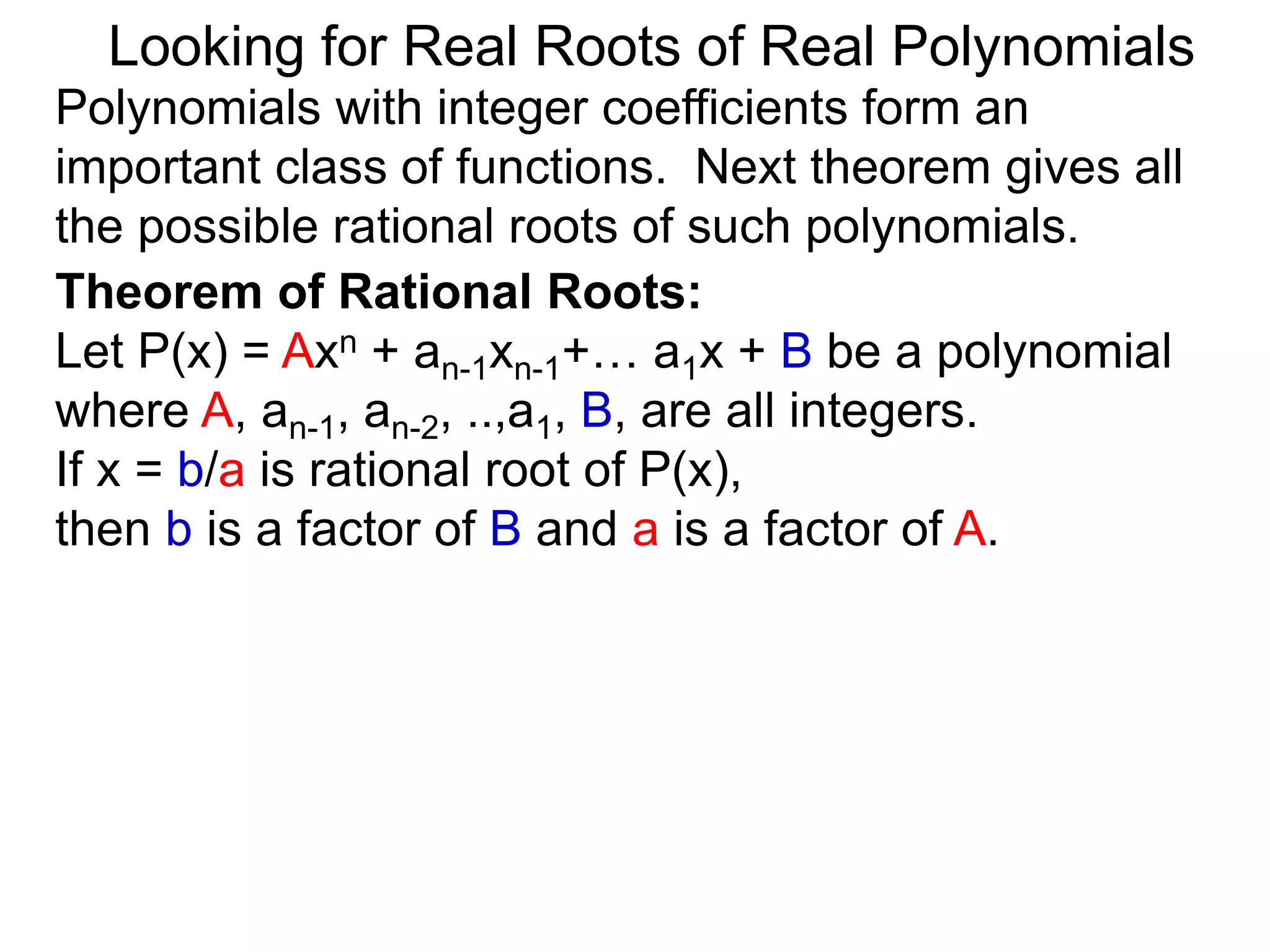
Polynomials with integer coefficients form an
important class of functions.
Looking for Real Roots of Real Polynomials
Polynomials with integer coefficients form an
important class of functions. The next theorem gives
all the possible rational roots of such polynomials.
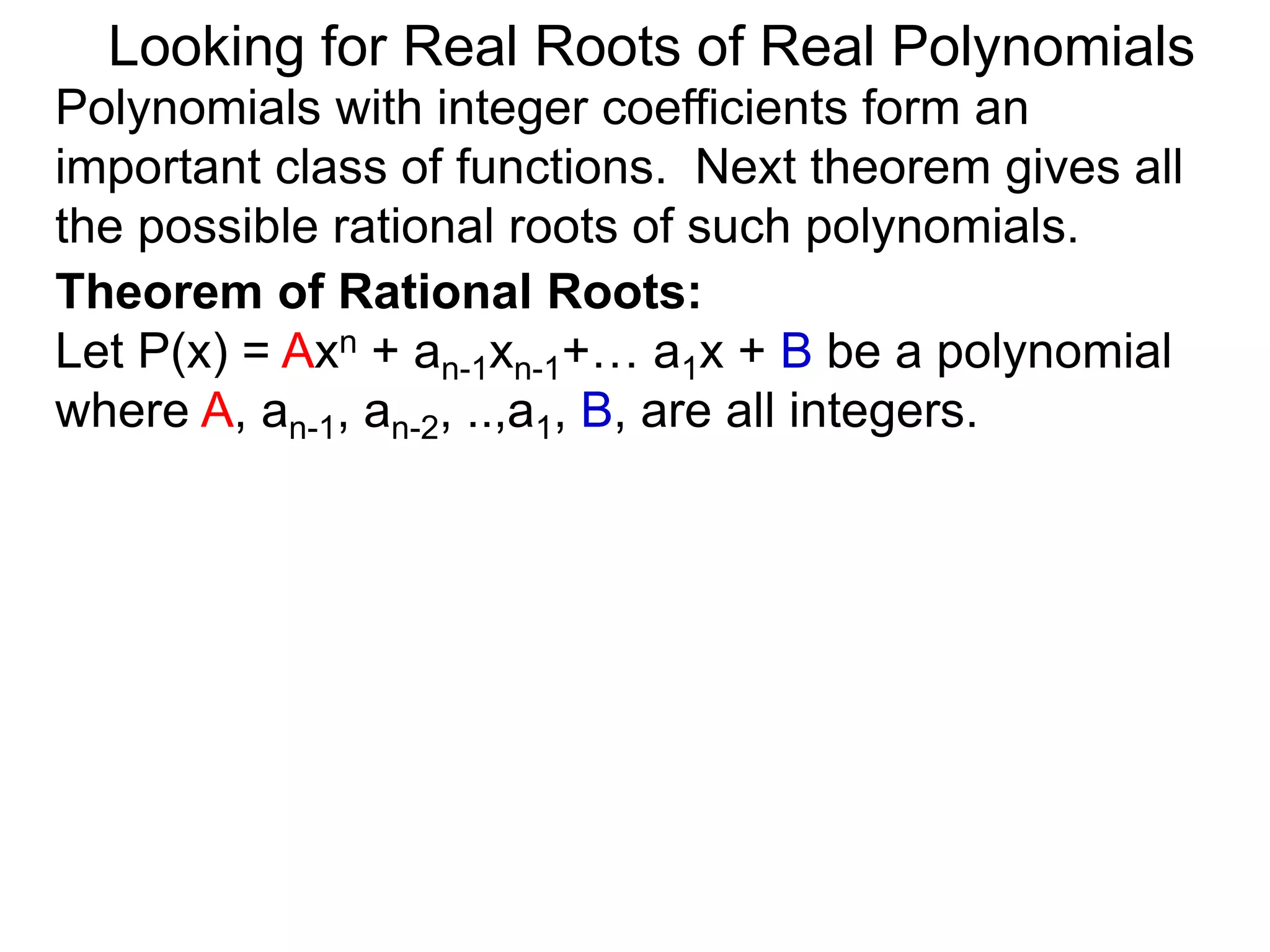
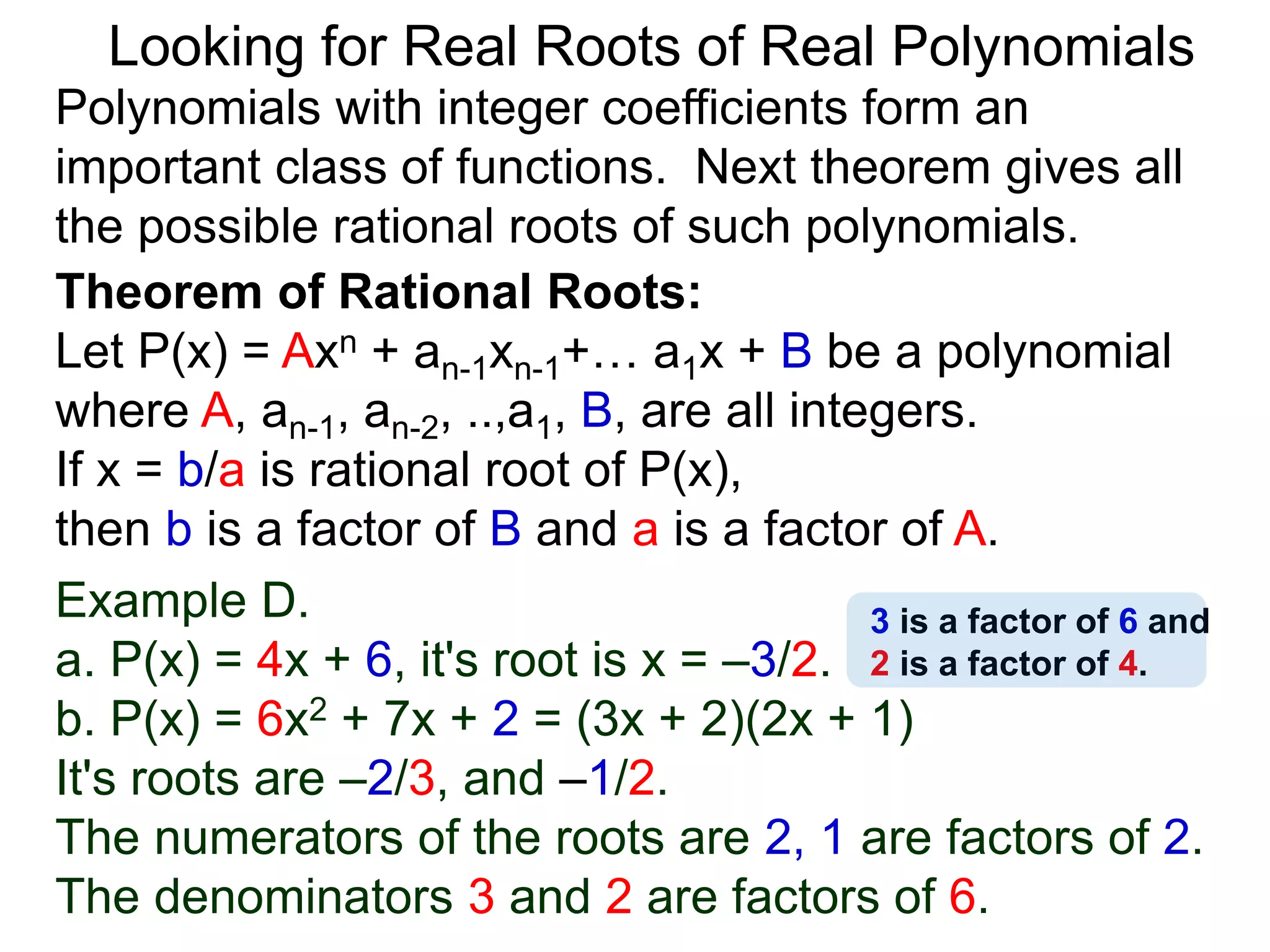
Theorem of Rational Roots:
Looking for Real Roots of Real Polynomials
Polynomials with integer coefficients form an
important class of functions. The next theorem gives
all the possible rational roots of such polynomials.
Theorem of Rational Roots:
Let P(x) = Axn + an-1xn-1+… a1x + B be a polynomial
where A, an-1, an-2, ..,a1, B, are all integers.
Looking for Real Roots of Real Polynomials
Polynomials with integer coefficients form an
important class of functions. The next theorem gives
all the possible rational roots of such polynomials.
Theorem of Rational Roots:
Let P(x) = Axn + an-1xn-1+… a1x + B be a polynomial
where A, an-1, an-2, ..,a1, B, are all integers.
If x = b/a is rational root of P(x),
then b is a factor of B and a is a factor of A.
Looking for Real Roots of Real Polynomials
Polynomials with integer coefficients form an
important class of functions. The next theorem gives
all the possible rational roots of such polynomials.
Theorem of Rational Roots:
Let P(x) = Axn + an-1xn-1+… a1x + B be a polynomial
where A, an-1, an-2, ..,a1, B, are all integers.
If x = b/a is rational root of P(x),
then b is a factor of B and a is a factor of A.
Looking for Real Roots of Real Polynomials
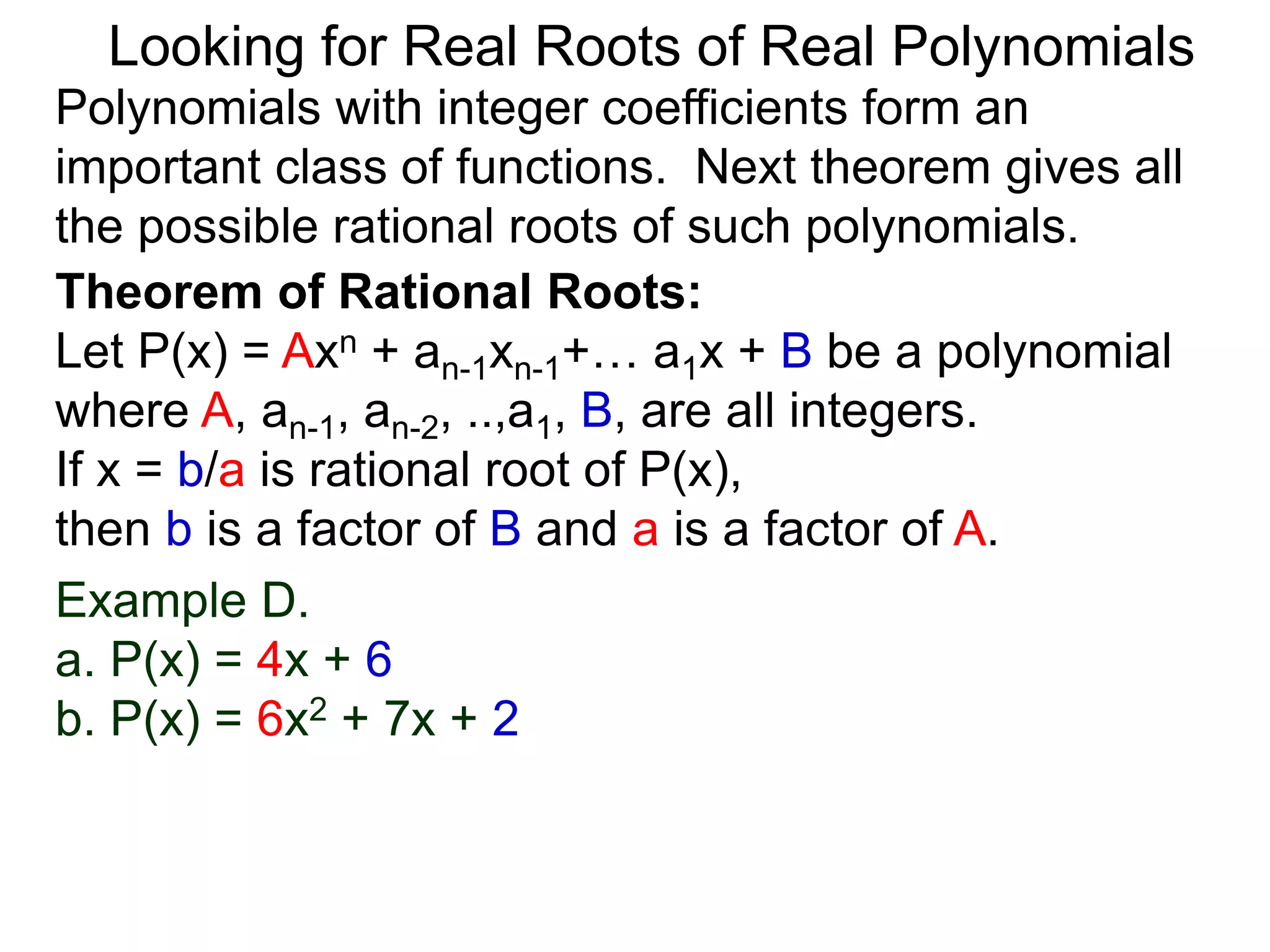
Example D.
a. P(x) = 4x + 6
b. P(x) = 6x2 + 7x + 2
Polynomials with integer coefficients form an
important class of functions. The next theorem gives
all the possible rational roots of such polynomials.
Theorem of Rational Roots:
Let P(x) = Axn + an-1xn-1+… a1x + B be a polynomial
where A, an-1, an-2, ..,a1, B, are all integers.
If x = b/a is rational root of P(x),
then b is a factor of B and a is a factor of A.
Looking for Real Roots of Real Polynomials
Example D.
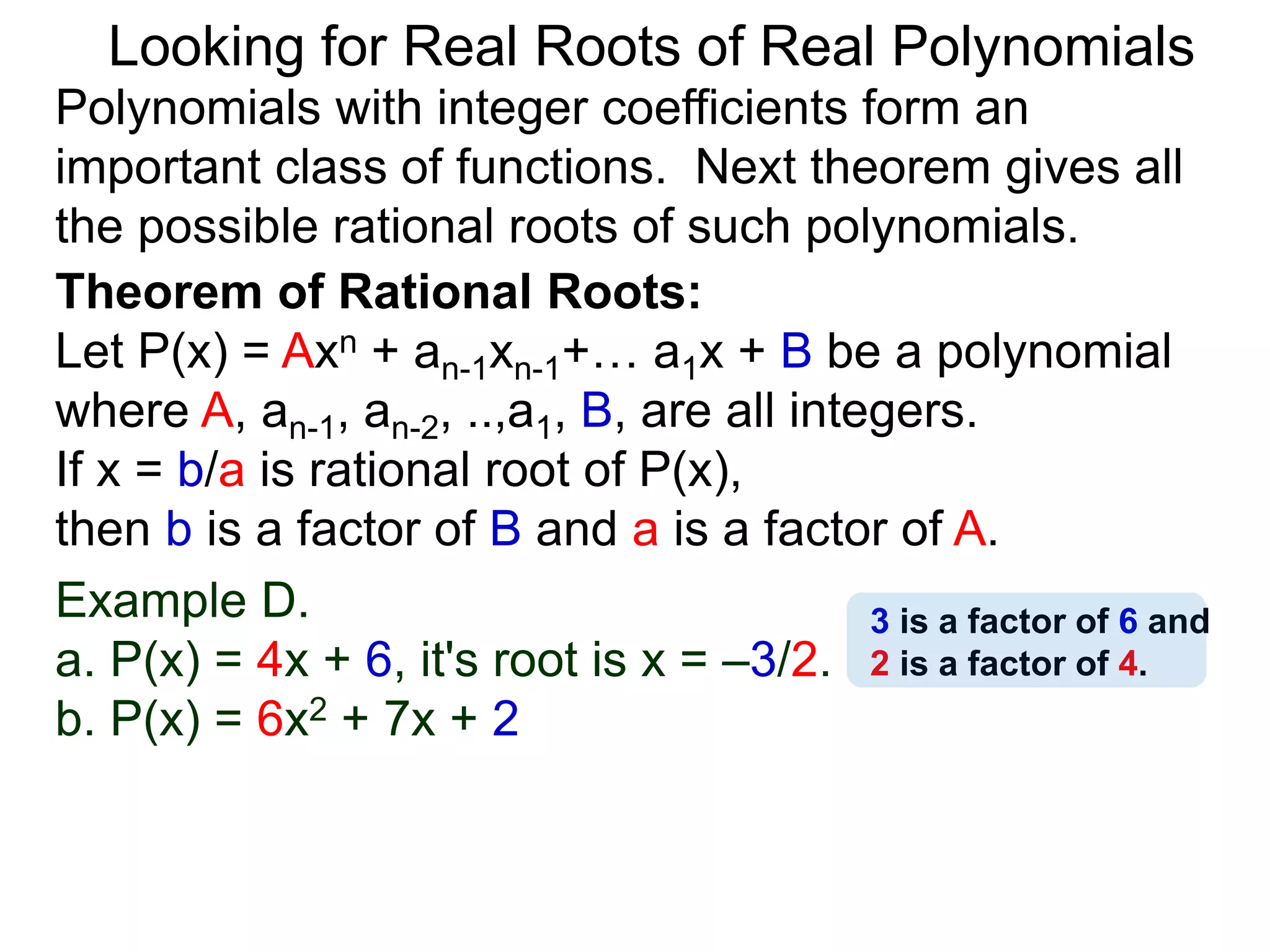
a. P(x) = 4x + 6, it's root is x = –3/2.
b. P(x) = 6x2 + 7x + 2
Polynomials with integer coefficients form an
important class of functions. The next theorem gives
all the possible rational roots of such polynomials.
3 is a factor of 6 and
2 is a factor of 4.
Theorem of Rational Roots:
Let P(x) = Axn + an-1xn-1+… a1x + B be a polynomial
where A, an-1, an-2, ..,a1, B, are all integers.
If x = b/a is rational root of P(x),
then b is a factor of B and a is a factor of A.
Looking for Real Roots of Real Polynomials
Example D.
a. P(x) = 4x + 6, it's root is x = –3/2.
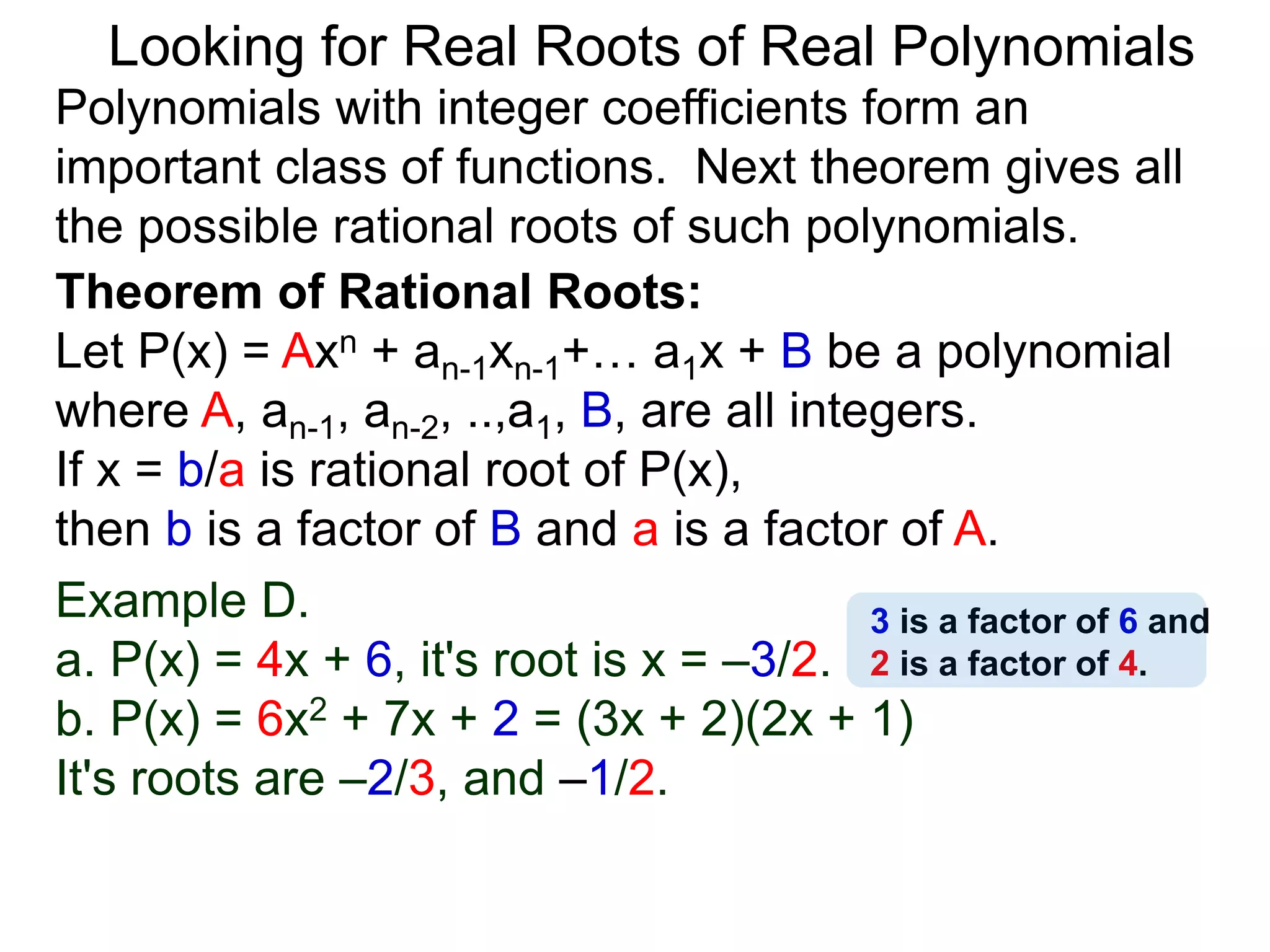
b. P(x) = 6x2 + 7x + 2 = (3x + 2)(2x + 1)
It's roots are –2/3, and –1/2.
Polynomials with integer coefficients form an
important class of functions. The next theorem gives
all the possible rational roots of such polynomials.
3 is a factor of 6 and
2 is a factor of 4.
Theorem of Rational Roots:
Let P(x) = Axn + an-1xn-1+… a1x + B be a polynomial
where A, an-1, an-2, ..,a1, B, are all integers.
If x = b/a is rational root of P(x),
then b is a factor of B and a is a factor of A.
Looking for Real Roots of Real Polynomials
Example D.
a. P(x) = 4x + 6, it's root is x = –3/2.
b. P(x) = 6x2 + 7x + 2 = (3x + 2)(2x + 1)
It's roots are –2/3, and –1/2.
The numerators of the roots are 2, 1 and are factors
of 2. The denominators 3 and 2 are factors of 6.
Polynomials with integer coefficients form an
important class of functions. The next theorem gives
all the possible rational roots of such polynomials.
3 is a factor of 6 and
2 is a factor of 4.
Looking for Real Roots of Real Polynomials
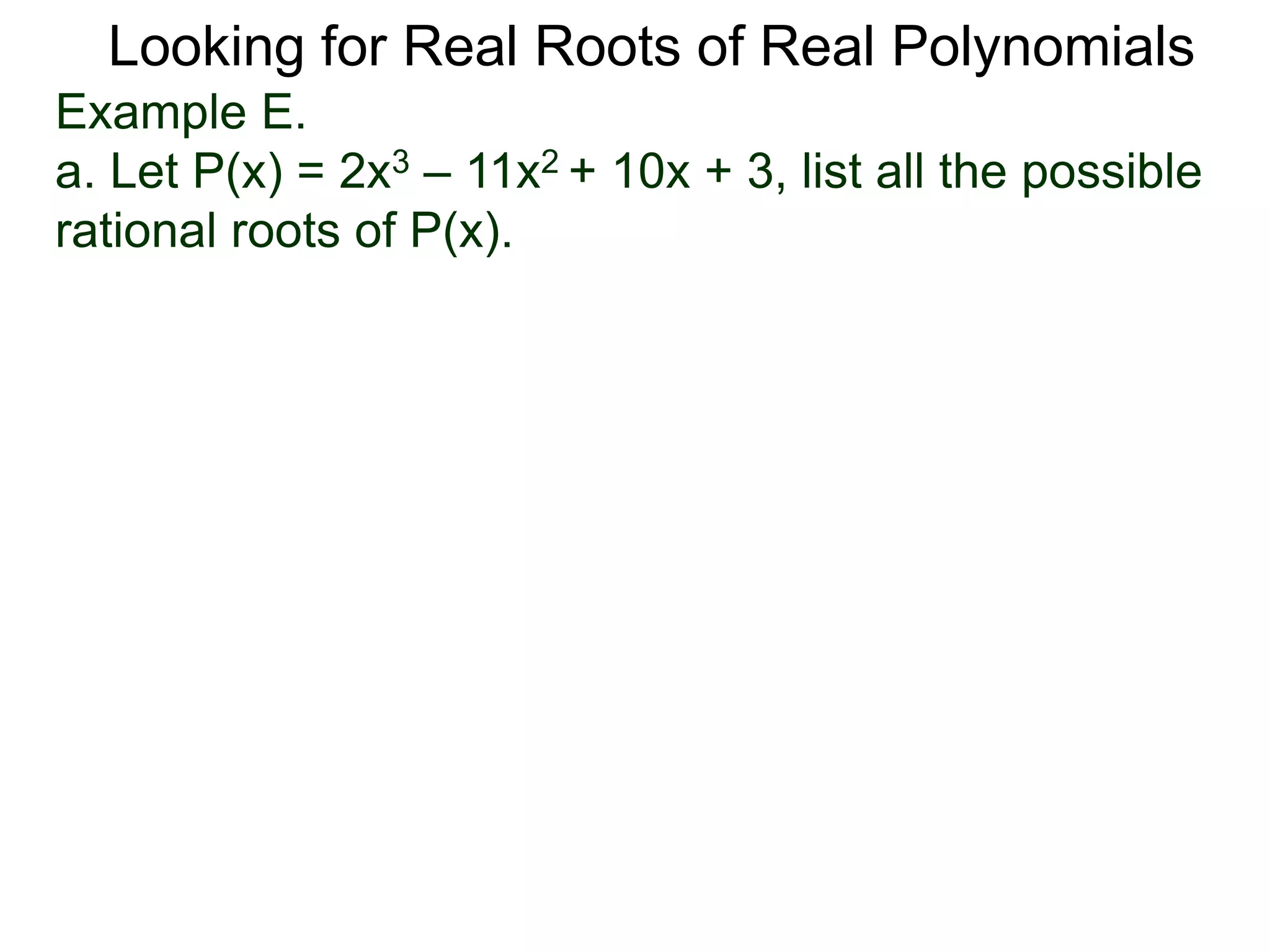
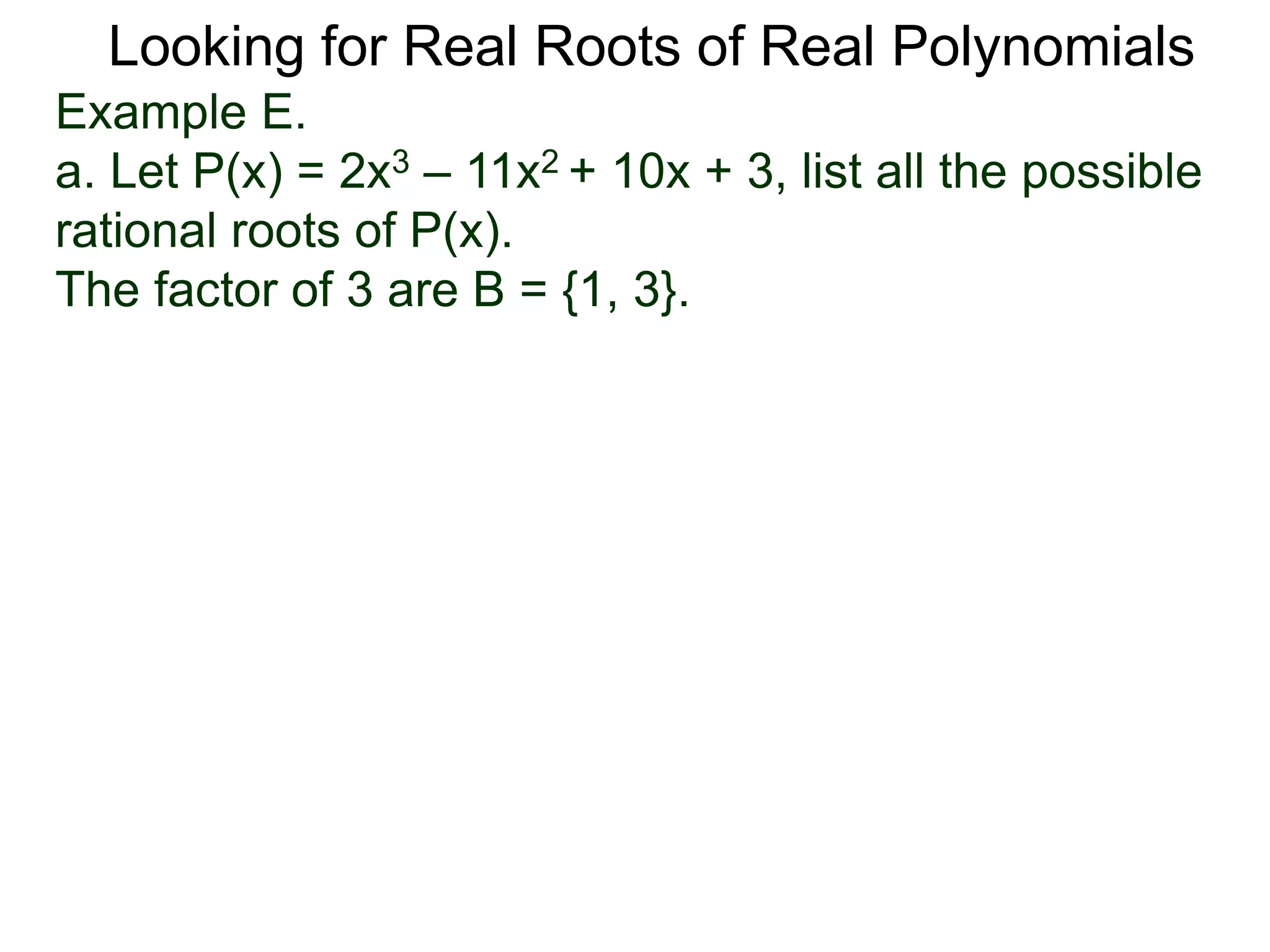
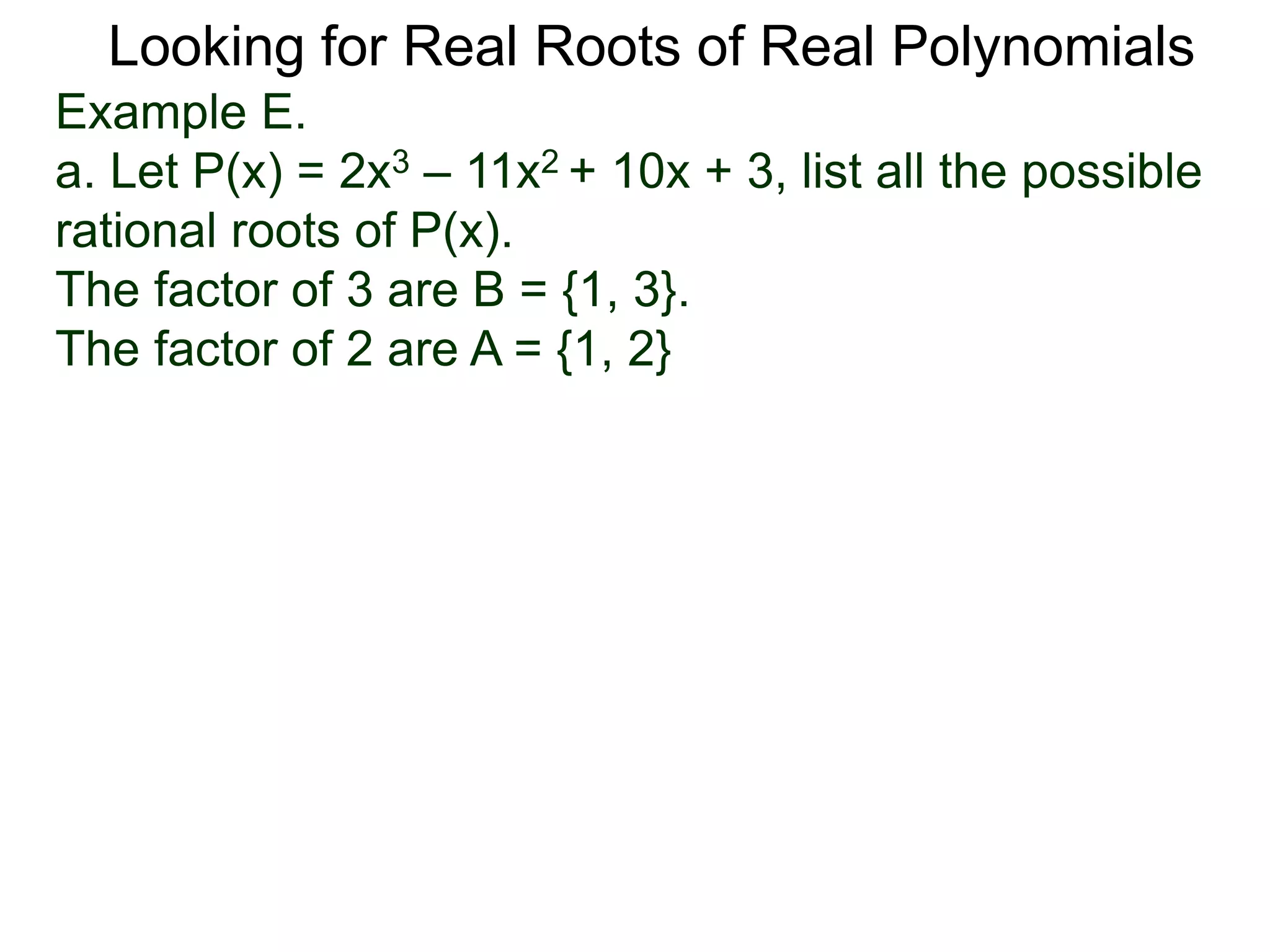
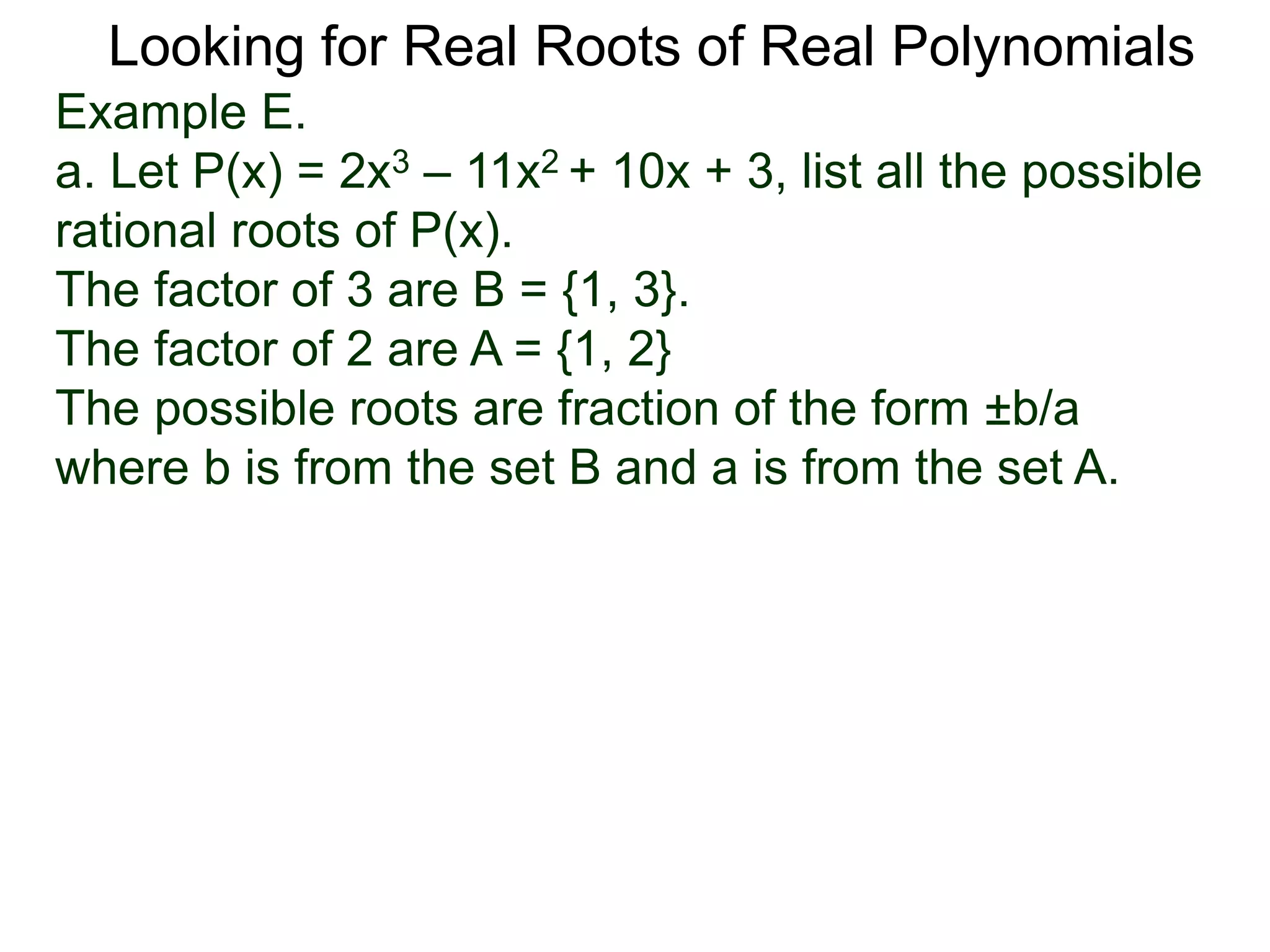
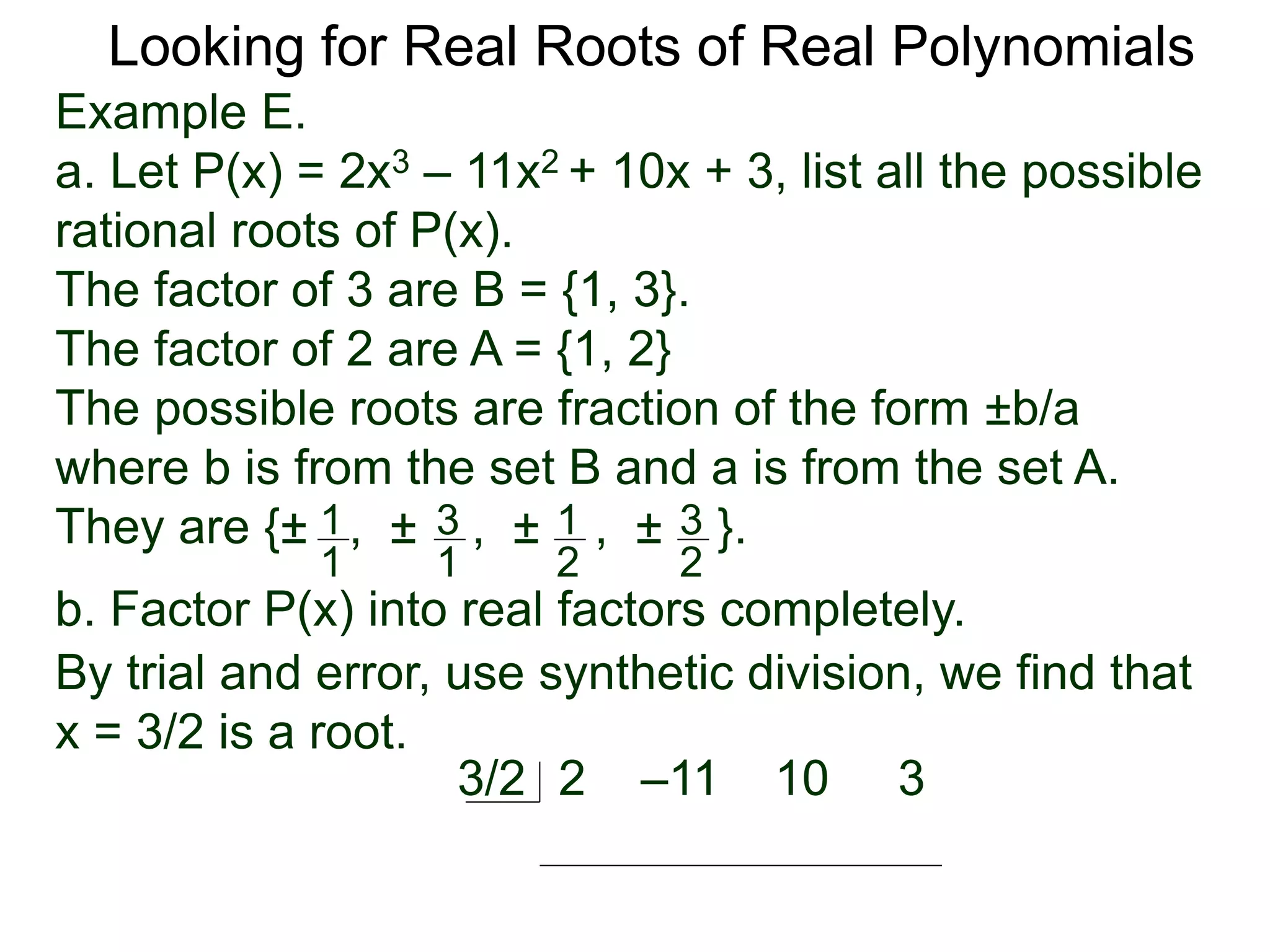
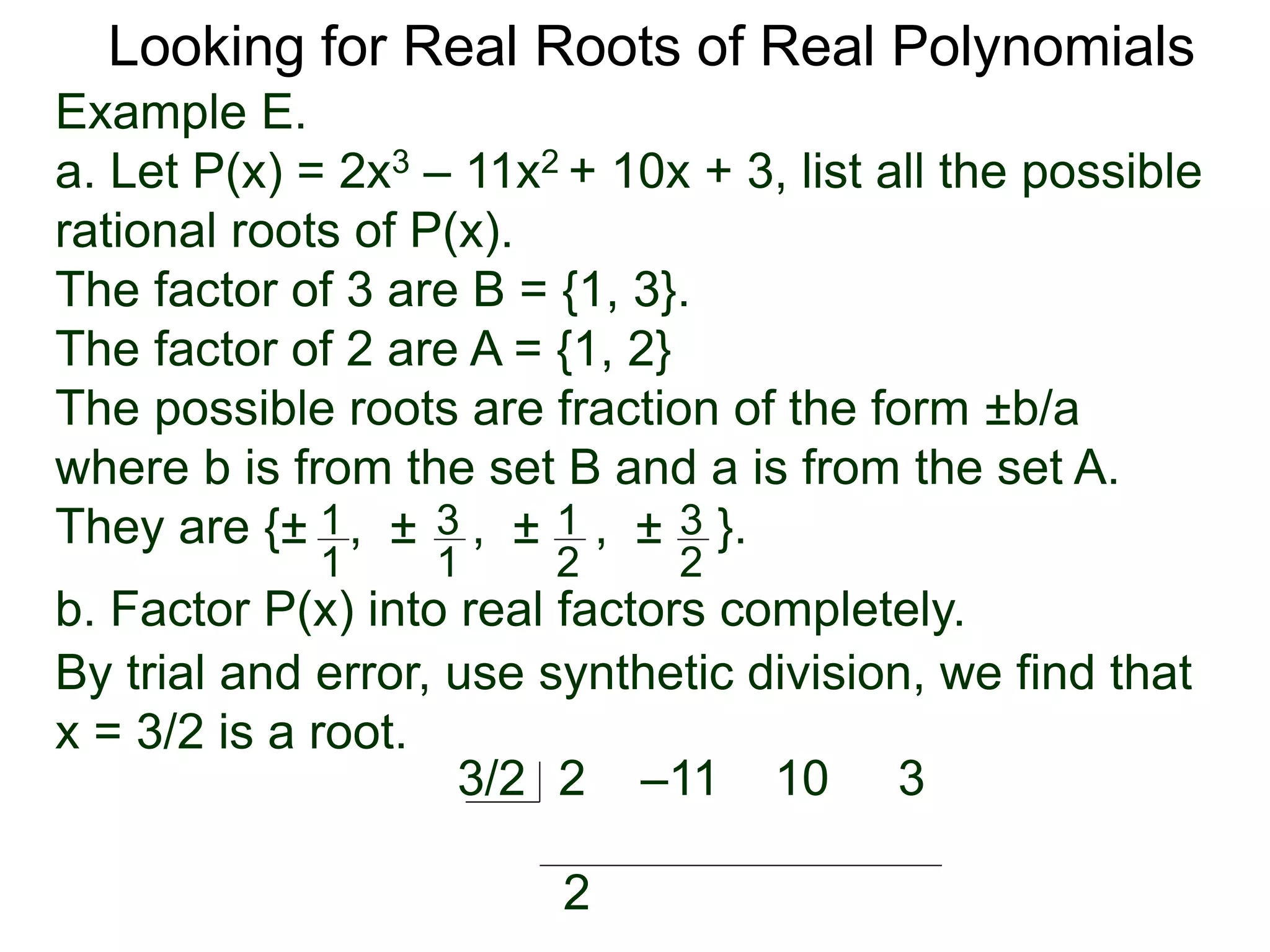
Example E.
a. Let P(x) = 2x3 – 11x2 + 10x + 3, list all the possible
rational roots of P(x).
Looking for Real Roots of Real Polynomials
Example E.
a. Let P(x) = 2x3 – 11x2 + 10x + 3, list all the possible
rational roots of P(x).
The factors of 3 are B = {1, 3}.
Looking for Real Roots of Real Polynomials
Example E.
a. Let P(x) = 2x3 – 11x2 + 10x + 3, list all the possible
rational roots of P(x).
The factors of 3 are B = {1, 3}.
The factors of 2 are A = {1, 2}
Looking for Real Roots of Real Polynomials
Example E.
a. Let P(x) = 2x3 – 11x2 + 10x + 3, list all the possible
rational roots of P(x).
The factors of 3 are B = {1, 3}.
The factors of 2 are A = {1, 2}
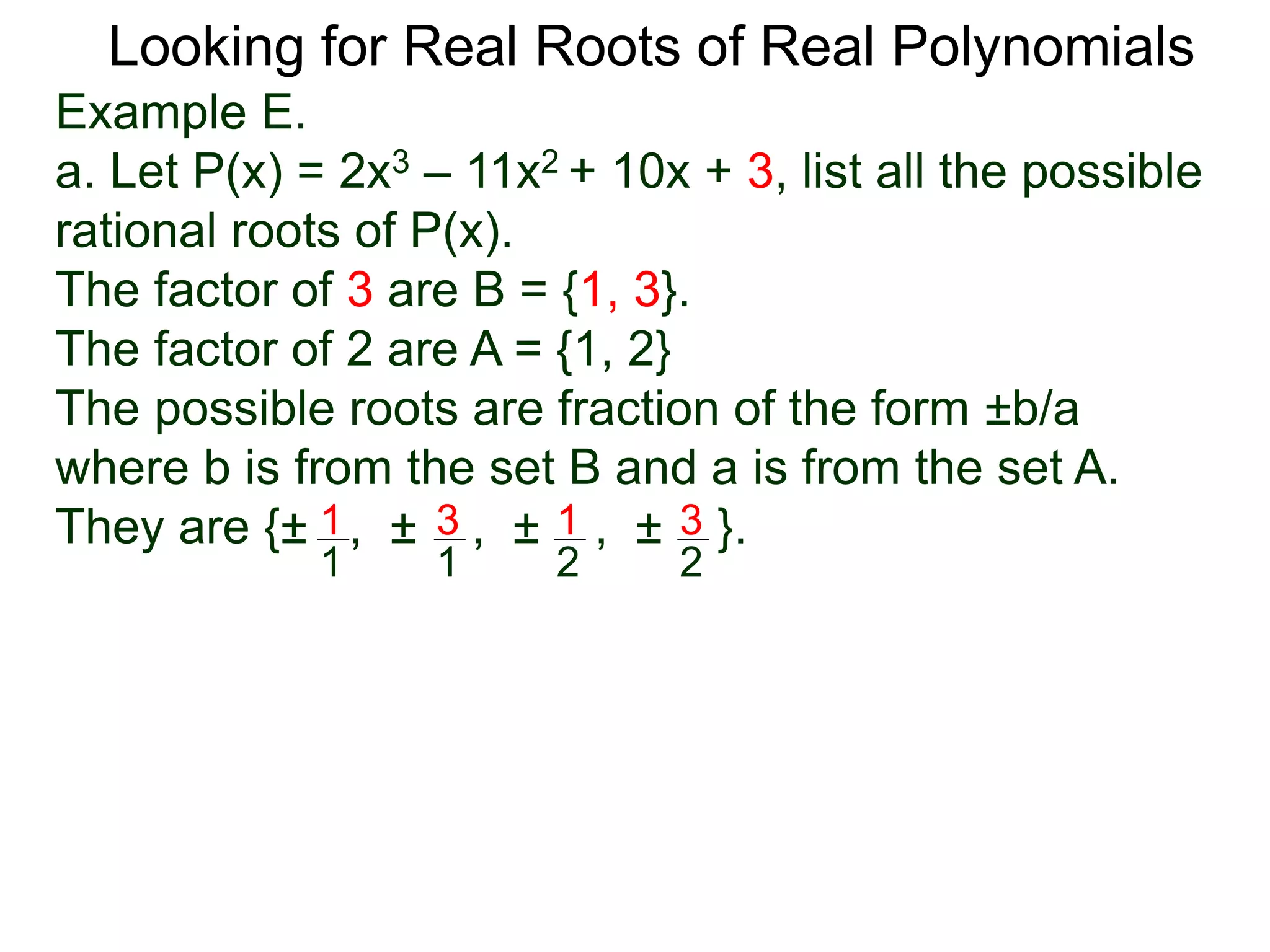
The possible roots are fractions of the form ±b/a
where b is from the set B and a is from the set A.
Looking for Real Roots of Real Polynomials
Example E.
a. Let P(x) = 2x3 – 11x2 + 10x + 3, list all the possible
rational roots of P(x).
The factors of 3 are B = {1, 3}.
The factors of 2 are A = {1, 2}
The possible roots are fractions of the form ±b/a
where b is from the set B and a is from the set A.
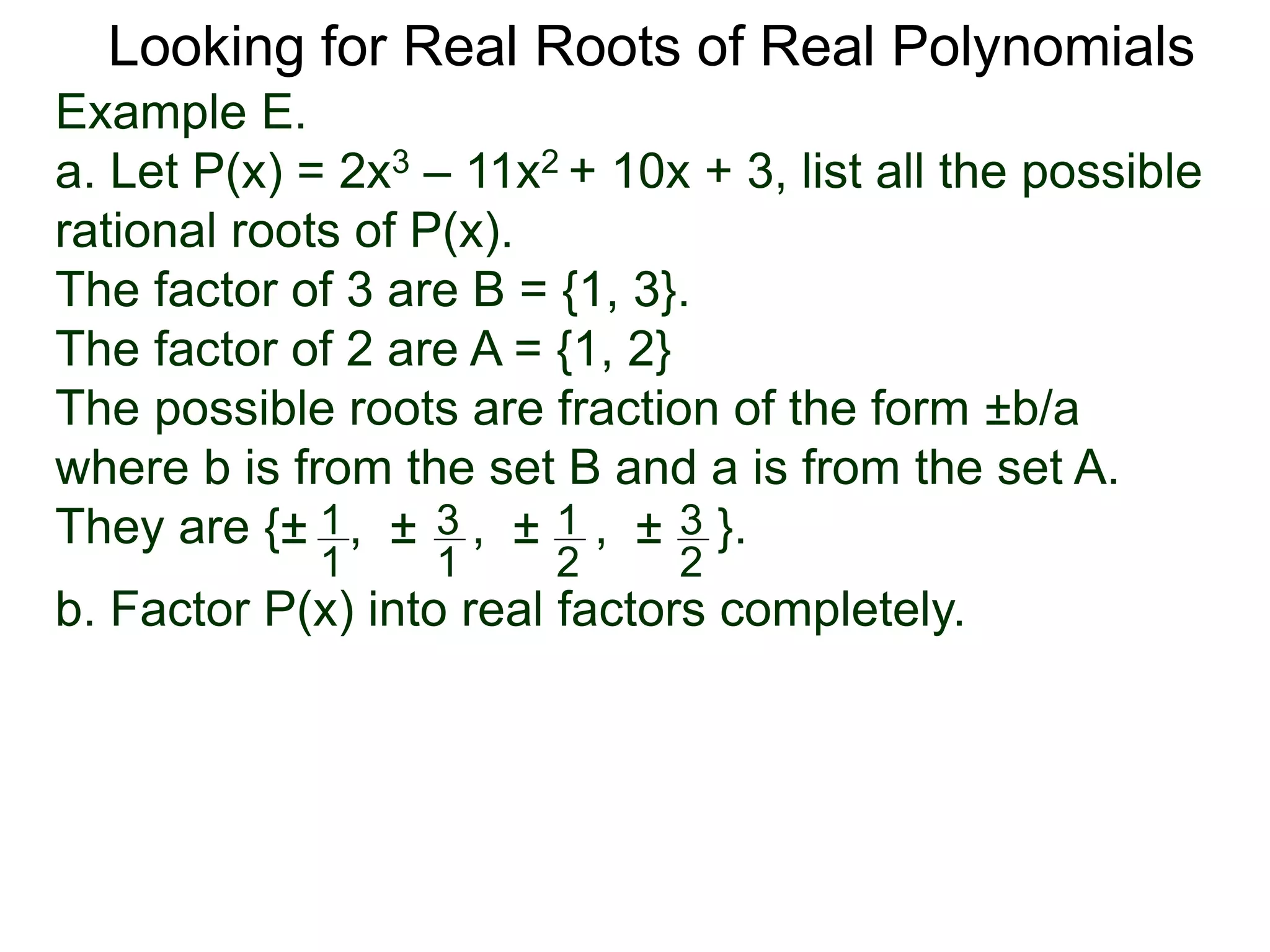
They are {± , ± , ± , ± }.1
1
3
1
1
2
3
2
Looking for Real Roots of Real Polynomials
Example E.
a. Let P(x) = 2x3 – 11x2 + 10x + 3, list all the possible
rational roots of P(x).
The factors of 3 are B = {1, 3}.
The factors of 2 are A = {1, 2}
The possible roots are fractions of the form ±b/a
where b is from the set B and a is from the set A.
They are {± , ± , ± , ± }.1
1
3
1
1
2
3
2
b. Factor P(x) into real factors completely.
Looking for Real Roots of Real Polynomials
Example E.
a. Let P(x) = 2x3 – 11x2 + 10x + 3, list all the possible
rational roots of P(x).
The factors of 3 are B = {1, 3}.
The factors of 2 are A = {1, 2}
The possible roots are fractions of the form ±b/a
where b is from the set B and a is from the set A.
They are {± , ± , ± , ± }.1
1
3
1
1
2
3
2
b. Factor P(x) into real factors completely.
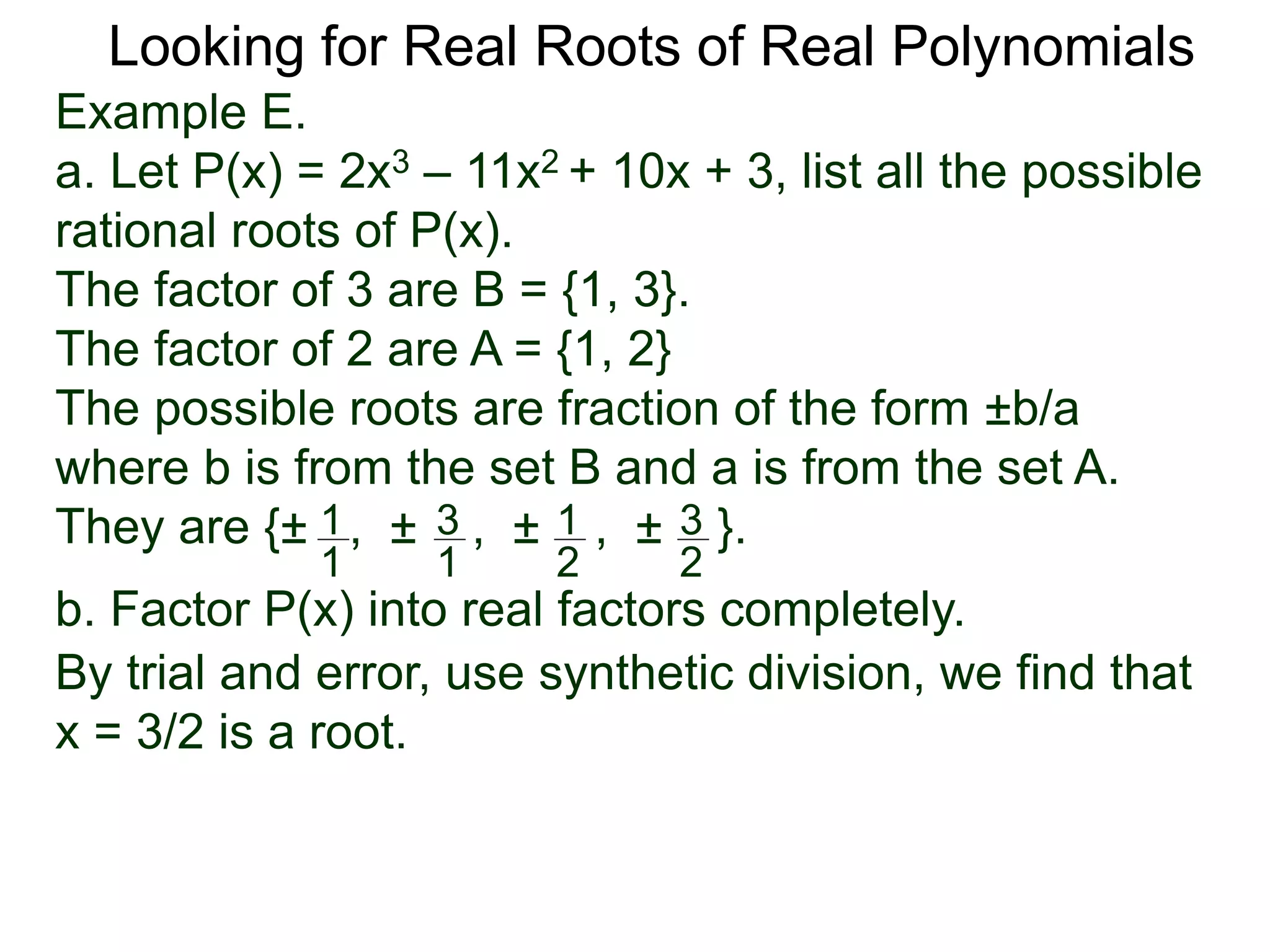
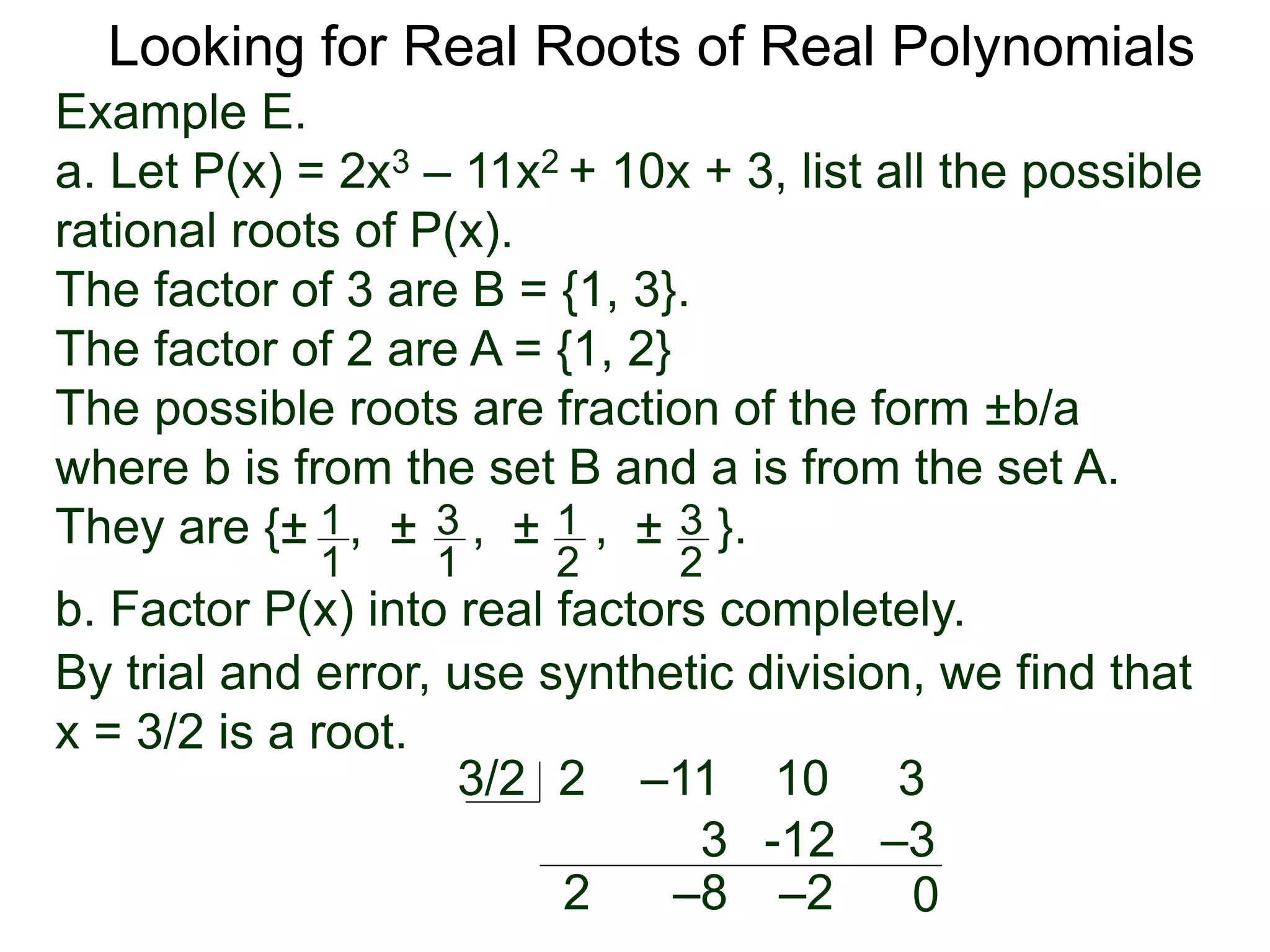
By trial and error, use synthetic division, we find that
x = 3/2 is a root.
Looking for Real Roots of Real Polynomials
Example E.
a. Let P(x) = 2x3 – 11x2 + 10x + 3, list all the possible
rational roots of P(x).
The factors of 3 are B = {1, 3}.
The factors of 2 are A = {1, 2}
The possible roots are fractions of the form ±b/a
where b is from the set B and a is from the set A.
They are {± , ± , ± , ± }.1
1
3
1
1
2
3
2
b. Factor P(x) into real factors completely.
By trial and error, use synthetic division, we find that
x = 3/2 is a root.
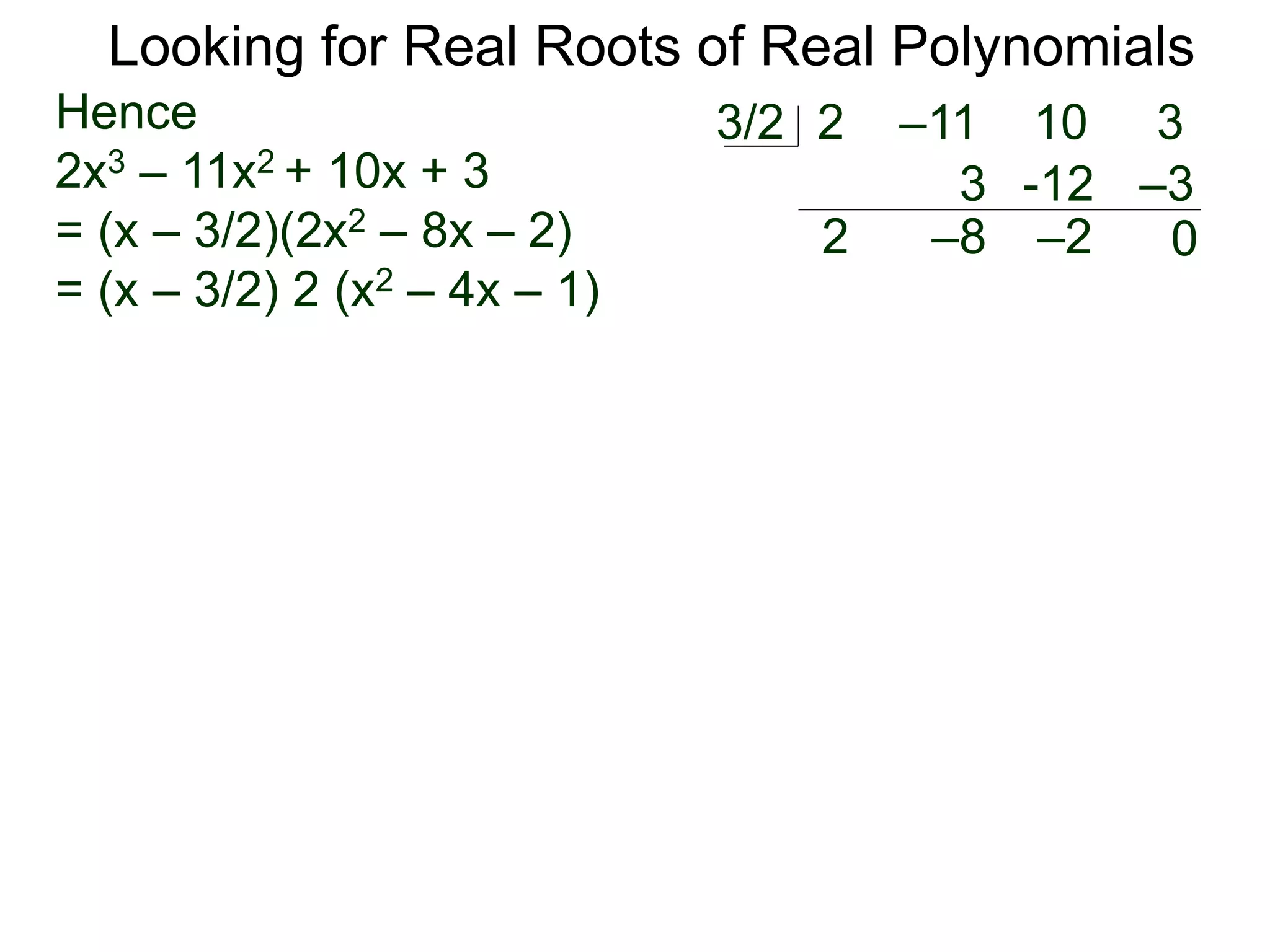
2 –11 10 33/2
Looking for Real Roots of Real Polynomials
Example E.
a. Let P(x) = 2x3 – 11x2 + 10x + 3, list all the possible
rational roots of P(x).
The factors of 3 are B = {1, 3}.
The factors of 2 are A = {1, 2}
The possible roots are fractions of the form ±b/a
where b is from the set B and a is from the set A.
They are {± , ± , ± , ± }.1
1
3
1
1
2
3
2
b. Factor P(x) into real factors completely.
By trial and error, use synthetic division, we find that
x = 3/2 is a root.
2 –11 10 33/2
2
Looking for Real Roots of Real Polynomials
Example E.
a. Let P(x) = 2x3 – 11x2 + 10x + 3, list all the possible
rational roots of P(x).
The factors of 3 are B = {1, 3}.
The factors of 2 are A = {1, 2}
The possible roots are fractions of the form ±b/a
where b is from the set B and a is from the set A.
They are {± , ± , ± , ± }.1
1
3
1
1
2
3
2
b. Factor P(x) into real factors completely.
By trial and error, use synthetic division, we find that
x = 3/2 is a root.
2 –11 10 33/2
2
3
–8
-12
–2
–3
0
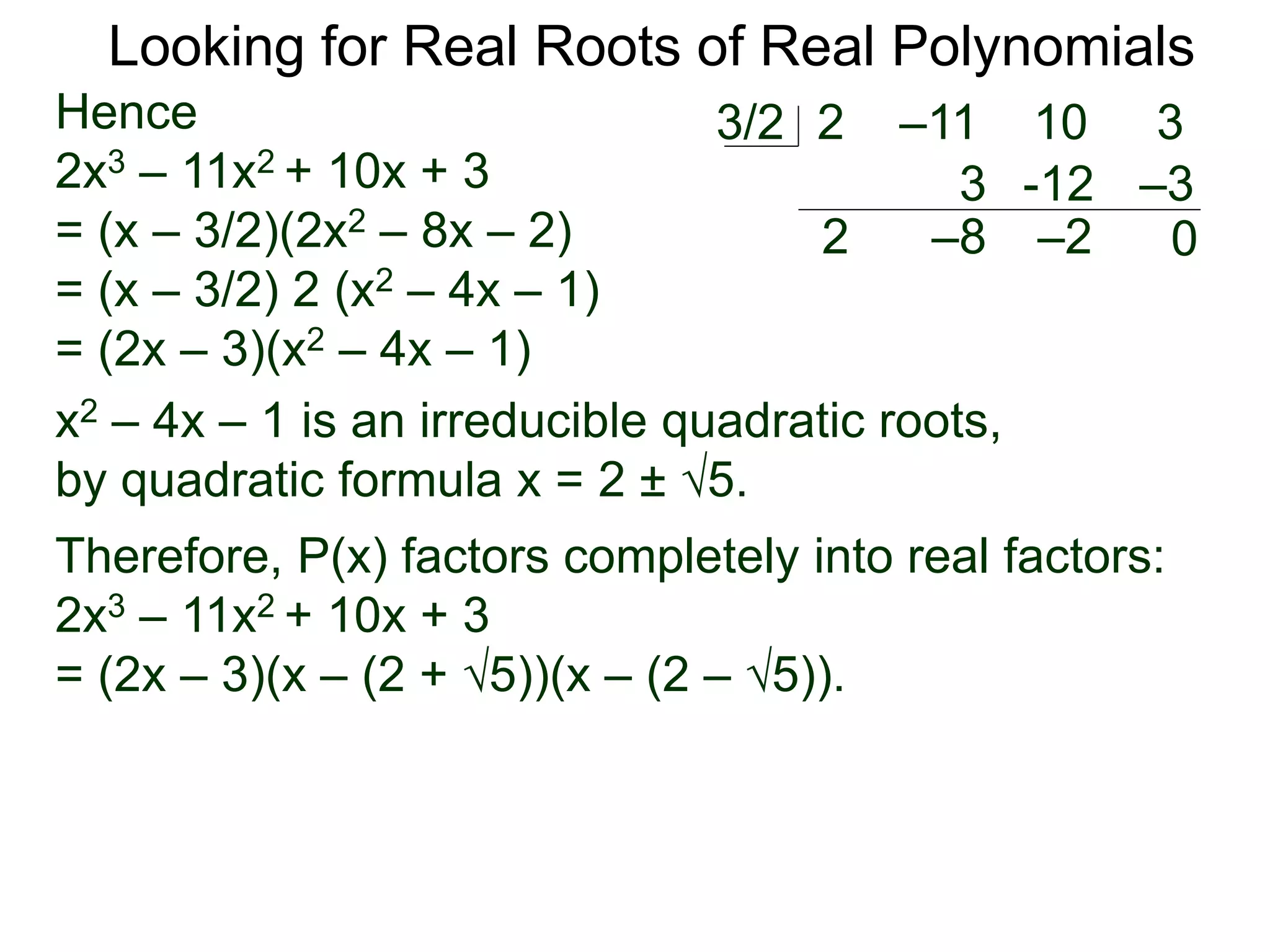
Looking for Real Roots of Real Polynomials
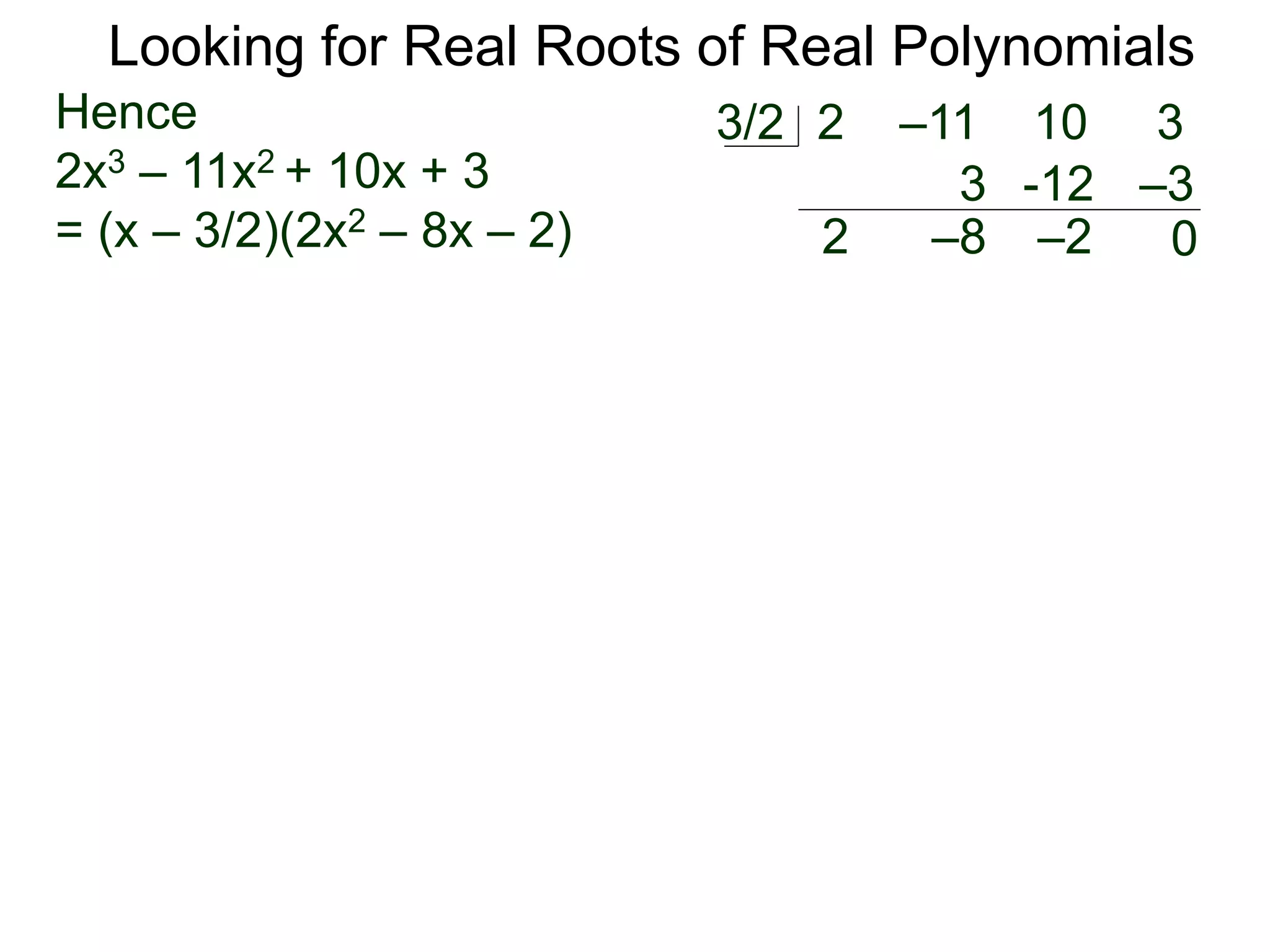
Hence
2x3 – 11x2 + 10x + 3
= (x – 3/2)(2x2 – 8x – 2)
2 –11 10 33/2
2
3
–8
-12
–2
–3
0
Looking for Real Roots of Real Polynomials
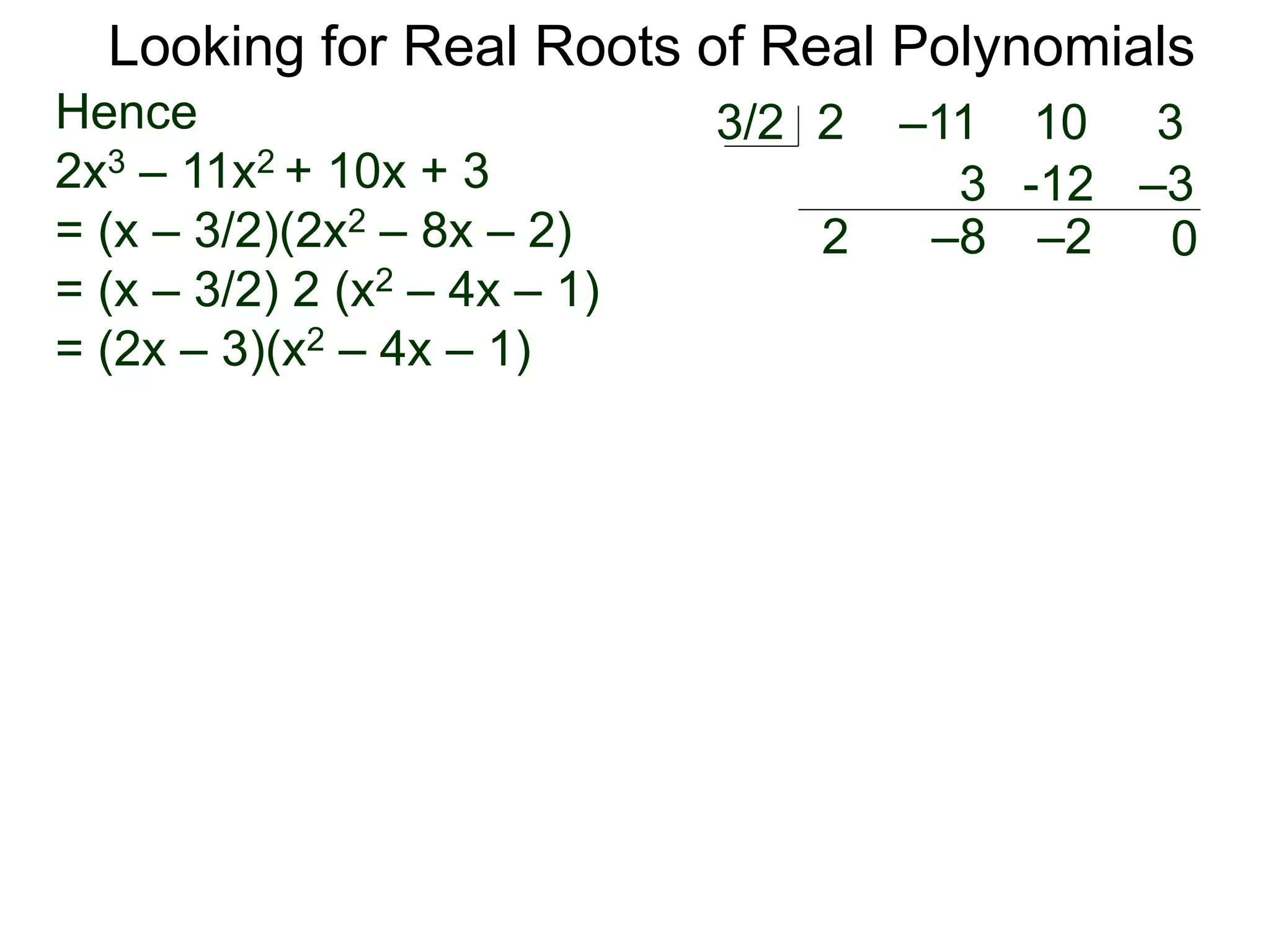
Hence
2x3 – 11x2 + 10x + 3
= (x – 3/2)(2x2 – 8x – 2)
= (x – 3/2) 2 (x2 – 4x – 1)
2 –11 10 33/2
2
3
–8
-12
–2
–3
0
Looking for Real Roots of Real Polynomials
Hence
2x3 – 11x2 + 10x + 3
= (x – 3/2)(2x2 – 8x – 2)
= (x – 3/2) 2 (x2 – 4x – 1)
= (2x – 3)(x2 – 4x – 1)
2 –11 10 33/2
2
3
–8
-12
–2
–3
0
Looking for Real Roots of Real Polynomials
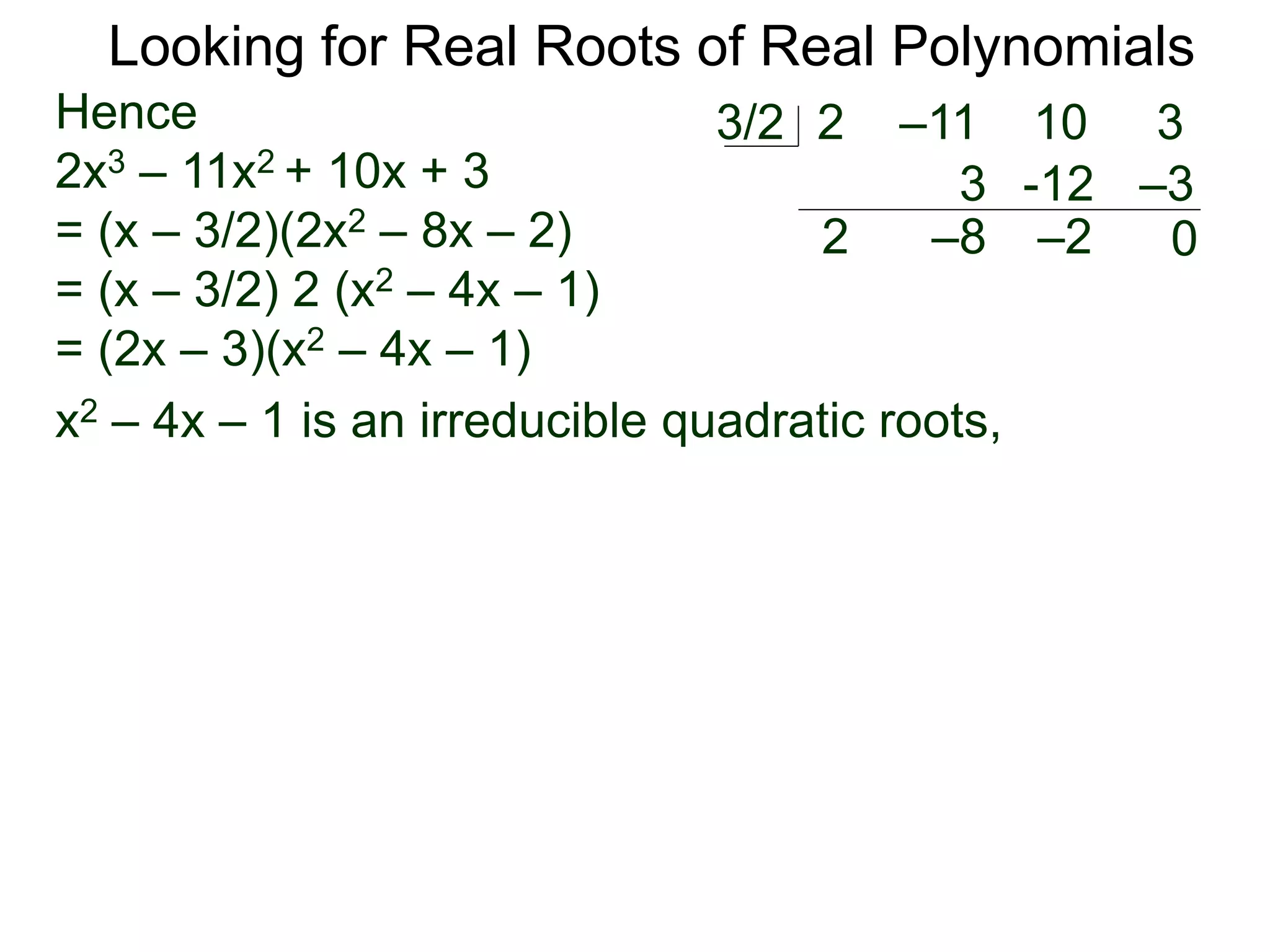
Hence
2x3 – 11x2 + 10x + 3
= (x – 3/2)(2x2 – 8x – 2)
= (x – 3/2) 2 (x2 – 4x – 1)
= (2x – 3)(x2 – 4x – 1)
x2 – 4x – 1 is an irreducible quadratic polynomial,
2 –11 10 33/2
2
3
–8
-12
–2
–3
0
Looking for Real Roots of Real Polynomials
Hence
2x3 – 11x2 + 10x + 3
= (x – 3/2)(2x2 – 8x – 2)
= (x – 3/2) 2 (x2 – 4x – 1)
= (2x – 3)(x2 – 4x – 1)
x2 – 4x – 1 is an irreducible quadratic polynomial,
by the quadratic formula x = 2 ± 5.
2 –11 10 33/2
2
3
–8
-12
–2
–3
0
Looking for Real Roots of Real Polynomials
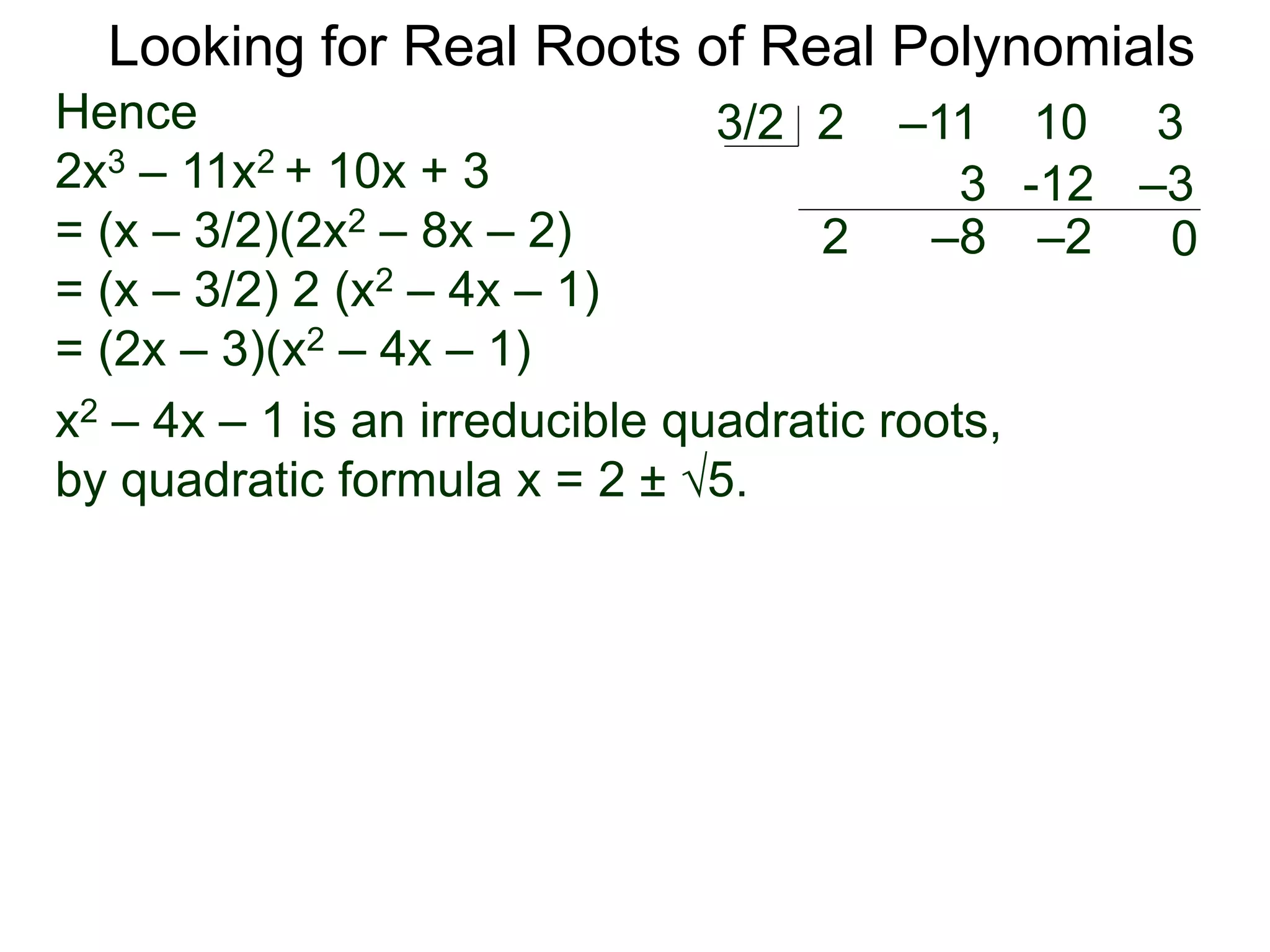
Hence
2x3 – 11x2 + 10x + 3
= (x – 3/2)(2x2 – 8x – 2)
= (x – 3/2) 2 (x2 – 4x – 1)
= (2x – 3)(x2 – 4x – 1)
x2 – 4x – 1 is an irreducible quadratic polynomial,
by the quadratic formula x = 2 ± 5.
Therefore, P(x) factors completely into real factors:
2x3 – 11x2 + 10x + 3
= (2x – 3)(x – (2 + 5))(x – (2 – 5)).
2 –11 10 33/2
2
3
–8
-12
–2
–3
0
Exercise A. (Descartes' Rule of Signss)
Determine the possible number of positive roots and negative
roots of the following polynomials.
Looking for Real Roots of Real Polynomials
B. (Theorem on the Bounds) Gives an interval where the roots
of the following polynomials must reside.
1. P(x) = x3 + x2 + x + 1 2. P(x) = x3 + x2 + x – 1
3. P(x) = x3 + x2 – x + 1 4. P(x) = x3 + x2 – x – 1
5. P(x) = x3 – x2 – x + 1 6. P(x) = x3 – x2 – x – 1
7. What can we say about the roots of a polynomial with
only even degree of x’s?
8. What can we conclude about the roots of a polynomial
with only odd degree of x’s?
1. P(x) = x5 + 6x3 + 2x2 – 1 2. P(x) = x4 + 0.01x3 + 0.23x2 – 1/π
3. By the sign-rule, there is at least one positive real root for
P(x) = x4 – 12x3 + 6.8x2 – √101. Graph P(x) using a calculator
over a chosen interval to see if there are more roots.
Looking for Real Roots of Real Polynomials
D. (Rational Roots and Factoring Polynomials)
List all the possible rational roots of the following polynomials.
Then find all the rational and irrational roots (all roots are real),
and factor each completely.
1. P(x) = x3 – 2x2 – 5x + 6 2. P(x) = x3 – 3x2 –10x + 6
3. P(x) = –2x3 + 3x2 – 11x – 6 4. P(x) = 3x3 – 4x2 –13x – 6
5. P(x) = –6x3 –13x2 – 4x + 3
6. P(x) = 12x4 – 8x3 – 21x2 + 5x + 6
7. P(x) = 3x4 – x3 – 24x2 – 16x + 8
8. P 𝑥 = 6𝑥4 + 5𝑥3 − 24𝑥2 − 12𝑥 + 16

3.4 looking for real roots of real polynomials

  • 1.
    Looking for RealRoots of Real Polynomials
  • 2.
    In this sectionwe give three theorems concerning real roots of real polynomials. Looking for Real Roots of Real Polynomials
  • 3.
    In this sectionwe give three theorems concerning real roots of real polynomials. They give three different approaches concerning looking for roots. Looking for Real Roots of Real Polynomials
  • 4.
    In this sectionwe give three theorems concerning real roots of real polynomials. They give three different approaches concerning looking for roots. Looking for Real Roots of Real Polynomials Descartes' Rule of Signss gives the possible number of real roots by eyeballing the polynomial.
  • 5.
    In this sectionwe give three theorems concerning real roots of real polynomials. They give three different approaches concerning looking for roots. Looking for Real Roots of Real Polynomials Descartes' Rule of Signss gives the possible number of real roots by eyeballing the polynomial. Theorem on the Bounds gives the interval of real numbers where the roots must reside.
  • 6.
    In this sectionwe give three theorems concerning real roots of real polynomials. They give three different approaches concerning looking for roots. Looking for Real Roots of Real Polynomials Descartes' Rule of Signss gives the possible number of real roots by eyeballing the polynomial. Theorem on the Bounds gives the interval of real numbers where the roots must reside. Theorem on Rational Roots gives the possible rational roots for polynomials with integer coefficients.
  • 7.
    In this sectionwe give three theorems concerning real roots of real polynomials. They give three different approaches concerning looking for roots. Looking for Real Roots of Real Polynomials Descartes' Rule of Signss gives the possible number of real roots by eyeballing the polynomial. Theorem on the Bounds gives the interval of real numbers where the roots must reside. Descartes' Rule and Theorem on the Bounds are existence-theorems in mathematics, i.e. they establish the existence of something but don’t say what they might be. Theorem on Rational Roots gives the possible rational roots for polynomials with integer coefficients.
  • 8.
    In this sectionwe give three theorems concerning real roots of real polynomials. They give three different approaches concerning looking for roots. Looking for Real Roots of Real Polynomials Descartes' Rule of Signss gives the possible number of real roots by eyeballing the polynomial. Theorem on the Bounds gives the interval of real numbers where the roots must reside. Descartes' Rule and Theorem on the Bounds are existence-theorems in mathematics, i.e. they establish the existence of something but don’t say what they might be. Theorem on Rational Roots tells us precisely what to check. Theorem on Rational Roots gives the possible rational roots for polynomials with integer coefficients.
  • 9.
    Looking for RealRoots of Real Polynomials Theorem: If the degree of a real polynomial P(x) is odd then P(x) must have an odd number of real roots.
  • 10.
    Looking for RealRoots of Real Polynomials Theorem: If the degree of a real polynomial P(x) is odd then P(x) must have an odd number of real roots. In particular, it has at least one real root.
  • 11.
    Looking for RealRoots of Real Polynomials Theorem: If the degree of a real polynomial P(x) is odd then P(x) must have an odd number of real roots. In particular, it has at least one real root. Proof: From the Fundamental Theorem Algebra the complex roots must be in conjugate pairs.
  • 12.
    Looking for RealRoots of Real Polynomials Theorem: If the degree of a real polynomial P(x) is odd then P(x) must have an odd number of real roots. In particular, it has at least one real root. Proof: From the Fundamental Theorem Algebra the complex roots must be in conjugate pairs. Hence there must be even number of complex roots.
  • 13.
    Looking for RealRoots of Real Polynomials Theorem: If the degree of a real polynomial P(x) is odd then P(x) must have an odd number of real roots. In particular, it has at least one real root. Proof: From the Fundamental Theorem Algebra the complex roots must be in conjugate pairs. Hence there must be even number of complex roots. So the remaining roots must be real and there must be an odd number of them. QED
  • 14.
    Looking for RealRoots of Real Polynomials Theorem: If the degree of a real polynomial P(x) is odd then P(x) must have an odd number of real roots. In particular, it has at least one real root. Proof: Given a polynomial P(x), arrange the signs of it's coefficients starting from the highest degree term in descending order, From the Fundamental Theorem Algebra the complex roots must be in conjugate pairs. Hence there must be even number of complex roots. So the remaining roots must be real and there must be an odd number of them. QED
  • 15.
    Looking for RealRoots of Real Polynomials Theorem: If the degree of a real polynomial P(x) is odd then P(x) must have an odd number of real roots. In particular, it has at least one real root. Proof: Given a polynomial P(x), arrange the signs of it's coefficients starting from the highest degree term in descending order, the total number of sign-changes between consecutive terms is called the variation of the signs of P(x). From the Fundamental Theorem Algebra the complex roots must be in conjugate pairs. Hence there must be even number of complex roots. So the remaining roots must be real and there must be an odd number of them. QED
  • 16.
    Looking for RealRoots of Real Polynomials For example, if P(x) = –3x5 + x3 + 2x2 + x – 1, the signs of its coefficients in order are – + + + –
  • 17.
    Looking for RealRoots of Real Polynomials For example, if P(x) = –3x5 + x3 + 2x2 + x – 1, the signs of its coefficients in order are – + + + – sign switched sign switched
  • 18.
    Looking for RealRoots of Real Polynomials For example, if P(x) = –3x5 + x3 + 2x2 + x – 1, the signs of its coefficients in order are – + + + – There are two sign-switches so the variation of signss of P(x) is 2. sign switched sign switched
  • 19.
    Looking for RealRoots of Real Polynomials For example, if P(x) = –3x5 + x3 + 2x2 + x – 1, the signs of its coefficients in order are – + + + – There are two sign-switches so the variation of signss of P(x) is 2. sign switched sign switched Descartes' Rule of Signs:
  • 20.
    Looking for RealRoots of Real Polynomials For example, if P(x) = –3x5 + x3 + 2x2 + x – 1, the signs of its coefficients in order are – + + + – There are two sign-switches so the variation of signss of P(x) is 2. sign switched sign switched Descartes' Rule of Signs: P(x) is a real polynomial,
  • 21.
    Looking for RealRoots of Real Polynomials For example, if P(x) = –3x5 + x3 + 2x2 + x – 1, the signs of its coefficients in order are – + + + – There are two sign-switches so the variation of signss of P(x) is 2. sign switched sign switched Descartes' Rule of Signs: P(x) is a real polynomial, a. the number of positive roots of P(x) is equal to the variation of signss of P(x) or less than the variation of signss of P(x) by an even number.
  • 22.
    Looking for RealRoots of Real Polynomials For example, if P(x) = –3x5 + x3 + 2x2 + x – 1, the signs of its coefficients in order are – + + + – There are two sign-switches so the variation of signss of P(x) is 2. sign switched sign switched Descartes' Rule of Signs: P(x) is a real polynomial, a. the number of positive roots of P(x) is equal to the variation of signss of P(x) or less than the variation of signss of P(x) by an even number. b. the number of negative roots of P(x) is equal to the variation of signss of P(–x) or less than the variation of signss of P(–x) by an even number.
  • 23.
    Looking for RealRoots of Real Polynomials Example A. For P(x) = –3x5 + x3 + 2x2 + x – 1 from the last slide, the variation of signs is 2.
  • 24.
    Looking for RealRoots of Real Polynomials Example A. For P(x) = –3x5 + x3 + 2x2 + x – 1 from the last slide, the variation of signs is 2. Hence P(x) has either 2 positive roots or no positive roots.
  • 25.
    Looking for RealRoots of Real Polynomials Example A. For P(x) = –3x5 + x3 + 2x2 + x – 1 from the last slide, the variation of signs is 2. Hence P(x) has either 2 positive roots or no positive roots. P(-x) = -3(-x)5 + (-x)3 + 2(-x)2 + (-x) – 1
  • 26.
    Looking for RealRoots of Real Polynomials Example A. For P(x) = –3x5 + x3 + 2x2 + x – 1 from the last slide, the variation of signs is 2. Hence P(x) has either 2 positive roots or no positive roots. P(-x) = -3(-x)5 + (-x)3 + 2(-x)2 + (-x) – 1 = 3x5 – x3 + 2x2 – x – 1
  • 27.
    Looking for RealRoots of Real Polynomials Example A. For P(x) = –3x5 + x3 + 2x2 + x – 1 from the last slide, the variation of signs is 2. Hence P(x) has either 2 positive roots or no positive roots. P(-x) = -3(-x)5 + (-x)3 + 2(-x)2 + (-x) – 1 = 3x5 – x3 + 2x2 – x – 1 The signs of its coefficients in order are + – + – –
  • 28.
    Looking for RealRoots of Real Polynomials Example A. For P(x) = –3x5 + x3 + 2x2 + x – 1 from the last slide, the variation of signs is 2. Hence P(x) has either 2 positive roots or no positive roots. P(-x) = -3(-x)5 + (-x)3 + 2(-x)2 + (-x) – 1 = 3x5 – x3 + 2x2 – x – 1 The signs of its coefficients in order are + – + – – sign switched
  • 29.
    Looking for RealRoots of Real Polynomials Example A. For P(x) = –3x5 + x3 + 2x2 + x – 1 from the last slide, the variation of signs is 2. Hence P(x) has either 2 positive roots or no positive roots. P(-x) = -3(-x)5 + (-x)3 + 2(-x)2 + (-x) – 1 = 3x5 – x3 + 2x2 – x – 1 The signs of its coefficients in order are + – + – – sign switched the variation of signs of P(-x) is 3.
  • 30.
    Looking for RealRoots of Real Polynomials Example A. For P(x) = –3x5 + x3 + 2x2 + x – 1 from the last slide, the variation of signs is 2. Hence P(x) has either 2 positive roots or no positive roots. P(-x) = -3(-x)5 + (-x)3 + 2(-x)2 + (-x) – 1 = 3x5 – x3 + 2x2 – x – 1 The signs of its coefficients in order are + – + – – sign switched the variation of signs of P(-x) is 3. Hence P(x) has either 3 negative roots or 1 negative root.
  • 31.
    Looking for RealRoots of Real Polynomials Example A. For P(x) = –3x5 + x3 + 2x2 + x – 1 from the last slide, the variation of signs is 2. Hence P(x) has either 2 positive roots or no positive roots. P(-x) = -3(-x)5 + (-x)3 + 2(-x)2 + (-x) – 1 = 3x5 – x3 + 2x2 – x – 1 The signs of its coefficients in order are + – + – – sign switched the variation of signs of P(-x) is 3. Hence P(x) has either 3 negative roots or 1 negative root. So P(x) may have 1 neg. root + 4 complex roots, or 1 neg. root + 2 positive roots + 2 complex roots, or 3 negative roots + 2 complex roots, or 3 negative roots + 2 positive roots.
  • 32.
    Looking for RealRoots of Real Polynomials The Theorem of Bounds gives the interval of real numbers where the roots must reside.
  • 33.
    Theorem of Bounds: Lookingfor Real Roots of Real Polynomials The Theorem of Bounds gives the interval of real numbers where the roots must reside.
  • 34.
    Theorem of Bounds: LetP(x) = anxn + an-1xn-1+… + a0 be a real polynomial, Looking for Real Roots of Real Polynomials The Theorem of Bounds gives the interval of real numbers where the roots must reside.
  • 35.
    Theorem of Bounds: LetP(x) = anxn + an-1xn-1+… + a0 be a real polynomial, the real roots of P(x) must be in the interval (–M, M) where M = Looking for Real Roots of Real Polynomials The Theorem of Bounds gives the interval of real numbers where the roots must reside. Max {|an|, |an-1|, |an-2|, ..|a0|} |an| + 1
  • 36.
    Theorem of Bounds: LetP(x) = anxn + an-1xn-1+… + a0 be a real polynomial, the real roots of P(x) must be in the interval (–M, M) where M = Looking for Real Roots of Real Polynomials The Theorem of Bounds gives the interval of real numbers where the roots must reside. Max {|an|, |an-1|, |an-2|, ..|a0|} |an| + 1 Example B. For P(x) = -2x5 + 6x3 + 2x2 + x – 1,
  • 37.
    Theorem of Bounds: LetP(x) = anxn + an-1xn-1+… + a0 be a real polynomial, the real roots of P(x) must be in the interval (–M, M) where M = Looking for Real Roots of Real Polynomials The Theorem of Bounds gives the interval of real numbers where the roots must reside. Max {|an|, |an-1|, |an-2|, ..|a0|} |an| + 1 Example B. For P(x) = -2x5 + 6x3 + 2x2 + x – 1, then Max{|-2|, |6|, |2|, |1|, |-1|} = 6
  • 38.
    Theorem of Bounds: LetP(x) = anxn + an-1xn-1+… + a0 be a real polynomial, the real roots of P(x) must be in the interval (–M, M) where M = Looking for Real Roots of Real Polynomials The Theorem of Bounds gives the interval of real numbers where the roots must reside. Max {|an|, |an-1|, |an-2|, ..|a0|} |an| + 1 Example B. For P(x) = -2x5 + 6x3 + 2x2 + x – 1, then Max{|-2|, |6|, |2|, |1|, |-1|} = 6 and |an| = 2,
  • 39.
    Theorem of Bounds: LetP(x) = anxn + an-1xn-1+… + a0 be a real polynomial, the real roots of P(x) must be in the interval (–M, M) where M = Looking for Real Roots of Real Polynomials The Theorem of Bounds gives the interval of real numbers where the roots must reside. Max {|an|, |an-1|, |an-2|, ..|a0|} |an| + 1 Example B. For P(x) = -2x5 + 6x3 + 2x2 + x – 1, then Max{|-2|, |6|, |2|, |1|, |-1|} = 6 and |an| = 2, hence M = 6/2 + 1 = 4 and all the real roots of P(x) reside in the interval (–4, 4).
  • 40.
    Theorem of Bounds: LetP(x) = anxn + an-1xn-1+… + a0 be a real polynomial, the real roots of P(x) must be in the interval (–M, M) where M = Looking for Real Roots of Real Polynomials The Theorem of Bounds gives the interval of real numbers where the roots must reside. Max {|an|, |an-1|, |an-2|, ..|a0|} |an| + 1 Example B. For P(x) = -2x5 + 6x3 + 2x2 + x – 1, then Max{|-2|, |6|, |2|, |1|, |-1|} = 6 and |an| = 2, hence M = 6/2 + 1 = 4 and all the real roots of P(x) reside in the interval (–4, 4). Note: If an = 1, then M = largest Coefficient + 1.
  • 41.
    Theorem of Bounds: LetP(x) = anxn + an-1xn-1+… + a0 be a real polynomial, the real roots of P(x) must be in the interval (–M, M) where M = Looking for Real Roots of Real Polynomials The Theorem of Bounds gives the interval of real numbers where the roots must reside. Max {|an|, |an-1|, |an-2|, ..|a0|} |an| + 1 Example B. For P(x) = -2x5 + 6x3 + 2x2 + x – 1, then Max{|-2|, |6|, |2|, |1|, |-1|} = 6 and |an| = 2, hence M = 6/2 + 1 = 4 and all the real roots of P(x) reside in the interval (–4, 4). Note: If an = 1, then M = largest Coefficient + 1. We may use The Theorem of Bounds to find decimal solutions via a graphing calculator or software.
  • 42.
    Looking for RealRoots of Real Polynomials Example C. To find the approximate real roots of P(x) = -2x5 + 6x3 + 2x2 + x – 1 with a graphing calculator,
  • 43.
    Looking for RealRoots of Real Polynomials Example C. To find the approximate real roots of P(x) = -2x5 + 6x3 + 2x2 + x – 1 with a graphing calculator, set the plot range of x to be [–4, 4], the plot range of y, to be say [20, –20].
  • 44.
    Looking for RealRoots of Real Polynomials Example C. To find the approximate real roots of P(x) = -2x5 + 6x3 + 2x2 + x – 1 with a graphing calculator, set the plot range of x to be [–4, 4], the plot range of y, to be say [20, –20].
  • 45.
    Looking for RealRoots of Real Polynomials We get three roots. y = -2x5 + 6x3 + 2x2 + x – 1 Example C. To find the approximate real roots of P(x) = -2x5 + 6x3 + 2x2 + x – 1 with a graphing calculator, set the plot range of x to be [–4, 4], the plot range of y, to be say [20, –20].
  • 46.
    Looking for RealRoots of Real Polynomials We get three roots. From the tracer-operation, their approximate values are x ≈ –1.65, 0.40, and 1.89. y = -2x5 + 6x3 + 2x2 + x – 1 -1.65 0.40 1.89 Example C. To find the approximate real roots of P(x) = -2x5 + 6x3 + 2x2 + x – 1 with a graphing calculator, set the plot range of x to be [–4, 4], the plot range of y, to be say [20, –20].
  • 47.
    Looking for RealRoots of Real Polynomials Polynomials with integer coefficients form an important class of functions.
  • 48.
    Looking for RealRoots of Real Polynomials Polynomials with integer coefficients form an important class of functions. The next theorem gives all the possible rational roots of such polynomials.
  • 49.
    Theorem of RationalRoots: Looking for Real Roots of Real Polynomials Polynomials with integer coefficients form an important class of functions. The next theorem gives all the possible rational roots of such polynomials.
  • 50.
    Theorem of RationalRoots: Let P(x) = Axn + an-1xn-1+… a1x + B be a polynomial where A, an-1, an-2, ..,a1, B, are all integers. Looking for Real Roots of Real Polynomials Polynomials with integer coefficients form an important class of functions. The next theorem gives all the possible rational roots of such polynomials.
  • 51.
    Theorem of RationalRoots: Let P(x) = Axn + an-1xn-1+… a1x + B be a polynomial where A, an-1, an-2, ..,a1, B, are all integers. If x = b/a is rational root of P(x), then b is a factor of B and a is a factor of A. Looking for Real Roots of Real Polynomials Polynomials with integer coefficients form an important class of functions. The next theorem gives all the possible rational roots of such polynomials.
  • 52.
    Theorem of RationalRoots: Let P(x) = Axn + an-1xn-1+… a1x + B be a polynomial where A, an-1, an-2, ..,a1, B, are all integers. If x = b/a is rational root of P(x), then b is a factor of B and a is a factor of A. Looking for Real Roots of Real Polynomials Example D. a. P(x) = 4x + 6 b. P(x) = 6x2 + 7x + 2 Polynomials with integer coefficients form an important class of functions. The next theorem gives all the possible rational roots of such polynomials.
  • 53.
    Theorem of RationalRoots: Let P(x) = Axn + an-1xn-1+… a1x + B be a polynomial where A, an-1, an-2, ..,a1, B, are all integers. If x = b/a is rational root of P(x), then b is a factor of B and a is a factor of A. Looking for Real Roots of Real Polynomials Example D. a. P(x) = 4x + 6, it's root is x = –3/2. b. P(x) = 6x2 + 7x + 2 Polynomials with integer coefficients form an important class of functions. The next theorem gives all the possible rational roots of such polynomials. 3 is a factor of 6 and 2 is a factor of 4.
  • 54.
    Theorem of RationalRoots: Let P(x) = Axn + an-1xn-1+… a1x + B be a polynomial where A, an-1, an-2, ..,a1, B, are all integers. If x = b/a is rational root of P(x), then b is a factor of B and a is a factor of A. Looking for Real Roots of Real Polynomials Example D. a. P(x) = 4x + 6, it's root is x = –3/2. b. P(x) = 6x2 + 7x + 2 = (3x + 2)(2x + 1) It's roots are –2/3, and –1/2. Polynomials with integer coefficients form an important class of functions. The next theorem gives all the possible rational roots of such polynomials. 3 is a factor of 6 and 2 is a factor of 4.
  • 55.
    Theorem of RationalRoots: Let P(x) = Axn + an-1xn-1+… a1x + B be a polynomial where A, an-1, an-2, ..,a1, B, are all integers. If x = b/a is rational root of P(x), then b is a factor of B and a is a factor of A. Looking for Real Roots of Real Polynomials Example D. a. P(x) = 4x + 6, it's root is x = –3/2. b. P(x) = 6x2 + 7x + 2 = (3x + 2)(2x + 1) It's roots are –2/3, and –1/2. The numerators of the roots are 2, 1 and are factors of 2. The denominators 3 and 2 are factors of 6. Polynomials with integer coefficients form an important class of functions. The next theorem gives all the possible rational roots of such polynomials. 3 is a factor of 6 and 2 is a factor of 4.
  • 56.
    Looking for RealRoots of Real Polynomials Example E. a. Let P(x) = 2x3 – 11x2 + 10x + 3, list all the possible rational roots of P(x).
  • 57.
    Looking for RealRoots of Real Polynomials Example E. a. Let P(x) = 2x3 – 11x2 + 10x + 3, list all the possible rational roots of P(x). The factors of 3 are B = {1, 3}.
  • 58.
    Looking for RealRoots of Real Polynomials Example E. a. Let P(x) = 2x3 – 11x2 + 10x + 3, list all the possible rational roots of P(x). The factors of 3 are B = {1, 3}. The factors of 2 are A = {1, 2}
  • 59.
    Looking for RealRoots of Real Polynomials Example E. a. Let P(x) = 2x3 – 11x2 + 10x + 3, list all the possible rational roots of P(x). The factors of 3 are B = {1, 3}. The factors of 2 are A = {1, 2} The possible roots are fractions of the form ±b/a where b is from the set B and a is from the set A.
  • 60.
    Looking for RealRoots of Real Polynomials Example E. a. Let P(x) = 2x3 – 11x2 + 10x + 3, list all the possible rational roots of P(x). The factors of 3 are B = {1, 3}. The factors of 2 are A = {1, 2} The possible roots are fractions of the form ±b/a where b is from the set B and a is from the set A. They are {± , ± , ± , ± }.1 1 3 1 1 2 3 2
  • 61.
    Looking for RealRoots of Real Polynomials Example E. a. Let P(x) = 2x3 – 11x2 + 10x + 3, list all the possible rational roots of P(x). The factors of 3 are B = {1, 3}. The factors of 2 are A = {1, 2} The possible roots are fractions of the form ±b/a where b is from the set B and a is from the set A. They are {± , ± , ± , ± }.1 1 3 1 1 2 3 2 b. Factor P(x) into real factors completely.
  • 62.
    Looking for RealRoots of Real Polynomials Example E. a. Let P(x) = 2x3 – 11x2 + 10x + 3, list all the possible rational roots of P(x). The factors of 3 are B = {1, 3}. The factors of 2 are A = {1, 2} The possible roots are fractions of the form ±b/a where b is from the set B and a is from the set A. They are {± , ± , ± , ± }.1 1 3 1 1 2 3 2 b. Factor P(x) into real factors completely. By trial and error, use synthetic division, we find that x = 3/2 is a root.
  • 63.
    Looking for RealRoots of Real Polynomials Example E. a. Let P(x) = 2x3 – 11x2 + 10x + 3, list all the possible rational roots of P(x). The factors of 3 are B = {1, 3}. The factors of 2 are A = {1, 2} The possible roots are fractions of the form ±b/a where b is from the set B and a is from the set A. They are {± , ± , ± , ± }.1 1 3 1 1 2 3 2 b. Factor P(x) into real factors completely. By trial and error, use synthetic division, we find that x = 3/2 is a root. 2 –11 10 33/2
  • 64.
    Looking for RealRoots of Real Polynomials Example E. a. Let P(x) = 2x3 – 11x2 + 10x + 3, list all the possible rational roots of P(x). The factors of 3 are B = {1, 3}. The factors of 2 are A = {1, 2} The possible roots are fractions of the form ±b/a where b is from the set B and a is from the set A. They are {± , ± , ± , ± }.1 1 3 1 1 2 3 2 b. Factor P(x) into real factors completely. By trial and error, use synthetic division, we find that x = 3/2 is a root. 2 –11 10 33/2 2
  • 65.
    Looking for RealRoots of Real Polynomials Example E. a. Let P(x) = 2x3 – 11x2 + 10x + 3, list all the possible rational roots of P(x). The factors of 3 are B = {1, 3}. The factors of 2 are A = {1, 2} The possible roots are fractions of the form ±b/a where b is from the set B and a is from the set A. They are {± , ± , ± , ± }.1 1 3 1 1 2 3 2 b. Factor P(x) into real factors completely. By trial and error, use synthetic division, we find that x = 3/2 is a root. 2 –11 10 33/2 2 3 –8 -12 –2 –3 0
  • 66.
    Looking for RealRoots of Real Polynomials Hence 2x3 – 11x2 + 10x + 3 = (x – 3/2)(2x2 – 8x – 2) 2 –11 10 33/2 2 3 –8 -12 –2 –3 0
  • 67.
    Looking for RealRoots of Real Polynomials Hence 2x3 – 11x2 + 10x + 3 = (x – 3/2)(2x2 – 8x – 2) = (x – 3/2) 2 (x2 – 4x – 1) 2 –11 10 33/2 2 3 –8 -12 –2 –3 0
  • 68.
    Looking for RealRoots of Real Polynomials Hence 2x3 – 11x2 + 10x + 3 = (x – 3/2)(2x2 – 8x – 2) = (x – 3/2) 2 (x2 – 4x – 1) = (2x – 3)(x2 – 4x – 1) 2 –11 10 33/2 2 3 –8 -12 –2 –3 0
  • 69.
    Looking for RealRoots of Real Polynomials Hence 2x3 – 11x2 + 10x + 3 = (x – 3/2)(2x2 – 8x – 2) = (x – 3/2) 2 (x2 – 4x – 1) = (2x – 3)(x2 – 4x – 1) x2 – 4x – 1 is an irreducible quadratic polynomial, 2 –11 10 33/2 2 3 –8 -12 –2 –3 0
  • 70.
    Looking for RealRoots of Real Polynomials Hence 2x3 – 11x2 + 10x + 3 = (x – 3/2)(2x2 – 8x – 2) = (x – 3/2) 2 (x2 – 4x – 1) = (2x – 3)(x2 – 4x – 1) x2 – 4x – 1 is an irreducible quadratic polynomial, by the quadratic formula x = 2 ± 5. 2 –11 10 33/2 2 3 –8 -12 –2 –3 0
  • 71.
    Looking for RealRoots of Real Polynomials Hence 2x3 – 11x2 + 10x + 3 = (x – 3/2)(2x2 – 8x – 2) = (x – 3/2) 2 (x2 – 4x – 1) = (2x – 3)(x2 – 4x – 1) x2 – 4x – 1 is an irreducible quadratic polynomial, by the quadratic formula x = 2 ± 5. Therefore, P(x) factors completely into real factors: 2x3 – 11x2 + 10x + 3 = (2x – 3)(x – (2 + 5))(x – (2 – 5)). 2 –11 10 33/2 2 3 –8 -12 –2 –3 0
  • 72.
    Exercise A. (Descartes'Rule of Signss) Determine the possible number of positive roots and negative roots of the following polynomials. Looking for Real Roots of Real Polynomials B. (Theorem on the Bounds) Gives an interval where the roots of the following polynomials must reside. 1. P(x) = x3 + x2 + x + 1 2. P(x) = x3 + x2 + x – 1 3. P(x) = x3 + x2 – x + 1 4. P(x) = x3 + x2 – x – 1 5. P(x) = x3 – x2 – x + 1 6. P(x) = x3 – x2 – x – 1 7. What can we say about the roots of a polynomial with only even degree of x’s? 8. What can we conclude about the roots of a polynomial with only odd degree of x’s? 1. P(x) = x5 + 6x3 + 2x2 – 1 2. P(x) = x4 + 0.01x3 + 0.23x2 – 1/π 3. By the sign-rule, there is at least one positive real root for P(x) = x4 – 12x3 + 6.8x2 – √101. Graph P(x) using a calculator over a chosen interval to see if there are more roots.
  • 73.
    Looking for RealRoots of Real Polynomials D. (Rational Roots and Factoring Polynomials) List all the possible rational roots of the following polynomials. Then find all the rational and irrational roots (all roots are real), and factor each completely. 1. P(x) = x3 – 2x2 – 5x + 6 2. P(x) = x3 – 3x2 –10x + 6 3. P(x) = –2x3 + 3x2 – 11x – 6 4. P(x) = 3x3 – 4x2 –13x – 6 5. P(x) = –6x3 –13x2 – 4x + 3 6. P(x) = 12x4 – 8x3 – 21x2 + 5x + 6 7. P(x) = 3x4 – x3 – 24x2 – 16x + 8 8. P 𝑥 = 6𝑥4 + 5𝑥3 − 24𝑥2 − 12𝑥 + 16