Linear Equations and Lines
In the rectangular coordinate system, ordered pairs (x, y)’s
correspond to locations of points.
Linear Equations and Lines
In the rectangular coordinate system, ordered pairs (x, y)’s
correspond to locations of points. Collections of points may be
specified by the mathematics relations between the
x-coordinate and the y coordinate.
Linear Equations and Lines
In the rectangular coordinate system, ordered pairs (x, y)’s
correspond to locations of points. Collections of points may be
specified by the mathematics relations between the
x-coordinate and the y coordinate. The plot of points that fit a
given relation is called the graph of that relation.
Linear Equations and Lines
In the rectangular coordinate system, ordered pairs (x, y)’s
correspond to locations of points. Collections of points may be
specified by the mathematics relations between the
x-coordinate and the y coordinate. The plot of points that fit a
given relation is called the graph of that relation. To make a
graph of a given mathematics relation, make a table of points
that fit the description and plot them.
Linear Equations and Lines
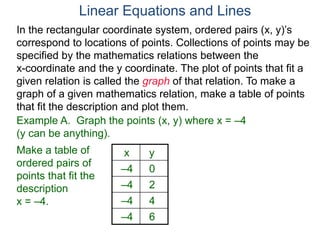
Example A. Graph the points (x, y) where x = –4
In the rectangular coordinate system, ordered pairs (x, y)’s
correspond to locations of points. Collections of points may be
specified by the mathematics relations between the
x-coordinate and the y coordinate. The plot of points that fit a
given relation is called the graph of that relation. To make a
graph of a given mathematics relation, make a table of points
that fit the description and plot them.
Linear Equations and Lines
Example A. Graph the points (x, y) where x = –4
(y can be anything).
In the rectangular coordinate system, ordered pairs (x, y)’s
correspond to locations of points. Collections of points may be
specified by the mathematics relations between the
x-coordinate and the y coordinate. The plot of points that fit a
given relation is called the graph of that relation. To make a
graph of a given mathematics relation, make a table of points
that fit the description and plot them.
Linear Equations and Lines
Example A. Graph the points (x, y) where x = –4
(y can be anything).
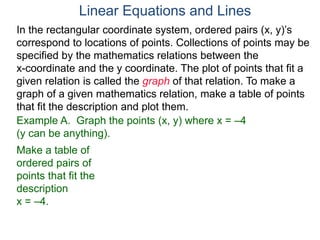
Make a table of
ordered pairs of
points that fit the
description
x = –4.
In the rectangular coordinate system, ordered pairs (x, y)’s
correspond to locations of points. Collections of points may be
specified by the mathematics relations between the
x-coordinate and the y coordinate. The plot of points that fit a
given relation is called the graph of that relation. To make a
graph of a given mathematics relation, make a table of points
that fit the description and plot them.
Linear Equations and Lines
Example A. Graph the points (x, y) where x = –4
(y can be anything).
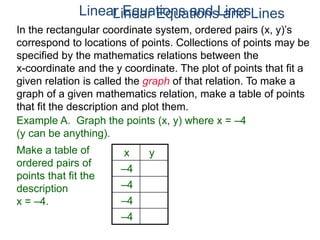
x y
–4
–4
–4
–4
Make a table of
ordered pairs of
points that fit the
description
x = –4.
In the rectangular coordinate system, ordered pairs (x, y)’s
correspond to locations of points. Collections of points may be
specified by the mathematics relations between the
x-coordinate and the y coordinate. The plot of points that fit a
given relation is called the graph of that relation. To make a
graph of a given mathematics relation, make a table of points
that fit the description and plot them.
Linear Equations and Lines
Example A. Graph the points (x, y) where x = –4
(y can be anything).
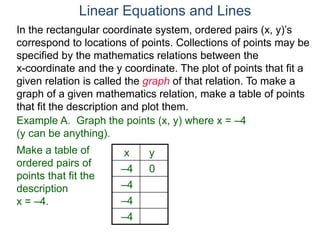
x y
–4 0
–4
–4
–4
Make a table of
ordered pairs of
points that fit the
description
x = –4.
In the rectangular coordinate system, ordered pairs (x, y)’s
correspond to locations of points. Collections of points may be
specified by the mathematics relations between the
x-coordinate and the y coordinate. The plot of points that fit a
given relation is called the graph of that relation. To make a
graph of a given mathematics relation, make a table of points
that fit the description and plot them.
Linear Equations and Lines
Example A. Graph the points (x, y) where x = –4
(y can be anything).
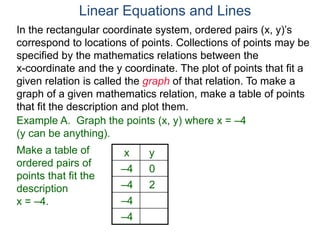
x y
–4 0
–4 2
–4
–4
Make a table of
ordered pairs of
points that fit the
description
x = –4.
In the rectangular coordinate system, ordered pairs (x, y)’s
correspond to locations of points. Collections of points may be
specified by the mathematics relations between the
x-coordinate and the y coordinate. The plot of points that fit a
given relation is called the graph of that relation. To make a
graph of a given mathematics relation, make a table of points
that fit the description and plot them.
Linear Equations and Lines
Example A. Graph the points (x, y) where x = –4
(y can be anything).
x y
–4 0
–4 2
–4 4
–4 6
Make a table of
ordered pairs of
points that fit the
description
x = –4.
In the rectangular coordinate system, ordered pairs (x, y)’s
correspond to locations of points. Collections of points may be
specified by the mathematics relations between the
x-coordinate and the y coordinate. The plot of points that fit a
given relation is called the graph of that relation. To make a
graph of a given mathematics relation, make a table of points
that fit the description and plot them.
Linear Equations and Lines
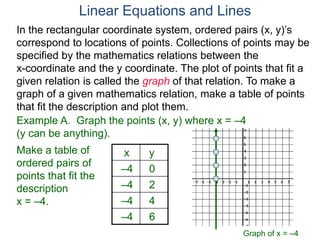
Example A. Graph the points (x, y) where x = –4
(y can be anything).
x y
–4 0
–4 2
–4 4
–4 6
Graph of x = –4
Make a table of
ordered pairs of
points that fit the
description
x = –4.
In the rectangular coordinate system, ordered pairs (x, y)’s
correspond to locations of points. Collections of points may be
specified by the mathematics relations between the
x-coordinate and the y coordinate. The plot of points that fit a
given relation is called the graph of that relation. To make a
graph of a given mathematics relation, make a table of points
that fit the description and plot them.
Linear Equations and Lines
First degree equation in the variables x and y are equations
that may be put into the form Ax + By = C where A, B, C are
numbers.
Linear Equations and Lines
First degree equation in the variables x and y are equations
that may be put into the form Ax + By = C where A, B, C are
numbers. First degree equations are the same as linear
equations.
Linear Equations and Lines
First degree equation in the variables x and y are equations
that may be put into the form Ax + By = C where A, B, C are
numbers. First degree equations are the same as linear
equations. They are called linear because their graphs are
straight lines.
Linear Equations and Lines
First degree equation in the variables x and y are equations
that may be put into the form Ax + By = C where A, B, C are
numbers. First degree equations are the same as linear
equations. They are called linear because their graphs are
straight lines. To graph a linear equation, find a few ordered
pairs that fit the equation.
Linear Equations and Lines
First degree equation in the variables x and y are equations
that may be put into the form Ax + By = C where A, B, C are
numbers. First degree equations are the same as linear
equations. They are called linear because their graphs are
straight lines. To graph a linear equation, find a few ordered
pairs that fit the equation.
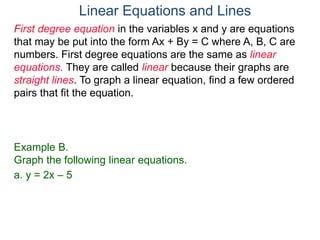
Example B.
Graph the following linear equations.
a. y = 2x – 5
Linear Equations and Lines
First degree equation in the variables x and y are equations
that may be put into the form Ax + By = C where A, B, C are
numbers. First degree equations are the same as linear
equations. They are called linear because their graphs are
straight lines. To graph a linear equation, find a few ordered
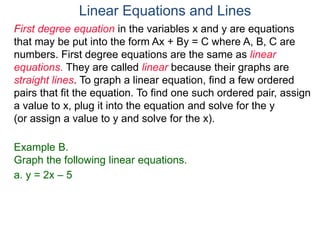
pairs that fit the equation. To find one such ordered pair, assign
a value to x, plug it into the equation and solve for the y
(or assign a value to y and solve for the x).
Example B.
Graph the following linear equations.
a. y = 2x – 5
Linear Equations and Lines
First degree equation in the variables x and y are equations
that may be put into the form Ax + By = C where A, B, C are
numbers. First degree equations are the same as linear
equations. They are called linear because their graphs are
straight lines. To graph a linear equation, find a few ordered
pairs that fit the equation. To find one such ordered pair, assign
a value to x, plug it into the equation and solve for the y
(or assign a value to y and solve for the x).
Example B.
Graph the following linear equations.
a. y = 2x – 5
Make a table by selecting a few numbers for x.
Linear Equations and Lines
First degree equation in the variables x and y are equations
that may be put into the form Ax + By = C where A, B, C are
numbers. First degree equations are the same as linear
equations. They are called linear because their graphs are
straight lines. To graph a linear equation, find a few ordered
pairs that fit the equation. To find one such ordered pair, assign
a value to x, plug it into the equation and solve for the y
(or assign a value to y and solve for the x).
For graphing lines, find at least two ordered pairs.
Example B.
Graph the following linear equations.
a. y = 2x – 5
Make a table by selecting a few numbers for x.
Linear Equations and Lines
First degree equation in the variables x and y are equations
that may be put into the form Ax + By = C where A, B, C are
numbers. First degree equations are the same as linear
equations. They are called linear because their graphs are
straight lines. To graph a linear equation, find a few ordered
pairs that fit the equation. To find one such ordered pair, assign
a value to x, plug it into the equation and solve for the y
(or assign a value to y and solve for the x).
For graphing lines, find at least two ordered pairs.
Example B.
Graph the following linear equations.
a. y = 2x – 5
Make a table by selecting a few numbers for x.
For easy calculation let’s select x = -1, 0, 1, and 2.
Linear Equations and Lines
First degree equation in the variables x and y are equations
that may be put into the form Ax + By = C where A, B, C are
numbers. First degree equations are the same as linear
equations. They are called linear because their graphs are
straight lines. To graph a linear equation, find a few ordered
pairs that fit the equation. To find one such ordered pair, assign
a value to x, plug it into the equation and solve for the y
(or assign a value to y and solve for the x).
For graphing lines, find at least two ordered pairs.
Example B.
Graph the following linear equations.
a. y = 2x – 5
Make a table by selecting a few numbers for x.
For easy calculation let’s select x = -1, 0, 1, and 2.
Plug these value into x and solve for y, one at a time,
to obtain four ordered pair as shown below.
Linear Equations and Lines
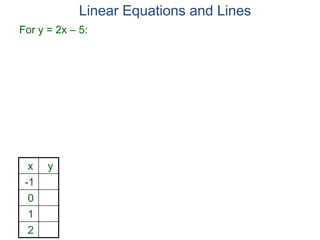
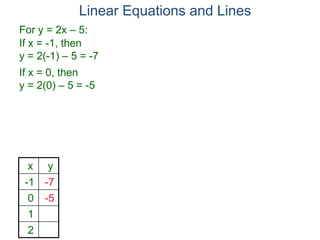
For y = 2x – 5:
x y
-1
0
1
2
Linear Equations and Lines
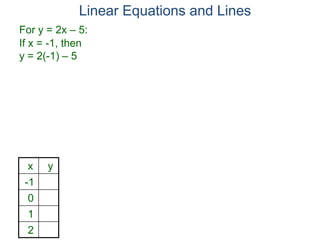
For y = 2x – 5:
x y
-1
0
1
2
If x = -1, then
y = 2(-1) – 5
Linear Equations and Lines
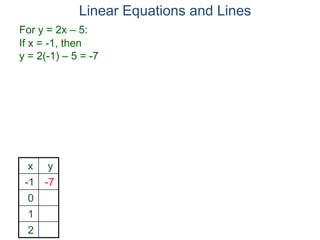
For y = 2x – 5:
x y
-1 -7
0
1
2
If x = -1, then
y = 2(-1) – 5 = -7
Linear Equations and Lines
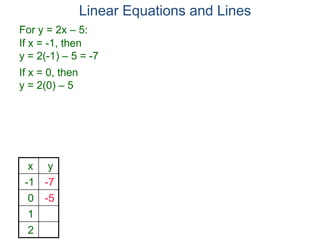
For y = 2x – 5:
x y
-1 -7
0 -5
1
2
If x = -1, then
y = 2(-1) – 5 = -7
If x = 0, then
y = 2(0) – 5
Linear Equations and Lines
For y = 2x – 5:
x y
-1 -7
0 -5
1
2
If x = -1, then
y = 2(-1) – 5 = -7
If x = 0, then
y = 2(0) – 5 = -5
Linear Equations and Lines
For y = 2x – 5:
x y
-1 -7
0 -5
1 -3
2 -1
If x = -1, then
y = 2(-1) – 5 = -7
If x = 0, then
y = 2(0) – 5 = -5
If x = 1, then
y = 2(1) – 5 = -3
If x = 2, then
y = 2(2) – 5 = -1
Linear Equations and Lines
For y = 2x – 5:
x y
-1 -7
0 -5
1 -3
2 -1
If x = -1, then
y = 2(-1) – 5 = -7
If x = 0, then
y = 2(0) – 5 = -5
If x = 1, then
y = 2(1) – 5 = -3
If x = 2, then
y = 2(2) – 5 = -1
Linear Equations and Lines
Plot these ordered pairs,
For y = 2x – 5:
x y
-1 -7
0 -5
1 -3
2 -1
If x = -1, then
y = 2(-1) – 5 = -7
If x = 0, then
y = 2(0) – 5 = -5
If x = 1, then
y = 2(1) – 5 = -3
If x = 2, then
y = 2(2) – 5 = -1
Linear Equations and Lines
Plot these ordered pairs,
(1,–7)
For y = 2x – 5:
x y
-1 -7
0 -5
1 -3
2 -1
If x = -1, then
y = 2(-1) – 5 = -7
If x = 0, then
y = 2(0) – 5 = -5
If x = 1, then
y = 2(1) – 5 = -3
If x = 2, then
y = 2(2) – 5 = -1
Linear Equations and Lines
Plot these ordered pairs,
(1,–7)
(0,–5)
For y = 2x – 5:
x y
-1 -7
0 -5
1 -3
2 -1
If x = -1, then
y = 2(-1) – 5 = -7
If x = 0, then
y = 2(0) – 5 = -5
If x = 1, then
y = 2(1) – 5 = -3
If x = 2, then
y = 2(2) – 5 = -1
Linear Equations and Lines
(1,–7)
(0,–5)
(1,–3)
(2,–1)
Plot these ordered pairs,
For y = 2x – 5:
x y
-1 -7
0 -5
1 -3
2 -1
If x = -1, then
y = 2(-1) – 5 = -7
If x = 0, then
y = 2(0) – 5 = -5
If x = 1, then
y = 2(1) – 5 = -3
If x = 2, then
y = 2(2) – 5 = -1
Linear Equations and Lines
(1,–7)
(0,–5)
(1,–3)
(2,–1)
Plot these ordered pairs,
then connect the dots to form the line.
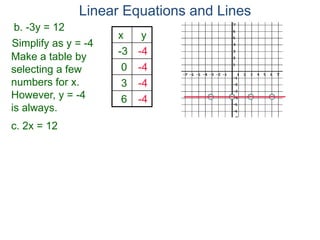
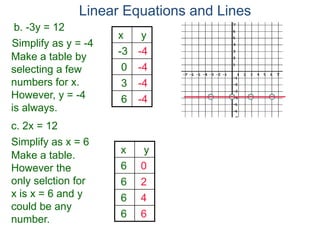
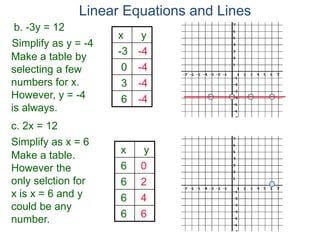
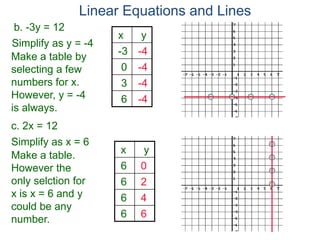
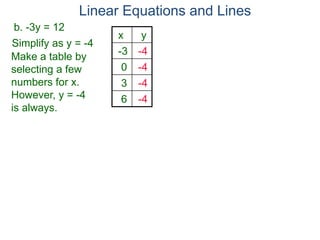
b. -3y = 12
Linear Equations and Lines
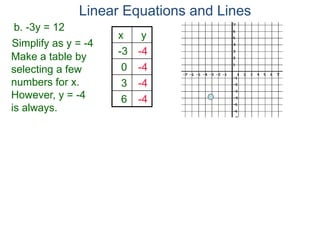
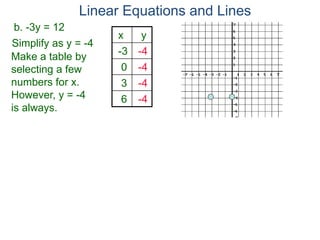
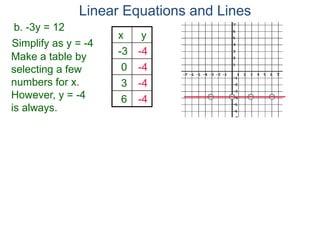
b. -3y = 12
Simplify as y = -4
Make a table by
selecting a few
numbers for x.
Linear Equations and Lines
b. -3y = 12
Simplify as y = -4
Make a table by
selecting a few
numbers for x.
x y
-3
0
3
6
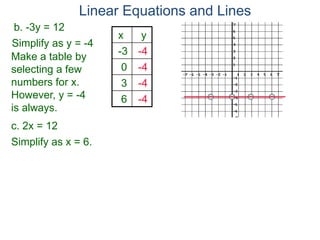
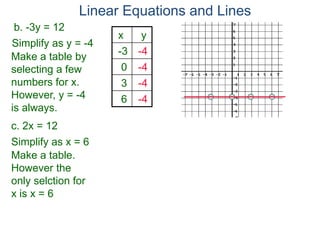
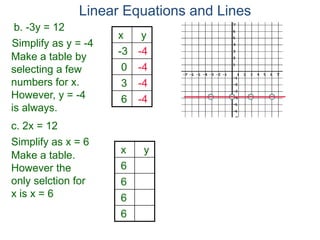
Linear Equations and Lines
b. -3y = 12
Simplify as y = -4
Make a table by
selecting a few
numbers for x.
However, y = -4
is always.
x y
-3 -4
0 -4
3 -4
6 -4
Linear Equations and Lines
b. -3y = 12
Simplify as y = -4
Make a table by
selecting a few
numbers for x.
However, y = -4
is always.
x y
-3 -4
0 -4
3 -4
6 -4
Linear Equations and Lines
b. -3y = 12
Simplify as y = -4
Make a table by
selecting a few
numbers for x.
However, y = -4
is always.
x y
-3 -4
0 -4
3 -4
6 -4
Linear Equations and Lines
b. -3y = 12
Simplify as y = -4
Make a table by
selecting a few
numbers for x.
However, y = -4
is always.
x y
-3 -4
0 -4
3 -4
6 -4
Linear Equations and Lines
b. -3y = 12
Simplify as y = -4
c. 2x = 12
Make a table by
selecting a few
numbers for x.
However, y = -4
is always.
x y
-3 -4
0 -4
3 -4
6 -4
Linear Equations and Lines
b. -3y = 12
Simplify as y = -4
c. 2x = 12
Make a table by
selecting a few
numbers for x.
However, y = -4
is always.
x y
-3 -4
0 -4
3 -4
6 -4
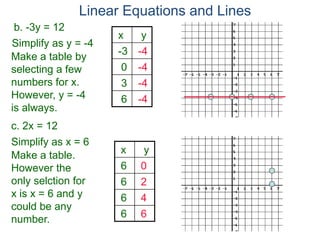
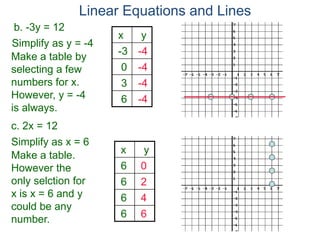
Simplify as x = 6.
Linear Equations and Lines
b. -3y = 12
Simplify as y = -4
c. 2x = 12
Make a table by
selecting a few
numbers for x.
However, y = -4
is always.
x y
-3 -4
0 -4
3 -4
6 -4
Simplify as x = 6
Make a table.
However the
only selction for
x is x = 6
Linear Equations and Lines
b. -3y = 12
Simplify as y = -4
c. 2x = 12
Make a table by
selecting a few
numbers for x.
However, y = -4
is always.
x y
-3 -4
0 -4
3 -4
6 -4
Simplify as x = 6
Make a table.
However the
only selction for
x is x = 6
x y
6
6
6
6
Linear Equations and Lines
b. -3y = 12
Simplify as y = -4
c. 2x = 12
Make a table by
selecting a few
numbers for x.
However, y = -4
is always.
x y
-3 -4
0 -4
3 -4
6 -4
Simplify as x = 6
Make a table.
However the
only selction for
x is x = 6 and y
could be any
number.
x y
6 0
6 2
6 4
6 6
Linear Equations and Lines
b. -3y = 12
Simplify as y = -4
c. 2x = 12
Make a table by
selecting a few
numbers for x.
However, y = -4
is always.
x y
-3 -4
0 -4
3 -4
6 -4
Simplify as x = 6
Make a table.
However the
only selction for
x is x = 6 and y
could be any
number.
x y
6 0
6 2
6 4
6 6
Linear Equations and Lines
b. -3y = 12
Simplify as y = -4
c. 2x = 12
Make a table by
selecting a few
numbers for x.
However, y = -4
is always.
x y
-3 -4
0 -4
3 -4
6 -4
Simplify as x = 6
Make a table.
However the
only selction for
x is x = 6 and y
could be any
number.
x y
6 0
6 2
6 4
6 6
Linear Equations and Lines
b. -3y = 12
Simplify as y = -4
c. 2x = 12
Make a table by
selecting a few
numbers for x.
However, y = -4
is always.
x y
-3 -4
0 -4
3 -4
6 -4
Simplify as x = 6
Make a table.
However the
only selction for
x is x = 6 and y
could be any
number.
x y
6 0
6 2
6 4
6 6
Linear Equations and Lines
b. -3y = 12
Simplify as y = -4
c. 2x = 12
Make a table by
selecting a few
numbers for x.
However, y = -4
is always.
x y
-3 -4
0 -4
3 -4
6 -4
Simplify as x = 6
Make a table.
However the
only selction for
x is x = 6 and y
could be any
number.
x y
6 0
6 2
6 4
6 6
Linear Equations and Lines
Summary of the graphs of linear equations:
Linear Equations and Lines
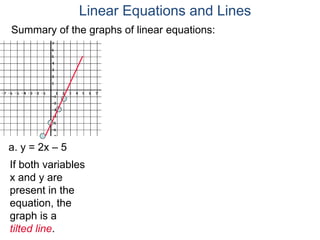
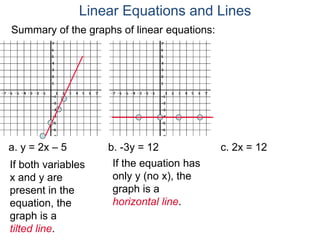
a. y = 2x – 5
Summary of the graphs of linear equations:
Linear Equations and Lines
a. y = 2x – 5
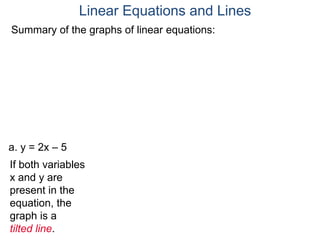
If both variables
x and y are
present in the
equation, the
graph is a
tilted line.
Summary of the graphs of linear equations:
Linear Equations and Lines
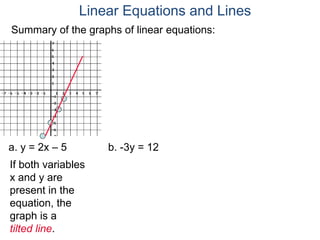
a. y = 2x – 5
If both variables
x and y are
present in the
equation, the
graph is a
tilted line.
Summary of the graphs of linear equations:
Linear Equations and Lines
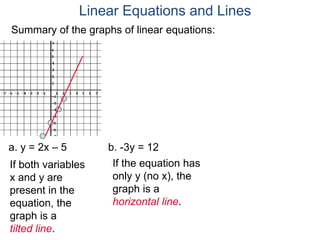
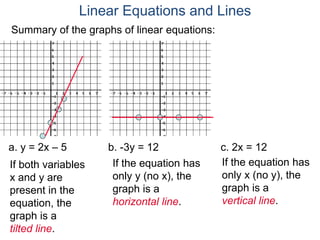
a. y = 2x – 5 b. -3y = 12
If both variables
x and y are
present in the
equation, the
graph is a
tilted line.
Summary of the graphs of linear equations:
Linear Equations and Lines
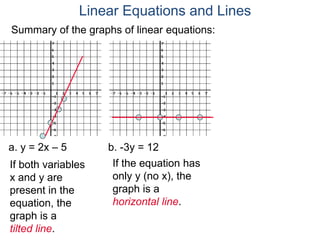
a. y = 2x – 5 b. -3y = 12
If both variables
x and y are
present in the
equation, the
graph is a
tilted line.
If the equation has
only y (no x), the
graph is a
horizontal line.
Summary of the graphs of linear equations:
Linear Equations and Lines
a. y = 2x – 5 b. -3y = 12
If both variables
x and y are
present in the
equation, the
graph is a
tilted line.
If the equation has
only y (no x), the
graph is a
horizontal line.
Summary of the graphs of linear equations:
Linear Equations and Lines
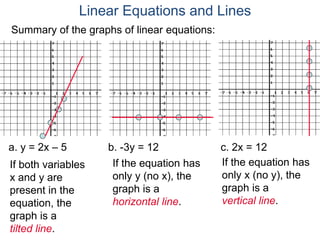
a. y = 2x – 5 b. -3y = 12 c. 2x = 12
If both variables
x and y are
present in the
equation, the
graph is a
tilted line.
If the equation has
only y (no x), the
graph is a
horizontal line.
Summary of the graphs of linear equations:
Linear Equations and Lines
a. y = 2x – 5 b. -3y = 12 c. 2x = 12
If both variables
x and y are
present in the
equation, the
graph is a
tilted line.
If the equation has
only y (no x), the
graph is a
horizontal line.
Summary of the graphs of linear equations:
If the equation has
only x (no y), the
graph is a
vertical line.
Linear Equations and Lines
a. y = 2x – 5 b. -3y = 12 c. 2x = 12
If both variables
x and y are
present in the
equation, the
graph is a
tilted line.
If the equation has
only y (no x), the
graph is a
horizontal line.
Summary of the graphs of linear equations:
If the equation has
only x (no y), the
graph is a
vertical line.
Linear Equations and Lines
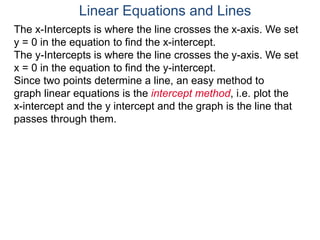
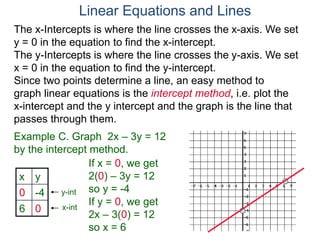
The x-Intercepts is where the line crosses the x-axis;
Linear Equations and Lines
The x-Intercepts is where the line crosses the x-axis. We set
y = 0 in the equation to find the x-intercept.
Linear Equations and Lines
The x-Intercepts is where the line crosses the x-axis. We set
y = 0 in the equation to find the x-intercept.
The y-Intercepts is where the line crosses the y-axis;
Linear Equations and Lines
The x-Intercepts is where the line crosses the x-axis. We set
y = 0 in the equation to find the x-intercept.
The y-Intercepts is where the line crosses the y-axis. We set
x = 0 in the equation to find the y-intercept.
Linear Equations and Lines
The x-Intercepts is where the line crosses the x-axis. We set
y = 0 in the equation to find the x-intercept.
The y-Intercepts is where the line crosses the y-axis. We set
x = 0 in the equation to find the y-intercept.
Since two points determine a line, an easy method to
graph linear equations is the intercept method,
Linear Equations and Lines
The x-Intercepts is where the line crosses the x-axis. We set
y = 0 in the equation to find the x-intercept.
The y-Intercepts is where the line crosses the y-axis. We set
x = 0 in the equation to find the y-intercept.
Since two points determine a line, an easy method to
graph linear equations is the intercept method, i.e. plot the
x-intercept and the y intercept and the graph is the line that
passes through them.
Linear Equations and Lines
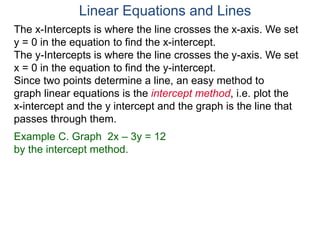
The x-Intercepts is where the line crosses the x-axis. We set
y = 0 in the equation to find the x-intercept.
The y-Intercepts is where the line crosses the y-axis. We set
x = 0 in the equation to find the y-intercept.
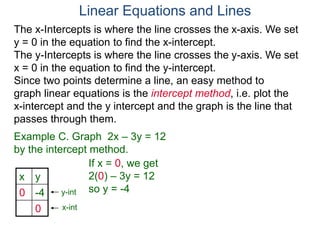
Example C. Graph 2x – 3y = 12
by the intercept method.
Since two points determine a line, an easy method to
graph linear equations is the intercept method, i.e. plot the
x-intercept and the y intercept and the graph is the line that
passes through them.
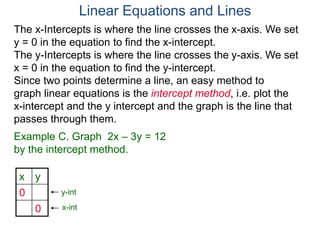
Linear Equations and Lines
x y
0
0
The x-Intercepts is where the line crosses the x-axis. We set
y = 0 in the equation to find the x-intercept.
The y-Intercepts is where the line crosses the y-axis. We set
x = 0 in the equation to find the y-intercept.
y-int
x-int
Example C. Graph 2x – 3y = 12
by the intercept method.
Since two points determine a line, an easy method to
graph linear equations is the intercept method, i.e. plot the
x-intercept and the y intercept and the graph is the line that
passes through them.
Linear Equations and Lines
x y
0
0
The x-Intercepts is where the line crosses the x-axis. We set
y = 0 in the equation to find the x-intercept.
The y-Intercepts is where the line crosses the y-axis. We set
x = 0 in the equation to find the y-intercept.
y-int
x-int
Example C. Graph 2x – 3y = 12
by the intercept method.
Since two points determine a line, an easy method to
graph linear equations is the intercept method, i.e. plot the
x-intercept and the y intercept and the graph is the line that
passes through them.
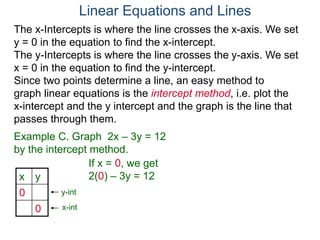
If x = 0, we get
2(0) – 3y = 12
Linear Equations and Lines
x y
0 -4
0
The x-Intercepts is where the line crosses the x-axis. We set
y = 0 in the equation to find the x-intercept.
The y-Intercepts is where the line crosses the y-axis. We set
x = 0 in the equation to find the y-intercept.
y-int
x-int
Example C. Graph 2x – 3y = 12
by the intercept method.
Since two points determine a line, an easy method to
graph linear equations is the intercept method, i.e. plot the
x-intercept and the y intercept and the graph is the line that
passes through them.
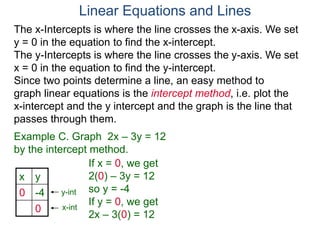
If x = 0, we get
2(0) – 3y = 12
so y = -4
Linear Equations and Lines
x y
0 -4
0
The x-Intercepts is where the line crosses the x-axis. We set
y = 0 in the equation to find the x-intercept.
The y-Intercepts is where the line crosses the y-axis. We set
x = 0 in the equation to find the y-intercept.
y-int
x-int
Example C. Graph 2x – 3y = 12
by the intercept method.
Since two points determine a line, an easy method to
graph linear equations is the intercept method, i.e. plot the
x-intercept and the y intercept and the graph is the line that
passes through them.
If x = 0, we get
2(0) – 3y = 12
so y = -4
If y = 0, we get
2x – 3(0) = 12
Linear Equations and Lines
x y
0 -4
6 0
The x-Intercepts is where the line crosses the x-axis. We set
y = 0 in the equation to find the x-intercept.
The y-Intercepts is where the line crosses the y-axis. We set
x = 0 in the equation to find the y-intercept.
y-int
x-int
Example C. Graph 2x – 3y = 12
by the intercept method.
Since two points determine a line, an easy method to
graph linear equations is the intercept method, i.e. plot the
x-intercept and the y intercept and the graph is the line that
passes through them.
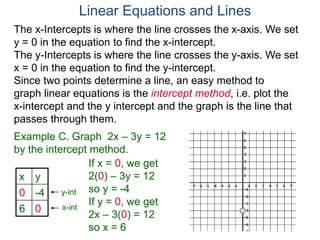
If x = 0, we get
2(0) – 3y = 12
so y = -4
If y = 0, we get
2x – 3(0) = 12
so x = 6
Linear Equations and Lines
x y
0 -4
6 0
The x-Intercepts is where the line crosses the x-axis. We set
y = 0 in the equation to find the x-intercept.
The y-Intercepts is where the line crosses the y-axis. We set
x = 0 in the equation to find the y-intercept.
y-int
x-int
Example C. Graph 2x – 3y = 12
by the intercept method.
Since two points determine a line, an easy method to
graph linear equations is the intercept method, i.e. plot the
x-intercept and the y intercept and the graph is the line that
passes through them.
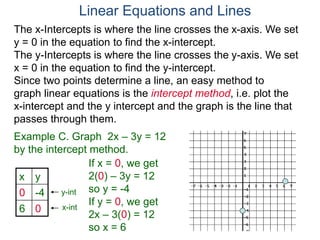
If x = 0, we get
2(0) – 3y = 12
so y = -4
If y = 0, we get
2x – 3(0) = 12
so x = 6
Linear Equations and Lines
x y
0 -4
6 0
The x-Intercepts is where the line crosses the x-axis. We set
y = 0 in the equation to find the x-intercept.
The y-Intercepts is where the line crosses the y-axis. We set
x = 0 in the equation to find the y-intercept.
y-int
x-int
Example C. Graph 2x – 3y = 12
by the intercept method.
Since two points determine a line, an easy method to
graph linear equations is the intercept method, i.e. plot the
x-intercept and the y intercept and the graph is the line that
passes through them.
If x = 0, we get
2(0) – 3y = 12
so y = -4
If y = 0, we get
2x – 3(0) = 12
so x = 6
Linear Equations and Lines
x y
0 -4
6 0
The x-Intercepts is where the line crosses the x-axis. We set
y = 0 in the equation to find the x-intercept.
The y-Intercepts is where the line crosses the y-axis. We set
x = 0 in the equation to find the y-intercept.
y-int
x-int
Example C. Graph 2x – 3y = 12
by the intercept method.
Since two points determine a line, an easy method to
graph linear equations is the intercept method, i.e. plot the
x-intercept and the y intercept and the graph is the line that
passes through them.
If x = 0, we get
2(0) – 3y = 12
so y = -4
If y = 0, we get
2x – 3(0) = 12
so x = 6
Linear Equations and Lines
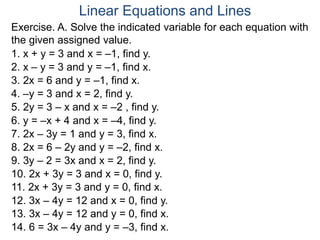
Exercise. A. Solve the indicated variable for each equation with
the given assigned value.
1. x + y = 3 and x = –1, find y.
2. x – y = 3 and y = –1, find x.
3. 2x = 6 and y = –1, find x.
4. –y = 3 and x = 2, find y.
5. 2y = 3 – x and x = –2 , find y.
6. y = –x + 4 and x = –4, find y.
7. 2x – 3y = 1 and y = 3, find x.
8. 2x = 6 – 2y and y = –2, find x.
9. 3y – 2 = 3x and x = 2, find y.
10. 2x + 3y = 3 and x = 0, find y.
11. 2x + 3y = 3 and y = 0, find x.
12. 3x – 4y = 12 and x = 0, find y.
13. 3x – 4y = 12 and y = 0, find x.
14. 6 = 3x – 4y and y = –3, find x.
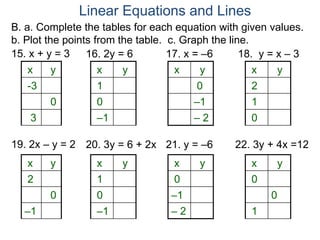
Linear Equations and Lines
B. a. Complete the tables for each equation with given values.
b. Plot the points from the table. c. Graph the line.
15. x + y = 3 16. 2y = 6
x y
-3
0
3
x y
1
0
–1
17. x = –6
x y
0
–1
– 2
18. y = x – 3
x y
2
1
0
19. 2x – y = 2 20. 3y = 6 + 2x
x y
2
0
–1
x y
1
0
–1
21. y = –6
x y
0
–1
– 2
22. 3y + 4x =12
x y
0
0
1
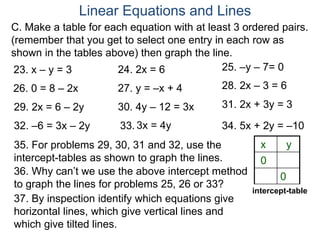
Linear Equations and Lines
C. Make a table for each equation with at least 3 ordered pairs.
(remember that you get to select one entry in each row as
shown in the tables above) then graph the line.
23. x – y = 3 24. 2x = 6 25. –y – 7= 0
26. 0 = 8 – 2x 27. y = –x + 4 28. 2x – 3 = 6
29. 2x = 6 – 2y 30. 4y – 12 = 3x 31. 2x + 3y = 3
32. –6 = 3x – 2y 33.
35. For problems 29, 30, 31 and 32, use the
intercept-tables as shown to graph the lines.
x y
0
0
intercept-table
36. Why can’t we use the above intercept method
to graph the lines for problems 25, 26 or 33?
37. By inspection identify which equations give
horizontal lines, which give vertical lines and
which give tilted lines.
3x = 4y 34. 5x + 2y = –10
Linear Equations and Lines

57 graphing lines from linear equations

  • 1.
  • 2.
    In the rectangularcoordinate system, ordered pairs (x, y)’s correspond to locations of points. Linear Equations and Lines
  • 3.
    In the rectangularcoordinate system, ordered pairs (x, y)’s correspond to locations of points. Collections of points may be specified by the mathematics relations between the x-coordinate and the y coordinate. Linear Equations and Lines
  • 4.
    In the rectangularcoordinate system, ordered pairs (x, y)’s correspond to locations of points. Collections of points may be specified by the mathematics relations between the x-coordinate and the y coordinate. The plot of points that fit a given relation is called the graph of that relation. Linear Equations and Lines
  • 5.
    In the rectangularcoordinate system, ordered pairs (x, y)’s correspond to locations of points. Collections of points may be specified by the mathematics relations between the x-coordinate and the y coordinate. The plot of points that fit a given relation is called the graph of that relation. To make a graph of a given mathematics relation, make a table of points that fit the description and plot them. Linear Equations and Lines
  • 6.
    Example A. Graphthe points (x, y) where x = –4 In the rectangular coordinate system, ordered pairs (x, y)’s correspond to locations of points. Collections of points may be specified by the mathematics relations between the x-coordinate and the y coordinate. The plot of points that fit a given relation is called the graph of that relation. To make a graph of a given mathematics relation, make a table of points that fit the description and plot them. Linear Equations and Lines
  • 7.
    Example A. Graphthe points (x, y) where x = –4 (y can be anything). In the rectangular coordinate system, ordered pairs (x, y)’s correspond to locations of points. Collections of points may be specified by the mathematics relations between the x-coordinate and the y coordinate. The plot of points that fit a given relation is called the graph of that relation. To make a graph of a given mathematics relation, make a table of points that fit the description and plot them. Linear Equations and Lines
  • 8.
    Example A. Graphthe points (x, y) where x = –4 (y can be anything). Make a table of ordered pairs of points that fit the description x = –4. In the rectangular coordinate system, ordered pairs (x, y)’s correspond to locations of points. Collections of points may be specified by the mathematics relations between the x-coordinate and the y coordinate. The plot of points that fit a given relation is called the graph of that relation. To make a graph of a given mathematics relation, make a table of points that fit the description and plot them. Linear Equations and Lines
  • 9.
    Linear Equations andLines Example A. Graph the points (x, y) where x = –4 (y can be anything). x y –4 –4 –4 –4 Make a table of ordered pairs of points that fit the description x = –4. In the rectangular coordinate system, ordered pairs (x, y)’s correspond to locations of points. Collections of points may be specified by the mathematics relations between the x-coordinate and the y coordinate. The plot of points that fit a given relation is called the graph of that relation. To make a graph of a given mathematics relation, make a table of points that fit the description and plot them. Linear Equations and Lines
  • 10.
    Example A. Graphthe points (x, y) where x = –4 (y can be anything). x y –4 0 –4 –4 –4 Make a table of ordered pairs of points that fit the description x = –4. In the rectangular coordinate system, ordered pairs (x, y)’s correspond to locations of points. Collections of points may be specified by the mathematics relations between the x-coordinate and the y coordinate. The plot of points that fit a given relation is called the graph of that relation. To make a graph of a given mathematics relation, make a table of points that fit the description and plot them. Linear Equations and Lines
  • 11.
    Example A. Graphthe points (x, y) where x = –4 (y can be anything). x y –4 0 –4 2 –4 –4 Make a table of ordered pairs of points that fit the description x = –4. In the rectangular coordinate system, ordered pairs (x, y)’s correspond to locations of points. Collections of points may be specified by the mathematics relations between the x-coordinate and the y coordinate. The plot of points that fit a given relation is called the graph of that relation. To make a graph of a given mathematics relation, make a table of points that fit the description and plot them. Linear Equations and Lines
  • 12.
    Example A. Graphthe points (x, y) where x = –4 (y can be anything). x y –4 0 –4 2 –4 4 –4 6 Make a table of ordered pairs of points that fit the description x = –4. In the rectangular coordinate system, ordered pairs (x, y)’s correspond to locations of points. Collections of points may be specified by the mathematics relations between the x-coordinate and the y coordinate. The plot of points that fit a given relation is called the graph of that relation. To make a graph of a given mathematics relation, make a table of points that fit the description and plot them. Linear Equations and Lines
  • 13.
    Example A. Graphthe points (x, y) where x = –4 (y can be anything). x y –4 0 –4 2 –4 4 –4 6 Graph of x = –4 Make a table of ordered pairs of points that fit the description x = –4. In the rectangular coordinate system, ordered pairs (x, y)’s correspond to locations of points. Collections of points may be specified by the mathematics relations between the x-coordinate and the y coordinate. The plot of points that fit a given relation is called the graph of that relation. To make a graph of a given mathematics relation, make a table of points that fit the description and plot them. Linear Equations and Lines
  • 14.
    First degree equationin the variables x and y are equations that may be put into the form Ax + By = C where A, B, C are numbers. Linear Equations and Lines
  • 15.
    First degree equationin the variables x and y are equations that may be put into the form Ax + By = C where A, B, C are numbers. First degree equations are the same as linear equations. Linear Equations and Lines
  • 16.
    First degree equationin the variables x and y are equations that may be put into the form Ax + By = C where A, B, C are numbers. First degree equations are the same as linear equations. They are called linear because their graphs are straight lines. Linear Equations and Lines
  • 17.
    First degree equationin the variables x and y are equations that may be put into the form Ax + By = C where A, B, C are numbers. First degree equations are the same as linear equations. They are called linear because their graphs are straight lines. To graph a linear equation, find a few ordered pairs that fit the equation. Linear Equations and Lines
  • 18.
    First degree equationin the variables x and y are equations that may be put into the form Ax + By = C where A, B, C are numbers. First degree equations are the same as linear equations. They are called linear because their graphs are straight lines. To graph a linear equation, find a few ordered pairs that fit the equation. Example B. Graph the following linear equations. a. y = 2x – 5 Linear Equations and Lines
  • 19.
    First degree equationin the variables x and y are equations that may be put into the form Ax + By = C where A, B, C are numbers. First degree equations are the same as linear equations. They are called linear because their graphs are straight lines. To graph a linear equation, find a few ordered pairs that fit the equation. To find one such ordered pair, assign a value to x, plug it into the equation and solve for the y (or assign a value to y and solve for the x). Example B. Graph the following linear equations. a. y = 2x – 5 Linear Equations and Lines
  • 20.
    First degree equationin the variables x and y are equations that may be put into the form Ax + By = C where A, B, C are numbers. First degree equations are the same as linear equations. They are called linear because their graphs are straight lines. To graph a linear equation, find a few ordered pairs that fit the equation. To find one such ordered pair, assign a value to x, plug it into the equation and solve for the y (or assign a value to y and solve for the x). Example B. Graph the following linear equations. a. y = 2x – 5 Make a table by selecting a few numbers for x. Linear Equations and Lines
  • 21.
    First degree equationin the variables x and y are equations that may be put into the form Ax + By = C where A, B, C are numbers. First degree equations are the same as linear equations. They are called linear because their graphs are straight lines. To graph a linear equation, find a few ordered pairs that fit the equation. To find one such ordered pair, assign a value to x, plug it into the equation and solve for the y (or assign a value to y and solve for the x). For graphing lines, find at least two ordered pairs. Example B. Graph the following linear equations. a. y = 2x – 5 Make a table by selecting a few numbers for x. Linear Equations and Lines
  • 22.
    First degree equationin the variables x and y are equations that may be put into the form Ax + By = C where A, B, C are numbers. First degree equations are the same as linear equations. They are called linear because their graphs are straight lines. To graph a linear equation, find a few ordered pairs that fit the equation. To find one such ordered pair, assign a value to x, plug it into the equation and solve for the y (or assign a value to y and solve for the x). For graphing lines, find at least two ordered pairs. Example B. Graph the following linear equations. a. y = 2x – 5 Make a table by selecting a few numbers for x. For easy calculation let’s select x = -1, 0, 1, and 2. Linear Equations and Lines
  • 23.
    First degree equationin the variables x and y are equations that may be put into the form Ax + By = C where A, B, C are numbers. First degree equations are the same as linear equations. They are called linear because their graphs are straight lines. To graph a linear equation, find a few ordered pairs that fit the equation. To find one such ordered pair, assign a value to x, plug it into the equation and solve for the y (or assign a value to y and solve for the x). For graphing lines, find at least two ordered pairs. Example B. Graph the following linear equations. a. y = 2x – 5 Make a table by selecting a few numbers for x. For easy calculation let’s select x = -1, 0, 1, and 2. Plug these value into x and solve for y, one at a time, to obtain four ordered pair as shown below. Linear Equations and Lines
  • 24.
    For y =2x – 5: x y -1 0 1 2 Linear Equations and Lines
  • 25.
    For y =2x – 5: x y -1 0 1 2 If x = -1, then y = 2(-1) – 5 Linear Equations and Lines
  • 26.
    For y =2x – 5: x y -1 -7 0 1 2 If x = -1, then y = 2(-1) – 5 = -7 Linear Equations and Lines
  • 27.
    For y =2x – 5: x y -1 -7 0 -5 1 2 If x = -1, then y = 2(-1) – 5 = -7 If x = 0, then y = 2(0) – 5 Linear Equations and Lines
  • 28.
    For y =2x – 5: x y -1 -7 0 -5 1 2 If x = -1, then y = 2(-1) – 5 = -7 If x = 0, then y = 2(0) – 5 = -5 Linear Equations and Lines
  • 29.
    For y =2x – 5: x y -1 -7 0 -5 1 -3 2 -1 If x = -1, then y = 2(-1) – 5 = -7 If x = 0, then y = 2(0) – 5 = -5 If x = 1, then y = 2(1) – 5 = -3 If x = 2, then y = 2(2) – 5 = -1 Linear Equations and Lines
  • 30.
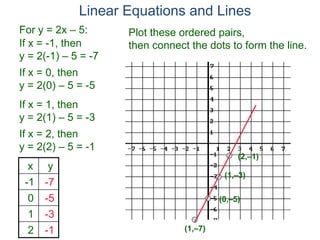
    For y =2x – 5: x y -1 -7 0 -5 1 -3 2 -1 If x = -1, then y = 2(-1) – 5 = -7 If x = 0, then y = 2(0) – 5 = -5 If x = 1, then y = 2(1) – 5 = -3 If x = 2, then y = 2(2) – 5 = -1 Linear Equations and Lines Plot these ordered pairs,
  • 31.
    For y =2x – 5: x y -1 -7 0 -5 1 -3 2 -1 If x = -1, then y = 2(-1) – 5 = -7 If x = 0, then y = 2(0) – 5 = -5 If x = 1, then y = 2(1) – 5 = -3 If x = 2, then y = 2(2) – 5 = -1 Linear Equations and Lines Plot these ordered pairs, (1,–7)
  • 32.
    For y =2x – 5: x y -1 -7 0 -5 1 -3 2 -1 If x = -1, then y = 2(-1) – 5 = -7 If x = 0, then y = 2(0) – 5 = -5 If x = 1, then y = 2(1) – 5 = -3 If x = 2, then y = 2(2) – 5 = -1 Linear Equations and Lines Plot these ordered pairs, (1,–7) (0,–5)
  • 33.
    For y =2x – 5: x y -1 -7 0 -5 1 -3 2 -1 If x = -1, then y = 2(-1) – 5 = -7 If x = 0, then y = 2(0) – 5 = -5 If x = 1, then y = 2(1) – 5 = -3 If x = 2, then y = 2(2) – 5 = -1 Linear Equations and Lines (1,–7) (0,–5) (1,–3) (2,–1) Plot these ordered pairs,
  • 34.
    For y =2x – 5: x y -1 -7 0 -5 1 -3 2 -1 If x = -1, then y = 2(-1) – 5 = -7 If x = 0, then y = 2(0) – 5 = -5 If x = 1, then y = 2(1) – 5 = -3 If x = 2, then y = 2(2) – 5 = -1 Linear Equations and Lines (1,–7) (0,–5) (1,–3) (2,–1) Plot these ordered pairs, then connect the dots to form the line.
  • 35.
    b. -3y =12 Linear Equations and Lines
  • 36.
    b. -3y =12 Simplify as y = -4 Make a table by selecting a few numbers for x. Linear Equations and Lines
  • 37.
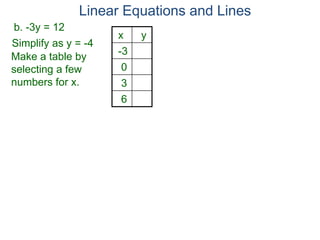
    b. -3y =12 Simplify as y = -4 Make a table by selecting a few numbers for x. x y -3 0 3 6 Linear Equations and Lines
  • 38.
    b. -3y =12 Simplify as y = -4 Make a table by selecting a few numbers for x. However, y = -4 is always. x y -3 -4 0 -4 3 -4 6 -4 Linear Equations and Lines
  • 39.
    b. -3y =12 Simplify as y = -4 Make a table by selecting a few numbers for x. However, y = -4 is always. x y -3 -4 0 -4 3 -4 6 -4 Linear Equations and Lines
  • 40.
    b. -3y =12 Simplify as y = -4 Make a table by selecting a few numbers for x. However, y = -4 is always. x y -3 -4 0 -4 3 -4 6 -4 Linear Equations and Lines
  • 41.
    b. -3y =12 Simplify as y = -4 Make a table by selecting a few numbers for x. However, y = -4 is always. x y -3 -4 0 -4 3 -4 6 -4 Linear Equations and Lines
  • 42.
    b. -3y =12 Simplify as y = -4 c. 2x = 12 Make a table by selecting a few numbers for x. However, y = -4 is always. x y -3 -4 0 -4 3 -4 6 -4 Linear Equations and Lines
  • 43.
    b. -3y =12 Simplify as y = -4 c. 2x = 12 Make a table by selecting a few numbers for x. However, y = -4 is always. x y -3 -4 0 -4 3 -4 6 -4 Simplify as x = 6. Linear Equations and Lines
  • 44.
    b. -3y =12 Simplify as y = -4 c. 2x = 12 Make a table by selecting a few numbers for x. However, y = -4 is always. x y -3 -4 0 -4 3 -4 6 -4 Simplify as x = 6 Make a table. However the only selction for x is x = 6 Linear Equations and Lines
  • 45.
    b. -3y =12 Simplify as y = -4 c. 2x = 12 Make a table by selecting a few numbers for x. However, y = -4 is always. x y -3 -4 0 -4 3 -4 6 -4 Simplify as x = 6 Make a table. However the only selction for x is x = 6 x y 6 6 6 6 Linear Equations and Lines
  • 46.
    b. -3y =12 Simplify as y = -4 c. 2x = 12 Make a table by selecting a few numbers for x. However, y = -4 is always. x y -3 -4 0 -4 3 -4 6 -4 Simplify as x = 6 Make a table. However the only selction for x is x = 6 and y could be any number. x y 6 0 6 2 6 4 6 6 Linear Equations and Lines
  • 47.
    b. -3y =12 Simplify as y = -4 c. 2x = 12 Make a table by selecting a few numbers for x. However, y = -4 is always. x y -3 -4 0 -4 3 -4 6 -4 Simplify as x = 6 Make a table. However the only selction for x is x = 6 and y could be any number. x y 6 0 6 2 6 4 6 6 Linear Equations and Lines
  • 48.
    b. -3y =12 Simplify as y = -4 c. 2x = 12 Make a table by selecting a few numbers for x. However, y = -4 is always. x y -3 -4 0 -4 3 -4 6 -4 Simplify as x = 6 Make a table. However the only selction for x is x = 6 and y could be any number. x y 6 0 6 2 6 4 6 6 Linear Equations and Lines
  • 49.
    b. -3y =12 Simplify as y = -4 c. 2x = 12 Make a table by selecting a few numbers for x. However, y = -4 is always. x y -3 -4 0 -4 3 -4 6 -4 Simplify as x = 6 Make a table. However the only selction for x is x = 6 and y could be any number. x y 6 0 6 2 6 4 6 6 Linear Equations and Lines
  • 50.
    b. -3y =12 Simplify as y = -4 c. 2x = 12 Make a table by selecting a few numbers for x. However, y = -4 is always. x y -3 -4 0 -4 3 -4 6 -4 Simplify as x = 6 Make a table. However the only selction for x is x = 6 and y could be any number. x y 6 0 6 2 6 4 6 6 Linear Equations and Lines
  • 51.
    Summary of thegraphs of linear equations: Linear Equations and Lines
  • 52.
    a. y =2x – 5 Summary of the graphs of linear equations: Linear Equations and Lines
  • 53.
    a. y =2x – 5 If both variables x and y are present in the equation, the graph is a tilted line. Summary of the graphs of linear equations: Linear Equations and Lines
  • 54.
    a. y =2x – 5 If both variables x and y are present in the equation, the graph is a tilted line. Summary of the graphs of linear equations: Linear Equations and Lines
  • 55.
    a. y =2x – 5 b. -3y = 12 If both variables x and y are present in the equation, the graph is a tilted line. Summary of the graphs of linear equations: Linear Equations and Lines
  • 56.
    a. y =2x – 5 b. -3y = 12 If both variables x and y are present in the equation, the graph is a tilted line. If the equation has only y (no x), the graph is a horizontal line. Summary of the graphs of linear equations: Linear Equations and Lines
  • 57.
    a. y =2x – 5 b. -3y = 12 If both variables x and y are present in the equation, the graph is a tilted line. If the equation has only y (no x), the graph is a horizontal line. Summary of the graphs of linear equations: Linear Equations and Lines
  • 58.
    a. y =2x – 5 b. -3y = 12 c. 2x = 12 If both variables x and y are present in the equation, the graph is a tilted line. If the equation has only y (no x), the graph is a horizontal line. Summary of the graphs of linear equations: Linear Equations and Lines
  • 59.
    a. y =2x – 5 b. -3y = 12 c. 2x = 12 If both variables x and y are present in the equation, the graph is a tilted line. If the equation has only y (no x), the graph is a horizontal line. Summary of the graphs of linear equations: If the equation has only x (no y), the graph is a vertical line. Linear Equations and Lines
  • 60.
    a. y =2x – 5 b. -3y = 12 c. 2x = 12 If both variables x and y are present in the equation, the graph is a tilted line. If the equation has only y (no x), the graph is a horizontal line. Summary of the graphs of linear equations: If the equation has only x (no y), the graph is a vertical line. Linear Equations and Lines
  • 61.
    The x-Intercepts iswhere the line crosses the x-axis; Linear Equations and Lines
  • 62.
    The x-Intercepts iswhere the line crosses the x-axis. We set y = 0 in the equation to find the x-intercept. Linear Equations and Lines
  • 63.
    The x-Intercepts iswhere the line crosses the x-axis. We set y = 0 in the equation to find the x-intercept. The y-Intercepts is where the line crosses the y-axis; Linear Equations and Lines
  • 64.
    The x-Intercepts iswhere the line crosses the x-axis. We set y = 0 in the equation to find the x-intercept. The y-Intercepts is where the line crosses the y-axis. We set x = 0 in the equation to find the y-intercept. Linear Equations and Lines
  • 65.
    The x-Intercepts iswhere the line crosses the x-axis. We set y = 0 in the equation to find the x-intercept. The y-Intercepts is where the line crosses the y-axis. We set x = 0 in the equation to find the y-intercept. Since two points determine a line, an easy method to graph linear equations is the intercept method, Linear Equations and Lines
  • 66.
    The x-Intercepts iswhere the line crosses the x-axis. We set y = 0 in the equation to find the x-intercept. The y-Intercepts is where the line crosses the y-axis. We set x = 0 in the equation to find the y-intercept. Since two points determine a line, an easy method to graph linear equations is the intercept method, i.e. plot the x-intercept and the y intercept and the graph is the line that passes through them. Linear Equations and Lines
  • 67.
    The x-Intercepts iswhere the line crosses the x-axis. We set y = 0 in the equation to find the x-intercept. The y-Intercepts is where the line crosses the y-axis. We set x = 0 in the equation to find the y-intercept. Example C. Graph 2x – 3y = 12 by the intercept method. Since two points determine a line, an easy method to graph linear equations is the intercept method, i.e. plot the x-intercept and the y intercept and the graph is the line that passes through them. Linear Equations and Lines
  • 68.
    x y 0 0 The x-Interceptsis where the line crosses the x-axis. We set y = 0 in the equation to find the x-intercept. The y-Intercepts is where the line crosses the y-axis. We set x = 0 in the equation to find the y-intercept. y-int x-int Example C. Graph 2x – 3y = 12 by the intercept method. Since two points determine a line, an easy method to graph linear equations is the intercept method, i.e. plot the x-intercept and the y intercept and the graph is the line that passes through them. Linear Equations and Lines
  • 69.
    x y 0 0 The x-Interceptsis where the line crosses the x-axis. We set y = 0 in the equation to find the x-intercept. The y-Intercepts is where the line crosses the y-axis. We set x = 0 in the equation to find the y-intercept. y-int x-int Example C. Graph 2x – 3y = 12 by the intercept method. Since two points determine a line, an easy method to graph linear equations is the intercept method, i.e. plot the x-intercept and the y intercept and the graph is the line that passes through them. If x = 0, we get 2(0) – 3y = 12 Linear Equations and Lines
  • 70.
    x y 0 -4 0 Thex-Intercepts is where the line crosses the x-axis. We set y = 0 in the equation to find the x-intercept. The y-Intercepts is where the line crosses the y-axis. We set x = 0 in the equation to find the y-intercept. y-int x-int Example C. Graph 2x – 3y = 12 by the intercept method. Since two points determine a line, an easy method to graph linear equations is the intercept method, i.e. plot the x-intercept and the y intercept and the graph is the line that passes through them. If x = 0, we get 2(0) – 3y = 12 so y = -4 Linear Equations and Lines
  • 71.
    x y 0 -4 0 Thex-Intercepts is where the line crosses the x-axis. We set y = 0 in the equation to find the x-intercept. The y-Intercepts is where the line crosses the y-axis. We set x = 0 in the equation to find the y-intercept. y-int x-int Example C. Graph 2x – 3y = 12 by the intercept method. Since two points determine a line, an easy method to graph linear equations is the intercept method, i.e. plot the x-intercept and the y intercept and the graph is the line that passes through them. If x = 0, we get 2(0) – 3y = 12 so y = -4 If y = 0, we get 2x – 3(0) = 12 Linear Equations and Lines
  • 72.
    x y 0 -4 60 The x-Intercepts is where the line crosses the x-axis. We set y = 0 in the equation to find the x-intercept. The y-Intercepts is where the line crosses the y-axis. We set x = 0 in the equation to find the y-intercept. y-int x-int Example C. Graph 2x – 3y = 12 by the intercept method. Since two points determine a line, an easy method to graph linear equations is the intercept method, i.e. plot the x-intercept and the y intercept and the graph is the line that passes through them. If x = 0, we get 2(0) – 3y = 12 so y = -4 If y = 0, we get 2x – 3(0) = 12 so x = 6 Linear Equations and Lines
  • 73.
    x y 0 -4 60 The x-Intercepts is where the line crosses the x-axis. We set y = 0 in the equation to find the x-intercept. The y-Intercepts is where the line crosses the y-axis. We set x = 0 in the equation to find the y-intercept. y-int x-int Example C. Graph 2x – 3y = 12 by the intercept method. Since two points determine a line, an easy method to graph linear equations is the intercept method, i.e. plot the x-intercept and the y intercept and the graph is the line that passes through them. If x = 0, we get 2(0) – 3y = 12 so y = -4 If y = 0, we get 2x – 3(0) = 12 so x = 6 Linear Equations and Lines
  • 74.
    x y 0 -4 60 The x-Intercepts is where the line crosses the x-axis. We set y = 0 in the equation to find the x-intercept. The y-Intercepts is where the line crosses the y-axis. We set x = 0 in the equation to find the y-intercept. y-int x-int Example C. Graph 2x – 3y = 12 by the intercept method. Since two points determine a line, an easy method to graph linear equations is the intercept method, i.e. plot the x-intercept and the y intercept and the graph is the line that passes through them. If x = 0, we get 2(0) – 3y = 12 so y = -4 If y = 0, we get 2x – 3(0) = 12 so x = 6 Linear Equations and Lines
  • 75.
    x y 0 -4 60 The x-Intercepts is where the line crosses the x-axis. We set y = 0 in the equation to find the x-intercept. The y-Intercepts is where the line crosses the y-axis. We set x = 0 in the equation to find the y-intercept. y-int x-int Example C. Graph 2x – 3y = 12 by the intercept method. Since two points determine a line, an easy method to graph linear equations is the intercept method, i.e. plot the x-intercept and the y intercept and the graph is the line that passes through them. If x = 0, we get 2(0) – 3y = 12 so y = -4 If y = 0, we get 2x – 3(0) = 12 so x = 6 Linear Equations and Lines
  • 76.
    Exercise. A. Solvethe indicated variable for each equation with the given assigned value. 1. x + y = 3 and x = –1, find y. 2. x – y = 3 and y = –1, find x. 3. 2x = 6 and y = –1, find x. 4. –y = 3 and x = 2, find y. 5. 2y = 3 – x and x = –2 , find y. 6. y = –x + 4 and x = –4, find y. 7. 2x – 3y = 1 and y = 3, find x. 8. 2x = 6 – 2y and y = –2, find x. 9. 3y – 2 = 3x and x = 2, find y. 10. 2x + 3y = 3 and x = 0, find y. 11. 2x + 3y = 3 and y = 0, find x. 12. 3x – 4y = 12 and x = 0, find y. 13. 3x – 4y = 12 and y = 0, find x. 14. 6 = 3x – 4y and y = –3, find x. Linear Equations and Lines
  • 77.
    B. a. Completethe tables for each equation with given values. b. Plot the points from the table. c. Graph the line. 15. x + y = 3 16. 2y = 6 x y -3 0 3 x y 1 0 –1 17. x = –6 x y 0 –1 – 2 18. y = x – 3 x y 2 1 0 19. 2x – y = 2 20. 3y = 6 + 2x x y 2 0 –1 x y 1 0 –1 21. y = –6 x y 0 –1 – 2 22. 3y + 4x =12 x y 0 0 1 Linear Equations and Lines
  • 78.
    C. Make atable for each equation with at least 3 ordered pairs. (remember that you get to select one entry in each row as shown in the tables above) then graph the line. 23. x – y = 3 24. 2x = 6 25. –y – 7= 0 26. 0 = 8 – 2x 27. y = –x + 4 28. 2x – 3 = 6 29. 2x = 6 – 2y 30. 4y – 12 = 3x 31. 2x + 3y = 3 32. –6 = 3x – 2y 33. 35. For problems 29, 30, 31 and 32, use the intercept-tables as shown to graph the lines. x y 0 0 intercept-table 36. Why can’t we use the above intercept method to graph the lines for problems 25, 26 or 33? 37. By inspection identify which equations give horizontal lines, which give vertical lines and which give tilted lines. 3x = 4y 34. 5x + 2y = –10 Linear Equations and Lines